ECU BMW X3 2.5I 2004 E83 User Guide
[x] Cancel search | Manufacturer: BMW, Model Year: 2004, Model line: X3 2.5I, Model: BMW X3 2.5I 2004 E83Pages: 132, PDF Size: 3.62 MB
Page 75 of 132
Reference
At a glance
Controls
Driving tips
Mobility
73
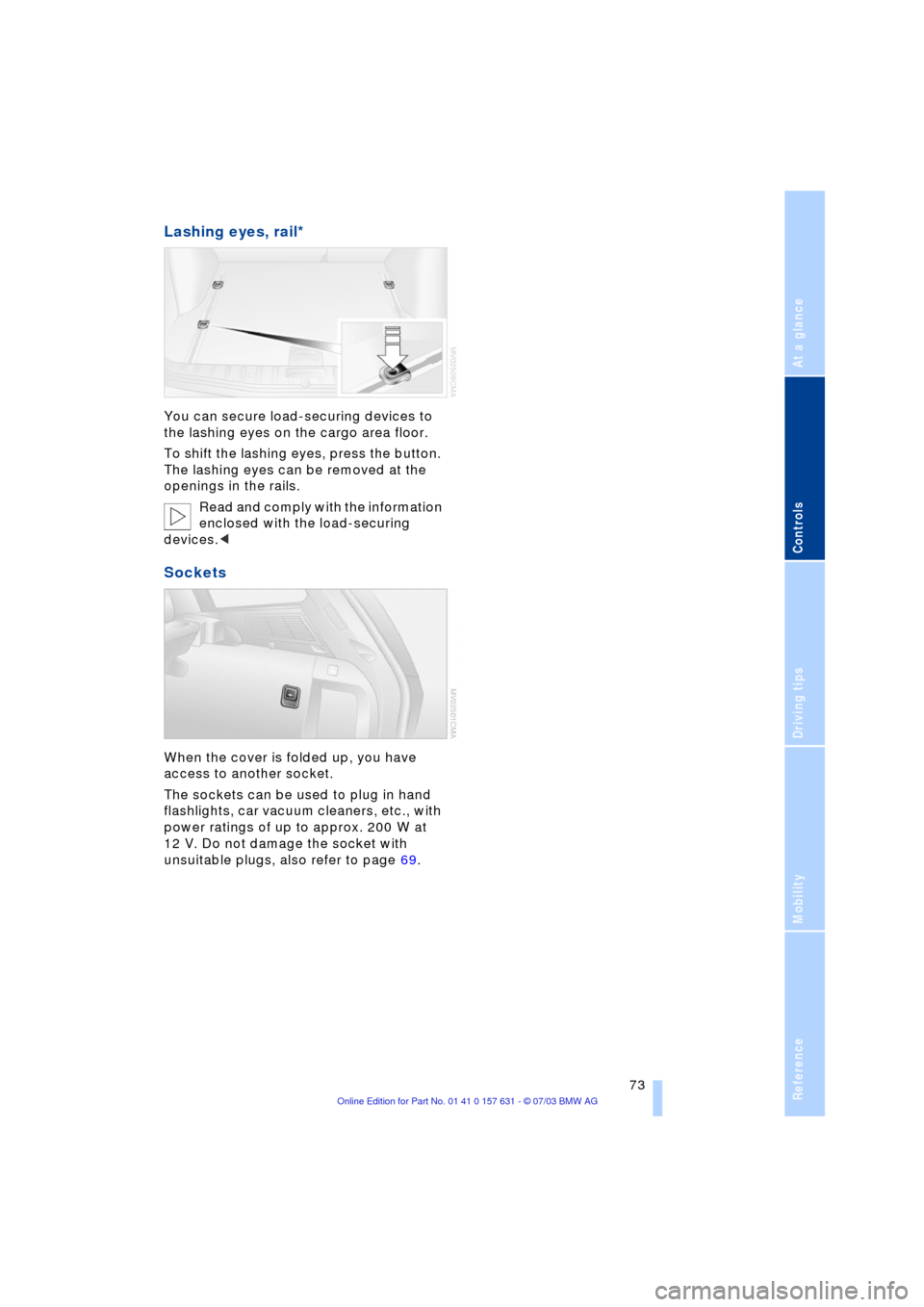
Lashing eyes, rail*
You can secure load-securing devices to
the lashing eyes on the cargo area floor.
To shift the lashing eyes, press the button.
The lashing eyes can be removed at the
openings in the rails.
Read and comply with the information
enclosed with the load-securing
devices.<
Sockets
When the cover is folded up, you have
access to another socket.
The sockets can be used to plug in hand
flashlights, car vacuum cleaners, etc., with
power ratings of up to approx. 200 W at
12 V. Do not damage the socket with
unsuitable plugs, also refer to page 69.
Page 81 of 132
Reference
At a glance
Controls
Driving tips
Mobility
79
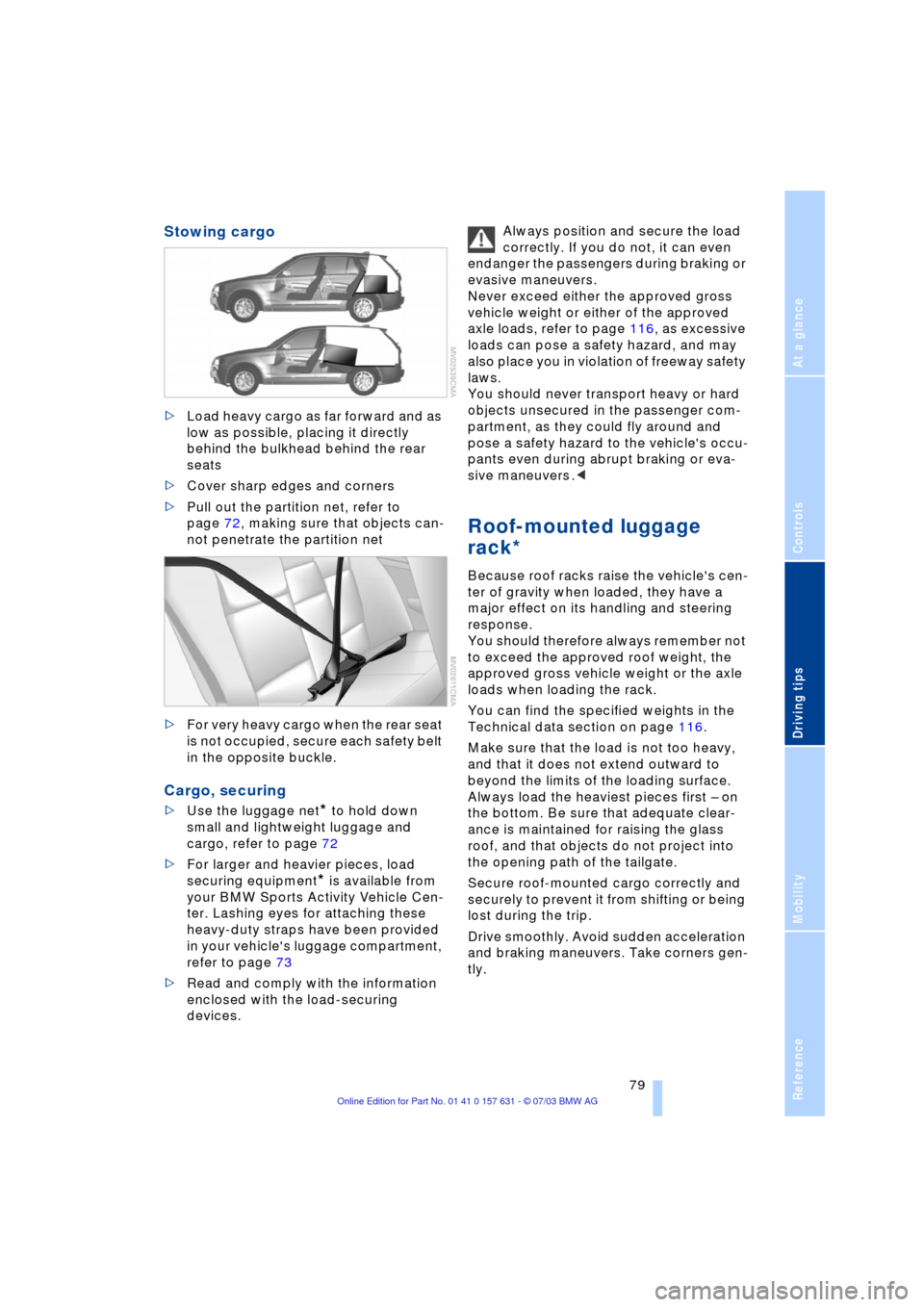
Stowing cargo
>Load heavy cargo as far forward and as
low as possible, placing it directly
behind the bulkhead behind the rear
seats
>Cover sharp edges and corners
>Pull out the partition net, refer to
page 72, making sure that objects can-
not penetrate the partition net
>For very heavy cargo when the rear seat
is not occupied, secure each safety belt
in the opposite buckle.
Cargo, securing
>Use the luggage net* to hold down
small and lightweight luggage and
cargo, refer to page 72
>For larger and heavier pieces, load
securing equipment
* is available from
your BMW Sports Activity Vehicle Cen-
ter. Lashing eyes for attaching these
heavy-duty straps have been provided
in your vehicle's luggage compartment,
refer to page 73
>Read and comply with the information
enclosed with the load-securing
devices.Always position and secure the load
correctly. If you do not, it can even
endanger the passengers during braking or
evasive maneuvers.
Never exceed either the approved gross
vehicle weight or either of the approved
axle loads, refer to page 116, as excessive
loads can pose a safety hazard, and may
also place you in violation of freeway safety
laws.
You should never transport heavy or hard
objects unsecured in the passenger com-
partment, as they could fly around and
pose a safety hazard to the vehicle's occu-
pants even during abrupt braking or eva-
sive maneuvers .<
Roof-mounted luggage
rack*
Because roof racks raise the vehicle's cen-
ter of gravity when loaded, they have a
major effect on its handling and steering
response.
You should therefore always remember not
to exceed the approved roof weight, the
approved gross vehicle weight or the axle
loads when loading the rack.
You can find the specified weights in the
Technical data section on page 116.
Make sure that the load is not too heavy,
and that it does not extend outward to
beyond the limits of the loading surface.
Always load the heaviest pieces first Ð on
the bottom. Be sure that adequate clear-
ance is maintained for raising the glass
roof, and that objects do not project into
the opening path of the tailgate.
Secure roof-mounted cargo correctly and
securely to prevent it from shifting or being
lost during the trip.
Drive smoothly. Avoid sudden acceleration
and braking maneuvers. Take corners gen-
tly.
Page 94 of 132
Under the engine hood
92
Under the engine hood
Never attempt to perform any service
or repair operations on your vehicle
without the required professional technical
training. If you are unaware of the regula-
tions that need to be observed, BMW rec-
ommends that you have this work per-
formed at a BMW Sports Activity Vehicle
Center, as otherwise unqualified handling
of parts and materials can lead to safety
risk for vehicle occupants and other road
users.<
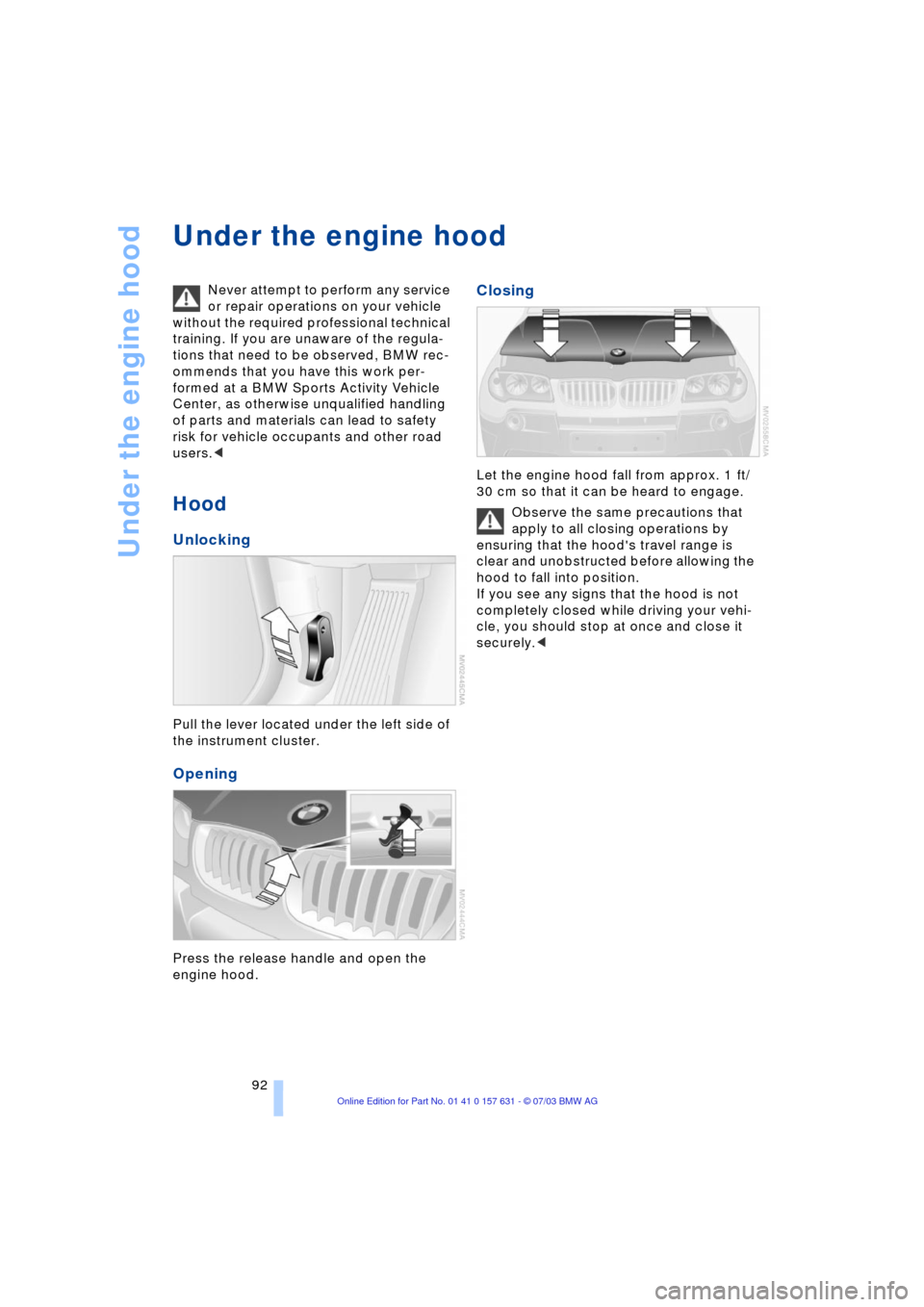
Hood
Unlocking
Pull the lever located under the left side of
the instrument cluster.
Opening
Press the release handle and open the
engine hood.
Closing
Let the engine hood fall from approx. 1 ft/
30 cm so that it can be heard to engage.
Observe the same precautions that
apply to all closing operations by
ensuring that the hood's travel range is
clear and unobstructed before allowing the
hood to fall into position.
If you see any signs that the hood is not
completely closed while driving your vehi-
cle, you should stop at once and close it
securely.<
Page 101 of 132
Reference
At a glance
Controls
Driving tips
Mobility
99
Replacing components
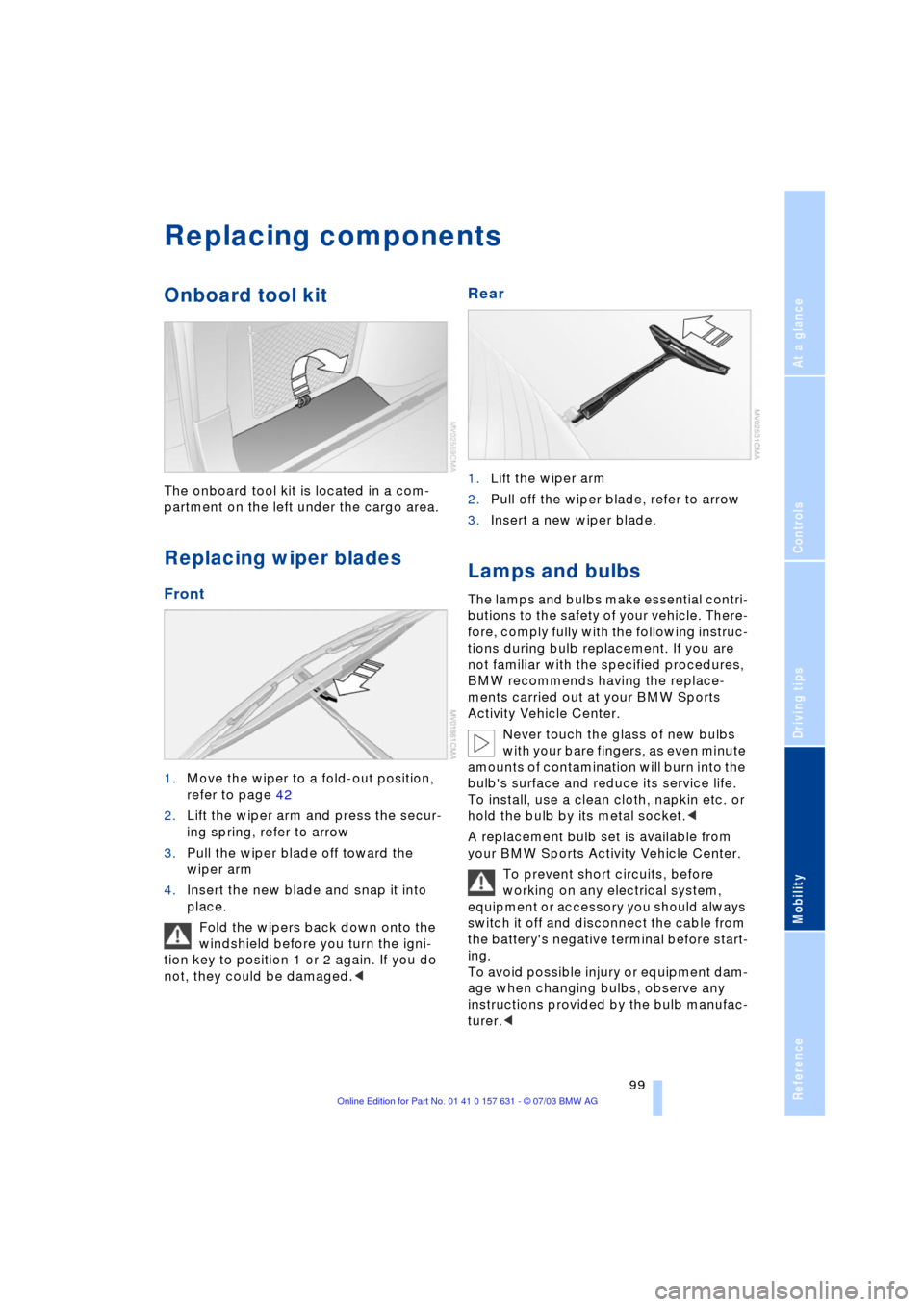
Onboard tool kit
The onboard tool kit is located in a com-
partment on the left under the cargo area.
Replacing wiper blades
Front
1.Move the wiper to a fold-out position,
refer to page 42
2.Lift the wiper arm and press the secur-
ing spring, refer to arrow
3.Pull the wiper blade off toward the
wiper arm
4.Insert the new blade and snap it into
place.
Fold the wipers back down onto the
windshield before you turn the igni-
tion key to position 1 or 2 again. If you do
not, they could be damaged.<
Rear
1.Lift the wiper arm
2.Pull off the wiper blade, refer to arrow
3.Insert a new wiper blade.
Lamps and bulbs
The lamps and bulbs make essential contri-
butions to the safety of your vehicle. There-
fore, comply fully with the following instruc-
tions during bulb replacement. If you are
not familiar with the specified procedures,
BMW recommends having the replace-
ments carried out at your BMW Sports
Activity Vehicle Center.
Never touch the glass of new bulbs
with your bare fingers, as even minute
amounts of contamination will burn into the
bulb's surface and reduce its service life.
To install, use a clean cloth, napkin etc. or
hold the bulb by its metal socket.<
A replacement bulb set is available from
your BMW Sports Activity Vehicle Center.
To prevent short circuits, before
working on any electrical system,
equipment or accessory you should always
switch it off and disconnect the cable from
the battery's negative terminal before start-
ing.
To avoid possible injury or equipment dam-
age when changing bulbs, observe any
instructions provided by the bulb manufac-
turer.<
Page 106 of 132
Replacing components
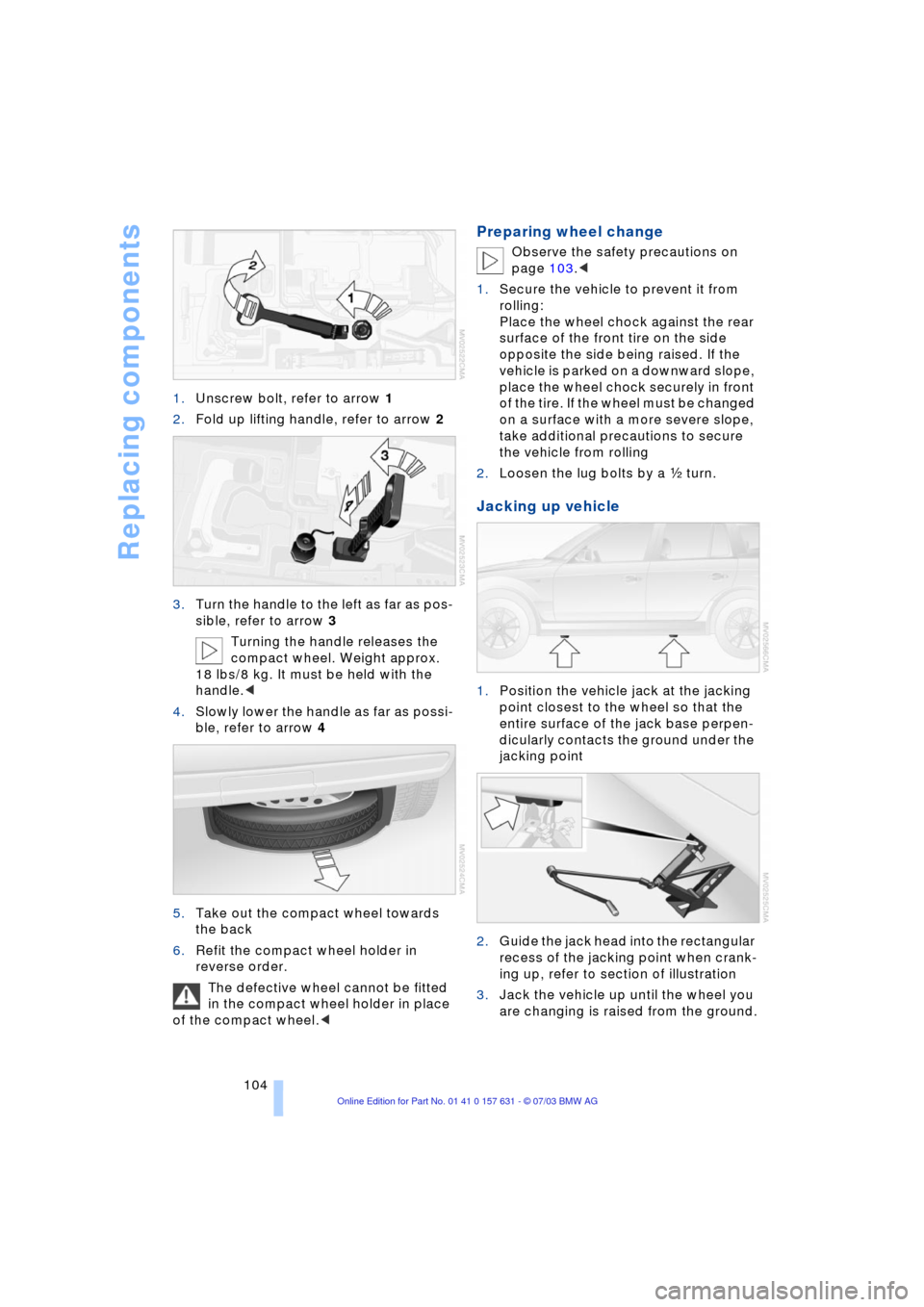
104 1.Unscrew bolt, refer to arrow 1
2.Fold up lifting handle, refer to arrow 2
3.Turn the handle to the left as far as pos-
sible, refer to arrow 3
Turning the handle releases the
compact wheel. Weight approx.
18 lbs/8 kg. It must be held with the
handle.<
4.Slowly lower the handle as far as possi-
ble, refer to arrow 4
5.Take out the compact wheel towards
the back
6.Refit the compact wheel holder in
reverse order.
The defective wheel cannot be fitted
in the compact wheel holder in place
of the compact wheel.<
Preparing wheel change
Observe the safety precautions on
page 103.<
1.Secure the vehicle to prevent it from
rolling:
Place the wheel chock against the rear
surface of the front tire on the side
opposite the side being raised. If the
vehicle is parked on a downward slope,
place the wheel chock securely in front
of the tire. If the wheel must be changed
on a surface with a more severe slope,
take additional precautions to secure
the vehicle from rolling
2.Loosen the lug bolts by a g turn.
Jacking up vehicle
1.Position the vehicle jack at the jacking
point closest to the wheel so that the
entire surface of the jack base perpen-
dicularly contacts the ground under the
jacking point
2.Guide the jack head into the rectangular
recess of the jacking point when crank-
ing up, refer to section of illustration
3.Jack the vehicle up until the wheel you
are changing is raised from the ground.
Page 107 of 132
Reference
At a glance
Controls
Driving tips
Mobility
105
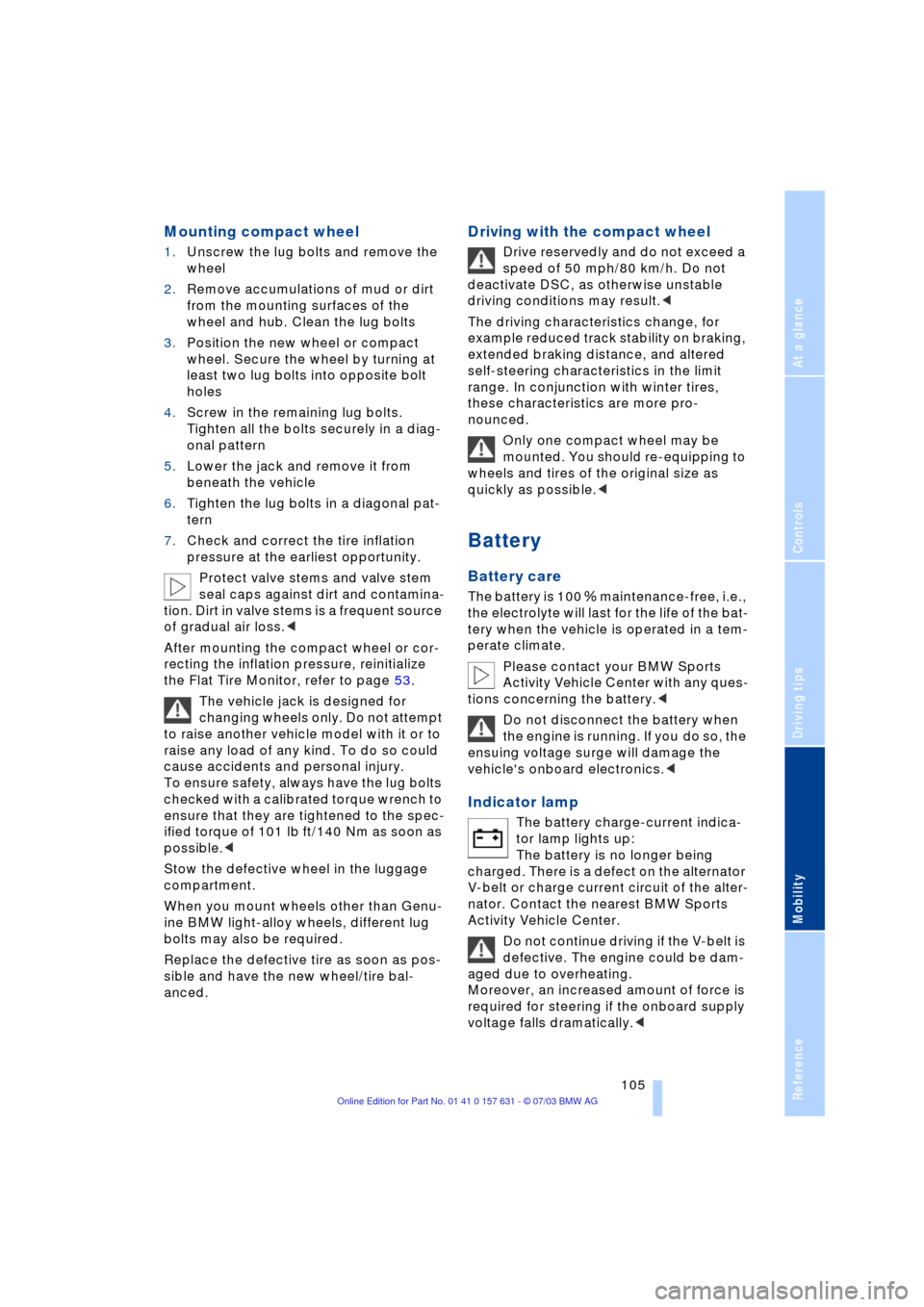
Mounting compact wheel
1.Unscrew the lug bolts and remove the
wheel
2.Remove accumulations of mud or dirt
from the mounting surfaces of the
wheel and hub. Clean the lug bolts
3.Position the new wheel or compact
wheel. Secure the wheel by turning at
least two lug bolts into opposite bolt
holes
4.Screw in the remaining lug bolts.
Tighten all the bolts securely in a diag-
onal pattern
5.Lower the jack and remove it from
beneath the vehicle
6.Tighten the lug bolts in a diagonal pat-
tern
7.Check and correct the tire inflation
pressure at the earliest opportunity.
Protect valve stems and valve stem
seal caps against dirt and contamina-
tion. Dirt in valve stems is a frequent source
of gradual air loss.<
After mounting the compact wheel or cor-
recting the inflation pressure, reinitialize
the Flat Tire Monitor, refer to page 53.
The vehicle jack is designed for
changing wheels only. Do not attempt
to raise another vehicle model with it or to
raise any load of any kind. To do so could
cause accidents and personal injury.
To ensure safety, always have the lug bolts
checked with a calibrated torque wrench to
ensure that they are tightened to the spec-
ified torque of 101 lb ft/140 Nm as soon as
possible.<
Stow the defective wheel in the luggage
compartment.
When you mount wheels other than Genu-
ine BMW light-alloy wheels, different lug
bolts may also be required.
Replace the defective tire as soon as pos-
sible and have the new wheel/tire bal-
anced.
Driving with the compact wheel
Drive reservedly and do not exceed a
speed of 50 mph/80 km/h. Do not
deactivate DSC, as otherwise unstable
driving conditions may result.<
The driving characteristics change, for
example reduced track stability on braking,
extended braking distance, and altered
self-steering characteristics in the limit
range. In conjunction with winter tires,
these characteristics are more pro-
nounced.
Only one compact wheel may be
mounted. You should re-equipping to
wheels and tires of the original size as
quickly as possible.<
Battery
Battery care
The battery is 100% maintenance-free, i.e.,
the electrolyte will last for the life of the bat-
tery when the vehicle is operated in a tem-
perate climate.
Please contact your BMW Sports
Activity Vehicle Center with any ques-
tions concerning the battery.<
Do not disconnect the battery when
the engine is running. If you do so, the
ensuing voltage surge will damage the
vehicle's onboard electronics.<
Indicator lamp
The battery charge-current indica-
tor lamp lights up:
The battery is no longer being
charged. There is a defect on the alternator
V-belt or charge current circuit of the alter-
nator. Contact the nearest BMW Sports
Activity Vehicle Center.
Do not continue driving if the V-belt is
defective. The engine could be dam-
aged due to overheating.
Moreover, an increased amount of force is
required for steering if the onboard supply
voltage falls dramatically.<
Page 125 of 132
Reference
At a glance
Controls
Driving tips
Mobility
123
High beams
Ð bulb replacement 100
Ð headlamp flasher 58
Ð indicator lamp 12
High Performance
Synthetic Oil 95
Hill-climbing ability, refer to
Driving on bad roads 80
Hill descent assistance,
refer to HDC 51
Hill Descent Control
HDC 51
Hills 77
Holder for beverage
cans 67
Horn 10
Hydraulic Brake Assistant,
refer to DBC 50
Hydroplaning 77
I
Ice warning 47
Ignition 37
Ignition key 18
Ignition lock 37
Imprint 2
Indicator/warning lamp
Ð airbags 55
Ð alarm system 25
Ð brake system 96
Ð DSC 51
Ð Flat Tire Monitor 53
Ð fog lamps 58
Ð reserve 45
Ð safety belt warning 30
Indicator/warning lamps 12
Individual settings, refer to
Vehicle Memory, Key
Memory 33
Inflation pressure, tires 86
Inflation pressure
monitoring, refer to Flat
Tire Monitor 53
Instrument cluster 10, 11
Instrument illumination 58
Instrument lighting 58
Integrated universal remote
control 66
Interior lamps 58Interior mirror
Ð automatic dimming
feature 32
Interior motion
sensor 22, 25
Ð switching off 19
Interior rearview mirror 32
Interlock, refer to Ignition
lock 37
Intermittent
Ð operation, wipers 41
J
Jacking points 104
Jumping, refer to Jump-
starting 108
Jump-starting 108
K
Key Memory 33
Keys 18
Kickdown 40
L
Lamps and bulbs 99
Lashing eyes, refer to
Securing the load 79
Leather care, refer to
Caring for your vehicle
brochure
LEDs light-emitting
diodes 103
License plate lamp
Ð bulb replacement 102
Lifting handle, compact
wheel 104
Light-alloy wheels, care,
refer to Caring for your
vehicle brochure
Light-emitting diodes
LEDs 103
Lighter 69
Lighter socket 69
Lighting of instruments 58
Lighting of the instruments,
refer to Instrument
lighting 58Lights, refer to Parking
lamps/low beams 57
Lights on warning 57
Load, refer to Loading 78
Loading
Ð securing the load 79
Ð stowing cargo 79
Ð vehicle 78
Loading area
Ð lid, refer to Tailgate 21
Load securing devices 79
Locking
Ð from inside 20
Ð from outside 18
Locking and unlocking
doors
Ð from inside 20
Ð from outside 18
Longlife oils
Ð approved oils 95
Low beams 57
Ð automatic 57
Ð bulb replacement 100
Ð indicator lamp 57
Low-fuel warning light,
refer to Fuel gauge 45
Lug bolts 104
Luggage compartment,
refer to Cargo area
Luggage rack, refer to
Roof-mounted luggage
rack 79
Lumbar support 29
M
Maintenance 97
Maintenance system,
BMW 97
Malfunction in automatic
transmission system 41
Manual operation
Ð doors 20
Ð driver's door 20
Ð fuel filler door 84
Ð glass roof 24
Ð panorama glass roof 24
Ð tailgate 21
Manual transmission 39
Master keys with remote
control 18
Page 127 of 132
Reference
At a glance
Controls
Driving tips
Mobility
125
Range
Ð setting units 47
Rear armrest, refer to
Center armrest 68
Rear backrests
Ð folding 71
Rear center armrest 68
Rear fog lamps
Ð bulb replacement 102
Rear lamps
Ð bulb replacement 102
Rear seat back
Ð folding 71
Rearview mirrors
Ð exterior 31
Rear window defroster
Ð air conditioner 61
Ð automatic climate
control 65
Rear window safety
switch 22
Rear window wiper 43
Recirculated-air mode
Ð air conditioner 61
Ð automatic climate
control 64
Reclining seat 28
Refueling 84
Ð fuel filler door 84
Remaining distance to next
vehicle service 46
Remote control
Ð fault 19
Ð garage-door opener 66
Ð tailgate 19
Removing condensation,
windows
Ð air conditioner 62
Ð automatic climate
control 64
Replacement fuses 106
Replacement of tires
Ð wheel changes 103
Replacement tire 103
Replacing bulbs, refer to
Lamps and bulbs 99
Replacing light bulbs 99
Reporting safety defects 7
Reservoir, washer
system 94Restraint systems, refer to
Safety belts 30
Reverse 39
Reverse gear
Ð automatic transmission
with Steptronic 40
Ð manual transmission 39
Rims 90
Roadside Assistance 107
Roll-up cover, refer to
Cargo area cover 71
RON, refer to Fuel
quality 85
Roof-mounted luggage
rack 79
Rope, refer to Tow-starting
and towing 109
Rotating coin holder, refer
to Storage
compartments 68
S
Safe sitting position with
safety belts 27
Safety belts 30
Ð sitting safely 27
Ð warning lamp 30
Safety belt tensioners, refer
to Safety belts 27
Safety belt warning
Ð indicator lamp 30
Safety defects, reporting 7
Safety feature
Ð power windows 22
Safety systems, refer to
ABS Antilock Brake
System 50
Safety systems, refer to
DSC Dynamic Stability
Control 50
Screwdriver, refer to
Onboard tool kit 99
Seat, electric power 29
Seat heating 30
Seat memory, refer to Seat
and mirror memory 29
Securing cargo 79
Selector lever, automatic
transmission 40Selector lever interlock,
refer to Shiftlock 40
Service and warranty
notes 7
Service Engine
Soon 38, 98
Service Interval
Display 46, 97
Setting the units 47
Setting units 47
Shiftlock, changing the
selector-lever
positions 40
Side airbags 54
Side lamps 57
Side tilt 80
Side turn signal indicators
Ð bulb replacement 101
Sitting safely 27
Ð with airbag 27
Ð with safety belts 27
Ski bag 70
Smokers' package, refer to
Ashtray 69
Sockets 69, 73
SOS, refer to Starting an
emergency call 107
Spare fuses 106
Spare key 18
Spare tire, refer to Wheel
changes 103
Special oils, refer to
Approved oils 95
Special washing
program 42
Specified oils 95
Speedometer 11
Speedometer, refer to
Instrument
cluster 11
Sport program
Ð automatic transmission
with Steptronic 40
Sports seat 28
Stability control, refer to
DSC Dynamic Stability
Control 50
Standing lamps 58
Starting, engine 37
Starting, refer to Starting
the engine 37