air condition BMW X3 2.5I 2004 E83 User Guide
[x] Cancel search | Manufacturer: BMW, Model Year: 2004, Model line: X3 2.5I, Model: BMW X3 2.5I 2004 E83Pages: 132, PDF Size: 3.62 MB
Page 88 of 132
Wheels and tires
86
Wheels and tires
Tire inflation pressure
Information for your safety
It is not merely the tire's service life, but
also driving comfort and Ð to a great extent
Ð driving safety that depend on the condi-
tion of the tires and the maintenance of the
specified tire pressure.
Check the tire inflation pressure regu-
larly and correct it if necessary,
including compact wheel: at least every
two weeks and before beginning a longer
trip. If you fail to observe this precaution
you may be driving on tires with incorrect
tire pressures, a condition that cannot only
compromise your vehicle's driving stability,
but also lead to tire damage and the risk of
an accident.
Do not drive with a depressurized, i.e. flat
tire. A flat tire will seriously impair your
vehicle's handling and braking response.
Attempts to drive on a flat tire can lead to
loss of control over the vehicle.<
Checking the pressure
Only check tire inflation pressure when the
tires are cold. That means after a maximum
of 1.25 miles/2 km driving or when the
vehicle has been parked for at least 2
hours. When tires are warm, the tire infla-
tion pressure increases.
After correcting the inflation pressure(s),
always reinitialize the Flat Tire Monitor,
refer to page 53.
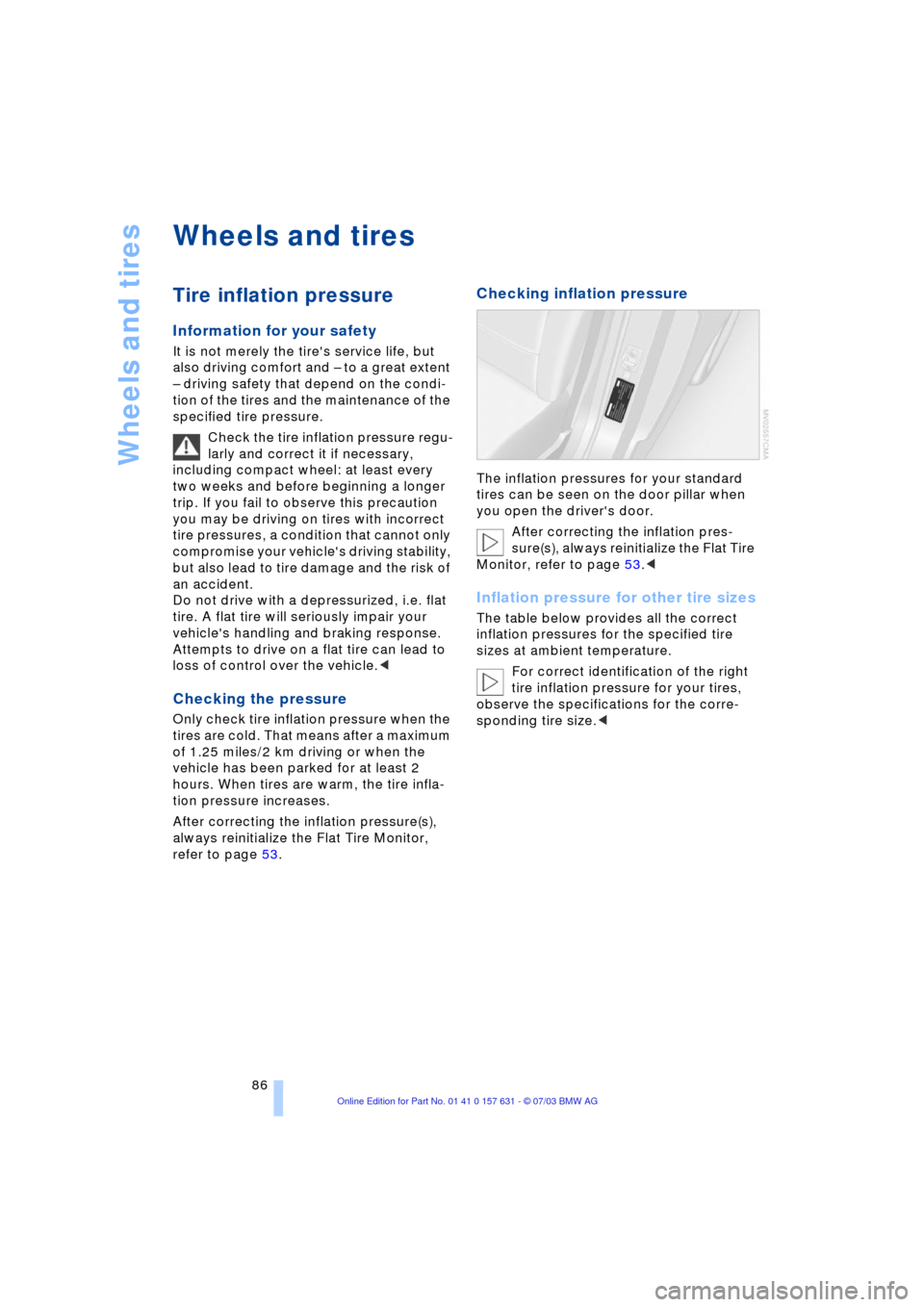
Checking inflation pressure
The inflation pressures for your standard
tires can be seen on the door pillar when
you open the driver's door.
After correcting the inflation pres-
sure(s), always reinitialize the Flat Tire
Monitor, refer to page 53.<
Inflation pressure for other tire sizes
The table below provides all the correct
inflation pressures for the specified tire
sizes at ambient temperature.
For correct identification of the right
tire inflation pressure for your tires,
observe the specifications for the corre-
sponding tire size.<
Page 92 of 132
Wheels and tires
90 with specialized knowledge and corre-
sponding equipment.<
The correct wheel and tire combination
affects various systems whose function
would otherwise be impaired, e.g. ABS,
DSC or xDrive.
Have the wheel and tire assemblies bal-
anced every time either a wheel or a tire is
replaced.
BMW does not recommend the use of
retreaded tires, as otherwise driving
safety may be reduced. Possible variations
in the design and the age Ð which could be
substantial Ð of the carcasses can lead to
unusually rapid wear.<
The right wheels and tires
BMW recommends that you use only
wheel and tire combinations that
BMW has tested and approved for your
particular vehicle. Variations in factors such
as manufacturing tolerances mean that
even wheels and tires with identical official
size ratings could actually have different
dimensions than the approved units Ð these
differences could lead to body contact, and
with it the risk of severe accidents. If non-
approved wheels and tires are used, BMW
cannot evaluate their suitability, and there-
fore cannot be held liable for driving
safety.<
To maintain good handling and vehicle
response, use only tires of a single tread
configuration from a single manufacturer.
After a flat tire, always remember to have
the specified wheel and tire combination
remounted on the vehicle as soon as pos-
sible.
Recommended tire brands
BMW tests certain tire brands for each tire
size, classifies them as road-safe and
approves them. You can obtain a list of
these from your BMW Sports Activity Vehi-
cle Center. Observe any country-specific
regulations, e.g. on making a correspond-
ing entry in the vehicle documents.
The factory-mounted tires have been spe-
cially selected to provide optimized perfor-mance when installed on your vehicle; if
properly cared for, they will provide a com-
bination of safety and excellent ride com-
fort.
Special characteristics of winter
tires
BMW recommends winter tires for use in
cold winter driving conditions. Although all-
season M+S tires provide better winter
traction than summer tires, they generally
fail to provide the same levels of cold-
weather performance as winter tires.
When switching to winter tires, observe the
descriptions at Tire condition and Replac-
ing wheels/tires, refer to page 89.
Observing speed ratings
Never exceed the maximum speed for
which the winter tires are rated.
Unprofessional attempts by laymen to ser-
vice tires can lead to damage and acci-
dents. Have this work performed by skilled
professionals only. The technicians at your
BMW Sports Activity Vehicle Center will be
glad to assist you with the required profes-
sional knowledge and specialized equip-
ment.<
Storage
Store wheels or tires in a cool, dry place,
protecting them against light whenever
possible. Protect the tires against contact
with oil, grease and fuel.
Do not exceed the maximum tire inflation
pressure specified on the side of the tire.
Snow chains*
Do not exceed a vehicle speed of
30 mph/50 km/h with snow chains
mounted.<
Only certain snow chains have been tested
by BMW and classified and approved as
safe. You can obtain a list of these from
your BMW Sports Activity Vehicle Center.
BMW recommends the use of approved
narrow-link snow chains only. These snow
chains are approved exclusively for use on
Page 99 of 132
Reference
At a glance
Controls
Driving tips
Mobility
97
Maintenance
The BMW maintenance
system
The BMW maintenance system is designed
in such a way that it reliably ensures the
road safety and operating reliability of the
vehicle Ð keeping the cost for you as low as
possible.
Regular maintenance is not only required
for the safety of the vehicle, it also
improves the resale value.
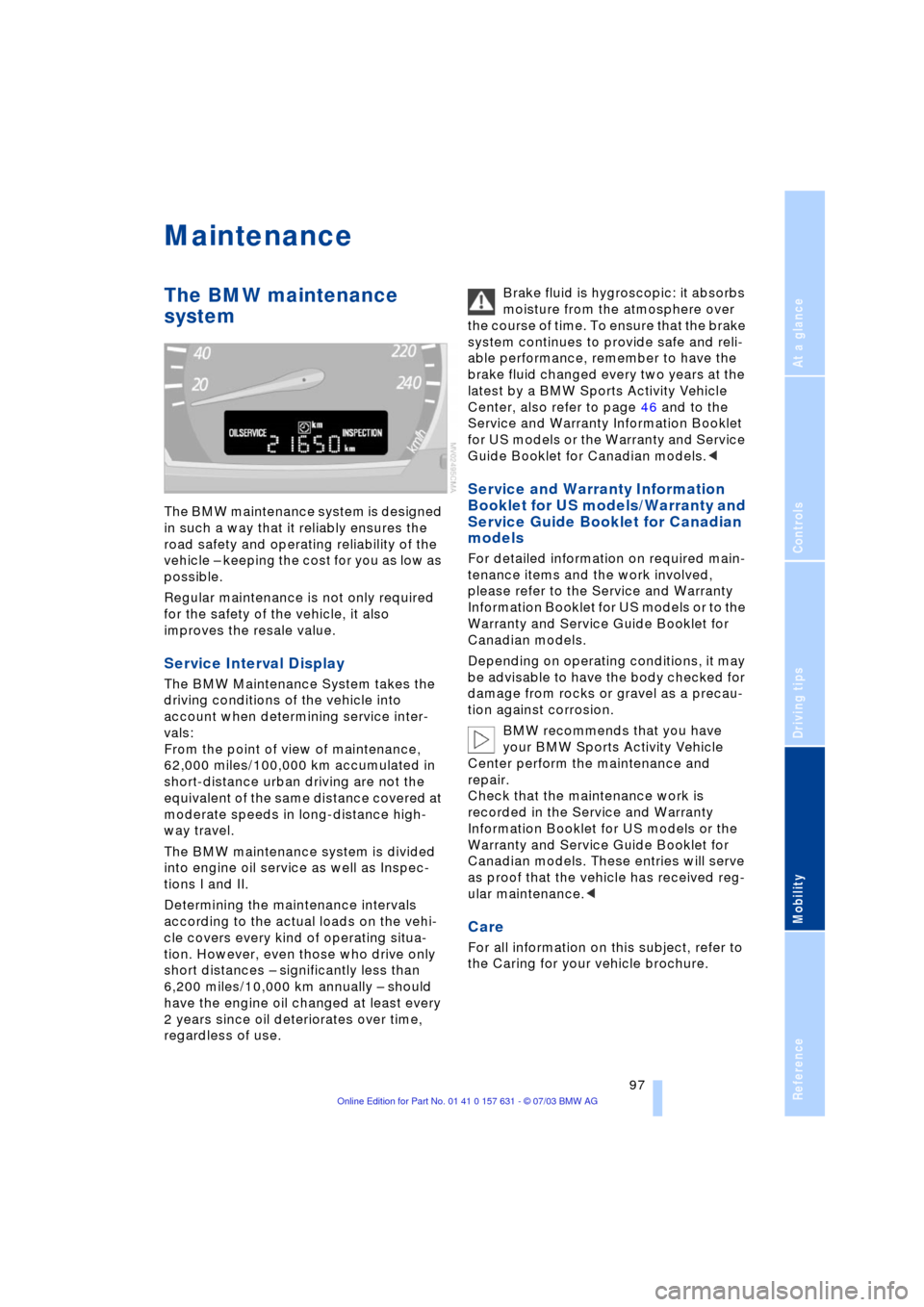
Service Interval Display
The BMW Maintenance System takes the
driving conditions of the vehicle into
account when determining service inter-
vals:
From the point of view of maintenance,
62,000 miles/100,000 km accumulated in
short-distance urban driving are not the
equivalent of the same distance covered at
moderate speeds in long-distance high-
way travel.
The BMW maintenance system is divided
into engine oil service as well as Inspec-
tions I and II.
Determining the maintenance intervals
according to the actual loads on the vehi-
cle covers every kind of operating situa-
tion. However, even those who drive only
short distances Ð significantly less than
6,200 miles/10,000 km annually Ð should
have the engine oil changed at least every
2 years since oil deteriorates over time,
regardless of use.Brake fluid is hygroscopic: it absorbs
moisture from the atmosphere over
the course of time. To ensure that the brake
system continues to provide safe and reli-
able performance, remember to have the
brake fluid changed every two years at the
latest by a BMW Sports Activity Vehicle
Center, also refer to page 46 and to the
Service and Warranty Information Booklet
for US models or the Warranty and Service
Guide Booklet for Canadian models.<
Service and Warranty Information
Booklet for US models/Warranty and
Service Guide Booklet for Canadian
models
For detailed information on required main-
tenance items and the work involved,
please refer to the Service and Warranty
Information Booklet for US models or to the
Warranty and Service Guide Booklet for
Canadian models.
Depending on operating conditions, it may
be advisable to have the body checked for
damage from rocks or gravel as a precau-
tion against corrosion.
BMW recommends that you have
your BMW Sports Activity Vehicle
Center perform the maintenance and
repair.
Check that the maintenance work is
recorded in the Service and Warranty
Information Booklet for US models or the
Warranty and Service Guide Booklet for
Canadian models. These entries will serve
as proof that the vehicle has received reg-
ular maintenance.<
Care
For all information on this subject, refer to
the Caring for your vehicle brochure.
Page 107 of 132
Reference
At a glance
Controls
Driving tips
Mobility
105
Mounting compact wheel
1.Unscrew the lug bolts and remove the
wheel
2.Remove accumulations of mud or dirt
from the mounting surfaces of the
wheel and hub. Clean the lug bolts
3.Position the new wheel or compact
wheel. Secure the wheel by turning at
least two lug bolts into opposite bolt
holes
4.Screw in the remaining lug bolts.
Tighten all the bolts securely in a diag-
onal pattern
5.Lower the jack and remove it from
beneath the vehicle
6.Tighten the lug bolts in a diagonal pat-
tern
7.Check and correct the tire inflation
pressure at the earliest opportunity.
Protect valve stems and valve stem
seal caps against dirt and contamina-
tion. Dirt in valve stems is a frequent source
of gradual air loss.<
After mounting the compact wheel or cor-
recting the inflation pressure, reinitialize
the Flat Tire Monitor, refer to page 53.
The vehicle jack is designed for
changing wheels only. Do not attempt
to raise another vehicle model with it or to
raise any load of any kind. To do so could
cause accidents and personal injury.
To ensure safety, always have the lug bolts
checked with a calibrated torque wrench to
ensure that they are tightened to the spec-
ified torque of 101 lb ft/140 Nm as soon as
possible.<
Stow the defective wheel in the luggage
compartment.
When you mount wheels other than Genu-
ine BMW light-alloy wheels, different lug
bolts may also be required.
Replace the defective tire as soon as pos-
sible and have the new wheel/tire bal-
anced.
Driving with the compact wheel
Drive reservedly and do not exceed a
speed of 50 mph/80 km/h. Do not
deactivate DSC, as otherwise unstable
driving conditions may result.<
The driving characteristics change, for
example reduced track stability on braking,
extended braking distance, and altered
self-steering characteristics in the limit
range. In conjunction with winter tires,
these characteristics are more pro-
nounced.
Only one compact wheel may be
mounted. You should re-equipping to
wheels and tires of the original size as
quickly as possible.<
Battery
Battery care
The battery is 100% maintenance-free, i.e.,
the electrolyte will last for the life of the bat-
tery when the vehicle is operated in a tem-
perate climate.
Please contact your BMW Sports
Activity Vehicle Center with any ques-
tions concerning the battery.<
Do not disconnect the battery when
the engine is running. If you do so, the
ensuing voltage surge will damage the
vehicle's onboard electronics.<
Indicator lamp
The battery charge-current indica-
tor lamp lights up:
The battery is no longer being
charged. There is a defect on the alternator
V-belt or charge current circuit of the alter-
nator. Contact the nearest BMW Sports
Activity Vehicle Center.
Do not continue driving if the V-belt is
defective. The engine could be dam-
aged due to overheating.
Moreover, an increased amount of force is
required for steering if the onboard supply
voltage falls dramatically.<
Page 121 of 132
Reference
At a glance
Controls
Driving tips
Mobility
119
Everything from A to Z
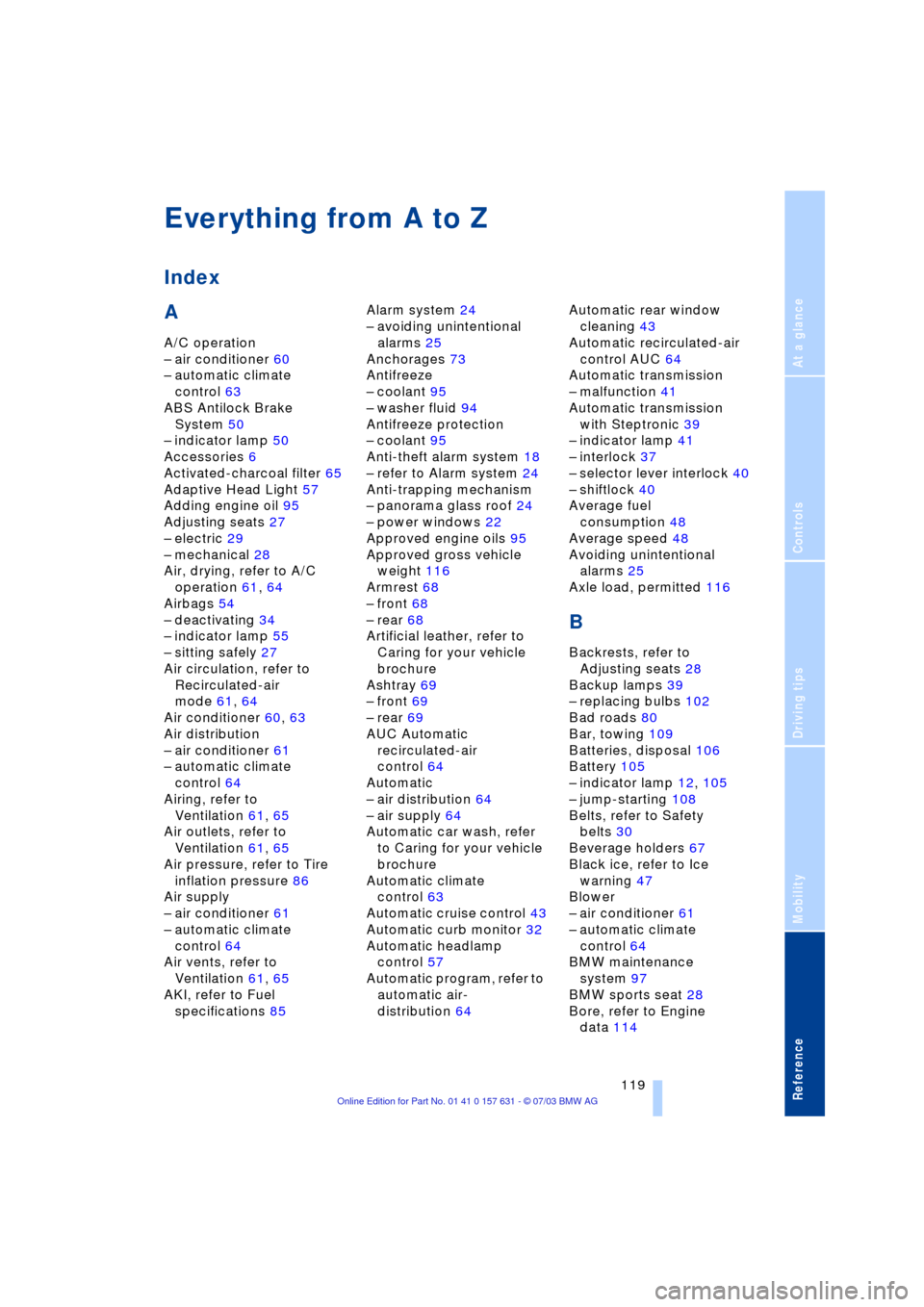
Index
A
A/C operation
Ð air conditioner 60
Ð automatic climate
control 63
ABS Antilock Brake
System 50
Ð indicator lamp 50
Accessories 6
Activated-charcoal filter 65
Adaptive Head Light 57
Adding engine oil 95
Adjusting seats 27
Ð electric 29
Ð mechanical 28
Air, drying, refer to A/C
operation 61, 64
Airbags 54
Ð deactivating 34
Ð indicator lamp 55
Ð sitting safely 27
Air circulation, refer to
Recirculated-air
mode 61, 64
Air conditioner 60, 63
Air distribution
Ð air conditioner 61
Ð automatic climate
control 64
Airing, refer to
Ventilation 61, 65
Air outlets, refer to
Ventilation 61, 65
Air pressure, refer to Tire
inflation pressure 86
Air supply
Ð air conditioner 61
Ð automatic climate
control 64
Air vents, refer to
Ventilation 61, 65
AKI, refer to Fuel
specifications 85Alarm system 24
Ð avoiding unintentional
alarms 25
Anchorages 73
Antifreeze
Ð coolant 95
Ð washer fluid 94
Antifreeze protection
Ð coolant 95
Anti-theft alarm system 18
Ð refer to Alarm system 24
Anti-trapping mechanism
Ð panorama glass roof 24
Ð power windows 22
Approved engine oils 95
Approved gross vehicle
weight 116
Armrest 68
Ð front 68
Ð rear 68
Artificial leather, refer to
Caring for your vehicle
brochure
Ashtray 69
Ð front 69
Ð rear 69
AUC Automatic
recirculated-air
control 64
Automatic
Ð air distribution 64
Ð air supply 64
Automatic car wash, refer
to Caring for your vehicle
brochure
Automatic climate
control 63
Automatic cruise control 43
Automatic curb monitor 32
Automatic headlamp
control 57
Automatic program, refer to
automatic air-
distribution 64Automatic rear window
cleaning 43
Automatic recirculated-air
control AUC 64
Automatic transmission
Ð malfunction 41
Automatic transmission
with Steptronic 39
Ð indicator lamp 41
Ð interlock 37
Ð selector lever interlock 40
Ð shiftlock 40
Average fuel
consumption 48
Average speed 48
Avoiding unintentional
alarms 25
Axle load, permitted 116
B
Backrests, refer to
Adjusting seats 28
Backup lamps 39
Ð replacing bulbs 102
Bad roads 80
Bar, towing 109
Batteries, disposal 106
Battery 105
Ð indicator lamp 12, 105
Ð jump-starting 108
Belts, refer to Safety
belts 30
Beverage holders 67
Black ice, refer to Ice
warning 47
Blower
Ð air conditioner 61
Ð automatic climate
control 64
BMW maintenance
system 97
BMW sports seat 28
Bore, refer to Engine
data 114
Page 123 of 132
Reference
At a glance
Controls
Driving tips
Mobility
121
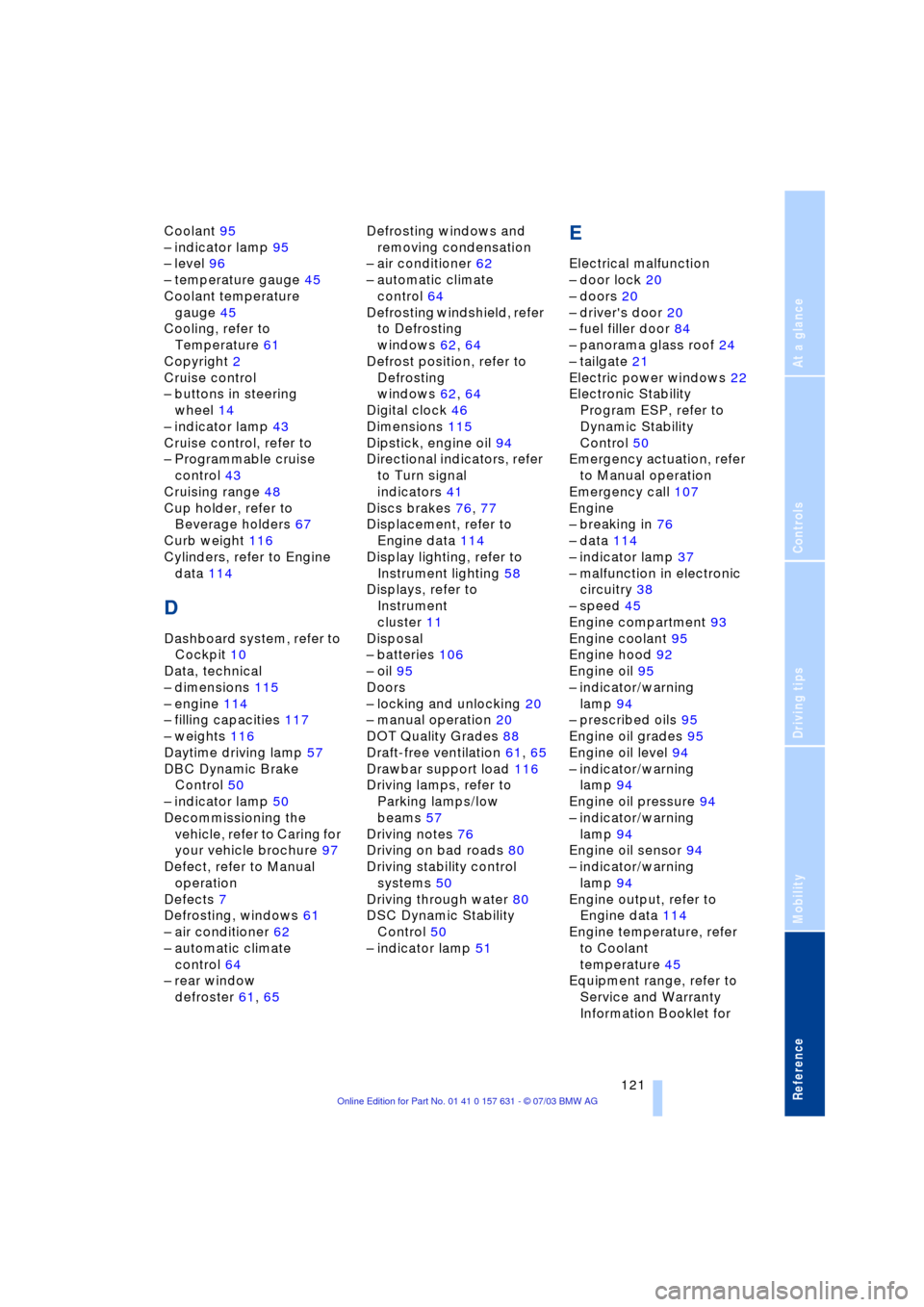
Coolant 95
Ð indicator lamp 95
Ð level 96
Ð temperature gauge 45
Coolant temperature
gauge 45
Cooling, refer to
Temperature 61
Copyright 2
Cruise control
Ð buttons in steering
wheel 14
Ð indicator lamp 43
Cruise control, refer to
Ð Programmable cruise
control 43
Cruising range 48
Cup holder, refer to
Beverage holders 67
Curb weight 116
Cylinders, refer to Engine
data 114
D
Dashboard system, refer to
Cockpit 10
Data, technical
Ð dimensions 115
Ð engine 114
Ð filling capacities 117
Ð weights 116
Daytime driving lamp 57
DBC Dynamic Brake
Control 50
Ð indicator lamp 50
Decommissioning the
vehicle, refer to Caring for
your vehicle brochure 97
Defect, refer to Manual
operation
Defects 7
Defrosting, windows 61
Ð air conditioner 62
Ð automatic climate
control 64
Ð rear window
defroster 61, 65Defrosting windows and
removing condensation
Ð air conditioner 62
Ð automatic climate
control 64
Defrosting windshield, refer
to Defrosting
windows 62, 64
Defrost position, refer to
Defrosting
windows 62, 64
Digital clock 46
Dimensions 115
Dipstick, engine oil 94
Directional indicators, refer
to Turn signal
indicators 41
Discs brakes 76, 77
Displacement, refer to
Engine data 114
Display lighting, refer to
Instrument lighting 58
Displays, refer to
Instrument
cluster 11
Disposal
Ð batteries 106
Ð oil 95
Doors
Ð locking and unlocking 20
Ð manual operation 20
DOT Quality Grades 88
Draft-free ventilation 61, 65
Drawbar support load 116
Driving lamps, refer to
Parking lamps/low
beams 57
Driving notes 76
Driving on bad roads 80
Driving stability control
systems 50
Driving through water 80
DSC Dynamic Stability
Control 50
Ð indicator lamp 51
E
Electrical malfunction
Ð door lock 20
Ð doors 20
Ð driver's door 20
Ð fuel filler door 84
Ð panorama glass roof 24
Ð tailgate 21
Electric power windows 22
Electronic Stability
Program ESP, refer to
Dynamic Stability
Control 50
Emergency actuation, refer
to Manual operation
Emergency call 107
Engine
Ð breaking in 76
Ð data 114
Ð indicator lamp 37
Ð malfunction in electronic
circuitry 38
Ð speed 45
Engine compartment 93
Engine coolant 95
Engine hood 92
Engine oil 95
Ð indicator/warning
lamp 94
Ð prescribed oils 95
Engine oil grades 95
Engine oil level 94
Ð indicator/warning
lamp 94
Engine oil pressure 94
Ð indicator/warning
lamp 94
Engine oil sensor 94
Ð indicator/warning
lamp 94
Engine output, refer to
Engine data 114
Engine temperature, refer
to Coolant
temperature 45
Equipment range, refer to
Service and Warranty
Information Booklet for
Page 124 of 132
Everything from A to Z
122 US models, Warranty and
Service Guide Booklet for
Canadian models
ESP Electronic Stability
Program, refer to DSC
Dynamic Stability
Control 50
Exhaust system, refer to
High temperatures 76
Exterior mirror
Ð automatic dimming
feature 32
Exterior mirrors 31
F
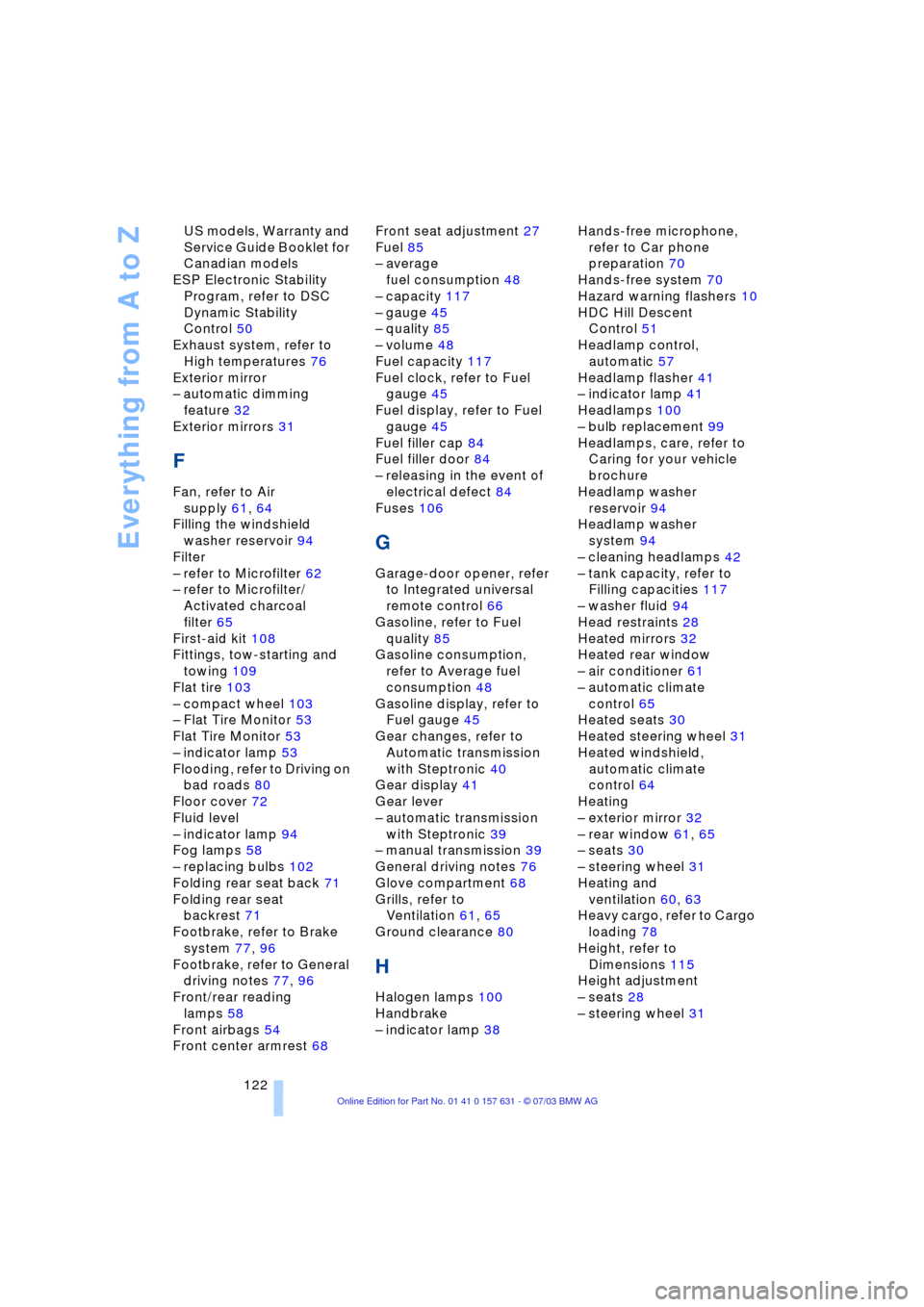
Fan, refer to Air
supply 61, 64
Filling the windshield
washer reservoir 94
Filter
Ð refer to Microfilter 62
Ð refer to Microfilter/
Activated charcoal
filter 65
First-aid kit 108
Fittings, tow-starting and
towing 109
Flat tire 103
Ð compact wheel 103
Ð Flat Tire Monitor 53
Flat Tire Monitor 53
Ð indicator lamp 53
Flooding, refer to Driving on
bad roads 80
Floor cover 72
Fluid level
Ð indicator lamp 94
Fog lamps 58
Ð replacing bulbs 102
Folding rear seat back 71
Folding rear seat
backrest 71
Footbrake, refer to Brake
system 77, 96
Footbrake, refer to General
driving notes 77, 96
Front/rear reading
lamps 58
Front airbags 54
Front center armrest 68Front seat adjustment 27
Fuel 85
Ð average
fuel consumption 48
Ð capacity 117
Ð gauge 45
Ð quality 85
Ð volume 48
Fuel capacity 117
Fuel clock, refer to Fuel
gauge 45
Fuel display, refer to Fuel
gauge 45
Fuel filler cap 84
Fuel filler door 84
Ð releasing in the event of
electrical defect 84
Fuses 106
G
Garage-door opener, refer
to Integrated universal
remote control 66
Gasoline, refer to Fuel
quality 85
Gasoline consumption,
refer to Average fuel
consumption 48
Gasoline display, refer to
Fuel gauge 45
Gear changes, refer to
Automatic transmission
with Steptronic 40
Gear display 41
Gear lever
Ð automatic transmission
with Steptronic 39
Ð manual transmission 39
General driving notes 76
Glove compartment 68
Grills, refer to
Ventilation 61, 65
Ground clearance 80
H
Halogen lamps 100
Handbrake
Ð indicator lamp 38Hands-free microphone,
refer to Car phone
preparation 70
Hands-free system 70
Hazard warning flashers 10
HDC Hill Descent
Control 51
Headlamp control,
automatic 57
Headlamp flasher 41
Ð indicator lamp 41
Headlamps 100
Ð bulb replacement 99
Headlamps, care, refer to
Caring for your vehicle
brochure
Headlamp washer
reservoir 94
Headlamp washer
system 94
Ð cleaning headlamps 42
Ð tank capacity, refer to
Filling capacities 117
Ð washer fluid 94
Head restraints 28
Heated mirrors 32
Heated rear window
Ð air conditioner 61
Ð automatic climate
control 65
Heated seats 30
Heated steering wheel 31
Heated windshield,
automatic climate
control 64
Heating
Ð exterior mirror 32
Ð rear window 61, 65
Ð seats 30
Ð steering wheel 31
Heating and
ventilation 60, 63
Heavy cargo, refer to Cargo
loading 78
Height, refer to
Dimensions 115
Height adjustment
Ð seats 28
Ð steering wheel 31
Page 126 of 132
Everything from A to Z
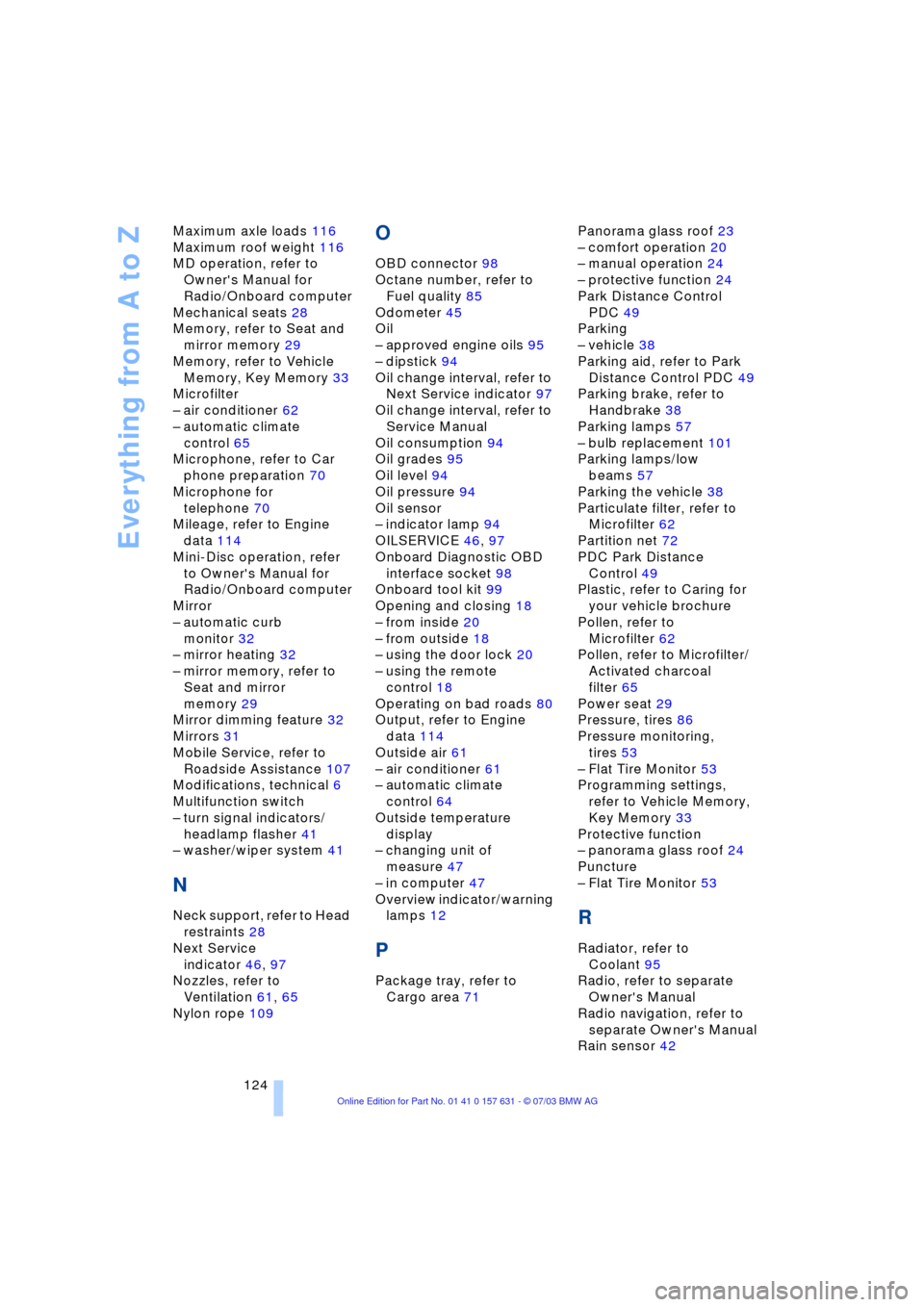
124 Maximum axle loads 116
Maximum roof weight 116
MD operation, refer to
Owner's Manual for
Radio/Onboard computer
Mechanical seats 28
Memory, refer to Seat and
mirror memory 29
Memory, refer to Vehicle
Memory, Key Memory 33
Microfilter
Ð air conditioner 62
Ð automatic climate
control 65
Microphone, refer to Car
phone preparation 70
Microphone for
telephone 70
Mileage, refer to Engine
data 114
Mini-Disc operation, refer
to Owner's Manual for
Radio/Onboard computer
Mirror
Ð automatic curb
monitor 32
Ð mirror heating 32
Ð mirror memory, refer to
Seat and mirror
memory 29
Mirror dimming feature 32
Mirrors 31
Mobile Service, refer to
Roadside Assistance 107
Modifications, technical 6
Multifunction switch
Ð turn signal indicators/
headlamp flasher 41
Ð washer/wiper system 41
N
Neck support, refer to Head
restraints 28
Next Service
indicator 46, 97
Nozzles, refer to
Ventilation 61, 65
Nylon rope 109
O
OBD connector 98
Octane number, refer to
Fuel quality 85
Odometer 45
Oil
Ð approved engine oils 95
Ð dipstick 94
Oil change interval, refer to
Next Service indicator 97
Oil change interval, refer to
Service Manual
Oil consumption 94
Oil grades 95
Oil level 94
Oil pressure 94
Oil sensor
Ð indicator lamp 94
OILSERVICE 46, 97
Onboard Diagnostic OBD
interface socket 98
Onboard tool kit 99
Opening and closing 18
Ð from inside 20
Ð from outside 18
Ð using the door lock 20
Ð using the remote
control 18
Operating on bad roads 80
Output, refer to Engine
data 114
Outside air 61
Ð air conditioner 61
Ð automatic climate
control 64
Outside temperature
display
Ð changing unit of
measure 47
Ð in computer 47
Overview indicator/warning
lamps 12
P
Package tray, refer to
Cargo area 71Panorama glass roof 23
Ð comfort operation 20
Ð manual operation 24
Ð protective function 24
Park Distance Control
PDC 49
Parking
Ð vehicle 38
Parking aid, refer to Park
Distance Control PDC 49
Parking brake, refer to
Handbrake 38
Parking lamps 57
Ð bulb replacement 101
Parking lamps/low
beams 57
Parking the vehicle 38
Particulate filter, refer to
Microfilter 62
Partition net 72
PDC Park Distance
Control 49
Plastic, refer to Caring for
your vehicle brochure
Pollen, refer to
Microfilter 62
Pollen, refer to Microfilter/
Activated charcoal
filter 65
Power seat 29
Pressure, tires 86
Pressure monitoring,
tires 53
Ð Flat Tire Monitor 53
Programming settings,
refer to Vehicle Memory,
Key Memory 33
Protective function
Ð panorama glass roof 24
Puncture
Ð Flat Tire Monitor 53
R
Radiator, refer to
Coolant 95
Radio, refer to separate
Owner's Manual
Radio navigation, refer to
separate Owner's Manual
Rain sensor 42
Page 127 of 132
Reference
At a glance
Controls
Driving tips
Mobility
125
Range
Ð setting units 47
Rear armrest, refer to
Center armrest 68
Rear backrests
Ð folding 71
Rear center armrest 68
Rear fog lamps
Ð bulb replacement 102
Rear lamps
Ð bulb replacement 102
Rear seat back
Ð folding 71
Rearview mirrors
Ð exterior 31
Rear window defroster
Ð air conditioner 61
Ð automatic climate
control 65
Rear window safety
switch 22
Rear window wiper 43
Recirculated-air mode
Ð air conditioner 61
Ð automatic climate
control 64
Reclining seat 28
Refueling 84
Ð fuel filler door 84
Remaining distance to next
vehicle service 46
Remote control
Ð fault 19
Ð garage-door opener 66
Ð tailgate 19
Removing condensation,
windows
Ð air conditioner 62
Ð automatic climate
control 64
Replacement fuses 106
Replacement of tires
Ð wheel changes 103
Replacement tire 103
Replacing bulbs, refer to
Lamps and bulbs 99
Replacing light bulbs 99
Reporting safety defects 7
Reservoir, washer
system 94Restraint systems, refer to
Safety belts 30
Reverse 39
Reverse gear
Ð automatic transmission
with Steptronic 40
Ð manual transmission 39
Rims 90
Roadside Assistance 107
Roll-up cover, refer to
Cargo area cover 71
RON, refer to Fuel
quality 85
Roof-mounted luggage
rack 79
Rope, refer to Tow-starting
and towing 109
Rotating coin holder, refer
to Storage
compartments 68
S
Safe sitting position with
safety belts 27
Safety belts 30
Ð sitting safely 27
Ð warning lamp 30
Safety belt tensioners, refer
to Safety belts 27
Safety belt warning
Ð indicator lamp 30
Safety defects, reporting 7
Safety feature
Ð power windows 22
Safety systems, refer to
ABS Antilock Brake
System 50
Safety systems, refer to
DSC Dynamic Stability
Control 50
Screwdriver, refer to
Onboard tool kit 99
Seat, electric power 29
Seat heating 30
Seat memory, refer to Seat
and mirror memory 29
Securing cargo 79
Selector lever, automatic
transmission 40Selector lever interlock,
refer to Shiftlock 40
Service and warranty
notes 7
Service Engine
Soon 38, 98
Service Interval
Display 46, 97
Setting the units 47
Setting units 47
Shiftlock, changing the
selector-lever
positions 40
Side airbags 54
Side lamps 57
Side tilt 80
Side turn signal indicators
Ð bulb replacement 101
Sitting safely 27
Ð with airbag 27
Ð with safety belts 27
Ski bag 70
Smokers' package, refer to
Ashtray 69
Sockets 69, 73
SOS, refer to Starting an
emergency call 107
Spare fuses 106
Spare key 18
Spare tire, refer to Wheel
changes 103
Special oils, refer to
Approved oils 95
Special washing
program 42
Specified oils 95
Speedometer 11
Speedometer, refer to
Instrument
cluster 11
Sport program
Ð automatic transmission
with Steptronic 40
Sports seat 28
Stability control, refer to
DSC Dynamic Stability
Control 50
Standing lamps 58
Starting, engine 37
Starting, refer to Starting
the engine 37
Page 128 of 132
Everything from A to Z
126 Starting assistance, refer to
Jump-starting 108
Starting difficulties
Ð temperature 38
Starting-off assistance,
DSC 50
Starting the engine 38
Startup difficulties
Ð jump-starting 108
Status of this Owner's
Manual at time of
printing 5
Steering lock 37
Steering wheel 10, 14
Ð adjustment 31
Ð lock 37
Steering wheel heater 31
Steering wheel with
buttons 14
Steptronic 39
Storage compartments 68
Storage package 68
Storage package nets 68
Storage space, refer to
Cargo area 71
Storing seat position, refer
to Seat and mirror
memory 29
Storing the seat
adjustment 29
Straps, refer to Loading 78
Stroke, refer to Engine
data 114
Supply reservoir cleaning
systems 94
Switches, refer to
Cockpit 10
Switching off the engine 38
Symbols 4
T
Table of contents 3
Tachometer 45
Tailgate
Ð closing 21
Ð emergency operation 21
Ð opening from the
outside 21
Ð remote control 19Tailgate lamp
Ð bulb replacement 103
Tail lamps
Ð bulb replacement 102
Ð indicator lamp 57
Tank capacity 117
Technical modifications 6
Telephone, refer to
separate Owner's Manual
Temperature
Ð air conditioner 61
Ð automatic climate
control 64
Temperature, tires 88
Temperature display
Ð ice warning 47
Ð outside temperature 47
Ð setting the units 47
Temperature gauge 45
Thigh support
adjustment 28, 29
Three-point belt 30
Tightening torque 105
Tilt alarm sensor 25
Ð switching off 25
Tilt function, passenger-
side mirror 32
Tire inflation pressures 86
Tire pressure monitoring,
refer to Flat Tire
Monitor 53
Tires
Ð age 88
Ð break-in procedure 76
Ð changing 89
Ð condition 89
Ð DOT Quality Grades 88
Ð flat 103
Ð inflation pressure 86, 87
Ð replacing 89
Ð storage 90
Ð temperature 88
Ð traction 88
Ð treadwear 88
Ð Uniform Tire Quality
Grading 89
Ð wear indicators, refer to
Tire tread/damage 89
Ð wheel change 103
Tools, refer to Onboard tool
kit 99Torque of lug bolts 105
Tow bar 109
Tow fittings 109
Towing 109
Towing the vehicle 109
Tow rope 109
Tow sockets for tow
fitting 109
Tow-starting 109
Track width, refer to
Dimensions 115
Traction 88
Traction control
Ð DSC 50
Trailer loads 116
Transmission 39
Ð automatic transmission
with Steptronic 39
Ð manual transmission 39
Transmission lockout, refer
to P Parking 40
Transmission
malfunction 41
Transporting children 34
Transporting children
safely 34
Tread depth, refer to Tire
tread 89
Treadwear 88
Trip-distance counter, refer
to Trip odometer 45
Trip odometer 45
Trunk, refer to Cargo
area 71
Trunk lid, refer to
Tailgate 21
Turning circle, refer to
Dimensions 115
Turn signal indicators 41
Ð bulb replacement 101
Turn signal indicators, side
Ð bulb replacement 101
U
Underbody protection,
refer to Caring for your
vehicle brochure
Uniform Tire Quality
Grading 89