lights BMW X3 2.5I 2004 E83 User Guide
[x] Cancel search | Manufacturer: BMW, Model Year: 2004, Model line: X3 2.5I, Model: BMW X3 2.5I 2004 E83Pages: 132, PDF Size: 3.62 MB
Page 56 of 132
Technology for comfort, convenience and safety
54
Brake force display
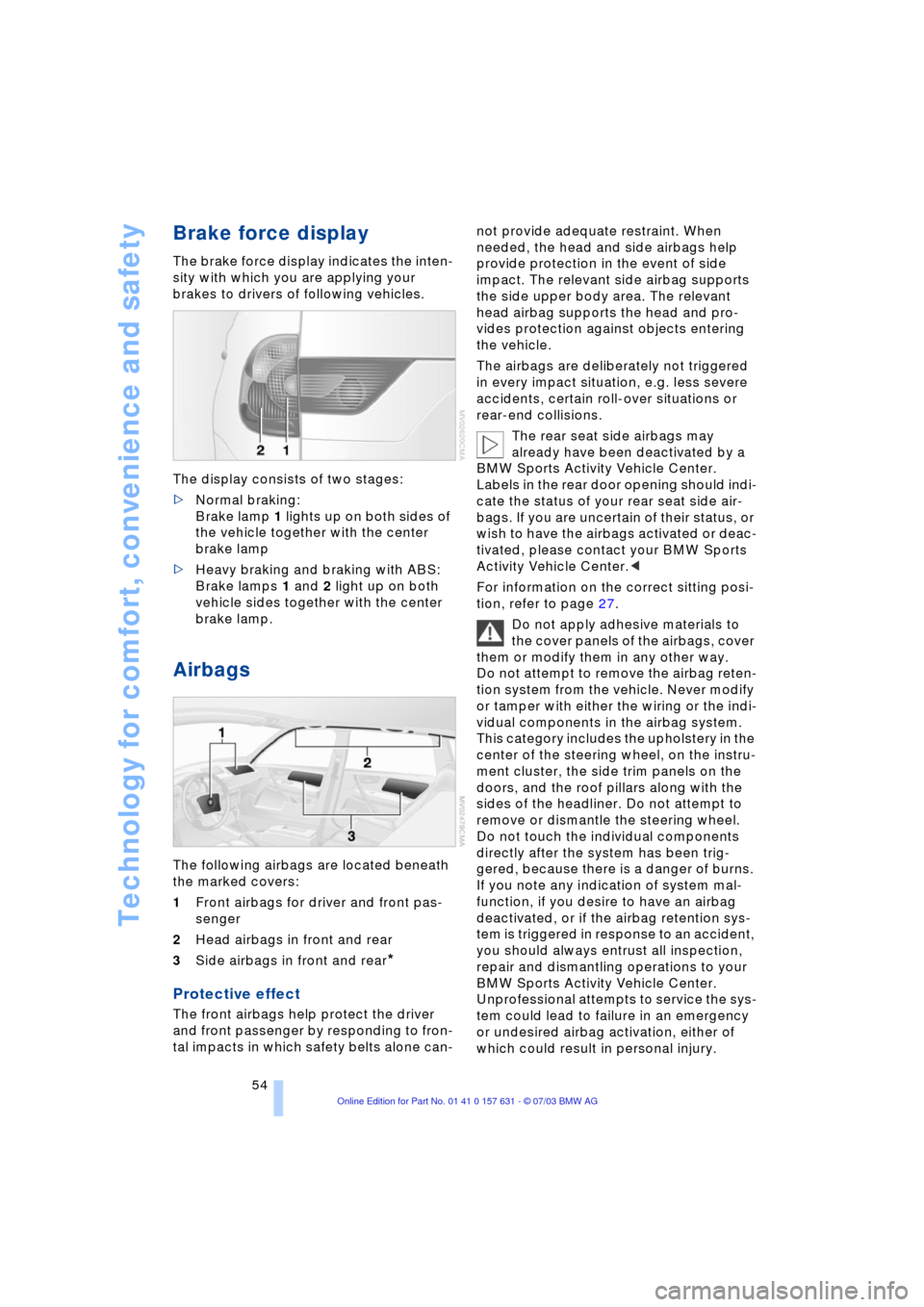
The brake force display indicates the inten-
sity with which you are applying your
brakes to drivers of following vehicles.
The display consists of two stages:
>Normal braking:
Brake lamp 1 lights up on both sides of
the vehicle together with the center
brake lamp
>Heavy braking and braking with ABS:
Brake lamps 1 and 2 light up on both
vehicle sides together with the center
brake lamp.
Airbags
The following airbags are located beneath
the marked covers:
1Front airbags for driver and front pas-
senger
2Head airbags in front and rear
3Side airbags in front and rear
*
Protective effect
The front airbags help protect the driver
and front passenger by responding to fron-
tal impacts in which safety belts alone can-not provide adequate restraint. When
needed, the head and side airbags help
provide protection in the event of side
impact. The relevant side airbag supports
the side upper body area. The relevant
head airbag supports the head and pro-
vides protection against objects entering
the vehicle.
The airbags are deliberately not triggered
in every impact situation, e.g. less severe
accidents, certain roll-over situations or
rear-end collisions.
The rear seat side airbags may
already have been deactivated by a
BMW Sports Activity Vehicle Center.
Labels in the rear door opening should indi-
cate the status of your rear seat side air-
bags. If you are uncertain of their status, or
wish to have the airbags activated or deac-
tivated, please contact your BMW Sports
Activity Vehicle Center.<
For information on the correct sitting posi-
tion, refer to page 27.
Do not apply adhesive materials to
the cover panels of the airbags, cover
them or modify them in any other way.
Do not attempt to remove the airbag reten-
tion system from the vehicle. Never modify
or tamper with either the wiring or the indi-
vidual components in the airbag system.
This category includes the upholstery in the
center of the steering wheel, on the instru-
ment cluster, the side trim panels on the
doors, and the roof pillars along with the
sides of the headliner. Do not attempt to
remove or dismantle the steering wheel.
Do not touch the individual components
directly after the system has been trig-
gered, because there is a danger of burns.
If you note any indication of system mal-
function, if you desire to have an airbag
deactivated, or if the airbag retention sys-
tem is triggered in response to an accident,
you should always entrust all inspection,
repair and dismantling operations to your
BMW Sports Activity Vehicle Center.
Unprofessional attempts to service the sys-
tem could lead to failure in an emergency
or undesired airbag activation, either of
which could result in personal injury.
Page 57 of 132
Reference
At a glance
Controls
Driving tips
Mobility
55
To ensure compliance with official safety
regulations, please also entrust disposal of
airbag generators to a BMW Sports Activity
Vehicle Center.<
Airbag warning information is also provided
on the sun visors.
Automatic deactivation of the front
passenger airbags
Your BMW has a seat occupation detection
system. By evaluating the weight on the
front passenger's seat, the system detects
whether or not the seat is occupied by a
child in the child-restraint system or an
adult.
>When a child is seated in the child-
restraint system or with an empty seat,
the front and side airbags are deacti-
vated on the passenger's side
>When an adult is traveling in the front
seat, the front and side airbags remain
active on the passenger side.
With heavier children, the front pas-
senger airbags can remain active, or
with very light adults or teenagers the front
passenger airbags can be deactivated
unintentionally.
The condition of the front passenger air-
bags is indicated via the telltale lamp, refer
to Indicator lamps in the following. In this
case transport the corresponding persons
on the rear seat.
Except when persons to be transported, do
not increase the load on the front passen-
ger seat with additional items. Do not fit
seat covers, seat cushion padding, ball
mats or other items to the front passenger
seat unless they are specifically recom-
mended by BMW. Do not place any items
under the seat. Otherwise, the function of
the seat occupation detection could be
impaired.<
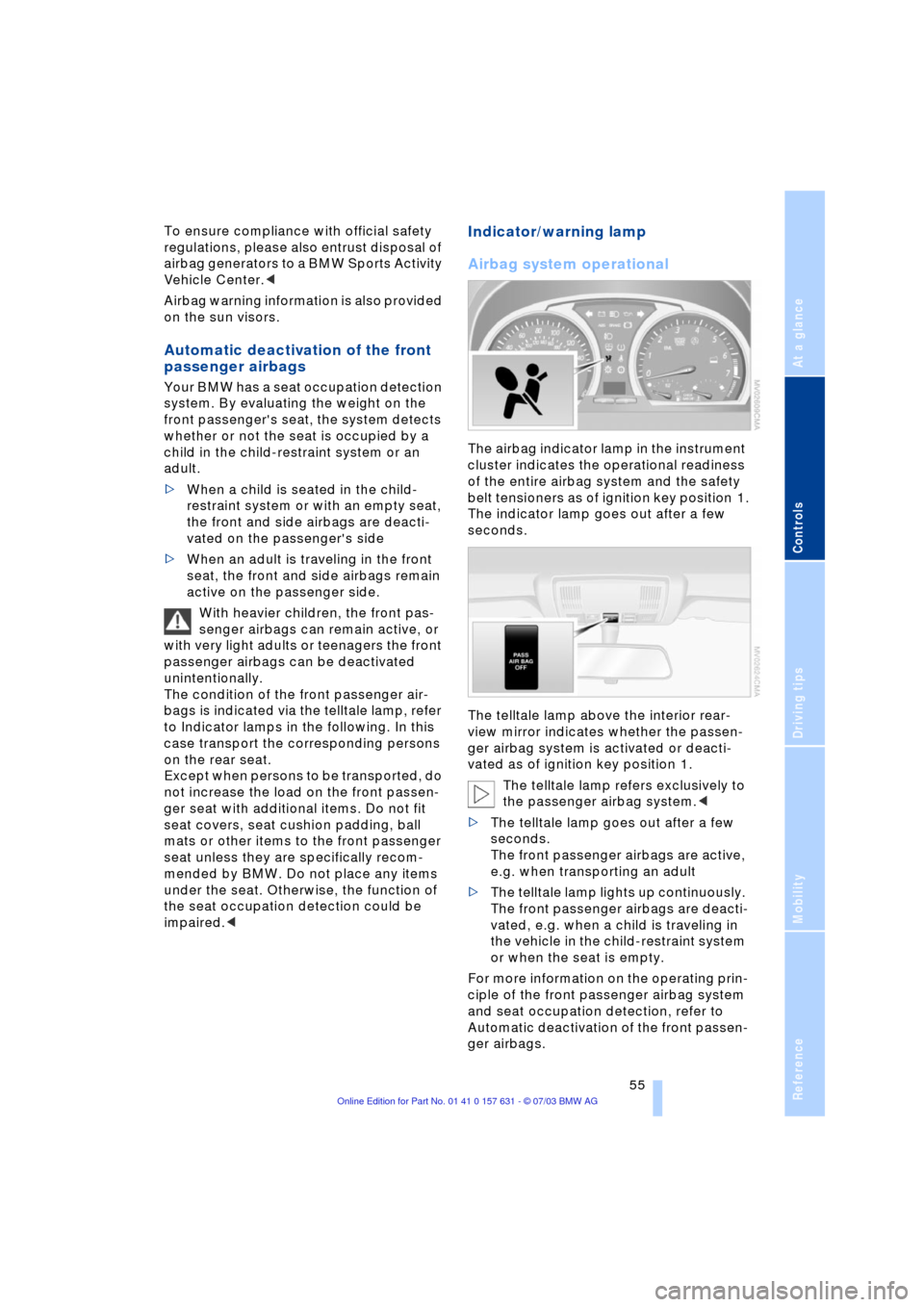
Indicator/warning lamp
Airbag system operational
The airbag indicator lamp in the instrument
cluster indicates the operational readiness
of the entire airbag system and the safety
belt tensioners as of ignition key position 1.
The indicator lamp goes out after a few
seconds.
The telltale lamp above the interior rear-
view mirror indicates whether the passen-
ger airbag system is activated or deacti-
vated as of ignition key position 1.
The telltale lamp refers exclusively to
the passenger airbag system.<
>The telltale lamp goes out after a few
seconds.
The front passenger airbags are active,
e.g. when transporting an adult
>The telltale lamp lights up continuously.
The front passenger airbags are deacti-
vated, e.g. when a child is traveling in
the vehicle in the child-restraint system
or when the seat is empty.
For more information on the operating prin-
ciple of the front passenger airbag system
and seat occupation detection, refer to
Automatic deactivation of the front passen-
ger airbags.
Page 58 of 132
Technology for comfort, convenience and safety
56
Airbag system malfunction
A system malfunction could prevent
the system from responding in the
expected manner to an impact occurring
within its normal response range.
Please have the airbag system checked
immediately by a BMW Sports Activity
Vehicle Center.<
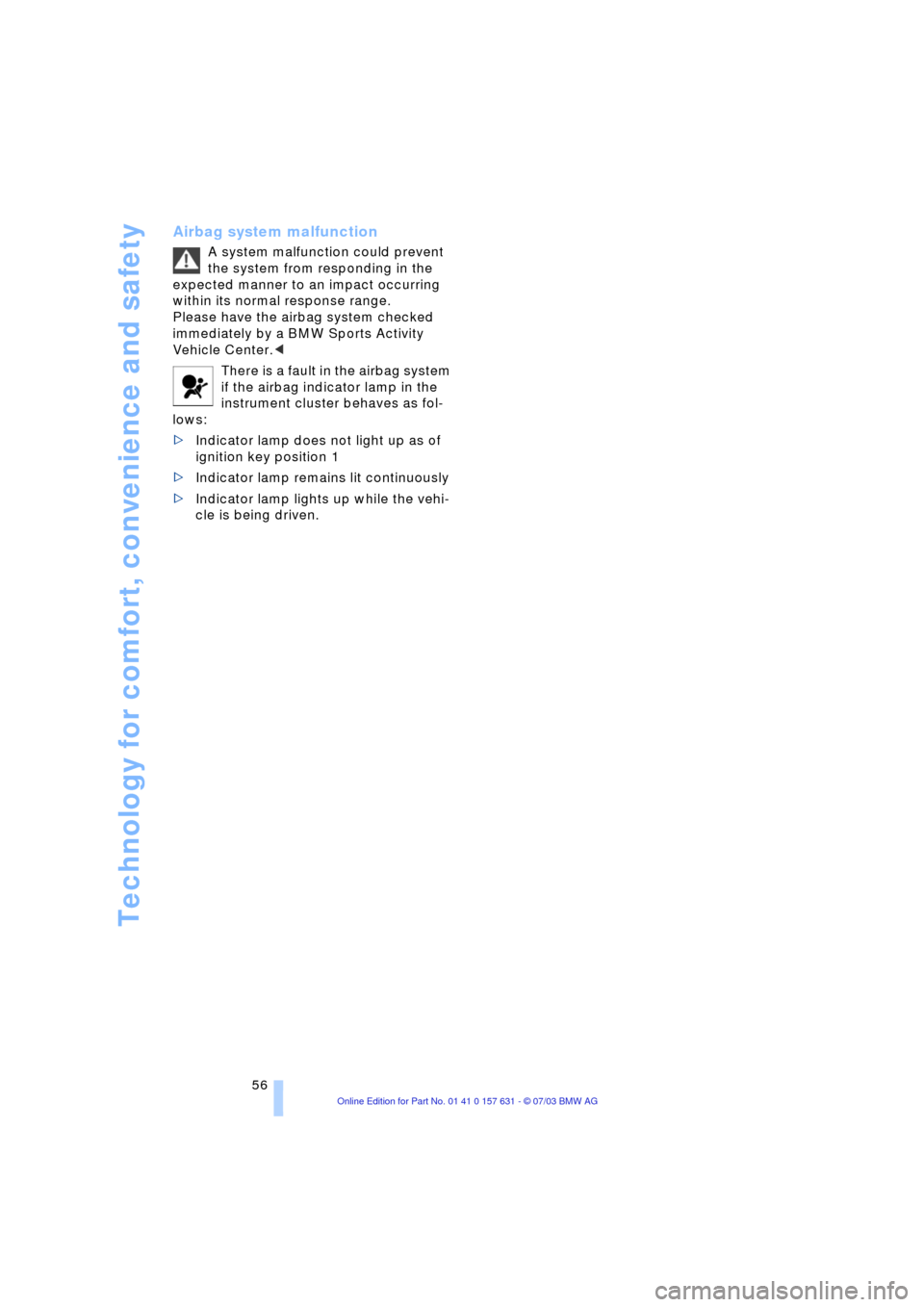
There is a fault in the airbag system
if the airbag indicator lamp in the
instrument cluster behaves as fol-
lows:
>Indicator lamp does not light up as of
ignition key position 1
>Indicator lamp remains lit continuously
>Indicator lamp lights up while the vehi-
cle is being driven.
Page 59 of 132
Reference
At a glance
Controls
Driving tips
Mobility
57
Lamps
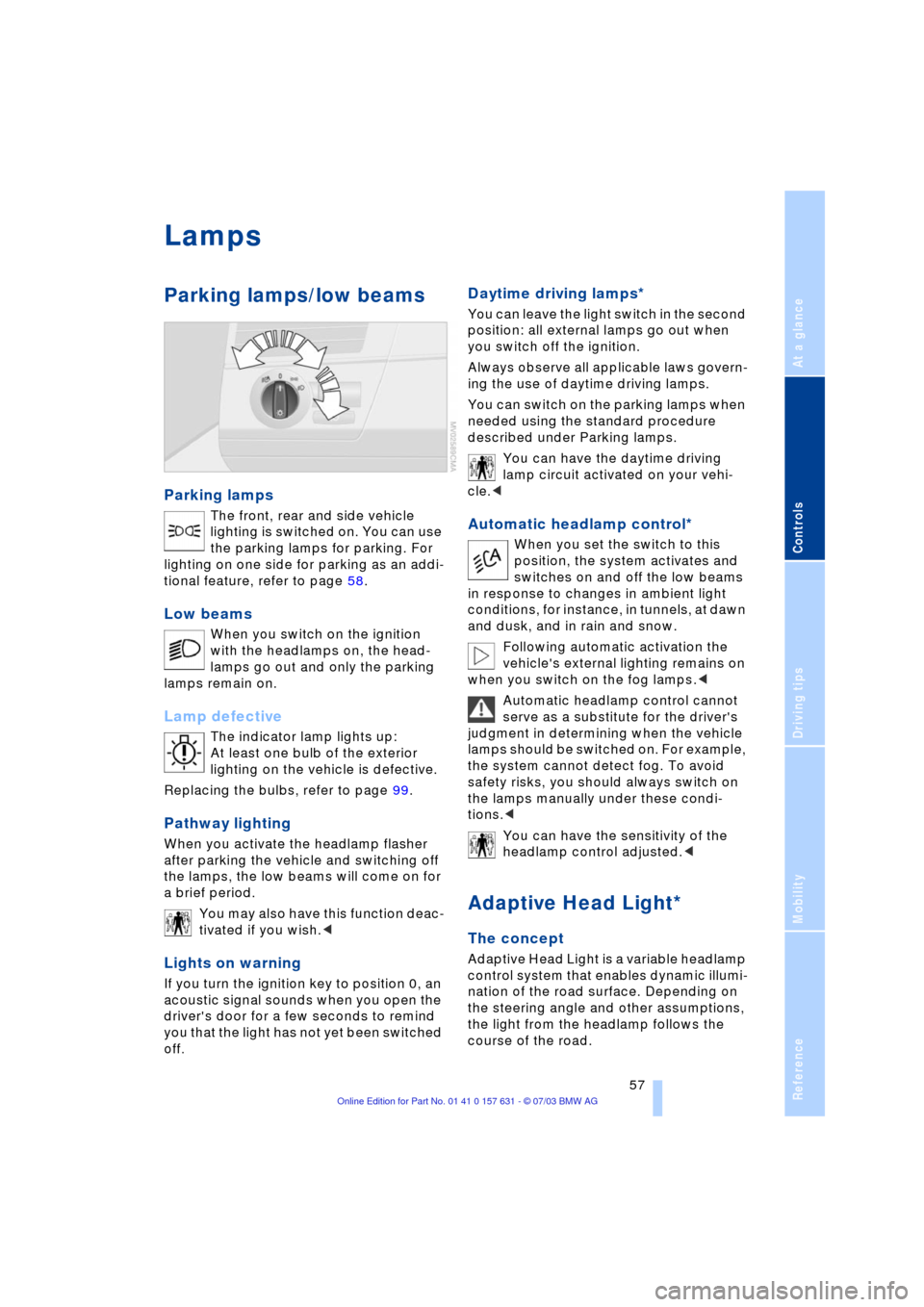
Parking lamps/low beams
Parking lamps
The front, rear and side vehicle
lighting is switched on. You can use
the parking lamps for parking. For
lighting on one side for parking as an addi-
tional feature, refer to page 58.
Low beams
When you switch on the ignition
with the headlamps on, the head-
lamps go out and only the parking
lamps remain on.
Lamp defective
The indicator lamp lights up:
At least one bulb of the exterior
lighting on the vehicle is defective.
Replacing the bulbs, refer to page 99.
Pathway lighting
When you activate the headlamp flasher
after parking the vehicle and switching off
the lamps, the low beams will come on for
a brief period.
You may also have this function deac-
tivated if you wish.<
Lights on warning
If you turn the ignition key to position 0, an
acoustic signal sounds when you open the
driver's door for a few seconds to remind
you that the light has not yet been switched
off
.
Daytime driving lamps*
You can leave the light switch in the second
position: all external lamps go out when
you switch off the ignition.
Always observe all applicable laws govern-
ing the use of daytime driving lamps.
You can switch on the parking lamps when
needed using the standard procedure
described under Parking lamps.
You can have the daytime driving
lamp circuit activated on your vehi-
cle.<
Automatic headlamp control*
When you set the switch to this
position, the system activates and
switches on and off the low beams
in response to changes in ambient light
conditions, for instance, in tunnels, at dawn
and dusk, and in rain and snow.
Following automatic activation the
vehicle's external lighting remains on
when you switch on the fog lamps.<
Automatic headlamp control cannot
serve as a substitute for the driver's
judgment in determining when the vehicle
lamps should be switched on. For example,
the system cannot detect fog. To avoid
safety risks, you should always switch on
the lamps manually under these condi-
tions.<
You can have the sensitivity of the
headlamp control adjusted.<
Adaptive Head Light*
The concept
Adaptive Head Light is a variable headlamp
control system that enables dynamic illumi-
nation of the road surface. Depending on
the steering angle and other assumptions,
the light from the headlamp follows the
course of the road.
Page 69 of 132
Reference
At a glance
Controls
Driving tips
Mobility
67
The corresponding memory button 1 is now
programmed with the signal of the original
hand-held transmitter.
The equipment can be used as of ignition
key position 2.
If the device cannot be operated after
repeated programming, check
whether the original hand-held transmitter
uses an alternating-code system. To do so,
either read the instructions of the original
hand-held transmitter or press and hold
down the programmed memory button 1 of
the integrated universal remote control. If
the indicator lamp 2 on the integrated uni-
versal remote control flashes rapidly for a
short time then lights up for approx. 2 sec-
onds, this indicates that the original hand-
held transmitter uses an alternating-code
system. In the case of an alternating-code
system, program the memory buttons 1 as
described at the section on alternating-
code transmitters.<
Alternating-code transmitters
Consult the operating instructions of the
unit you wish to set when programming the
universal remote control. You will find infor-
mation there on the possibilities for syn-
chronization.
When programming hand-held transmitters
that employ an alternating code, please
observe the following supplementary
instructions:
Programming will be easier with the
aid of a second person.<
1.Park your vehicle within the range of the
remote-controlled device
2.Program the integrated universal
remote control as described above at
Fixed-code hand-held transmitters
3.Locate the button at the receiver of the
equipment to be set, e.g. on the drive
4.Press the button on the receiver of the
device you want to set up. After step 4,
you have approx. 30 seconds for step 5
5.Press the programmed memory
button 1 of the integrated universal
remote control three times. The corresponding memory button 1 is now
programmed with the signal of the original
hand-held transmitter.
If you have questions, please contact
your BMW Sports Activity Vehicle
Center.<
Clearing the memory buttons
Press both outer buttons 1 of the inte-
grated universal remote control for approx.
20 seconds, maintaining pressure until the
indicator lamp 2 starts to flash. All three
memory buttons are cleared.
The memory of individual memory
buttons 1 cannot be cleared.
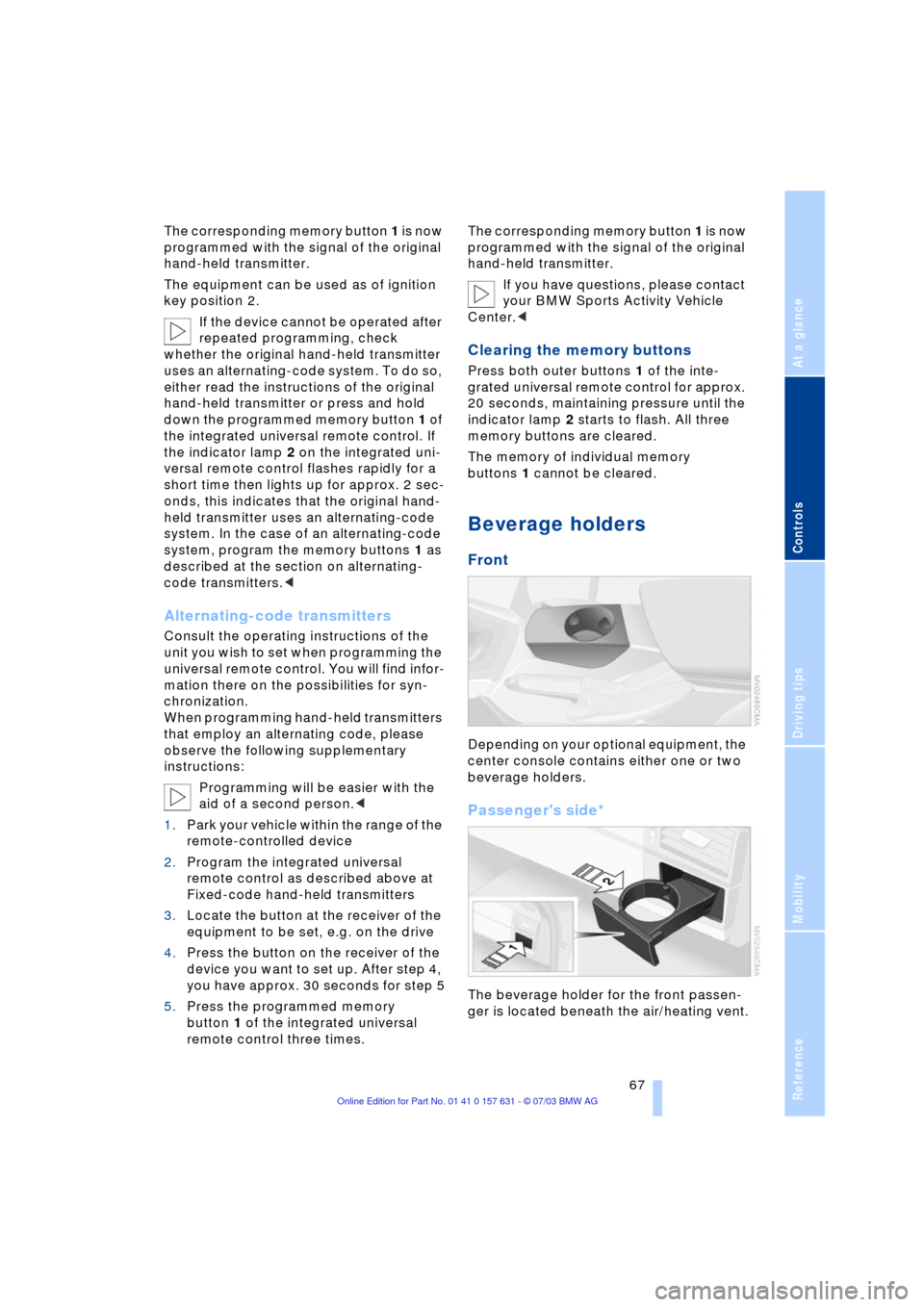
Beverage holders
Front
Depending on your optional equipment, the
center console contains either one or two
beverage holders.
Passenger's side*
The beverage holder for the front passen-
ger is located beneath the air/heating vent.
Page 71 of 132
Reference
At a glance
Controls
Driving tips
Mobility
69
>Nets in the luggage compartment and
on the rear of the front seats.
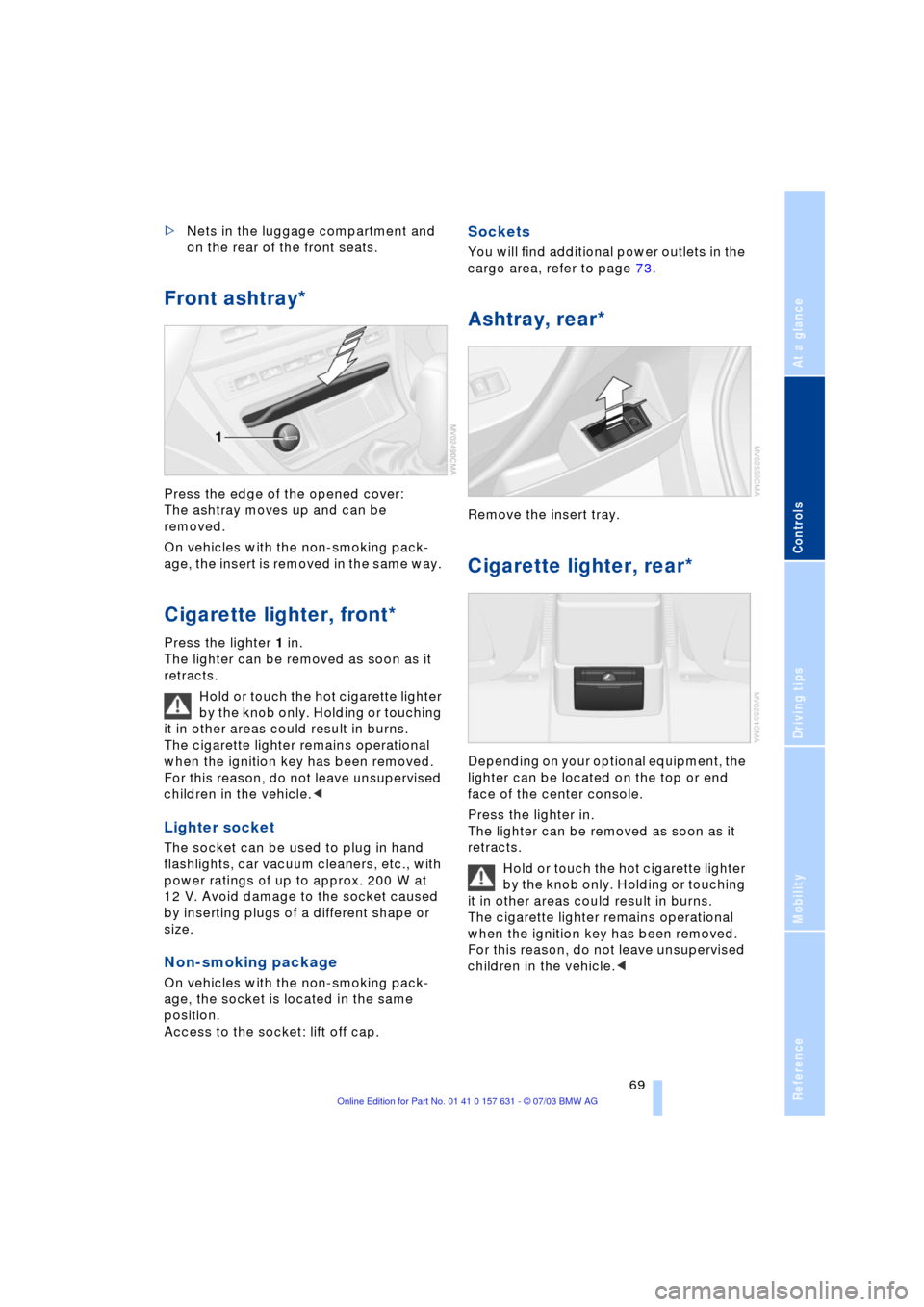
Front ashtray*
Press the edge of the opened cover:
The ashtray moves up and can be
removed.
On vehicles with the non-smoking pack-
age, the insert is removed in the same way.
Cigarette lighter, front*
Press the lighter 1 in.
The lighter can be removed as soon as it
retracts.
Hold or touch the hot cigarette lighter
by the knob only. Holding or touching
it in other areas could result in burns.
The cigarette lighter remains operational
when the ignition key has been removed.
For this reason, do not leave unsupervised
children in the vehicle.<
Lighter socket
The socket can be used to plug in hand
flashlights, car vacuum cleaners, etc., with
power ratings of up to approx. 200 W at
12 V. Avoid damage to the socket caused
by inserting plugs of a different shape or
size.
Non-smoking package
On vehicles with the non-smoking pack-
age, the socket is located in the same
position.
Access to the socket: lift off cap.
Sockets
You will find additional power outlets in the
cargo area, refer to page 73.
Ashtray, rear*
Remove the insert tray.
Cigarette lighter, rear*
Depending on your optional equipment, the
lighter can be located on the top or end
face of the center console.
Press the lighter in.
The lighter can be removed as soon as it
retracts.
Hold or touch the hot cigarette lighter
by the knob only. Holding or touching
it in other areas could result in burns.
The cigarette lighter remains operational
when the ignition key has been removed.
For this reason, do not leave unsupervised
children in the vehicle.<
Page 75 of 132
Reference
At a glance
Controls
Driving tips
Mobility
73
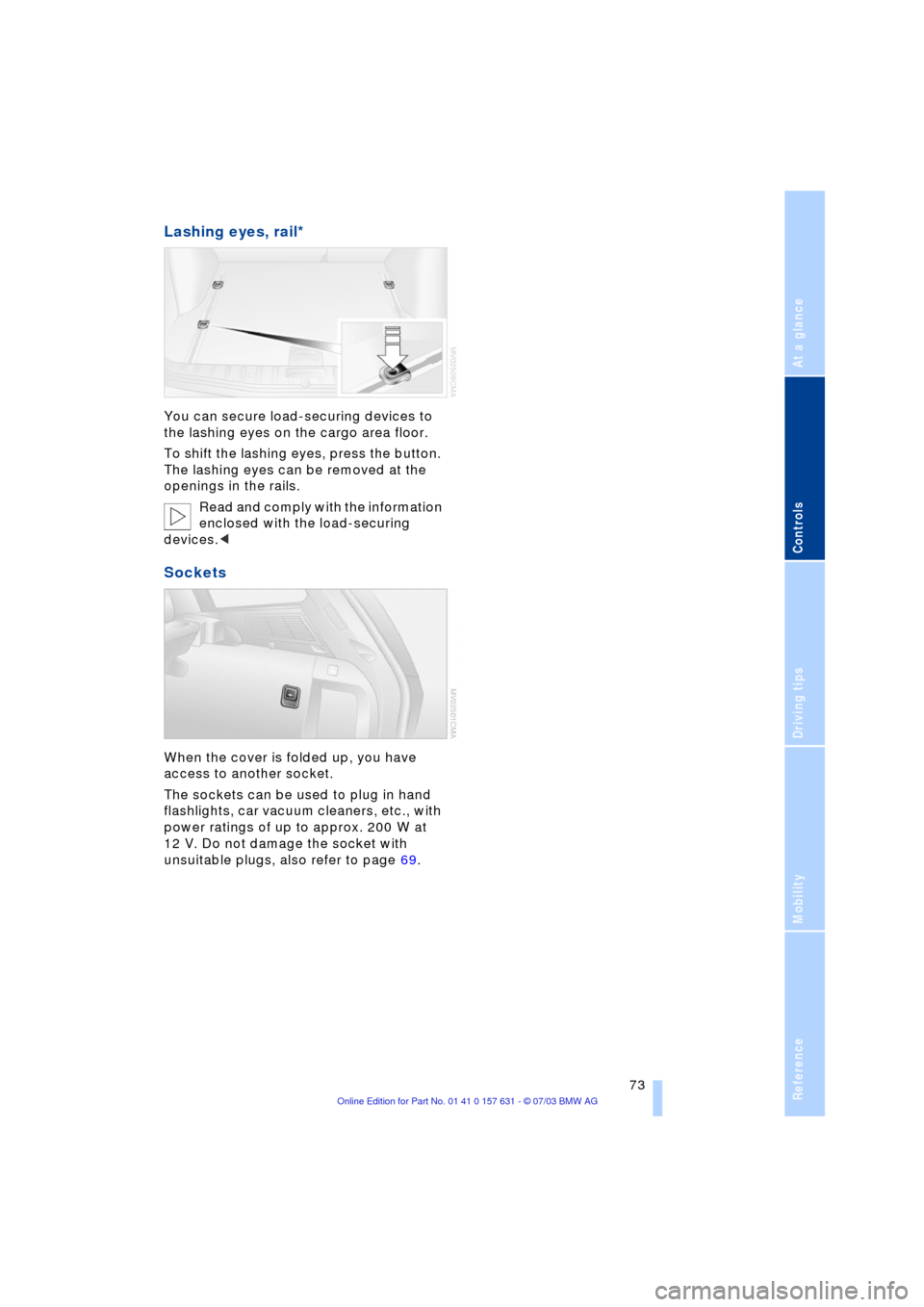
Lashing eyes, rail*
You can secure load-securing devices to
the lashing eyes on the cargo area floor.
To shift the lashing eyes, press the button.
The lashing eyes can be removed at the
openings in the rails.
Read and comply with the information
enclosed with the load-securing
devices.<
Sockets
When the cover is folded up, you have
access to another socket.
The sockets can be used to plug in hand
flashlights, car vacuum cleaners, etc., with
power ratings of up to approx. 200 W at
12 V. Do not damage the socket with
unsuitable plugs, also refer to page 69.
Page 96 of 132
Under the engine hood
94
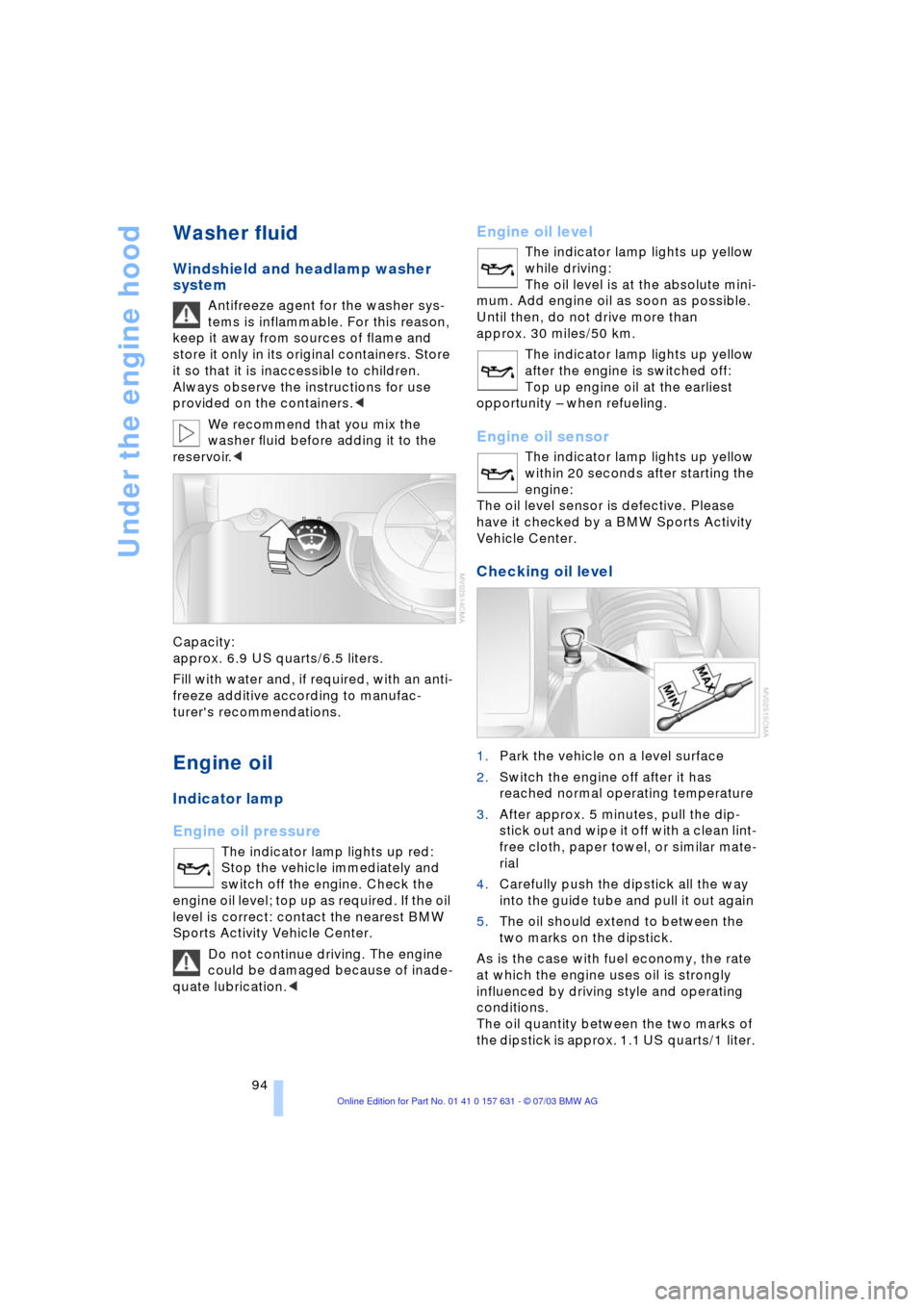
Washer fluid
Windshield and headlamp washer
system
Antifreeze agent for the washer sys-
tems is inflammable. For this reason,
keep it away from sources of flame and
store it only in its original containers. Store
it so that it is inaccessible to children.
Always observe the instructions for use
provided on the containers.<
We recommend that you mix the
washer ßuid before adding it to the
reservoir.<
Capacity:
approx. 6.9 US quarts/6.5 liters.
Fill with water and, if required, with an anti-
freeze additive according to manufac-
turer's recommendations.
Engine oil
Indicator lamp
Engine oil pressure
The indicator lamp lights up red:
Stop the vehicle immediately and
switch off the engine. Check the
engine oil level; top up as required. If the oil
level is correct: contact the nearest BMW
Sports Activity Vehicle Center.
Do not continue driving. The engine
could be damaged because of inade-
quate lubrication.<
Engine oil level
The indicator lamp lights up yellow
while driving:
The oil level is at the absolute mini-
mum. Add engine oil as soon as possible.
Until then, do not drive more than
approx. 30 miles/50 km.
The indicator lamp lights up yellow
after the engine is switched off:
Top up engine oil at the earliest
opportunity Ð when refueling.
Engine oil sensor
The indicator lamp lights up yellow
within 20 seconds after starting the
engine:
The oil level sensor is defective. Please
have it checked by a BMW Sports Activity
Vehicle Center.
Checking oil level
1.Park the vehicle on a level surface
2.Switch the engine off after it has
reached normal operating temperature
3.After approx. 5 minutes, pull the dip-
stick out and wipe it off with a clean lint-
free cloth, paper towel, or similar mate-
rial
4.Carefully push the dipstick all the way
into the guide tube and pull it out again
5.The oil should extend to between the
two marks on the dipstick.
As is the case with fuel economy, the rate
at which the engine uses oil is strongly
influenced by driving style and operating
conditions.
The oil quantity between the two marks of
the dipstick is approx. 1.1 US quarts/1 liter.
Page 97 of 132
Reference
At a glance
Controls
Driving tips
Mobility
95
Do not fill beyond the upper mark on the
dipstick. Excess oil can damage the
engine.
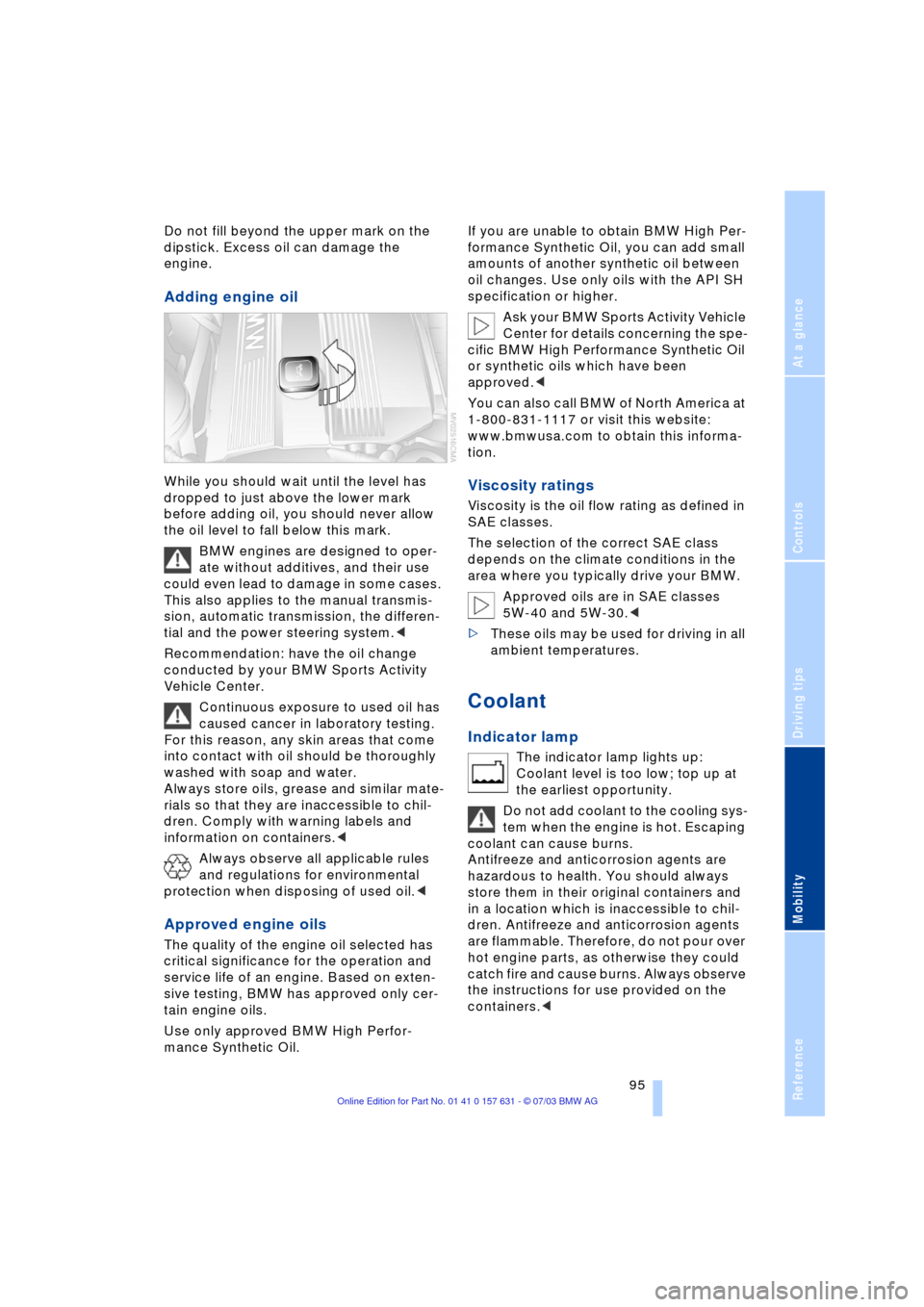
Adding engine oil
While you should wait until the level has
dropped to just above the lower mark
before adding oil, you should never allow
the oil level to fall below this mark.
BMW engines are designed to oper-
ate without additives, and their use
could even lead to damage in some cases.
This also applies to the manual transmis-
sion, automatic transmission, the differen-
tial and the power steering system.<
Recommendation: have the oil change
conducted by your BMW Sports Activity
Vehicle Center.
Continuous exposure to used oil has
caused cancer in laboratory testing.
For this reason, any skin areas that come
into contact with oil should be thoroughly
washed with soap and water.
Always store oils, grease and similar mate-
rials so that they are inaccessible to chil-
dren. Comply with warning labels and
information on containers.<
Always observe all applicable rules
and regulations for environmental
protection when disposing of used oil.<
Approved engine oils
The quality of the engine oil selected has
critical significance for the operation and
service life of an engine. Based on exten-
sive testing, BMW has approved only cer-
tain engine oils.
Use only approved BMW High Perfor-
mance Synthetic Oil.If you are unable to obtain BMW High Per-
formance Synthetic Oil, you can add small
amounts of another synthetic oil between
oil changes. Use only oils with the API SH
specification or higher.
Ask your BMW Sports Activity Vehicle
Center for details concerning the spe-
cific BMW High Performance Synthetic Oil
or synthetic oils which have been
approved.<
You can also call BMW of North America at
1-800-831-1117 or visit this website:
www.bmwusa.com to obtain this informa-
tion.
Viscosity ratings
Viscosity is the oil flow rating as defined in
SAE classes.
The selection of the correct SAE class
depends on the climate conditions in the
area where you typically drive your BMW.
Approved oils are in SAE classes
5W-40 and 5W-30.<
>These oils may be used for driving in all
ambient temperatures.
Coolant
Indicator lamp
The indicator lamp lights up:
Coolant level is too low; top up at
the earliest opportunity.
Do not add coolant to the cooling sys-
tem when the engine is hot. Escaping
coolant can cause burns.
Antifreeze and anticorrosion agents are
hazardous to health. You should always
store them in their original containers and
in a location which is inaccessible to chil-
dren. Antifreeze and anticorrosion agents
are flammable. Therefore, do not pour over
hot engine parts, as otherwise they could
catch fire and cause burns. Always observe
the instructions for use provided on the
containers.<
Page 98 of 132
Under the engine hood
96
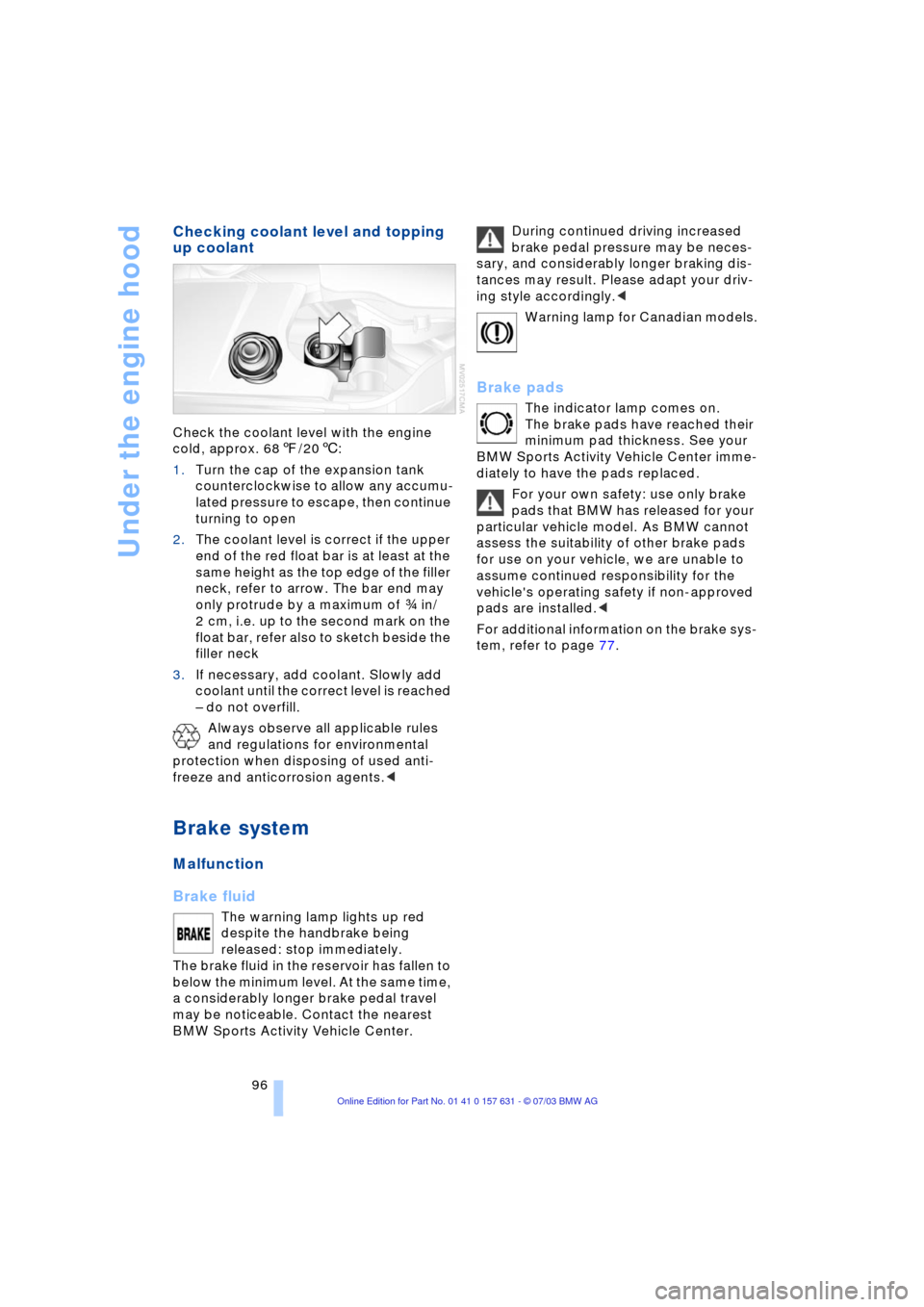
Checking coolant level and topping
up coolant
Check the coolant level with the engine
cold, approx. 687/206:
1.Turn the cap of the expansion tank
counterclockwise to allow any accumu-
lated pressure to escape, then continue
turning to open
2.The coolant level is correct if the upper
end of the red float bar is at least at the
same height as the top edge of the filler
neck, refer to arrow. The bar end may
only protrude by a maximum of i in/
2 cm, i.e. up to the second mark on the
float bar, refer also to sketch beside the
filler neck
3.If necessary, add coolant. Slowly add
coolant until the correct level is reached
Ð do not overfill.
Always observe all applicable rules
and regulations for environmental
protection when disposing of used anti-
freeze and anticorrosion agents.<
Brake system
Malfunction
Brake fluid
The warning lamp lights up red
despite the handbrake being
released: stop immediately.
The brake fluid in the reservoir has fallen to
below the minimum level. At the same time,
a considerably longer brake pedal travel
may be noticeable. Contact the nearest
BMW Sports Activity Vehicle Center.During continued driving increased
brake pedal pressure may be neces-
sary, and considerably longer braking dis-
tances may result. Please adapt your driv-
ing style accordingly.<
Warning lamp for Canadian models.
Brake pads
The indicator lamp comes on.
The brake pads have reached their
minimum pad thickness. See your
BMW Sports Activity Vehicle Center imme-
diately to have the pads replaced.
For your own safety: use only brake
pads that BMW has released for your
particular vehicle model. As BMW cannot
assess the suitability of other brake pads
for use on your vehicle, we are unable to
assume continued responsibility for the
vehicle's operating safety if non-approved
pads are installed.<
For additional information on the brake sys-
tem, refer to page 77.