service BMW X3 2.5I 2004 E83 User Guide
[x] Cancel search | Manufacturer: BMW, Model Year: 2004, Model line: X3 2.5I, Model: BMW X3 2.5I 2004 E83Pages: 132, PDF Size: 3.62 MB
Page 86 of 132
Refueling
84
Refueling
Fuel filler door
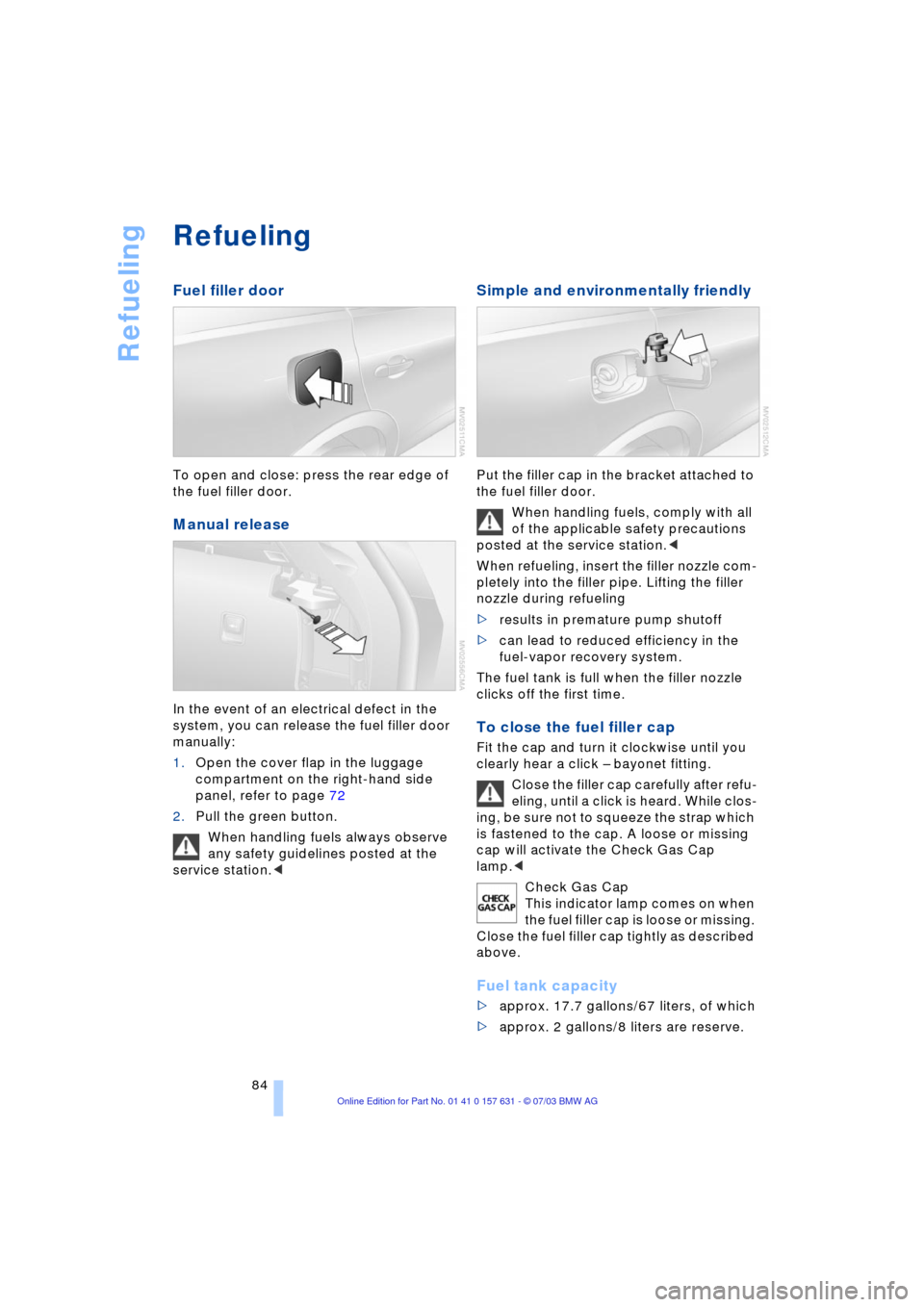
To open and close: press the rear edge of
the fuel filler door.
Manual release
In the event of an electrical defect in the
system, you can release the fuel filler door
manually:
1.Open the cover flap in the luggage
compartment on the right-hand side
panel, refer to page 72
2.Pull the green button.
When handling fuels always observe
any safety guidelines posted at the
service station.<
Simple and environmentally friendly
Put the filler cap in the bracket attached to
the fuel filler door.
When handling fuels, comply with all
of the applicable safety precautions
posted at the service station.<
When refueling, insert the filler nozzle com-
pletely into the filler pipe. Lifting the filler
nozzle during refueling
>results in premature pump shutoff
>can lead to reduced efficiency in the
fuel-vapor recovery system.
The fuel tank is full when the filler nozzle
clicks off the first time.
To close the fuel filler cap
Fit the cap and turn it clockwise until you
clearly hear a click Ð bayonet fitting.
Close the filler cap carefully after refu-
eling, until a click is heard. While clos-
ing, be sure not to squeeze the strap which
is fastened to the cap. A loose or missing
cap will activate the Check Gas Cap
lamp.<
Check Gas Cap
This indicator lamp comes on when
the fuel filler cap is loose or missing.
Close the fuel filler cap tightly as described
above.
Fuel tank capacity
>approx. 17.7 gallons/67 liters, of which
>approx. 2 gallons/8 liters are reserve.
Page 88 of 132
Wheels and tires
86
Wheels and tires
Tire inflation pressure
Information for your safety
It is not merely the tire's service life, but
also driving comfort and Ð to a great extent
Ð driving safety that depend on the condi-
tion of the tires and the maintenance of the
specified tire pressure.
Check the tire inflation pressure regu-
larly and correct it if necessary,
including compact wheel: at least every
two weeks and before beginning a longer
trip. If you fail to observe this precaution
you may be driving on tires with incorrect
tire pressures, a condition that cannot only
compromise your vehicle's driving stability,
but also lead to tire damage and the risk of
an accident.
Do not drive with a depressurized, i.e. flat
tire. A flat tire will seriously impair your
vehicle's handling and braking response.
Attempts to drive on a flat tire can lead to
loss of control over the vehicle.<
Checking the pressure
Only check tire inflation pressure when the
tires are cold. That means after a maximum
of 1.25 miles/2 km driving or when the
vehicle has been parked for at least 2
hours. When tires are warm, the tire infla-
tion pressure increases.
After correcting the inflation pressure(s),
always reinitialize the Flat Tire Monitor,
refer to page 53.
Checking inflation pressure
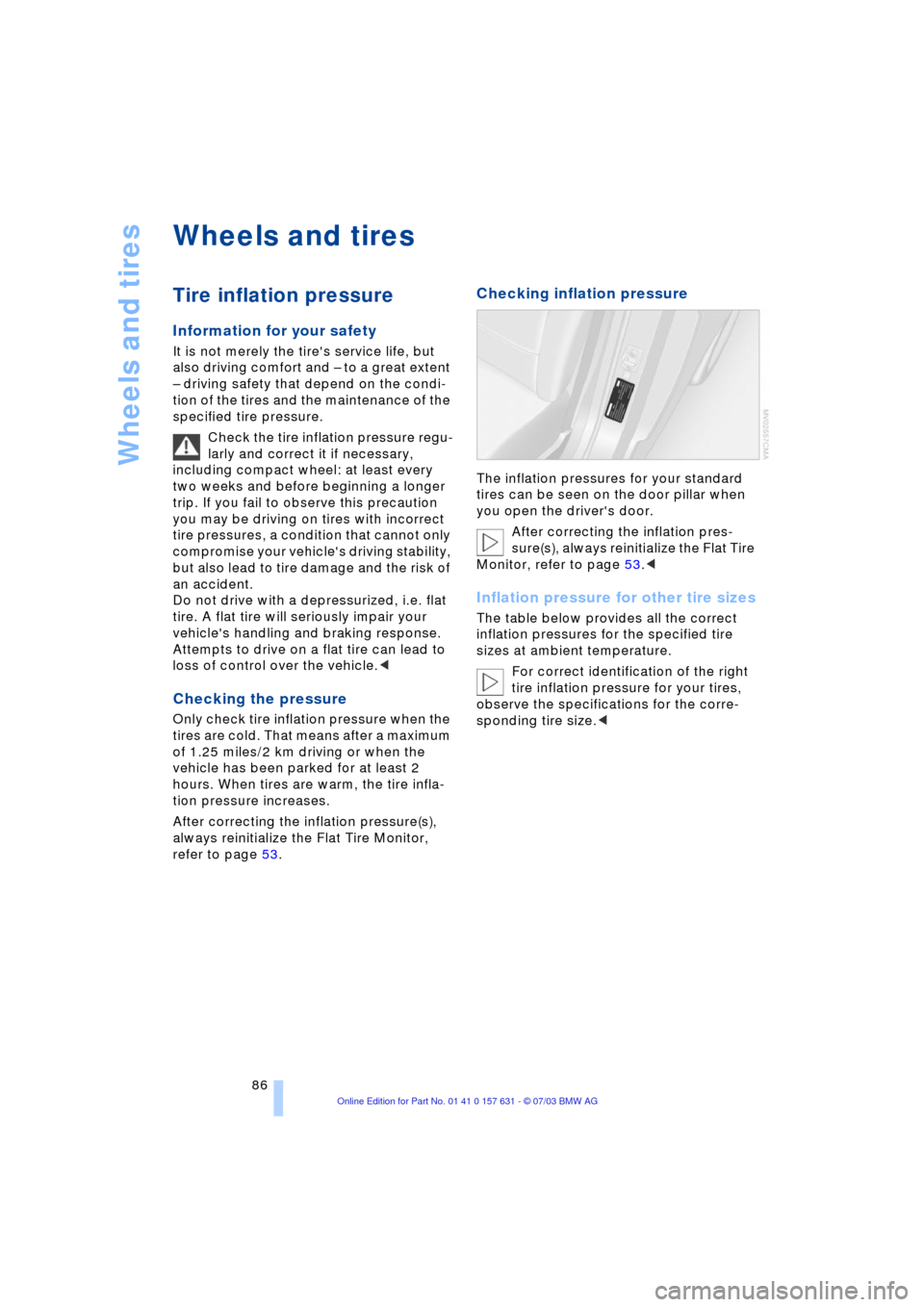
The inflation pressures for your standard
tires can be seen on the door pillar when
you open the driver's door.
After correcting the inflation pres-
sure(s), always reinitialize the Flat Tire
Monitor, refer to page 53.<
Inflation pressure for other tire sizes
The table below provides all the correct
inflation pressures for the specified tire
sizes at ambient temperature.
For correct identification of the right
tire inflation pressure for your tires,
observe the specifications for the corre-
sponding tire size.<
Page 90 of 132
Wheels and tires
88
Tire identification marks
Knowledge of the labeling on the side of
the tire makes it easier to identify and
choose the right tires.
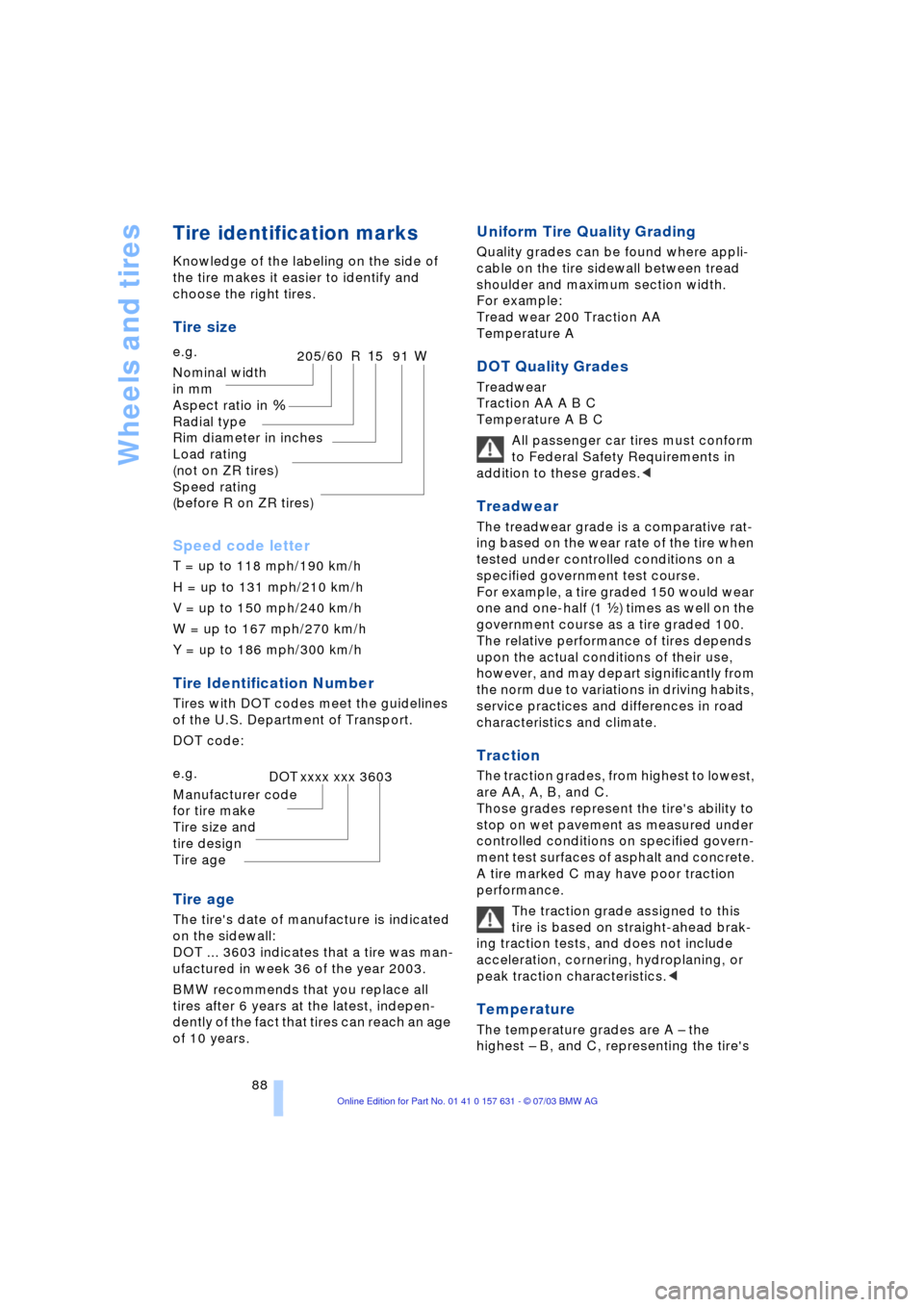
Tire size
Speed code letter
T = up to 118 mph/190 km/h
H = up to 131 mph/210 km/h
V = up to 150 mph/240 km/h
W = up to 167 mph/270 km/h
Y = up to 186 mph/300 km/h
Tire Identification Number
Tires with DOT codes meet the guidelines
of the U.S. Department of Transport.
DOT code:
Tire age
The tire's date of manufacture is indicated
on the sidewall:
DOT ... 3603 indicates that a tire was man-
ufactured in week 36 of the year 2003.
BMW recommends that you replace all
tires after 6 years at the latest, indepen-
dently of the fact that tires can reach an age
of 10 years.
Uniform Tire Quality Grading
Quality grades can be found where appli-
cable on the tire sidewall between tread
shoulder and maximum section width.
For example:
Tread wear 200 Traction AA
Temperature A
DOT Quality Grades
Treadwear
Traction AA A B C
Temperature A B C
All passenger car tires must conform
to Federal Safety Requirements in
addition to these grades.<
Treadwear
The treadwear grade is a comparative rat-
ing based on the wear rate of the tire when
tested under controlled conditions on a
specified government test course.
For example, a tire graded 150 would wear
one and one-half (1 g) times as well on the
government course as a tire graded 100.
The relative performance of tires depends
upon the actual conditions of their use,
however, and may depart significantly from
the norm due to variations in driving habits,
service practices and differences in road
characteristics and climate.
Traction
The traction grades, from highest to lowest,
are AA, A, B, and C.
Those grades represent the tire's ability to
stop on wet pavement as measured under
controlled conditions on specified govern-
ment test surfaces of asphalt and concrete.
A tire marked C may have poor traction
performance.
The traction grade assigned to this
tire is based on straight-ahead brak-
ing traction tests, and does not include
acceleration, cornering, hydroplaning, or
peak traction characteristics.<
Temperature
The temperature grades are A Ð the
highest Ð B, and C, representing the tire's e.g.
Nominal width
in mm
Aspect ratio in X
Radial type
Rim diameter in inches
Load rating
(not on ZR tires)
Speed rating
(before R on ZR tires)
205/60 R1591W
e.g.
Manufacturer code
for tire make
Tire size and
tire design
Tire ageDOT xxxx xxx 3603
Page 91 of 132
Reference
At a glance
Controls
Driving tips
Mobility
89
resistance to the generation of heat and its
ability to dissipate heat when tested under
controlled conditions on a specified indoor
laboratory test wheel.
Sustained high temperature can cause the
material of the tire to degenerate and
reduce tire life, and excessive temperature
can lead to sudden tire failure. The grade C
corresponds to a level of performance
which all passenger car tires must meet
under the Federal Motor Vehicle Safety
Standard No. 109. Grades B and A repre-
sent higher levels of performance on the
laboratory test wheel than the minimum
required by law.
The temperature grade for this tire is
established for a tire that is properly
inflated and not overloaded. Excessive
speed, underinflation, or excessive load-
ing, either separately or in combination,
can cause heat buildup and possible tire
failure.<
M+S
Winter and all-season tires.
These have better winter properties than
summer tires.
Tire condition
Inspect your tires frequently for treadwear,
signs of damage and for foreign objects
lodged in the tread. Check the tread pat-
tern depth.
Tire tread
The tread depth should not drop below
0.12 in/3 mm, although, for example, Euro-
pean legislation only specifies a minimum
tread depth of 0.063 in/1.6 mm. At tread
depths below 0.12 in/3 mm, there is an
increased risk of high-speed hydroplaning,
even when only small amounts of water are
present on the road surface.
As winter tires display a noticeable loss in
their ability to cope with cold-weather driv-
ing conditions once the tread wears to
below 0.16 in/4 mm, to ensure continued safety you should always have such tires
replaced.
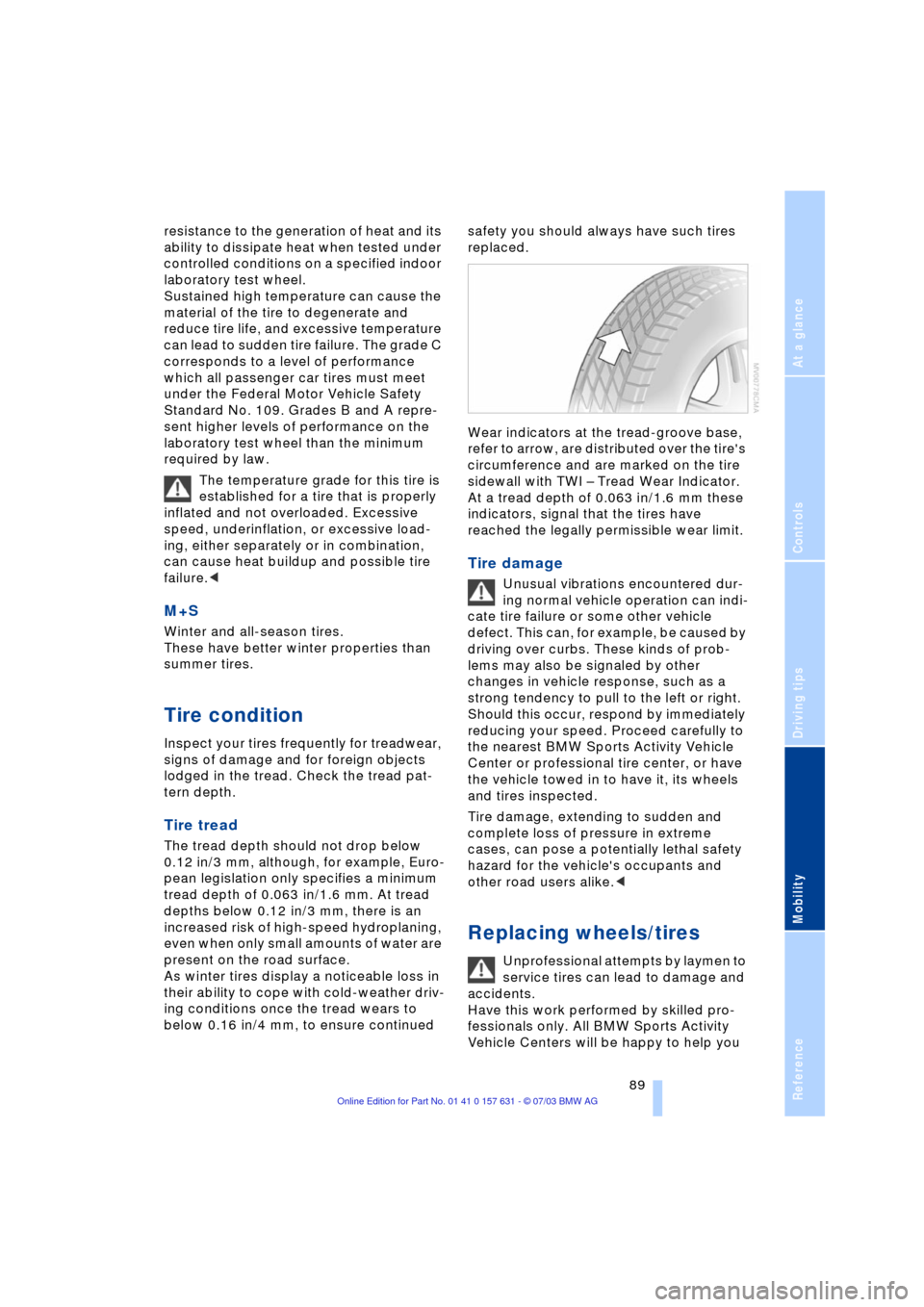
Wear indicators at the tread-groove base,
refer to arrow, are distributed over the tire's
circumference and are marked on the tire
sidewall with TWI Ð Tread Wear Indicator.
At a tread depth of 0.063 in/1.6 mm these
indicators, signal that the tires have
reached the legally permissible wear limit.
Tire damage
Unusual vibrations encountered dur-
ing normal vehicle operation can indi-
cate tire failure or some other vehicle
defect. This can, for example, be caused by
driving over curbs. These kinds of prob-
lems may also be signaled by other
changes in vehicle response, such as a
strong tendency to pull to the left or right.
Should this occur, respond by immediately
reducing your speed. Proceed carefully to
the nearest BMW Sports Activity Vehicle
Center or professional tire center, or have
the vehicle towed in to have it, its wheels
and tires inspected.
Tire damage, extending to sudden and
complete loss of pressure in extreme
cases, can pose a potentially lethal safety
hazard for the vehicle's occupants and
other road users alike.<
Replacing wheels/tires
Unprofessional attempts by laymen to
service tires can lead to damage and
accidents.
Have this work performed by skilled pro-
fessionals only. All BMW Sports Activity
Vehicle Centers will be happy to help you
Page 94 of 132
Under the engine hood
92
Under the engine hood
Never attempt to perform any service
or repair operations on your vehicle
without the required professional technical
training. If you are unaware of the regula-
tions that need to be observed, BMW rec-
ommends that you have this work per-
formed at a BMW Sports Activity Vehicle
Center, as otherwise unqualified handling
of parts and materials can lead to safety
risk for vehicle occupants and other road
users.<
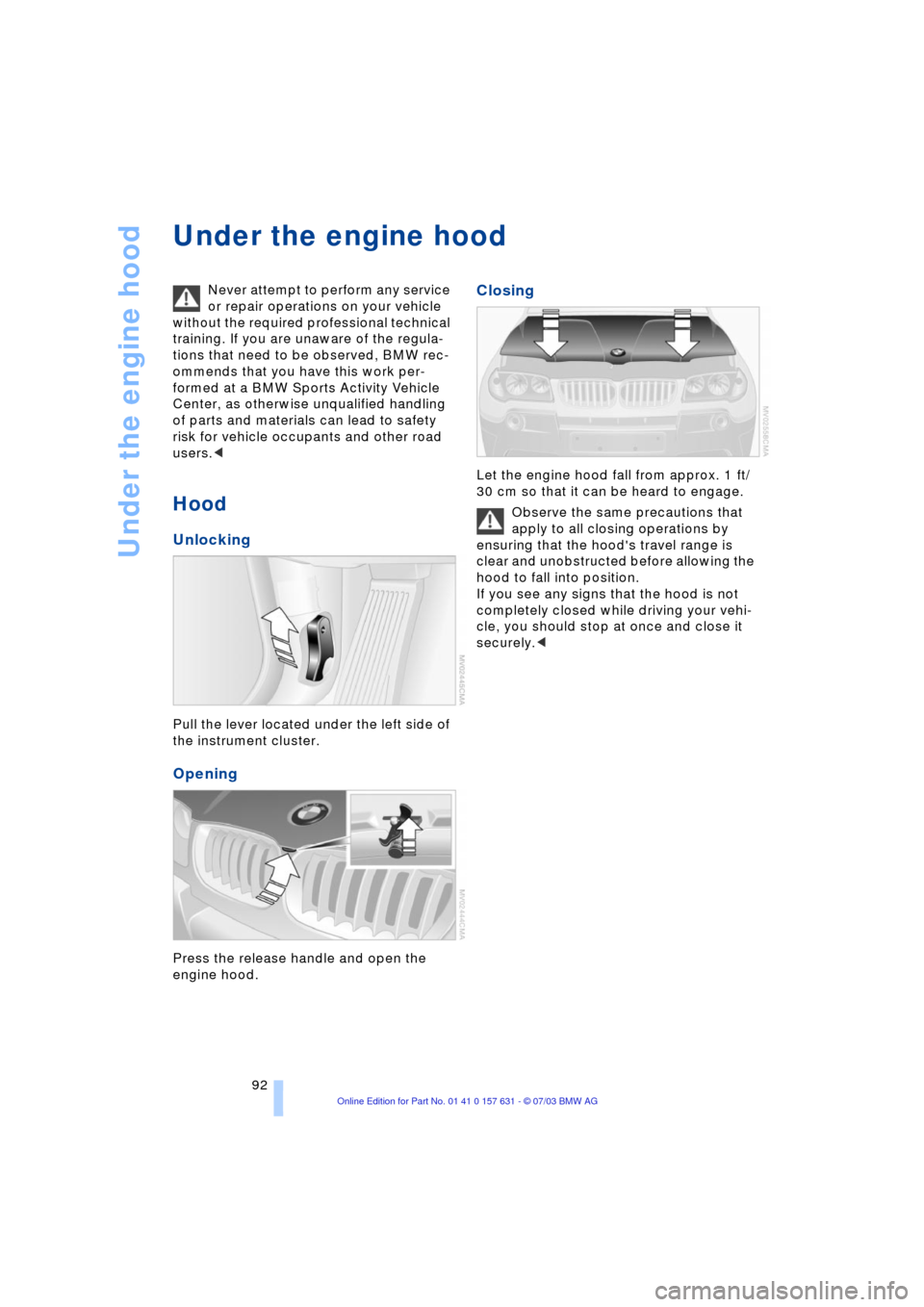
Hood
Unlocking
Pull the lever located under the left side of
the instrument cluster.
Opening
Press the release handle and open the
engine hood.
Closing
Let the engine hood fall from approx. 1 ft/
30 cm so that it can be heard to engage.
Observe the same precautions that
apply to all closing operations by
ensuring that the hood's travel range is
clear and unobstructed before allowing the
hood to fall into position.
If you see any signs that the hood is not
completely closed while driving your vehi-
cle, you should stop at once and close it
securely.<
Page 97 of 132
Reference
At a glance
Controls
Driving tips
Mobility
95
Do not fill beyond the upper mark on the
dipstick. Excess oil can damage the
engine.
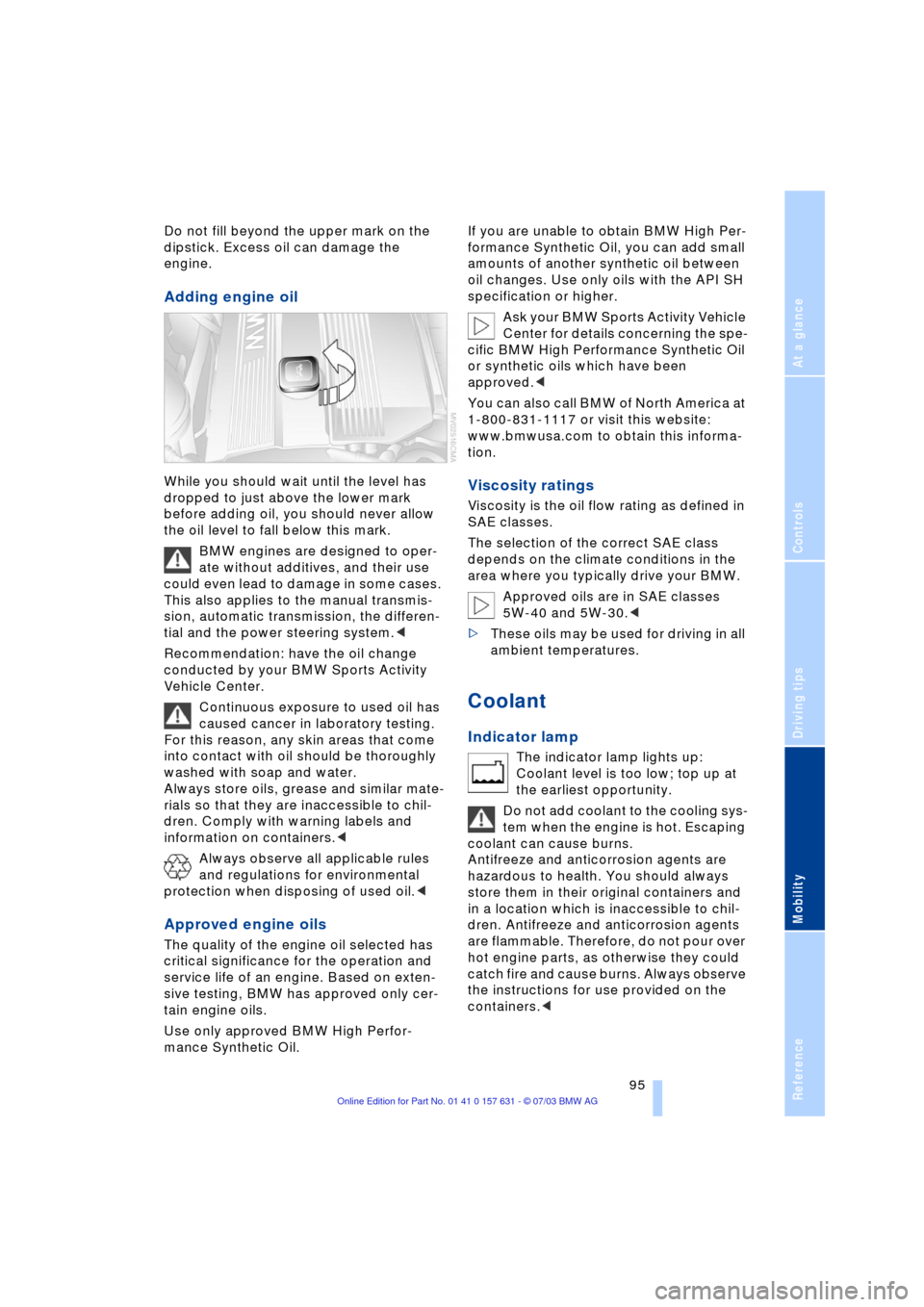
Adding engine oil
While you should wait until the level has
dropped to just above the lower mark
before adding oil, you should never allow
the oil level to fall below this mark.
BMW engines are designed to oper-
ate without additives, and their use
could even lead to damage in some cases.
This also applies to the manual transmis-
sion, automatic transmission, the differen-
tial and the power steering system.<
Recommendation: have the oil change
conducted by your BMW Sports Activity
Vehicle Center.
Continuous exposure to used oil has
caused cancer in laboratory testing.
For this reason, any skin areas that come
into contact with oil should be thoroughly
washed with soap and water.
Always store oils, grease and similar mate-
rials so that they are inaccessible to chil-
dren. Comply with warning labels and
information on containers.<
Always observe all applicable rules
and regulations for environmental
protection when disposing of used oil.<
Approved engine oils
The quality of the engine oil selected has
critical significance for the operation and
service life of an engine. Based on exten-
sive testing, BMW has approved only cer-
tain engine oils.
Use only approved BMW High Perfor-
mance Synthetic Oil.If you are unable to obtain BMW High Per-
formance Synthetic Oil, you can add small
amounts of another synthetic oil between
oil changes. Use only oils with the API SH
specification or higher.
Ask your BMW Sports Activity Vehicle
Center for details concerning the spe-
cific BMW High Performance Synthetic Oil
or synthetic oils which have been
approved.<
You can also call BMW of North America at
1-800-831-1117 or visit this website:
www.bmwusa.com to obtain this informa-
tion.
Viscosity ratings
Viscosity is the oil flow rating as defined in
SAE classes.
The selection of the correct SAE class
depends on the climate conditions in the
area where you typically drive your BMW.
Approved oils are in SAE classes
5W-40 and 5W-30.<
>These oils may be used for driving in all
ambient temperatures.
Coolant
Indicator lamp
The indicator lamp lights up:
Coolant level is too low; top up at
the earliest opportunity.
Do not add coolant to the cooling sys-
tem when the engine is hot. Escaping
coolant can cause burns.
Antifreeze and anticorrosion agents are
hazardous to health. You should always
store them in their original containers and
in a location which is inaccessible to chil-
dren. Antifreeze and anticorrosion agents
are flammable. Therefore, do not pour over
hot engine parts, as otherwise they could
catch fire and cause burns. Always observe
the instructions for use provided on the
containers.<
Page 99 of 132
Reference
At a glance
Controls
Driving tips
Mobility
97
Maintenance
The BMW maintenance
system
The BMW maintenance system is designed
in such a way that it reliably ensures the
road safety and operating reliability of the
vehicle Ð keeping the cost for you as low as
possible.
Regular maintenance is not only required
for the safety of the vehicle, it also
improves the resale value.
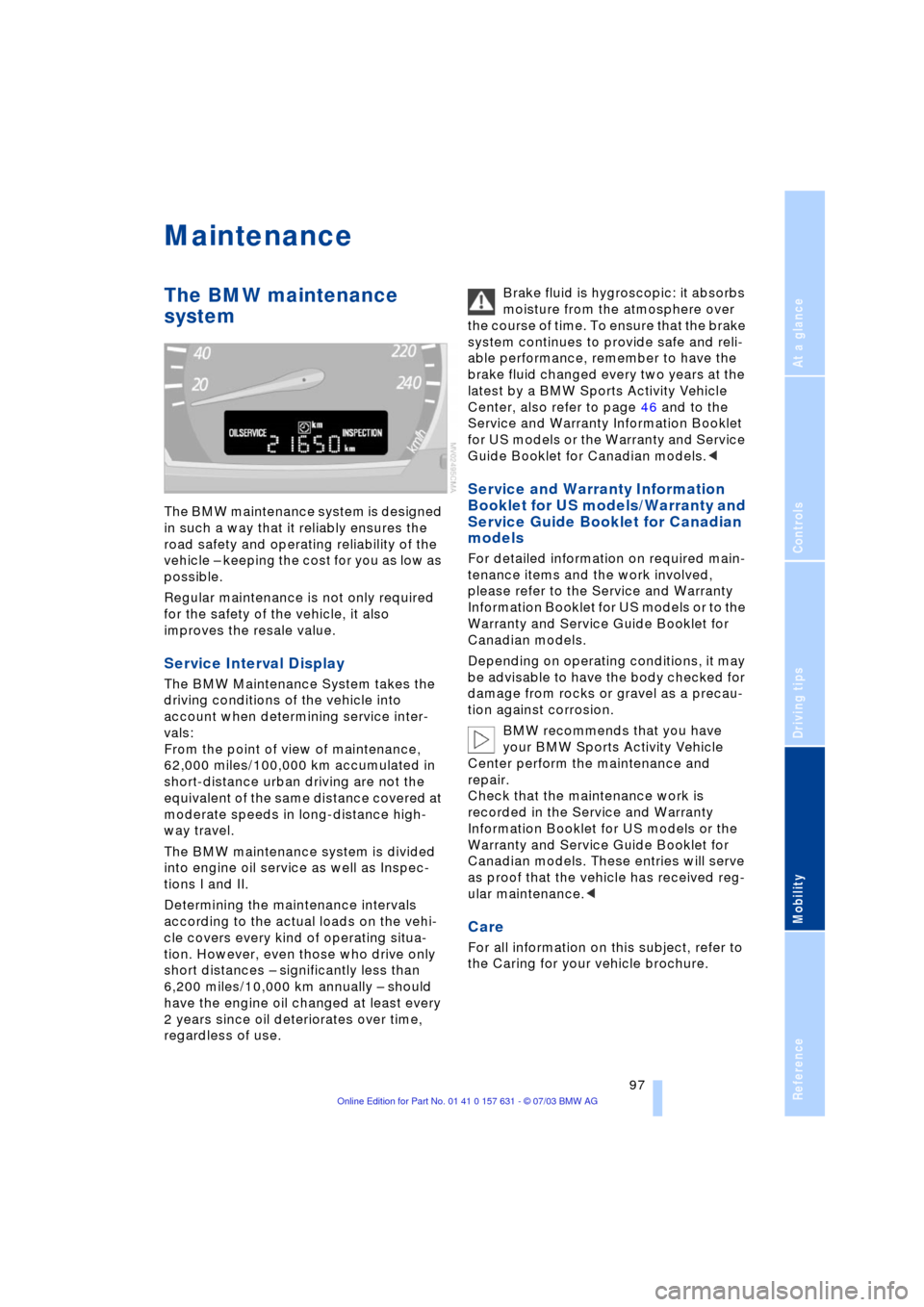
Service Interval Display
The BMW Maintenance System takes the
driving conditions of the vehicle into
account when determining service inter-
vals:
From the point of view of maintenance,
62,000 miles/100,000 km accumulated in
short-distance urban driving are not the
equivalent of the same distance covered at
moderate speeds in long-distance high-
way travel.
The BMW maintenance system is divided
into engine oil service as well as Inspec-
tions I and II.
Determining the maintenance intervals
according to the actual loads on the vehi-
cle covers every kind of operating situa-
tion. However, even those who drive only
short distances Ð significantly less than
6,200 miles/10,000 km annually Ð should
have the engine oil changed at least every
2 years since oil deteriorates over time,
regardless of use.Brake fluid is hygroscopic: it absorbs
moisture from the atmosphere over
the course of time. To ensure that the brake
system continues to provide safe and reli-
able performance, remember to have the
brake fluid changed every two years at the
latest by a BMW Sports Activity Vehicle
Center, also refer to page 46 and to the
Service and Warranty Information Booklet
for US models or the Warranty and Service
Guide Booklet for Canadian models.<
Service and Warranty Information
Booklet for US models/Warranty and
Service Guide Booklet for Canadian
models
For detailed information on required main-
tenance items and the work involved,
please refer to the Service and Warranty
Information Booklet for US models or to the
Warranty and Service Guide Booklet for
Canadian models.
Depending on operating conditions, it may
be advisable to have the body checked for
damage from rocks or gravel as a precau-
tion against corrosion.
BMW recommends that you have
your BMW Sports Activity Vehicle
Center perform the maintenance and
repair.
Check that the maintenance work is
recorded in the Service and Warranty
Information Booklet for US models or the
Warranty and Service Guide Booklet for
Canadian models. These entries will serve
as proof that the vehicle has received reg-
ular maintenance.<
Care
For all information on this subject, refer to
the Caring for your vehicle brochure.
Page 100 of 132
Laws and regulations
98
Laws and regulations
California Proposition 65
Warning
California laws require us to state the fol-
lowing warning:
Engine exhaust and a wide variety of
automobile components and parts,
including components found in the interior
furnishings in a vehicle, contain or emit
chemicals known to the State of California
to cause cancer and birth defects and
reproductive harm. In addition, certain flu-
ids contained in vehicles and certain prod-
ucts of component wear contain or emit
chemicals known to the State of California
to cause cancer and birth defects or other
reproductive harm. Battery posts, terminals
and related accessories contain lead and
lead compounds. Wash your hands after
handling. Used engine oil contains chemi-
cals that have caused cancer in laboratory
animals. Always protect your skin by wash-
ing thoroughly with soap and water.<
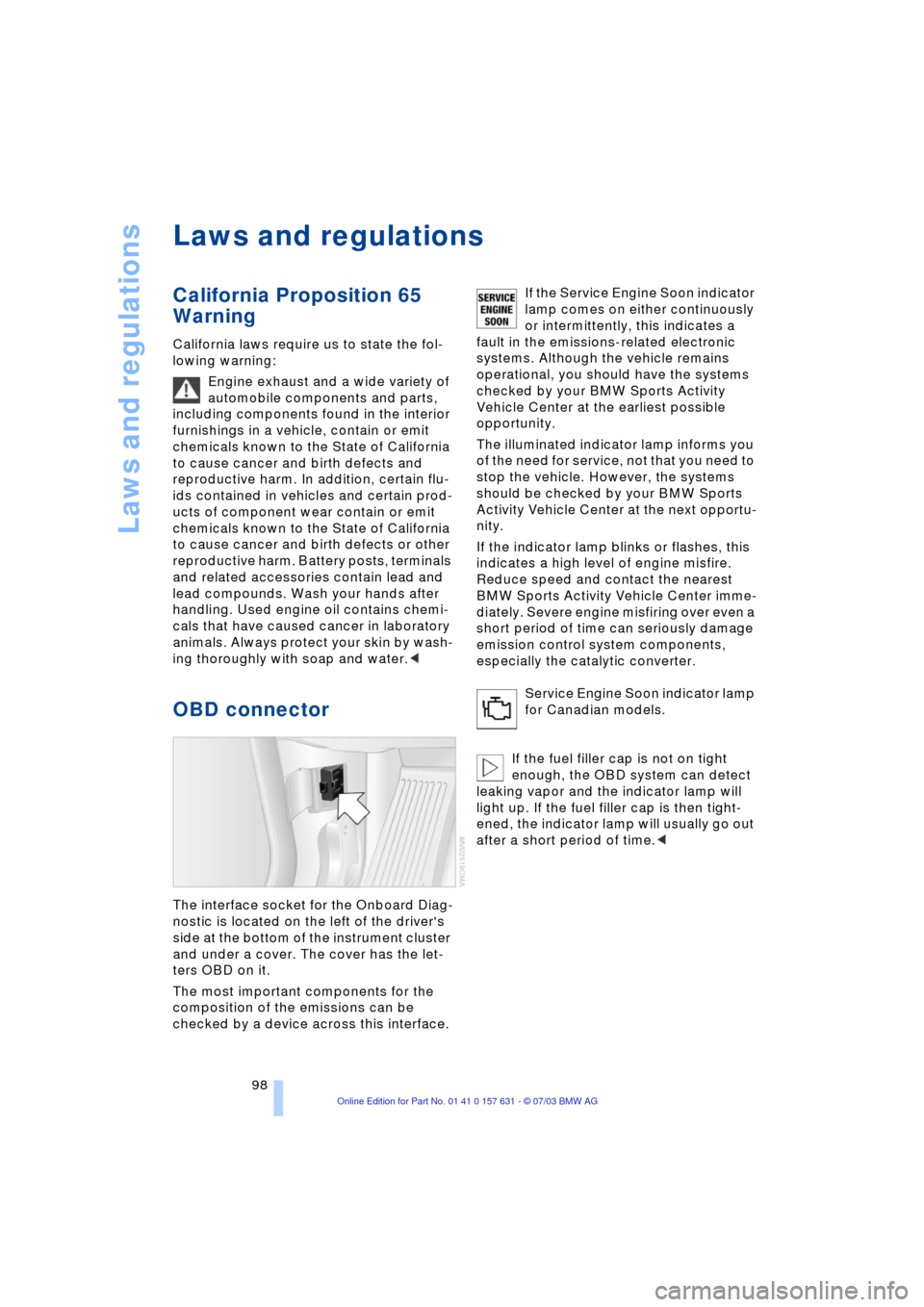
OBD connector
The interface socket for the Onboard Diag-
nostic is located on the left of the driver's
side at the bottom of the instrument cluster
and under a cover. The cover has the let-
ters OBD on it.
The most important components for the
composition of the emissions can be
checked by a device across this interface. If the Service Engine Soon indicator
lamp comes on either continuously
or intermittently, this indicates a
fault in the emissions-related electronic
systems. Although the vehicle remains
operational, you should have the systems
checked by your BMW Sports Activity
Vehicle Center at the earliest possible
opportunity.
The illuminated indicator lamp informs you
of the need for service, not that you need to
stop the vehicle. However, the systems
should be checked by your BMW Sports
Activity Vehicle Center at the next opportu-
nity.
If the indicator lamp blinks or flashes, this
indicates a high level of engine misfire.
Reduce speed and contact the nearest
BMW Sports Activity Vehicle Center imme-
diately. Severe engine misfiring over even a
short period of time can seriously damage
emission control system components,
especially the catalytic converter.
Service Engine Soon indicator lamp
for Canadian models.
If the fuel filler cap is not on tight
enough, the OBD system can detect
leaking vapor and the indicator lamp will
light up. If the fuel filler cap is then tight-
ened, the indicator lamp will usually go out
after a short period of time.<
Page 101 of 132
Reference
At a glance
Controls
Driving tips
Mobility
99
Replacing components
Onboard tool kit
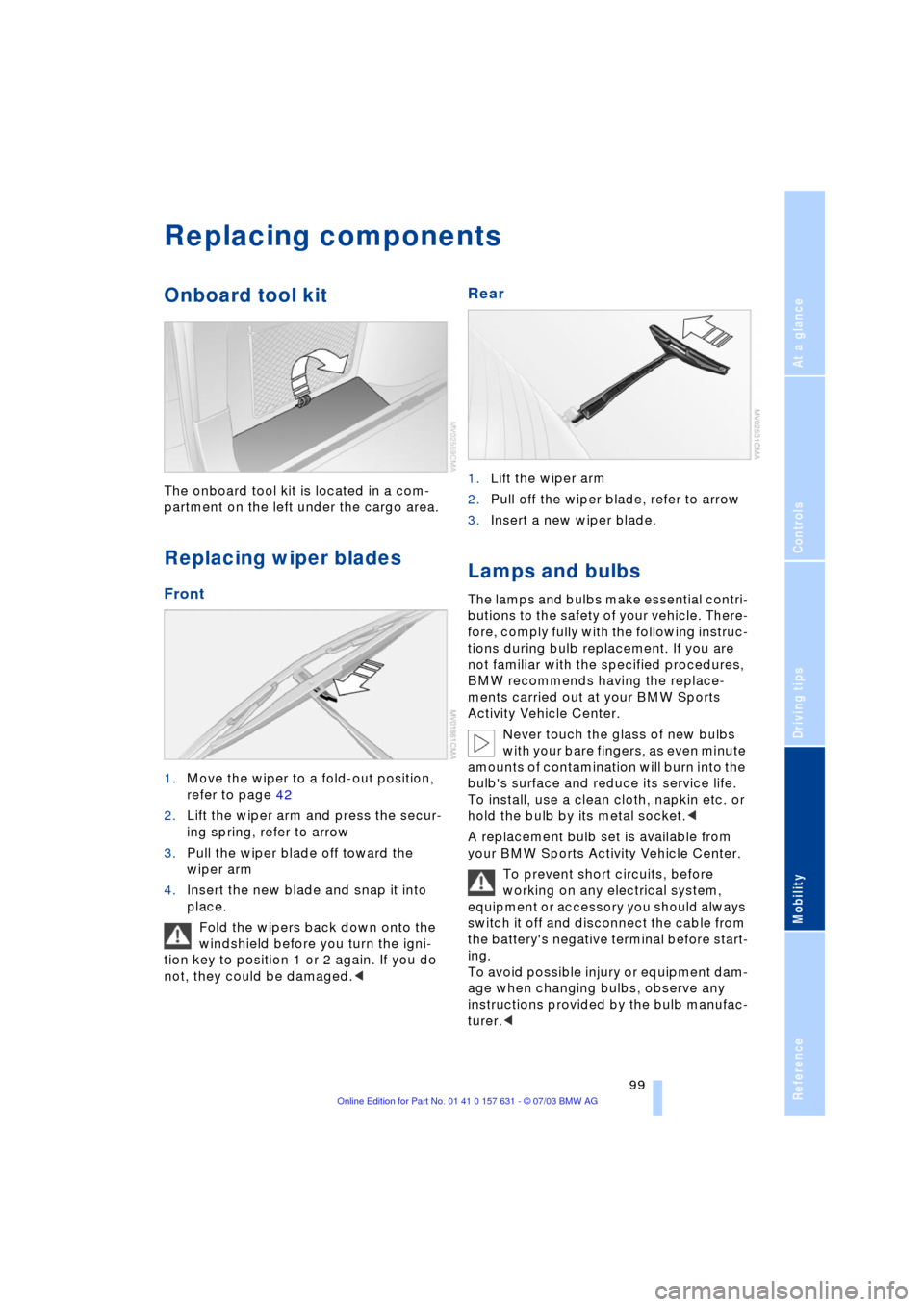
The onboard tool kit is located in a com-
partment on the left under the cargo area.
Replacing wiper blades
Front
1.Move the wiper to a fold-out position,
refer to page 42
2.Lift the wiper arm and press the secur-
ing spring, refer to arrow
3.Pull the wiper blade off toward the
wiper arm
4.Insert the new blade and snap it into
place.
Fold the wipers back down onto the
windshield before you turn the igni-
tion key to position 1 or 2 again. If you do
not, they could be damaged.<
Rear
1.Lift the wiper arm
2.Pull off the wiper blade, refer to arrow
3.Insert a new wiper blade.
Lamps and bulbs
The lamps and bulbs make essential contri-
butions to the safety of your vehicle. There-
fore, comply fully with the following instruc-
tions during bulb replacement. If you are
not familiar with the specified procedures,
BMW recommends having the replace-
ments carried out at your BMW Sports
Activity Vehicle Center.
Never touch the glass of new bulbs
with your bare fingers, as even minute
amounts of contamination will burn into the
bulb's surface and reduce its service life.
To install, use a clean cloth, napkin etc. or
hold the bulb by its metal socket.<
A replacement bulb set is available from
your BMW Sports Activity Vehicle Center.
To prevent short circuits, before
working on any electrical system,
equipment or accessory you should always
switch it off and disconnect the cable from
the battery's negative terminal before start-
ing.
To avoid possible injury or equipment dam-
age when changing bulbs, observe any
instructions provided by the bulb manufac-
turer.<
Page 103 of 132
Reference
At a glance
Controls
Driving tips
Mobility
101
4.Apply the lamp base with the lower
edge to the bracket and press it in until
the lamp base locks in place.
Make sure that the cover does not fall
into the engine compartment, as oth-
erwise the vehicle can be damaged or
other road users can be endangered.<
Front passenger side
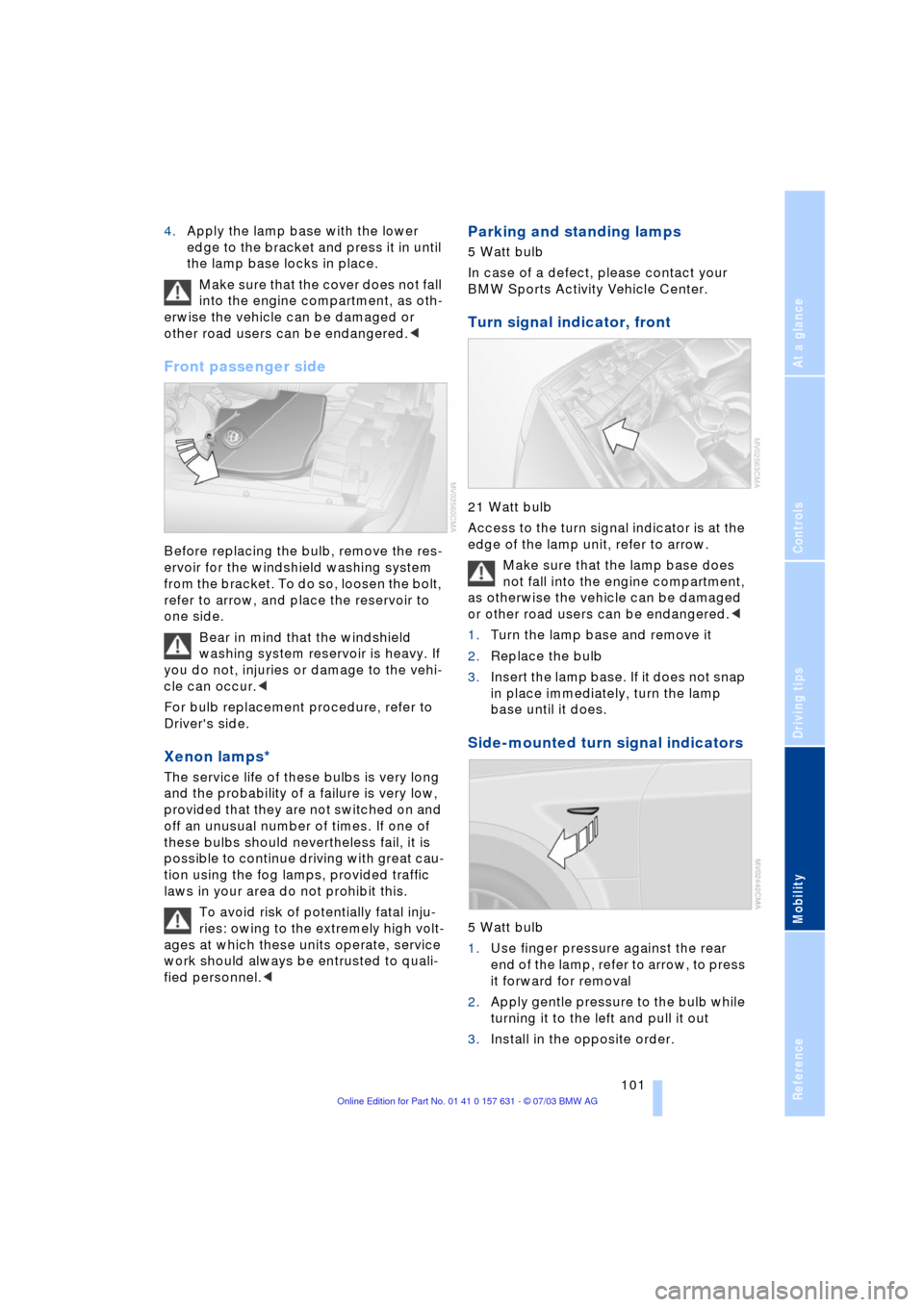
Before replacing the bulb, remove the res-
ervoir for the windshield washing system
from the bracket. To do so, loosen the bolt,
refer to arrow, and place the reservoir to
one side.
Bear in mind that the windshield
washing system reservoir is heavy. If
you do not, injuries or damage to the vehi-
cle can occur.<
For bulb replacement procedure, refer to
Driver's side.
Xenon lamps*
The service life of these bulbs is very long
and the probability of a failure is very low,
provided that they are not switched on and
off an unusual number of times. If one of
these bulbs should nevertheless fail, it is
possible to continue driving with great cau-
tion using the fog lamps, provided traffic
laws in your area do not prohibit this.
To avoid risk of potentially fatal inju-
ries: owing to the extremely high volt-
ages at which these units operate, service
work should always be entrusted to quali-
fied personnel.<
Parking and standing lamps
5 Watt bulb
In case of a defect, please contact your
BMW Sports Activity Vehicle Center.
Turn signal indicator, front
21 Watt bulb
Access to the turn signal indicator is at the
edge of the lamp unit, refer to arrow.
Make sure that the lamp base does
not fall into the engine compartment,
as otherwise the vehicle can be damaged
or other road users can be endangered.<
1.Turn the lamp base and remove it
2.Replace the bulb
3.Insert the lamp base. If it does not snap
in place immediately, turn the lamp
base until it does.
Side-mounted turn signal indicators
5 Watt bulb
1.Use finger pressure against the rear
end of the lamp, refer to arrow, to press
it forward for removal
2.Apply gentle pressure to the bulb while
turning it to the left and pull it out
3.Install in the opposite order.