warning BMW X3 2.5I 2004 E83 User Guide
[x] Cancel search | Manufacturer: BMW, Model Year: 2004, Model line: X3 2.5I, Model: BMW X3 2.5I 2004 E83Pages: 132, PDF Size: 3.62 MB
Page 49 of 132
Reference
At a glance
Controls
Driving tips
Mobility
47
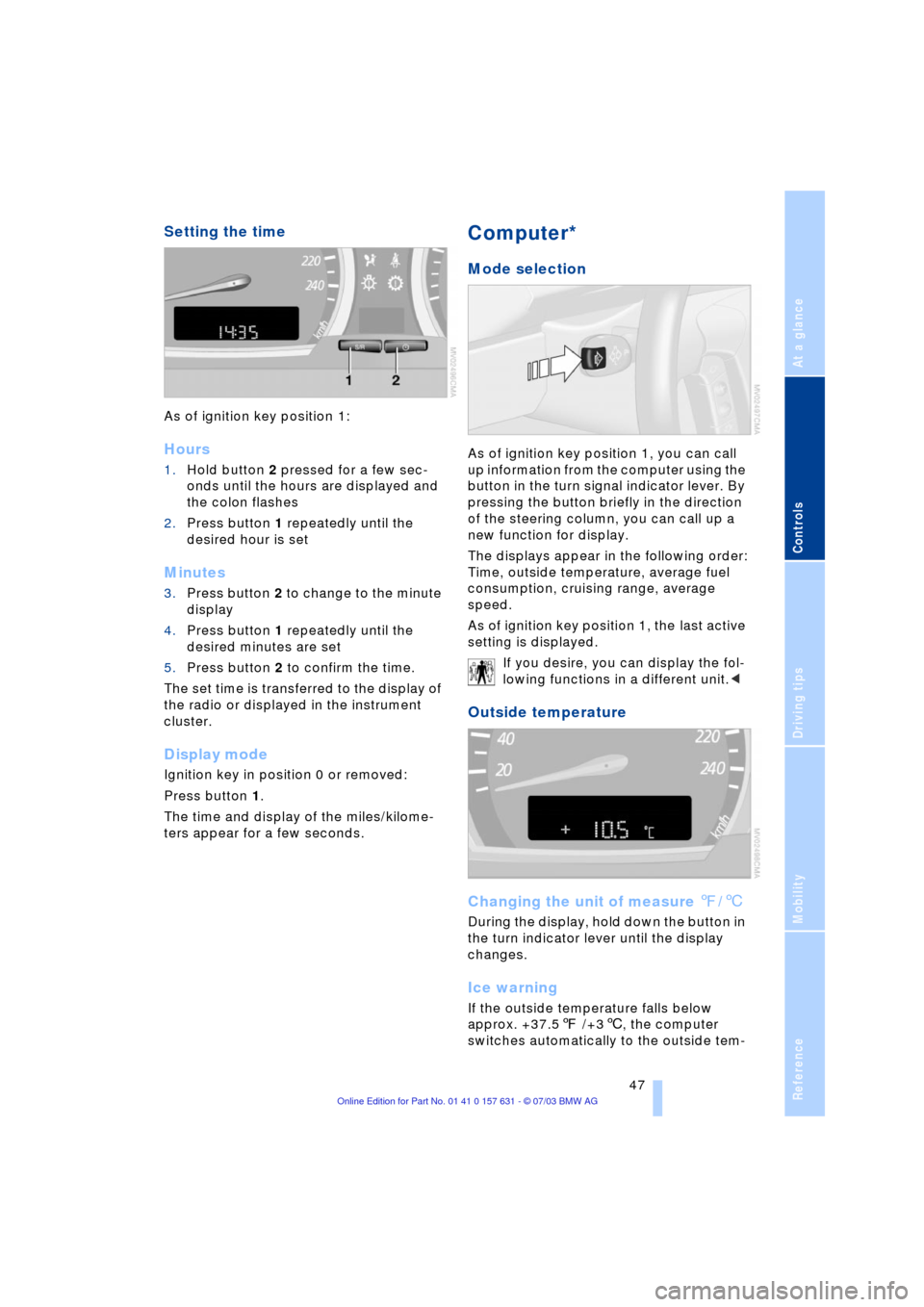
Setting the time
As of ignition key position 1:
Hours
1.Hold button 2 pressed for a few sec-
onds until the hours are displayed and
the colon flashes
2.Press button 1 repeatedly until the
desired hour is set
Minutes
3.Press button 2 to change to the minute
display
4.Press button 1 repeatedly until the
desired minutes are set
5.Press button 2 to confirm the time.
The set time is transferred to the display of
the radio or displayed in the instrument
cluster.
Display mode
Ignition key in position 0 or removed:
Press button 1.
The time and display of the miles/kilome-
ters appear for a few seconds.
Computer*
Mode selection
As of ignition key position 1, you can call
up information from the computer using the
button in the turn signal indicator lever. By
pressing the button briefly in the direction
of the steering column, you can call up a
new function for display.
The displays appear in the following order:
Time, outside temperature, average fuel
consumption, cruising range, average
speed.
As of ignition key position 1, the last active
setting is displayed.
If you desire, you can display the fol-
lowing functions in a different unit.<
Outside temperature
Changing the unit of measure 7/6
During the display, hold down the button in
the turn indicator lever until the display
changes.
Ice warning
If the outside temperature falls below
approx. +37.57 /+36, the computer
switches automatically to the outside tem-
Page 50 of 132
Everything under control
48 perature display. In addition, an acoustic
signal sounds and the display flashes for a
short time.
After an ice warning has been issued,
the display returns to the previous
setting. You can have this activated/deacti-
vated.<
Please bear in mind that the ice warn-
ing does nothing to alter the fact that
glare ice may be present on roads at tem-
peratures higher than +37.57/+36, for
instance, on bridges and shaded roads.<
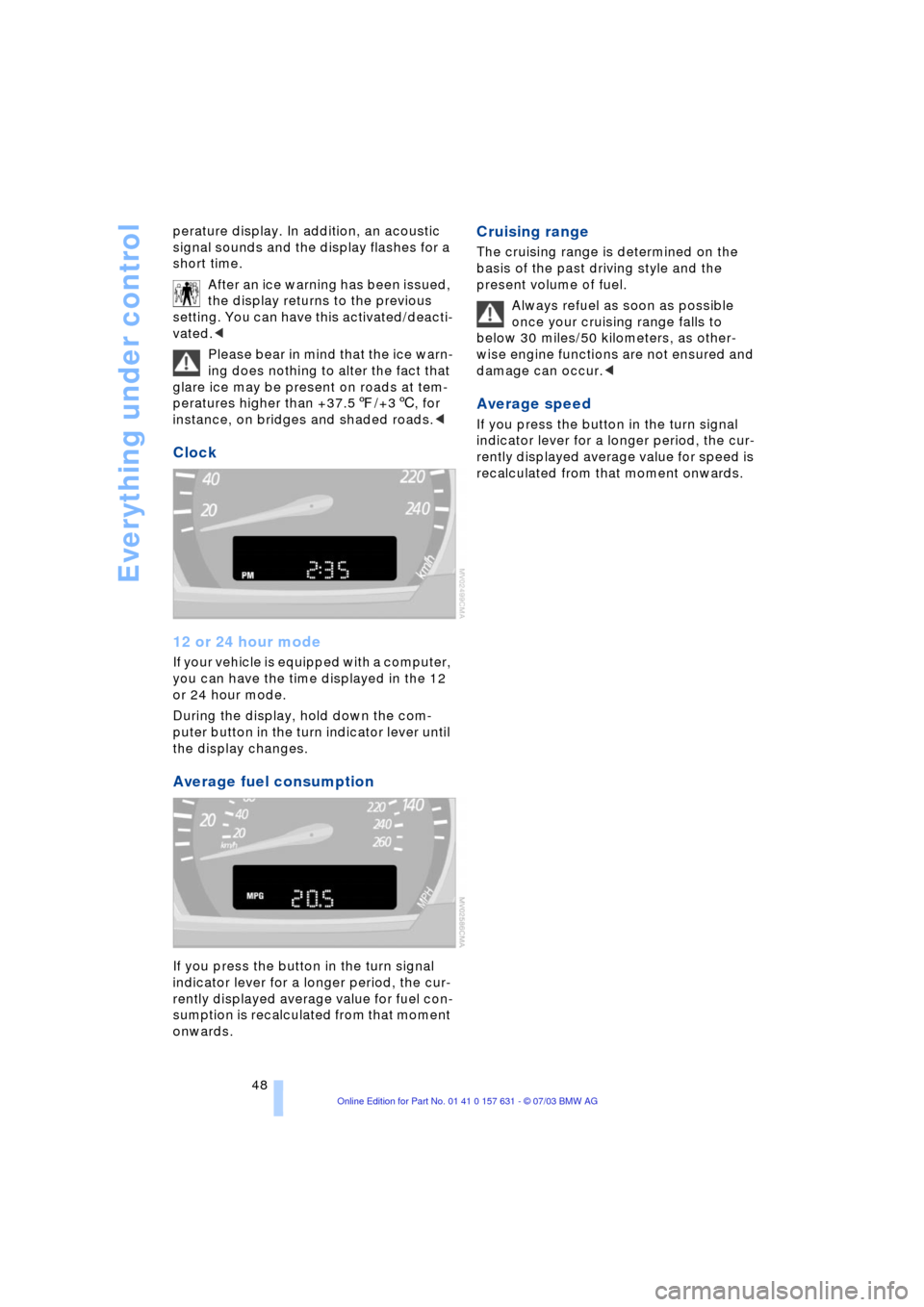
Clock
12 or 24 hour mode
If your vehicle is equipped with a computer,
you can have the time displayed in the 12
or 24 hour mode.
During the display, hold down the com-
puter button in the turn indicator lever until
the display changes.
Average fuel consumption
If you press the button in the turn signal
indicator lever for a longer period, the cur-
rently displayed average value for fuel con-
sumption is recalculated from that moment
onwards.
Cruising range
The cruising range is determined on the
basis of the past driving style and the
present volume of fuel.
Always refuel as soon as possible
once your cruising range falls to
below 30 miles/50 kilometers, as other-
wise engine functions are not ensured and
damage can occur.<
Average speed
If you press the button in the turn signal
indicator lever for a longer period, the cur-
rently displayed average value for speed is
recalculated from that moment onwards.
Page 51 of 132
Reference
At a glance
Controls
Driving tips
Mobility
49
Technology for comfort, convenience
and safety
Park Distance Control PDC*
The concept
PDC provides extra safety and conven-
ience during parking maneuvers. Signal
tones indicate the current distance to an
object behind or in front of your vehicle.
Four ultrasonic sensors in both the
bumpers monitor the distance to the near-
est object.
The front and rear sensors on the corners
have a range of approx. 2 ft/60 cm. The
two rear middle sensors have a range of
approx. 5 ft/1.50 m and the two front mid-
dle sensors of approx. 2.6 ft/80 cm.
PDC is a parking aid that can indicate
objects when they are approached
slowly, as is usually the case when parking.
Avoid approaching objects too fast, other-
wise the system may give warning of phys-
ical obstacles too late.<
If you are driving with a trailer, the rear sen-
sors are unable to make proper measure-
ments Ð so they do not switch on.
Automatic mode
As of ignition key position 2, the system
automatically assumes operational status
after a few seconds each time you engage
reverse gear or selector-lever position R.
Wait this short period before park-
ing.<
You can have a signal tone pro-
grammed into the system to verify
that the PDC is active.<
Automatic deactivation
After driving a distance of more than
approx. 160 ft/50 m or exceeding a speed
of approx. 20 mph/30 km/h, the system
switches off and the indicator lamp goes
out. You can reactivate the system manu-
ally as needed.
Manual mode
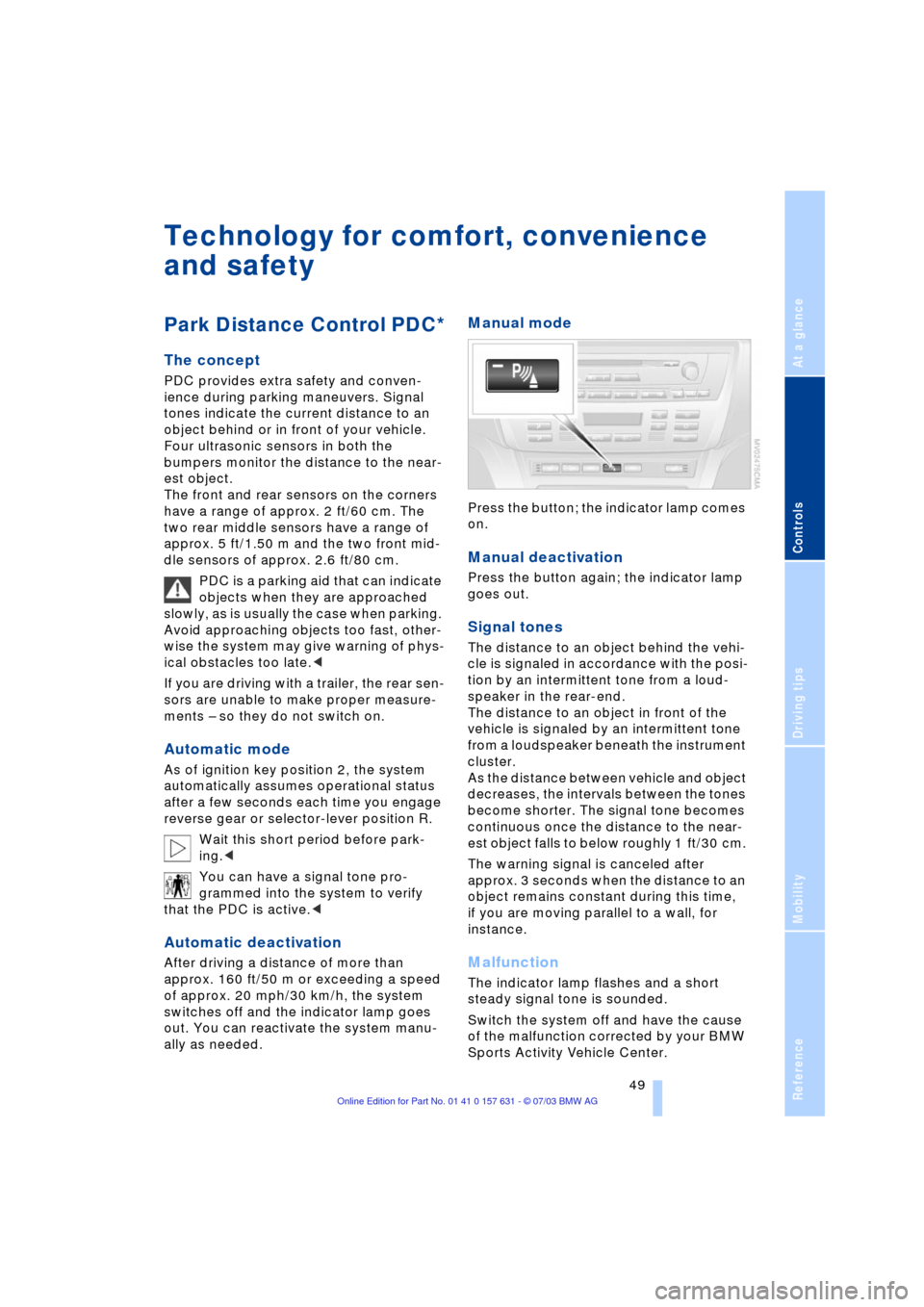
Press the button; the indicator lamp comes
on.
Manual deactivation
Press the button again; the indicator lamp
goes out.
Signal tones
The distance to an object behind the vehi-
cle is signaled in accordance with the posi-
tion by an intermittent tone from a loud-
speaker in the rear-end.
The distance to an object in front of the
vehicle is signaled by an intermittent tone
from a loudspeaker beneath the instrument
cluster.
As the distance between vehicle and object
decreases, the intervals between the tones
become shorter. The signal tone becomes
continuous once the distance to the near-
est object falls to below roughly 1 ft/30 cm.
The warning signal is canceled after
approx. 3 seconds when the distance to an
object remains constant during this time,
if you are moving parallel to a wall, for
instance.
Malfunction
The indicator lamp flashes and a short
steady signal tone is sounded.
Switch the system off and have the cause
of the malfunction corrected by your BMW
Sports Activity Vehicle Center.
Page 54 of 132
Technology for comfort, convenience and safety
52
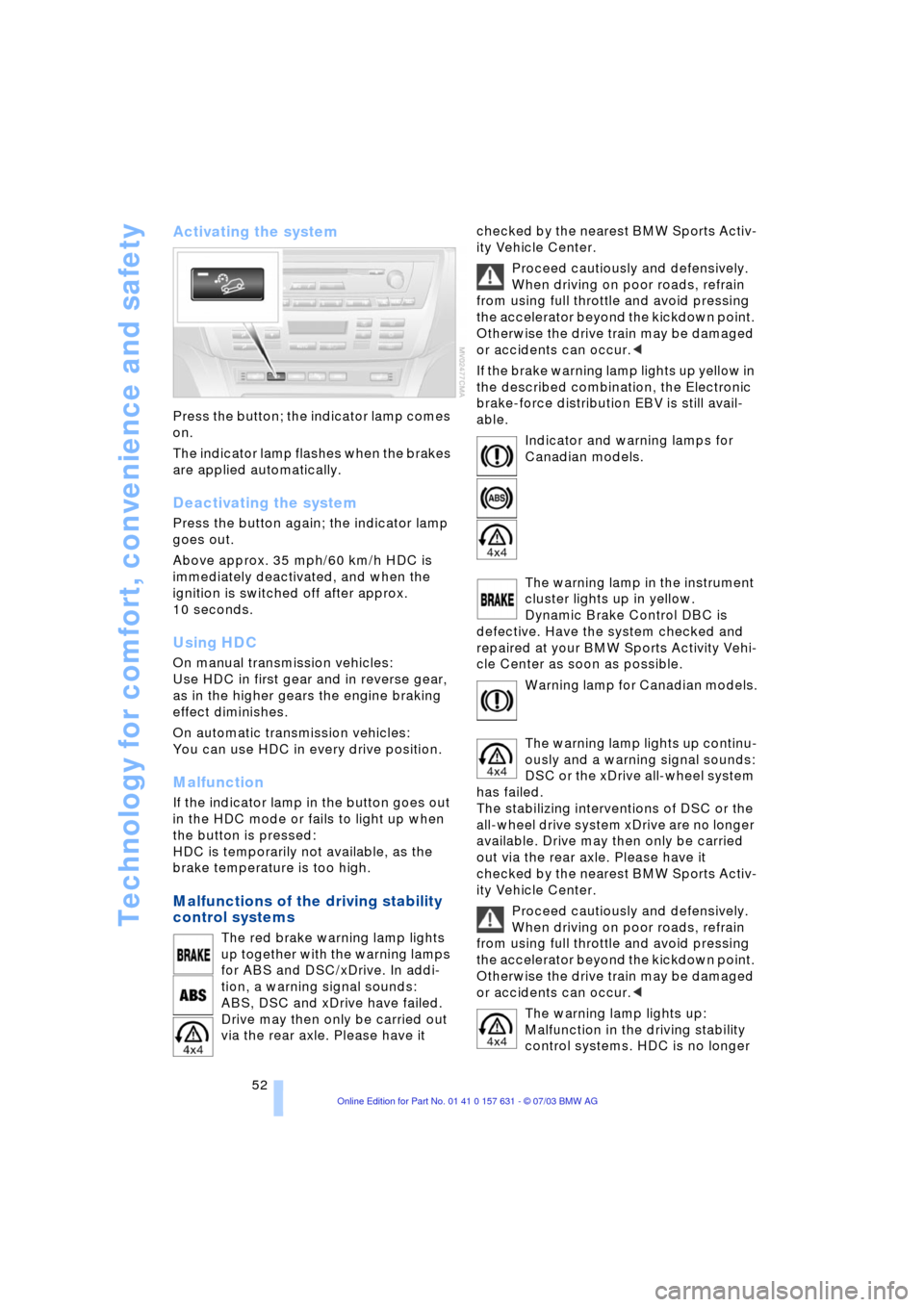
Activating the system
Press the button; the indicator lamp comes
on.
The indicator lamp flashes when the brakes
are applied automatically.
Deactivating the system
Press the button again; the indicator lamp
goes out.
Above approx. 35 mph/60 km/h HDC is
immediately deactivated, and when the
ignition is switched off after approx.
10 seconds.
Using HDC
On manual transmission vehicles:
Use HDC in first gear and in reverse gear,
as in the higher gears the engine braking
effect diminishes.
On automatic transmission vehicles:
You can use HDC in every drive position.
Malfunction
If the indicator lamp in the button goes out
in the HDC mode or fails to light up when
the button is pressed:
HDC is temporarily not available, as the
brake temperature is too high.
Malfunctions of the driving stability
control systems
The red brake warning lamp lights
up together with the warning lamps
for ABS and DSC/xDrive. In addi-
tion, a warning signal sounds:
ABS, DSC and xDrive have failed.
Drive may then only be carried out
via the rear axle. Please have it checked by the nearest BMW Sports Activ-
ity Vehicle Center.
Proceed cautiously and defensively.
When driving on poor roads, refrain
from using full throttle and avoid pressing
the accelerator beyond the kickdown point.
Otherwise the drive train may be damaged
or accidents can occur.<
If the brake warning lamp lights up yellow in
the described combination, the Electronic
brake-force distribution EBV is still avail-
able.
Indicator and warning lamps for
Canadian models.
The warning lamp in the instrument
cluster lights up in yellow.
Dynamic Brake Control DBC is
defective. Have the system checked and
repaired at your BMW Sports Activity Vehi-
cle Center as soon as possible.
Warning lamp for Canadian models.
The warning lamp lights up continu-
ously and a warning signal sounds:
DSC or the xDrive all-wheel system
has failed.
The stabilizing interventions of DSC or the
all-wheel drive system xDrive are no longer
available. Drive may then only be carried
out via the rear axle. Please have it
checked by the nearest BMW Sports Activ-
ity Vehicle Center.
Proceed cautiously and defensively.
When driving on poor roads, refrain
from using full throttle and avoid pressing
the accelerator beyond the kickdown point.
Otherwise the drive train may be damaged
or accidents can occur.<
The warning lamp lights up:
Malfunction in the driving stability
control systems. HDC is no longer
Page 57 of 132
Reference
At a glance
Controls
Driving tips
Mobility
55
To ensure compliance with official safety
regulations, please also entrust disposal of
airbag generators to a BMW Sports Activity
Vehicle Center.<
Airbag warning information is also provided
on the sun visors.
Automatic deactivation of the front
passenger airbags
Your BMW has a seat occupation detection
system. By evaluating the weight on the
front passenger's seat, the system detects
whether or not the seat is occupied by a
child in the child-restraint system or an
adult.
>When a child is seated in the child-
restraint system or with an empty seat,
the front and side airbags are deacti-
vated on the passenger's side
>When an adult is traveling in the front
seat, the front and side airbags remain
active on the passenger side.
With heavier children, the front pas-
senger airbags can remain active, or
with very light adults or teenagers the front
passenger airbags can be deactivated
unintentionally.
The condition of the front passenger air-
bags is indicated via the telltale lamp, refer
to Indicator lamps in the following. In this
case transport the corresponding persons
on the rear seat.
Except when persons to be transported, do
not increase the load on the front passen-
ger seat with additional items. Do not fit
seat covers, seat cushion padding, ball
mats or other items to the front passenger
seat unless they are specifically recom-
mended by BMW. Do not place any items
under the seat. Otherwise, the function of
the seat occupation detection could be
impaired.<
Indicator/warning lamp
Airbag system operational
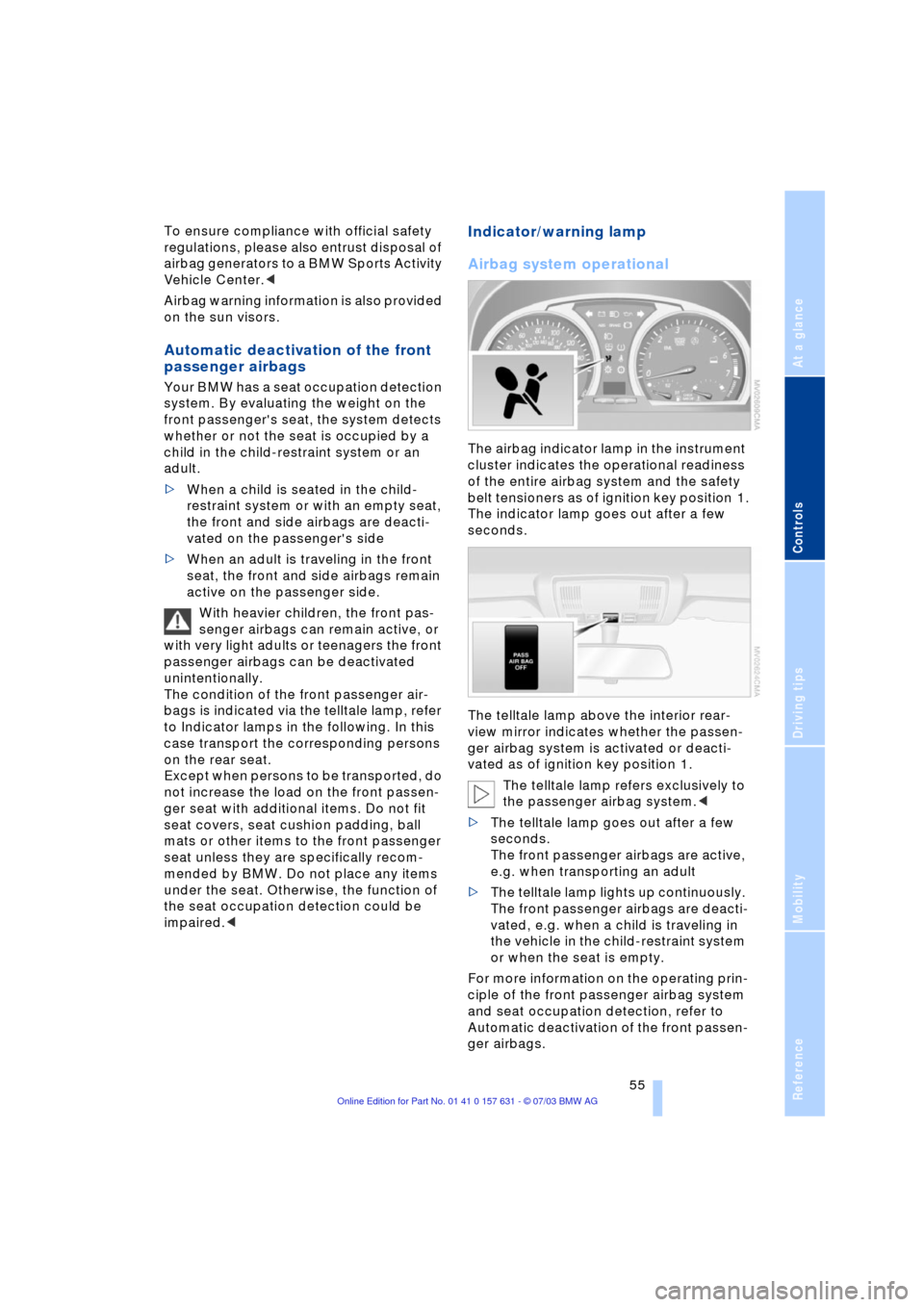
The airbag indicator lamp in the instrument
cluster indicates the operational readiness
of the entire airbag system and the safety
belt tensioners as of ignition key position 1.
The indicator lamp goes out after a few
seconds.
The telltale lamp above the interior rear-
view mirror indicates whether the passen-
ger airbag system is activated or deacti-
vated as of ignition key position 1.
The telltale lamp refers exclusively to
the passenger airbag system.<
>The telltale lamp goes out after a few
seconds.
The front passenger airbags are active,
e.g. when transporting an adult
>The telltale lamp lights up continuously.
The front passenger airbags are deacti-
vated, e.g. when a child is traveling in
the vehicle in the child-restraint system
or when the seat is empty.
For more information on the operating prin-
ciple of the front passenger airbag system
and seat occupation detection, refer to
Automatic deactivation of the front passen-
ger airbags.
Page 59 of 132
Reference
At a glance
Controls
Driving tips
Mobility
57
Lamps
Parking lamps/low beams
Parking lamps
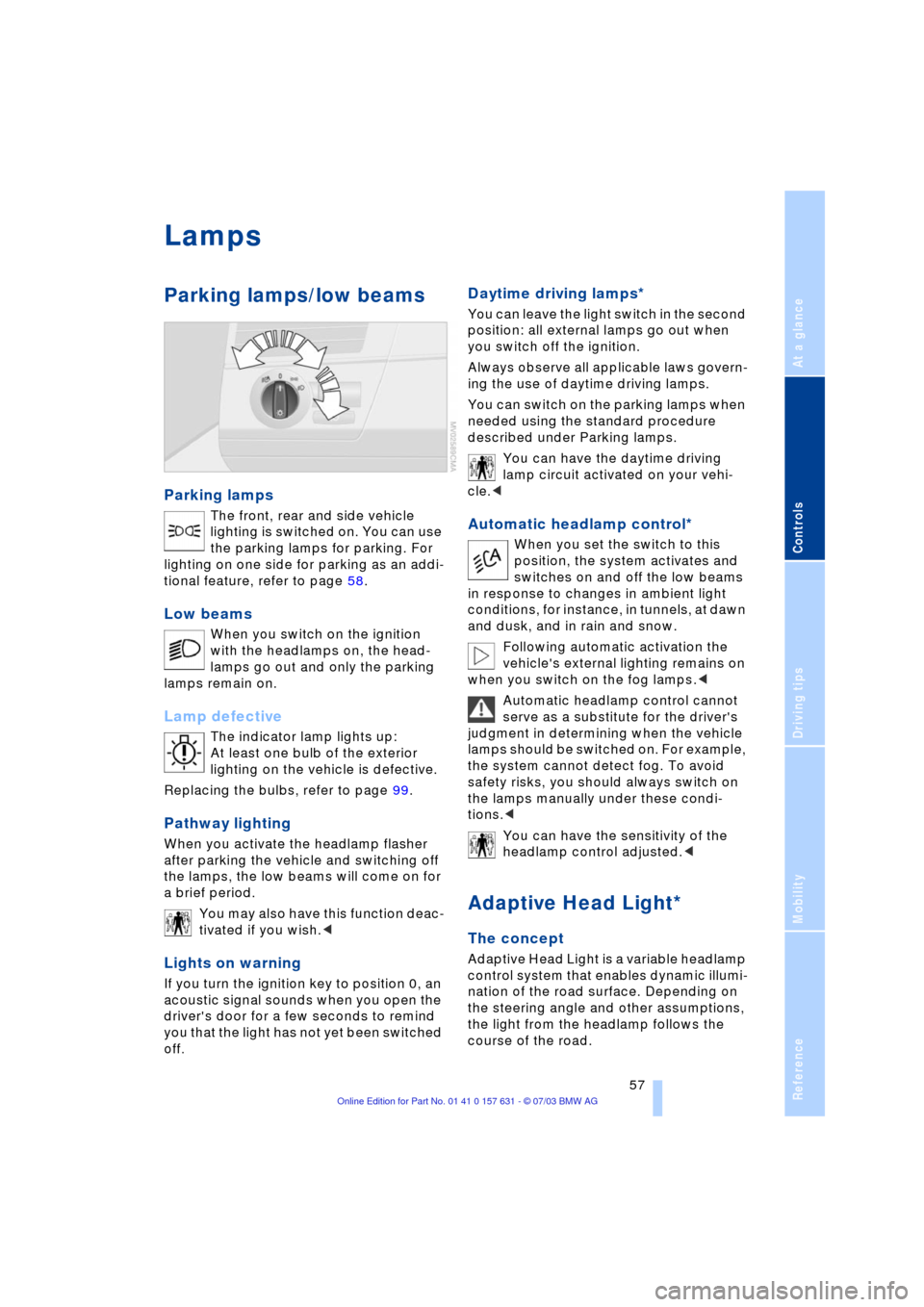
The front, rear and side vehicle
lighting is switched on. You can use
the parking lamps for parking. For
lighting on one side for parking as an addi-
tional feature, refer to page 58.
Low beams
When you switch on the ignition
with the headlamps on, the head-
lamps go out and only the parking
lamps remain on.
Lamp defective
The indicator lamp lights up:
At least one bulb of the exterior
lighting on the vehicle is defective.
Replacing the bulbs, refer to page 99.
Pathway lighting
When you activate the headlamp flasher
after parking the vehicle and switching off
the lamps, the low beams will come on for
a brief period.
You may also have this function deac-
tivated if you wish.<
Lights on warning
If you turn the ignition key to position 0, an
acoustic signal sounds when you open the
driver's door for a few seconds to remind
you that the light has not yet been switched
off
.
Daytime driving lamps*
You can leave the light switch in the second
position: all external lamps go out when
you switch off the ignition.
Always observe all applicable laws govern-
ing the use of daytime driving lamps.
You can switch on the parking lamps when
needed using the standard procedure
described under Parking lamps.
You can have the daytime driving
lamp circuit activated on your vehi-
cle.<
Automatic headlamp control*
When you set the switch to this
position, the system activates and
switches on and off the low beams
in response to changes in ambient light
conditions, for instance, in tunnels, at dawn
and dusk, and in rain and snow.
Following automatic activation the
vehicle's external lighting remains on
when you switch on the fog lamps.<
Automatic headlamp control cannot
serve as a substitute for the driver's
judgment in determining when the vehicle
lamps should be switched on. For example,
the system cannot detect fog. To avoid
safety risks, you should always switch on
the lamps manually under these condi-
tions.<
You can have the sensitivity of the
headlamp control adjusted.<
Adaptive Head Light*
The concept
Adaptive Head Light is a variable headlamp
control system that enables dynamic illumi-
nation of the road surface. Depending on
the steering angle and other assumptions,
the light from the headlamp follows the
course of the road.
Page 73 of 132
Reference
At a glance
Controls
Driving tips
Mobility
71
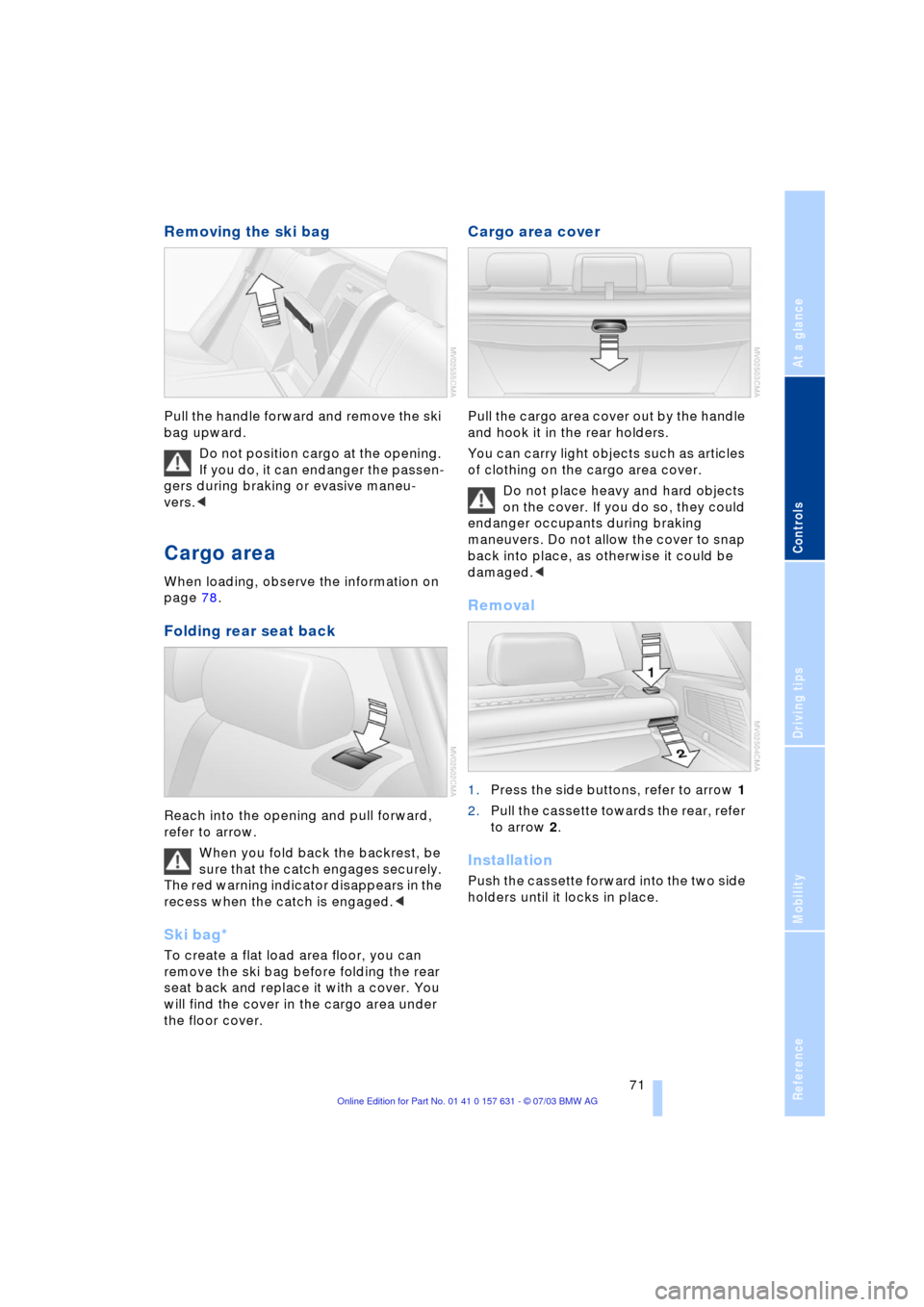
Removing the ski bag
Pull the handle forward and remove the ski
bag upward.
Do not position cargo at the opening.
If you do, it can endanger the passen-
gers during braking or evasive maneu-
vers.<
Cargo area
When loading, observe the information on
page 78.
Folding rear seat back
Reach into the opening and pull forward,
refer to arrow.
When you fold back the backrest, be
sure that the catch engages securely.
The red warning indicator disappears in the
recess when the catch is engaged.<
Ski bag*
To create a flat load area floor, you can
remove the ski bag before folding the rear
seat back and replace it with a cover. You
will find the cover in the cargo area under
the floor cover.
Cargo area cover
Pull the cargo area cover out by the handle
and hook it in the rear holders.
You can carry light objects such as articles
of clothing on the cargo area cover.
Do not place heavy and hard objects
on the cover. If you do so, they could
endanger occupants during braking
maneuvers. Do not allow the cover to snap
back into place, as otherwise it could be
damaged.<
Removal
1.Press the side buttons, refer to arrow 1
2.Pull the cassette towards the rear, refer
to arrow 2.
Installation
Push the cassette forward into the two side
holders until it locks in place.
Page 97 of 132
Reference
At a glance
Controls
Driving tips
Mobility
95
Do not fill beyond the upper mark on the
dipstick. Excess oil can damage the
engine.
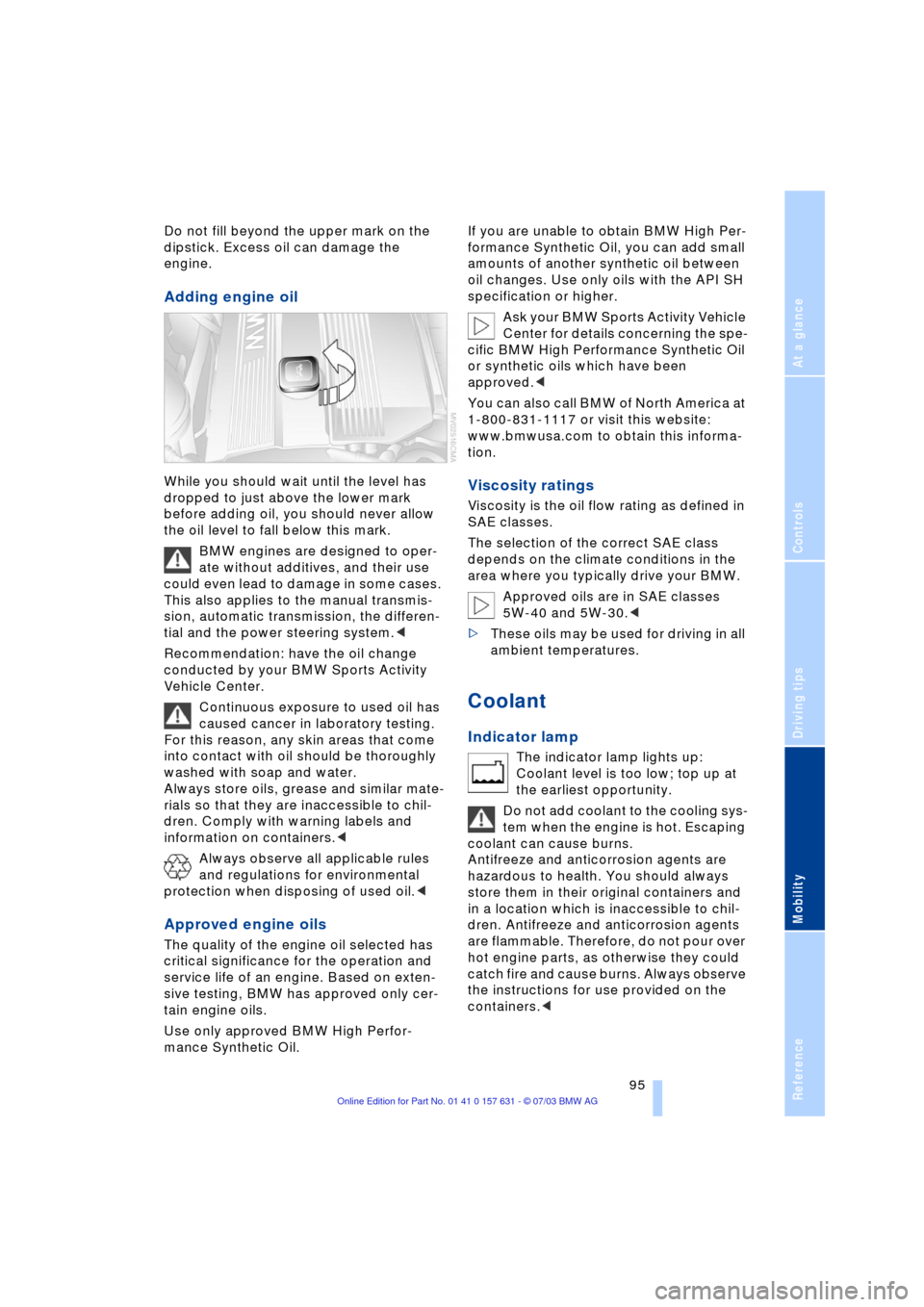
Adding engine oil
While you should wait until the level has
dropped to just above the lower mark
before adding oil, you should never allow
the oil level to fall below this mark.
BMW engines are designed to oper-
ate without additives, and their use
could even lead to damage in some cases.
This also applies to the manual transmis-
sion, automatic transmission, the differen-
tial and the power steering system.<
Recommendation: have the oil change
conducted by your BMW Sports Activity
Vehicle Center.
Continuous exposure to used oil has
caused cancer in laboratory testing.
For this reason, any skin areas that come
into contact with oil should be thoroughly
washed with soap and water.
Always store oils, grease and similar mate-
rials so that they are inaccessible to chil-
dren. Comply with warning labels and
information on containers.<
Always observe all applicable rules
and regulations for environmental
protection when disposing of used oil.<
Approved engine oils
The quality of the engine oil selected has
critical significance for the operation and
service life of an engine. Based on exten-
sive testing, BMW has approved only cer-
tain engine oils.
Use only approved BMW High Perfor-
mance Synthetic Oil.If you are unable to obtain BMW High Per-
formance Synthetic Oil, you can add small
amounts of another synthetic oil between
oil changes. Use only oils with the API SH
specification or higher.
Ask your BMW Sports Activity Vehicle
Center for details concerning the spe-
cific BMW High Performance Synthetic Oil
or synthetic oils which have been
approved.<
You can also call BMW of North America at
1-800-831-1117 or visit this website:
www.bmwusa.com to obtain this informa-
tion.
Viscosity ratings
Viscosity is the oil flow rating as defined in
SAE classes.
The selection of the correct SAE class
depends on the climate conditions in the
area where you typically drive your BMW.
Approved oils are in SAE classes
5W-40 and 5W-30.<
>These oils may be used for driving in all
ambient temperatures.
Coolant
Indicator lamp
The indicator lamp lights up:
Coolant level is too low; top up at
the earliest opportunity.
Do not add coolant to the cooling sys-
tem when the engine is hot. Escaping
coolant can cause burns.
Antifreeze and anticorrosion agents are
hazardous to health. You should always
store them in their original containers and
in a location which is inaccessible to chil-
dren. Antifreeze and anticorrosion agents
are flammable. Therefore, do not pour over
hot engine parts, as otherwise they could
catch fire and cause burns. Always observe
the instructions for use provided on the
containers.<
Page 98 of 132
Under the engine hood
96
Checking coolant level and topping
up coolant
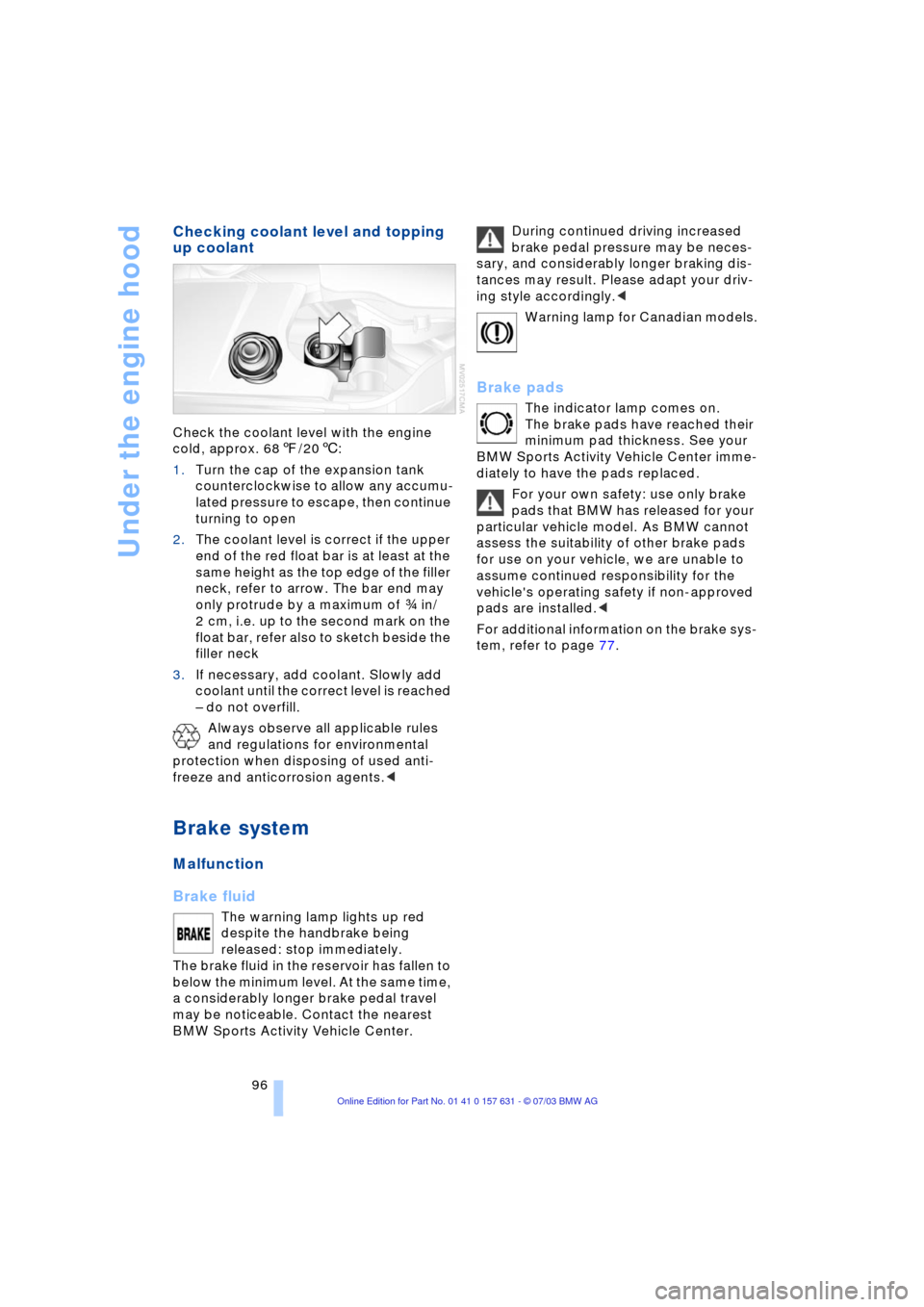
Check the coolant level with the engine
cold, approx. 687/206:
1.Turn the cap of the expansion tank
counterclockwise to allow any accumu-
lated pressure to escape, then continue
turning to open
2.The coolant level is correct if the upper
end of the red float bar is at least at the
same height as the top edge of the filler
neck, refer to arrow. The bar end may
only protrude by a maximum of i in/
2 cm, i.e. up to the second mark on the
float bar, refer also to sketch beside the
filler neck
3.If necessary, add coolant. Slowly add
coolant until the correct level is reached
Ð do not overfill.
Always observe all applicable rules
and regulations for environmental
protection when disposing of used anti-
freeze and anticorrosion agents.<
Brake system
Malfunction
Brake fluid
The warning lamp lights up red
despite the handbrake being
released: stop immediately.
The brake fluid in the reservoir has fallen to
below the minimum level. At the same time,
a considerably longer brake pedal travel
may be noticeable. Contact the nearest
BMW Sports Activity Vehicle Center.During continued driving increased
brake pedal pressure may be neces-
sary, and considerably longer braking dis-
tances may result. Please adapt your driv-
ing style accordingly.<
Warning lamp for Canadian models.
Brake pads
The indicator lamp comes on.
The brake pads have reached their
minimum pad thickness. See your
BMW Sports Activity Vehicle Center imme-
diately to have the pads replaced.
For your own safety: use only brake
pads that BMW has released for your
particular vehicle model. As BMW cannot
assess the suitability of other brake pads
for use on your vehicle, we are unable to
assume continued responsibility for the
vehicle's operating safety if non-approved
pads are installed.<
For additional information on the brake sys-
tem, refer to page 77.
Page 100 of 132
Laws and regulations
98
Laws and regulations
California Proposition 65
Warning
California laws require us to state the fol-
lowing warning:
Engine exhaust and a wide variety of
automobile components and parts,
including components found in the interior
furnishings in a vehicle, contain or emit
chemicals known to the State of California
to cause cancer and birth defects and
reproductive harm. In addition, certain flu-
ids contained in vehicles and certain prod-
ucts of component wear contain or emit
chemicals known to the State of California
to cause cancer and birth defects or other
reproductive harm. Battery posts, terminals
and related accessories contain lead and
lead compounds. Wash your hands after
handling. Used engine oil contains chemi-
cals that have caused cancer in laboratory
animals. Always protect your skin by wash-
ing thoroughly with soap and water.<
OBD connector
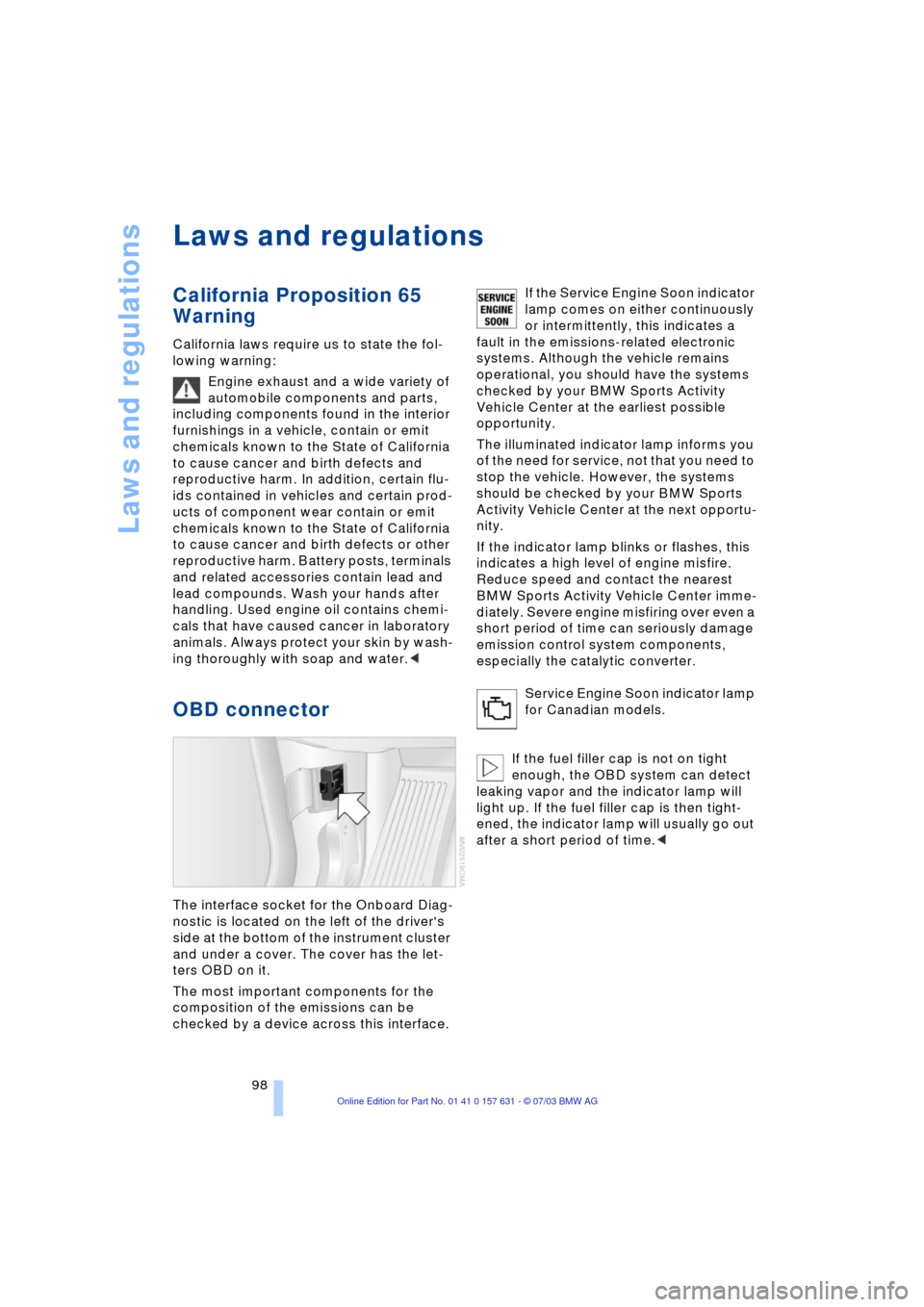
The interface socket for the Onboard Diag-
nostic is located on the left of the driver's
side at the bottom of the instrument cluster
and under a cover. The cover has the let-
ters OBD on it.
The most important components for the
composition of the emissions can be
checked by a device across this interface. If the Service Engine Soon indicator
lamp comes on either continuously
or intermittently, this indicates a
fault in the emissions-related electronic
systems. Although the vehicle remains
operational, you should have the systems
checked by your BMW Sports Activity
Vehicle Center at the earliest possible
opportunity.
The illuminated indicator lamp informs you
of the need for service, not that you need to
stop the vehicle. However, the systems
should be checked by your BMW Sports
Activity Vehicle Center at the next opportu-
nity.
If the indicator lamp blinks or flashes, this
indicates a high level of engine misfire.
Reduce speed and contact the nearest
BMW Sports Activity Vehicle Center imme-
diately. Severe engine misfiring over even a
short period of time can seriously damage
emission control system components,
especially the catalytic converter.
Service Engine Soon indicator lamp
for Canadian models.
If the fuel filler cap is not on tight
enough, the OBD system can detect
leaking vapor and the indicator lamp will
light up. If the fuel filler cap is then tight-
ened, the indicator lamp will usually go out
after a short period of time.<