ECU BMW X3 2.5I 2005 E83 User Guide
[x] Cancel search | Manufacturer: BMW, Model Year: 2005, Model line: X3 2.5I, Model: BMW X3 2.5I 2005 E83Pages: 126, PDF Size: 4.65 MB
Page 67 of 126
Practical interior accessories
66
Car phone preparation*
Hands-free system
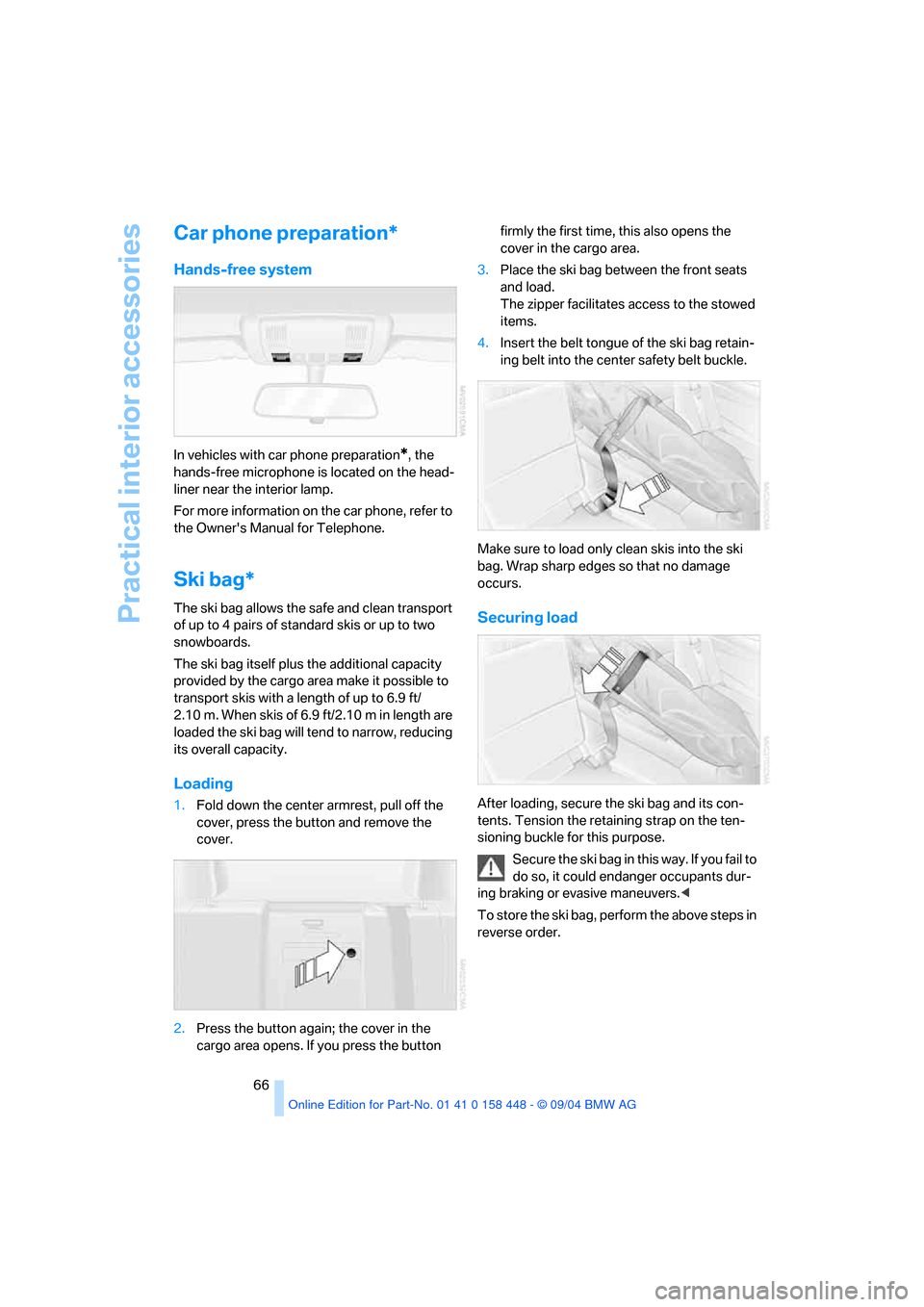
In vehicles with car phone preparation*, the
hands-free microphone is located on the head-
liner near the interior lamp.
For more information on the car phone, refer to
the Owner's Manual for Telephone.
Ski bag*
The ski bag allows the safe and clean transport
of up to 4 pairs of standard skis or up to two
snowboards.
The ski bag itself plus the additional capacity
provided by the cargo area make it possible to
transport skis with a length of up to 6.9 ft/
2.10 m. When skis of 6.9 ft/2.10 m in length are
loaded the ski bag will tend to narrow, reducing
its overall capacity.
Loading
1.Fold down the center armrest, pull off the
cover, press the button and remove the
cover.
2.Press the button again; the cover in the
cargo area opens. If you press the button firmly the first time, this also opens the
cover in the cargo area.
3.Place the ski bag between the front seats
and load.
The zipper facilitates access to the stowed
items.
4.Insert the belt tongue of the ski bag retain-
ing belt into the center safety belt buckle.
Make sure to load only clean skis into the ski
bag. Wrap sharp edges so that no damage
occurs.
Securing load
After loading, secure the ski bag and its con-
tents. Tension the retaining strap on the ten-
sioning buckle for this purpose.
Secure the ski bag in this way. If you fail to
do so, it could endanger occupants dur-
ing braking or evasive maneuvers.<
To store the ski bag, perform the above steps in
reverse order.
Page 68 of 126
Reference
At a glance
Controls
Driving tips
Mobility
67
Inserting ski bag
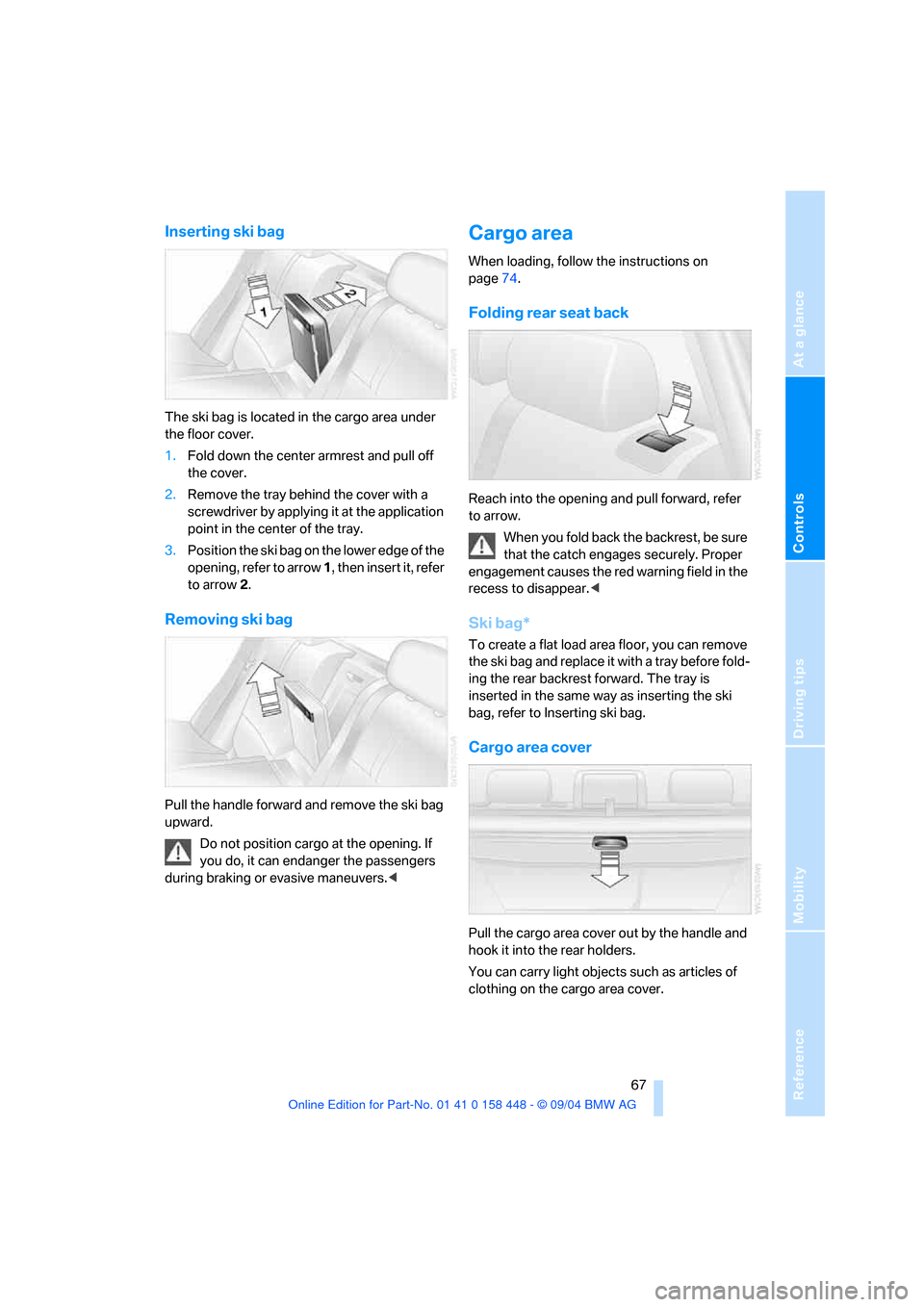
The ski bag is located in the cargo area under
the floor cover.
1.Fold down the center armrest and pull off
the cover.
2.Remove the tray behind the cover with a
screwdriver by applying it at the application
point in the center of the tray.
3.Position the ski bag on the lower edge of the
opening, refer to arrow 1, then insert it, refer
to arrow 2.
Removing ski bag
Pull the handle forward and remove the ski bag
upward.
Do not position cargo at the opening. If
you do, it can endanger the passengers
during braking or evasive maneuvers.<
Cargo area
When loading, follow the instructions on
page74.
Folding rear seat back
Reach into the opening and pull forward, refer
to arrow.
When you fold back the backrest, be sure
that the catch engages securely. Proper
engagement causes the red warning field in the
recess to disappear.<
Ski bag*
To create a flat load area floor, you can remove
the ski bag and replace it with a tray before fold-
ing the rear backrest forward. The tray is
inserted in the same way as inserting the ski
bag, refer to Inserting ski bag.
Cargo area cover
Pull the cargo area cover out by the handle and
hook it into the rear holders.
You can carry light objects such as articles of
clothing on the cargo area cover.
Page 70 of 126
Reference
At a glance
Controls
Driving tips
Mobility
69
Floor cover
Opening
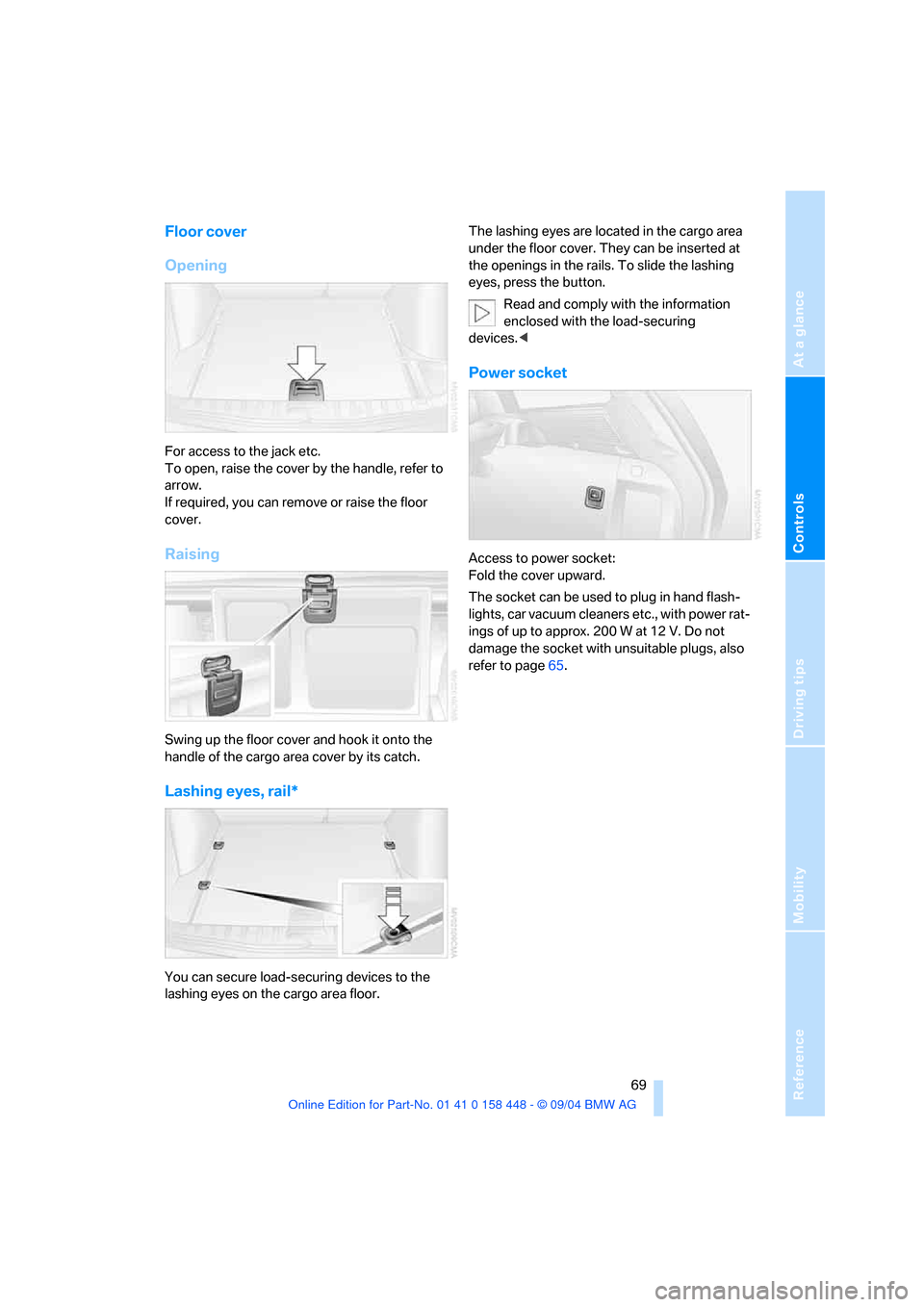
For access to the jack etc.
To open, raise the cover by the handle, refer to
arrow.
If required, you can remove or raise the floor
cover.
Raising
Swing up the floor cover and hook it onto the
handle of the cargo area cover by its catch.
Lashing eyes, rail*
You can secure load-securing devices to the
lashing eyes on the cargo area floor. The lashing eyes are located in the cargo area
under the floor cover. They can be inserted at
the openings in the rails. To slide the lashing
eyes, press the button.
Read and comply with the information
enclosed with the load-securing
devices.<
Power socket
Access to power socket:
Fold the cover upward.
The socket can be used to plug in hand flash-
lights, car vacuum cleaners etc., with power rat-
ings of up to approx. 200 W at 12 V. Do not
damage the socket with unsuitable plugs, also
refer to page65.
Page 76 of 126
Reference
At a glance
Controls
Driving tips
Mobility
75
3.Subtract the combined weight of the driver
and passengers from XXX lbs. or YYY kg.
4.The resulting figure equals the available
amount of cargo and luggage load capacity.
For example, if the XXX amount equals
990 lbs. and there will be five 150-lbs. pas-
sengers in your vehicle, the amount of avail-
able cargo and luggage load capacity is
240 lbs.:
990 lbs. minus 750 lbs. = 240 lbs.
5.Determine the combined weight of luggage
and cargo being loaded on the vehicle. That
weight may not safely exceed the available
cargo and luggage load capacity calculated
in step 4.
6.If your vehicle will be towing a trailer, part of
the load from your trailer will be transferred
to your vehicle. Consult the manual for
transporting a trailer to determine how this
may reduce the available cargo and luggage
load capacity of your vehicle.
Load
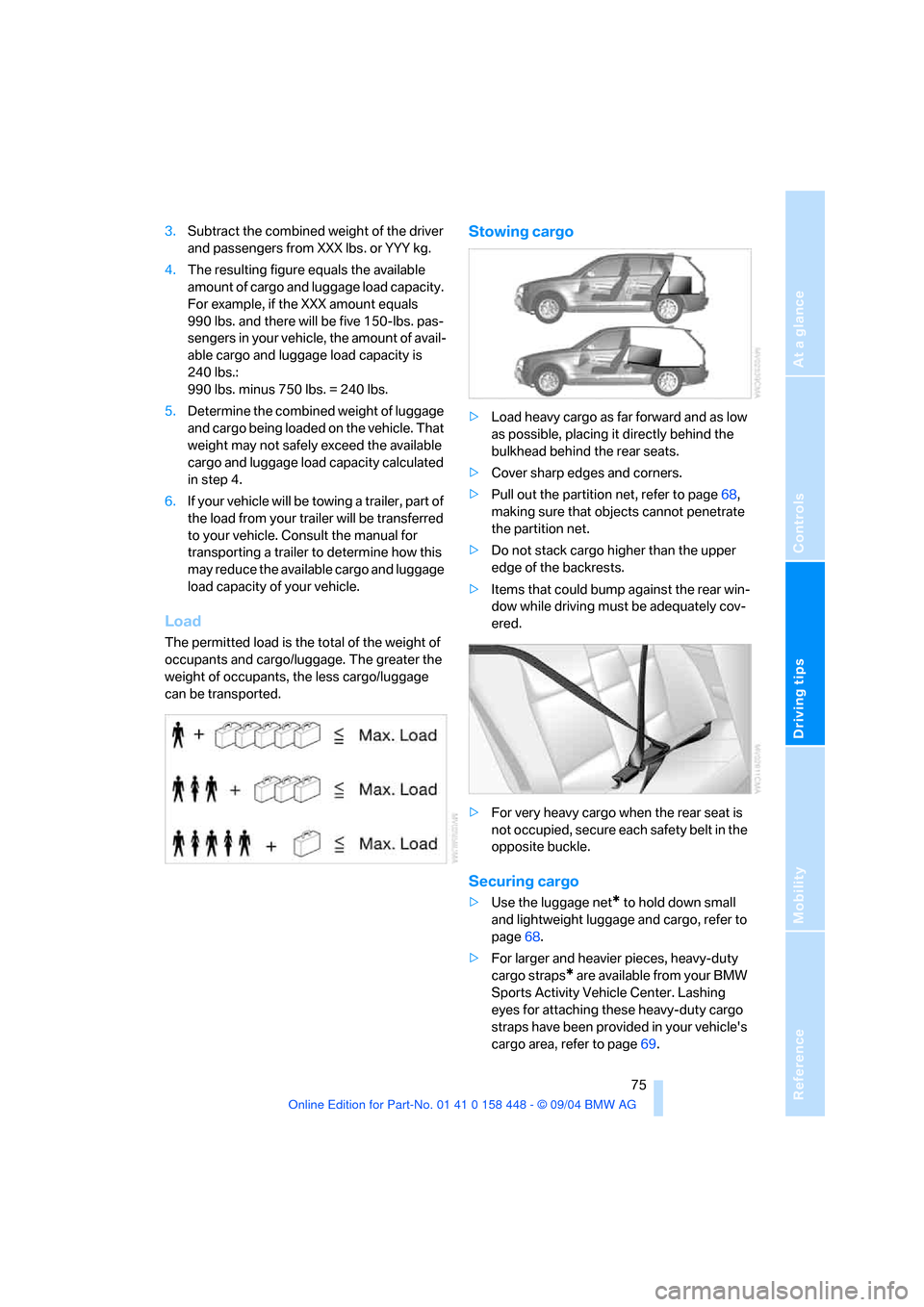
The permitted load is the total of the weight of
occupants and cargo/luggage. The greater the
weight of occupants, the less cargo/luggage
can be transported.
Stowing cargo
>Load heavy cargo as far forward and as low
as possible, placing it directly behind the
bulkhead behind the rear seats.
>Cover sharp edges and corners.
>Pull out the partition net, refer to page68,
making sure that objects cannot penetrate
the partition net.
>Do not stack cargo higher than the upper
edge of the backrests.
>Items that could bump against the rear win-
dow while driving must be adequately cov-
ered.
>For very heavy cargo when the rear seat is
not occupied, secure each safety belt in the
opposite buckle.
Securing cargo
>Use the luggage net* to hold down small
and lightweight luggage and cargo, refer to
page68.
>For larger and heavier pieces, heavy-duty
cargo straps
* are available from your BMW
Sports Activity Vehicle Center. Lashing
eyes for attaching these heavy-duty cargo
straps have been provided in your vehicle's
cargo area, refer to page69.
Page 77 of 126
Things to remember when driving
76 >Read and comply with the information
enclosed with the heavy-duty cargo straps.
Always position and secure the load as
described above. If you do not, it can even
endanger the passengers during braking or
evasive maneuvers.
Never exceed either the approved gross vehicle
weight or either of the approved axle loads, refer
to page112, as excessive loads can pose a
safety hazard, and may also place you in viola-
tion of freeway safety laws.
You should never transport heavy or hard
objects unsecured in the passenger compart-
ment, as they could fly around and pose a safety
hazard to the vehicle's occupants during abrupt
braking or evasive maneuvers.<
Roof-mounted luggage rack*
A special rack system is available as a optional
accessory for your BMW. Please observe the
information contained in the installation instruc-
tions.
Loading luggage rack
Because roof racks raise the vehicle's center of
gravity when loaded, they have a major effect on
its handling and steering response. You should
therefore always remember not to exceed the
approved roof weight, the approved gross vehi-
cle weight or the axle loads when loading the
rack.
You can find the specified weights in the Tech-
nical data section on page112.
Make sure that the load is evenly distributed,
and that it does not extend outward to beyond
the limits of the loading surface. Always load the
heaviest pieces first – on the bottom. Be sure
that adequate clearance is maintained for rais-
ing the glass sunroof, and that objects do not
project into the opening path of the tailgate.
Secure roof-mounted cargo correctly and
securely to prevent it from shifting or being lost
during the trip.
Drive smoothly. Avoid sudden acceleration and
braking maneuvers. Take corners gently.
Driving on poor roads
Your X3 is at home on all paved and unpaved
roads. It combines all-wheel drive with the
advantages of a normal passenger car.
Driving on unpaved terrain can cause
damage to the vehicle.<
When you are driving on poor roads, there are a
few points which you should strictly observe –
for your own safety, for that of your passengers,
and for the safety of the vehicle:
>Familiarize yourself with the vehicle before
you begin driving. Do not take risks with the
vehicle under any circumstances.
>Always adapt the driving speed to the road
conditions. The more steep and uneven the
roadway is, the lower the speed should be.
>You can operate your vehicle on uphill and
downhill gradients with a maximum slope of
50 %. If you wish to drive on uphill and
downhill grades of this nature, make sure
beforehand that the engine oil and coolant
levels are near the MAX mark, refer to
pages90 and91.
>For very steep downhill driving, use HDC
Hill Descent Control, refer to page48. It is
possible to start off on upward inclines of up
to 32 %.
The permitted side tilt is 32 %.
>While driving, watch carefully for obstacles
such as rocks or holes. Try to avoid these
obstacles whenever possible.
>Avoid that the body makes contact with the
ground, e.g. on the crests of hills and bumpy
roads. The ground clearance of the vehicle
is a maximum of approx. 8.0 in/20 cm.
Please be aware that the ground clearance
can vary depending on the load and operat-
ing conditions of the vehicle.
>Do not drive in water that is deeper than
20 in/50 cm. If you must drive through water
up to that depth, drive at a walking speed
and do not stop.
After leaving the water, press on the foot-
brake gently several times while driving at a
low speed. The brake applications will help
Page 89 of 126
Under the hood
88
Under the hood
Never attempt to perform any service or
repair operations on your vehicle without
the required professional technical training. If
you are not familiar with the regulations to be
observed, have work on your vehicle carried out
only by a BMW Sports Activity Vehicle Center
or a workshop that uses personnel trained in
accordance with BMW requirements. If this
work is not carried out properly, there is a dan-
ger of subsequent damage and related safety
hazards.<
Hood
Unlocking
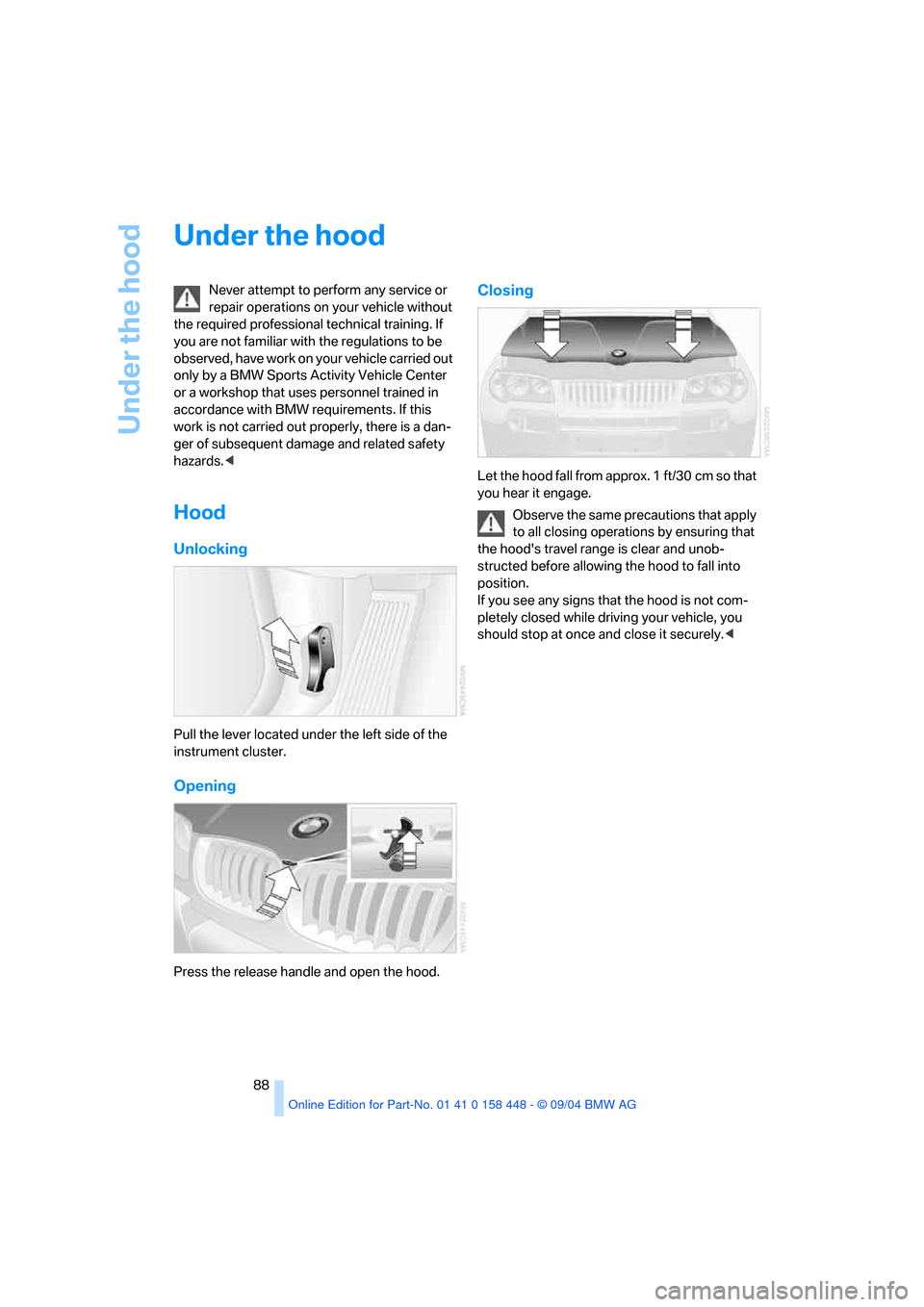
Pull the lever located under the left side of the
instrument cluster.
Opening
Press the release handle and open the hood.
Closing
Let the hood fall from approx. 1 ft/30 cm so that
you hear it engage.
Observe the same precautions that apply
to all closing operations by ensuring that
the hood's travel range is clear and unob-
structed before allowing the hood to fall into
position.
If you see any signs that the hood is not com-
pletely closed while driving your vehicle, you
should stop at once and close it securely.<
Page 96 of 126
Reference
At a glance
Controls
Driving tips
Mobility
95
Replacing components
Onboard tool kit
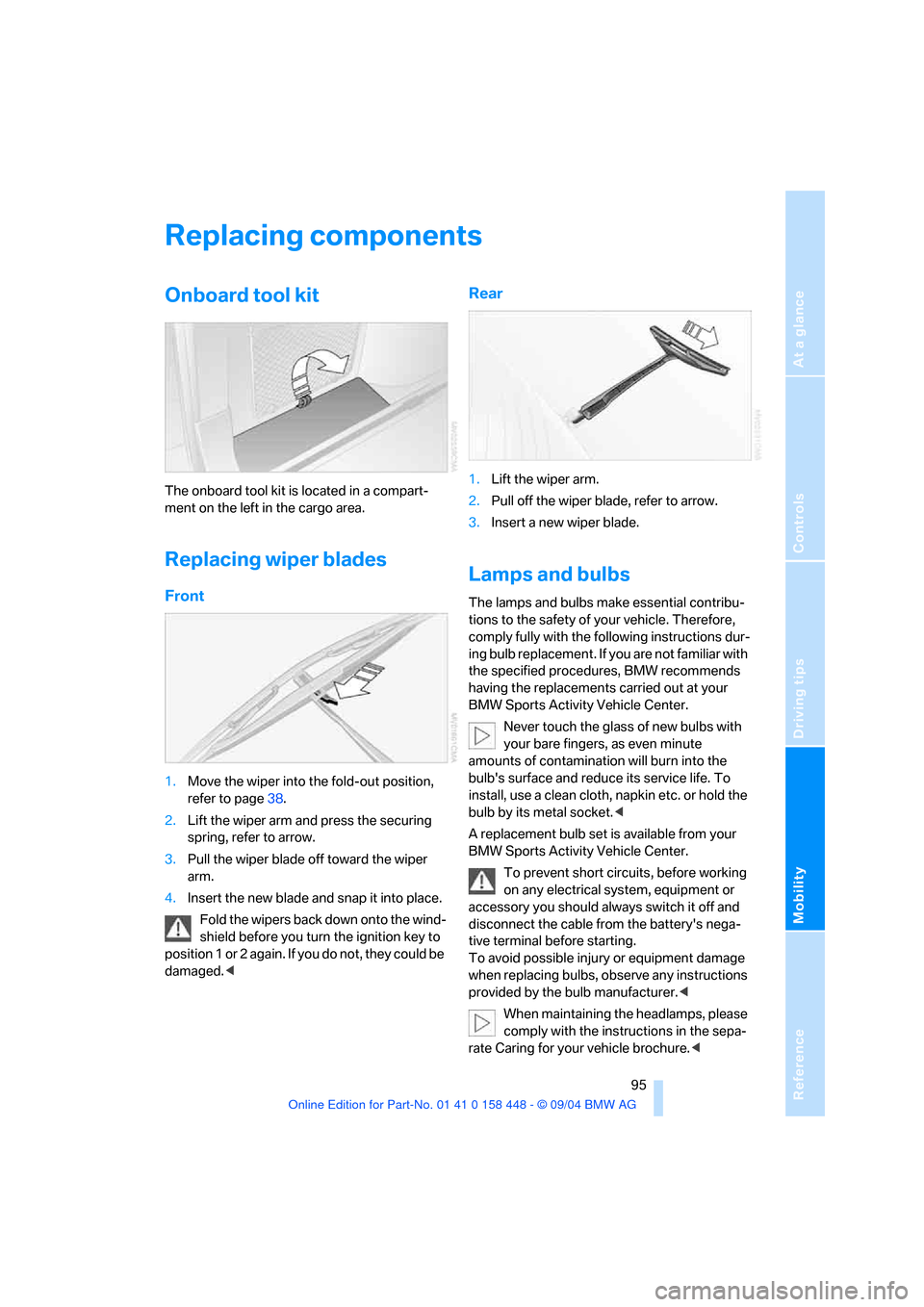
The onboard tool kit is located in a compart-
ment on the left in the cargo area.
Replacing wiper blades
Front
1.Move the wiper into the fold-out position,
refer to page38.
2.Lift the wiper arm and press the securing
spring, refer to arrow.
3.Pull the wiper blade off toward the wiper
arm.
4.Insert the new blade and snap it into place.
Fold the wipers back down onto the wind-
shield before you turn the ignition key to
p o s i t i o n 1 o r 2 a g a i n . I f y o u d o n o t , t h e y c o u l d b e
damaged.<
Rear
1.Lift the wiper arm.
2.Pull off the wiper blade, refer to arrow.
3.Insert a new wiper blade.
Lamps and bulbs
The lamps and bulbs make essential contribu-
tions to the safety of your vehicle. Therefore,
comply fully with the following instructions dur-
ing bulb replacement. If you are not familiar with
the specified procedures, BMW recommends
having the replacements carried out at your
BMW Sports Activity Vehicle Center.
Never touch the glass of new bulbs with
your bare fingers, as even minute
amounts of contamination will burn into the
bulb's surface and reduce its service life. To
install, use a clean cloth, napkin etc. or hold the
bulb by its metal socket.<
A replacement bulb set is available from your
BMW Sports Activity Vehicle Center.
To prevent short circuits, before working
on any electrical system, equipment or
accessory you should always switch it off and
disconnect the cable from the battery's nega-
tive terminal before starting.
To avoid possible injury or equipment damage
when replacing bulbs, observe any instructions
provided by the bulb manufacturer.<
When maintaining the headlamps, please
comply with the instructions in the sepa-
rate Caring for your vehicle brochure.<
Page 101 of 126
Replacing components
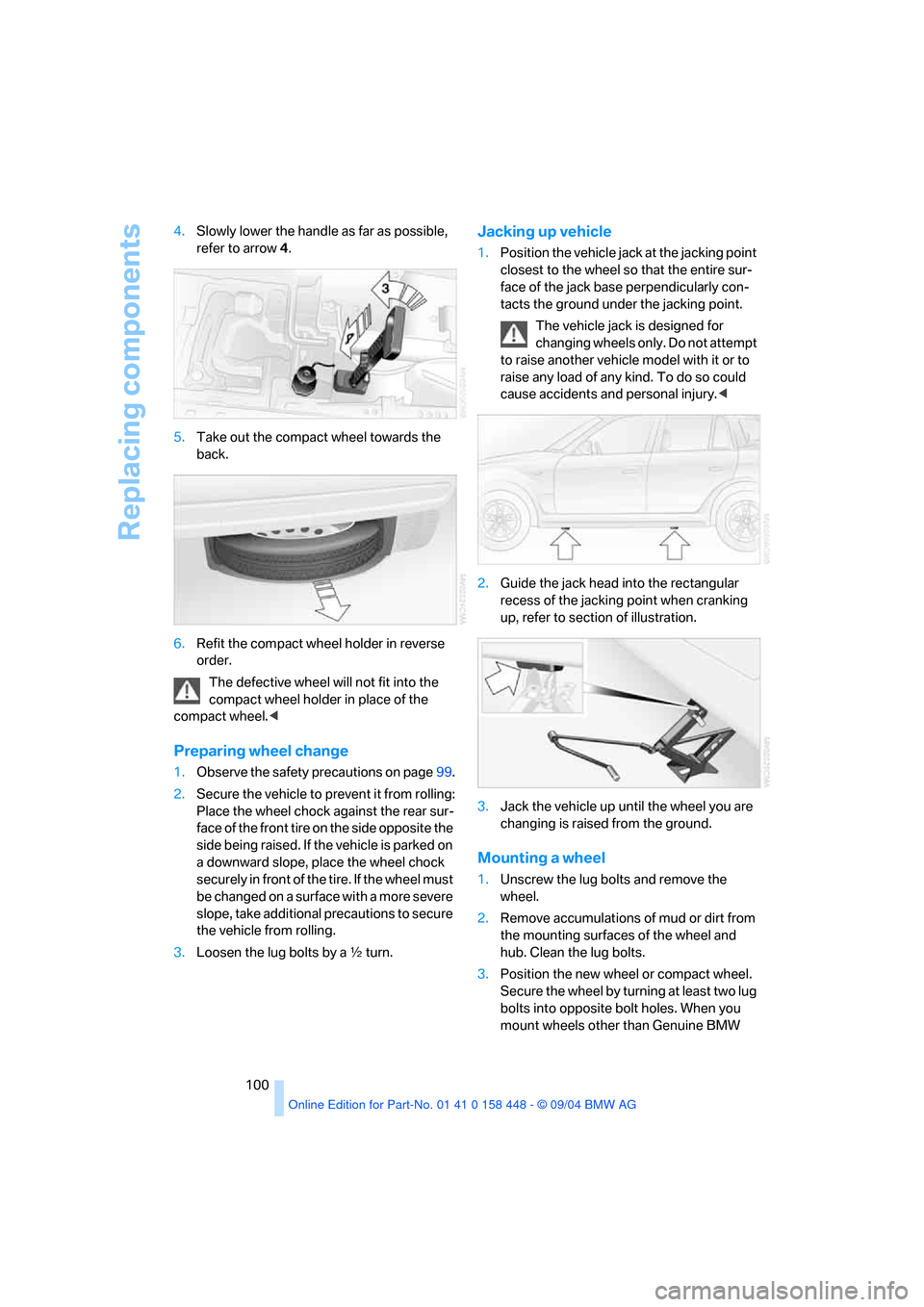
100 4.Slowly lower the handle as far as possible,
refer to arrow4.
5.Take out the compact wheel towards the
back.
6.Refit the compact wheel holder in reverse
order.
The defective wheel will not fit into the
compact wheel holder in place of the
compact wheel.<
Preparing wheel change
1.Observe the safety precautions on page99.
2.Secure the vehicle to prevent it from rolling:
Place the wheel chock against the rear sur-
face of the front tire on the side opposite the
side being raised. If the vehicle is parked on
a downward slope, place the wheel chock
securely in front of the tire. If the wheel must
be changed on a surface with a more severe
slope, take additional precautions to secure
the vehicle from rolling.
3.Loosen the lug bolts by a γ turn.
Jacking up vehicle
1.Position the vehicle jack at the jacking point
closest to the wheel so that the entire sur-
face of the jack base perpendicularly con-
tacts the ground under the jacking point.
The vehicle jack is designed for
changing wheels only. Do not attempt
to raise another vehicle model with it or to
raise any load of any kind. To do so could
cause accidents and personal injury.<
2.Guide the jack head into the rectangular
recess of the jacking point when cranking
up, refer to section of illustration.
3.Jack the vehicle up until the wheel you are
changing is raised from the ground.
Mounting a wheel
1.Unscrew the lug bolts and remove the
wheel.
2.Remove accumulations of mud or dirt from
the mounting surfaces of the wheel and
hub. Clean the lug bolts.
3.Position the new wheel or compact wheel.
Secure the wheel by turning at least two lug
bolts into opposite bolt holes. When you
mount wheels other than Genuine BMW
Page 102 of 126
Reference
At a glance
Controls
Driving tips
Mobility
101
light-alloy wheels, different lug bolts may
also be required.
4.Screw in the remaining lug bolts. Tighten all
the bolts securely in a diagonal pattern.
5.Lower the jack and remove it from beneath
the vehicle.
After mounting
1.Tighten the lug bolts in a diagonal pattern.
To ensure safety, always have the lug
bolts checked with a calibrated
torque wrench as soon as possible to
ensure that they are tightened to the speci-
fied torque. The tightening torque is
101lbft/140Nm.<
2.Stow the defective wheel in the cargo area.
3.Check and correct the tire inflation pressure
at the earliest opportunity.
Protect valve stems and valve stem
seal caps against dirt and contamina-
tion. Dirt in valve stems is a frequent source
of gradual air loss.<
4.Reinitialize the Flat Tire Monitor, refer to
page49.
Do not initialize the system when driv-
ing with the compact wheel.<
5.Replace the damaged tire with a new one as
soon as possible and have the new wheel
balanced.
Driving with compact wheel
Drive reservedly and do not exceed a
speed of 50 mph/80 km/h. Do not deacti-
vate DSC, as otherwise unstable driving condi-
tions may result.<
The driving characteristics change, for example
reduced track stability on braking, extended
braking distance, and altered self-steering
characteristics in the limit range. In conjunction
with winter tires, these characteristics are more
pronounced.
Only one compact wheel may be
mounted. You should re-equip with
wheels and tires of the original size as quickly as
possible.<
Vehicle battery
Maintenance
The battery is 100 % maintenance-free, i.e., the
electrolyte will last for the life of the battery
when the vehicle is operated in a temperate cli-
mate. Your BMW Sports Activity Vehicle Center
will be happy to consult you on all questions
concerning the battery.
Warning lamp
The warning lamp lights up. The bat-
tery is no longer being charged. The
alternator V-belt is defective or there is
a malfunction in the charge current circuit of the
alternator. Have the system checked immedi-
ately.
Do not continue driving if the V-belt is
defective. The engine could be damaged
due to overheating.
Moreover, an increased amount of force is
required for steering if there is a sharp drop in
the onboard supply voltage.<
Charging battery
Charge the battery in the vehicle only when the
engine is not running. Use the connections pro-
vided in the engine compartment. For connec-
tions, refer to Jump starting on page104.
Disposal
Have old batteries disposed of following
replacement at your BMW Sports Activity
Vehicle Center or bring them to a collection
point. Maintain the battery in an upright position
for transport and storage. Always secure the
battery to prevent it from tipping over during
transport.<
Page 107 of 126
Giving and receiving assistance
106 The tow fittings used should be on the same
side on both vehicles. Should it prove impossi-
ble to avoid mounting the tow bar at an offset
angle, please observe the following:
>Clearance and maneuvering capability will
be strictly limited in corners.
>When mounted at an angle, the tow bar will
exert lateral forces, tending to push the
vehicle sideways.
Secure the tow bar to the tow fitting only.
Otherwise damage could result on other
vehicle parts.<
With tow-rope
When starting off in the towing vehicle, make
sure that the tow-rope is taut.
To avoid jerking and the associated
stresses on vehicle components when
towing, always use nylon ropes or nylon straps.
Secure the tow-rope on the tow fitting only.
Otherwise damage could result on other vehicle
parts.<
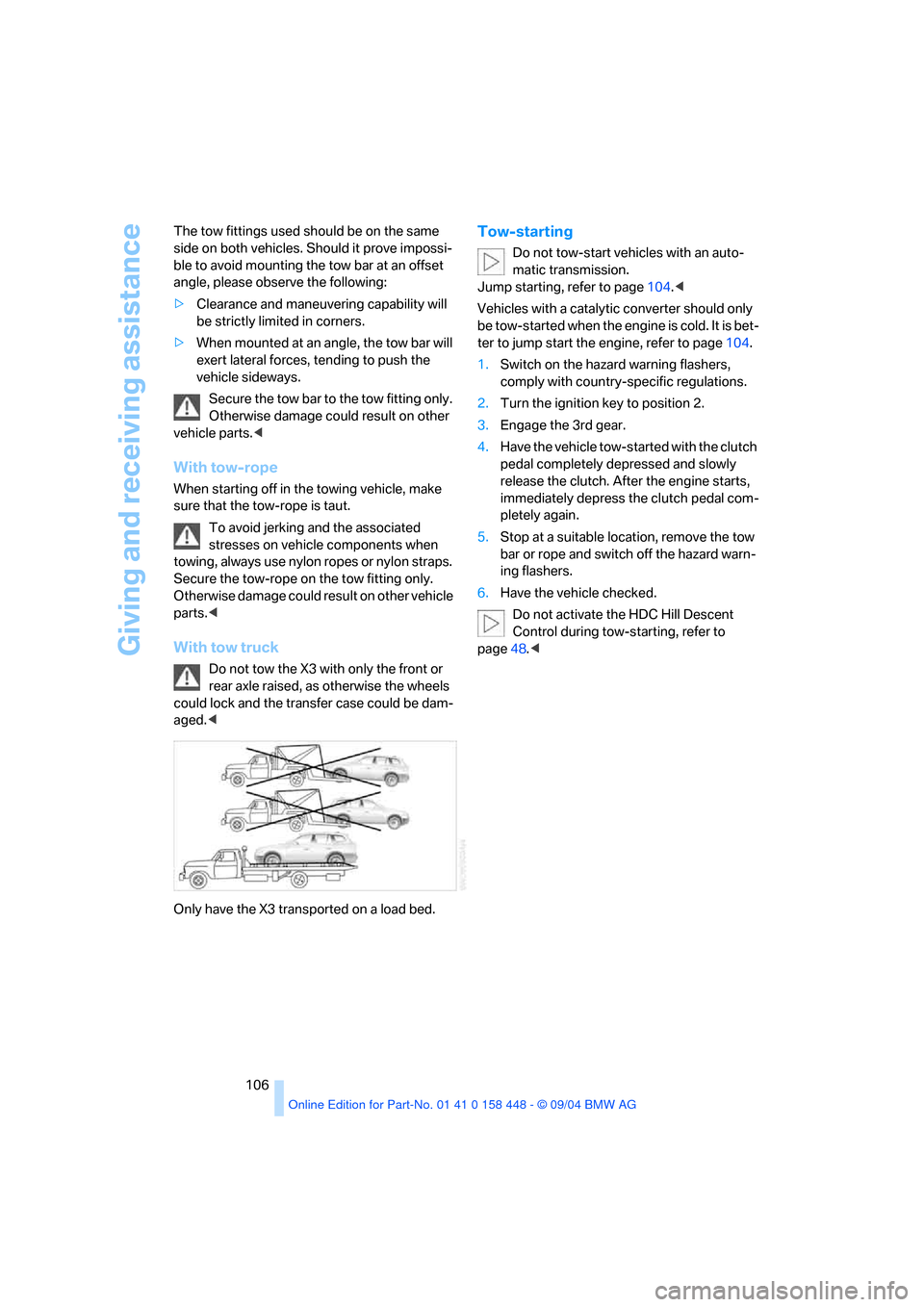
With tow truck
Do not tow the X3 with only the front or
rear axle raised, as otherwise the wheels
could lock and the transfer case could be dam-
aged.<
Only have the X3 transported on a load bed.
Tow-starting
Do not tow-start vehicles with an auto-
matic transmission.
Jump starting, refer to page104.<
Vehicles with a catalytic converter should only
be tow-started when the engine is cold. It is bet-
ter to jump start the engine, refer to page104.
1.Switch on the hazard warning flashers,
comply with country-specific regulations.
2.Turn the ignition key to position 2.
3.Engage the 3rd gear.
4.Have the vehicle tow-started with the clutch
pedal completely depressed and slowly
release the clutch. After the engine starts,
immediately depress the clutch pedal com-
pletely again.
5.Stop at a suitable location, remove the tow
bar or rope and switch off the hazard warn-
ing flashers.
6.Have the vehicle checked.
Do not activate the HDC Hill Descent
Control during tow-starting, refer to
page48.<