fuel BMW X3 2.5I 2005 E83 User Guide
[x] Cancel search | Manufacturer: BMW, Model Year: 2005, Model line: X3 2.5I, Model: BMW X3 2.5I 2005 E83Pages: 126, PDF Size: 4.65 MB
Page 46 of 126
Reference
At a glance
Controls
Driving tips
Mobility
45
Cruising range
Displays the estimated cruising range available
with the remaining fuel. The fuel level is mea-
sured and the range is calculated taking into
account the driving style over the last 20 miles/
30 km.
Always refuel as soon as possible once
your cruising range falls to below
30 miles/50 kilometers, as otherwise engine
functions are not ensured and damage can
occur.<
Average speed
If you press the computer button for approx.
2 seconds, the currently displayed average
value for speed is recalculated from that
moment onwards.
Page 80 of 126
Mobility
This section helps you maintain your mobility
by supplying important information on
vital topics including fuels and lubricants,
wheels and tires, service, maintenance
and breakdown assistance.
Mobility
Page 81 of 126
Refueling
80
Refueling
Fuel filler door
Always switch off the engine before refu-
eling, as it is not possible to add fuel with
the engine running, and attempts to do so may
also trigger the Service Engine Soon lamp.<
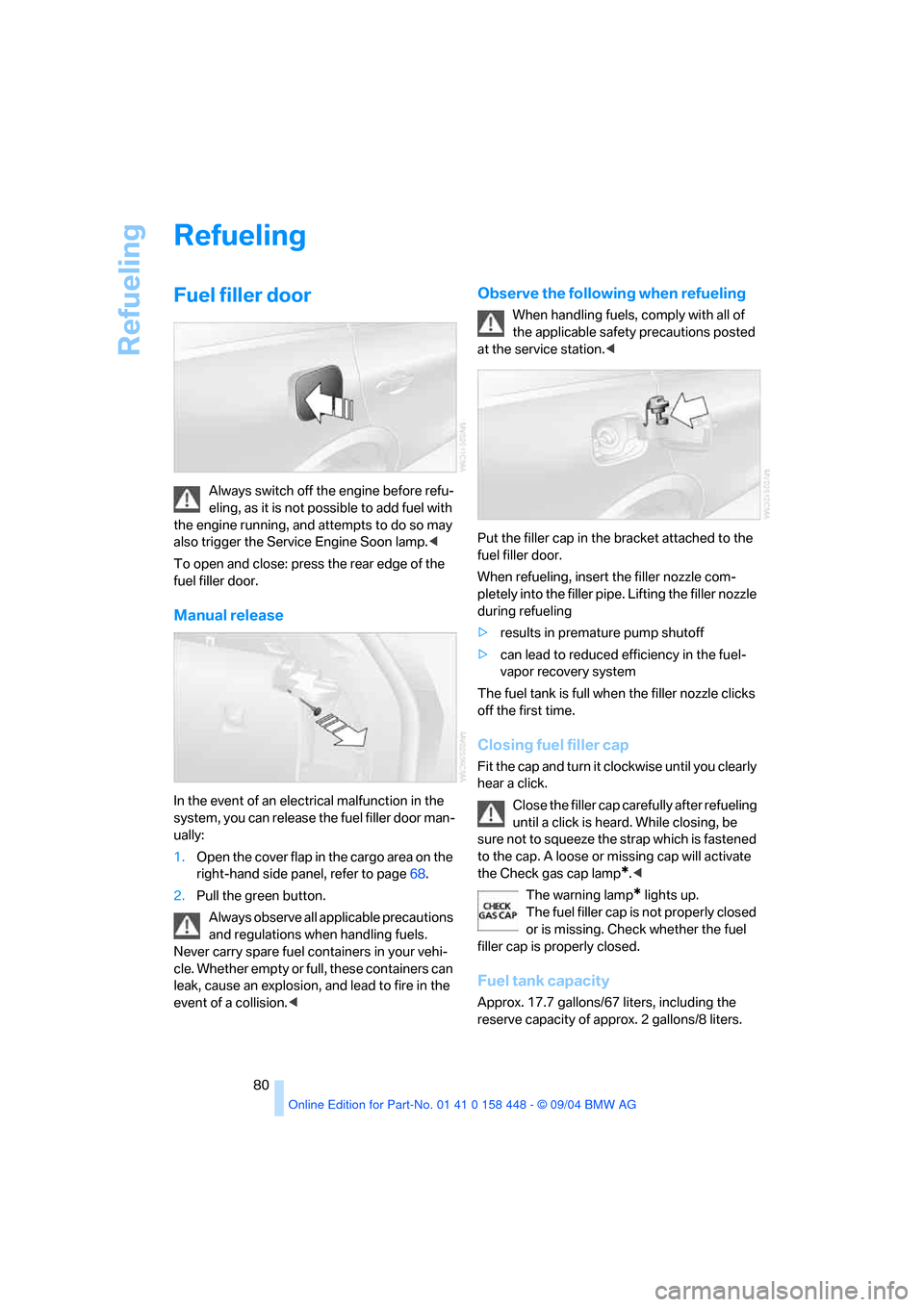
To open and close: press the rear edge of the
fuel filler door.
Manual release
In the event of an electrical malfunction in the
system, you can release the fuel filler door man-
ually:
1.Open the cover flap in the cargo area on the
right-hand side panel, refer to page68.
2.Pull the green button.
Always observe all applicable precautions
and regulations when handling fuels.
Never carry spare fuel containers in your vehi-
cle. Whether empty or full, these containers can
leak, cause an explosion, and lead to fire in the
event of a collision.<
Observe the following when refueling
When handling fuels, comply with all of
the applicable safety precautions posted
at the service station.<
Put the filler cap in the bracket attached to the
fuel filler door.
When refueling, insert the filler nozzle com-
pletely into the filler pipe. Lifting the filler nozzle
during refueling
>results in premature pump shutoff
>can lead to reduced efficiency in the fuel-
vapor recovery system
The fuel tank is full when the filler nozzle clicks
off the first time.
Closing fuel filler cap
Fit the cap and turn it clockwise until you clearly
hear a click.
Close the filler cap carefully after refueling
until a click is heard. While closing, be
sure not to squeeze the strap which is fastened
to the cap. A loose or missing cap will activate
the Check gas cap lamp
*.<
The warning lamp
* lights up.
The fuel filler cap is not properly closed
or is missing. Check whether the fuel
filler cap is properly closed.
Fuel tank capacity
Approx. 17.7 gallons/67 liters, including the
reserve capacity of approx. 2 gallons/8 liters.
Page 82 of 126
Reference
At a glance
Controls
Driving tips
Mobility
81
Never attempt to continue driving until
the tank is completely empty, as engine
functions could be affected, and the vehicle
could sustain damage as a result.<
Fuel specifications
The engine uses unleaded gasoline only.
Required fuel
Premium unleaded gasoline,
minimum octane rating: 91.
Minimum octane rating corresponds to the
Anti Knock Index AKI and is determined to the
so-called (R+M)/2 method.
Do not use leaded gasoline, as otherwise
the lambda probe and catalytic converter
will be permanently damaged.<
Use high-quality brands
Field experience has indicated significant dif-
ferences in fuel quality: volatility, composition,
additives, etc., among gasolines offered for sale
in the United States and Canada. Fuels contain-
ing up to and including 10 % ethanol or other
oxygenates with up to 2.8 % oxygen by weight,
that is, 15 % MTBE or 3 % methanol plus an
equivalent amount of co-solvent, will not void
the applicable warranties with respect to
defects in materials or workmanship.
The use of poor-quality fuels may result in
drivability, starting and stalling problems
especially under certain environmental condi-
tions such as high ambient temperature and
high altitude.
Should you encounter drivability problems
which you suspect could be related to the fuel
you are using, we recommend that you respond
by switching to a recognized high-quality
brand. Failure to comply with these recommen-
dations may also result in unscheduled mainte-
nance.<
Page 87 of 126
Wheels and tires
86
New wheels and tires
Have new wheels and tires installed only
by your BMW Sports Activity Vehicle
Center or tire shop that works according to
BMW repair procedures with correspondingly
trained personnel. If this work is not carried out
properly, there is a danger of subsequent dam-
age and related safety hazards.<
Retreaded tires
BMW does not recommend the use of
retreaded tires, as otherwise driving
safety may be reduced. The causes for this
include the possibly different tire casing struc-
tures and the often wide variations in their age,
which can result in a limited service life.<
The right wheels and tires
BMW recommends that you use only
wheel and tire combinations that BMW
has tested and approved for your particular
vehicle. Variations in factors such as manufac-
turing tolerances mean that even wheels and
tires with identical official size ratings could
actually have different dimensions than the
approved units – these differences could lead to
body contact, and with it the risk of severe acci-
dents. If non-approved wheels and tires are
used, BMW cannot evaluate their suitability,
and therefore cannot be held liable for driving
safety.<
You can ask your BMW Sports Activity Vehicle
Center for the correct wheel-and-tire combina-
tion.
The correct wheel-and-tire combination affects
various systems whose function would other-
wise be impaired, e.g. ABS, DSC or xDrive.
To maintain good handling and vehicle
response, use only tires of a single tread config-
uration from a single manufacturer. After a flat
tire, always remember to have the specified
wheel-and-tire combination remounted on the
vehicle as soon as possible.
Recommended tire sizes and brands
BMW tests certain tire brands for each tire size,
classifies them as road-safe and approves
them. These are available at a specialized
dealer, preferably your BMW Sports Activity
Vehicle Center. Observe any country-specific
regulations, e.g. on making a corresponding
entry in the vehicle documents.
The factory-mounted tires have been specially
selected to provide optimized performance
when installed on your vehicle; if properly cared
for, they will provide a combination of safety and
excellent ride comfort.
Special characteristics of winter tires
BMW recommends winter tires for use in cold
winter driving conditions. Although all-season
M+S tires provide better winter traction than
summer tires, they generally fail to provide the
same levels of cold-weather performance as
winter tires.
Observing speed ratings
Never exceed the maximum speed for
which the winter tires are rated. Unpro-
fessional attempts by laymen to service tires
can lead to damage and accidents. Have this
work performed by skilled professionals only.
The technicians at your BMW Sports Activity
V e h i c l e C e n t e r w i l l b e g l a d t o a s s i s t y o u w i t h t h e
required professional knowledge and special-
ized equipment.<
Storage
Store wheels or tires in a cool, dry place, pro-
tecting them against light whenever possible.
Protect the tires against contact with oil, grease
and fuel. Do not exceed the maximum tire infla-
tion pressure indicated on the side wall of the
tire.
Page 91 of 126
Under the hood
90
Washer fluid
Headlamp* and windshield washer
system
The antifreeze for the washer systems is
flammable. For this reason, keep it away
from sources of flame and store it only in its
original containers. Store it so that it is inacces-
sible to children. Always observe the instruc-
tions for use provided on the containers.<
We recommend that you mix the washer
fluid before adding it to the reservoir.<
Capacity of the windshield washer system:
approx. 3.2 US quarts/3 liters.
Capacity for equipment with headlamp washer
system: approx. 6.9 US quarts/6.5 liters.
Fill with water and, if required, with an antifreeze
additive according to manufacturer's recom-
mendations.
Engine oil
Engine oil consumption depends on driving
style and operating conditions.
Warning lamp
Engine oil pressure
The warning lamp lights up red:
Stop the vehicle immediately and
switch off the engine. Check the engine
oil level; top off as required. If the oil level is cor-
rect: have the system checked immediately.
Do not continue driving. The engine could
be damaged because of inadequate lubri-
cation.<
Engine oil level
The warning lamp lights up yellow while
driving:
The oil level is at the absolute mini-
mum. Add engine oil as soon as possible. Until
then, do not drive more than approx. 30 miles/
50 km.
The warning lamp lights up yellow after
the engine is switched off:
Top off engine oil at the earliest oppor-
tunity, e.g. when refueling.
Engine oil sensor
The warning lamp lights up yellow
within 20 seconds after starting the
engine:
The oil level sensor is defective. Have checked
as soon as possible.
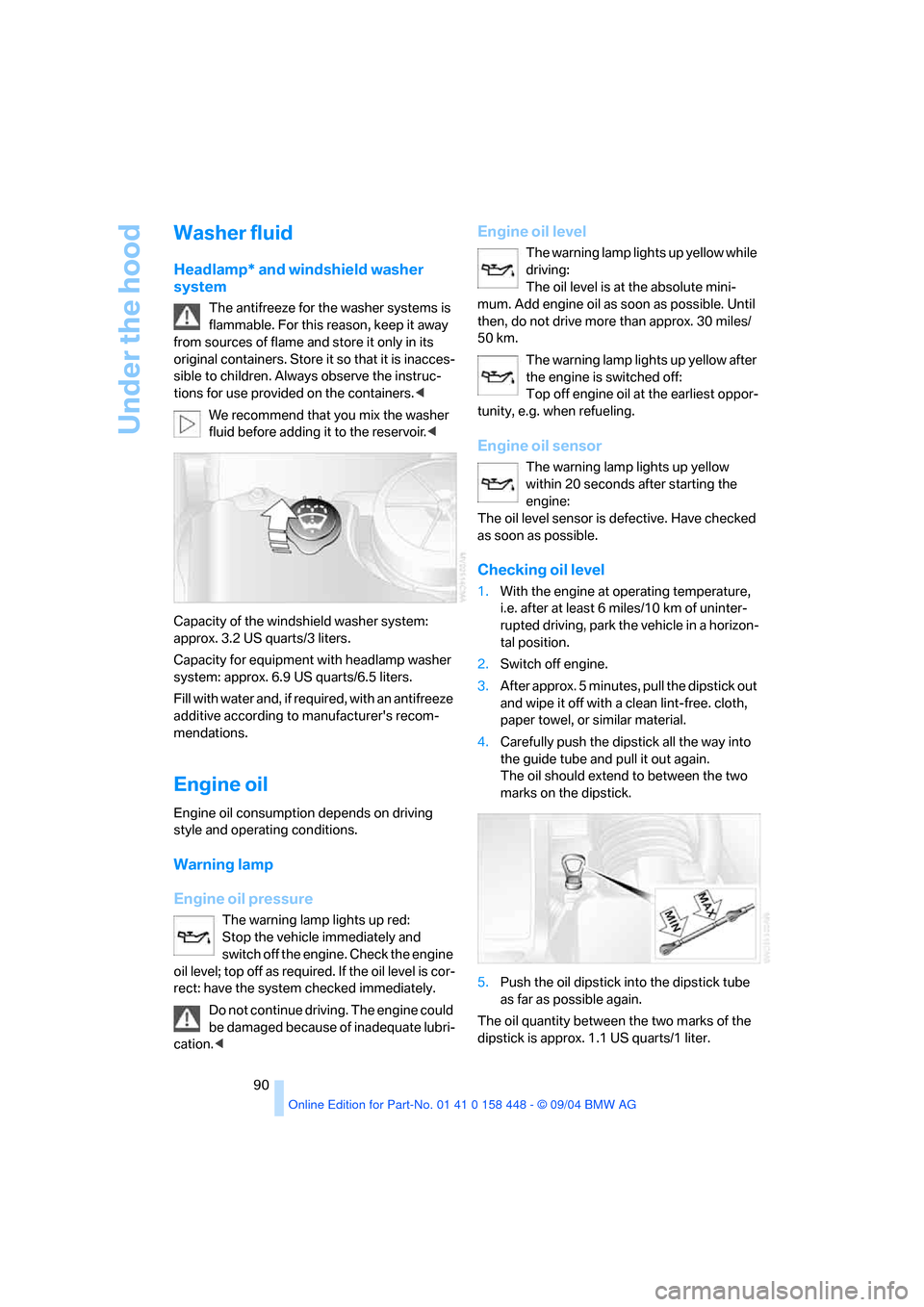
Checking oil level
1.With the engine at operating temperature,
i.e. after at least 6 miles/10 km of uninter-
rupted driving, park the vehicle in a horizon-
tal position.
2.Switch off engine.
3.After approx. 5 minutes, pull the dipstick out
and wipe it off with a clean lint-free. cloth,
paper towel, or similar material.
4.Carefully push the dipstick all the way into
the guide tube and pull it out again.
The oil should extend to between the two
marks on the dipstick.
5.Push the oil dipstick into the dipstick tube
as far as possible again.
The oil quantity between the two marks of the
dipstick is approx. 1.1 US quarts/1 liter.
Page 95 of 126
Maintenance
94 the bottom of the instrument cluster and under
a cover. The cover has the letters OBD on it.
The most important components for the com-
position of the emissions can be checked by a
device via this interface.
If the Service Engine Soon indicator
lamp lights up either continuously or
intermittently, this indicates a malfunc-
tion in the emissions-related electronic sys-
tems. Although the vehicle remains operational,
you should have the systems checked by your
BMW Sports Activity Vehicle Center at the ear-
liest possible opportunity.
The illuminated indicator informs you of the
need for service, not that you need to stop the
vehicle. However, the systems should be
checked by your BMW Sports Activity Vehicle
Center at the next opportunity.
If the indicator blinks or flashes, this indicates
a high level of engine misfire. Reduce speed
and contact the nearest BMW Sports Activity
Vehicle Center immediately. Severe engine
misfiring over even a short period of time can
seriously damage emission control system
components, especially the catalytic converter.
Display of the previously described
malfunction on Canadian models.
If the fuel filler cap is not on tight enough,
the OBD system can detect leaking vapor
and the indicator lamp will light up. If the fuel
filler cap is then tightened, the indicator lamp
will usually go out after a short period of time.<
Event Data Recorders
Your vehicle may be equipped with one or more
sensing and diagnostic modules or a recording
device capable of recording or transmitting cer-
tain vehicle data or information. In addition, if
you have a Subscription Service Agreement for
the BMW Assist system, certain vehicle infor-
mation may be transmitted or recorded in order
to provide such services.
Care
For all information on this subject, refer to the
Caring for your vehicle brochure.
Page 113 of 126
Technical data
112
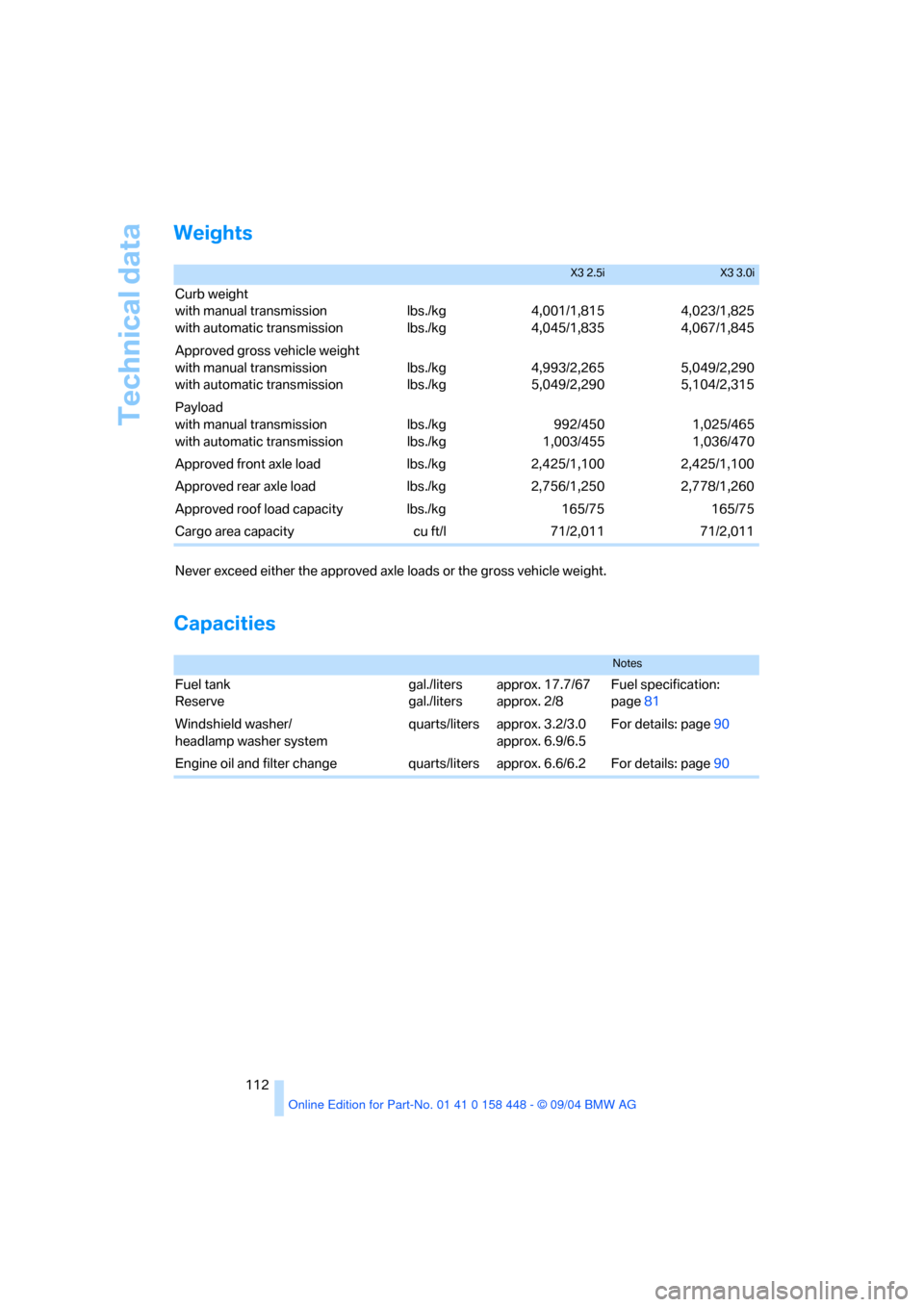
Weights
Capacities
X3 2.5iX3 3.0i
Curb weight
with manual transmission
with automatic transmissionlbs./kg
lbs./kg4,001/1,815
4,045/1,8354,023/1,825
4,067/1,845
Approved gross vehicle weight
with manual transmission
with automatic transmissionlbs./kg
lbs./kg4,993/2,265
5,049/2,2905,049/2,290
5,104/2,315
Payload
with manual transmission
with automatic transmissionlbs./kg
lbs./kg992/450
1,003/4551,025/465
1,036/470
Approved front axle load lbs./kg 2,425/1,100 2,425/1,100
Approved rear axle load lbs./kg 2,756/1,250 2,778/1,260
Approved roof load capacity lbs./kg 165/75 165/75
Cargo area capacity cu ft/l 71/2,011 71/2,011
Never exceed either the approved axle loads or the gross vehicle weight.
Notes
Fuel tank
Reserve gal./liters
gal./litersapprox. 17.7/67
approx. 2/8Fuel specification:
page81
Windshield washer/
headlamp washer systemquarts/liters approx. 3.2/3.0
approx. 6.9/6.5For details: page90
Engine oil and filter change quarts/liters approx. 6.6/6.2 For details: page90
Page 114 of 126
Reference
At a glance
Controls
Driving tips
Mobility
113
Everything from A to Z
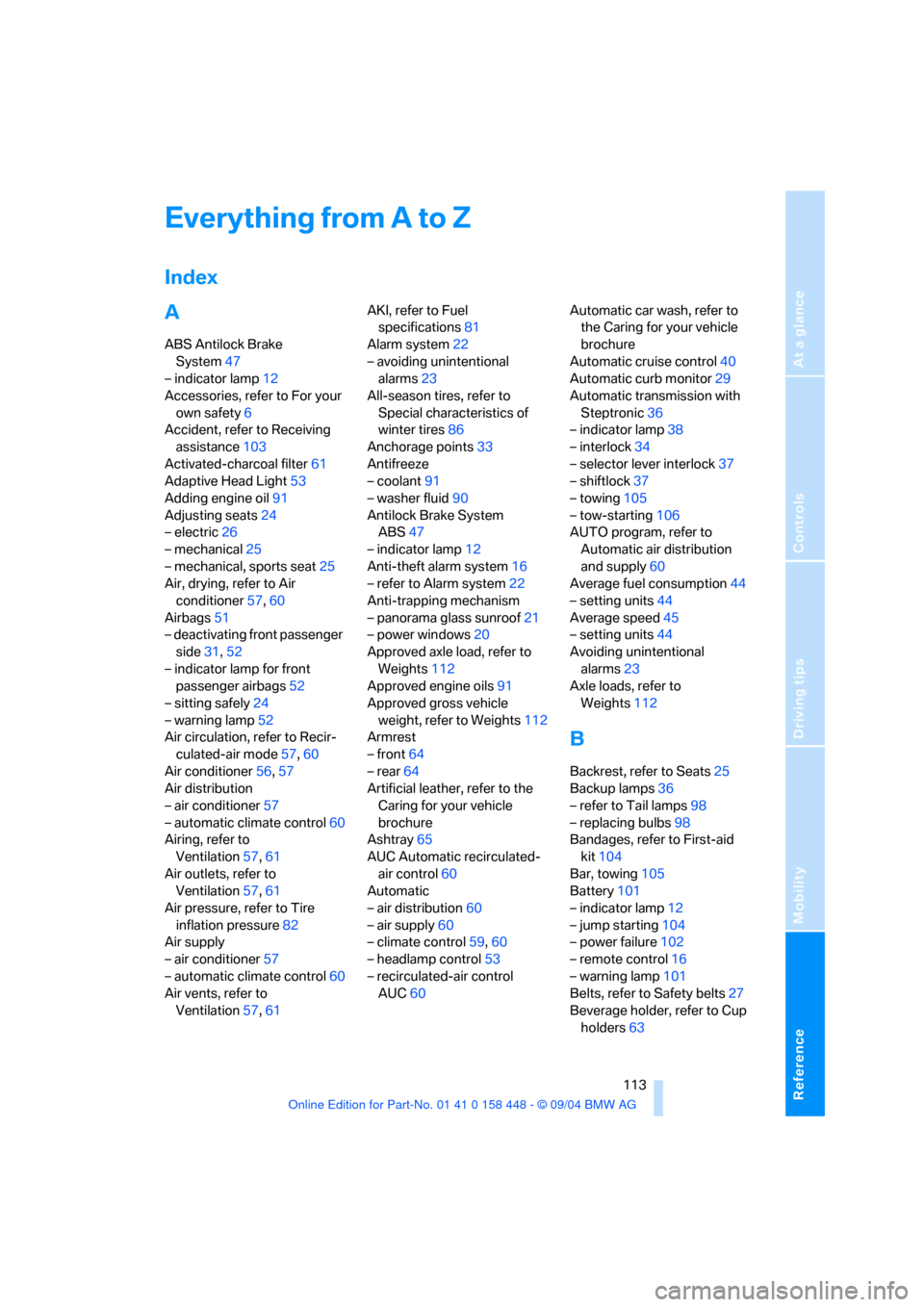
Index
A
ABS Antilock Brake
System47
– indicator lamp12
Accessories, refer to For your
own safety6
Accident, refer to Receiving
assistance103
Activated-charcoal filter61
Adaptive Head Light53
Adding engine oil91
Adjusting seats24
– electric26
– mechanical25
– mechanical, sports seat25
Air, drying, refer to Air
conditioner57,60
Airbags51
– deactivating front passenger
side31,52
– indicator lamp for front
passenger airbags52
– sitting safely24
– warning lamp52
Air circulation, refer to Recir-
culated-air mode57,60
Air conditioner56,57
Air distribution
– air conditioner57
– automatic climate control60
Airing, refer to
Ventilation57,61
Air outlets, refer to
Ventilation57,61
Air pressure, refer to Tire
inflation pressure82
Air supply
– air conditioner57
– automatic climate control60
Air vents, refer to
Ventilation57,61AKI, refer to Fuel
specifications81
Alarm system22
– avoiding unintentional
alarms23
All-season tires, refer to
Special characteristics of
winter tires86
Anchorage points33
Antifreeze
– coolant91
– washer fluid90
Antilock Brake System
ABS47
– indicator lamp12
Anti-theft alarm system16
– refer to Alarm system22
Anti-trapping mechanism
– panorama glass sunroof21
– power windows20
Approved axle load, refer to
Weights112
Approved engine oils91
Approved gross vehicle
weight, refer to Weights112
Armrest
– front64
– rear64
Artificial leather, refer to the
Caring for your vehicle
brochure
Ashtray65
AUC Automatic recirculated-
air control60
Automatic
– air distribution60
– air supply60
– climate control59,60
– headlamp control53
– recirculated-air control
AUC60Automatic car wash, refer to
the Caring for your vehicle
brochure
Automatic cruise control40
Automatic curb monitor29
Automatic transmission with
Steptronic36
– indicator lamp38
– interlock34
– selector lever interlock37
– shiftlock37
– towing105
– tow-starting106
AUTO program, refer to
Automatic air distribution
and supply60
Average fuel consumption44
– setting units44
Average speed45
– setting units44
Avoiding unintentional
alarms23
Axle loads, refer to
Weights112
B
Backrest, refer to Seats25
Backup lamps36
– refer to Tail lamps98
– replacing bulbs98
Bandages, refer to First-aid
kit104
Bar, towing105
Battery101
– indicator lamp12
– jump starting104
– power failure102
– remote control16
– warning lamp101
Belts, refer to Safety belts27
Beverage holder, refer to Cup
holders63
Page 116 of 126
Reference
At a glance
Controls
Driving tips
Mobility
115
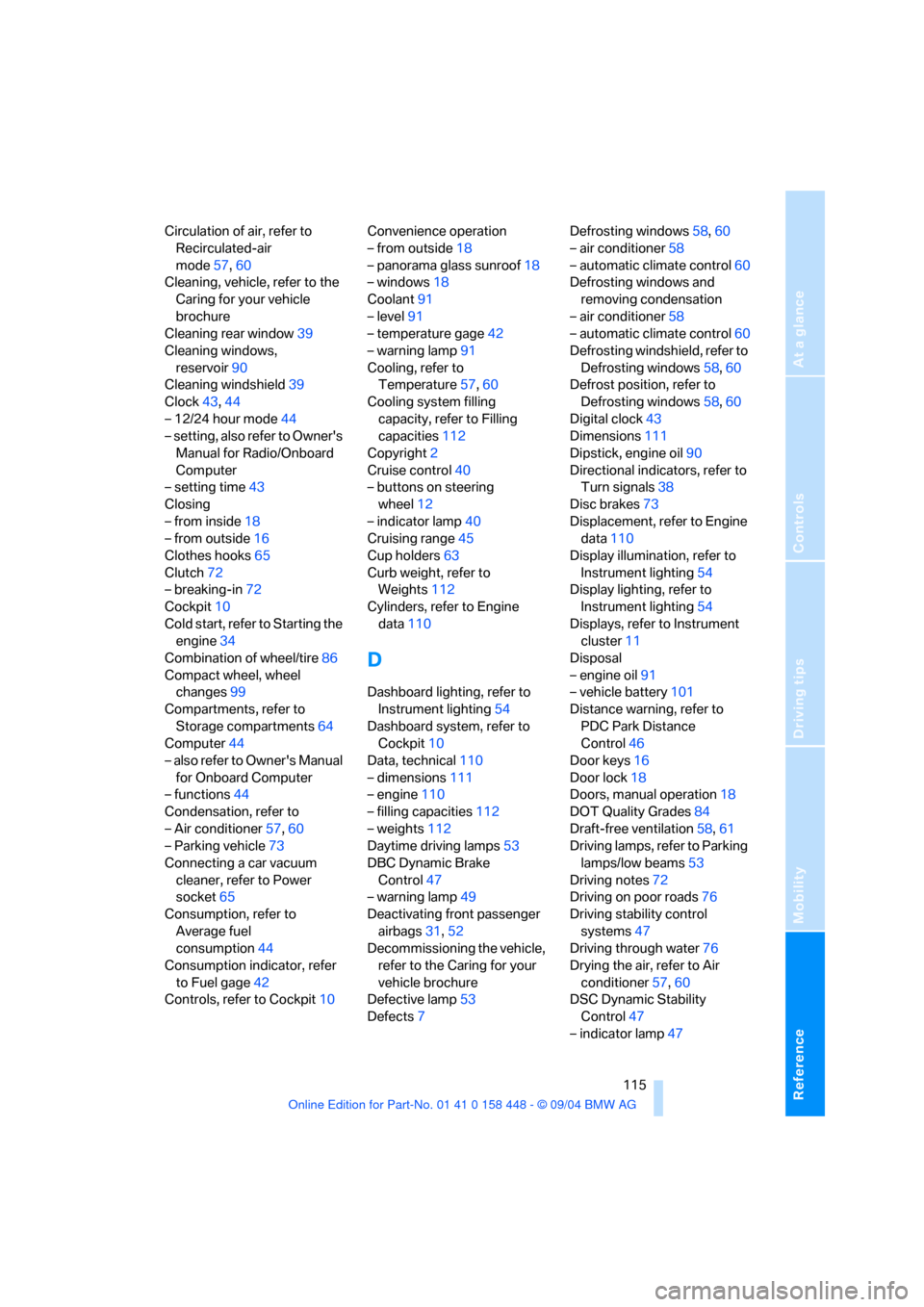
Circulation of air, refer to
Recirculated-air
mode57,60
Cleaning, vehicle, refer to the
Caring for your vehicle
brochure
Cleaning rear window39
Cleaning windows,
reservoir90
Cleaning windshield39
Clock43,44
– 12/24 hour mode44
– setting, also refer to Owner's
Manual for Radio/Onboard
Computer
– setting time43
Closing
– from inside18
– from outside16
Clothes hooks65
Clutch72
– breaking-in72
Cockpit10
Cold start, refer to Starting the
engine34
Combination of wheel/tire86
Compact wheel, wheel
changes99
Compartments, refer to
Storage compartments64
Computer44
– also refer to Owner's Manual
for Onboard Computer
– functions44
Condensation, refer to
– Air conditioner57,60
– Parking vehicle73
Connecting a car vacuum
cleaner, refer to Power
socket65
Consumption, refer to
Average fuel
consumption44
Consumption indicator, refer
to Fuel gage42
Controls, refer to Cockpit10Convenience operation
– from outside18
– panorama glass sunroof18
– windows18
Coolant91
– level91
– temperature gage42
– warning lamp91
Cooling, refer to
Temperature57,60
Cooling system filling
capacity, refer to Filling
capacities112
Copyright2
Cruise control40
– buttons on steering
wheel12
– indicator lamp40
Cruising range45
Cup holders63
Curb weight, refer to
Weights112
Cylinders, refer to Engine
data110
D
Dashboard lighting, refer to
Instrument lighting54
Dashboard system, refer to
Cockpit10
Data, technical110
– dimensions111
– engine110
– filling capacities112
– weights112
Daytime driving lamps53
DBC Dynamic Brake
Control47
– warning lamp49
Deactivating front passenger
airbags31,52
Decommissioning the vehicle,
refer to the Caring for your
vehicle brochure
Defective lamp53
Defects7Defrosting windows58,60
– air conditioner58
– automatic climate control60
Defrosting windows and
removing condensation
– air conditioner58
– automatic climate control60
Defrosting windshield, refer to
Defrosting windows58,60
Defrost position, refer to
Defrosting windows58,60
Digital clock43
Dimensions111
Dipstick, engine oil90
Directional indicators, refer to
Turn signals38
Disc brakes73
Displacement, refer to Engine
data110
Display illumination, refer to
Instrument lighting54
Display lighting, refer to
Instrument lighting54
Displays, refer to Instrument
cluster11
Disposal
– engine oil91
– vehicle battery101
Distance warning, refer to
PDC Park Distance
Control46
Door keys16
Door lock18
Doors, manual operation18
DOT Quality Grades84
Draft-free ventilation58,61
Driving lamps, refer to Parking
lamps/low beams53
Driving notes72
Driving on poor roads76
Driving stability control
systems47
Driving through water76
Drying the air, refer to Air
conditioner57,60
DSC Dynamic Stability
Control47
– indicator lamp47