service BMW X3 2.5I 2005 E83 User Guide
[x] Cancel search | Manufacturer: BMW, Model Year: 2005, Model line: X3 2.5I, Model: BMW X3 2.5I 2005 E83Pages: 126, PDF Size: 4.65 MB
Page 85 of 126
Wheels and tires
84
Tire identification marks
Knowledge of the labeling on the side of the tire
makes it easier to identify and choose the right
tires.
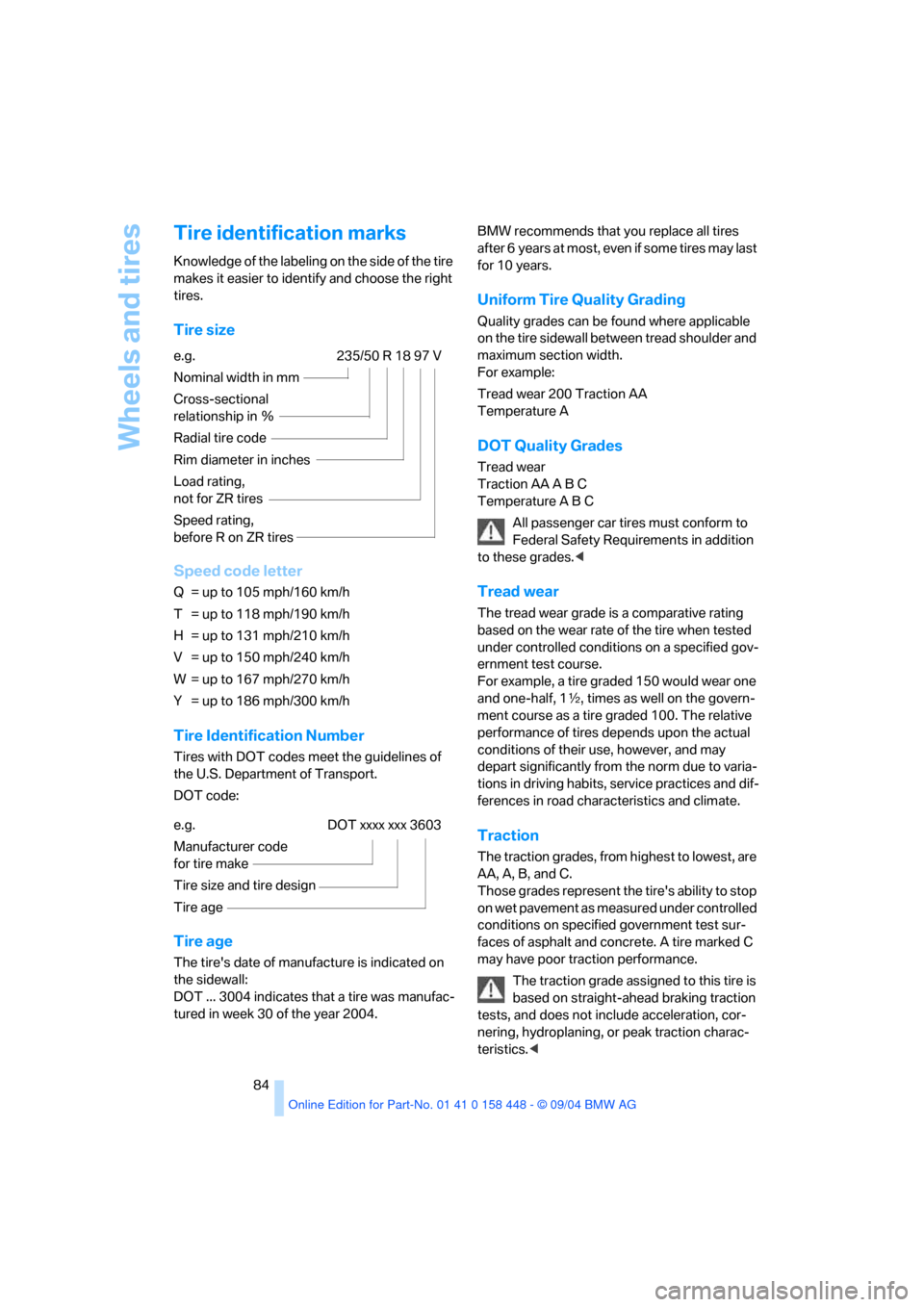
Tire size
Speed code letter
Q = up to 105 mph/160 km/h
T = up to 118 mph/190 km/h
H = up to 131 mph/210 km/h
V = up to 150 mph/240 km/h
W = up to 167 mph/270 km/h
Y = up to 186 mph/300 km/h
Tire Identification Number
Tires with DOT codes meet the guidelines of
the U.S. Department of Transport.
DOT code:
Tire age
The tire's date of manufacture is indicated on
the sidewall:
DOT ... 3004 indicates that a tire was manufac-
tured in week 30 of the year 2004.BMW recommends that you replace all tires
after 6 years at most, even if some tires may last
for 10 years.
Uniform Tire Quality Grading
Quality grades can be found where applicable
on the tire sidewall between tread shoulder and
maximum section width.
For example:
Tread wear 200 Traction AA
Temperature A
DOT Quality Grades
Tread wear
Traction AA A B C
Temperature A B C
All passenger car tires must conform to
Federal Safety Requirements in addition
to these grades.<
Tread wear
The tread wear grade is a comparative rating
based on the wear rate of the tire when tested
under controlled conditions on a specified gov-
ernment test course.
For example, a tire graded 150 would wear one
and one-half, 1γ, times as well on the govern-
ment course as a tire graded 100. The relative
performance of tires depends upon the actual
conditions of their use, however, and may
depart significantly from the norm due to varia-
tions in driving habits, service practices and dif-
ferences in road characteristics and climate.
Traction
The traction grades, from highest to lowest, are
AA, A, B, and C.
Those grades represent the tire's ability to stop
on wet pavement as measured under controlled
conditions on specified government test sur-
faces of asphalt and concrete. A tire marked C
may have poor traction performance.
The traction grade assigned to this tire is
based on straight-ahead braking traction
tests, and does not include acceleration, cor-
nering, hydroplaning, or peak traction charac-
teristics.< e.g. 235/50 R 18 97 V
Nominal width in mm
Cross-sectional
relationship in Ξ
Radial tire code
Rim diameter in inches
Load rating,
not for ZR tires
Speed rating,
before R on ZR tires
e.g. DOT xxxx xxx 3603
Manufacturer code
for tire make
Tire size and tire design
Tire age
Page 87 of 126
Wheels and tires
86
New wheels and tires
Have new wheels and tires installed only
by your BMW Sports Activity Vehicle
Center or tire shop that works according to
BMW repair procedures with correspondingly
trained personnel. If this work is not carried out
properly, there is a danger of subsequent dam-
age and related safety hazards.<
Retreaded tires
BMW does not recommend the use of
retreaded tires, as otherwise driving
safety may be reduced. The causes for this
include the possibly different tire casing struc-
tures and the often wide variations in their age,
which can result in a limited service life.<
The right wheels and tires
BMW recommends that you use only
wheel and tire combinations that BMW
has tested and approved for your particular
vehicle. Variations in factors such as manufac-
turing tolerances mean that even wheels and
tires with identical official size ratings could
actually have different dimensions than the
approved units – these differences could lead to
body contact, and with it the risk of severe acci-
dents. If non-approved wheels and tires are
used, BMW cannot evaluate their suitability,
and therefore cannot be held liable for driving
safety.<
You can ask your BMW Sports Activity Vehicle
Center for the correct wheel-and-tire combina-
tion.
The correct wheel-and-tire combination affects
various systems whose function would other-
wise be impaired, e.g. ABS, DSC or xDrive.
To maintain good handling and vehicle
response, use only tires of a single tread config-
uration from a single manufacturer. After a flat
tire, always remember to have the specified
wheel-and-tire combination remounted on the
vehicle as soon as possible.
Recommended tire sizes and brands
BMW tests certain tire brands for each tire size,
classifies them as road-safe and approves
them. These are available at a specialized
dealer, preferably your BMW Sports Activity
Vehicle Center. Observe any country-specific
regulations, e.g. on making a corresponding
entry in the vehicle documents.
The factory-mounted tires have been specially
selected to provide optimized performance
when installed on your vehicle; if properly cared
for, they will provide a combination of safety and
excellent ride comfort.
Special characteristics of winter tires
BMW recommends winter tires for use in cold
winter driving conditions. Although all-season
M+S tires provide better winter traction than
summer tires, they generally fail to provide the
same levels of cold-weather performance as
winter tires.
Observing speed ratings
Never exceed the maximum speed for
which the winter tires are rated. Unpro-
fessional attempts by laymen to service tires
can lead to damage and accidents. Have this
work performed by skilled professionals only.
The technicians at your BMW Sports Activity
V e h i c l e C e n t e r w i l l b e g l a d t o a s s i s t y o u w i t h t h e
required professional knowledge and special-
ized equipment.<
Storage
Store wheels or tires in a cool, dry place, pro-
tecting them against light whenever possible.
Protect the tires against contact with oil, grease
and fuel. Do not exceed the maximum tire infla-
tion pressure indicated on the side wall of the
tire.
Page 89 of 126
Under the hood
88
Under the hood
Never attempt to perform any service or
repair operations on your vehicle without
the required professional technical training. If
you are not familiar with the regulations to be
observed, have work on your vehicle carried out
only by a BMW Sports Activity Vehicle Center
or a workshop that uses personnel trained in
accordance with BMW requirements. If this
work is not carried out properly, there is a dan-
ger of subsequent damage and related safety
hazards.<
Hood
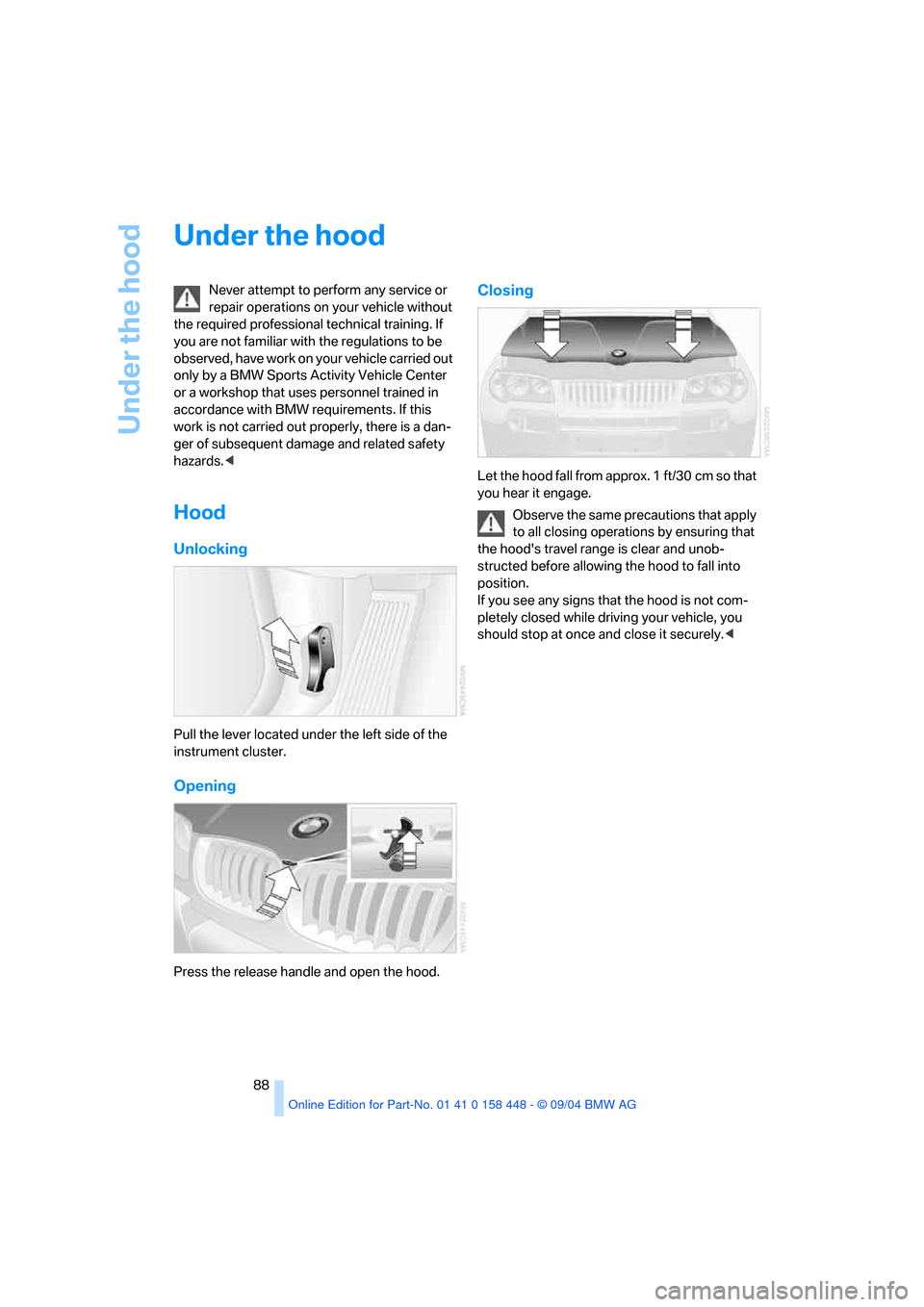
Unlocking
Pull the lever located under the left side of the
instrument cluster.
Opening
Press the release handle and open the hood.
Closing
Let the hood fall from approx. 1 ft/30 cm so that
you hear it engage.
Observe the same precautions that apply
to all closing operations by ensuring that
the hood's travel range is clear and unob-
structed before allowing the hood to fall into
position.
If you see any signs that the hood is not com-
pletely closed while driving your vehicle, you
should stop at once and close it securely.<
Page 92 of 126
Reference
At a glance
Controls
Driving tips
Mobility
91
Do not fill beyond the upper mark on the
dipstick. Excess oil can damage the
engine.<
Adding engine oil
Do not add oil until the oil level has dropped to
just above the lower marking on the dipstick,
refer to page90.
Add oil within the next 30 miles/50 km,
otherwise engine damage could result.<
Store oil, grease etc., well out of the reach
of children; always observe all warning
labels on the containers.<
Oil change
Have oil changed only at your BMW Sports
Activity Vehicle Center or at a workshop that
works according to BMW repair procedures
with correspondingly trained personnel.
Approved engine oils
The quality of the engine oil selected has critical
significance for the operation and service life of
an engine. Based on extensive testing, BMW
has approved only certain engine oils.
Use only approved BMW High Performance
Synthetic Oil.
If you are unable to obtain BMW High Perfor-
mance Synthetic Oil, you can add small
amounts of another synthetic oil between oil
changes. Use only oils with the API SH specifi-
cation or higher.
Ask your BMW Sports Activity Vehicle
Center for details concerning the specific
BMW High Performance Synthetic Oil or syn-
thetic oils which have been approved.
www.bmwusa.com to obtain this information.
BMW engines are designed to operate
without additives, and their use could
even lead to damage in some cases.<
Viscosity ratings
Viscosity is the oil flow rating as defined in
SAE classes.
The selection of the correct SAE class depends
on the climate conditions in the area where you
typically drive your BMW.
Approved oils are in SAE classes 5W-40
and 5W-30.<
These oils may be used for driving in all ambient
temperatures.
Coolant
Warning lamp
The warning lamp lights up: coolant
level is too low; top off at the next
opportunity.
Do not open the cooling system when the
engine is hot. Escaping coolant can cause
burns.<
Coolant consists of water and coolant additive.
Not all commercially available additives are suit-
able for your BMW. Ask your BMW Sport Activ-
ity Vehicle Center for suitable additives.
Only use suitable additives, as otherwise
engine damage may result. The additives
present a health hazard.<
Always observe all applicable environ-
mental laws and regulations when dis-
posing of used coolant additives.<
Checking coolant level
1.The engine must be at ambient tempera-
ture.
2.Turn the cap of the expansion tank counter-
clockwise to allow any accumulated pres-
Page 94 of 126
Reference
At a glance
Controls
Driving tips
Mobility
93
Maintenance
The BMW maintenance
system
The BMW maintenance system supports the
preservation of the traffic and operating safety
of your BMW.
Regular maintenance is not only required for
the safety of the vehicle, it also improves the
resale value.
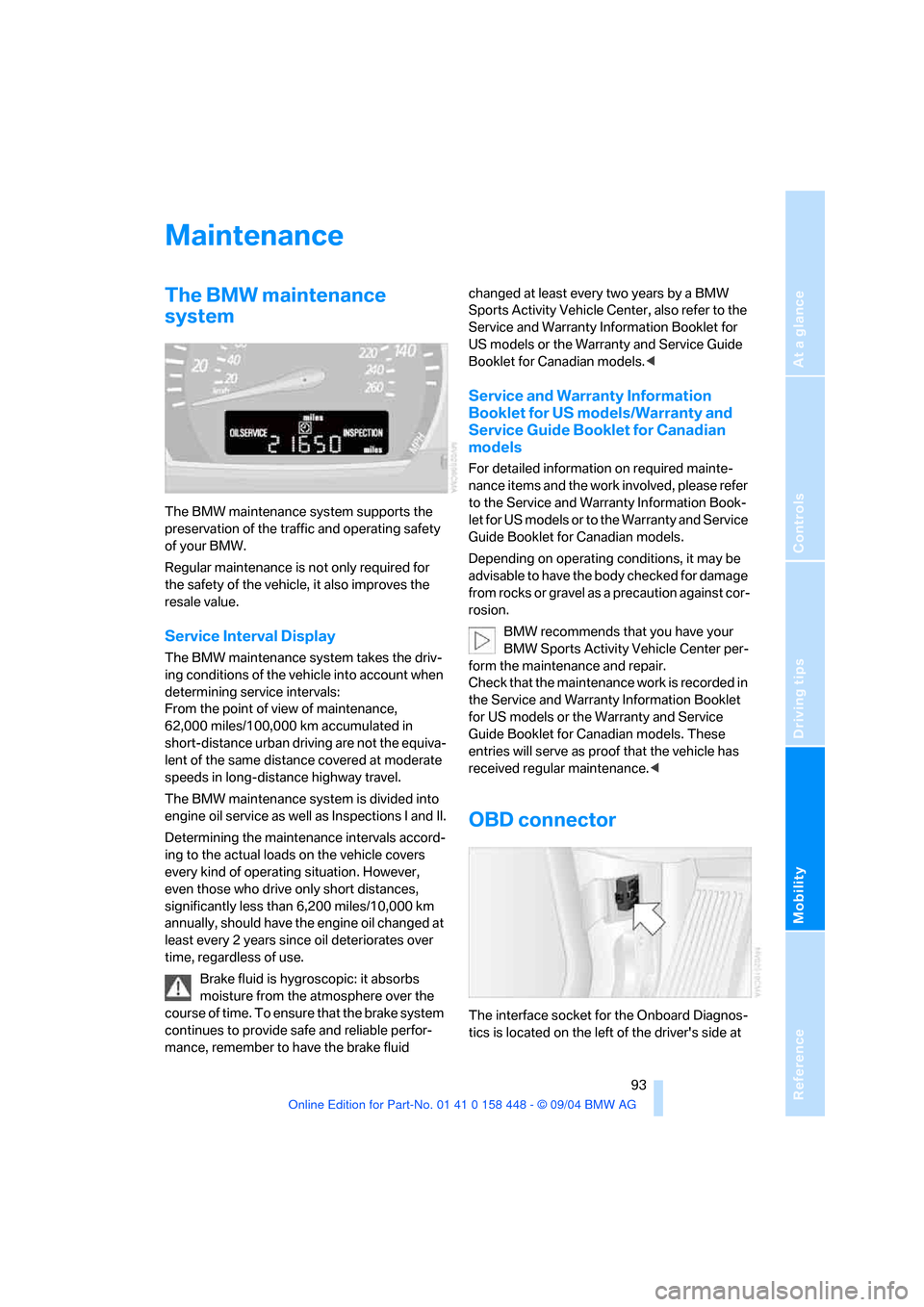
Service Interval Display
The BMW maintenance system takes the driv-
ing conditions of the vehicle into account when
determining service intervals:
From the point of view of maintenance,
62,000 miles/100,000 km accumulated in
short-distance urban driving are not the equiva-
lent of the same distance covered at moderate
speeds in long-distance highway travel.
The BMW maintenance system is divided into
engine oil service as well as Inspections I and II.
Determining the maintenance intervals accord-
ing to the actual loads on the vehicle covers
every kind of operating situation. However,
even those who drive only short distances,
significantly less than 6,200 miles/10,000 km
annually, should have the engine oil changed at
least every 2 years since oil deteriorates over
time, regardless of use.
Brake fluid is hygroscopic: it absorbs
moisture from the atmosphere over the
course of time. To ensure that the brake system
continues to provide safe and reliable perfor-
mance, remember to have the brake fluid changed at least every two years by a BMW
Sports Activity Vehicle Center, also refer to the
Service and Warranty Information Booklet for
US models or the Warranty and Service Guide
Booklet for Canadian models.<
Service and Warranty Information
Booklet for US models/Warranty and
Service Guide Booklet for Canadian
models
For detailed information on required mainte-
nance items and the work involved, please refer
to the Service and Warranty Information Book-
let for US models or to the Warranty and Service
Guide Booklet for Canadian models.
Depending on operating conditions, it may be
advisable to have the body checked for damage
from rocks or gravel as a precaution against cor-
rosion.
BMW recommends that you have your
BMW Sports Activity Vehicle Center per-
form the maintenance and repair.
Check that the maintenance work is recorded in
the Service and Warranty Information Booklet
for US models or the Warranty and Service
Guide Booklet for Canadian models. These
entries will serve as proof that the vehicle has
received regular maintenance.<
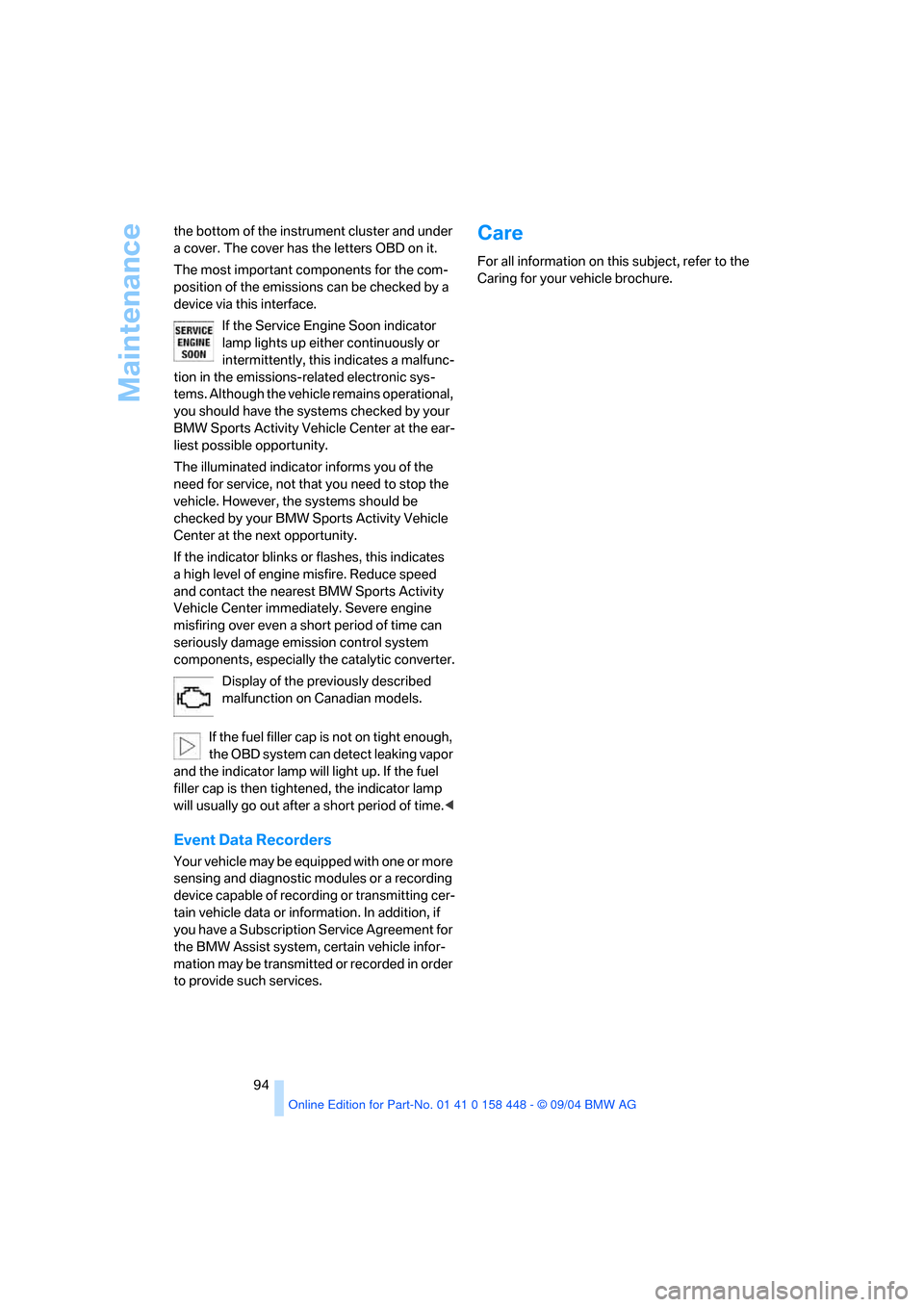
OBD connector
The interface socket for the Onboard Diagnos-
tics is located on the left of the driver's side at
Page 95 of 126
Maintenance
94 the bottom of the instrument cluster and under
a cover. The cover has the letters OBD on it.
The most important components for the com-
position of the emissions can be checked by a
device via this interface.
If the Service Engine Soon indicator
lamp lights up either continuously or
intermittently, this indicates a malfunc-
tion in the emissions-related electronic sys-
tems. Although the vehicle remains operational,
you should have the systems checked by your
BMW Sports Activity Vehicle Center at the ear-
liest possible opportunity.
The illuminated indicator informs you of the
need for service, not that you need to stop the
vehicle. However, the systems should be
checked by your BMW Sports Activity Vehicle
Center at the next opportunity.
If the indicator blinks or flashes, this indicates
a high level of engine misfire. Reduce speed
and contact the nearest BMW Sports Activity
Vehicle Center immediately. Severe engine
misfiring over even a short period of time can
seriously damage emission control system
components, especially the catalytic converter.
Display of the previously described
malfunction on Canadian models.
If the fuel filler cap is not on tight enough,
the OBD system can detect leaking vapor
and the indicator lamp will light up. If the fuel
filler cap is then tightened, the indicator lamp
will usually go out after a short period of time.<
Event Data Recorders
Your vehicle may be equipped with one or more
sensing and diagnostic modules or a recording
device capable of recording or transmitting cer-
tain vehicle data or information. In addition, if
you have a Subscription Service Agreement for
the BMW Assist system, certain vehicle infor-
mation may be transmitted or recorded in order
to provide such services.
Care
For all information on this subject, refer to the
Caring for your vehicle brochure.
Page 96 of 126
Reference
At a glance
Controls
Driving tips
Mobility
95
Replacing components
Onboard tool kit
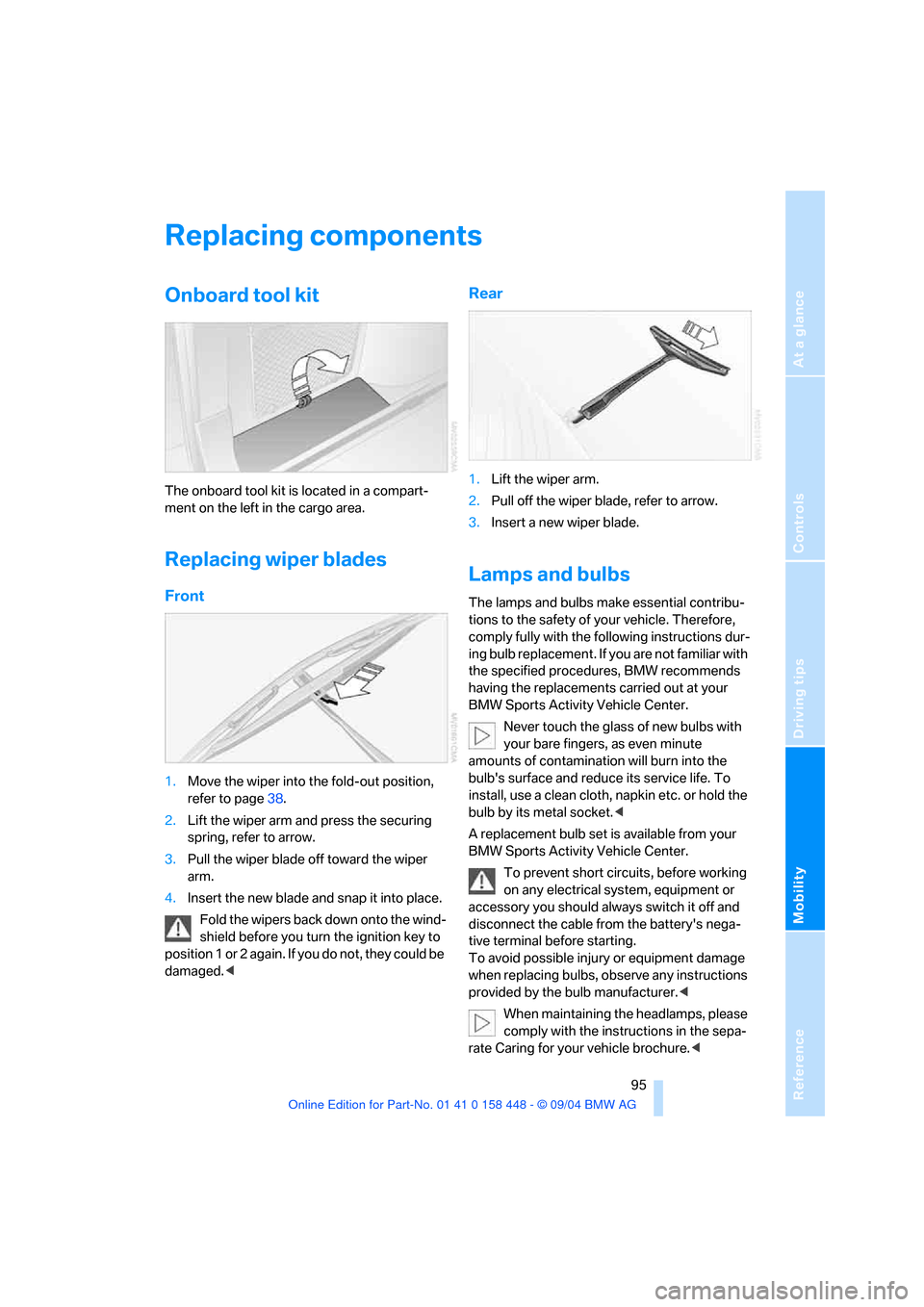
The onboard tool kit is located in a compart-
ment on the left in the cargo area.
Replacing wiper blades
Front
1.Move the wiper into the fold-out position,
refer to page38.
2.Lift the wiper arm and press the securing
spring, refer to arrow.
3.Pull the wiper blade off toward the wiper
arm.
4.Insert the new blade and snap it into place.
Fold the wipers back down onto the wind-
shield before you turn the ignition key to
p o s i t i o n 1 o r 2 a g a i n . I f y o u d o n o t , t h e y c o u l d b e
damaged.<
Rear
1.Lift the wiper arm.
2.Pull off the wiper blade, refer to arrow.
3.Insert a new wiper blade.
Lamps and bulbs
The lamps and bulbs make essential contribu-
tions to the safety of your vehicle. Therefore,
comply fully with the following instructions dur-
ing bulb replacement. If you are not familiar with
the specified procedures, BMW recommends
having the replacements carried out at your
BMW Sports Activity Vehicle Center.
Never touch the glass of new bulbs with
your bare fingers, as even minute
amounts of contamination will burn into the
bulb's surface and reduce its service life. To
install, use a clean cloth, napkin etc. or hold the
bulb by its metal socket.<
A replacement bulb set is available from your
BMW Sports Activity Vehicle Center.
To prevent short circuits, before working
on any electrical system, equipment or
accessory you should always switch it off and
disconnect the cable from the battery's nega-
tive terminal before starting.
To avoid possible injury or equipment damage
when replacing bulbs, observe any instructions
provided by the bulb manufacturer.<
When maintaining the headlamps, please
comply with the instructions in the sepa-
rate Caring for your vehicle brochure.<
Page 98 of 126
Reference
At a glance
Controls
Driving tips
Mobility
97
4.Place the lamp base with the lower edge
against the bracket and press it in until the
lamp base locks in place.
Make sure that the cover does not fall into
the engine compartment, as otherwise
the vehicle can be damaged or other road users
can be endangered.<
Front passenger side
Before replacing the bulb, remove the reservoir
of the windshield washer system from the
bracket, refer to Halogen low beams on
page96.
For bulb replacement procedure, refer to
Driver's side.
Xenon lamps*
The service life of these bulbs is very long and
the probability of a failure is very low, provided
that they are not switched on and off an unusual
number of times. If one of these bulbs should
nevertheless fail, it is possible to continue driv-
ing with great caution using the fog lamps, pro-
vided traffic laws in your area do not prohibit
this.
To avoid risk of potentially fatal injuries:
owing to the extremely high voltages at
which these units operate, service work should
always be entrusted to qualified personnel.<
Parking and roadside parking lamps
5 Watt bulb
In case of a malfunction, please contact your
BMW Sports Activity Vehicle Center.
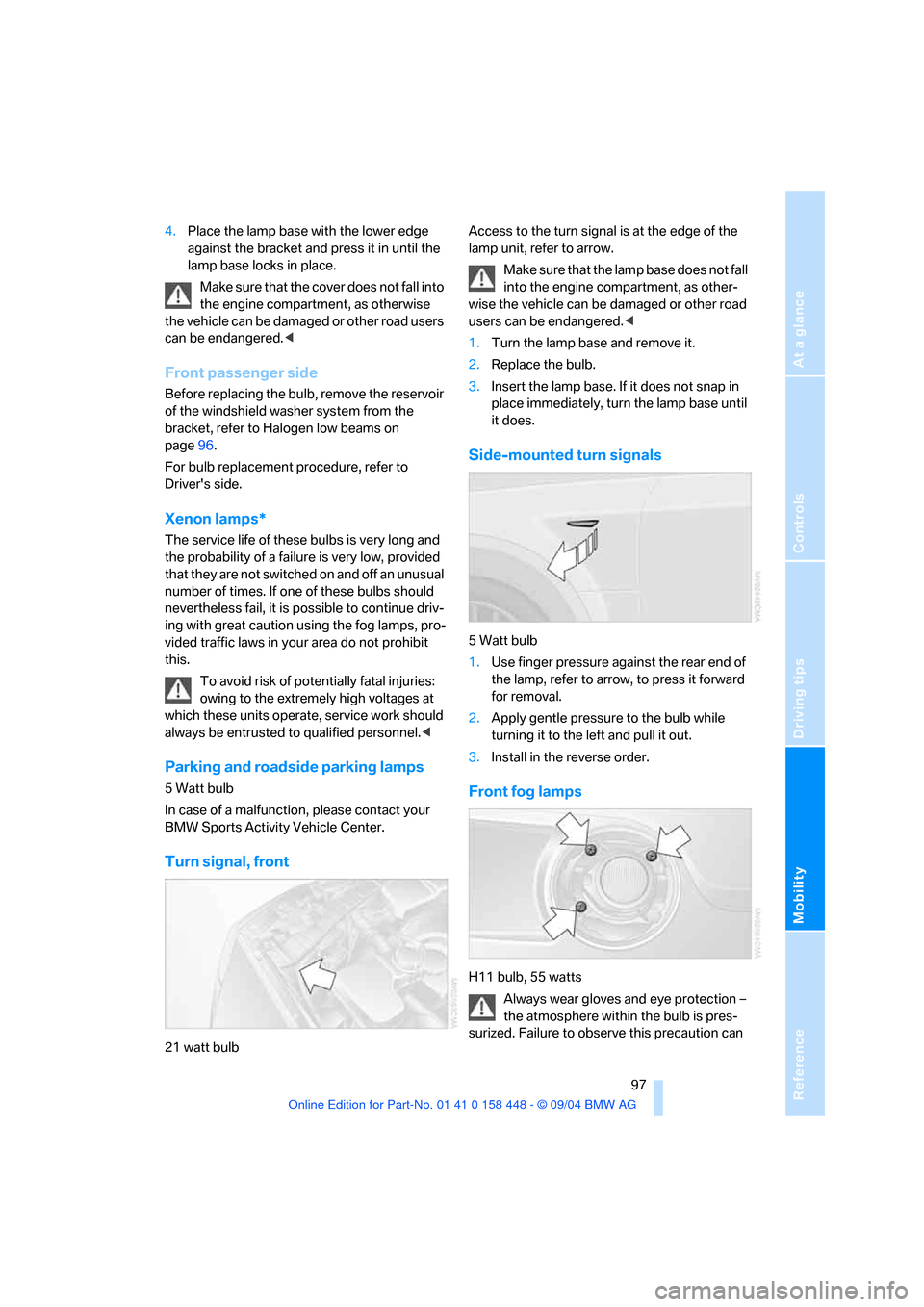
Turn signal, front
21 watt bulb Access to the turn signal is at the edge of the
lamp unit, refer to arrow.
Make sure that the lamp base does not fall
into the engine compartment, as other-
wise the vehicle can be damaged or other road
users can be endangered.<
1.Turn the lamp base and remove it.
2.Replace the bulb.
3.Insert the lamp base. If it does not snap in
place immediately, turn the lamp base until
it does.
Side-mounted turn signals
5 Watt bulb
1.Use finger pressure against the rear end of
the lamp, refer to arrow, to press it forward
for removal.
2.Apply gentle pressure to the bulb while
turning it to the left and pull it out.
3.Install in the reverse order.
Front fog lamps
H11 bulb, 55 watts
Always wear gloves and eye protection –
the atmosphere within the bulb is pres-
surized. Failure to observe this precaution can
Page 115 of 126
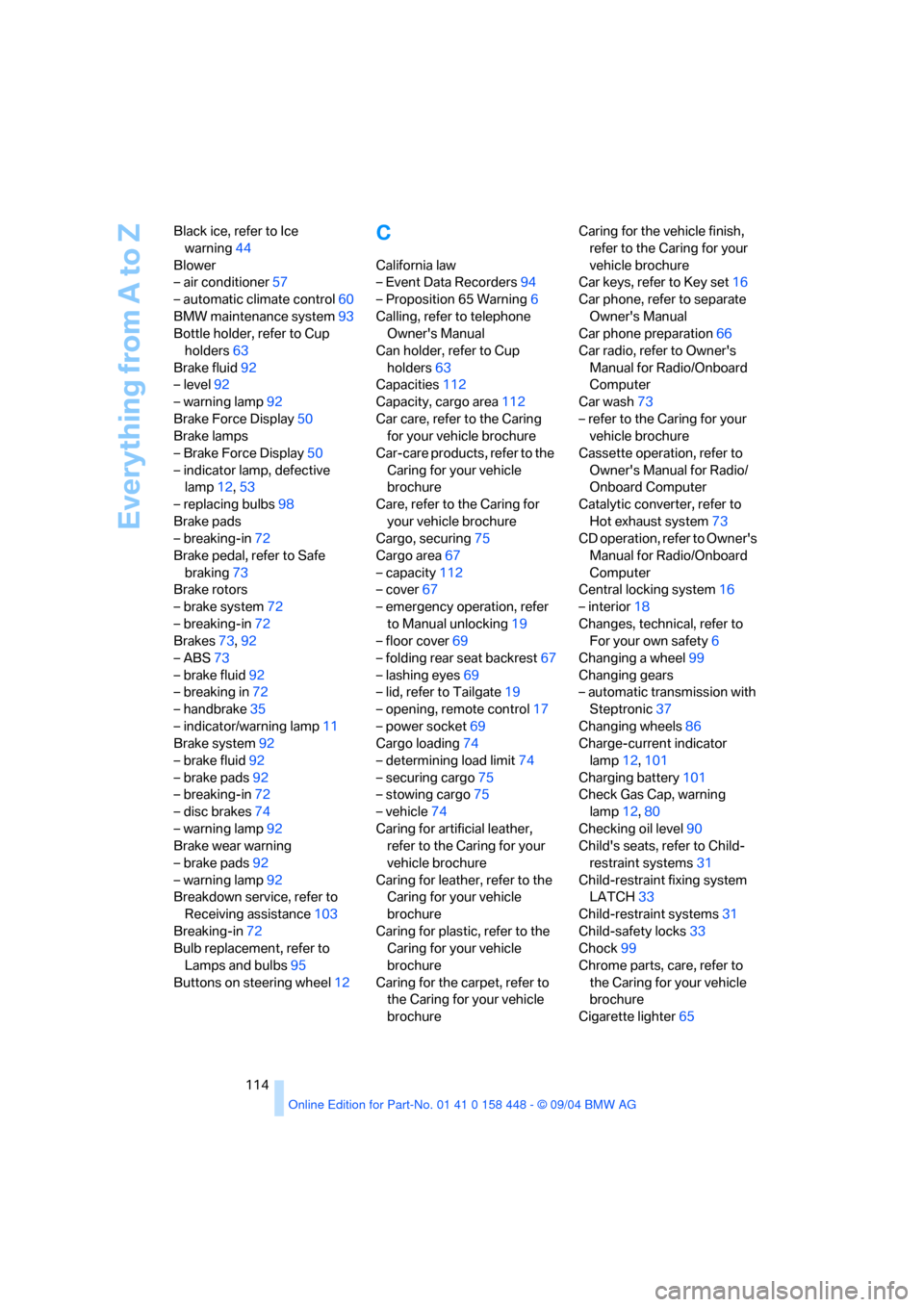
Everything from A to Z
114 Black ice, refer to Ice
warning44
Blower
– air conditioner57
– automatic climate control60
BMW maintenance system93
Bottle holder, refer to Cup
holders63
Brake fluid92
– level92
– warning lamp92
Brake Force Display50
Brake lamps
– Brake Force Display50
– indicator lamp, defective
lamp12,53
– replacing bulbs98
Brake pads
– breaking-in72
Brake pedal, refer to Safe
braking73
Brake rotors
– brake system72
– breaking-in72
Brakes73,92
– ABS73
– brake fluid92
– breaking in72
– handbrake35
– indicator/warning lamp11
Brake system92
– brake fluid92
– brake pads92
– breaking-in72
– disc brakes74
– warning lamp92
Brake wear warning
– brake pads92
– warning lamp92
Breakdown service, refer to
Receiving assistance103
Breaking-in72
Bulb replacement, refer to
Lamps and bulbs95
Buttons on steering wheel12
C
California law
– Event Data Recorders94
– Proposition 65 Warning6
Calling, refer to telephone
Owner's Manual
Can holder, refer to Cup
holders63
Capacities112
Capacity, cargo area112
Car care, refer to the Caring
for your vehicle brochure
Car-care products, refer to the
Caring for your vehicle
brochure
Care, refer to the Caring for
your vehicle brochure
Cargo, securing75
Cargo area67
– capacity112
– cover67
– emergency operation, refer
to Manual unlocking19
– floor cover69
– folding rear seat backrest67
– lashing eyes69
– lid, refer to Tailgate19
– opening, remote control17
– power socket69
Cargo loading74
– determining load limit74
– securing cargo75
– stowing cargo75
– vehicle74
Caring for artificial leather,
refer to the Caring for your
vehicle brochure
Caring for leather, refer to the
Caring for your vehicle
brochure
Caring for plastic, refer to the
Caring for your vehicle
brochure
Caring for the carpet, refer to
the Caring for your vehicle
brochureCaring for the vehicle finish,
refer to the Caring for your
vehicle brochure
Car keys, refer to Key set16
Car phone, refer to separate
Owner's Manual
Car phone preparation66
Car radio, refer to Owner's
Manual for Radio/Onboard
Computer
Car wash73
– refer to the Caring for your
vehicle brochure
Cassette operation, refer to
Owner's Manual for Radio/
Onboard Computer
Catalytic converter, refer to
Hot exhaust system73
CD operation, refer to Owner's
Manual for Radio/Onboard
Computer
Central locking system16
– interior18
Changes, technical, refer to
For your own safety6
Changing a wheel99
Changing gears
– automatic transmission with
Steptronic37
Changing wheels86
Charge-current indicator
lamp12,101
Charging battery101
Check Gas Cap, warning
lamp12,80
Checking oil level90
Child's seats, refer to Child-
restraint systems31
Child-restraint fixing system
LATCH33
Child-restraint systems31
Child-safety locks33
Chock99
Chrome parts, care, refer to
the Caring for your vehicle
brochure
Cigarette lighter65
Page 117 of 126
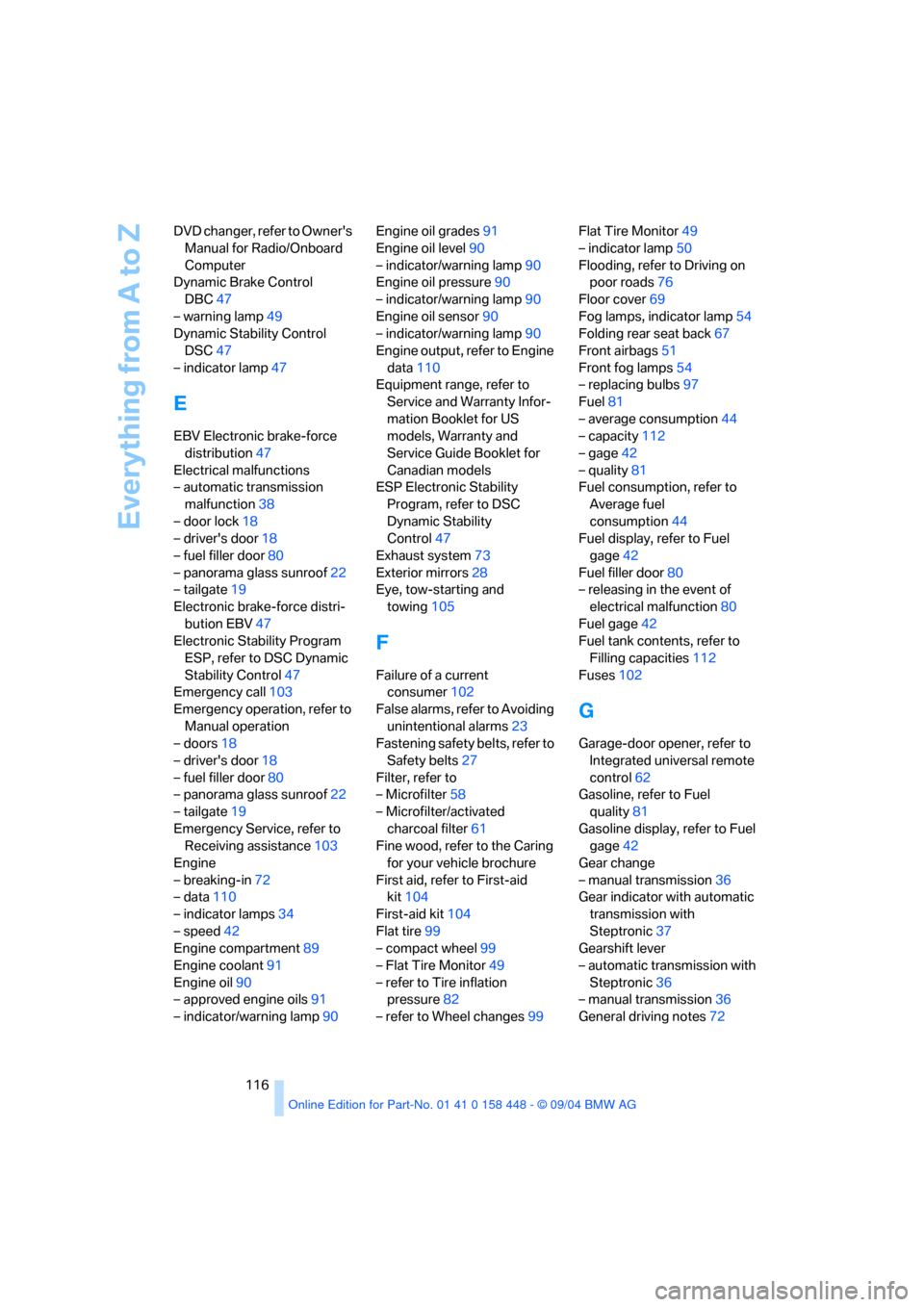
Everything from A to Z
116 DVD changer, refer to Owner's
Manual for Radio/Onboard
Computer
Dynamic Brake Control
DBC47
– warning lamp49
Dynamic Stability Control
DSC47
– indicator lamp47
E
EBV Electronic brake-force
distribution47
Electrical malfunctions
– automatic transmission
malfunction38
– door lock18
– driver's door18
– fuel filler door80
– panorama glass sunroof22
– tailgate19
Electronic brake-force distri-
bution EBV47
Electronic Stability Program
ESP, refer to DSC Dynamic
Stability Control47
Emergency call103
Emergency operation, refer to
Manual operation
– doors18
– driver's door18
– fuel filler door80
– panorama glass sunroof22
– tailgate19
Emergency Service, refer to
Receiving assistance103
Engine
– breaking-in72
– data110
– indicator lamps34
– speed42
Engine compartment89
Engine coolant91
Engine oil90
– approved engine oils91
– indicator/warning lamp90Engine oil grades91
Engine oil level90
– indicator/warning lamp90
Engine oil pressure90
– indicator/warning lamp90
Engine oil sensor90
– indicator/warning lamp90
Engine output, refer to Engine
data110
Equipment range, refer to
Service and Warranty Infor-
mation Booklet for US
models, Warranty and
Service Guide Booklet for
Canadian models
ESP Electronic Stability
Program, refer to DSC
Dynamic Stability
Control47
Exhaust system73
Exterior mirrors28
Eye, tow-starting and
towing105
F
Failure of a current
consumer102
False alarms, refer to Avoiding
unintentional alarms23
Fastening safety belts, refer to
Safety belts27
Filter, refer to
– Microfilter58
– Microfilter/activated
charcoal filter61
Fine wood, refer to the Caring
for your vehicle brochure
First aid, refer to First-aid
kit104
First-aid kit104
Flat tire99
– compact wheel99
– Flat Tire Monitor49
– refer to Tire inflation
pressure82
– refer to Wheel changes99Flat Tire Monitor49
– indicator lamp50
Flooding, refer to Driving on
poor roads76
Floor cover69
Fog lamps, indicator lamp54
Folding rear seat back67
Front airbags51
Front fog lamps54
– replacing bulbs97
Fuel81
– average consumption44
– capacity112
– gage42
– quality81
Fuel consumption, refer to
Average fuel
consumption44
Fuel display, refer to Fuel
gage42
Fuel filler door80
– releasing in the event of
electrical malfunction80
Fuel gage42
Fuel tank contents, refer to
Filling capacities112
Fuses102
G
Garage-door opener, refer to
Integrated universal remote
control62
Gasoline, refer to Fuel
quality81
Gasoline display, refer to Fuel
gage42
Gear change
– manual transmission36
Gear indicator with automatic
transmission with
Steptronic37
Gearshift lever
– automatic transmission with
Steptronic36
– manual transmission36
General driving notes72