els BMW X3 2.5I 2006 E83 Owner's Guide
[x] Cancel search | Manufacturer: BMW, Model Year: 2006, Model line: X3 2.5I, Model: BMW X3 2.5I 2006 E83Pages: 133, PDF Size: 8.37 MB
Page 92 of 133
Wheels and tires
90 age and related safety hazards. Make sure that
the new wheels are balanced.<
Retreaded tires
BMW does not recommend the use of
retreaded tires; otherwise, driving safety
may be reduced. The causes for this include the
possibly different tire casing structures and the
often wide variations in their age, which can
result in a limited service life.<
The right wheels and tires
BMW recommends that you use only
wheel and tire combinations that BMW
has tested and approved for your particular
vehicle. Variations in factors such as manufac-
turing tolerances mean that even wheels and
tires with identical official size ratings could
actually have different dimensions than the
approved units – these differences could lead to
body contact and with it, the risk of severe acci-
dents. If non-approved wheels and tires are
used, BMW cannot evaluate their suitability,
and therefore cannot be held liable for driving
safety.<
You can ask your BMW Sports Activity Vehicle
Center for the correct wheel-and-tire combina-
tion.
The correct wheel-and-tire combination affects
various systems whose function would other-
wise be impaired, e.g. ABS, DSC or xDrive.
To maintain good handling and vehicle
response, use only tires of a single tread config-
uration from a single manufacturer. After a flat
tire, always have the original wheel-and-tire
combination remounted on the vehicle as soon
as possible.
Wheels equipped with electronics for
TPM Tire Pressure Monitor
When installing new tires or when changing
from summer tires to winter tires or vice versa,
only use wheels equipped with TPM electron-
ics; otherwise, the Tire Pressure Monitor can-
not detect a flat tire, refer to page52. Your
BMW Sports Activity Vehicle Center will be
happy to advise you in this regard.
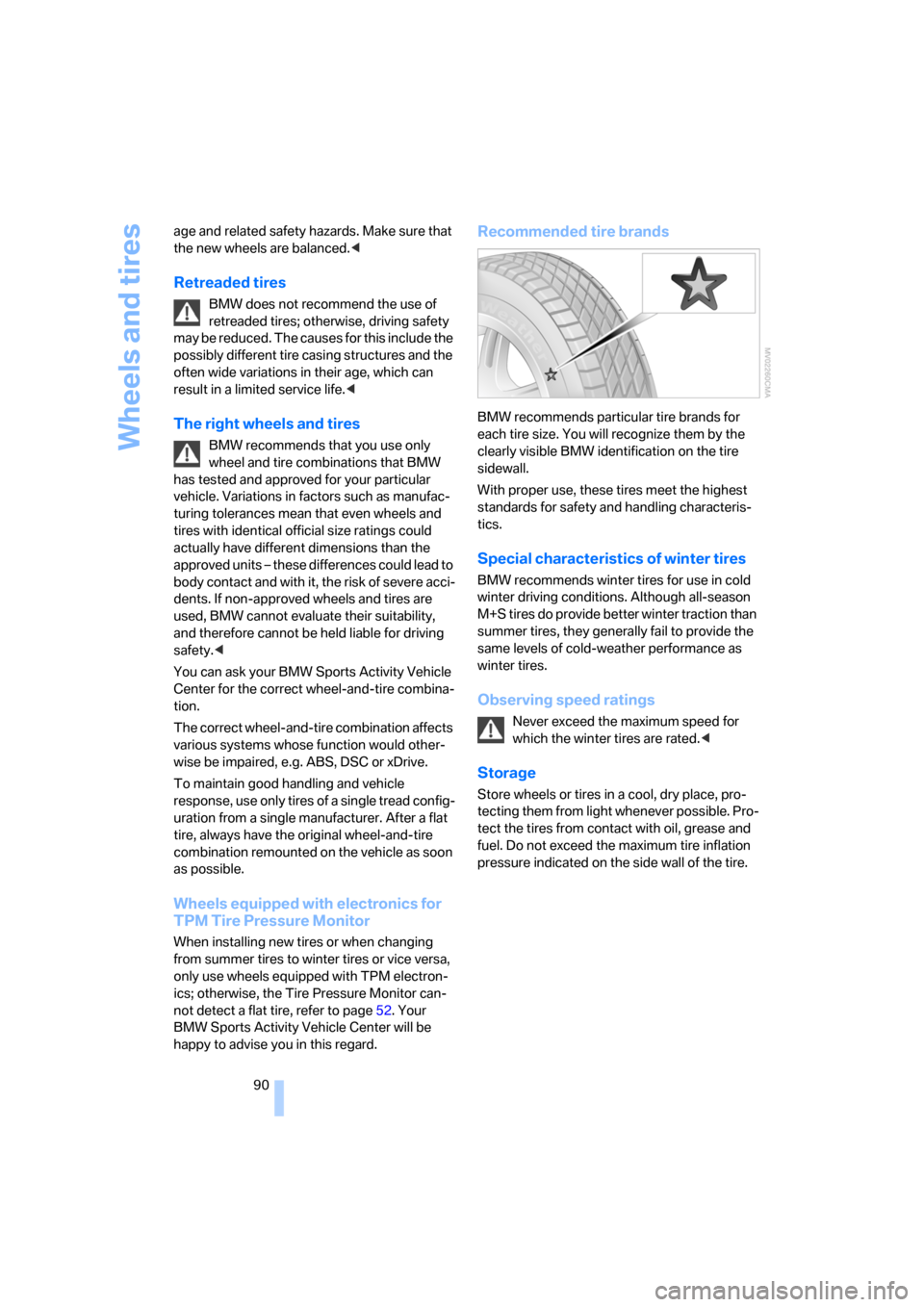
Recommended tire brands
BMW recommends particular tire brands for
each tire size. You will recognize them by the
clearly visible BMW identification on the tire
sidewall.
With proper use, these tires meet the highest
standards for safety and handling characteris-
tics.
Special characteristics of winter tires
BMW recommends winter tires for use in cold
winter driving conditions. Although all-season
M+S tires do provide better winter traction than
summer tires, they generally fail to provide the
same levels of cold-weather performance as
winter tires.
Observing speed ratings
Never exceed the maximum speed for
which the winter tires are rated.<
Storage
Store wheels or tires in a cool, dry place, pro-
tecting them from light whenever possible. Pro-
tect the tires from contact with oil, grease and
fuel. Do not exceed the maximum tire inflation
pressure indicated on the side wall of the tire.
Page 93 of 133

Reference
At a glance
Controls
Driving tips
Mobility
91
Snow chains*
Only certain fine-link snow chains are tested,
classified as road-safe, and recommended by
BMW. You can obtain a list of these from your
BMW Sports Activity Vehicle Center. It is only
permissible to use them in pairs and on the rear
wheels.
Follow the manufacturer's instructions when
installing snow chains.
Do not exceed a vehicle speed of 30 mph/
50 km/h with snow chains mounted.
It is not permissible to use snow chains on the
following tire sizes:
>255/45 R 18
>255/40 R 19
Do not initialize the Flat Tire Monitor
*
with snow chains installed; otherwise, the
instrument might issue an incorrect reading.
When you are driving with snow chains, it can
be beneficial to switch off DSC briefly, refer to
page49.<
Page 98 of 133

Under the hood
96
Brake system
Malfunction
Brake fluid
The warning lamp lights up red despite
the handbrake being released. Stop
immediately.
The brake fluid in the reservoir has fallen to
below the minimum level. At the same time, a
considerably longer brake pedal travel may be
noticeable. Have the system checked immedi-
ately.
During continued driving, increased brake
pedal travel may be necessary, and con-
siderably longer braking distances may result.
Please adapt your driving style accordingly.<
Display of the previously described mal-
function on Canadian models.
Brake pads
The warning lamp lights up.
The brake pads have reached their min-
imum pad thickness. Have brake pads
replaced immediately.
For your own safety, use only brake pads
that BMW has approved for your particu-
lar vehicle model. As BMW cannot assess the
suitability of other brake pads for use in your
vehicle, we are unable to assume continued
responsibility for the vehicle's operating safety
if non-approved pads are installed.<
Page 99 of 133
Reference
At a glance
Controls
Driving tips
Mobility
97
Maintenance
The BMW maintenance
system
The BMW maintenance system supports the
preservation of the road and operating safety of
your BMW.
Regular maintenance is not only required for
the safety of the vehicle, it also improves the
resale value.
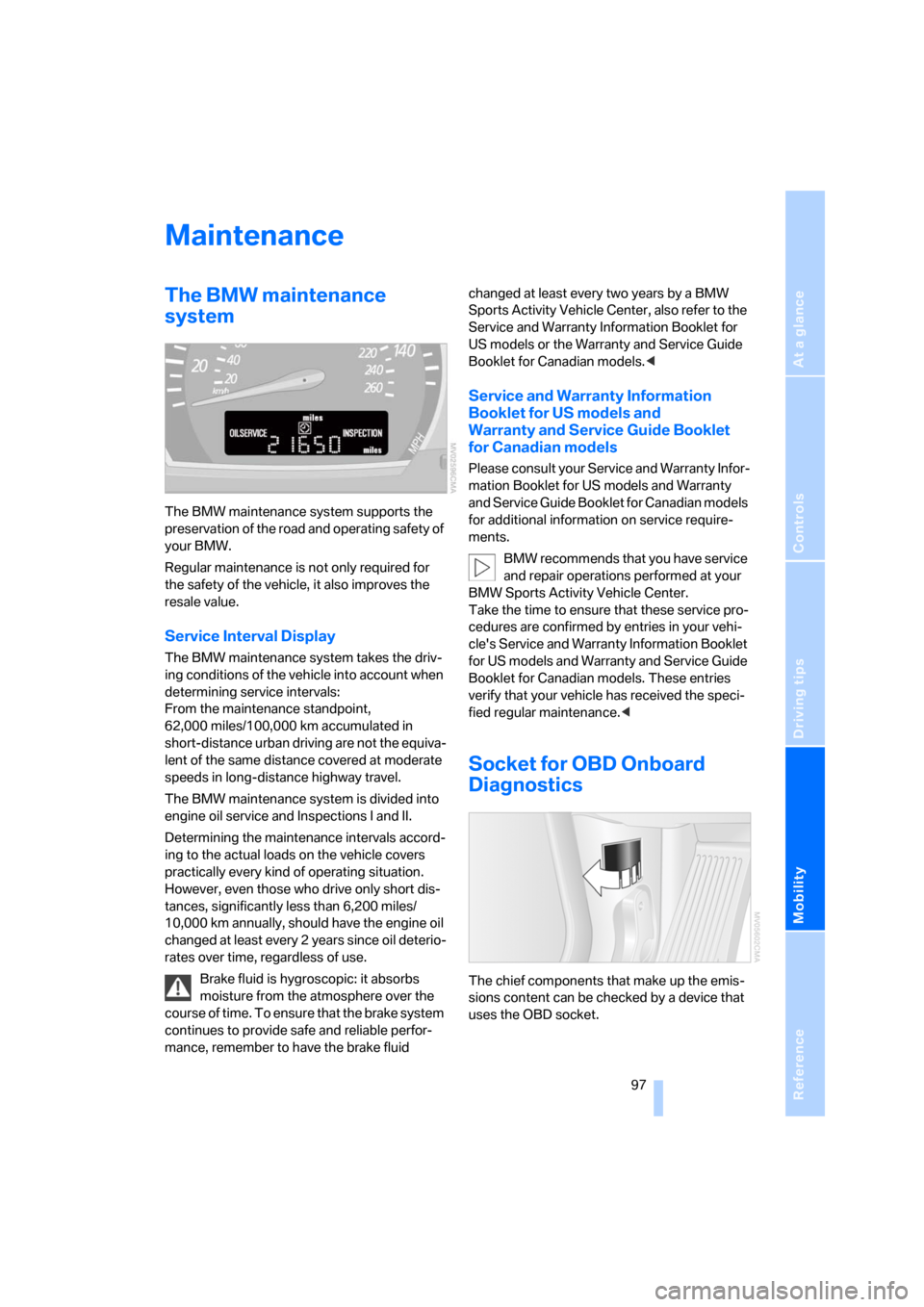
Service Interval Display
The BMW maintenance system takes the driv-
ing conditions of the vehicle into account when
determining service intervals:
From the maintenance standpoint,
62,000 miles/100,000 km accumulated in
short-distance urban driving are not the equiva-
lent of the same distance covered at moderate
speeds in long-distance highway travel.
The BMW maintenance system is divided into
engine oil service and Inspections I and II.
Determining the maintenance intervals accord-
ing to the actual loads on the vehicle covers
practically every kind of operating situation.
However, even those who drive only short dis-
tances, significantly less than 6,200 miles/
10,000 km annually, should have the engine oil
changed at least every 2 years since oil deterio-
rates over time, regardless of use.
Brake fluid is hygroscopic: it absorbs
moisture from the atmosphere over the
course of time. To ensure that the brake system
continues to provide safe and reliable perfor-
mance, remember to have the brake fluid changed at least every two years by a BMW
Sports Activity Vehicle Center, also refer to the
Service and Warranty Information Booklet for
US models or the Warranty and Service Guide
Booklet for Canadian models.<
Service and Warranty Information
Booklet for US models and
Warranty and Service Guide Booklet
for Canadian models
Please consult your Service and Warranty Infor-
mation Booklet for US models and Warranty
and Service Guide Booklet for Canadian models
for additional information on service require-
ments.
BMW recommends that you have service
and repair operations performed at your
BMW Sports Activity Vehicle Center.
Take the time to ensure that these service pro-
cedures are confirmed by entries in your vehi-
cle's Service and Warranty Information Booklet
for US models and Warranty and Service Guide
Booklet for Canadian models. These entries
verify that your vehicle has received the speci-
fied regular maintenance.<
Socket for OBD Onboard
Diagnostics
The chief components that make up the emis-
sions content can be checked by a device that
uses the OBD socket.
Page 100 of 133

Maintenance
98 This socket is located under a cover on the left
side of the driver's footwell, just under the dash-
board.
Emissions values
The warning lamp lights up. Exhaust
values are deteriorating. Have the vehi-
cle checked as soon as possible.
Under certain conditions, the indicator will flash.
This indicates a serious rate of engine misfire.
When this occurs, you should reduce speed
and consult the nearest BMW Sports Activity
Vehicle Center as soon as possible. Severe
engine misfire even for only a short period of
time can seriously damage emission control
components, especially the catalytic converter.
Display of the previously described mal-
function on Canadian models.
When the fuel filler cap is not properly
tightened, the OBD system can detect
the vapor leak and the indicator lamp will light
up. If the filler cap is subsequently tightened,
the indicator lamp should go out within a few
days.<
Event data recorders
Your vehicle may be equipped with one or more
sensing and diagnostic modules or a recording
device capable of recording or transmitting cer-
tain vehicle data or information. In addition, if
you have a Subscription Service Agreement for
the BMW Assist system, certain vehicle infor-
mation may be transmitted or recorded in order
to provide such services.
Care
You can find useful information on caring for
your BMW in the Caring for your vehicle bro-
chure.
Page 105 of 133
Reference
At a glance
Controls
Driving tips
Mobility
103
Liftgate lamp
5 Watt bulb
1.Take out the bulb holder.
2.Replace the bulb.
Wheel changes
Safety precautions to observe in the
event of a flat tire and during all tire
changes:
Park the vehicle as far as possible from passing
traffic. Park on a firm, flat, surface. Switch on the
hazard warning flashers.
Lock the steering wheel with the wheels point-
ing straight ahead. Engage the handbrake and
shift into first gear or reverse, or move the
selector lever to position P.
All passengers should be outside the vehicle
and well away from your immediate working
area, behind a guardrail, for instance.
If a warning triangle or portable hazard warning
lamp is required, set it up on the roadside at an
appropriate distance from the rear of the vehi-
cle. Comply with all safety guidelines and regu-
lations.
Change the wheel only on a level, firm surface
which is not slippery. The vehicle or the jack
could slip to the side if you attempt to raise the
vehicle on a soft or slippery surface such as
snow, ice, tile, etc.
Position the jack on a firm support surface.
Do not use a wooden block or similar object as a
support base for the jack, as this would prevent
it from extending to its full support height and
reduce its load-carrying capacity.To avoid serious or fatal injury: never lie under
the vehicle, and never start the engine while it is
supported by the jack.<
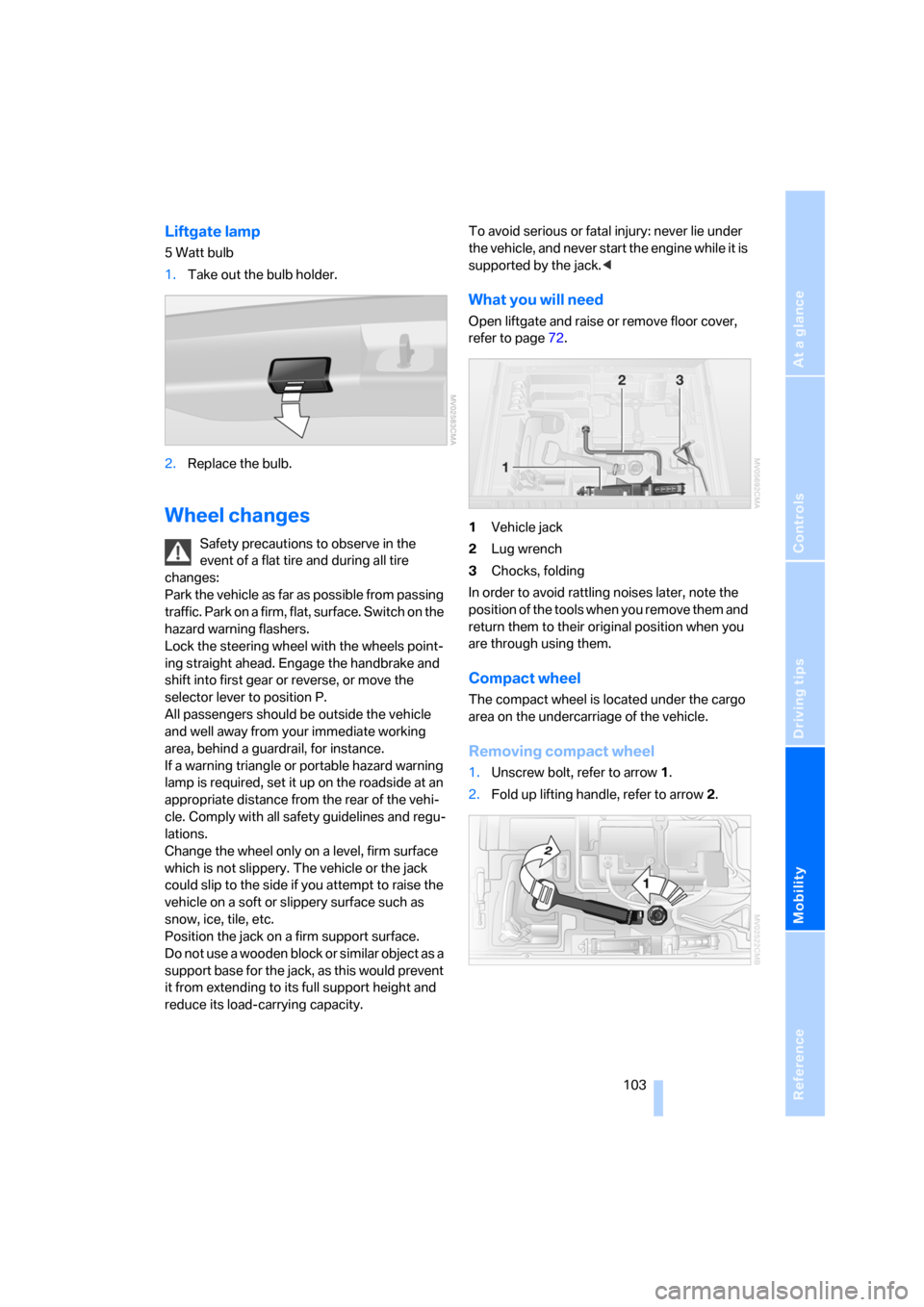
What you will need
Open liftgate and raise or remove floor cover,
refer to page72.
1Vehicle jack
2Lug wrench
3Chocks, folding
In order to avoid rattling noises later, note the
position of the tools when you remove them and
return them to their original position when you
are through using them.
Compact wheel
The compact wheel is located under the cargo
area on the undercarriage of the vehicle.
Removing compact wheel
1.Unscrew bolt, refer to arrow1.
2.Fold up lifting handle, refer to arrow2.
Page 106 of 133
Replacing components
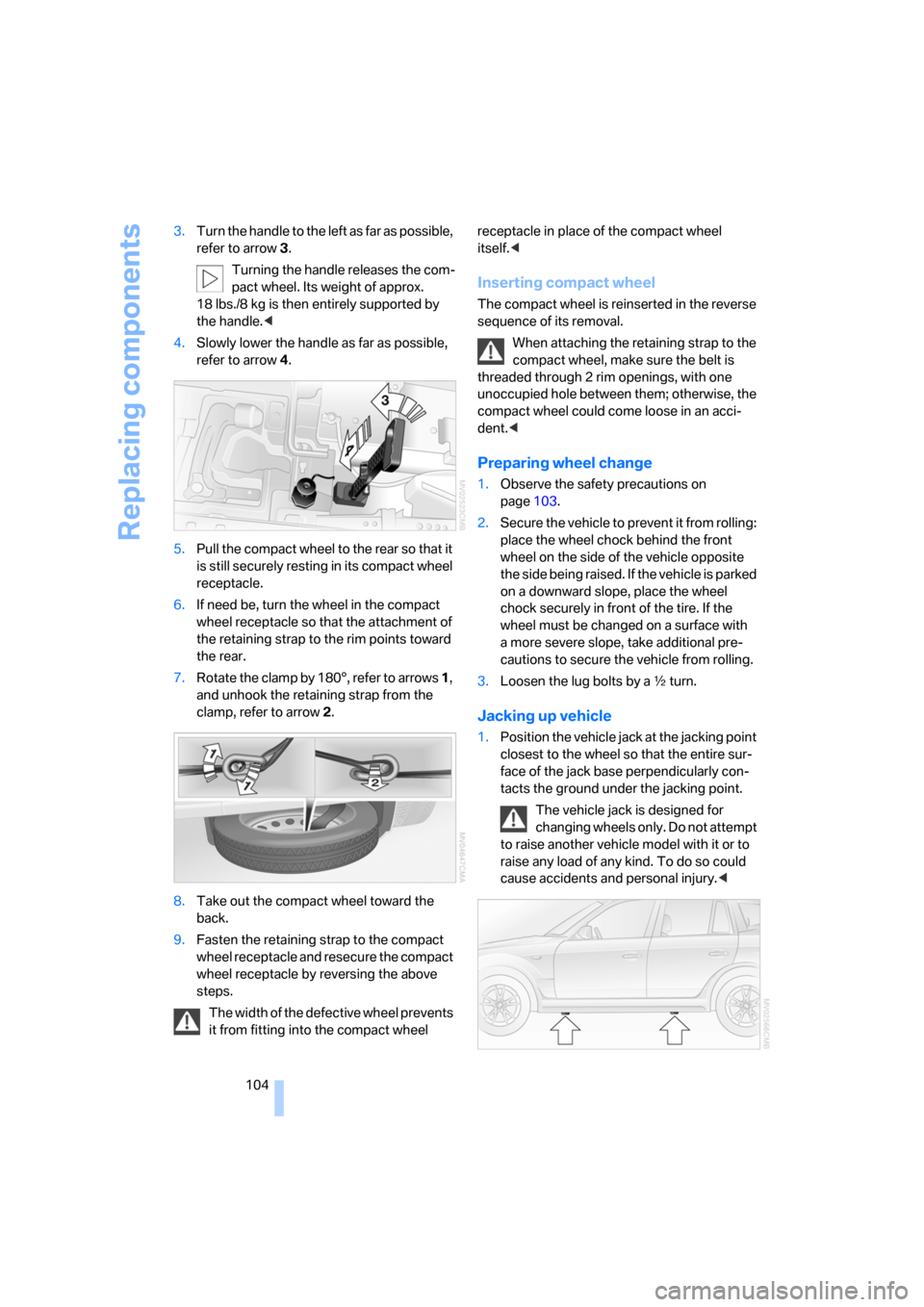
104 3.Turn the handle to the left as far as possible,
refer to arrow3.
Turning the handle releases the com-
pact wheel. Its weight of approx.
18 lbs./8 kg is then entirely supported by
the handle.<
4.Slowly lower the handle as far as possible,
refer to arrow4.
5.Pull the compact wheel to the rear so that it
is still securely resting in its compact wheel
receptacle.
6.If need be, turn the wheel in the compact
wheel receptacle so that the attachment of
the retaining strap to the rim points toward
the rear.
7.Rotate the clamp by 180°, refer to arrows 1,
and unhook the retaining strap from the
clamp, refer to arrow 2.
8.Take out the compact wheel toward the
back.
9.Fasten the retaining strap to the compact
wheel receptacle and resecure the compact
wheel receptacle by reversing the above
steps.
The width of the defective wheel prevents
it from fitting into the compact wheel receptacle in place of the compact wheel
itself.<
Inserting compact wheel
The compact wheel is reinserted in the reverse
sequence of its removal.
When attaching the retaining strap to the
compact wheel, make sure the belt is
threaded through 2 rim openings, with one
unoccupied hole between them; otherwise, the
compact wheel could come loose in an acci-
dent.<
Preparing wheel change
1.Observe the safety precautions on
page103.
2.Secure the vehicle to prevent it from rolling:
place the wheel chock behind the front
wheel on the side of the vehicle opposite
the side being raised. If the vehicle is parked
on a downward slope, place the wheel
chock securely in front of the tire. If the
wheel must be changed on a surface with
a more severe slope, take additional pre-
cautions to secure the vehicle from rolling.
3.Loosen the lug bolts by a γ turn.
Jacking up vehicle
1.Position the vehicle jack at the jacking point
closest to the wheel so that the entire sur-
face of the jack base perpendicularly con-
tacts the ground under the jacking point.
The vehicle jack is designed for
changing wheels only. Do not attempt
to raise another vehicle model with it or to
raise any load of any kind. To do so could
cause accidents and personal injury.<
Page 107 of 133
Reference
At a glance
Controls
Driving tips
Mobility
105
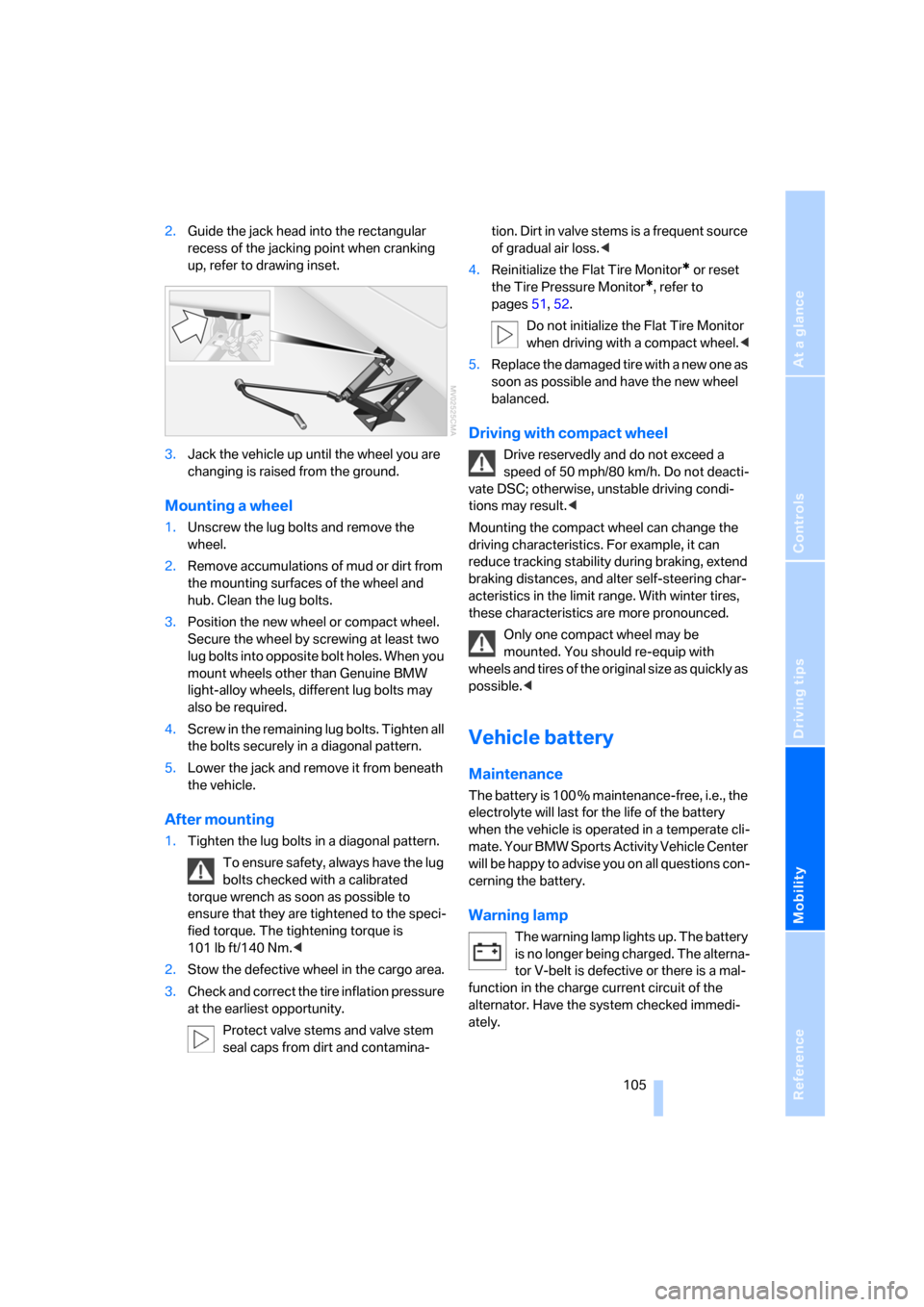
2.Guide the jack head into the rectangular
recess of the jacking point when cranking
up, refer to drawing inset.
3.Jack the vehicle up until the wheel you are
changing is raised from the ground.
Mounting a wheel
1.Unscrew the lug bolts and remove the
wheel.
2.Remove accumulations of mud or dirt from
the mounting surfaces of the wheel and
hub. Clean the lug bolts.
3.Position the new wheel or compact wheel.
Secure the wheel by screwing at least two
lug bolts into opposite bolt holes. When you
mount wheels other than Genuine BMW
light-alloy wheels, different lug bolts may
also be required.
4.Screw in the remaining lug bolts. Tighten all
the bolts securely in a diagonal pattern.
5.Lower the jack and remove it from beneath
the vehicle.
After mounting
1.Tighten the lug bolts in a diagonal pattern.
To ensure safety, always have the lug
bolts checked with a calibrated
torque wrench as soon as possible to
ensure that they are tightened to the speci-
fied torque. The tightening torque is
101lbft/140Nm.<
2.Stow the defective wheel in the cargo area.
3.Check and correct the tire inflation pressure
at the earliest opportunity.
Protect valve stems and valve stem
seal caps from dirt and contamina-tion. Dirt in valve stems is a frequent source
of gradual air loss.<
4.Reinitialize the Flat Tire Monitor
* or reset
the Tire Pressure Monitor
*, refer to
pages51, 52.
Do not initialize the Flat Tire Monitor
when driving with a compact wheel.<
5.Replace the damaged tire with a new one as
soon as possible and have the new wheel
balanced.
Driving with compact wheel
Drive reservedly and do not exceed a
speed of 50 mph/80 km/h. Do not deacti-
vate DSC; otherwise, unstable driving condi-
tions may result.<
Mounting the compact wheel can change the
driving characteristics. For example, it can
reduce tracking stability during braking, extend
braking distances, and alter self-steering char-
acteristics in the limit range. With winter tires,
these characteristics are more pronounced.
Only one compact wheel may be
mounted. You should re-equip with
wheels and tires of the original size as quickly as
possible.<
Vehicle battery
Maintenance
The battery is 100 % maintenance-free, i.e., the
electrolyte will last for the life of the battery
when the vehicle is operated in a temperate cli-
mate. Your BMW Sports Activity Vehicle Center
will be happy to advise you on all questions con-
cerning the battery.
Warning lamp
The warning lamp lights up. The battery
is no longer being charged. The alterna-
tor V-belt is defective or there is a mal-
function in the charge current circuit of the
alternator. Have the system checked immedi-
ately.
Page 112 of 133
Giving and receiving assistance
110
With tow bar
The towing vehicle must not be lighter
than the vehicle to be towed; otherwise,
it will not be possible to safely control vehicle
response.<
The tow fittings used should be on the same
side on both vehicles. Should it prove impossi-
ble to avoid mounting the tow bar at an offset
angle, please observe the following:
>Clearance and maneuvering capability will
be strictly limited in corners.
>When mounted at an angle, the tow bar will
exert lateral forces, tending to push the
vehicle sideways.
Secure the tow bar to the tow fittings
only. Otherwise, other vehicle parts could
be damaged.<
With tow-rope
When starting off in the towing vehicle, make
sure that the tow-rope is taut.
To avoid jerking and the associated
stresses on vehicle components when
towing, always use nylon ropes or nylon straps.
Secure the tow rope to the tow fittings only.
Otherwise, other vehicle parts could be dam-
aged.<
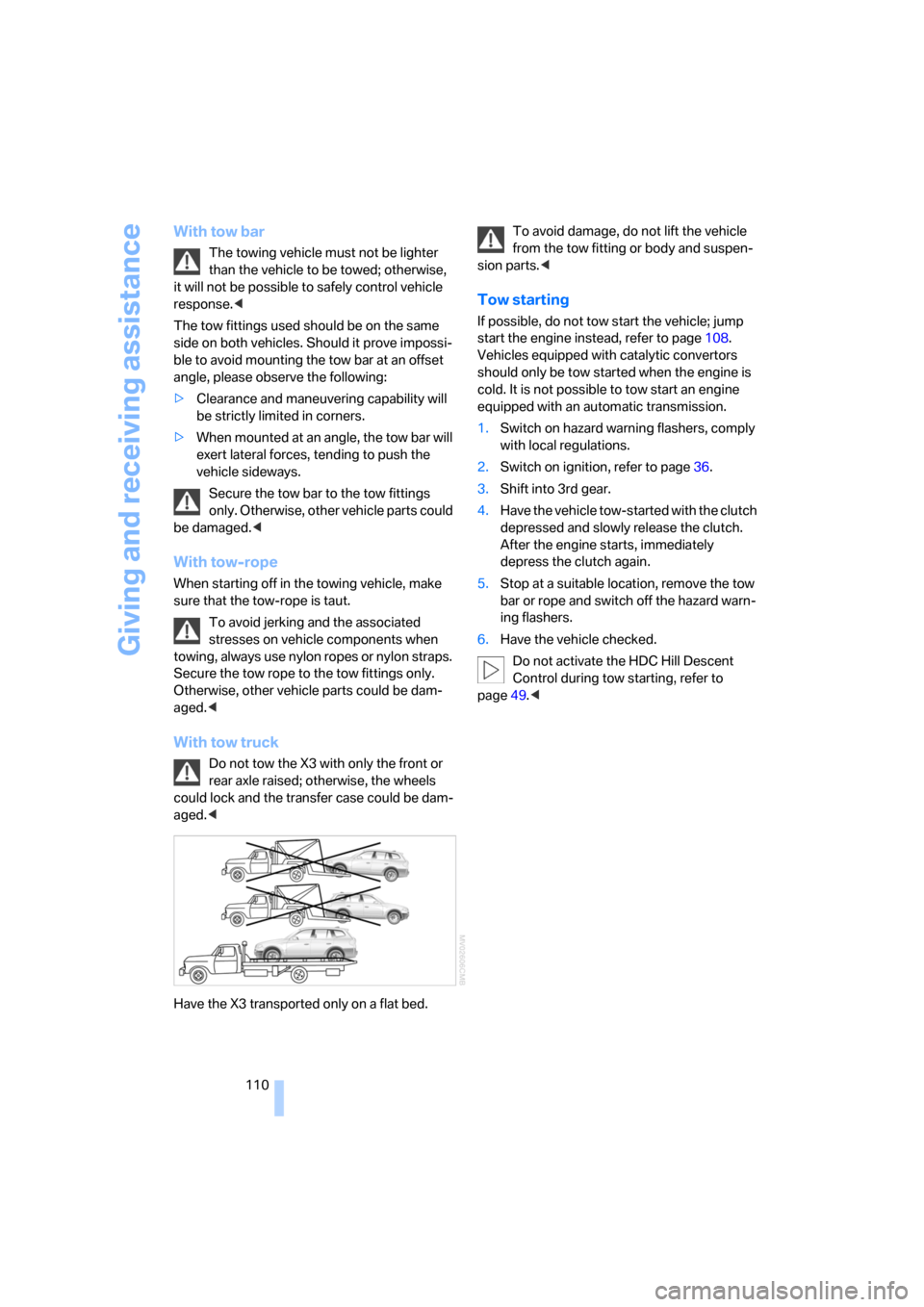
With tow truck
Do not tow the X3 with only the front or
rear axle raised; otherwise, the wheels
could lock and the transfer case could be dam-
aged.<
Have the X3 transported only on a flat bed.To avoid damage, do not lift the vehicle
from the tow fitting or body and suspen-
sion parts.<
Tow starting
If possible, do not tow start the vehicle; jump
start the engine instead, refer to page108.
Vehicles equipped with catalytic convertors
should only be tow started when the engine is
cold. It is not possible to tow start an engine
equipped with an automatic transmission.
1.Switch on hazard warning flashers, comply
with local regulations.
2.Switch on ignition, refer to page36.
3.Shift into 3rd gear.
4.Have the vehicle tow-started with the clutch
depressed and slowly release the clutch.
After the engine starts, immediately
depress the clutch again.
5.Stop at a suitable location, remove the tow
bar or rope and switch off the hazard warn-
ing flashers.
6.Have the vehicle checked.
Do not activate the HDC Hill Descent
Control during tow starting, refer to
page49.<
Page 121 of 133
Reference
At a glance
Controls
Driving tips
Mobility
119
Belts, refer to Safety belts29
Beverage holder, refer to Cup
holders66
Blower, refer to
– Air volume60
– Air volume, adjusting
manually63
BMW maintenance system97
Bottle holder, refer to Cup
holders66
Brake fluid96
– level96
– warning lamp96
Brake force display53
Brake lamps
– brake force display53
– indicator lamp, defective
bulb12,56
– replacing bulbs102
Brake light, refer to Brake
lamps102
Brake pads96
– breaking-in76
– warning lamp96
Brake pedal, refer to Safe
braking78
Brake rotors
– brake system76
– breaking-in76
Brakes78,96
– ABS48,78
– brake fluid96
– brake pads96
– breaking-in76
– handbrake37
– indicator/warning lamp12
Brake system96
– brake fluid96
– brake pads96
– breaking-in76
– disk brakes78
– warning lamp96
Brake wear warning
– refer to Brake pads96
– warning lamp96
Breakdown service, refer to
Receiving assistance107
Breaking-in76Bulb replacement, refer to
Lamps and bulbs99
Buttons on steering wheel13
C
California law
– Event Data Recorders98
– Proposition 65 Warning6
Calling, refer to telephone
Owner's Manual
Can holder, refer to Cup
holders66
Capacities116
Capacity, cargo area116
Car care, refer to Caring for
your vehicle brochure
Car-care products, refer to
Caring for your vehicle
brochure
Care, refer to Caring for your
vehicle brochure
Cargo, securing79
Cargo area21,70
– capacity116
– cover71
– emergency operation, refer
to Opening manually21
– enlarging70
– floor cover72
– folding rear seat backrest70
– lashing eyes73
– lid, refer to Liftgate21
– opening from outside21
– opening with remote
control19
– power socket69
Cargo loading78
– load79
– securing cargo79
– stowing cargo79
– vehicle78
Caring for artificial leather,
refer to Caring for your
vehicle brochure
Caring for carpet, refer to
Caring for your vehicle
brochureCaring for leather, refer to
Caring for your vehicle
brochure
Caring for plastic, refer to
Caring for your vehicle
brochure
Caring for vehicle finish, refer
to Caring for your vehicle
brochure
Car keys, refer to Key set18
Car phone, refer to separate
Owner's Manual
Car phone preparation69
Car radio, refer to Owner's
Manual for Radio/Onboard
Computer
Car wash77
– refer to Caring for your
vehicle brochure
Cassette operation, refer to
Owner's Manual for Radio/
Onboard Computer
CD operation, refer to Owner's
Manual for Radio/Onboard
Computer
Cellphone, refer to separate
Owner's Manual
Central locking system18
– interior20
Changes, technical, refer to
For your own safety6
Changing a wheel103
Changing gears
– automatic transmission with
Steptronic39
– manual transmission38
Changing wheels89
Charge-current indicator
lamp12,105
Charging battery106
Check Gas Cap, warning
lamp12,84
Checking oil level94
Child's seat, refer to Child
restraint systems33
Child-restraint fixing system
LATCH34