brake BMW X3 2.5I SAV 2004 User Guide
[x] Cancel search | Manufacturer: BMW, Model Year: 2004, Model line: X3 2.5I SAV, Model: BMW X3 2.5I SAV 2004Pages: 132, PDF Size: 3.62 MB
Page 56 of 132
Technology for comfort, convenience and safety
54
Brake force display
The brake force display indicates the inten-
sity with which you are applying your
brakes to drivers of following vehicles.
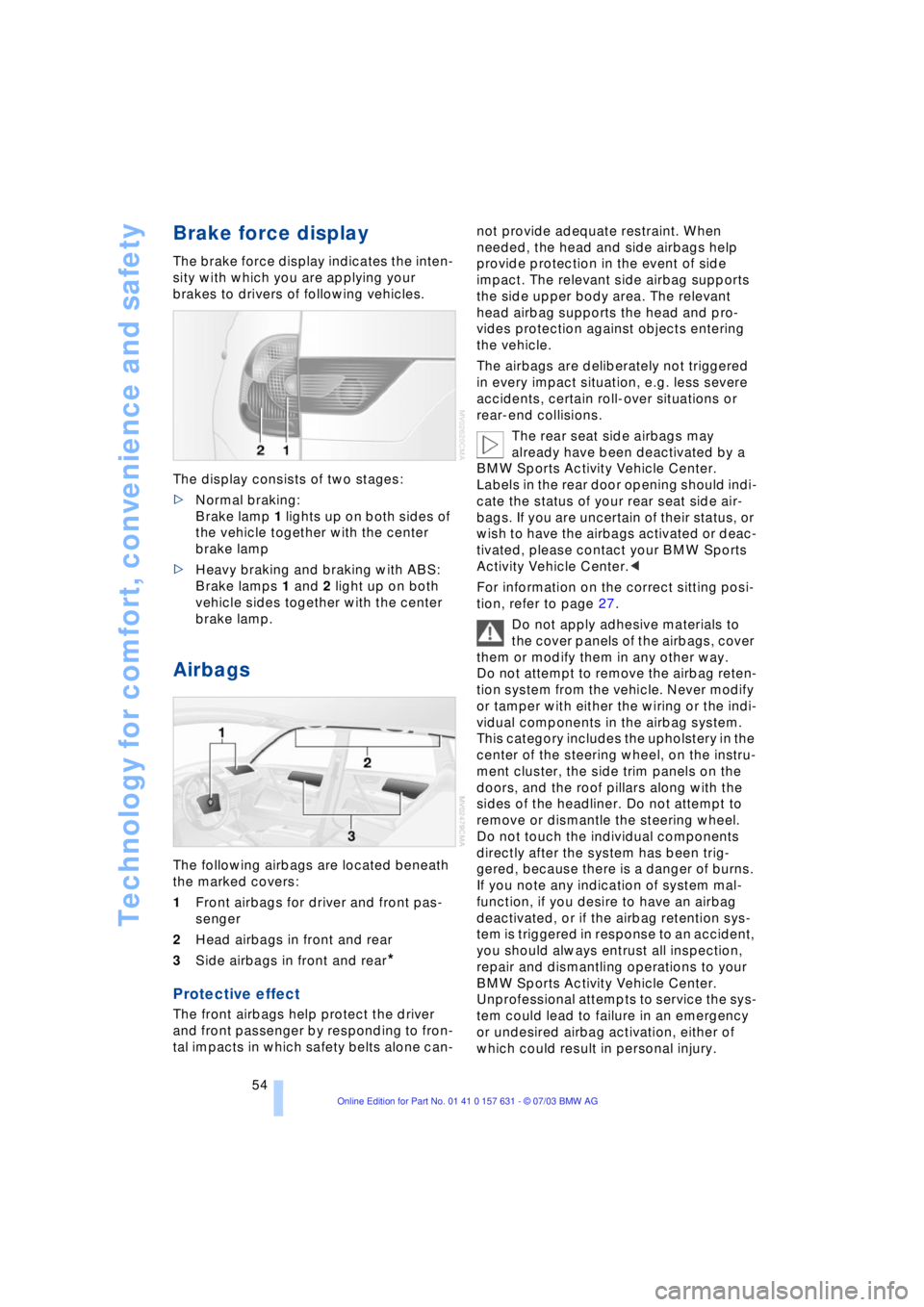
The display consists of two stages:
>Normal braking:
Brake lamp 1 lights up on both sides of
the vehicle together with the center
brake lamp
>Heavy braking and braking with ABS:
Brake lamps 1 and 2 light up on both
vehicle sides together with the center
brake lamp.
Airbags
The following airbags are located beneath
the marked covers:
1Front airbags for driver and front pas-
senger
2Head airbags in front and rear
3Side airbags in front and rear
*
Protective effect
The front airbags help protect the driver
and front passenger by responding to fron-
tal impacts in which safety belts alone can-not provide adequate restraint. When
needed, the head and side airbags help
provide protection in the event of side
impact. The relevant side airbag supports
the side upper body area. The relevant
head airbag supports the head and pro-
vides protection against objects entering
the vehicle.
The airbags are deliberately not triggered
in every impact situation, e.g. less severe
accidents, certain roll-over situations or
rear-end collisions.
The rear seat side airbags may
already have been deactivated by a
BMW Sports Activity Vehicle Center.
Labels in the rear door opening should indi-
cate the status of your rear seat side air-
bags. If you are uncertain of their status, or
wish to have the airbags activated or deac-
tivated, please contact your BMW Sports
Activity Vehicle Center.<
For information on the correct sitting posi-
tion, refer to page 27.
Do not apply adhesive materials to
the cover panels of the airbags, cover
them or modify them in any other way.
Do not attempt to remove the airbag reten-
tion system from the vehicle. Never modify
or tamper with either the wiring or the indi-
vidual components in the airbag system.
This category includes the upholstery in the
center of the steering wheel, on the instru-
ment cluster, the side trim panels on the
doors, and the roof pillars along with the
sides of the headliner. Do not attempt to
remove or dismantle the steering wheel.
Do not touch the individual components
directly after the system has been trig-
gered, because there is a danger of burns.
If you note any indication of system mal-
function, if you desire to have an airbag
deactivated, or if the airbag retention sys-
tem is triggered in response to an accident,
you should always entrust all inspection,
repair and dismantling operations to your
BMW Sports Activity Vehicle Center.
Unprofessional attempts to service the sys-
tem could lead to failure in an emergency
or undesired airbag activation, either of
which could result in personal injury.
Page 78 of 132
Things to remember when driving
76
Things to remember when driving
Break-in procedures
To ensure that your vehicle provides maxi-
mum economy throughout a long service
life, we request that you observe the fol-
lowing instructions:
Engine and differential
Up to 1,200 miles/2,000 km:
During this initial period you should attempt
to avoid constant, steady-state operation
and vary both vehicle and engine speeds
as often as possible. Until the break-in
period has been completed you should
also refrain from exceeding the following:
>4,500 rpm or 100 mph/160 km/h.
Always obey all official speed limits.
Refrain from using full throttle and avoid
pressing the accelerator beyond the kick-
down point.
Once you have driven 1,200 miles/
2,000 km, the engine and vehicle speeds
can be gradually increased.
You should also comply with these break-in
procedures should the engine or one of the
differentials be replaced later in the course
of the vehicle's service life.
Tires
Due to technical factors associated with
their manufacture, tires do not achieve their
full traction potential until after an initial
break-in period. For this reason, drive with
extra care during the initial 200 miles/
300 km.
Obey your local and state maximum speed
limits.
When the vehicle is operated on wet
or slushy roads, a wedge of water
may form between the tire and the road
surface. This phenomenon is referred to as
hydroplaning and can lead to partial or
complete loss of traction, vehicle control
and braking effectiveness. Reduce your
speed on wet roads.<
Brake system
Approx. 300 miles/500 km must elapse
before the brake pads and rotors achieve
the optimal pad-surface and wear patterns
required for trouble-free operation and
long service life later on.
To break in the separate handbrake drums,
apply the handbrake lightly when coasting
to a standstill Ð at a traffic signal, for
instance; use caution to avoid posing a
danger to other road users.
To avoid corrosion, repeat this procedure
from time to time.
The brake lamps do not come on when the
handbrake is set.
Vacuum for the brake system servo
unit on your BMW is available only
when the engine is running. When you
move the vehicle with the engine off Ð e.g.
by towing Ð substantially higher levels of
pedal force will be required to brake the
vehicle.<
Clutch
The function of the clutch is also only at its
optimized level after a distance driven of
approx. 300 miles/500 km. During this
break-in period, engage the clutch gently.
General driving notes
High temperatures
Extreme temperatures occur at the
catalytic converter on this and every
catalyst-equipped vehicle. Do not remove
the heat shields installed adjacent to vari-
ous sections of the exhaust system, and
never apply undercoating to them. When
driving, standing at idle and while parking
take care to avoid possible contact
between the hot exhaust system and any
highly flammable materials such as hay,
leaves, grass, etc. Such contact could lead
Page 79 of 132
Reference
At a glance
Controls
Driving tips
Mobility
77
to a fire, and with it the risk of serious prop-
erty damage as well as personal injury.<
Parking the vehicle
Condensation forms in the air conditioner
system during operation, and then exits
under the vehicle. Traces of condensed
water under the vehicle are thus normal.
Before driving into the car wash
Fold in the exterior mirrors, refer to
page 31, as otherwise they could be dam-
aged due to the width of the vehicle.
Deactivate the rain sensor as otherwise
damage could result from undesired wiper
activation, refer to page 42.
Hydroplaning
When driving on wet or slushy roads,
reduce road speed. If you do not, a
wedge of water can form between tires and
road surface. This phenomenon is referred
to as hydroplaning, and is characterized by
a partial or complete loss of contact
between tires and road surface, ultimately
undermining your ability to steer and brake
the vehicle.<
Driving through water
Do not drive through water on the
road if it is deeper than 20 in/50 cm,
and then only at walking speed. Otherwise,
the vehicle's engine, the electrical systems
and the transmission may be damaged.<
Safe braking
Emergency stops
The best way to brake is to apply maximum
pressure to the brake pedal during emer-
gency Ð panic stops. Since the vehicle
maintains steering responsiveness, you
can nevertheless avoid possible obstacles
with a minimum of steering effort.
Pulsation at the brake pedal combined with
sounds from the hydraulic circuits indicates
to the driver that ABS is in its active mode. Do not drive with your foot resting on
the brake pedal. Otherwise, even light
but consistent pedal pressure can lead to
high temperatures, brake wear and possi-
bly even brake failure.<
Wet conditions
While driving in wet conditions and in
heavy rain, it is a good idea to apply light
pressure to the brake pedal every few
miles. Watch traffic conditions to ensure
that this maneuver does not endanger
other road users. The heat which is gener-
ated by the brake applications helps to dry
the brake pads and rotors. The required
braking force will then be available when
you need it.
On a grade
You can retain full and unimpaired braking
efficiency by downshifting to a gear in
which only minimal brake applications are
needed when descending long or steep
downhill stretches.
You can further enhance the engine's brak-
ing effect by selecting a lower gear in the
automatic transmission's manual mode,
downshifting as far as first gear on
extremely steep stretches, refer to
page 38. This strategy helps you avoid
placing excessive loads on the brake sys-
tem.
During slower downhill driving, use the Hill
Descent Control HDC, refer to page 51.
Never drive with the clutch pressed,
with the transmission in Neutral or
with the engine switched off, as otherwise
there is no engine braking when the trans-
mission is in Neutral, and no power-assist
for brakes and steering.
Never allow floor mats, carpets or any other
objects to protrude into the area around the
accelerator and brake pedals and obstruct
their movement.<
Corrosion
When the vehicle is driven only occasion-
ally, during extended periods when the
vehicle is not used at all, and in operating
conditions where brake applications are
Page 80 of 132
Things to remember when driving
78 less frequent, there is an increased ten-
dency for corrosion to form on rotors, while
contaminants accumulate on the brake
pads. This occurs because the minimal
pressure which must be exerted by the
pads during brake applications to clean the
rotors is not reached.
Should corrosion form on the brake rotors,
the brakes will tend to respond with a pul-
sating effect that even extended applica-
tion will fail to cure.
Cargo loading
To avoid loading the tires beyond
their approved carrying capacity,
never overload the vehicle. Overloading
can lead to overheating and increases the
rate at which damage develops inside the
tires. The ultimate result can assume the
form of a sudden air loss.<
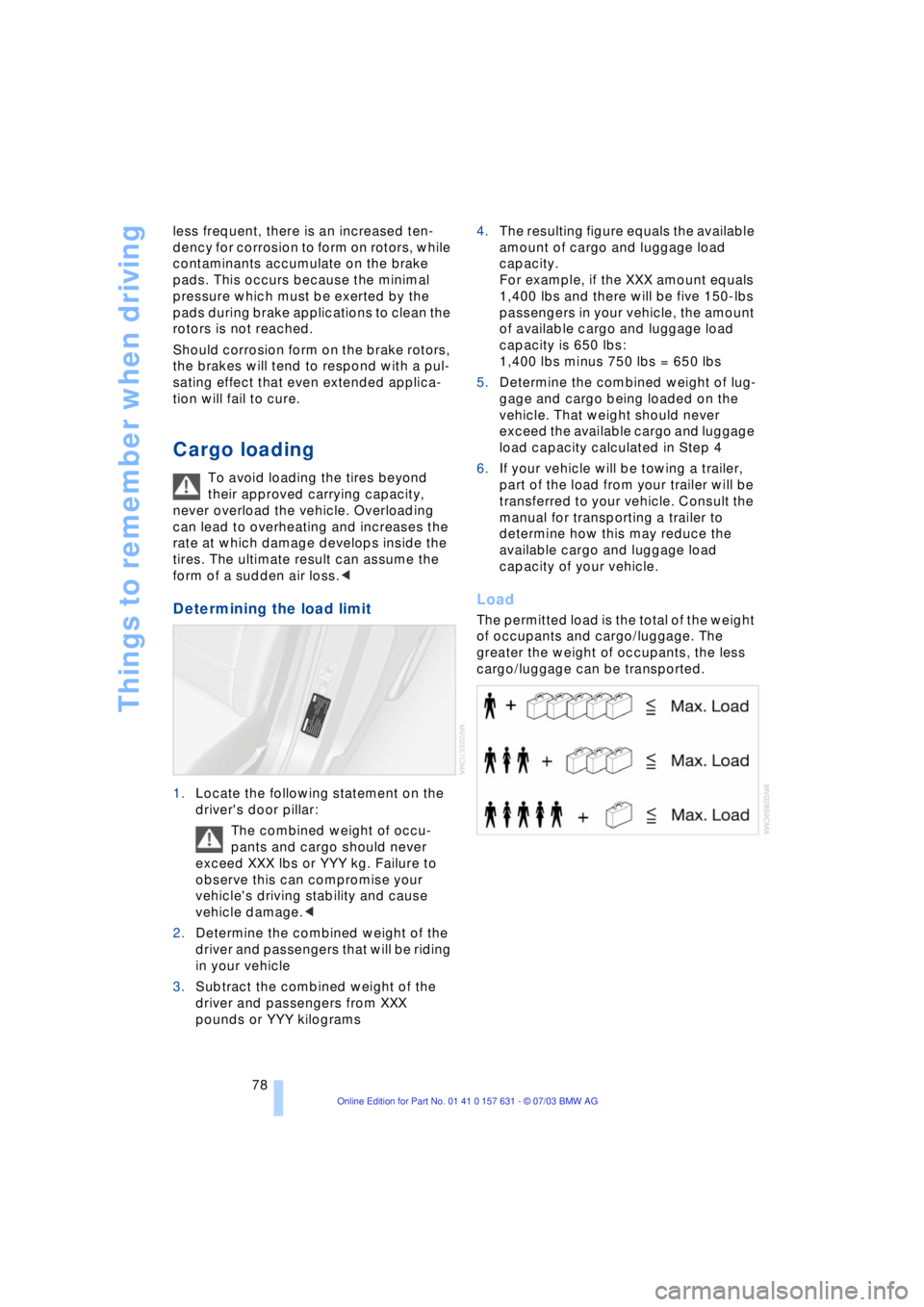
Determining the load limit
1.Locate the following statement on the
driver's door pillar:
The combined weight of occu-
pants and cargo should never
exceed XXX lbs or YYY kg. Failure to
observe this can compromise your
vehicle's driving stability and cause
vehicle damage.<
2.Determine the combined weight of the
driver and passengers that will be riding
in your vehicle
3.Subtract the combined weight of the
driver and passengers from XXX
pounds or YYY kilograms4.The resulting figure equals the available
amount of cargo and luggage load
capacity.
For example, if the XXX amount equals
1,400 lbs and there will be five 150-lbs
passengers in your vehicle, the amount
of available cargo and luggage load
capacity is 650 lbs:
1,400 lbs minus 750 lbs = 650 lbs
5.Determine the combined weight of lug-
gage and cargo being loaded on the
vehicle. That weight should never
exceed the available cargo and luggage
load capacity calculated in Step 4
6.If your vehicle will be towing a trailer,
part of the load from your trailer will be
transferred to your vehicle. Consult the
manual for transporting a trailer to
determine how this may reduce the
available cargo and luggage load
capacity of your vehicle.
Load
The permitted load is the total of the weight
of occupants and cargo/luggage. The
greater the weight of occupants, the less
cargo/luggage can be transported.
Page 82 of 132

Things to remember when driving
80
Driving on bad roads
Your BMW X3 is at home on all paved and
unpaved roads. It combines all-wheel drive
with the advantages of a normal passenger
car.
Driving on unpaved terrain can cause
damage to the vehicle.<
When you are driving on bad roads, there
are a few points which you should strictly
observe Ñ for your own safety, for that of
your passengers, and for the safety of the
vehicle:
>Familiarize yourself with the vehicle
before you begin driving. Do not take
risks with the vehicle under any circum-
stances
>Always adapt the driving speed to the
road conditions. The more steep and
uneven the roadway is, the lower the
speed should be
>You can operate your vehicle on uphill
and downhill gradients with a maximum
slope of 50 %. If you wish to drive on
uphill and downhill grades of this
nature, make sure beforehand that the
engine oil and coolant levels are near
the max mark, refer to pages 94 and 96
>For very steep downhill driving, use Hill
Descent Control HDC, refer to page 51.
Driving off is possible on upward
inclines of up to 33%.
The permitted side inclination is 50 %
>While driving, watch carefully for obsta-
cles such as rocks or holes. Try to avoid
these obstacles whenever possible
>Avoid that the body makes contact with
the ground, e.g. on the crests of hills
and bumpy roads
>Do not drive in water that is deeper than
20 in/50 cm. If you must drive through
water up to that depth, drive at a walk-
ing speed and do not stop.
After leaving the water, press on the
footbrake gently several times while
driving at a low speed. The brake appli-
cations will help to dry the brakes, thus
preventing a reduction in braking per-
formance caused by the moisture. For cleaning the handbrake, apply the
lever slightly at approx. 25 mph/40 km/
h and continue to drive for approx. 200
yards/200 meters, provided that traffic
conditions allow you to do so.
Please bear the following points in mind
after driving on poor roads, in order to pre-
serve the road safety of your BMW:
>Clean the heavy dirt from the body
>Clean mud, snow, ice and other materi-
als from the wheels and tires. Check the
tires for damage.
Page 95 of 132
Reference
At a glance
Controls
Driving tips
Mobility
93
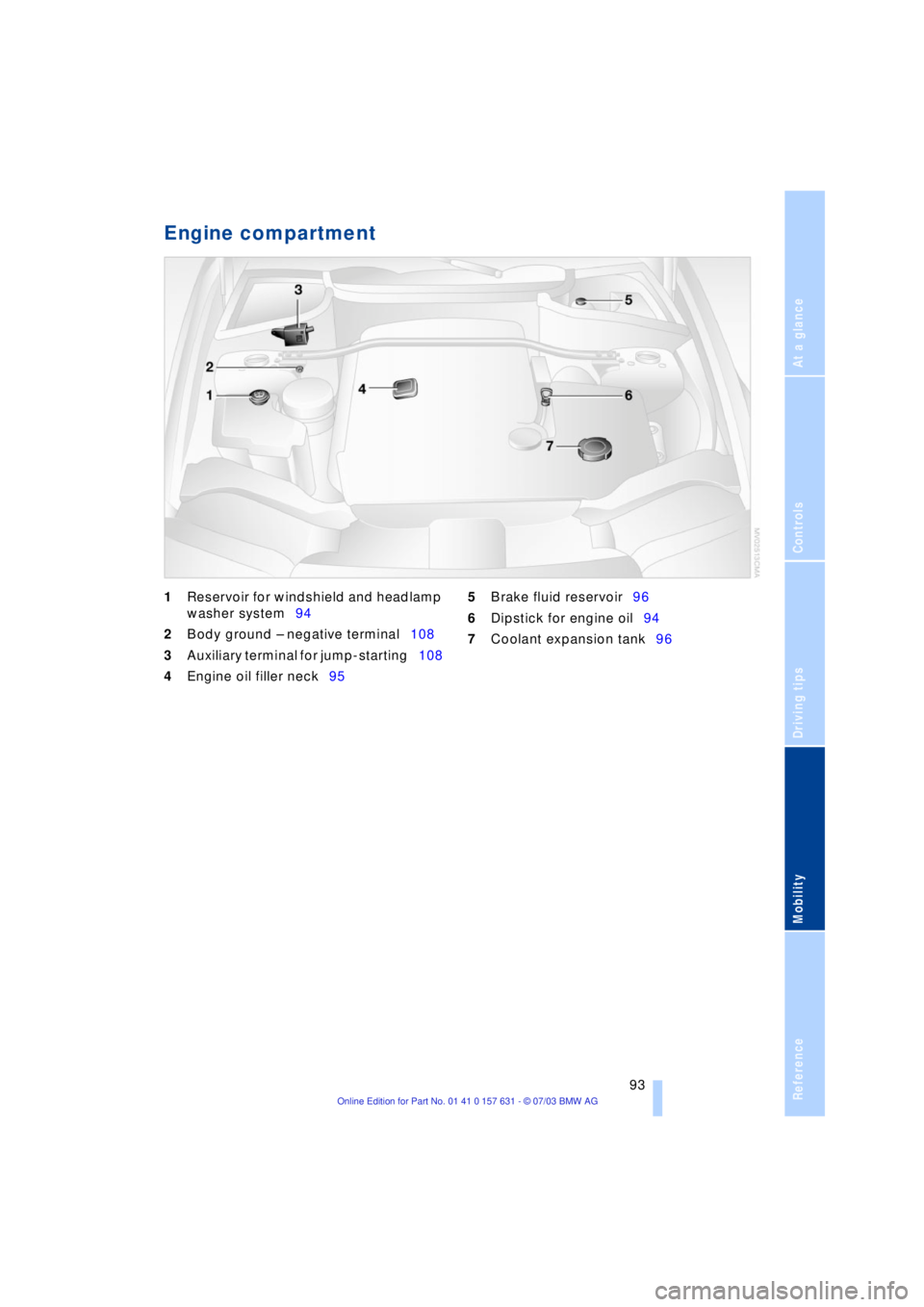
Engine compartment
1Reservoir for windshield and headlamp
washer system94
2Body ground Ð negative terminal108
3Auxiliary terminal for jump-starting108
4Engine oil filler neck95 5Brake fluid reservoir96
6Dipstick for engine oil94
7Coolant expansion tank96
Page 98 of 132
Under the engine hood
96
Checking coolant level and topping
up coolant
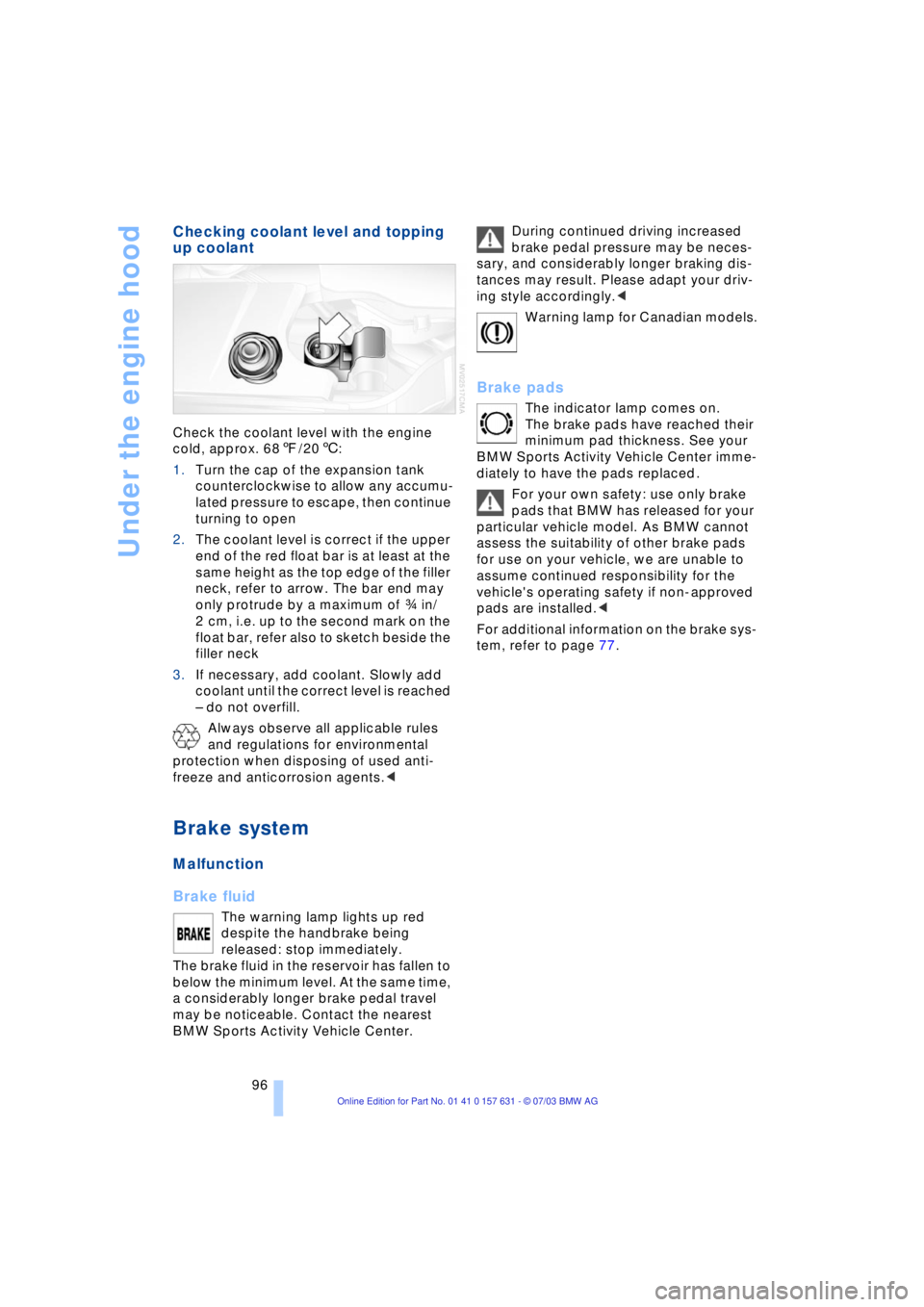
Check the coolant level with the engine
cold, approx. 687/206:
1.Turn the cap of the expansion tank
counterclockwise to allow any accumu-
lated pressure to escape, then continue
turning to open
2.The coolant level is correct if the upper
end of the red float bar is at least at the
same height as the top edge of the filler
neck, refer to arrow. The bar end may
only protrude by a maximum of i in/
2 cm, i.e. up to the second mark on the
float bar, refer also to sketch beside the
filler neck
3.If necessary, add coolant. Slowly add
coolant until the correct level is reached
Ð do not overfill.
Always observe all applicable rules
and regulations for environmental
protection when disposing of used anti-
freeze and anticorrosion agents.<
Brake system
Malfunction
Brake fluid
The warning lamp lights up red
despite the handbrake being
released: stop immediately.
The brake fluid in the reservoir has fallen to
below the minimum level. At the same time,
a considerably longer brake pedal travel
may be noticeable. Contact the nearest
BMW Sports Activity Vehicle Center.During continued driving increased
brake pedal pressure may be neces-
sary, and considerably longer braking dis-
tances may result. Please adapt your driv-
ing style accordingly.<
Warning lamp for Canadian models.
Brake pads
The indicator lamp comes on.
The brake pads have reached their
minimum pad thickness. See your
BMW Sports Activity Vehicle Center imme-
diately to have the pads replaced.
For your own safety: use only brake
pads that BMW has released for your
particular vehicle model. As BMW cannot
assess the suitability of other brake pads
for use on your vehicle, we are unable to
assume continued responsibility for the
vehicle's operating safety if non-approved
pads are installed.<
For additional information on the brake sys-
tem, refer to page 77.
Page 99 of 132
Reference
At a glance
Controls
Driving tips
Mobility
97
Maintenance
The BMW maintenance
system
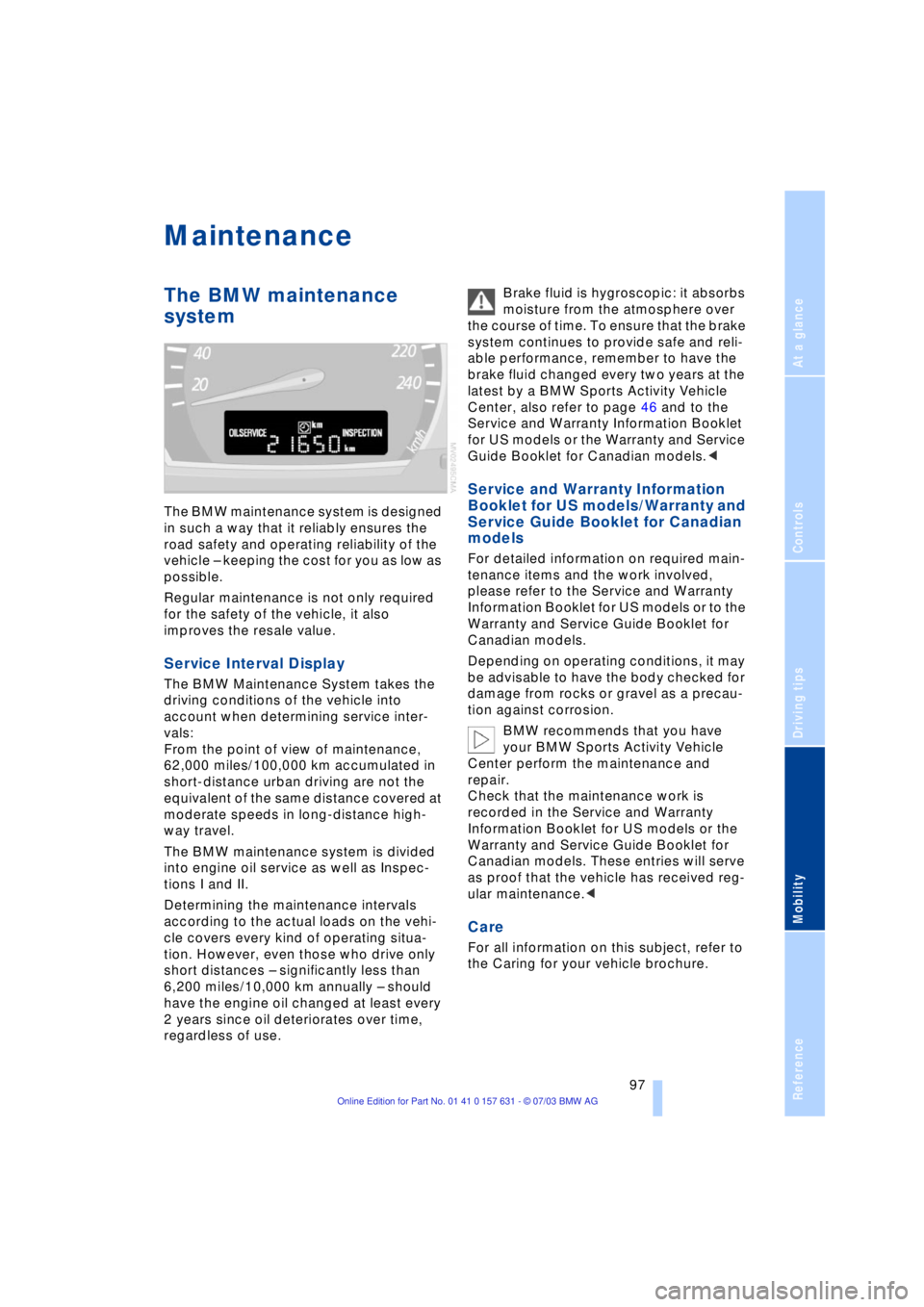
The BMW maintenance system is designed
in such a way that it reliably ensures the
road safety and operating reliability of the
vehicle Ð keeping the cost for you as low as
possible.
Regular maintenance is not only required
for the safety of the vehicle, it also
improves the resale value.
Service Interval Display
The BMW Maintenance System takes the
driving conditions of the vehicle into
account when determining service inter-
vals:
From the point of view of maintenance,
62,000 miles/100,000 km accumulated in
short-distance urban driving are not the
equivalent of the same distance covered at
moderate speeds in long-distance high-
way travel.
The BMW maintenance system is divided
into engine oil service as well as Inspec-
tions I and II.
Determining the maintenance intervals
according to the actual loads on the vehi-
cle covers every kind of operating situa-
tion. However, even those who drive only
short distances Ð significantly less than
6,200 miles/10,000 km annually Ð should
have the engine oil changed at least every
2 years since oil deteriorates over time,
regardless of use.Brake fluid is hygroscopic: it absorbs
moisture from the atmosphere over
the course of time. To ensure that the brake
system continues to provide safe and reli-
able performance, remember to have the
brake fluid changed every two years at the
latest by a BMW Sports Activity Vehicle
Center, also refer to page 46 and to the
Service and Warranty Information Booklet
for US models or the Warranty and Service
Guide Booklet for Canadian models.<
Service and Warranty Information
Booklet for US models/Warranty and
Service Guide Booklet for Canadian
models
For detailed information on required main-
tenance items and the work involved,
please refer to the Service and Warranty
Information Booklet for US models or to the
Warranty and Service Guide Booklet for
Canadian models.
Depending on operating conditions, it may
be advisable to have the body checked for
damage from rocks or gravel as a precau-
tion against corrosion.
BMW recommends that you have
your BMW Sports Activity Vehicle
Center perform the maintenance and
repair.
Check that the maintenance work is
recorded in the Service and Warranty
Information Booklet for US models or the
Warranty and Service Guide Booklet for
Canadian models. These entries will serve
as proof that the vehicle has received reg-
ular maintenance.<
Care
For all information on this subject, refer to
the Caring for your vehicle brochure.
Page 104 of 132
Replacing components
102
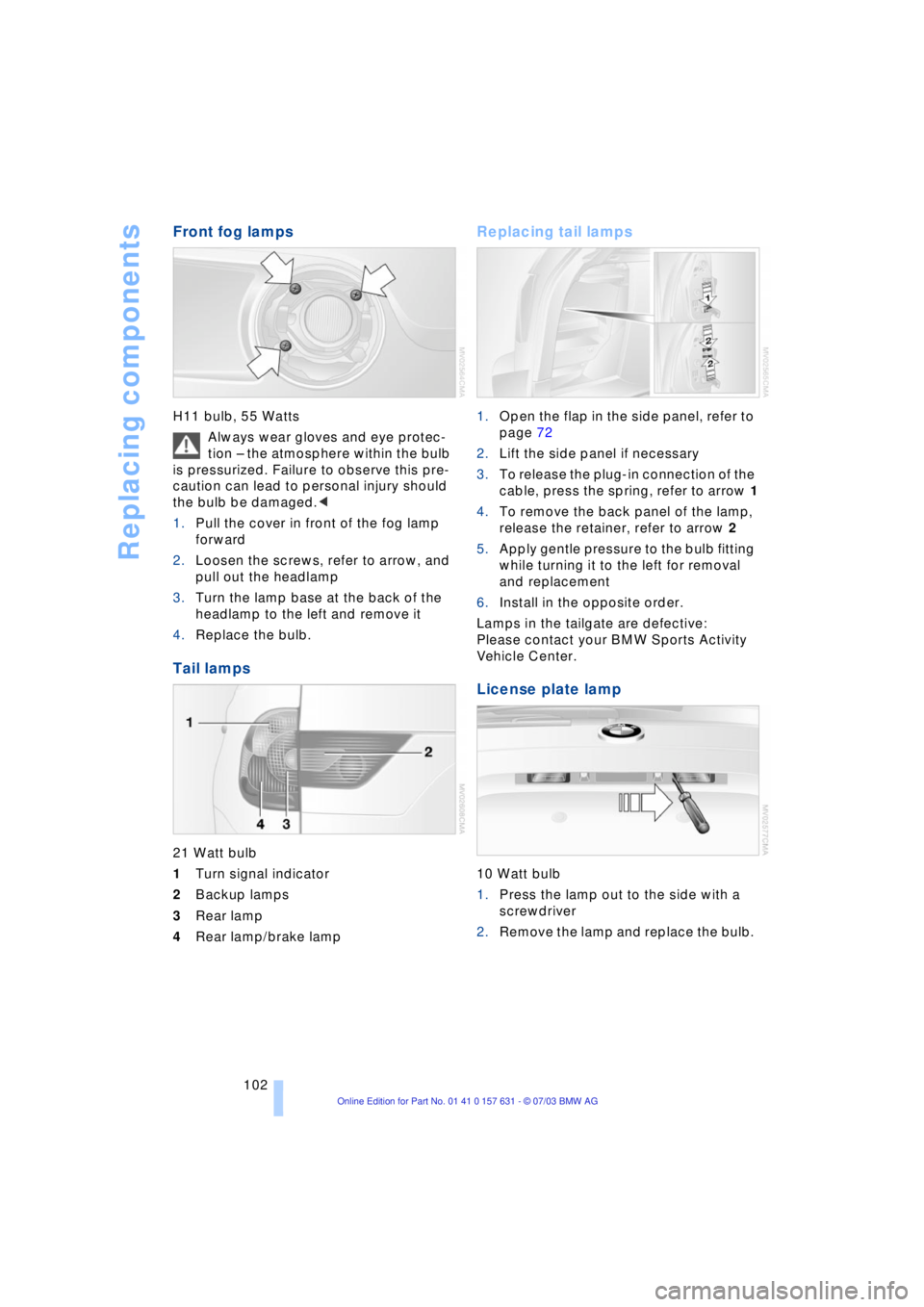
Front fog lamps
H11 bulb, 55 Watts
Always wear gloves and eye protec-
tion Ð the atmosphere within the bulb
is pressurized. Failure to observe this pre-
caution can lead to personal injury should
the bulb be damaged.<
1.Pull the cover in front of the fog lamp
forward
2.Loosen the screws, refer to arrow, and
pull out the headlamp
3.Turn the lamp base at the back of the
headlamp to the left and remove it
4.Replace the bulb.
Tail lamps
21 Watt bulb
1Turn signal indicator
2Backup lamps
3Rear lamp
4Rear lamp/brake lamp
Replacing tail lamps
1.Open the flap in the side panel, refer to
page 72
2.Lift the side panel if necessary
3.To release the plug-in connection of the
cable, press the spring, refer to arrow 1
4.To remove the back panel of the lamp,
release the retainer, refer to arrow 2
5.Apply gentle pressure to the bulb fitting
while turning it to the left for removal
and replacement
6.Install in the opposite order.
Lamps in the tailgate are defective:
Please contact your BMW Sports Activity
Vehicle Center.
License plate lamp
10 Watt bulb
1.Press the lamp out to the side with a
screwdriver
2.Remove the lamp and replace the bulb.
Page 105 of 132
Reference
At a glance
Controls
Driving tips
Mobility
103
Tailgate lamp
5 Watt bulb
1.Pull off the bulb holder
2.Replace the bulb.
Light-emitting diodes LEDs
Light-emitting diodes installed behind
translucent lenses serve as the light source
for many of the controls and displays in
your vehicle. These light-emitting diodes,
which operate using a concept similar to
that applied in conventional lasers, are offi-
cially designated as Class 1 light-emitting
diodes.
Do not remove the covers, and never
stare into the unfiltered light for sev-
eral hours, as irritation of the retina could
result.<
Changing a wheel
Safety precautions to observe in the
event of a flat tire and during all tire
changes:
Park the vehicle as far as possible from
passing traffic. Park on a firm, flat, surface.
Switch on the hazard warning flashers.
Lock the steering wheel in straight-ahead
setting of the wheels. Set the handbrake
and engage first gear, reverse gear or
selector-lever position P.
All passengers should be outside the vehi-
cle and well away from your immediate
working area, behind a guardrail, for
instance.
If a warning triangle or portable hazard
warning lamp is required, set it up on the
roadside at an appropriate distance from
the rear of the vehicle. Comply with all safety guidelines and regulations.
Change the wheel only on a level, firm sur-
face which is not slippery. The vehicle or
the jack could slip to the side if you attempt
to raise the vehicle on a soft or slippery sur-
face such as snow, ice, tiles, etc.
Position the jack on a firm support surface.
Do not use a wooden block or similar
object as a support base for the jack, as
this would prevent it from extending to its
full support height and reduce its load-car-
rying capacity.
To avoid serious or fatal injury: never lie
under the vehicle, and never start the
engine while it is supported by the jack.<
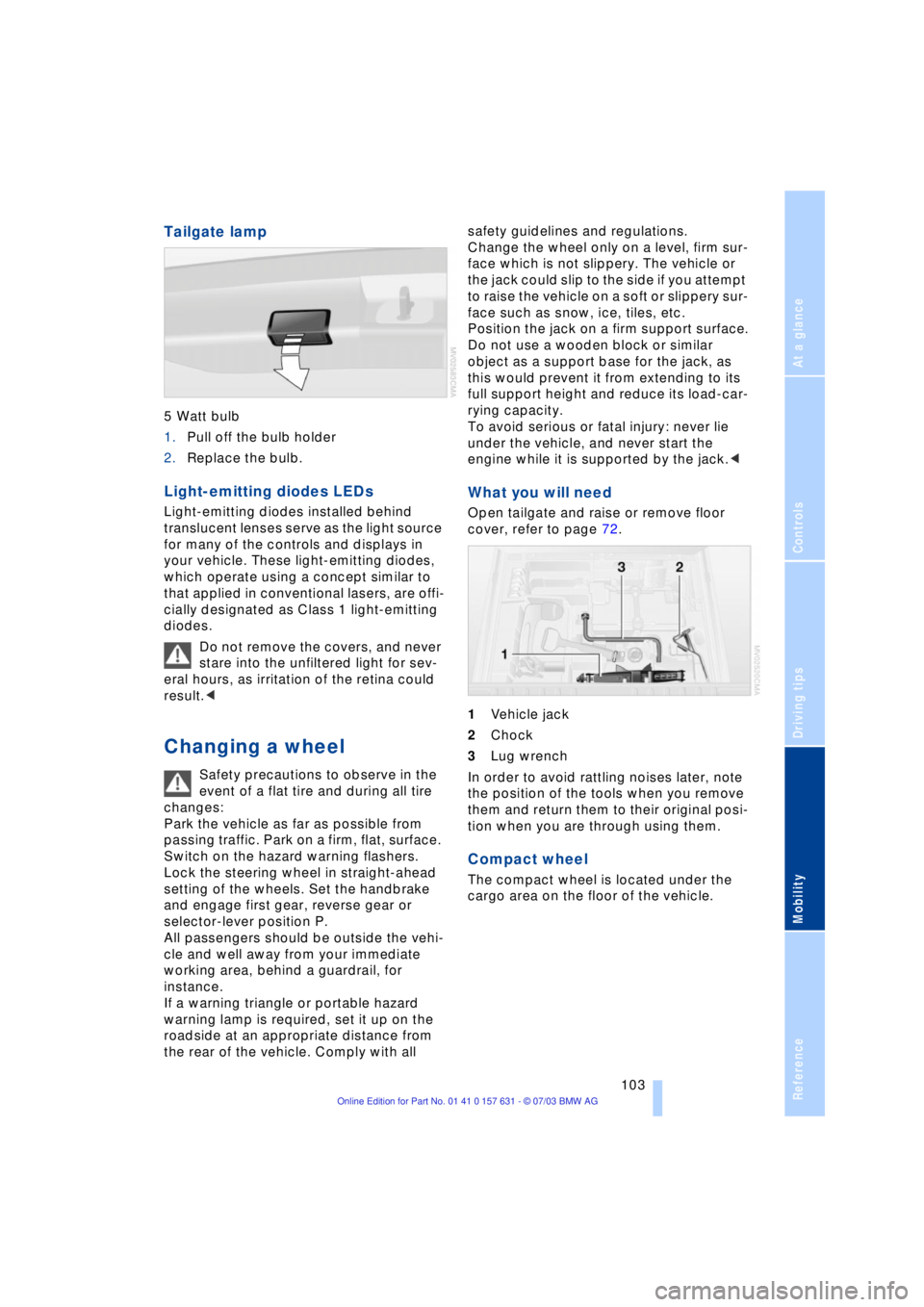
What you will need
Open tailgate and raise or remove floor
cover, refer to page 72.
1Vehicle jack
2Chock
3Lug wrench
In order to avoid rattling noises later, note
the position of the tools when you remove
them and return them to their original posi-
tion when you are through using them.
Compact wheel
The compact wheel is located under the
cargo area on the floor of the vehicle.