air condition BMW X3 2.5I SAV 2004 Owners Manual
[x] Cancel search | Manufacturer: BMW, Model Year: 2004, Model line: X3 2.5I SAV, Model: BMW X3 2.5I SAV 2004Pages: 132, PDF Size: 3.62 MB
Page 8 of 132
Notes
6
For your own safety
Fuels
Use unleaded gasoline only. Fuels
containing up to and including 10 %
ethanol or other oxygenates with up to
2.8 % oxygen by weight, i.e. 15% MTBE or
3% methanol plus an equivalent amount of
co-solvent Ð will not void the applicable
warranties respecting defects in materials
or workmanship. Field experience has indi-
cated significant differences in fuel quality Ð
i.e. volatility, composition, additives, etc. Ð
among gasolines offered for sale in the
United States and Canada. The use of
poor-quality fuels may result in driveability,
starting and stalling problems especially
under certain environmental conditions,
such as high ambient temperature and high
altitude.
Should you encounter driveability prob-
lems which you suspect could be related to
the fuel you are using, we recommend that
you respond by switching to a recognized
high-quality brand.
Failure to comply with these recommenda-
tions may result in unscheduled mainte-
nance.
Follow the relevant safety rules when you
are handling gasoline.
<
Maintenance and repair
Advanced technology, e.g. the use of
modern materials and high-perfor-
mance electronics, requires specially
adapted maintenance and repair methods.
Therefore, only have corresponding work
on your BMW carried out by a BMW Sports
Activity Vehicle Center or a workshop that
works according to BMW repair proce-
dures with correspondingly trained person-
nel. If work is carried out improperly, there
is a danger of consequential damage and
the related safety risks.
<
Parts and accessories
For your own safety, use genuine
parts and accessories approved by
BMW.
When you purchase accessories tested
and approved by BMW and Genuine BMW
Parts, you simultaneously acquire the
assurance that they have been thoroughly
tested by BMW to ensure optimum perfor-
mance when installed on your vehicle.
BMW warrants these parts to be free from
defects in material and workmanship.
BMW will not accept any liability for dam-
ages resulting from installation of parts and
accessories not approved by BMW.
BMW cannot test every product made by
other manufacturers to verify if it can be
used on a BMW safely and without risk to
either the vehicle, its operation, or its occu-
pants.
Genuine BMW Parts, BMW Accessories
and other products approved by BMW,
together with professional advice on using
these items, are available from all BMW
Sports Activity Vehicle Centers.
Installation and operation of non-BMW
approved accessories such as alarms,
radios, amplifiers, radar detectors, wheels,
suspension components, brake dust
shields, telephones Ð including operation of
any portable phone from within the vehicle
without using an externally mounted
antenna Ð or transceiver equipment, for
instance, CBs, walkie-talkie, ham radio or
similar accessories, may cause extensive
damage to the vehicle, compromise its
safety, interfere with the vehicle's electrical
system or affect the validity of the BMW
Limited Warranty. See your BMW Sports
Activity Vehicle Center for additional infor-
mation.
<
Maintenance, replacement, or repair
of the emission control devices and
systems may be performed by any automo-
tive repair establishment or individual using
any certified automotive part.
<
Page 16 of 132
Cockpit
14
Buttons in steering wheel*
The buttons integrated in the steering
wheel are provided so that you can operate
a number of accessories quickly and with-
out being distracted from traffic conditions.
You may operate:
>selected audio source functions
>Recirculating air mode/steering wheel
heating
*
>the cruise control
>some telephone functions
>the voice command system.
In order to operate a system, the cor-
responding system must be switched
on.<
Telephone/voice command system
Press briefly:
Accept incoming call, start dialing, termi-
nate call.
Extended pressure:
Switch voice command system on and off
Telephone/audio sources
Switching between telephone and radio,
cassette, CD or MD
Fast forward/reverse
>Radio
Press briefly: next station
>CD
Press briefly: skipping tracks
Maintain pressure on the button: fast
forward/reverse
>Telephone
Browse name directory
VolumeCruise control
Cruise control: calling up
Cruise control: storing and accelerating
+
as well as braking and storing
Ð
Cruise control: activate/interrupt/deacti-
vate
Recirculated-air mode/steering
wheel heating
Depending on the equipment, there is
a button for the recirculated-air mode
or steering wheel heating.<
Switching the recirculated-air mode and
automatic recirculated-air control on and
off
Steering wheel heating: switching on/off,
refer to page 31.
Page 23 of 132
Reference
At a glance
Controls
Driving tips
Mobility
21
Unlocking and opening the doors
1.Press the button for central locking sys-
tem
2.Pull the respective door handle above
the armrest
or
individually pull on the door handle of each
door twice to unlock and open.
Engaging the locks
>Press button for central locking system
or
>press down the individual safety lock
buttons.
To prevent you from being locked
out, the opened driver's door can-
not be locked using the safety lock but-
ton.<
Because any persons or animals left
unattended in a parked vehicle could
lock the doors from the inside, you should
always take the vehicle's keys with you so
that the vehicle can be opened again from
the outside at any time.<
Tailgate
Opening from outside
Press the button in the handle strip. The
tailgate is unlocked and opens somewhat.
During opening, the tailgate pivots
upward and to the rear. Ensure that
adequate clearance is available before
opening.<
When the tailgate is open, the cargo area
and interior are lit up.
Manual unlocking
In the event of an electrical defect:
1.Fold up the floor cover in the cargo area
2.Press the lever to the right.
The tailgate is locked again as soon as you
close it.
Closing
The handle recesses on the interior trim of
the tailgate make it easier to pull down.
To avoid injuries, be sure that the
travel path of the tailgate is clear
when it is closed, as with all closing proce-
dures.<
Operate the vehicle only when the
tailgate is completely closed. Other-
wise, exhaust fumes could penetrate the
interior of the vehicle.<
If special circumstances should make it
absolutely necessary to operate the vehicle
with the tailgate open:
1.Close all windows and the glass roof
2.Greatly increase the air supply of the air
conditioner or automatic climate con-
trol, refer to page 60 or 63.
Page 52 of 132
Technology for comfort, convenience and safety
50
Limits of the system
Even with PDC, final responsibility for
estimating the distance between the
vehicle and any obstructions always
remains with the driver. Even when sensors
are involved, there is a blind spot in which
objects cannot be detected. The system is
also subject to the physical limits that apply
to all forms of ultrasonic measurement,
such as those encountered with tow bars
and trailer couplings, or thin and wedge-
shaped objects etc. Low objects already
displayed, e.g. a curb, can also disappear
from the detection area of the sensors
again before a continuous tone sounds.
Loud sources of sound, inside and outside
the vehicle, could drown out the PDC sig-
nal tone.<
Keep the sensors clean and free of ice
or snow in order to ensure that they
will continue to operate effectively.
Do not apply high pressure spray to the
sensors for a prolonged period of time.
Keep the spray at least 4 in/10 cm away
from the sensors.<
Driving stability control
systems
Your BMW is equipped with an extended
array of systems designed to enhance and
maintain vehicle stability under extreme
conditions. The following section describes
these functions based on ABS, DSC, HDC
and xDrive.
Antilock Brake System ABS
ABS enhances active safety by preventing
the wheels from locking under braking. The
vehicle continues to be steerable during
hard braking.
ABS also includes Electronic brake-force
distribution EBV.
Safe braking, refer to page 77.
Electronic brake-force distribution
EBV
EBV controls the brake system's applica-
tion pressure at the rear wheels to ensure
stable deceleration.
Dynamic Brake Control DBC
The Dynamic Brake Control actively sup-
ports the driver in dangerous braking situa-
tions. Quickly pumping the brake pedal
increases the braking effect with low pedal
pressure so that the shortest possible
braking distance is achieved. This system
exploits all of the benefits provided by ABS.
Do not reduce the pressure on the brake
pedal for the duration of the brake applica-
tion. DBC is deactivated when you release
the brake pedal.
Dynamic Stability Control DSC
The concept
DSC maintains vehicle stability, even in
critical driving situations.
The DSC is operational every time you start
the engine.
The system optimizes the driving stability
during acceleration and when starting from
a standstill. The system recognizes any
tendency for the vehicle to assume an
unstable attitude such as oversteer or
understeer; it then counteracts this ten-
dency with a combination of graduated
reductions in engine torque and selective
braking intervention at individual wheels.
DSC provides optimal stability within the
limits defined by the laws of physics.
The laws of physics cannot be
repealed, even with DSC. An appro-
priate driving style always remains the
responsibility of the driver. Avoid using the
additional safety margin provided by the
system as an excuse for taking unneces-
sary risks.
Do not make any modifications to the DSC
system. Never allow anyone other than
authorized professional technicians to
carry out service or repairs on the system.<
Page 57 of 132
Reference
At a glance
Controls
Driving tips
Mobility
55
To ensure compliance with official safety
regulations, please also entrust disposal of
airbag generators to a BMW Sports Activity
Vehicle Center.<
Airbag warning information is also provided
on the sun visors.
Automatic deactivation of the front
passenger airbags
Your BMW has a seat occupation detection
system. By evaluating the weight on the
front passenger's seat, the system detects
whether or not the seat is occupied by a
child in the child-restraint system or an
adult.
>When a child is seated in the child-
restraint system or with an empty seat,
the front and side airbags are deacti-
vated on the passenger's side
>When an adult is traveling in the front
seat, the front and side airbags remain
active on the passenger side.
With heavier children, the front pas-
senger airbags can remain active, or
with very light adults or teenagers the front
passenger airbags can be deactivated
unintentionally.
The condition of the front passenger air-
bags is indicated via the telltale lamp, refer
to Indicator lamps in the following. In this
case transport the corresponding persons
on the rear seat.
Except when persons to be transported, do
not increase the load on the front passen-
ger seat with additional items. Do not fit
seat covers, seat cushion padding, ball
mats or other items to the front passenger
seat unless they are specifically recom-
mended by BMW. Do not place any items
under the seat. Otherwise, the function of
the seat occupation detection could be
impaired.<
Indicator/warning lamp
Airbag system operational
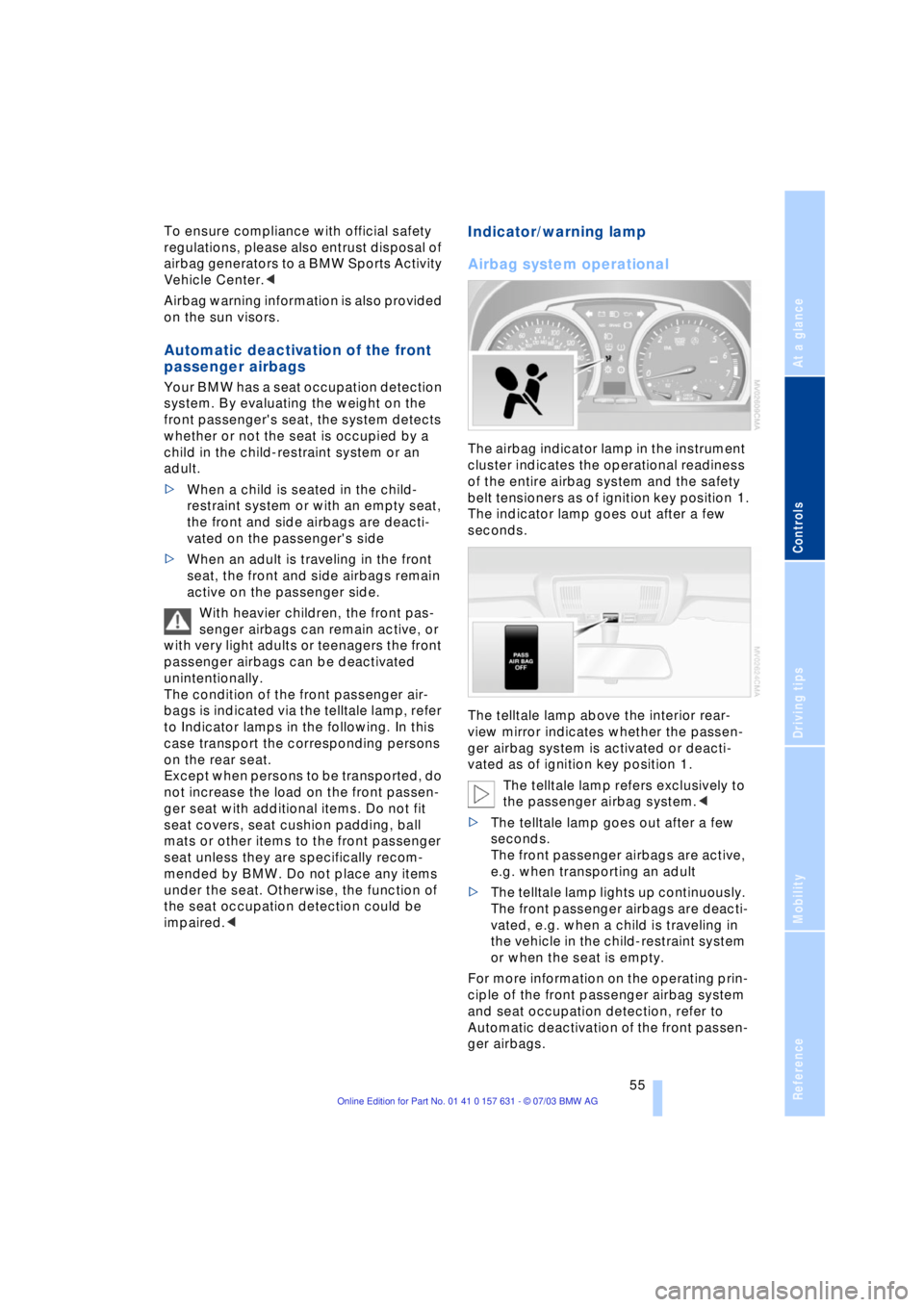
The airbag indicator lamp in the instrument
cluster indicates the operational readiness
of the entire airbag system and the safety
belt tensioners as of ignition key position 1.
The indicator lamp goes out after a few
seconds.
The telltale lamp above the interior rear-
view mirror indicates whether the passen-
ger airbag system is activated or deacti-
vated as of ignition key position 1.
The telltale lamp refers exclusively to
the passenger airbag system.<
>The telltale lamp goes out after a few
seconds.
The front passenger airbags are active,
e.g. when transporting an adult
>The telltale lamp lights up continuously.
The front passenger airbags are deacti-
vated, e.g. when a child is traveling in
the vehicle in the child-restraint system
or when the seat is empty.
For more information on the operating prin-
ciple of the front passenger airbag system
and seat occupation detection, refer to
Automatic deactivation of the front passen-
ger airbags.
Page 62 of 132
A congenial climate
60
A congenial climate
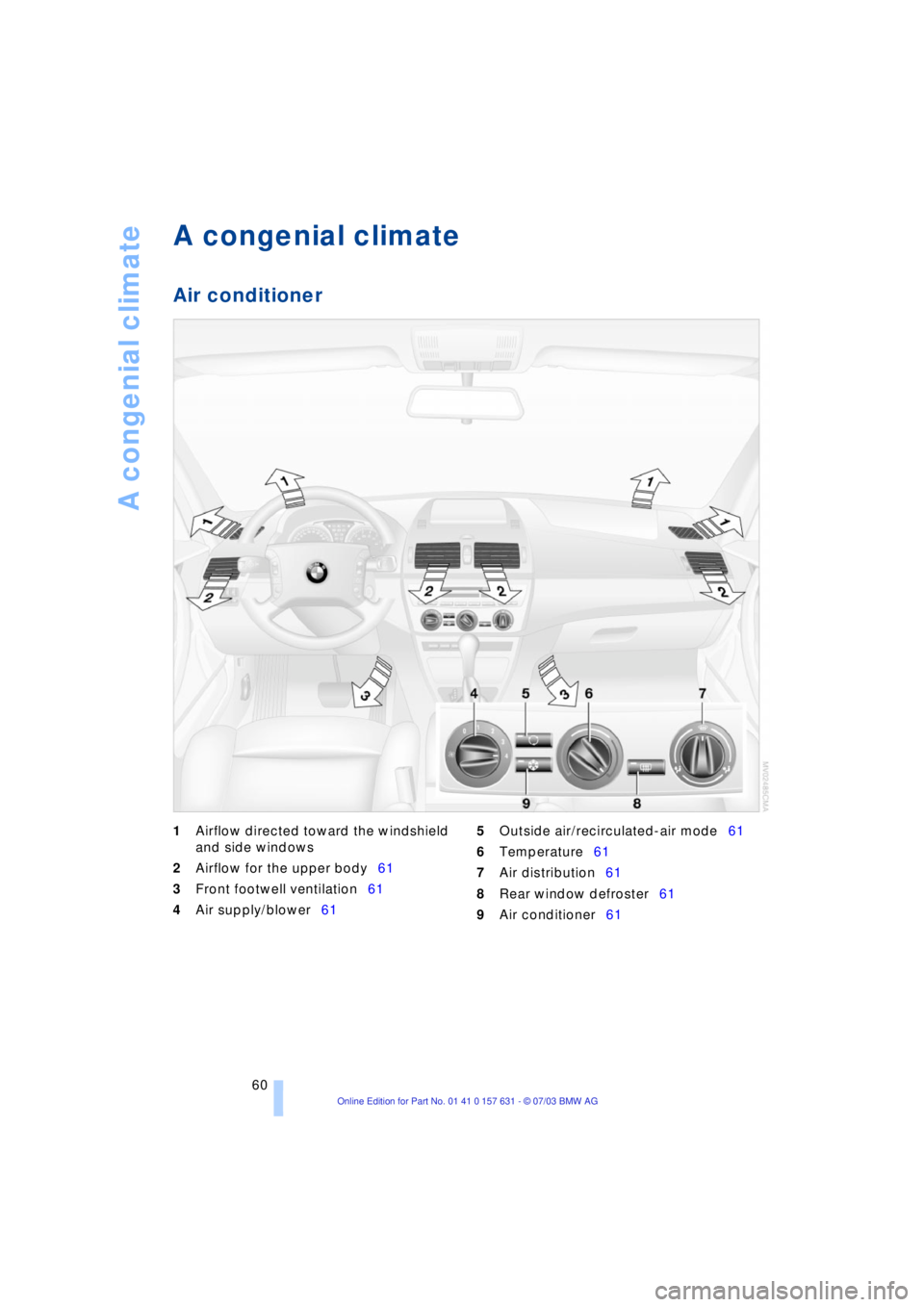
Air conditioner
1Airflow directed toward the windshield
and side windows
2Airflow for the upper body61
3Front footwell ventilation61
4Air supply/blower615Outside air/recirculated-air mode61
6Temperature61
7Air distribution61
8Rear window defroster61
9Air conditioner61
Page 63 of 132
Reference
At a glance
Controls
Driving tips
Mobility
61
Air supply/blower
You can select blower speeds 1
to 4. The heating and ventilation
become more and more effec-
tive as the air supply settings
are increased. In position 0, the
blower and heater are switched off. The air
supply is blocked in position 0.
Temperature
To increase the temperature of
the interior, turn to the right.
Air distribution
You can direct air to flow onto
the windows , toward the
upper body and into the
footwell . All intermediate
settings are possible. In the
setting, there is a low flow of air onto the
windows to keep them free of condensa-
tion.
Rear window defroster
When the rear window
defroster is activated,
the indicator lamp comes on.
The rear window defroster switches off
automatically.
You can have your vehicle pro-
grammed in such a way that the rear
window defroster switches on automati-
cally. It is then switched on at outside tem-
peratures of less than approx. +46/397
within 5 minutes of the engine start.<
Air conditioning
The air is cooled and dehumidi-
fied and Ñ depending on the
temperature setting Ñ warmed
again. Depending on the weather, the
windshield may fog over briefly when the
engine is started. You can reduce conden-
sation forming on the windows by switch-
ing on the air conditioning.
During air conditioning condensation
forms, which then exits under the vehicle. Traces of condensed water of this
kind are thus normal.<
Outside air/recirculated-air mode
You can respond to unpleasant
odors outside the vehicle by
temporarily switching off the
outside air supply. The system then recir-
culates the air currently within the vehicle.
If condensation starts to form on the
inside window surfaces during opera-
tion in the recirculated-air mode, you
should switch it off while also increasing air
supply as required. The recirculated-air
mode should not be used over a sustained
longer period of time, as the air quality
inside the vehicle deteriorates.<
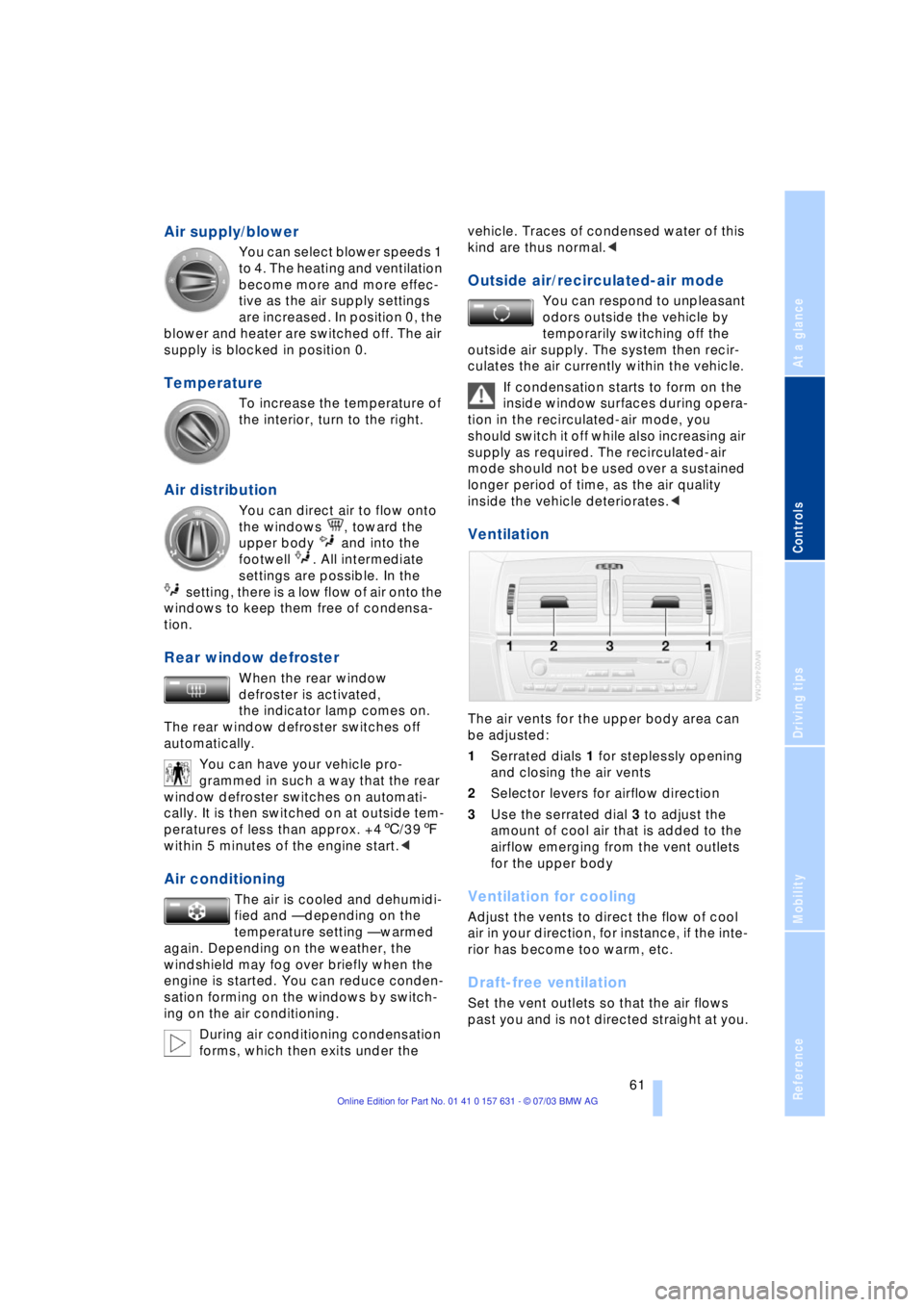
Ventilation
The air vents for the upper body area can
be adjusted:
1Serrated dials 1 for steplessly opening
and closing the air vents
2Selector levers for airflow direction
3Use the serrated dial 3 to adjust the
amount of cool air that is added to the
airflow emerging from the vent outlets
for the upper body
Ventilation for cooling
Adjust the vents to direct the flow of cool
air in your direction, for instance, if the inte-
rior has become too warm, etc.
Draft-free ventilation
Set the vent outlets so that the air flows
past you and is not directed straight at you.
Page 65 of 132
Reference
At a glance
Controls
Driving tips
Mobility
63
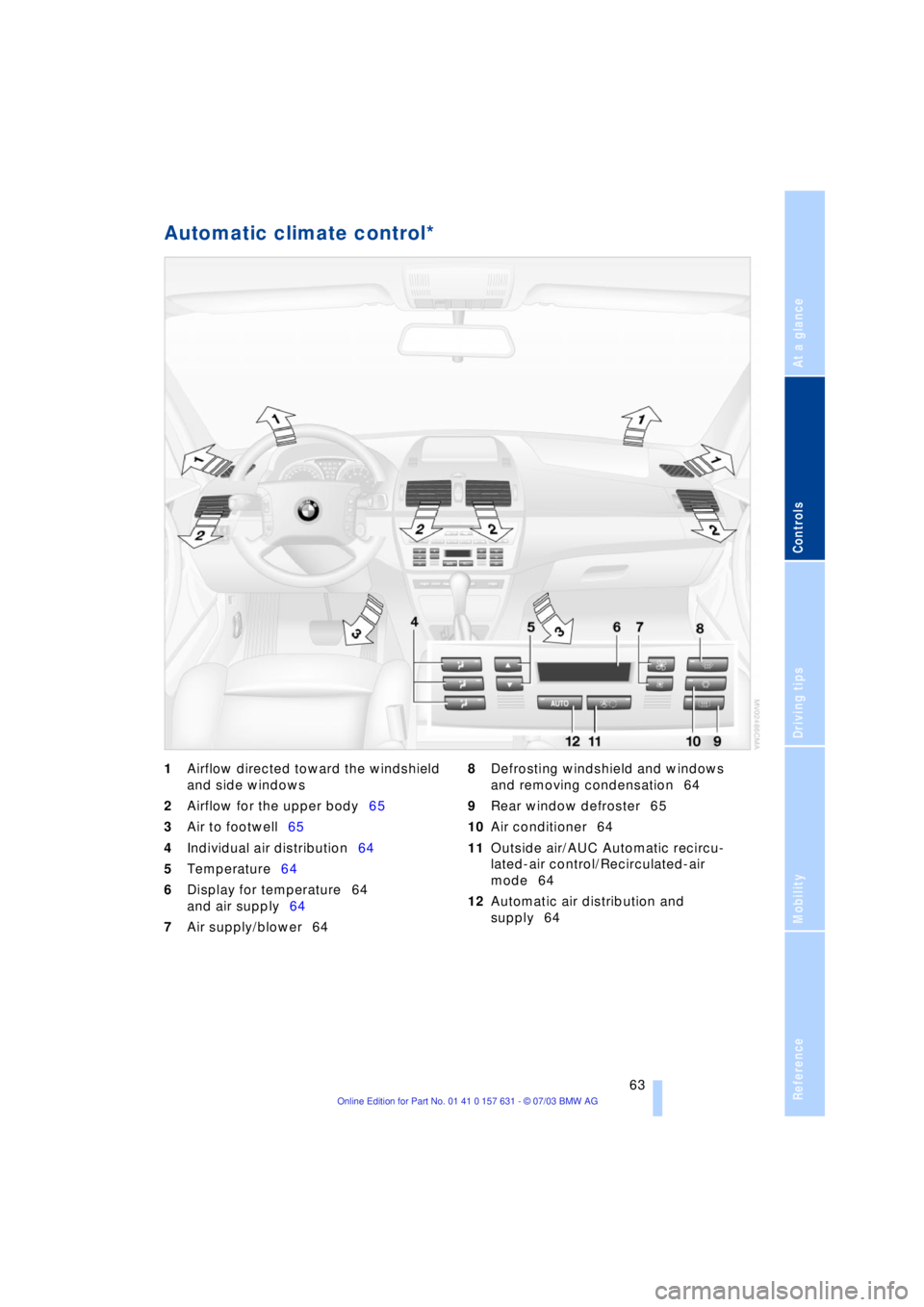
Automatic climate control*
1Airflow directed toward the windshield
and side windows
2Airflow for the upper body65
3Air to footwell65
4Individual air distribution64
5Temperature64
6Display for temperature 64
and air supply64
7Air supply/blower 648Defrosting windshield and windows
and removing condensation 64
9Rear window defroster 65
10Air conditioner 64
11Outside air/AUC Automatic recircu-
lated-air control/Recirculated-air
mode 64
12Automatic air distribution and
supply 64
Page 66 of 132
A congenial climate
64
A congenial climate
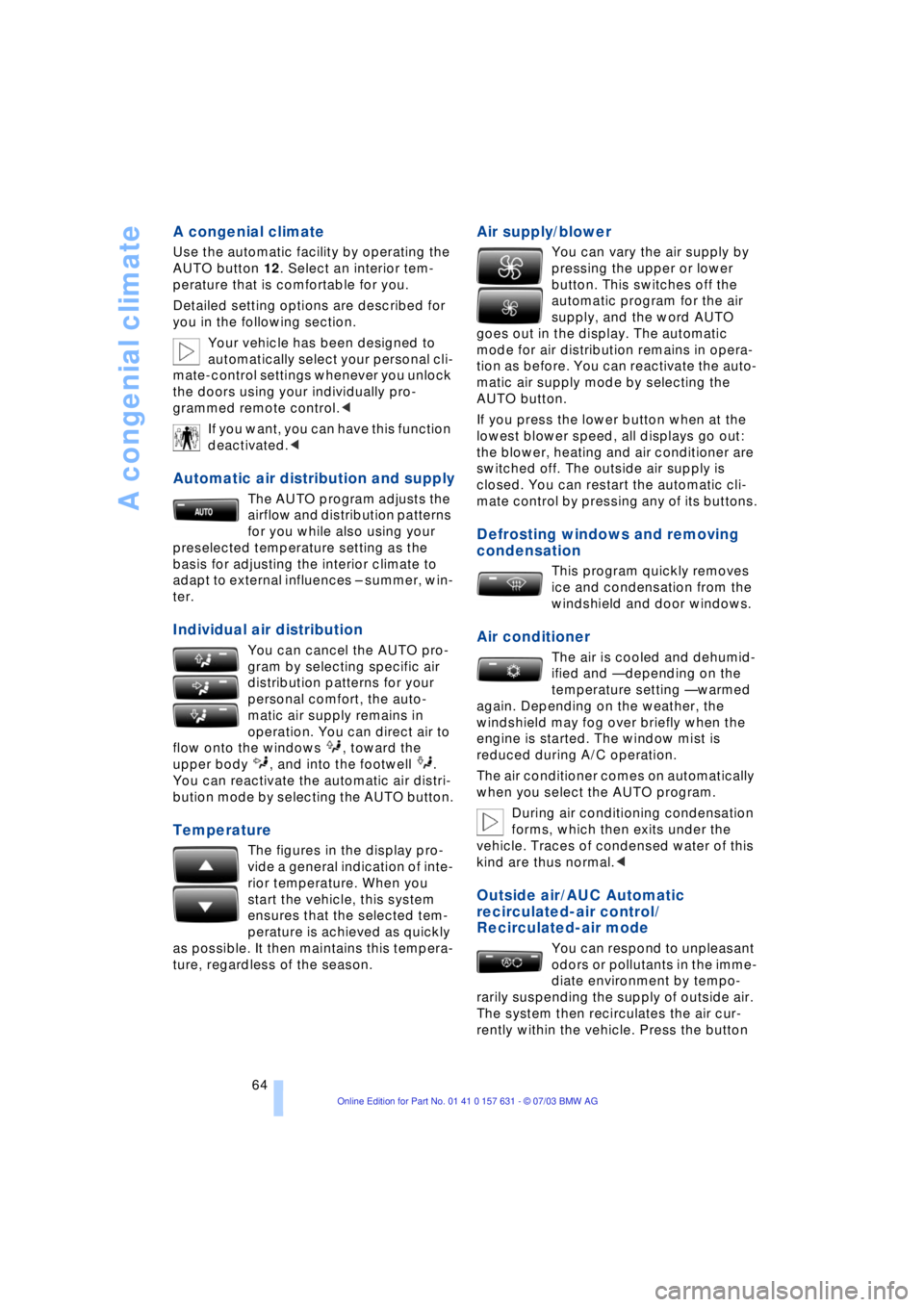
Use the automatic facility by operating the
AUTO button 12. Select an interior tem-
perature that is comfortable for you.
Detailed setting options are described for
you in the following section.
Your vehicle has been designed to
automatically select your personal cli-
mate-control settings whenever you unlock
the doors using your individually pro-
grammed remote control.<
If you want, you can have this function
deactivated.<
Automatic air distribution and supply
The AUTO program adjusts the
airflow and distribution patterns
for you while also using your
preselected temperature setting as the
basis for adjusting the interior climate to
adapt to external influences Ð summer, win-
ter.
Individual air distribution
You can cancel the AUTO pro-
gram by selecting specific air
distribution patterns for your
personal comfort, the auto-
matic air supply remains in
operation. You can direct air to
flow onto the windows , toward the
upper body , and into the footwell .
You can reactivate the automatic air distri-
bution mode by selecting the AUTO button.
Temperature
The figures in the display pro-
vide a general indication of inte-
rior temperature. When you
start the vehicle, this system
ensures that the selected tem-
perature is achieved as quickly
as possible. It then maintains this tempera-
ture, regardless of the season.
Air supply/blower
You can vary the air supply by
pressing the upper or lower
button. This switches off the
automatic program for the air
supply, and the word AUTO
goes out in the display. The automatic
mode for air distribution remains in opera-
tion as before. You can reactivate the auto-
matic air supply mode by selecting the
AUTO button.
If you press the lower button when at the
lowest blower speed, all displays go out:
the blower, heating and air conditioner are
switched off. The outside air supply is
closed. You can restart the automatic cli-
mate control by pressing any of its buttons.
Defrosting windows and removing
condensation
This program quickly removes
ice and condensation from the
windshield and door windows.
Air conditioner
The air is cooled and dehumid-
ified and Ñ depending on the
temperature setting Ñ warmed
again. Depending on the weather, the
windshield may fog over briefly when the
engine is started. The window mist is
reduced during A/C operation.
The air conditioner comes on automatically
when you select the AUTO program.
During air conditioning condensation
forms, which then exits under the
vehicle. Traces of condensed water of this
kind are thus normal.<
Outside air/AUC Automatic
recirculated-air control/
Recirculated-air mode
You can respond to unpleasant
odors or pollutants in the imme-
diate environment by tempo-
rarily suspending the supply of outside air.
The system then recirculates the air cur-
rently within the vehicle. Press the button
Page 79 of 132
Reference
At a glance
Controls
Driving tips
Mobility
77
to a fire, and with it the risk of serious prop-
erty damage as well as personal injury.<
Parking the vehicle
Condensation forms in the air conditioner
system during operation, and then exits
under the vehicle. Traces of condensed
water under the vehicle are thus normal.
Before driving into the car wash
Fold in the exterior mirrors, refer to
page 31, as otherwise they could be dam-
aged due to the width of the vehicle.
Deactivate the rain sensor as otherwise
damage could result from undesired wiper
activation, refer to page 42.
Hydroplaning
When driving on wet or slushy roads,
reduce road speed. If you do not, a
wedge of water can form between tires and
road surface. This phenomenon is referred
to as hydroplaning, and is characterized by
a partial or complete loss of contact
between tires and road surface, ultimately
undermining your ability to steer and brake
the vehicle.<
Driving through water
Do not drive through water on the
road if it is deeper than 20 in/50 cm,
and then only at walking speed. Otherwise,
the vehicle's engine, the electrical systems
and the transmission may be damaged.<
Safe braking
Emergency stops
The best way to brake is to apply maximum
pressure to the brake pedal during emer-
gency Ð panic stops. Since the vehicle
maintains steering responsiveness, you
can nevertheless avoid possible obstacles
with a minimum of steering effort.
Pulsation at the brake pedal combined with
sounds from the hydraulic circuits indicates
to the driver that ABS is in its active mode. Do not drive with your foot resting on
the brake pedal. Otherwise, even light
but consistent pedal pressure can lead to
high temperatures, brake wear and possi-
bly even brake failure.<
Wet conditions
While driving in wet conditions and in
heavy rain, it is a good idea to apply light
pressure to the brake pedal every few
miles. Watch traffic conditions to ensure
that this maneuver does not endanger
other road users. The heat which is gener-
ated by the brake applications helps to dry
the brake pads and rotors. The required
braking force will then be available when
you need it.
On a grade
You can retain full and unimpaired braking
efficiency by downshifting to a gear in
which only minimal brake applications are
needed when descending long or steep
downhill stretches.
You can further enhance the engine's brak-
ing effect by selecting a lower gear in the
automatic transmission's manual mode,
downshifting as far as first gear on
extremely steep stretches, refer to
page 38. This strategy helps you avoid
placing excessive loads on the brake sys-
tem.
During slower downhill driving, use the Hill
Descent Control HDC, refer to page 51.
Never drive with the clutch pressed,
with the transmission in Neutral or
with the engine switched off, as otherwise
there is no engine braking when the trans-
mission is in Neutral, and no power-assist
for brakes and steering.
Never allow floor mats, carpets or any other
objects to protrude into the area around the
accelerator and brake pedals and obstruct
their movement.<
Corrosion
When the vehicle is driven only occasion-
ally, during extended periods when the
vehicle is not used at all, and in operating
conditions where brake applications are