change wheel BMW X3 3.0I 2004 E83 Owner's Manual
[x] Cancel search | Manufacturer: BMW, Model Year: 2004, Model line: X3 3.0I, Model: BMW X3 3.0I 2004 E83Pages: 132, PDF Size: 3.62 MB
Page 45 of 132
Reference
At a glance
Controls
Driving tips
Mobility
43
matically heated as of ignition key
position 2.
Cleaning headlamps*
When the vehicle lighting system is
switched on, the headlamps are cleaned at
regular and appropriate intervals.
Rear window wiper
Rear window wiper in intermittent mode.
When reverse gear is engaged, the wiper
operates continuously.
You can also program the interval:
1.Briefly move the wiper lever from posi-
tion 0 to position 2
2.Wait for desired interval; maximum of
30 seconds
3.Move the wiper lever from position 0 to
position 2 again
To change the wiper blades, refer to
page 99.
Cruise control*
The vehicle maintains and stores the speed
that you set as of a speed of approx.
20 mph/30 km/h.
You can use cruise control whenever the
system is active while the engine is run-
ning.
Indicator lamp
Indicator lamp in the instrument
cluster lights up green:
System ready for operation using
the buttons in the steering wheel.
Activating the system
From ignition key position 2:
Press button in steering wheel; the indica-
tor lamp in the instrument cluster comes
on. You are able to use the cruise control.
Do not use the cruise control when
driving on winding roads, in heavy
traffic or in poor road conditions Ð e.g. snow, rain, ice, loose road surface Ð that do
not permit a constant speed.<
Deactivating system
Press the button repeatedly until the indi-
cator lamp in the instrument cluster goes
out.
The cruise control is also deactivated when
the ignition key is turned to position 0. The
speed stored in the memory is deleted in
the process.
Maintaining and storing speed or
accelerating
Briefly press button +:
The system maintains and stores the cur-
rent vehicle speed. Every time you briefly
press the button, the vehicle's speed
increases by roughly 1Ðmph/1 km/h.
Press and hold button
+:
The vehicle accelerates without pressure
on the accelerator pedal. When you release
the button, the system maintains and
stores the current speed.
If, on a downhill gradient, the engine's
braking effect is not sufficient, the
controlled speed can be exceeded. Speed
can drop on uphill grades if the engine out-
put is insufficient.<
Decelerating
Briefly press button Ð:
Every time you briefly press the button,
the vehicle's speed decreases by roughly
1 mph/1 km/h if you are already driving
with cruise control.
Press and hold button
Ð:
With the cruise control active, the system
automatically reduces the throttle opening
to slow the vehicle. When you release the
button, the system maintains and stores
the current speed.
Page 55 of 132
Reference
At a glance
Controls
Driving tips
Mobility
53
available. See your BMW Sports Activity
Vehicle Center to have the system
repaired.
Flat Tire Monitor
The concept
The Flat Tire Monitor keeps track of the
inflation pressures in the four fitted tires as
you drive. The system provides an alert
whenever the inflation pressure drops sig-
nificantly in relation to the pressure another
tire.
The check of the tire inflation pressure is
based on monitoring the relative speeds of
the wheels. A flat tire is detected and
reported on the basis of a deviation in cer-
tain speed ratios.
Functional requirement
So that the Flat Tire Monitor can learn the
correct inflation pressure, please perform
the following:
1.Check the inflation pressures in all tires
2.Compare with the inflation pressure
table on page 87 and correct if neces-
sary
3.Initialize the system.
Limits of the system
The Flat Tire Monitor cannot indicate
sudden severe tire damage caused
by outside factors and does not detect a
natural, even pressure drop in all four
tires.<
In the following situations, on the other
hand, there can be delays in detecting tire
pressure losses, and even system failure:
>When driving on snow-covered or slip-
pery road surfaces
>In the case of performance-oriented
driving: slip on the drive wheels, high
lateral acceleration
>False alarms and undetected loss of
pressure may occur when you are driv-
ing with snow chains fitted>When driving with a compact wheel, the
Flat Tire Monitor cannot operate.
Initializing the system
Perform the initialization immediately
every time you correct the inflation
pressure, change a tire or change a wheel
or all wheels. A drive is required for this
purpose.<
1.Before the start of driving, start the
engine, but do not drive off
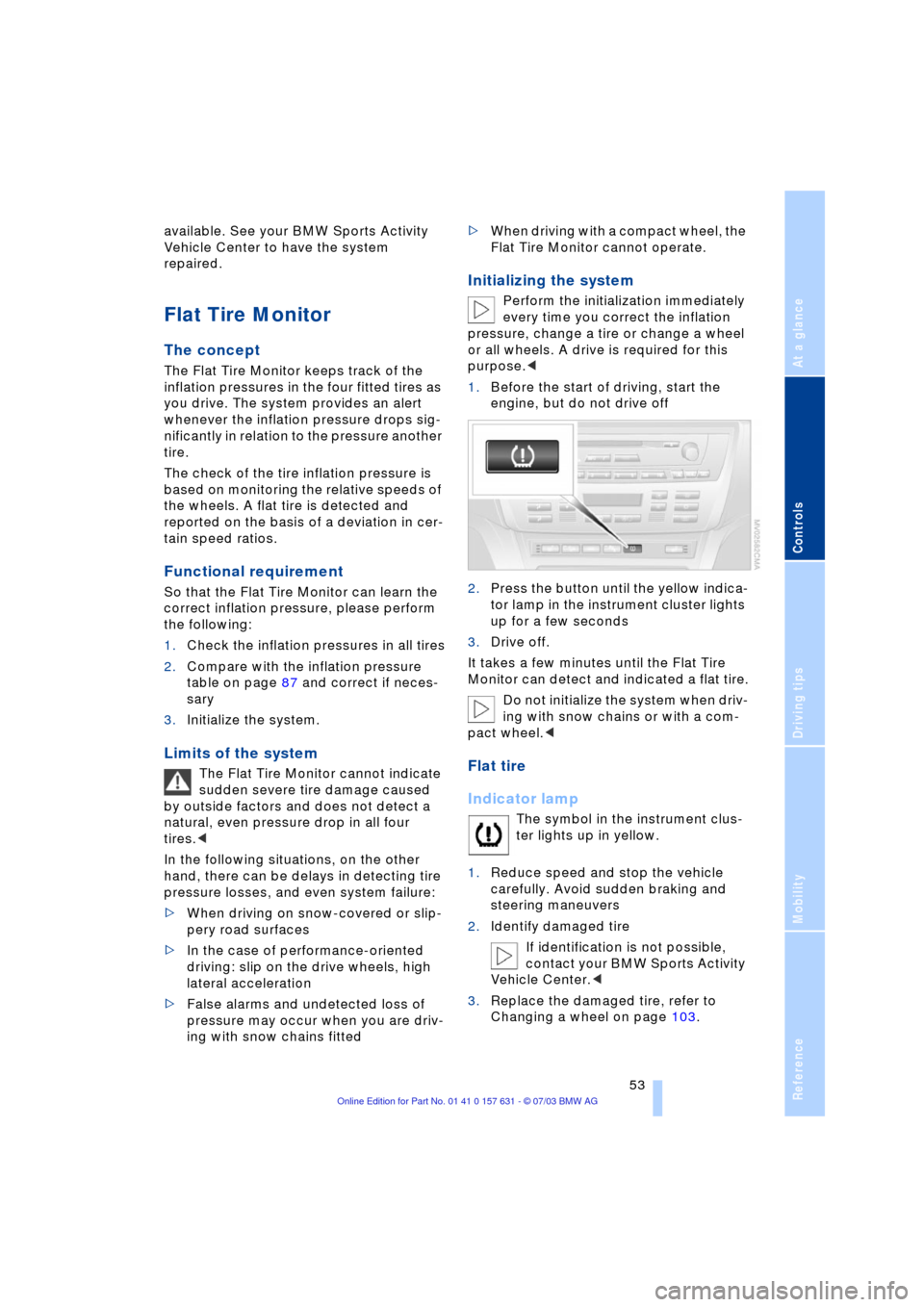
2.Press the button until the yellow indica-
tor lamp in the instrument cluster lights
up for a few seconds
3.Drive off.
It takes a few minutes until the Flat Tire
Monitor can detect and indicated a flat tire.
Do not initialize the system when driv-
ing with snow chains or with a com-
pact wheel.<
Flat tire
Indicator lamp
The symbol in the instrument clus-
ter lights up in yellow.
1.Reduce speed and stop the vehicle
carefully. Avoid sudden braking and
steering maneuvers
2.Identify damaged tire
If identification is not possible,
contact your BMW Sports Activity
Vehicle Center.<
3.Replace the damaged tire, refer to
Changing a wheel on page 103.
Page 91 of 132
Reference
At a glance
Controls
Driving tips
Mobility
89
resistance to the generation of heat and its
ability to dissipate heat when tested under
controlled conditions on a specified indoor
laboratory test wheel.
Sustained high temperature can cause the
material of the tire to degenerate and
reduce tire life, and excessive temperature
can lead to sudden tire failure. The grade C
corresponds to a level of performance
which all passenger car tires must meet
under the Federal Motor Vehicle Safety
Standard No. 109. Grades B and A repre-
sent higher levels of performance on the
laboratory test wheel than the minimum
required by law.
The temperature grade for this tire is
established for a tire that is properly
inflated and not overloaded. Excessive
speed, underinflation, or excessive load-
ing, either separately or in combination,
can cause heat buildup and possible tire
failure.<
M+S
Winter and all-season tires.
These have better winter properties than
summer tires.
Tire condition
Inspect your tires frequently for treadwear,
signs of damage and for foreign objects
lodged in the tread. Check the tread pat-
tern depth.
Tire tread
The tread depth should not drop below
0.12 in/3 mm, although, for example, Euro-
pean legislation only specifies a minimum
tread depth of 0.063 in/1.6 mm. At tread
depths below 0.12 in/3 mm, there is an
increased risk of high-speed hydroplaning,
even when only small amounts of water are
present on the road surface.
As winter tires display a noticeable loss in
their ability to cope with cold-weather driv-
ing conditions once the tread wears to
below 0.16 in/4 mm, to ensure continued safety you should always have such tires
replaced.
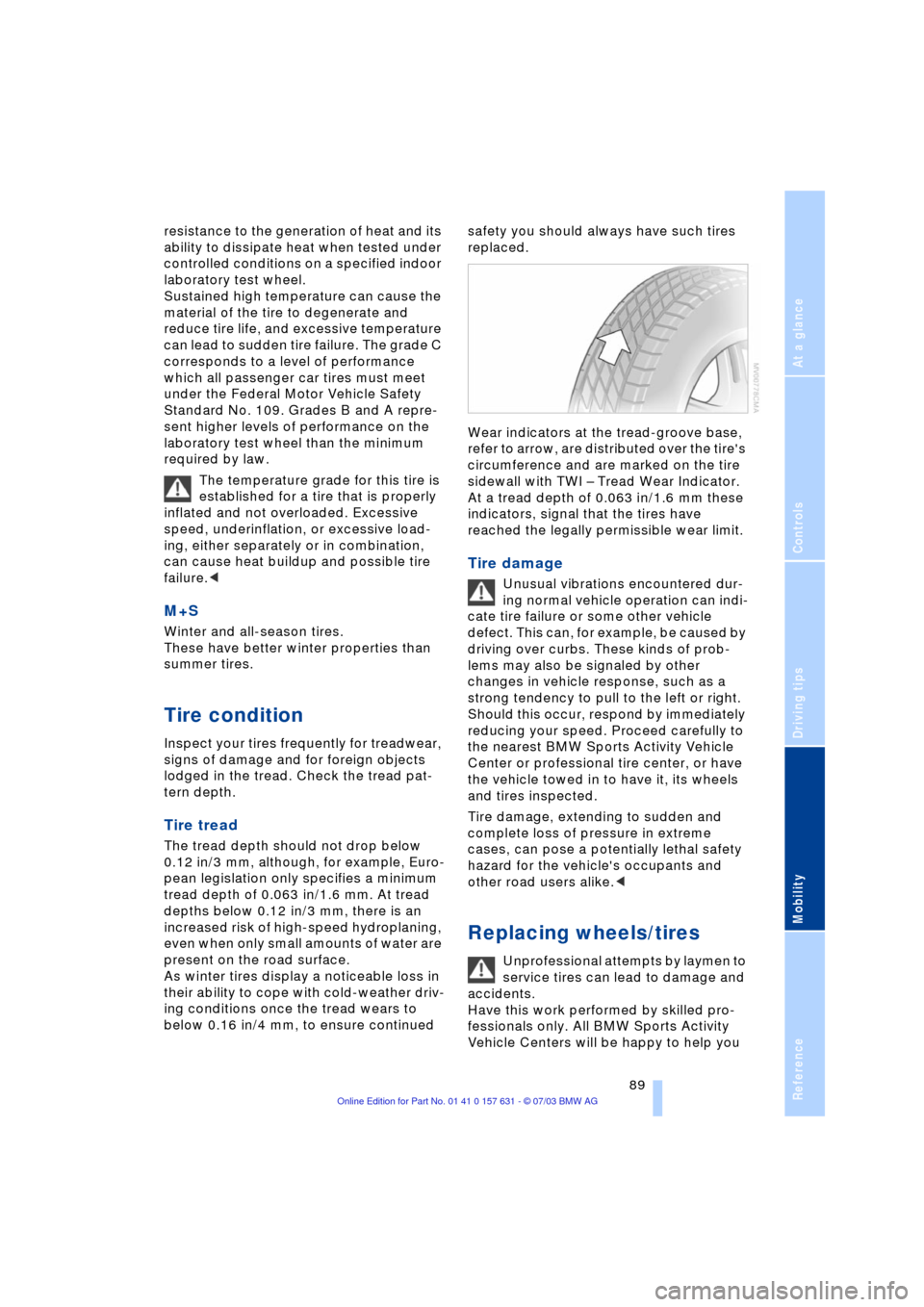
Wear indicators at the tread-groove base,
refer to arrow, are distributed over the tire's
circumference and are marked on the tire
sidewall with TWI Ð Tread Wear Indicator.
At a tread depth of 0.063 in/1.6 mm these
indicators, signal that the tires have
reached the legally permissible wear limit.
Tire damage
Unusual vibrations encountered dur-
ing normal vehicle operation can indi-
cate tire failure or some other vehicle
defect. This can, for example, be caused by
driving over curbs. These kinds of prob-
lems may also be signaled by other
changes in vehicle response, such as a
strong tendency to pull to the left or right.
Should this occur, respond by immediately
reducing your speed. Proceed carefully to
the nearest BMW Sports Activity Vehicle
Center or professional tire center, or have
the vehicle towed in to have it, its wheels
and tires inspected.
Tire damage, extending to sudden and
complete loss of pressure in extreme
cases, can pose a potentially lethal safety
hazard for the vehicle's occupants and
other road users alike.<
Replacing wheels/tires
Unprofessional attempts by laymen to
service tires can lead to damage and
accidents.
Have this work performed by skilled pro-
fessionals only. All BMW Sports Activity
Vehicle Centers will be happy to help you
Page 105 of 132
Reference
At a glance
Controls
Driving tips
Mobility
103
Tailgate lamp
5 Watt bulb
1.Pull off the bulb holder
2.Replace the bulb.
Light-emitting diodes LEDs
Light-emitting diodes installed behind
translucent lenses serve as the light source
for many of the controls and displays in
your vehicle. These light-emitting diodes,
which operate using a concept similar to
that applied in conventional lasers, are offi-
cially designated as Class 1 light-emitting
diodes.
Do not remove the covers, and never
stare into the unfiltered light for sev-
eral hours, as irritation of the retina could
result.<
Changing a wheel
Safety precautions to observe in the
event of a flat tire and during all tire
changes:
Park the vehicle as far as possible from
passing traffic. Park on a firm, flat, surface.
Switch on the hazard warning flashers.
Lock the steering wheel in straight-ahead
setting of the wheels. Set the handbrake
and engage first gear, reverse gear or
selector-lever position P.
All passengers should be outside the vehi-
cle and well away from your immediate
working area, behind a guardrail, for
instance.
If a warning triangle or portable hazard
warning lamp is required, set it up on the
roadside at an appropriate distance from
the rear of the vehicle. Comply with all safety guidelines and regulations.
Change the wheel only on a level, firm sur-
face which is not slippery. The vehicle or
the jack could slip to the side if you attempt
to raise the vehicle on a soft or slippery sur-
face such as snow, ice, tiles, etc.
Position the jack on a firm support surface.
Do not use a wooden block or similar
object as a support base for the jack, as
this would prevent it from extending to its
full support height and reduce its load-car-
rying capacity.
To avoid serious or fatal injury: never lie
under the vehicle, and never start the
engine while it is supported by the jack.<
What you will need
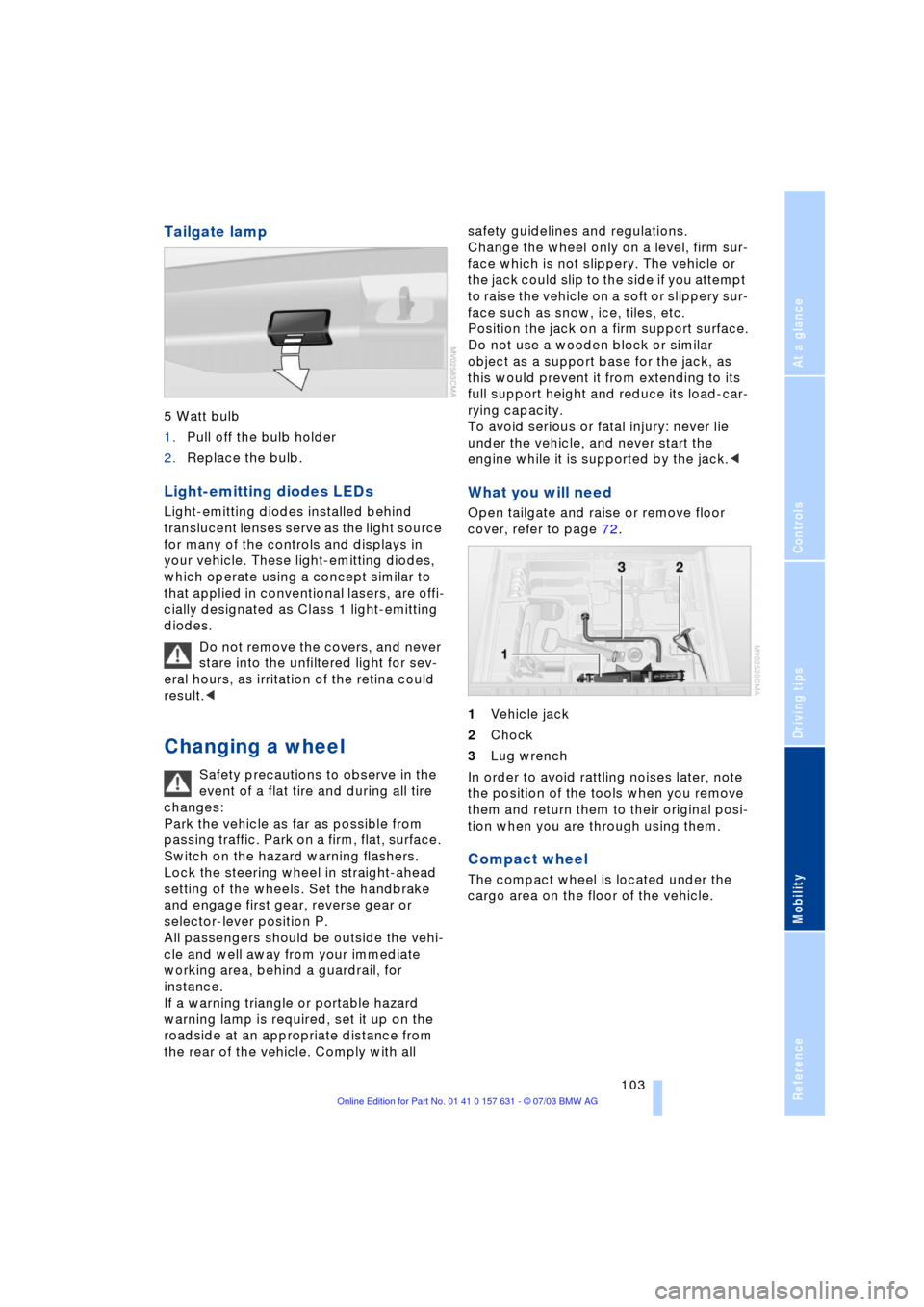
Open tailgate and raise or remove floor
cover, refer to page 72.
1Vehicle jack
2Chock
3Lug wrench
In order to avoid rattling noises later, note
the position of the tools when you remove
them and return them to their original posi-
tion when you are through using them.
Compact wheel
The compact wheel is located under the
cargo area on the floor of the vehicle.
Page 106 of 132
Replacing components
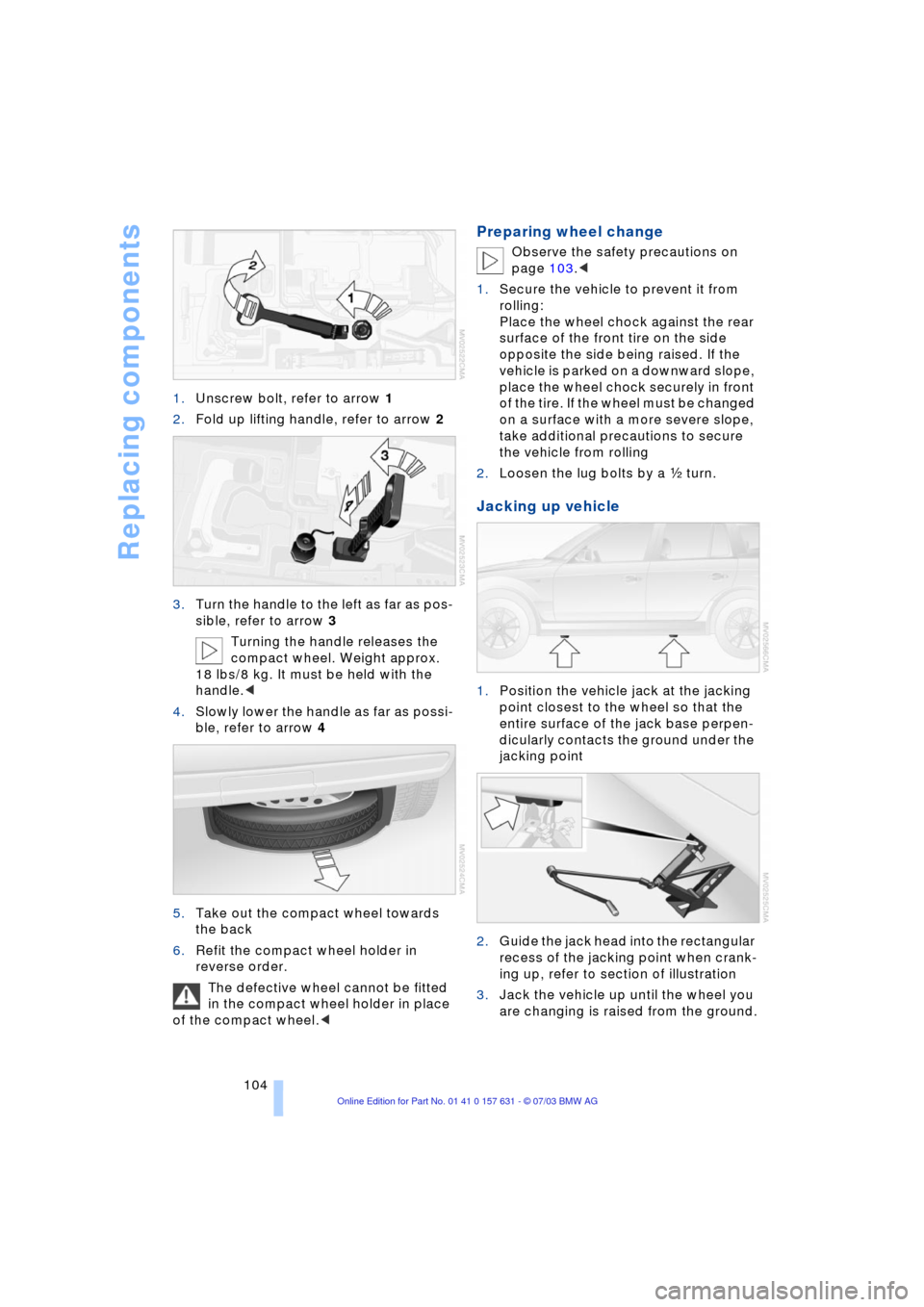
104 1.Unscrew bolt, refer to arrow 1
2.Fold up lifting handle, refer to arrow 2
3.Turn the handle to the left as far as pos-
sible, refer to arrow 3
Turning the handle releases the
compact wheel. Weight approx.
18 lbs/8 kg. It must be held with the
handle.<
4.Slowly lower the handle as far as possi-
ble, refer to arrow 4
5.Take out the compact wheel towards
the back
6.Refit the compact wheel holder in
reverse order.
The defective wheel cannot be fitted
in the compact wheel holder in place
of the compact wheel.<
Preparing wheel change
Observe the safety precautions on
page 103.<
1.Secure the vehicle to prevent it from
rolling:
Place the wheel chock against the rear
surface of the front tire on the side
opposite the side being raised. If the
vehicle is parked on a downward slope,
place the wheel chock securely in front
of the tire. If the wheel must be changed
on a surface with a more severe slope,
take additional precautions to secure
the vehicle from rolling
2.Loosen the lug bolts by a g turn.
Jacking up vehicle
1.Position the vehicle jack at the jacking
point closest to the wheel so that the
entire surface of the jack base perpen-
dicularly contacts the ground under the
jacking point
2.Guide the jack head into the rectangular
recess of the jacking point when crank-
ing up, refer to section of illustration
3.Jack the vehicle up until the wheel you
are changing is raised from the ground.
Page 107 of 132
Reference
At a glance
Controls
Driving tips
Mobility
105
Mounting compact wheel
1.Unscrew the lug bolts and remove the
wheel
2.Remove accumulations of mud or dirt
from the mounting surfaces of the
wheel and hub. Clean the lug bolts
3.Position the new wheel or compact
wheel. Secure the wheel by turning at
least two lug bolts into opposite bolt
holes
4.Screw in the remaining lug bolts.
Tighten all the bolts securely in a diag-
onal pattern
5.Lower the jack and remove it from
beneath the vehicle
6.Tighten the lug bolts in a diagonal pat-
tern
7.Check and correct the tire inflation
pressure at the earliest opportunity.
Protect valve stems and valve stem
seal caps against dirt and contamina-
tion. Dirt in valve stems is a frequent source
of gradual air loss.<
After mounting the compact wheel or cor-
recting the inflation pressure, reinitialize
the Flat Tire Monitor, refer to page 53.
The vehicle jack is designed for
changing wheels only. Do not attempt
to raise another vehicle model with it or to
raise any load of any kind. To do so could
cause accidents and personal injury.
To ensure safety, always have the lug bolts
checked with a calibrated torque wrench to
ensure that they are tightened to the spec-
ified torque of 101 lb ft/140 Nm as soon as
possible.<
Stow the defective wheel in the luggage
compartment.
When you mount wheels other than Genu-
ine BMW light-alloy wheels, different lug
bolts may also be required.
Replace the defective tire as soon as pos-
sible and have the new wheel/tire bal-
anced.
Driving with the compact wheel
Drive reservedly and do not exceed a
speed of 50 mph/80 km/h. Do not
deactivate DSC, as otherwise unstable
driving conditions may result.<
The driving characteristics change, for
example reduced track stability on braking,
extended braking distance, and altered
self-steering characteristics in the limit
range. In conjunction with winter tires,
these characteristics are more pro-
nounced.
Only one compact wheel may be
mounted. You should re-equipping to
wheels and tires of the original size as
quickly as possible.<
Battery
Battery care
The battery is 100% maintenance-free, i.e.,
the electrolyte will last for the life of the bat-
tery when the vehicle is operated in a tem-
perate climate.
Please contact your BMW Sports
Activity Vehicle Center with any ques-
tions concerning the battery.<
Do not disconnect the battery when
the engine is running. If you do so, the
ensuing voltage surge will damage the
vehicle's onboard electronics.<
Indicator lamp
The battery charge-current indica-
tor lamp lights up:
The battery is no longer being
charged. There is a defect on the alternator
V-belt or charge current circuit of the alter-
nator. Contact the nearest BMW Sports
Activity Vehicle Center.
Do not continue driving if the V-belt is
defective. The engine could be dam-
aged due to overheating.
Moreover, an increased amount of force is
required for steering if the onboard supply
voltage falls dramatically.<
Page 122 of 132

Everything from A to Z
120 Bottle holder, refer to
Beverage holders 67
Brake fluid 96
Ð indicator lamp 96
Ð level 96
Ð replacing 96
Brake force display 54
Brake lamps
Ð defect 57
Ð indicator lamp 12
Ð replacing the bulbs 102
Brake pads and rotors
Ð breaking-in procedure 76
Brakes 77, 96
Ð ABS 77
Ð brake fluid 96
Ð break-in procedure 76
Ð handbrake 38
Ð indicator/warning
lamp 38
Brake system
Ð brake-fluid level 96
Ð brake pads 96
Ð corrosion 77
Ð disc brakes 76, 77
Ð indicator lamp 96
Ð rotors 76, 77
Brake wear warning
Ð brake pads 96
Ð indicator lamp 96
Break-in procedures 76
Bulbs and lamps 99
Buttons in steering
wheel 14
C
California Proposition
65 Warning 98
Capacities 117
Car care, refer to Caring for
your vehicle brochure
Car-care products, refer to
Caring for your vehicle
brochure
Care, refer to Caring for
your vehicle brochureCargo area 71
Ð capacity 116
Ð cover 71
Ð floor cover 72
Ð folding rear seat
backrest 71
Ð increasing volume 71
Ð lashing eyes 73
Ð manual unlocking 21
Ð opening, remote
control 19
Ð opening/closing 21
Ð opening from the
outside 21
Ð sockets 73
Ð volume 116
Cargo bay, refer to Cargo
area 71
Cargo loading 78
Caring for leather, refer to
Caring for your vehicle
brochure
Caring for the carpet, refer
to Caring for your vehicle
brochure
Caring for the vehicle finish,
refer to Caring for your
vehicle brochure
Car keys, refer to Key
set 18
Car phone preparation 70
Car wash 77
Car wash, refer to Caring
for your vehicle brochure
Catalytic converter, refer to
High temperatures 76
Central locking system 18
Ð interior 20
Changes, technical, refer to
For your own safety 6
Changing a wheel 103
Check Gas Cap
Ð indicator lamp 12, 84
Checking inflation
pressure 86
Child's seats, refer to
Child-restraint
systems 34
Child-restraint systems 34
Child-safety locks 36
Chock 103Chrome parts, care, refer to
Caring for your vehicle
brochure
Cigarette lighter
Ð front 69
Ð rear 69
Circulation of air, refer to
Recirculated-air
mode 61, 64
Cleaning, vehicle, refer to
Caring for your vehicle
brochure
Cleaning the windshield 42
Cleaning windows,
reservoir 94
Clean the rear window 42
Clock 46
Ð 12/24 hour mode 48
Ð setting, refer also to
Owner's Manual for
Radio/Onboard
computer 46
Clutch 76
Ð breaking in 76
Cockpit 10
Cold start, refer to Starting
the engine 37
Comfort operation
Ð panorama glass roof 20
Compact wheel
Ð wheel changes 103
Compression ratio, refer to
Engine data 114
Computer 47
Computer, functions 48
Condensation, refer to A/C
operation 61, 64
Connecting a vacuum
cleaner, refer to Lighter
socket 69
Consumption, refer to
Average fuel
consumption 48
Consumption indicator,
refer to Fuel gauge 45
Contents 3
Controls, refer to
Cockpit 10
Convenience operation
Ð from outside 20
Ð windows 20
Page 124 of 132

Everything from A to Z
122 US models, Warranty and
Service Guide Booklet for
Canadian models
ESP Electronic Stability
Program, refer to DSC
Dynamic Stability
Control 50
Exhaust system, refer to
High temperatures 76
Exterior mirror
Ð automatic dimming
feature 32
Exterior mirrors 31
F
Fan, refer to Air
supply 61, 64
Filling the windshield
washer reservoir 94
Filter
Ð refer to Microfilter 62
Ð refer to Microfilter/
Activated charcoal
filter 65
First-aid kit 108
Fittings, tow-starting and
towing 109
Flat tire 103
Ð compact wheel 103
Ð Flat Tire Monitor 53
Flat Tire Monitor 53
Ð indicator lamp 53
Flooding, refer to Driving on
bad roads 80
Floor cover 72
Fluid level
Ð indicator lamp 94
Fog lamps 58
Ð replacing bulbs 102
Folding rear seat back 71
Folding rear seat
backrest 71
Footbrake, refer to Brake
system 77, 96
Footbrake, refer to General
driving notes 77, 96
Front/rear reading
lamps 58
Front airbags 54
Front center armrest 68Front seat adjustment 27
Fuel 85
Ð average
fuel consumption 48
Ð capacity 117
Ð gauge 45
Ð quality 85
Ð volume 48
Fuel capacity 117
Fuel clock, refer to Fuel
gauge 45
Fuel display, refer to Fuel
gauge 45
Fuel filler cap 84
Fuel filler door 84
Ð releasing in the event of
electrical defect 84
Fuses 106
G
Garage-door opener, refer
to Integrated universal
remote control 66
Gasoline, refer to Fuel
quality 85
Gasoline consumption,
refer to Average fuel
consumption 48
Gasoline display, refer to
Fuel gauge 45
Gear changes, refer to
Automatic transmission
with Steptronic 40
Gear display 41
Gear lever
Ð automatic transmission
with Steptronic 39
Ð manual transmission 39
General driving notes 76
Glove compartment 68
Grills, refer to
Ventilation 61, 65
Ground clearance 80
H
Halogen lamps 100
Handbrake
Ð indicator lamp 38Hands-free microphone,
refer to Car phone
preparation 70
Hands-free system 70
Hazard warning flashers 10
HDC Hill Descent
Control 51
Headlamp control,
automatic 57
Headlamp flasher 41
Ð indicator lamp 41
Headlamps 100
Ð bulb replacement 99
Headlamps, care, refer to
Caring for your vehicle
brochure
Headlamp washer
reservoir 94
Headlamp washer
system 94
Ð cleaning headlamps 42
Ð tank capacity, refer to
Filling capacities 117
Ð washer fluid 94
Head restraints 28
Heated mirrors 32
Heated rear window
Ð air conditioner 61
Ð automatic climate
control 65
Heated seats 30
Heated steering wheel 31
Heated windshield,
automatic climate
control 64
Heating
Ð exterior mirror 32
Ð rear window 61, 65
Ð seats 30
Ð steering wheel 31
Heating and
ventilation 60, 63
Heavy cargo, refer to Cargo
loading 78
Height, refer to
Dimensions 115
Height adjustment
Ð seats 28
Ð steering wheel 31
Page 127 of 132
Reference
At a glance
Controls
Driving tips
Mobility
125
Range
Ð setting units 47
Rear armrest, refer to
Center armrest 68
Rear backrests
Ð folding 71
Rear center armrest 68
Rear fog lamps
Ð bulb replacement 102
Rear lamps
Ð bulb replacement 102
Rear seat back
Ð folding 71
Rearview mirrors
Ð exterior 31
Rear window defroster
Ð air conditioner 61
Ð automatic climate
control 65
Rear window safety
switch 22
Rear window wiper 43
Recirculated-air mode
Ð air conditioner 61
Ð automatic climate
control 64
Reclining seat 28
Refueling 84
Ð fuel filler door 84
Remaining distance to next
vehicle service 46
Remote control
Ð fault 19
Ð garage-door opener 66
Ð tailgate 19
Removing condensation,
windows
Ð air conditioner 62
Ð automatic climate
control 64
Replacement fuses 106
Replacement of tires
Ð wheel changes 103
Replacement tire 103
Replacing bulbs, refer to
Lamps and bulbs 99
Replacing light bulbs 99
Reporting safety defects 7
Reservoir, washer
system 94Restraint systems, refer to
Safety belts 30
Reverse 39
Reverse gear
Ð automatic transmission
with Steptronic 40
Ð manual transmission 39
Rims 90
Roadside Assistance 107
Roll-up cover, refer to
Cargo area cover 71
RON, refer to Fuel
quality 85
Roof-mounted luggage
rack 79
Rope, refer to Tow-starting
and towing 109
Rotating coin holder, refer
to Storage
compartments 68
S
Safe sitting position with
safety belts 27
Safety belts 30
Ð sitting safely 27
Ð warning lamp 30
Safety belt tensioners, refer
to Safety belts 27
Safety belt warning
Ð indicator lamp 30
Safety defects, reporting 7
Safety feature
Ð power windows 22
Safety systems, refer to
ABS Antilock Brake
System 50
Safety systems, refer to
DSC Dynamic Stability
Control 50
Screwdriver, refer to
Onboard tool kit 99
Seat, electric power 29
Seat heating 30
Seat memory, refer to Seat
and mirror memory 29
Securing cargo 79
Selector lever, automatic
transmission 40Selector lever interlock,
refer to Shiftlock 40
Service and warranty
notes 7
Service Engine
Soon 38, 98
Service Interval
Display 46, 97
Setting the units 47
Setting units 47
Shiftlock, changing the
selector-lever
positions 40
Side airbags 54
Side lamps 57
Side tilt 80
Side turn signal indicators
Ð bulb replacement 101
Sitting safely 27
Ð with airbag 27
Ð with safety belts 27
Ski bag 70
Smokers' package, refer to
Ashtray 69
Sockets 69, 73
SOS, refer to Starting an
emergency call 107
Spare fuses 106
Spare key 18
Spare tire, refer to Wheel
changes 103
Special oils, refer to
Approved oils 95
Special washing
program 42
Specified oils 95
Speedometer 11
Speedometer, refer to
Instrument
cluster 11
Sport program
Ð automatic transmission
with Steptronic 40
Sports seat 28
Stability control, refer to
DSC Dynamic Stability
Control 50
Standing lamps 58
Starting, engine 37
Starting, refer to Starting
the engine 37
Page 128 of 132

Everything from A to Z
126 Starting assistance, refer to
Jump-starting 108
Starting difficulties
Ð temperature 38
Starting-off assistance,
DSC 50
Starting the engine 38
Startup difficulties
Ð jump-starting 108
Status of this Owner's
Manual at time of
printing 5
Steering lock 37
Steering wheel 10, 14
Ð adjustment 31
Ð lock 37
Steering wheel heater 31
Steering wheel with
buttons 14
Steptronic 39
Storage compartments 68
Storage package 68
Storage package nets 68
Storage space, refer to
Cargo area 71
Storing seat position, refer
to Seat and mirror
memory 29
Storing the seat
adjustment 29
Straps, refer to Loading 78
Stroke, refer to Engine
data 114
Supply reservoir cleaning
systems 94
Switches, refer to
Cockpit 10
Switching off the engine 38
Symbols 4
T
Table of contents 3
Tachometer 45
Tailgate
Ð closing 21
Ð emergency operation 21
Ð opening from the
outside 21
Ð remote control 19Tailgate lamp
Ð bulb replacement 103
Tail lamps
Ð bulb replacement 102
Ð indicator lamp 57
Tank capacity 117
Technical modifications 6
Telephone, refer to
separate Owner's Manual
Temperature
Ð air conditioner 61
Ð automatic climate
control 64
Temperature, tires 88
Temperature display
Ð ice warning 47
Ð outside temperature 47
Ð setting the units 47
Temperature gauge 45
Thigh support
adjustment 28, 29
Three-point belt 30
Tightening torque 105
Tilt alarm sensor 25
Ð switching off 25
Tilt function, passenger-
side mirror 32
Tire inflation pressures 86
Tire pressure monitoring,
refer to Flat Tire
Monitor 53
Tires
Ð age 88
Ð break-in procedure 76
Ð changing 89
Ð condition 89
Ð DOT Quality Grades 88
Ð flat 103
Ð inflation pressure 86, 87
Ð replacing 89
Ð storage 90
Ð temperature 88
Ð traction 88
Ð treadwear 88
Ð Uniform Tire Quality
Grading 89
Ð wear indicators, refer to
Tire tread/damage 89
Ð wheel change 103
Tools, refer to Onboard tool
kit 99Torque of lug bolts 105
Tow bar 109
Tow fittings 109
Towing 109
Towing the vehicle 109
Tow rope 109
Tow sockets for tow
fitting 109
Tow-starting 109
Track width, refer to
Dimensions 115
Traction 88
Traction control
Ð DSC 50
Trailer loads 116
Transmission 39
Ð automatic transmission
with Steptronic 39
Ð manual transmission 39
Transmission lockout, refer
to P Parking 40
Transmission
malfunction 41
Transporting children 34
Transporting children
safely 34
Tread depth, refer to Tire
tread 89
Treadwear 88
Trip-distance counter, refer
to Trip odometer 45
Trip odometer 45
Trunk, refer to Cargo
area 71
Trunk lid, refer to
Tailgate 21
Turning circle, refer to
Dimensions 115
Turn signal indicators 41
Ð bulb replacement 101
Turn signal indicators, side
Ð bulb replacement 101
U
Underbody protection,
refer to Caring for your
vehicle brochure
Uniform Tire Quality
Grading 89