warning BMW X3 3.0I 2007 E83 Owner's Guide
[x] Cancel search | Manufacturer: BMW, Model Year: 2007, Model line: X3 3.0I, Model: BMW X3 3.0I 2007 E83Pages: 139, PDF Size: 4.74 MB
Page 59 of 139
Reference
At a glance
Controls
Driving tips
Mobility
57
seat from below. Otherwise, a correct analysis
of the seat cushion is not ensured.<
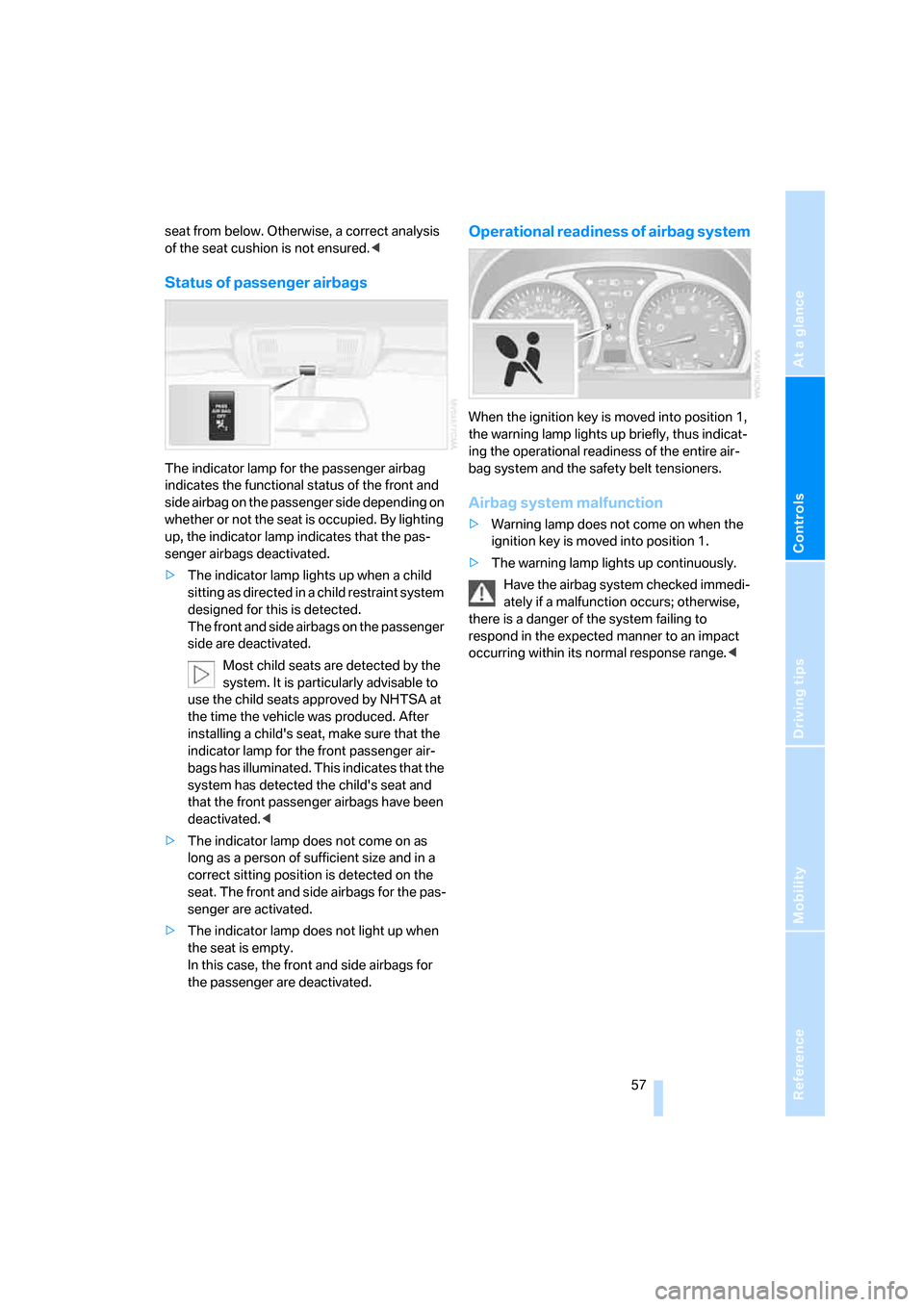
Status of passenger airbags
The indicator lamp for the passenger airbag
indicates the functional status of the front and
side airbag on the passenger side depending on
whether or not the seat is occupied. By lighting
up, the indicator lamp indicates that the pas-
senger airbags deactivated.
>The indicator lamp lights up when a child
sitting as directed in a child restraint system
designed for this is detected.
The front and side airbags on the passenger
side are deactivated.
Most child seats are detected by the
system. It is particularly advisable to
use the child seats approved by NHTSA at
the time the vehicle was produced. After
installing a child's seat, make sure that the
indicator lamp for the front passenger air-
bags has illuminated. This indicates that the
system has detected the child's seat and
that the front passenger airbags have been
deactivated.<
>The indicator lamp does not come on as
long as a person of sufficient size and in a
correct sitting position is detected on the
seat. The front and side airbags for the pas-
senger are activated.
>The indicator lamp does not light up when
the seat is empty.
In this case, the front and side airbags for
the passenger are deactivated.
Operational readiness of airbag system
When the ignition key is moved into position 1,
the warning lamp lights up briefly, thus indicat-
ing the operational readiness of the entire air-
bag system and the safety belt tensioners.
Airbag system malfunction
>Warning lamp does not come on when the
ignition key is moved into position 1.
>The warning lamp lights up continuously.
Have the airbag system checked immedi-
ately if a malfunction occurs; otherwise,
there is a danger of the system failing to
respond in the expected manner to an impact
occurring within its normal response range.<
Page 76 of 139
Practical interior accessories
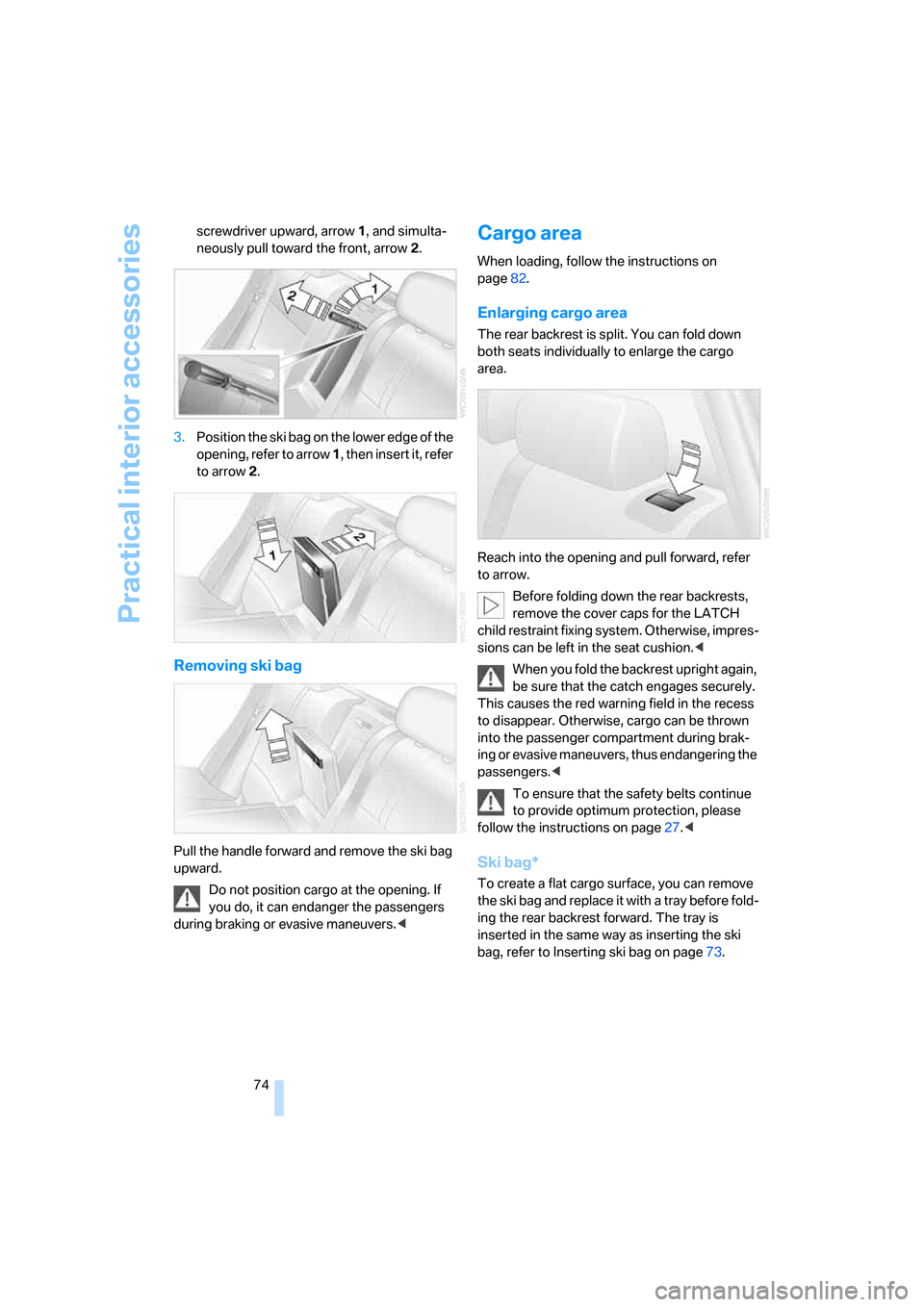
74 screwdriver upward, arrow1, and simulta-
neously pull toward the front, arrow2.
3.Position the ski bag on the lower edge of the
opening, refer to arrow 1, then insert it, refer
to arrow 2.
Removing ski bag
Pull the handle forward and remove the ski bag
upward.
Do not position cargo at the opening. If
you do, it can endanger the passengers
during braking or evasive maneuvers.<
Cargo area
When loading, follow the instructions on
page82.
Enlarging cargo area
The rear backrest is split. You can fold down
both seats individually to enlarge the cargo
area.
Reach into the opening and pull forward, refer
to arrow.
Before folding down the rear backrests,
remove the cover caps for the LATCH
child restraint fixing system. Otherwise, impres-
sions can be left in the seat cushion.<
When you fold the backrest upright again,
be sure that the catch engages securely.
This causes the red warning field in the recess
to disappear. Otherwise, cargo can be thrown
into the passenger compartment during brak-
ing or evasive maneuvers, thus endangering the
passengers.<
To ensure that the safety belts continue
to provide optimum protection, please
follow the instructions on page27.<
Ski bag*
To create a flat cargo surface, you can remove
the ski bag and replace it with a tray before fold-
ing the rear backrest forward. The tray is
inserted in the same way as inserting the ski
bag, refer to Inserting ski bag on page73.
Page 84 of 139
Things to remember when driving
82
Hills
To prevent overheating and reduced effi-
ciency of the brake system, drive long or
steep downhill grades in the gear in which the
least braking is required. Otherwise, even light
but continuous pressure on the brake can lead
to high temperatures, brake wear and possibly
even brake failure.<
The braking action of the engine can be further
intensified by downshifting, all the way down to
first gear if need be. This strategy helps you
avoid placing excessive loads on the brake sys-
tem. Downshifting in manual mode of automatic
transmission, refer to page40. When descend-
ing hills slowly, use HDC Hill Descent Control,
refer to page51.
Never drive with the clutch depressed,
with the transmission in neutral, or with
the engine switched off; otherwise, you will
have neither the braking action of the engine or
nor its power assistance to the brakes or steer-
ing.
Never allow floor mats, carpeting, or other arti-
cles to protrude into the area around the brake
or accelerator pedals and obstruct their move-
ment.<
Corrosion on brake rotors
When the vehicle is driven only occasionally,
during extended periods when the vehicle is not
used at all, and in operating conditions where
brake applications are less frequent, there is an
increased tendency for corrosion to form on
rotors, while contaminants accumulate on the
brake pads. This occurs because the minimal
pressure which must be exerted by the pads
during brake applications to clean the rotors is
not reached.
Should corrosion form on the brake rotors, the
brakes will tend to respond with a pulsating
effect that even extended application will fail to
cure.
Brake pads
The warning lamp lights up.
The brake pads have reached their min-
imum pad thickness. Have brake pads
replaced immediately.
Cargo loading
To avoid loading the tires beyond their
approved carrying capacity, never over-
load the vehicle. Overloading can lead to over-
heating of the tire and increases the rate at
which damage develops inside the tires. The
ultimate result can assume the form of a sudden
blow-out.<
Determining load limit
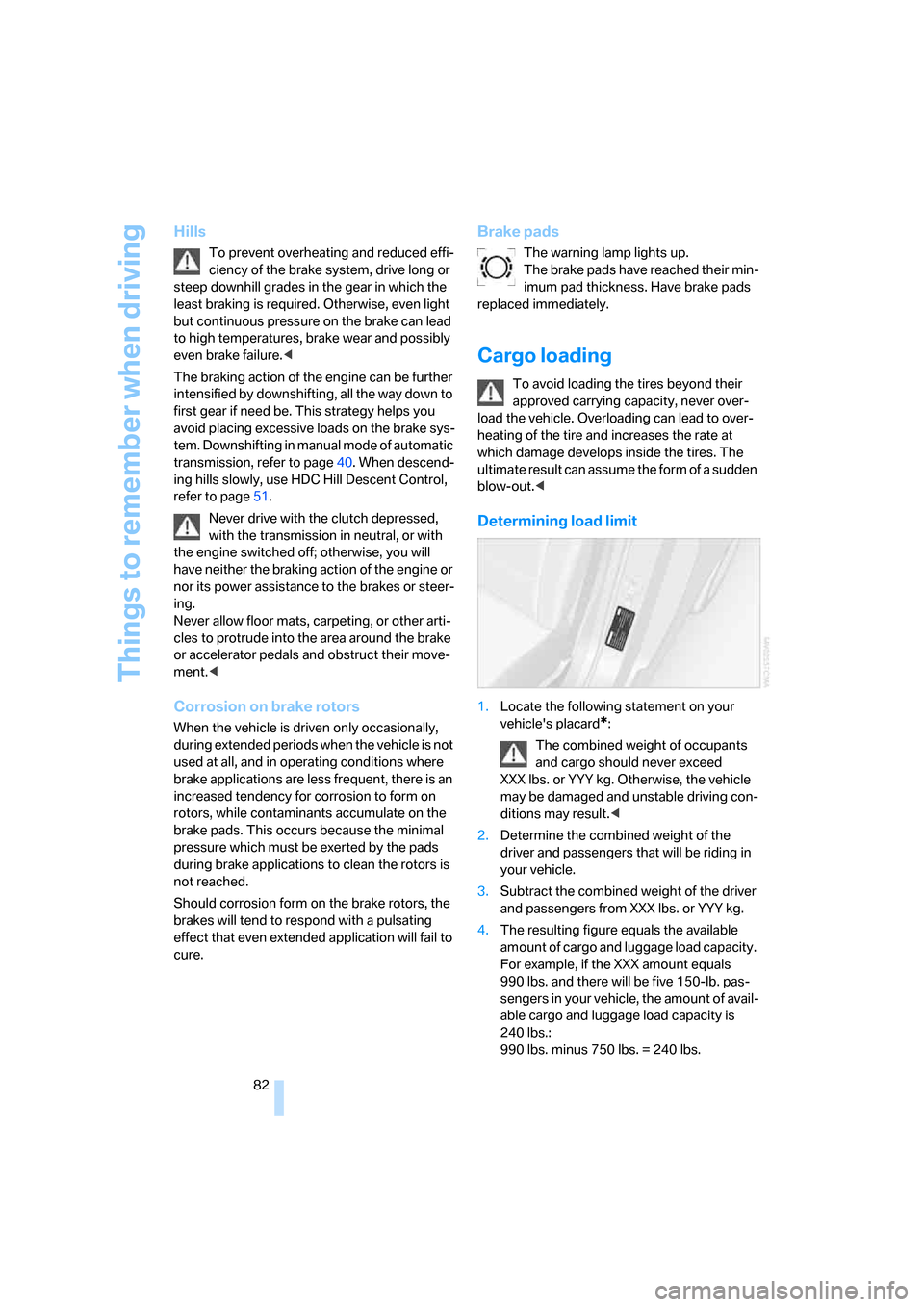
1.Locate the following statement on your
vehicle's placard
*:
The combined weight of occupants
and cargo should never exceed
XXX lbs. or YYY kg. Otherwise, the vehicle
may be damaged and unstable driving con-
ditions may result.<
2.Determine the combined weight of the
driver and passengers that will be riding in
your vehicle.
3.Subtract the combined weight of the driver
and passengers from XXX lbs. or YYY kg.
4.The resulting figure equals the available
amount of cargo and luggage load capacity.
For example, if the XXX amount equals
990 lbs. and there will be five 150-lb. pas-
sengers in your vehicle, the amount of avail-
able cargo and luggage load capacity is
240 lbs.:
990 lbs. minus 750 lbs. = 240 lbs.
Page 90 of 139
Refueling
88
Refueling
Fuel cap
Opening
Always switch off the engine before
refueling. Otherwise, no fuel can be dis-
pensed into the tank and the Service Engine
Soon lamp lights up.<
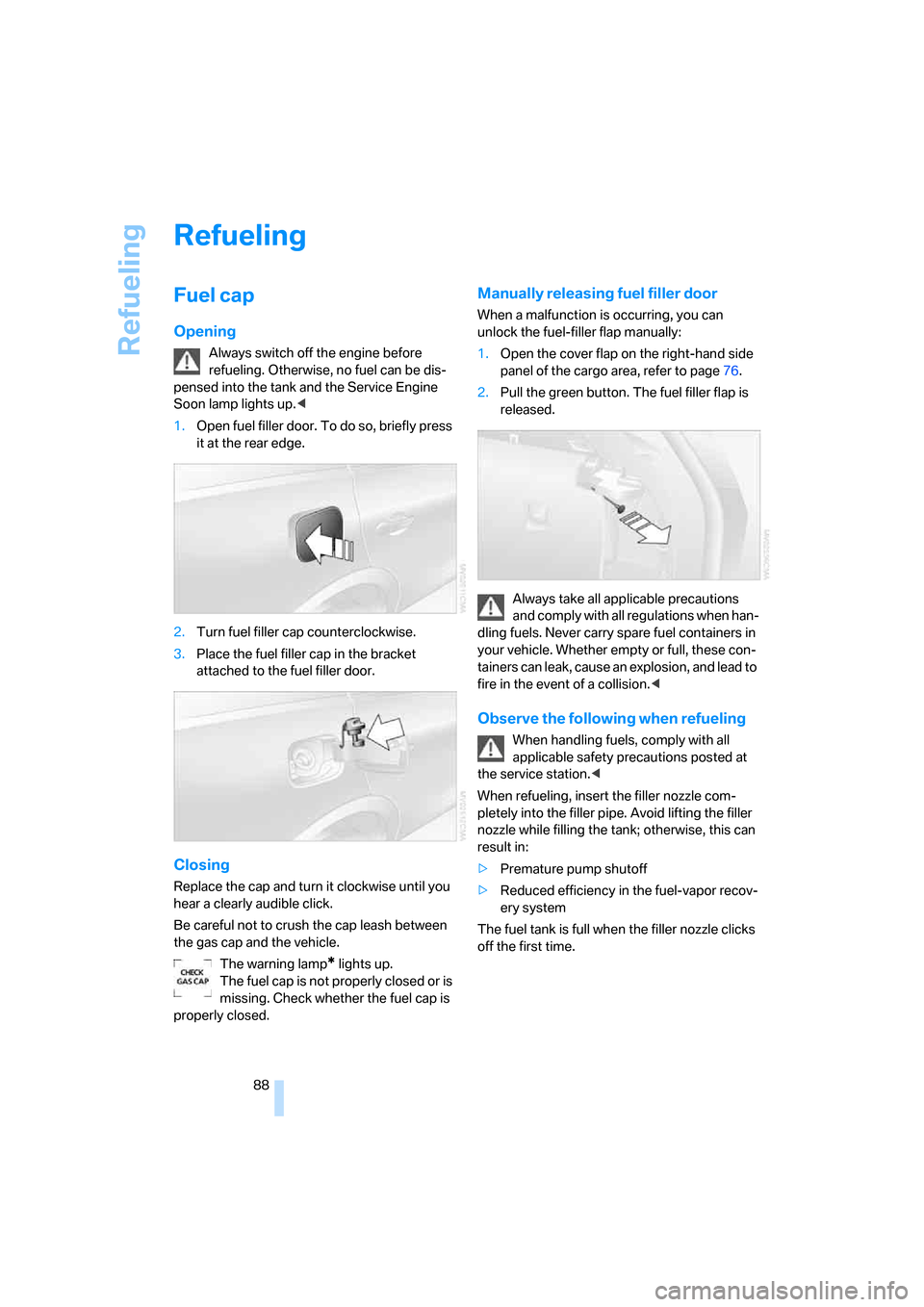
1.Open fuel filler door. To do so, briefly press
it at the rear edge.
2.Turn fuel filler cap counterclockwise.
3.Place the fuel filler cap in the bracket
attached to the fuel filler door.
Closing
Replace the cap and turn it clockwise until you
hear a clearly audible click.
Be careful not to crush the cap leash between
the gas cap and the vehicle.
The warning lamp
* lights up.
The fuel cap is not properly closed or is
missing. Check whether the fuel cap is
properly closed.
Manually releasing fuel filler door
When a malfunction is occurring, you can
unlock the fuel-filler flap manually:
1.Open the cover flap on the right-hand side
panel of the cargo area, refer to page76.
2.Pull the green button. The fuel filler flap is
released.
Always take all applicable precautions
and comply with all regulations when han-
dling fuels. Never carry spare fuel containers in
your vehicle. Whether empty or full, these con-
tainers can leak, cause an explosion, and lead to
fire in the event of a collision.<
Observe the following when refueling
When handling fuels, comply with all
applicable safety precautions posted at
the service station.<
When refueling, insert the filler nozzle com-
pletely into the filler pipe. Avoid lifting the filler
nozzle while filling the tank; otherwise, this can
result in:
>Premature pump shutoff
>Reduced efficiency in the fuel-vapor recov-
ery system
The fuel tank is full when the filler nozzle clicks
off the first time.
Page 101 of 139
Reference
At a glance
Controls
Driving tips
Mobility
99
Engine oil
Engine oil consumption depends on driving
style and operating conditions.
Warning lamp
Engine oil pressure
The warning lamp lights up red:
The engine oil pressure is too low.
Stop the vehicle immediately and
switch off the engine. Check the engine oil level
and top off as needed. If the oil level is correct:
Have the system checked immediately.
Do not continue driving. The engine could
be damaged because of inadequate lubri-
cation.<
Engine oil level
The warning lamp lights up yellow dur-
ing driving. An acoustic signal also
sounds and "+1.0 " is displayed in the
instrument cluster, refer to page99.
The oil level is at its absolute minimum; top off
engine oil as soon as possible. Until then, do not
drive more than approx. 125 miles/200 km.
The warning lamp lights up yellow after
the engine is switched off. In addition, a
signal sounds.
Top off engine oil at the earliest opportunity,
e.g. with your next refueling.
The warning lamp lights up yellow
within 30 seconds after starting the
engine:
The oil level sensor has failed. It is not possible
to take a current or meaningful measurement.
Have the system checked as soon as possible.
Checking oil level
Your vehicle is equipped with an electronic oil
level control.
For the most precise possible display of the oil
level, the engine must be at operating tempera-
ture, i.e. after at least 6.5 miles/10 km of unin-
terrupted driving. You can have the oil level dis-
played while you drive or while the vehicle is standing on a flat surface with the engine run-
ning.
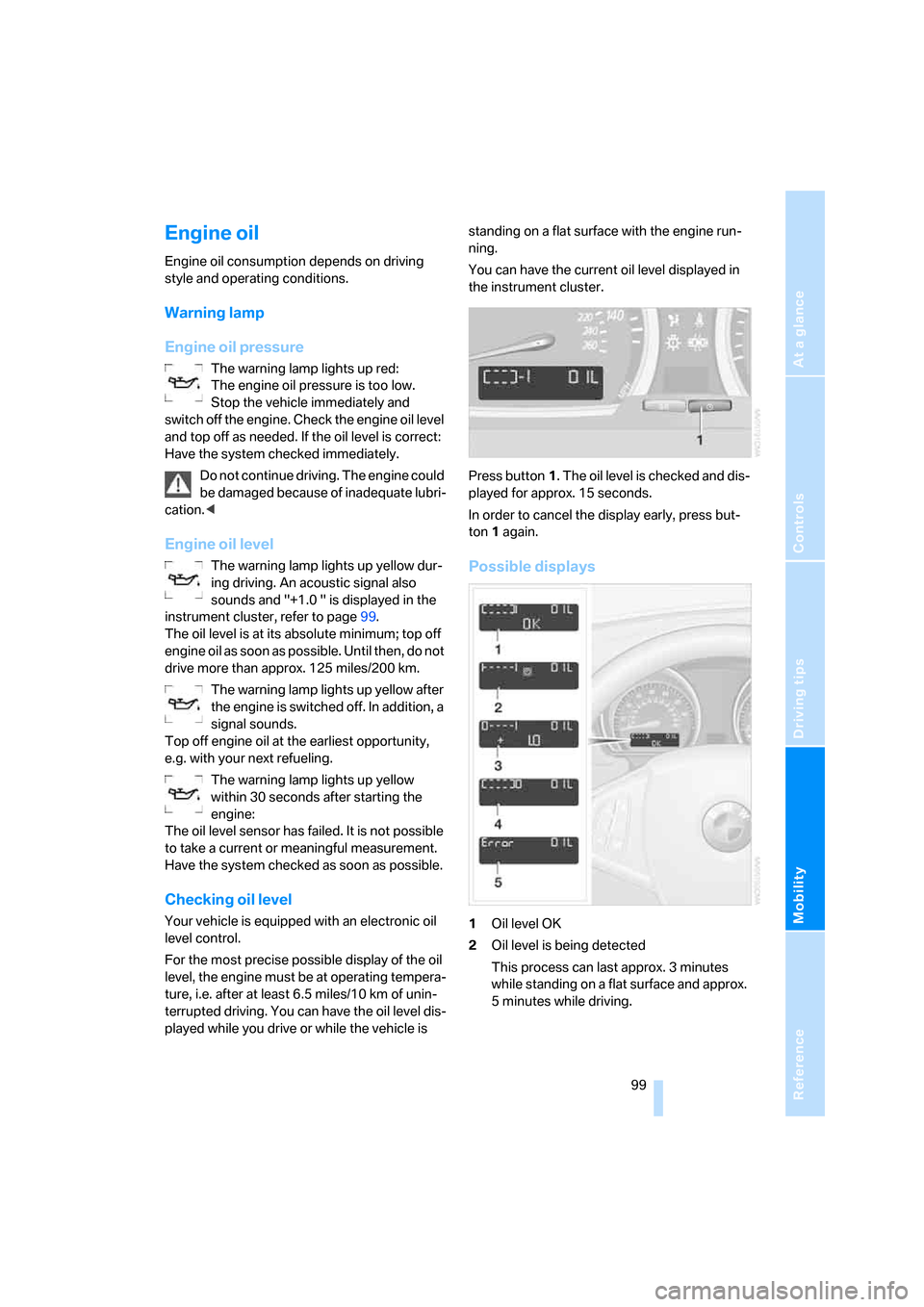
You can have the current oil level displayed in
the instrument cluster.
Press button1. The oil level is checked and dis-
played for approx. 15 seconds.
In order to cancel the display early, press but-
ton 1 again.
Possible displays
1Oil level OK
2Oil level is being detected
This process can last approx. 3 minutes
while standing on a flat surface and approx.
5 minutes while driving.
Page 102 of 139
Under the hood
100 3Oil level at minimum
A t yo ur e a r li es t o p p ortunity, add 1 US quart/
1 liter engine oil, also refer to Adding engine
oil.
4Oil level too high
Have vehicle checked immediately;
otherwise, overfilled oil can lead to
engine damage.<
5Oil level sensor has failed
It is not possible to take a current or mean-
ingful measurement.
Do not add engine oil. It is possible to con-
tinue driving. Have the system checked as
soon as possible.
Adding engine oil
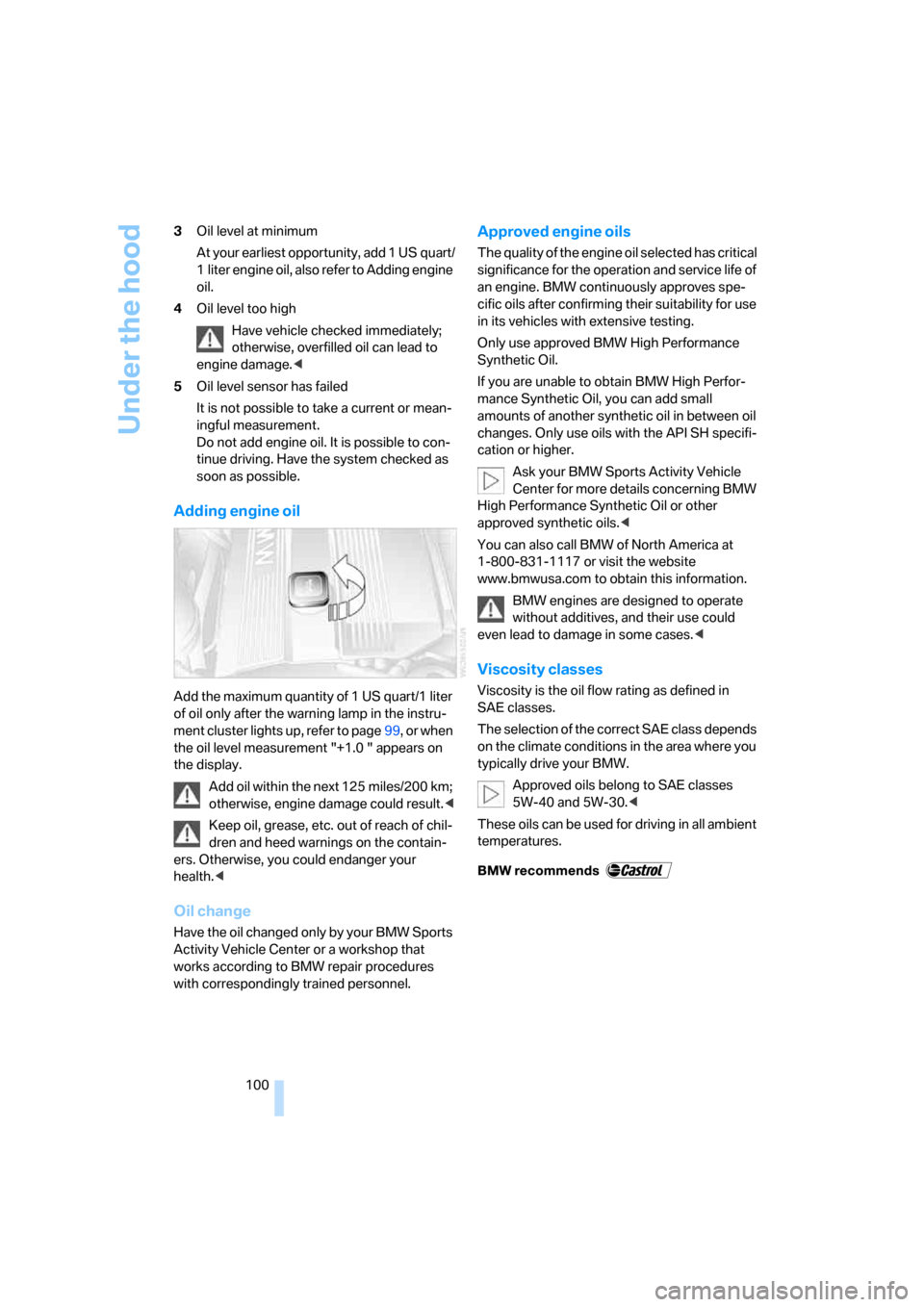
Add the maximum quantity of 1 US quart/1 liter
of oil only after the warning lamp in the instru-
ment cluster lights up, refer to page99, or when
the oil level measurement "+1.0 " appears on
the display.
Add oil within the next 125 miles/200 km;
otherwise, engine damage could result.<
Keep oil, grease, etc. out of reach of chil-
dren and heed warnings on the contain-
ers. Otherwise, you could endanger your
health.<
Oil change
Have the oil changed only by your BMW Sports
Activity Vehicle Center or a workshop that
works according to BMW repair procedures
with correspondingly trained personnel.
Approved engine oils
The quality of the engine oil selected has critical
significance for the operation and service life of
an engine. BMW continuously approves spe-
cific oils after confirming their suitability for use
in its vehicles with extensive testing.
Only use approved BMW High Performance
Synthetic Oil.
If you are unable to obtain BMW High Perfor-
mance Synthetic Oil, you can add small
amounts of another synthetic oil in between oil
changes. Only use oils with the API SH specifi-
cation or higher.
Ask your BMW Sports Activity Vehicle
Center for more details concerning BMW
High Performance Synthetic Oil or other
approved synthetic oils.<
You can also call BMW of North America at
1-800-831-1117 or visit the website
www.bmwusa.com to obtain this information.
BMW engines are designed to operate
without additives, and their use could
even lead to damage in some cases.<
Viscosity classes
Viscosity is the oil flow rating as defined in
SAE classes.
The selection of the correct SAE class depends
on the climate conditions in the area where you
typically drive your BMW.
Approved oils belong to SAE classes
5W-40 and 5W-30.<
These oils can be used for driving in all ambient
temperatures.
Page 103 of 139
Reference
At a glance
Controls
Driving tips
Mobility
101
Coolant
Warning lamp
The warning lamp lights up: coolant
level is too low; top off at the next
opportunity.
Do not open the cooling system when the
engine is hot. Escaping coolant can cause
burns.<
Coolant consists of water and coolant additive.
Not all commercially available additives are suit-
able for your BMW. Ask your BMW Sports
Activity Vehicle Center for suitable additives.
Only use suitable additives; otherwise,
engine damage may result. The additives
are harmful to your health, so follow the instruc-
tions on the containers.<
Always observe all applicable environ-
mental laws and regulations when dis-
posing of used coolant additives.<
Checking coolant level
1.Allow engine to cool.
2.Turn the cap of the expansion tank counter-
clockwise to allow any accumulated pres-
sure to escape, then continue turning to
open.
3.The coolant level is correct when it is
between the MIN and MAX marks, also refer
to illustration next to filler neck.
4.If the coolant is low, slowly add coolant up to
the specified level – do not overfill.
5.Screw on the cap and tighten snugly.
6.Have the reason for the coolant loss cor-
rected as soon as possible.
Brake system
Malfunction
Brake fluid
The warning lamp lights up red despite
the handbrake being released.
The brake fluid in the reservoir has
fallen to below the minimum level. At the same
time, a considerably longer brake pedal travel
may be noticeable. Have the system checked
immediately.
During continued driving, increased brake
pedal travel may be necessary, and con-
siderably longer braking distances may result.
Please adapt your driving style accordingly.<
Display of the previously described mal-
function on Canadian models.
Page 105 of 139
Reference
At a glance
Controls
Driving tips
Mobility
103
Emissions values
The warning lamp lights up. Exhaust
values are deteriorating. Have the vehi-
cle checked as soon as possible.
Under certain conditions, the indicator will flash.
This indicates a serious rate of engine misfire.
When this occurs, you should reduce speed
and consult the nearest BMW Sports Activity
Vehicle Center as soon as possible. Severe
engine misfire even for only a short period of
time can seriously damage emission control
components, especially the catalytic converter.
Display of the previously described mal-
function on Canadian models.
When the fuel filler cap is not properly
tightened, the OBD system can detect
the vapor leak and the indicator lamp will light
up. If the filler cap is subsequently tightened,
the indicator lamp should go out within a few
days.<
Event data recorders
Your vehicle may be equipped with one or more
sensing and diagnostic modules or a recording
device capable of recording or transmitting cer-
tain vehicle data or information. In addition, if
you have a Subscription Service Agreement for
the BMW Assist system, certain vehicle infor-
mation may be transmitted or recorded in order
to provide such services.
Care
You can find useful information on caring for
your BMW in the Caring for your vehicle bro-
chure.
Page 110 of 139
Replacing components
108 Brake lamp:
1.Remove bulb holder, refer to arrow 2.
2.Remove and replace the bulb.
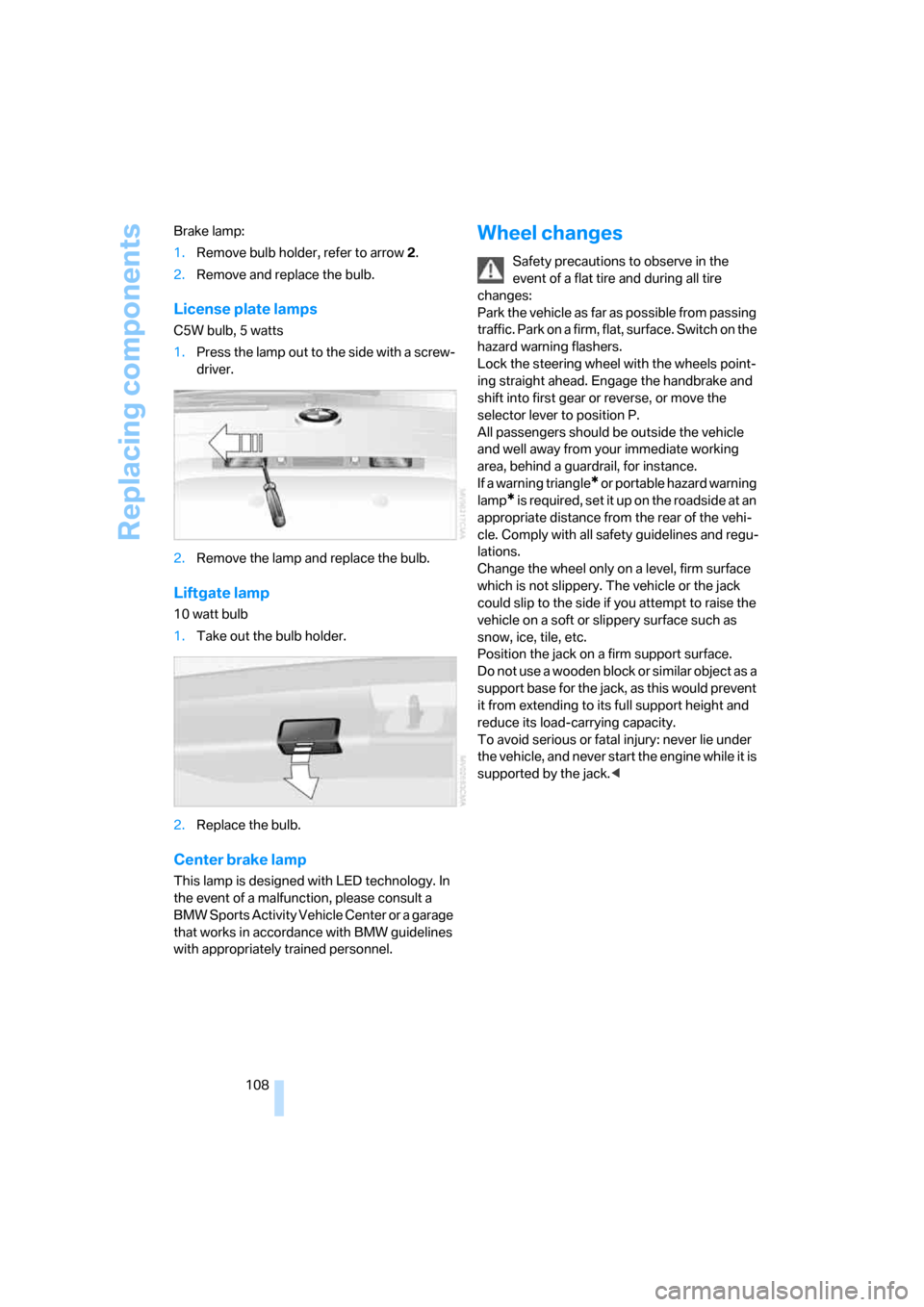
License plate lamps
C5W bulb, 5 watts
1.Press the lamp out to the side with a screw-
driver.
2.Remove the lamp and replace the bulb.
Liftgate lamp
10 watt bulb
1.Take out the bulb holder.
2.Replace the bulb.
Center brake lamp
This lamp is designed with LED technology. In
the event of a malfunction, please consult a
BMW Sports Activity Vehicle Center or a garage
that works in accordance with BMW guidelines
with appropriately trained personnel.
Wheel changes
Safety precautions to observe in the
event of a flat tire and during all tire
changes:
Park the vehicle as far as possible from passing
traffic. Park on a firm, flat, surface. Switch on the
hazard warning flashers.
Lock the steering wheel with the wheels point-
ing straight ahead. Engage the handbrake and
shift into first gear or reverse, or move the
selector lever to position P.
All passengers should be outside the vehicle
and well away from your immediate working
area, behind a guardrail, for instance.
If a warning triangle
* or portable hazard warning
lamp
* is required, set it up on the roadside at an
appropriate distance from the rear of the vehi-
cle. Comply with all safety guidelines and regu-
lations.
Change the wheel only on a level, firm surface
which is not slippery. The vehicle or the jack
could slip to the side if you attempt to raise the
vehicle on a soft or slippery surface such as
snow, ice, tile, etc.
Position the jack on a firm support surface.
Do not use a wooden block or similar object as a
support base for the jack, as this would prevent
it from extending to its full support height and
reduce its load-carrying capacity.
To avoid serious or fatal injury: never lie under
the vehicle, and never start the engine while it is
supported by the jack.<
Page 113 of 139
Reference
At a glance
Controls
Driving tips
Mobility
111
Protect valve stems with valve stem
seal caps from dirt and contamina-
tion. Dirt in valve stems is a frequent source
of gradual air loss.<
4.Reinitialize the Flat Tire Monitor
* or reset
the Tire Pressure Monitor
*, refer to
pages53, 54.
Do not initialize the Flat Tire Monitor
when driving with a compact wheel.<
5.Replace the defective tire as soon as possi-
ble and have the new wheel/tire balanced.
Driving with compact wheel
Drive reservedly and do not exceed a speed of
50 mph/80 km/h.
Mounting the compact wheel can change the
driving characteristics. For example, it can
reduce tracking stability during braking, extend
braking distances, and alter self-steering char-
acteristics in the limit range. With winter tires,
these characteristics are more pronounced.
Only one compact wheel may be
mounted. You should re-equip with
wheels and tires of the original size as soon as
possible.<
Vehicle battery
Maintenance
The battery is 100 % maintenance-free, i.e., the
electrolyte will last for the life of the battery
when the vehicle is operated in a temperate cli-
mate. Your BMW Sports Activity Vehicle Center
will be happy to advise you on all questions con-
cerning the battery.
Warning lamp
The warning lamp lights up. The battery
is no longer being charged. The alterna-
tor V-belt is defective or there is a mal-
function in the charge current circuit of the
alternator. Have the system checked immedi-
ately.Do not continue driving if the V-belt is
defective. The engine could be damaged
due to overheating.
Moreover, an increased amount of force is
required for steering if there is a sharp drop in
the onboard supply voltage.<
Charging battery
Charge the battery in the vehicle only when the
engine has been switched off. For connections,
refer to Jump starting on page114.
Disposal
Have old batteries disposed of following
replacement at your BMW Sports Activity
Vehicle Center or bring them to a collection
point. Maintain the battery in an upright position
for transport and storage. Always secure the
battery to prevent it from tipping over during
transport.<
Power failure
After a temporary power supply interruption,
some equipment is subject to limited use and
must be reinitialized. Individual settings are also
lost and must be updated again:
>Panorama glass sunroof
It may be only possible to raise the sunroof.
The system must be initialized, refer to
page24.
>Power windows
The pinch protection system must be reini-
tialized, refer to page23.
>Seat and mirror memory
The positions must be stored again, refer to
page30.
>Time
Must be set again, refer to page46.