high BMW X3 XDRIVE 28I 2011 Repair Manual
[x] Cancel search | Manufacturer: BMW, Model Year: 2011, Model line: X3 XDRIVE 28I, Model: BMW X3 XDRIVE 28I 2011Pages: 262, PDF Size: 11.2 MB
Page 212 of 262
In case of tire damage
If there are indications of tire damage, re‐
duce your speed immediately and have the
wheels and tires checked right away; otherwise,
there is the increased risk of an accident.
Drive carefully to the next service center or tire
shop.
If necessary, have the vehicle towed.◀
Repair of tire damage
For safety reasons, the manufacturer of
your vehicle recommends that you do not have
damaged tires repaired; they should be re‐
placed. Otherwise, damage can occur as a re‐
sult.◀
Tire age
Recommendation
Regardless of wear, replace tires at least every
6 years.
Manufacture date
On the sidewall:
DOT … 3510: the tire was manufactured in the
35th week in 2010.
Changing wheels and tires
Mounting Information on mounting tires
Have mounting and balancing performed
only by a service center or tire specialist.
If this work is not carried out properly, there is
the danger of subsequent damage and related
safety hazards.◀
Wheel and tire combination
Information on the correct wheel-tire combina‐
tion and rim versions for your vehicle can be ob‐
tained from your service center.Incorrect wheel and tire combinations impair the
function of a variety of systems such as ABS or
DSC.
To maintain good handling and vehicle re‐
sponse, use only tires with a single tread con‐
figuration from a single manufacturer.
Following tire damage, have the original wheel
and tire combination remounted on the vehicle
as soon as possible.
Approved wheels and tires
The manufacturer of your vehicle recom‐
mends that you use only wheels and tires that
have been approved for your particular vehicle
model.
For example, despite having the same official
size ratings, variations can lead to body contact
and with it, the risk of severe accidents.
The manufacturer of your vehicle cannot evalu‐
ate non-approved wheels and tires to determine
if they are suited for use, and therefore cannot
ensure the operating safety of the vehicle if they
are mounted.◀
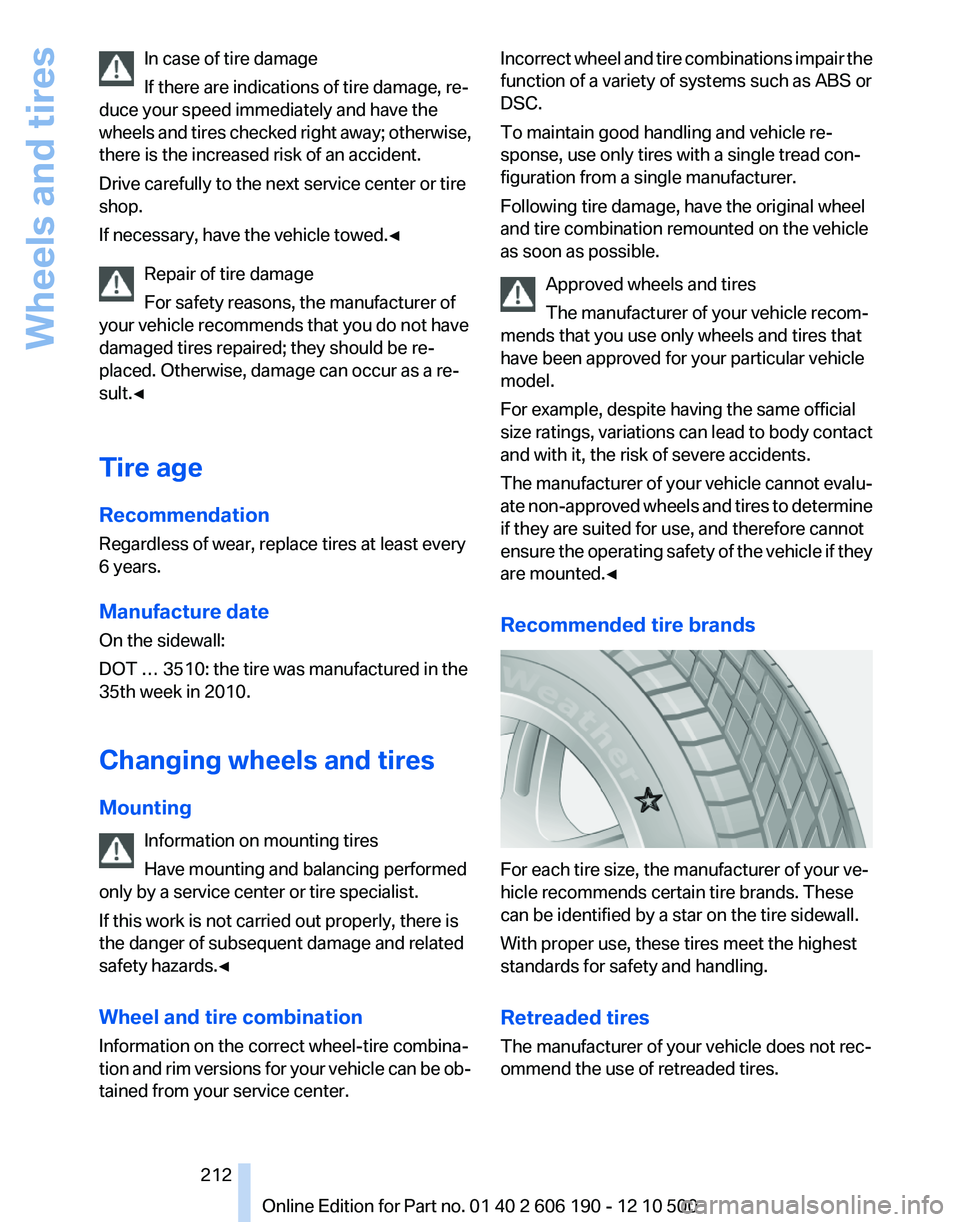
Recommended tire brands
For each tire size, the manufacturer of your ve‐
hicle recommends certain tire brands. These
can be identified by a star on the tire sidewall.
With proper use, these tires meet the highest
standards for safety and handling.
Retreaded tires
The manufacturer of your vehicle does not rec‐
ommend the use of retreaded tires.
Seite 212212
Online Edition for Part no. 01 40 2 606 190 - 12 10 500Wheels and tires
Page 213 of 262
Retreaded tires
Possibly substantial variations in the de‐
sign and age of the tire casing structures can
limit service life and have a negative impact on
road safety.◀
Winter tires
The manufacturer of your vehicle recommends
winter tires for winter roads or at temperatures
below +45 ℉/+7 ℃.
Although so-called all-season M+S tires do pro‐
vide better winter traction than summer tires,
they do not provide the same level of perform‐
ance as winter tires.
Maximum speed of winter tires
If the maximum speed of the vehicle is higher
than the permissible speed for the winter tires,
then display a corresponding sign in the field of
vision. You can obtain this sign from the tire spe‐
cialist or from your service center.
Maximum speed for winter tires
Do not exceed the maximum speed for the
winter tires; otherwise, tire damage and acci‐
dents can occur.◀
Run-flat tires
For your own safety, only use run-flat tires. No
spare tire is available in the case of a flat tire. Your
service center will be glad to advise you.
Rotating wheels between axles
The manufacturer of your vehicle advises
against swapping wheels between the front and
rear axles.
This can impair the handling characteristics.
Storage
Store wheels and tires in a cool, dry place with
as little exposure to light as possible.
Always protect tires against all contact with oil,
grease and fuels.
Do not exceed the maximum tire inflation pres‐
sure indicated on the side wall of the tire.Run-flat tires*
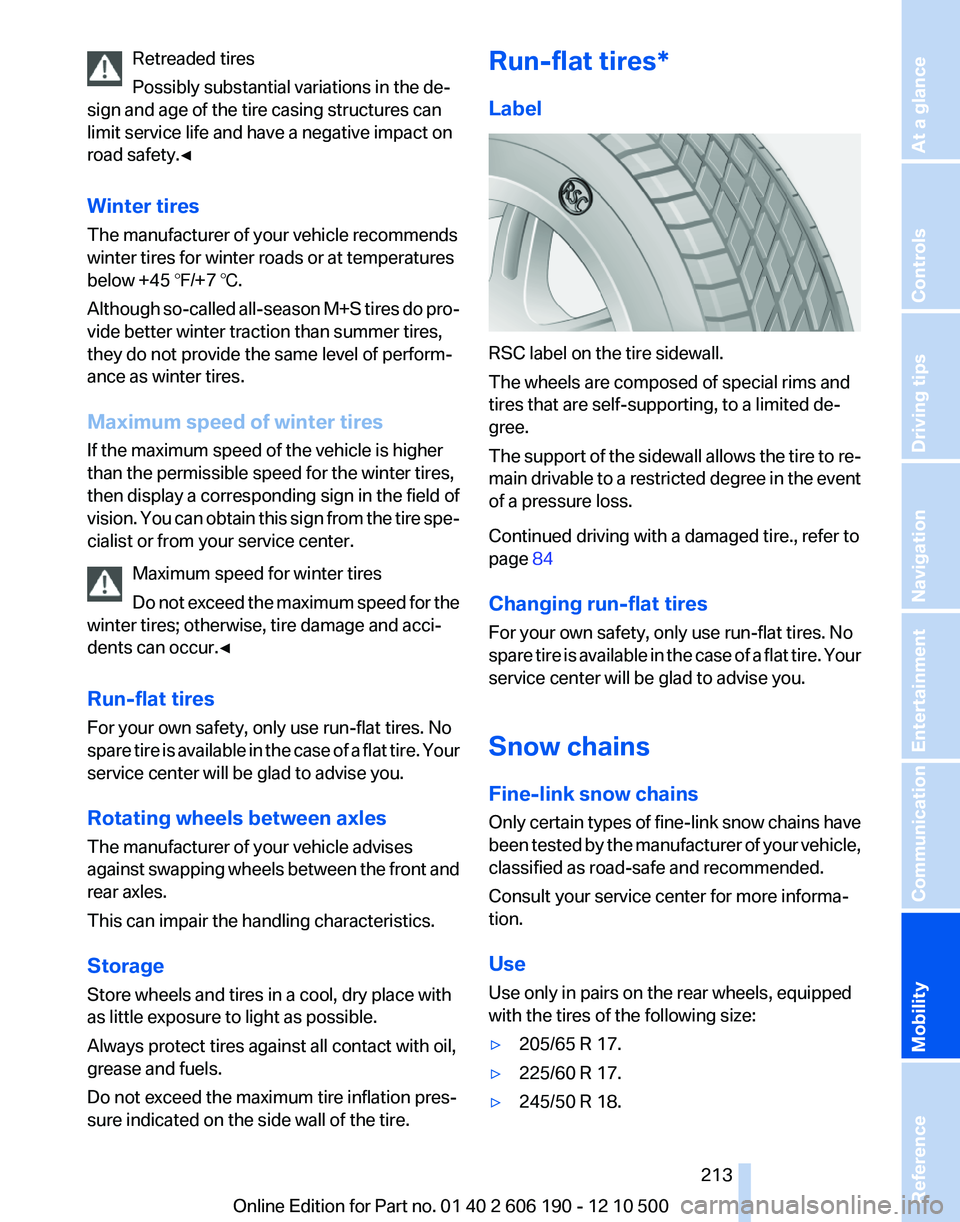
Label
RSC label on the tire sidewall.
The wheels are composed of special rims and
tires that are self-supporting, to a limited de‐
gree.
The support of the sidewall allows the tire to re‐
main drivable to a restricted degree in the event
of a pressure loss.
Continued driving with a damaged tire., refer to
page 84
Changing run-flat tires
For your own safety, only use run-flat tires. No
spare tire is available in the case of a flat tire. Your
service center will be glad to advise you.
Snow chains
Fine-link snow chains
Only certain types of fine-link snow chains have
been tested by the manufacturer of your vehicle,
classified as road-safe and recommended.
Consult your service center for more informa‐
tion.
Use
Use only in pairs on the rear wheels, equipped
with the tires of the following size:
▷205/65 R 17.▷225/60 R 17.▷245/50 R 18.Seite 213213
Online Edition for Part no. 01 40 2 606 190 - 12 10 500
ReferenceMobilityCommunicationEntertainmentNavigationDriving tipsControlsAt a glance
Page 217 of 262
Engine oilGeneral information
The engine oil consumption is dependent on the
driving style and driving conditions.
Therefore, check the engine oil level after every
refueling using the electronic engine oil level
check.
Checking the oil level
The concept
The oil level is monitored electronically and dis‐
played on the Control Display.
Requirements▷The engine must be running and warm after
the vehicle has been driven for at least
6 miles/10 km.▷The vehicle is stopped or being driven on a
level roadway.
Displaying the oil level
1."Vehicle Info"2."Vehicle status"3. "Engine oil level"
Possible messages
▷"Engine oil level OK"▷"Measurement not possible at this time."▷"Measuring engine oil level..."
Duration with the engine running: ap‐
prox. 3 minutes.
Duration while driving: approx. 5 minutes.▷"Engine oil level below minimum. Add 1
quart!"
Add oil within the next 125 miles/200 km.▷"Engine oil level too high! Have this
checked."
Have the vehicle checked immediately.Too much engine oil
Have the vehicle checked immedi‐
ately; otherwise, surplus oil can lead to en‐
gine damage.◀▷"Measurement inactive. Have this
checked."
Note the newly calculated remaining mile‐
age until the next oil service. Have the sys‐
tem checked as soon as possible.
Adding engine oil
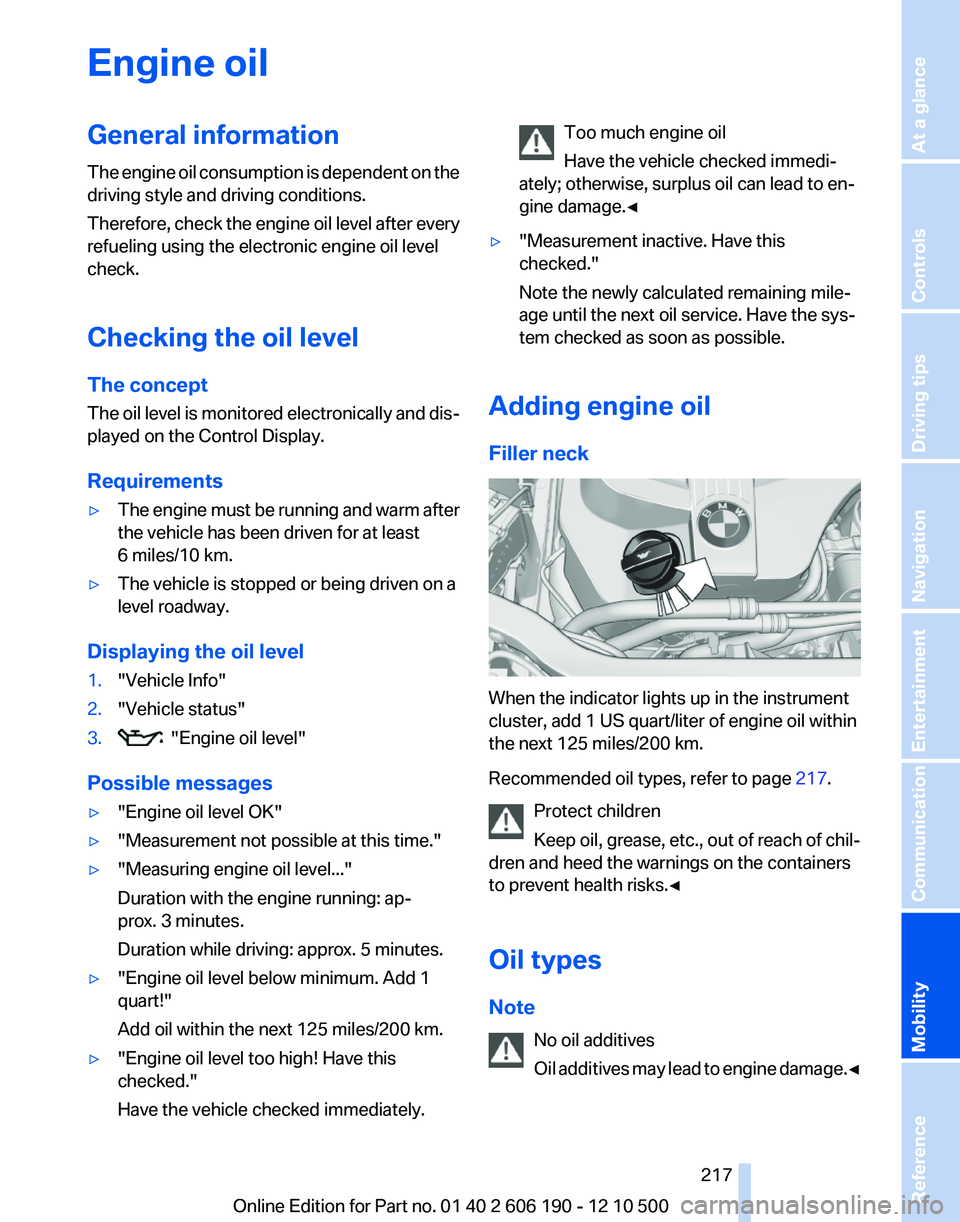
Filler neck
When the indicator lights up in the instrument
cluster, add 1 US quart/liter of engine oil within
the next 125 miles/200 km.
Recommended oil types, refer to page 217.
Protect children
Keep oil, grease, etc., out of reach of chil‐
dren and heed the warnings on the containers
to prevent health risks.◀
Oil types
Note No oil additives
Oil additives may lead to engine damage. ◀
Seite 217217
Online Edition for Part no. 01 40 2 606 190 - 12 10 500
ReferenceMobilityCommunicationEntertainmentNavigationDriving tipsControlsAt a glance
Page 218 of 262
Approved oil types
Your service center can advise you on which en‐
gine oils have been approved by the manufac‐
turer of your vehicle.
The engine oil quality is critical for the life of the
engine.
Only use approved BMW High Performance oil.
Approved oils belong to the viscosity grades
SAE 0W-40, SAE 0W-30, SAE 5W-40 and SAE
5W-30.
Alternative oil types
If the approved engine oils are not available, up
to 1 US quart/liter of another oil with the follow‐
ing specification may be used.
API SM quality standards or higher.
Coolant
General information Danger of burns from hot engine
Do not open the cooling system while the
engine is hot; otherwise, escaping coolant may
cause burns.◀
Suitable additives
Only use suitable additives; otherwise, en‐
gine damage may occur. The additives are
harmful to your health.◀
Coolant consists of water and additives.
Not all commercially available additives are suit‐
able for your vehicle. Ask your service center for
suitable additives.
Coolant level
Checking1.Let the engine cool.2.Turn the cap of the expansion tank slightly
counterclockwise to allow any excess pres‐
sure to dissipate, and then open it.3.The coolant level is correct if it lies between
the minimum and maximum marks in the
filler neck.4.If the coolant is low, slowly add coolant up to
the specified level; do not overfill.5.Turn the cap until there is an audible click.6.Have the cause of the coolant loss elimi‐
nated as soon as possible.
Disposal
Comply with the relevant environmental
protection regulations when disposing
of coolant and coolant additives.
Seite 218218
Online Edition for Part no. 01 40 2 606 190 - 12 10 500Engine oil
Page 222 of 262
Danger of burns
Only change bulbs when they are cool;
otherwise, there is the danger of getting
burned.◀
Working on the lighting system
When working on the lighting system, you
should always switch off the lights affected to
prevent short circuits.
To avoid possible injury or equipment damage
when replacing bulbs, observe any instructions
provided by the bulb manufacturer.◀
Do not touch the bulbs
Do not touch the glass of new bulbs with
your bare hands, as even minute amounts of
contamination will burn into the bulb's surface
and reduce its service life.
Use a clean tissue, cloth or something similar, or
hold the bulb by its base.◀
Light-emitting diodes (LEDs)
Light-emitting diodes installed behind a cover
serve as the light source for controls, display el‐
ements and other equipment.
These light-emitting diodes, which are related
to conventional lasers, are officially designated
as Class 1 light-emitting diodes.
Do not remove the covers
Do not remove the covers, and never stare
into the unfiltered light for several hours; other‐
wise, irritation of the retina could result.◀
Headlamp glass
Condensation can form on the inside of the ex‐
ternal lamps in cool or humid weather. When the
light is switched on, the condensation evapo‐
rates after a short time. The headlamp glasses
do not need to be changed.
If there is a large amount of moisture, e.g., water
droplets form in the lamp, have it checked by
your service center.Front lamps, bulb replacement
At a glance
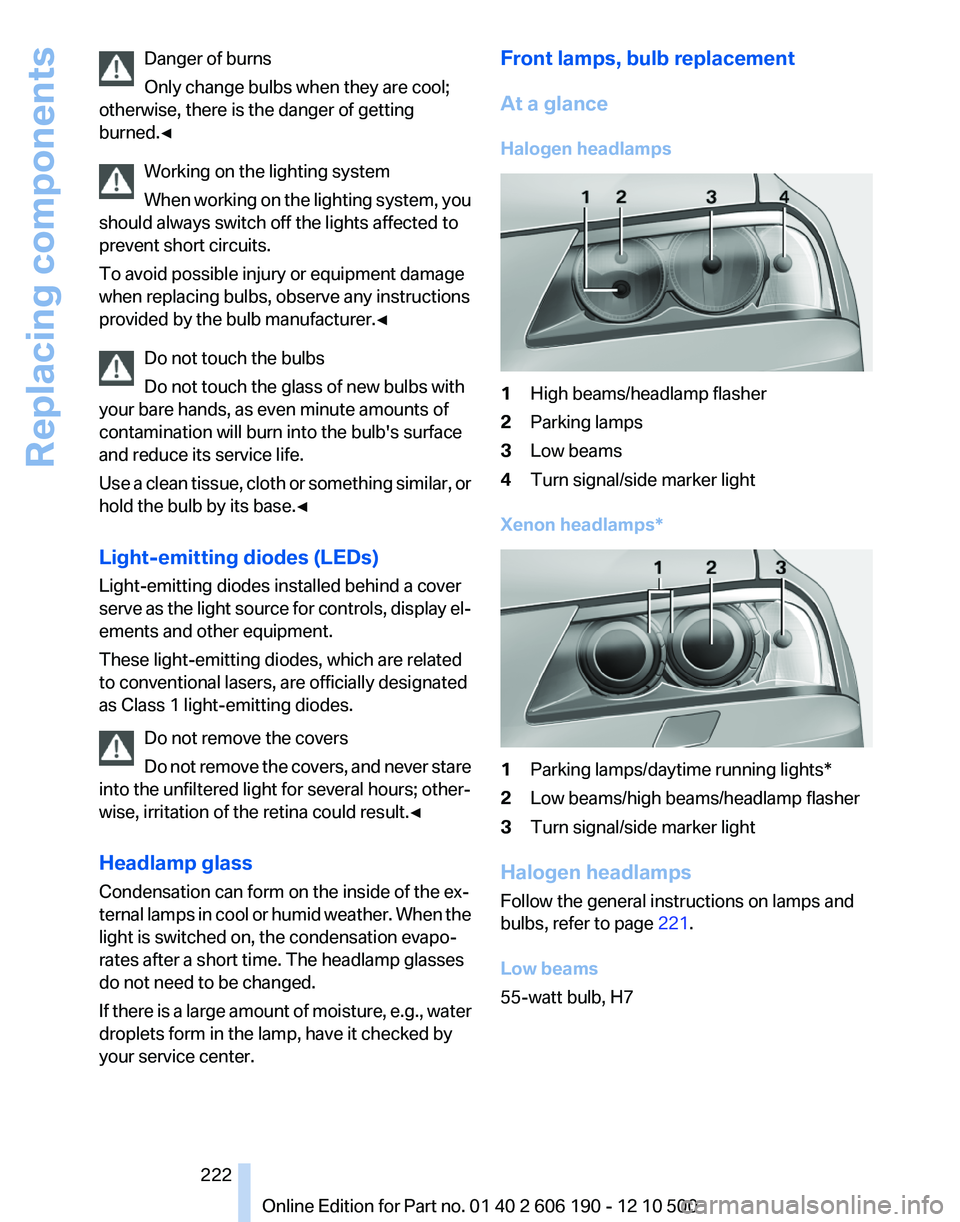
Halogen headlamps1High beams/headlamp flasher2Parking lamps3Low beams4Turn signal/side marker light
Xenon headlamps*
1Parking lamps/daytime running lights*2Low beams/high beams/headlamp flasher3Turn signal/side marker light
Halogen headlamps
Follow the general instructions on lamps and
bulbs, refer to page 221.
Low beams
55-watt bulb, H7
Seite 222222
Online Edition for Part no. 01 40 2 606 190 - 12 10 500Replacing components
Page 223 of 262
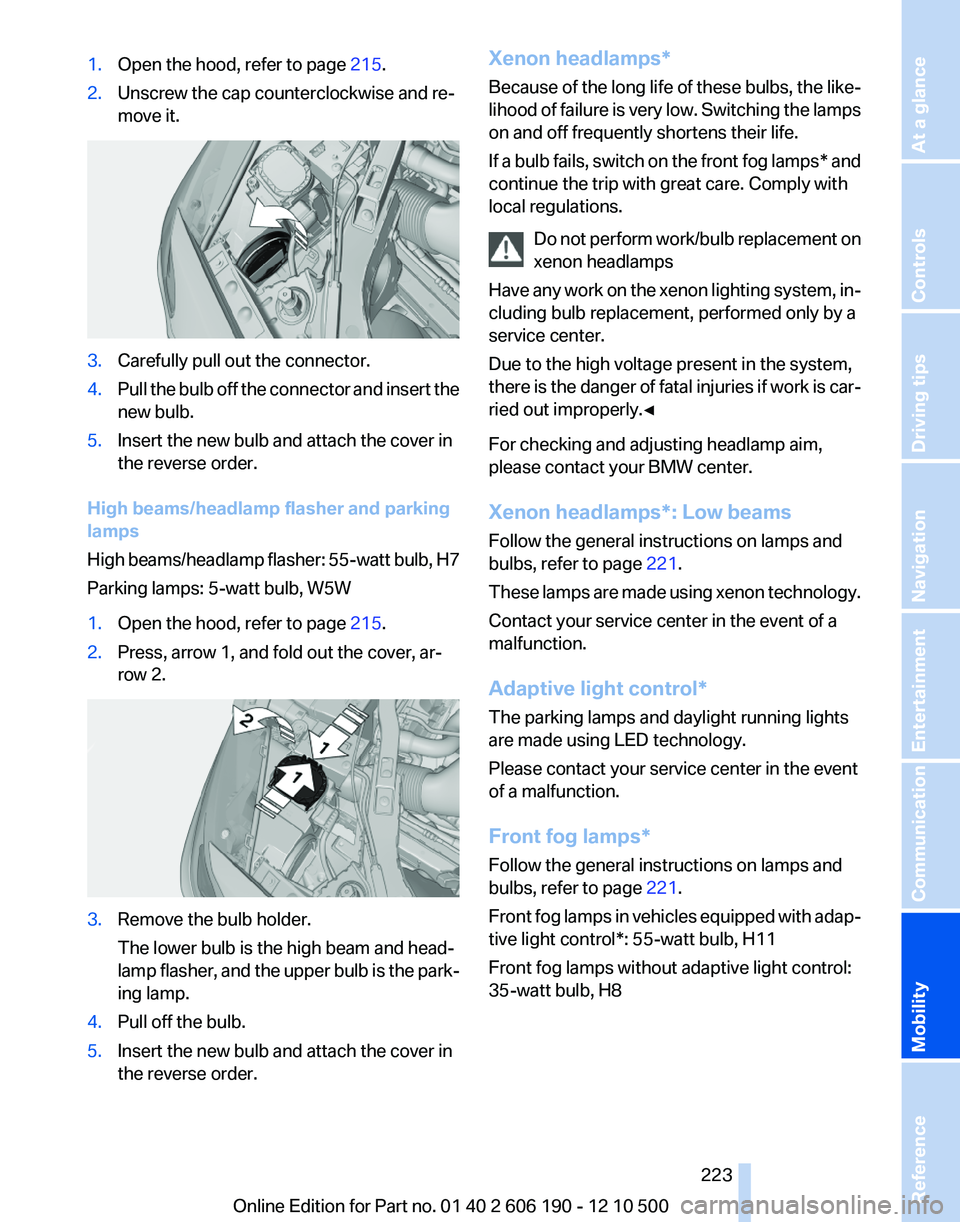
1.Open the hood, refer to page 215.2.Unscrew the cap counterclockwise and re‐
move it.3.Carefully pull out the connector.4.Pull the bulb off the connector and insert the
new bulb.5.Insert the new bulb and attach the cover in
the reverse order.
High beams/headlamp flasher and parking
lamps
High beams/headlamp flasher: 55-watt bulb, H7
Parking lamps: 5-watt bulb, W5W
1.Open the hood, refer to page 215.2.Press, arrow 1, and fold out the cover, ar‐
row 2.3.Remove the bulb holder.
The lower bulb is the high beam and head‐
lamp flasher, and the upper bulb is the park‐
ing lamp.4.Pull off the bulb.5.Insert the new bulb and attach the cover in
the reverse order.Xenon headlamps*
Because of the long life of these bulbs, the like‐
lihood of failure is very low. Switching the lamps
on and off frequently shortens their life.
If a bulb fails, switch on the front fog lamps* and
continue the trip with great care. Comply with
local regulations.
Do not perform work/bulb replacement on
xenon headlamps
Have any work on the xenon lighting system, in‐
cluding bulb replacement, performed only by a
service center.
Due to the high voltage present in the system,
there is the danger of fatal injuries if work is car‐
ried out improperly.◀
For checking and adjusting headlamp aim,
please contact your BMW center.
Xenon headlamps*: Low beams
Follow the general instructions on lamps and
bulbs, refer to page 221.
These lamps are made using xenon technology.
Contact your service center in the event of a
malfunction.
Adaptive light control*
The parking lamps and daylight running lights
are made using LED technology.
Please contact your service center in the event
of a malfunction.
Front fog lamps*
Follow the general instructions on lamps and
bulbs, refer to page 221.
Front fog lamps in vehicles equipped with adap‐
tive light control*: 55-watt bulb, H11
Front fog lamps without adaptive light control:
35-watt bulb, H8Seite 223223
Online Edition for Part no. 01 40 2 606 190 - 12 10 500
ReferenceMobilityCommunicationEntertainmentNavigationDriving tipsControlsAt a glance
Page 233 of 262
CareCar washes
Notes Steam jets or high-pressure washers
When using steam jets or high-pressure
washers, hold them a sufficient distance away
and use a maximum temperature of 140 ℉/
60 ℃.
Holding them too close or using excessively
high pressures or temperatures can cause dam‐
age or preliminary damage that may then lead to
long-term damage.
Follow the operating instructions for the high-
pressure washer.◀
Cleaning sensors/cameras with high-
pressure washers
When using high-pressure washers, do not
spray the exterior sensors and cameras, e.g.,
Park Distance Control*, for extended periods of
time and only from a distance of at least 12 in/
30 cm.◀
Wash your vehicle frequently, particularly in win‐
ter.
Intense soiling and road salt can damage the ve‐
hicle.
Washing in automatic car washes
Your vehicle can be washed in automatic car
washes right from the start.
Give preference to cloth car washes or those
that use soft brushes in order to avoid paint
damage.
Notes
Note the following:▷Make sure that the wheels and tires are not
damaged by the transport mechanisms.▷Fold in the exterior mirrors; otherwise, they
may be damaged, depending on the width of
the vehicle.▷Deactivate the rain sensor*, refer to
page 63, to avoid unintentional wiper acti‐
vation.▷In some cases, an unintentional alarm can be
triggered by the interior motion sensor of the
alarm system*. Follow the instructions on
avoiding an unintentional alarm, refer to
page 43.
Guide rails in car washes
Avoid car washes with guide rails higher
than 4 in/10 cm; otherwise, the vehicle body
could be damaged.◀
Before driving into a car wash
The vehicle is able to roll when the following
steps are taken:
Manual transmission:
Automatic transmission/Sport automatic trans‐
mission*:
1.Depress the brake pedal.2.Engage transmission position N.3.Release the parking brake, refer to page 60,
or deactivate Automatic Hold, refer to
page 61.4.Switch the engine off.
Transmission position P with the igni‐
tion off
When the ignition is switched off, position P
is engaged automatically. When in an auto‐
matic car wash, for example, ensure that the
ignition is not switched off accidentally.◀
The vehicle cannot be locked from the outside
when in transmission position N.
A signal is sounded when an attempt is made to
lock the vehicle.
Transmission position
Transmission position P is engaged automati‐
cally:
Seite 233233
Online Edition for Part no. 01 40 2 606 190 - 12 10 500
ReferenceMobilityCommunicationEntertainmentNavigationDriving tipsControlsAt a glance
Page 246 of 262
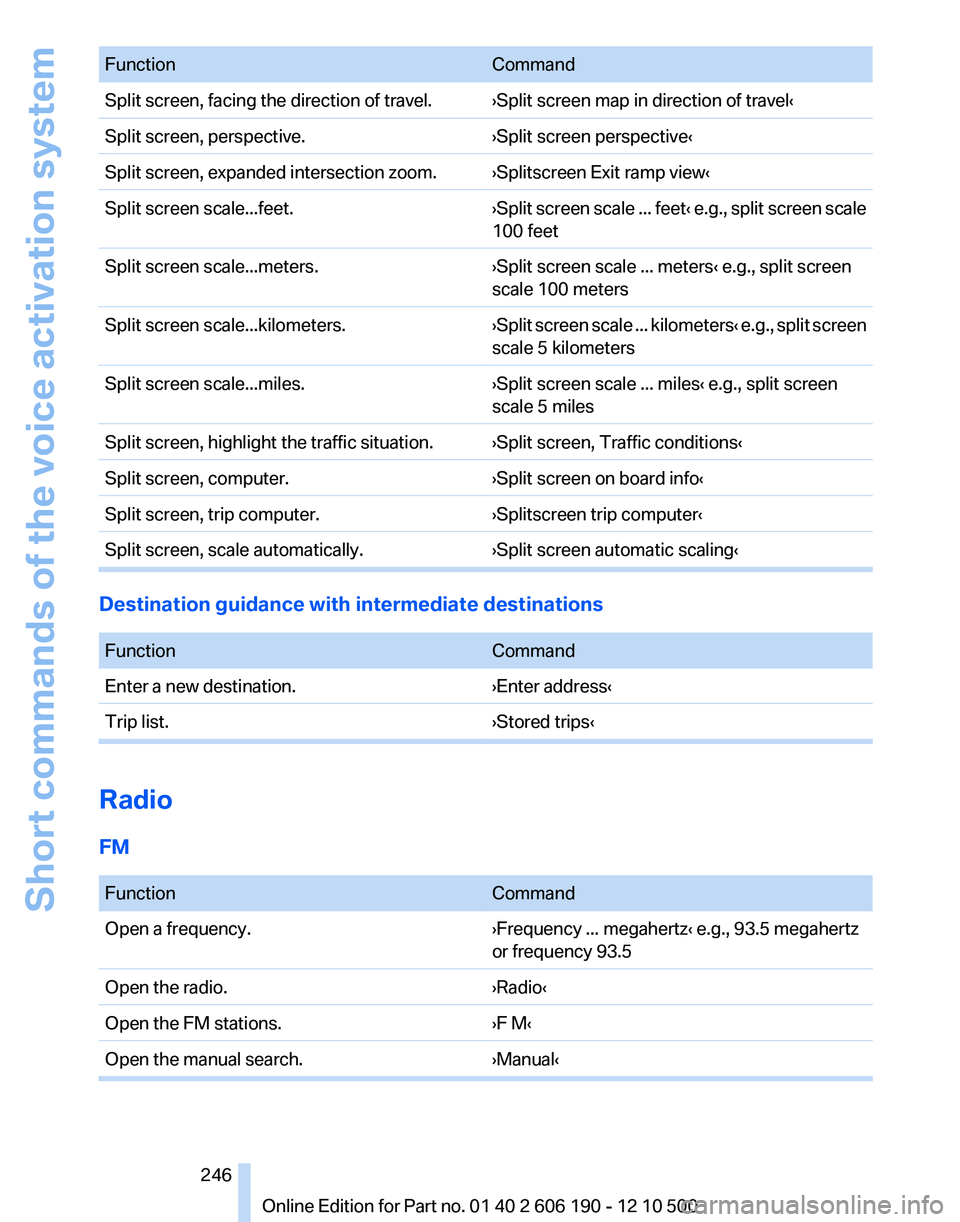
FunctionCommandSplit screen, facing the direction of travel.›Split screen map in direction of travel‹Split screen, perspective.›Split screen perspective‹Split screen, expanded intersection zoom.›Splitscreen Exit ramp view‹Split screen scale...feet.›Split screen scale ... feet ‹ e.g., split screen scale
100 feetSplit screen scale...meters.›Split screen scale ... meters‹ e.g., split screen
scale 100 metersSplit screen scale...kilometers.› Split screen scale ... kilometers ‹ e.g., split screen
scale 5 kilometersSplit screen scale...miles.›Split screen scale ... miles‹ e.g., split screen
scale 5 milesSplit screen, highlight the traffic situation.›Split screen, Traffic conditions‹Split screen, computer.›Split screen on board info‹Split screen, trip computer.›Splitscreen trip computer‹Split screen, scale automatically.›Split screen automatic scaling‹
Destination guidance with intermediate destinations
FunctionCommandEnter a new destination.›Enter address‹Trip list.›Stored trips‹
Radio
FM
FunctionCommandOpen a frequency.›Frequency ... megahertz‹ e.g., 93.5 megahertz
or frequency 93.5Open the radio.›Radio‹Open the FM stations.›F M‹Open the manual search.›Manual‹Seite 246246
Online Edition for Part no. 01 40 2 606 190 - 12 10 500Short commands of the voice activation system
Page 255 of 262
Fuel filler flap 204
Fuel gauge 67
Fuel quality 206
Fuel, tank capacity 242
Fuse 227
G
Garage door opener, refer to Integrated universal remote
control 107
Gas station recommenda‐ tion 137
Gear change, automatic trans‐ mission 65
General driving notes 120
Glass sunroof, refer to Panor‐ amic glass sunroof 45
Glove compartment 114
GPS navigation, refer to Navi‐ gation system 128
Gross vehicle weight, ap‐ proved 241
Gross weight, permissible for trailer towing 241
H
Hand brake, refer to Parking brake 59
Hand-held transmitter, alter‐ nating code 108
Hazard warning flashers 228
HDC Hill Descent Control 87
HD Radio 149
Head airbags 80
Headlamp control, auto‐ matic 77
Headlamp courtesy delay fea‐ ture 76
Headlamp courtesy delay fea‐ ture via remote control 36
Headlamp flasher 62
Headlamp flasher, bulb re‐ placement 223
Headlamp glass 222
Headlamps 222
Headlamps, care 234 Headlamp washer system 62
Headliner 18
Head restraints 47
Head restraints, front 51
Head restraints, rear 51
Head-up Display 99
Head-up Display, care 235
Heavy cargo, stowing 123
Height, seats 47
Height, vehicle 238
High-beam Assistant 78
High beams 62
High beams/low beams, refer to High-beam Assistant 78
High beams, bulb replace‐ ment 223
Hill Descent Control HDC 87
Hills 121
Holder for beverages 115
Homepage 6
Hood 215
Horn 12
Hot exhaust system 120
House number, entering for navigation 129
Hydroplaning 121
I
Ice warning, refer to External temperature warning 69
Icy roads, refer to External temperature warning 69
Identification marks, tires 210
Identification number, refer to Engine compartment 215
iDrive 19
Ignition key, refer to Remote control 32
Ignition off 58
Ignition on 58
Indication of a flat tire 83
Indicator and warning mes‐ sages 14
Indicator lamps 14
Individual air distribu‐ tion 101, 103 Individual settings, refer to
Personal Profile 33
Inflation pressure, tires 207
Info display, refer to Com‐ puter 70
Information on the navigation data 142
Initializing, Tire Pressure Mon‐ itor TPM 83
Instrument cluster 13, 67
Instrument cluster, electronic displays 15
Instrument lighting 79
Integrated key 32
Integrated universal remote control 107
Intensity, AUTO program 104
Interactive map 132
Interior equipment 107
Interior lamps 79
Interior lamps via remote con‐ trol 36
Interior motion sensor 43
Interior rearview and exterior mirrors, automatic dimming
feature 54
Interior rearview mirror 54
Intermediate destinations 134
Internet 198
Internet page 6
Intersection, entering for navi‐ gation 129
Interval display, service re‐ quirements 73
iPod/iPhone 167
J
Jacking points for the vehicle jack 226
Jack, refer to Vehicle jack 226
Joystick, automatic transmis‐ sion 65
Jump starting 229
K
Key/remote control 32 Seite 255255
Online Edition for Part no. 01 40 2 606 190 - 12 10 500
ReferenceMobilityCommunicationEntertainmentNavigationDriving tipsControlsAt a glance
Page 256 of 262
Keyless Go, refer to ComfortAccess 41
Key Memory, refer to Personal Profile 33
Kickdown, automatic trans‐ mission 65
Knee airbag 80
L
Lamp replacement 221
Lamp replacement, front 222
Lamp replacement, rear 225
Lamps 76
Lamps and bulbs 221
Language on Control Dis‐ play 73
Lashing eyes, securing cargo 123
LATCH child restraint fixing system 56
Leather, care 234
LEDs, light-emitting di‐ odes 222
Length, vehicle 240
Letters and numbers, enter‐ ing 24
Light-alloy wheels, care 234
Light control 77
Light-emitting diodes, LEDs 222
Lighting 76
Lighting via remote control 36
Light switch 76
Load 123
Loading 122
Lock, door 38
Locking/unlocking from in‐ side 38
Locking/unlocking via door lock 38
Locking/unlocking with re‐ mote control 36
Locking, automatic 38
Locking, central 35
Locking via tailgate 39
Lock, power window 44 Locks, doors, and win‐
dows 57
Low beams 76
Low beams, automatic, refer to High-beam Assistant 78
Lower back support 49
Lug bolt lock 226
Luggage compartment roller cover 110
Luggage rack, refer to Roof- mounted luggage rack 124
Lumbar support 49
M
Maintenance 219
Maintenance require‐ ments 219
Maintenance, service require‐ ments 73
Maintenance system, BMW 219
Malfunction displays, refer to Check Control 74
Manual air distribu‐ tion 101, 103
Manual air volume 101, 104
Manual brake, refer to Parking brake 59
Manual mode, transmis‐ sion 65
Manual operation, backup camera 95
Manual operation, door lock 38
Manual operation, exterior mir‐ rors 53
Manual operation, fuel filler flap 204
Manual operation, Park Dis‐ tance Control PDC 94
Manual operation, Top View 98
Map, destination entry 132
Map in split screen 139
Map view 138
Marking on approved tires 212 Marking, run-flat tires 213
Master key, refer to Remote control 32
Maximum cooling 104
Maximum speed, winter tires 213
Measure, units of 73
Medical kit 229
Memory, seat, mirror 52
Menu in instrument cluster 69
Menus, operating, iDrive 19
Menus, refer to iDrive operat‐ ing concept 20
Message list, traffic bulle‐ tins 139
Messages 187
Microfilter 103, 105
Minimum tread, tires 211
Mirror 53
Mirror memory 52
Mobile communication devi‐ ces in the vehicle 121
Mobile phone 176
Modifications, technical, refer to Safety 6
Moisture in headlamp 222
Monitor, refer to Control Dis‐ play 19
Mounting of child restraint fix‐ ing systems 55
MP3 player 166
Multifunction steering wheel, buttons 12
Multimedia 155
Music collection 162
Music search 163
Music, storing 162
N
Navigation 128
Navigation data 142
Neck restraints, front, refer to Head restraints 51
Neck restraints, rear, refer to Head restraints 51
New wheels and tires 212 Seite 256256
Online Edition for Part no. 01 40 2 606 190 - 12 10 500Everything from A to Z