window BMW X3 XDRIVE 30I 2009 E83 User Guide
[x] Cancel search | Manufacturer: BMW, Model Year: 2009, Model line: X3 XDRIVE 30I, Model: BMW X3 XDRIVE 30I 2009 E83Pages: 146, PDF Size: 4.87 MB
Page 69 of 146

Reference
At a glance
Controls
Driving tips
Mobility
67
A congenial climate
For almost all conditions, the AUTO pro-
gram12 offers the optimum air distribution and
air volume, refer to AUTO program below. You
need only select an interior temperature 5 that
you find pleasant.
The following sections contain more detailed
information on the available setting options.
Your vehicle has been designed to auto-
matically select your personal climate-
control settings whenever you unlock the doors
using your individually programmed remote
control.<
AUTO program
The AUTO program handles the
adjustment of air distribution to the
windshield and side windows, in
the direction of the upper body, and in the foot-
well. It also adapts your instructions for the air
volume and temperature to outside influences
throughout the year, e.g. solar radiation or win-
dow condensation.
The cooling function is switched on automati-
cally along with the AUTO program.
Manually switching air distribution
on/off
You can direct air to flow onto the
windows , toward the upper
body and into the footwell .
You can reactivate the automatic
air distribution mode by selecting
the AUTO button.
Temperature
Set the desired temperature.
The automatic climate control
assures that this temperature is
reached as quickly as possible any
time of year, using maximum cool-
ing or heating capacity as needed, and then
keeps this temperature constant.The highest setting produces the maximum
heat output regardless of the outside tempera-
ture. The lowest setting activates maximum air
conditioning.
When you change between different tem-
perature settings in rapid succession, the
system does not have enough time to achieve
the desired temperature.<
Manually adjusting air volume
By pressing the lower button, you
can reduce the air volume. You can
increase it by pressing the upper
button.
You can reactivate the automatic
air volume mode by pressing the AUTO button.
Switching system on/off
At the lowest fan speed, press the lower button
to turn off the automatic climate control com-
pletely. All displays disappear.
Press any button to turn the automatic climate
control back on again.
Defrosting windows and removing
condensation
Quickly removes ice and conden-
sation from the windshield and
front door windows.
Also switch on the cooling function.
Switching cooling function on/off
When the cooling function is on,
the air is cooled, dehumidified, and
then reheated depending on the
temperature setting. This function is only avail-
able with the engine running.
The cooling function helps to prevent conden-
sation from forming on the windows or to
remove it quickly.
Depending on the weather, the windshield may
fog over briefly when the engine is started.
The cooling function is automatically switched
on along with the AUTO program.
Page 70 of 146

Air conditioner
68
AUC Automatic Recirculated-air
Control/recirculated air mode
You can set the desired operating
mode by pressing the button
repeatedly:
>LEDs off: outside air continuously flows into
the vehicle.
>Left LED on, AUC mode: a sensor detects
pollutants in the outside air. The system
suspends the supply of outside air as
needed and recirculates the air currently
within the vehicle. As soon as the concen-
tration of pollutants in the outside air has
decreased sufficiently, the system switches
automatically back to supplying outside air.
>Right LED on, recirculated-air mode: the
outside air supply into the vehicle is shut off
continuously. The system then recirculates
the air currently within the vehicle.
If the windows fog over in recirculated-air
mode, then press the AUTO button or
switch off the recirculated air mode and
increase the air volume as needed.
The recirculated-air mode should not be used
over a sustained period of time; otherwise, the
air quality inside the vehicle will steadily deteri-
orate.<
Rear window defroster
The rear window heating switches
off automatically after a certain
amount of time. Depending on
your equipment package, the upper wires are
used as an antenna and are not part of the rear
window defroster.
Ventilation
1Serrated dials for opening and closing the
air vents through an infinitely variable range
2Levers for changing airflow direction
3Serrated dial for more or less cool air from
the air vents for the upper body region,
independent of the temperature selected
on the automatic climate control
Ventilation for cooling
Adjust the vents to direct the flow of cool air in
your direction, for instance, if the interior has
become too warm.
Draft-free ventilation
Set the vent outlets so that the air flows past
you and is not directed straight at you.
Microfilter/activated-charcoal filter*
The microfilter removes dust and pollen from
the incoming outside air. The activated-char-
coal filter provides additional protection by fil-
tering gaseous pollutants from the outside air.
This combined filter is replaced when mainte-
nance is performed by your BMW Sports Activ-
ity Vehicle Center. A substantial reduction in
air supply indicates that the filter should be
replaced before normal maintenance.
Page 85 of 146

Reference
At a glance
Controls
Driving tips
Mobility
83
Saving fuel
The fuel consumption of your vehicle is depen-
dent on various factors. You can improve your
vehicle's fuel consumption and reduce the
strain on the environment with several mea-
sures, your driving style and regular mainte-
nance.
Removing unnecessary cargo
Additional weight increases fuel consumption.
Removing attached parts following use
Remove auxiliary mirrors, roof or rear luggage
racks which are no longer required following
use. Attached parts on the vehicle impair the
aerodynamics and increase the fuel consump-
tion.
Closing windows and panorama glass
sunroof
An open panorama glass sunroof or an open
window also increases the aerodynamic drag,
and with it the fuel consumption.
Checking tire inflation pressures
regularly
Check the tire inflation pressures at least twice
a month and before starting off on a longer trip
and correct them if necessary.
An insufficient tire inflation pressure increases
the rolling resistance, therefore increasing fuel
consumption and tire wear.
Driving off immediately
Do not allow the engine to warm up by leaving it
running while the vehicle remains stationary.
Instead, drive off immediately at a moderate
engine speed. This enables a cold engine to
reach its operating temperature most rapidly.
Looking well ahead when driving
Avoid unnecessary acceleration and braking by
maintaining a corresponding distance to the
vehicle driving ahead. Driving smoothly and
looking ahead reduces fuel consumption.
Avoiding high engine speeds
Only use 1st gear when starting off. Accelerate
briskly from 2nd gear while avoiding high
engine speeds and shifting up prematurely.
When the desired speed is reached, shift into
the highest possible gear and drive at constant
speed at the lowest possible engine speed.
Always remember: driving at low engine speeds
decreases fuel consumption and reduces wear.
Using overrun conditions
When approaching a red light, take your foot off
the accelerator and allow the vehicle to coast in
the highest possible gear.
On a downhill stretch of road, take your foot off
the accelerator and allow the vehicle to coast in
the suitable gear.
The flow of fuel is interrupted in overrun.
Switching off engine during longer
stops
Switch off the engine during longer stops, e.g.
at traffic lights, railroad crossings or in traffic
jams. You already save fuel from approx. 4 sec-
onds with the engine switched off.
Switching off functions currently not
required
Functions like the air conditioner, seat heating
or the rear-window defroster require a lot of
energy and consume additional fuel. This plays
a major role especially when driving in urban
and in stop-and-go traffic. Therefore, switch off
these functions when they are not really
required.
Having maintenance carried out
Have regular maintenance performed on the
vehicle to achieve optimum the economy and
service life of your vehicle. BMW recommends
having maintenance carried out by a BMW
Sports Activity Vehicle Center. Also observe
the BMW maintenance system, refer to
page106.
Page 86 of 146

Things to remember when driving
84
General driving notes
Closing liftgate
Operate the vehicle only when the liftgate
is completely closed; otherwise, exhaust
fumes could enter the interior of the vehicle.<
If special circumstances should make it abso-
lutely necessary to operate the vehicle with the
liftgate open:
1.Close all windows and the panorama glass
sunroof.
2.Greatly increase the air supply of the air
conditioning system or automatic climate
control, refer to page64 or67.
Hot exhaust system
High temperatures occur in the exhaust
system of every vehicle. Do not remove
the heat shields installed adjacent to various
sections of the exhaust system, and never apply
undercoating to them. When driving, standing
at idle, and parking, take care to avoid possible
contact between the hot exhaust system and
any highly flammable materials such as hay,
leaves, grass, etc. Such contact could lead to
a fire, resulting in serious personal injury and
property damage. Do not touch hot exhaust
pipe, it can cause burns.<
When vehicle is parked
Condensation forms in the air conditioner/auto-
matic climate control system during operation,
and then exits under the vehicle. Traces of con-
densed water under the vehicle are therefore
normal.
Before driving into a car wash
Fold in the exterior mirrors, refer to page33;
otherwise, they could be damaged due to the
width of the vehicle.
Deactivate the rain sensor; otherwise, damage
could result from undesired wiper activation,
refer to page42.
Hydroplaning
When driving on wet or slushy roads,
reduce road speed. If you do not, a wedge
of water can form between tires and road sur-
face. This phenomenon is referred to as hydro-
planing, and is characterized by a partial or
complete loss of contact between tires and
road surface, ultimately undermining your abil-
ity to steer and brake the vehicle.<
The danger of hydroplaning increases as tire
tread depth decreases, also refer to Minimum
tread depth on page98.
Driving through water
Do not drive through water on the road if it
is deeper than 20 in/50 cm, and then only
at walking speed. Otherwise, the vehicle´s
engine, the electrical systems and the trans-
mission may be damaged.<
Using handbrake on inclines
Do not hold the vehicle in place on slopes
by slipping or riding the clutch, use the
handbrake instead. Otherwise, greater clutch
wear will result.<
Safe braking
Your BMW is equipped with ABS as standard
equipment. In situations in which it is required, it
is best to apply the brakes fully. Since the vehi-
cle maintains steering responsiveness, you can
nevertheless avoid possible obstacles with a
minimum of steering effort.
Pulsation at the brake pedal combined with
sounds from the hydraulic circuits indicates to
the driver that ABS is in its active mode.
Wet roads
On wet roads or in heavy rain, briefly apply light
pressure to the brake pedal every few miles.
Watch traffic conditions to ensure that this
maneuver does not endanger other road users.
The heat that is generated by the brake applica-
tions helps to dry the brake rotors and pads.
The full braking force will then be available
when you need it.
Page 110 of 146

Care
108
Care
Car-care products
BMW recommends that your vehicle be
cleaned, cared for, and maintained using prod-
ucts that have been approved by BMW for this
purpose.
Regular cleaning and care makes a significant
contribution to maintaining the value of your
BMW.
Your BMW Sports Activity Vehicle Center will
be happy to advise you on products and ser-
vices for the cleaning, care, and maintenance of
your BMW.
Genuine BMW Care Products are materi-
als tested, lab tested, and field tested and
offer optimum care, maintenance, and protec-
tion for your vehicle.<
Do not use cleansers that contain alcohol
or solvents; they can damage your vehi-
cle.<
Cleaning agents can contain substances
that are dangerous or pose health risks.
For this reason, always read and comply with
the warnings and danger notices on the pack-
aging. Open the doors or windows on your vehi-
cle whenever cleaning the interior. Make sure
that there is sufficient ventilation when working
in enclosed spaces. Use only products that are
provided for cleaning vehicles.<
Exterior care
Washing your vehicle
In the winter months, it is especially
important to ensure that the vehicle is
washed on a regular basis. Heavy soiling and
road salts can result in damage to the vehicle.<
After washing the vehicle, apply the
brakes briefly to dry them. Failure to do so
may lead to a reduction in braking efficiency and
also to corrosion of the brake rotors.<
Car washes
Give preference to cloth car washes.
Before driving into the car wash, check whether
the system is suitable for your BMW. To do so,
pay attention to the following points:
>Dimensions of your vehicle, refer to
page129
>If necessary: fold in the exterior mirrors,
refer to page33.
>Maximum permissible tire width.
Preparations for driving into the car wash:
>Deactivate rain sensor
* to prevent undes-
ired wiper operation.
>Deactivate rear window wiper and protect
from damage. Ask the operator of the car
wash about suitable protection measures
should the need arise.
>Remove additional add-on components,
e.g. spoilers or telephone antennas; other-
wise, they could be damaged.
Steam cleaners/high pressure cleaning
jets
When using steam cleaners or high pres-
sure cleaning jets, be sure to maintain a
sufficient distance and do not exceed a maxi-
mum temperature of 1407/606.
Insufficient distance or excessive pressure or
temperature can damage parts of the vehicle or
water can penetrate to the interior of the vehi-
cle. Follow the operating instructions for the
high pressure cleaning jet.<
Do not aim high pressure cleaning jets at
sensors such as those of the Park Dis-
tance Control for long periods of time and main-
tain a distance of at least 12 in/30 cm.<
Page 111 of 146
Reference
At a glance
Controls
Driving tips
Mobility
109
Hand washes
When washing the vehicle by hand, use ample
water and optionally Auto Shampoo. Clean the
vehicle with gentle pressure, using a sponge or
a washing brush.
Before cleaning the windshield, deacti-
vate the rain sensor or switch off the igni-
tion in order to prevent undesired wiper activa-
tion.<
Obey local regulations for washing vehi-
cles by hand.<
Headlamps
Do not rub dry and never use abrasives or
strong solvents to clean the covers.
Use shampoo or insect remover to soften
insects and then rinse with ample water.
Remove accumulated ice and snow with win-
dow deicer, not a scraper.
Windows
Use glass cleaner to clean outer and inner sur-
faces of windows and mirror glass.
Do not clean mirror glass with cleansers
that contain powdered quartz.<
Wiper blades
Clean with soapy water and replace regularly to
prevent streaking.
Wax residues and dirt on the windshield
cause streaking during wiper operation
and lead to premature wear on wiper blades and
can cause the rain sensor to malfunction.<
Caring for vehicle finish
Regular care and maintenance helps your vehi-
cle retain its value and protects its finish against
the long-term effects of finish-damaging sub-
stances.
Environmental factors that occur locally or
regionally can have a negative impact on the fin-
ish of your vehicle and may damage it. It is
therefore important to adjust the frequency and
extent of vehicle care accordingly.Immediately remove particularly corrosive sub-
stances such as spilled fuel, oil, grease, brake
fluid, tree sap, or bird droppings; otherwise,
they can damage the finish.
Repairing damages to finish
Depending on the severity of the damage,
have stone damage or scratches touched
up immediately in order to prevent rust from
forming.<
BMW recommends having paint damage pro-
fessionally repaired in accordance with factory
guidelines using Genuine BMW finish materials.
Waxing
It is time to wax the vehicle when water no
longer beads on the clean surface of the paint.
Use only products that contain carnauba wax or
synthetic waxes to protect the finish.
Rubber seals
Only treat with water or rubber cleaner.
To avoid noise or damage, do not use
care products that contain silicone when
caring for rubber seals.<
Chrome parts
Carefully clean parts such as the radiator grille,
door handles, or window frames with ample
water and added shampoo, particularly when
they have been exposed to road salts. Use
chrome polish for additional treatment.
Light-alloy wheels
By design, the system produces dust during
braking, which settles on the light-alloy wheels.
Remove it frequently with an acid-free wheel
cleaner.
Do not use corrosive, acid-containing,
strongly alkaline, or coarse cleansers or
steam cleaners hotter than 1407/606; oth-
erwise, you can damage your vehicle.<
Aluminum running boards
Superficial rust on the aluminum running
boards can be removed with a special cleanser.
Page 121 of 146
Reference
At a glance
Controls
Driving tips
Mobility
119
Protect valve stems with valve stem
seal caps from dirt and contamina-
tion. Dirt in valve stems is a frequent source
of gradual air loss.<
4.Reinitialize the Flat Tire Monitor
* or reset
the Tire Pressure Monitor
*, refer to
pages54, 55.
Do not initialize the Flat Tire Monitor
when driving with a compact wheel.<
5.Replace the defective tire as soon as possi-
ble and have the new wheel/tire balanced.
Driving with compact wheel
Drive reservedly and do not exceed a speed of
50 mph/80 km/h.
Mounting the compact wheel can change the
driving characteristics. For example, it can
reduce tracking stability during braking, extend
braking distances, and alter self-steering char-
acteristics in the limit range. With winter tires,
these characteristics are more pronounced.
Only one compact wheel may be
mounted. You should re-equip with
wheels and tires of the original size as soon as
possible.<
Vehicle battery
Maintenance
The battery is 100 % maintenance-free, i.e., the
electrolyte will last for the life of the battery
when the vehicle is operated in a temperate cli-
mate. Your BMW Sports Activity Vehicle Center
will be happy to advise you on all questions con-
cerning the battery.
Warning lamp
The warning lamp lights up. The battery
is no longer being charged. The alterna-
tor V-belt is defective or there is a mal-
function in the charge current circuit of the
alternator. Have the system checked immedi-
ately.Do not continue driving if the V-belt is
defective. The engine could be damaged
due to overheating.
Moreover, an increased amount of force is
required for steering if there is a sharp drop in
the onboard supply voltage.<
Charging battery
Charge the battery in the vehicle only when the
engine has been switched off. For connections,
refer to Jump starting on page122.
Disposal
Have old batteries disposed of following
replacement at your BMW Sports Activity
Vehicle Center or bring them to a collection
point. Maintain the battery in an upright position
for transport and storage. Always secure the
battery to prevent it from tipping over during
transport.<
Power failure
After a temporary power supply interruption,
some equipment is subject to limited use and
must be reinitialized. Individual settings are also
lost and must be updated again:
>Panorama glass sunroof
It may be only possible to raise the sunroof.
The system must be initialized, refer to
page24.
>Power windows
The pinch protection system must be reini-
tialized, refer to page23.
>Seat and mirror memory
The positions must be stored again, refer to
page31.
>Time
Must be set again, refer to page47.
Page 125 of 146
Reference
At a glance
Controls
Driving tips
Mobility
123
Starting engine
1.Start the engine of the assisting vehicle and
let it run at a slightly elevated idling speed
for a few minutes.
2.Start the engine on the other vehicle in the
usual way.
If the first start attempt is not successful,
wait a few minutes before another attempt
in order to allow the discharged battery to
recharge.
3.Let the engines run for a few minutes.
4.Disconnect the jumper cables by reversing
the connection sequence.
If need be, have the battery checked and
recharged.
Never use spray fluids to start the
engine.<
Tow starting and towing
Obey all applicable laws and guidelines
for tow starting and towing.<
Do not allow any passengers other than
the driver to ride in a vehicle that is being
towed.<
Using tow fitting
The threaded tow fitting is stored in the
onboard tool kit, refer to page112, and must
always remain in the vehicle. It can be screwed
in at the front or rear of the BMW.
Only use the tow fitting that comes with
the vehicle and screw it in as far as it will
go. Use the tow fitting only for towing on roads.
Avoid lateral loading of the tow fitting, e.g. do
not lift the vehicle by the tow fitting. Otherwise,
the tow fitting and the vehicle can be dam-
aged.<
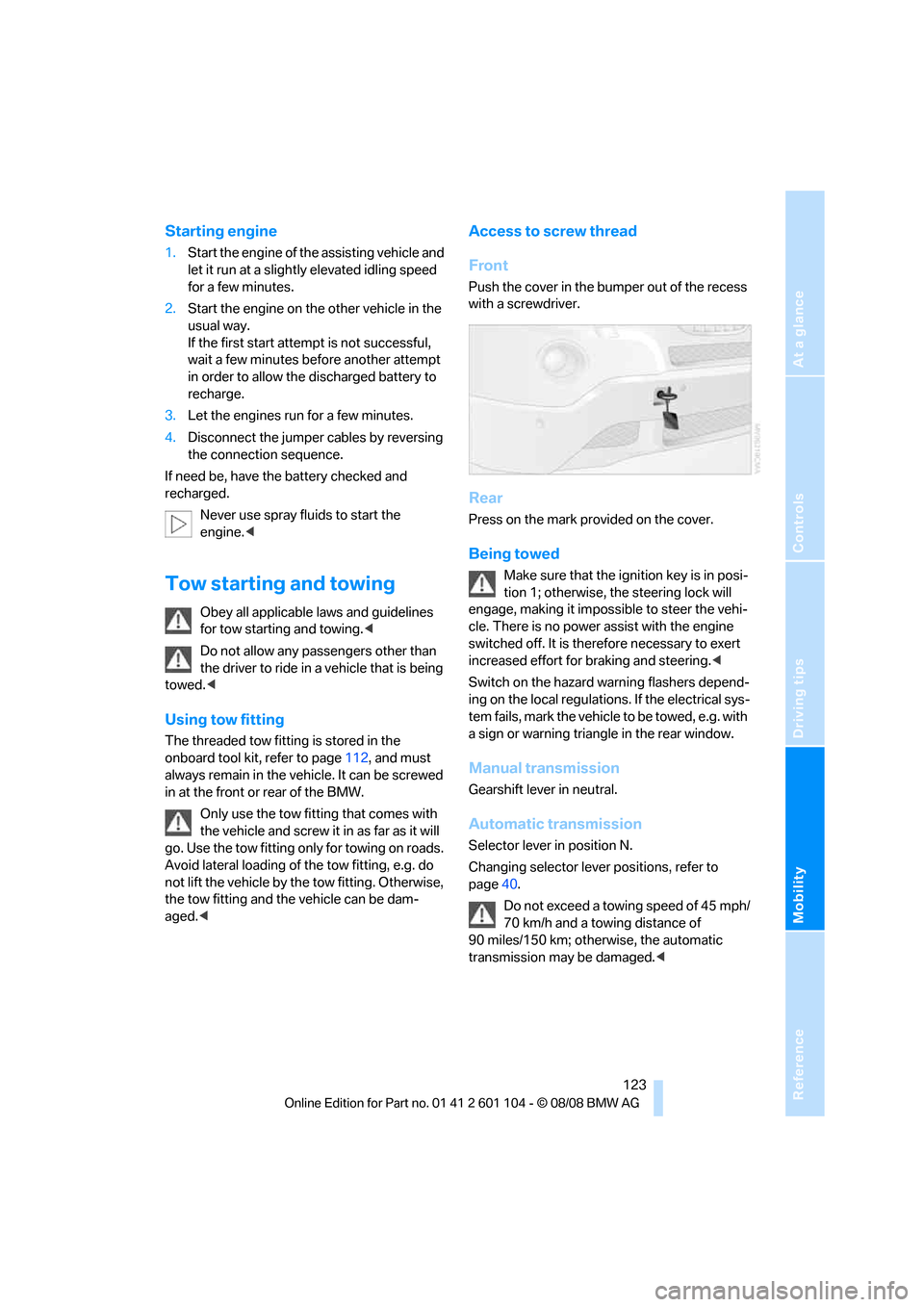
Access to screw thread
Front
Push the cover in the bumper out of the recess
with a screwdriver.
Rear
Press on the mark provided on the cover.
Being towed
Make sure that the ignition key is in posi-
tion 1; otherwise, the steering lock will
engage, making it impossible to steer the vehi-
cle. There is no power assist with the engine
switched off. It is therefore necessary to exert
increased effort for braking and steering.<
Switch on the hazard warning flashers depend-
ing on the local regulations. If the electrical sys-
tem fails, mark the vehicle to be towed, e.g. with
a sign or warning triangle in the rear window.
Manual transmission
Gearshift lever in neutral.
Automatic transmission
Selector lever in position N.
Changing selector lever positions, refer to
page40.
Do not exceed a towing speed of 45 mph/
70 km/h and a towing distance of
90 miles/150 km; otherwise, the automatic
transmission may be damaged.<
Page 135 of 146

Reference
At a glance
Controls
Driving tips
Mobility
133
Blower, refer to
– Air volume64
– Air volume, adjusting
manually67
BMW homepage4
BMW maintenance
system106
Bottle holder, refer to Cup
holders72
Brake assistant51
– warning lamp53
Brake fluid105
– level105
– warning lamp105
Brake force display56
Brake lamps115
– brake force display56
– indicator lamp, defective
bulb12,59
– replacing bulbs115
Brake pads85
– breaking-in82
– warning lamp85
Brake pedal, refer to Safe
braking84
Brake rotors
– brake system82
– breaking-in82
Brakes84,105
– ABS51,84
– brake fluid105
– brake pads85
– breaking-in82
– handbrake39
– indicator/warning lamp12
Brake system105
– brake fluid105
– brake pads85
– breaking-in82
– disk brakes85
– warning lamp105
Brake wear warning
– refer to Brake pads85
– warning lamp105
Breakdown service, refer to
Receiving assistance121
Breaking-in82Bulb replacement, refer to
Lamps and bulbs112
Buttons on steering wheel13
C
California law
– Event Data Recorders107
– Proposition 65 Warning5
Calling, refer to telephone
operation instructions
Can holder, refer to Cup
holders72
Capacities131
Capacity, cargo area130
Care
– exterior108
– interior110
Care and maintenance
– car-care products108
– carpets110
– car washes108
– CD/DVD players110
– chrome sections109
– displays110
– fine wood components110
– finish109
– hand washes109
– headlamps109
– high pressure cleaning
jets108
– leather110
– light-alloy wheels109
– plastic components110
– rubber seals109
– running boards109
– safety belts110
– sensors110
– upholstery materials/cloth
coverings110
– windows109
– wiper blades109
Cargo, securing86Cargo area22,76
– capacity130
– cover77
– emergency release, refer to
Opening manually22
– enlarging76
– floor cover78
– foldable rear backrest76
– hatch, refer to Liftgate22
– lashing eyes78
– opening from outside22
– opening with remote
control20
– power socket74
Cargo loading85
– load86
– securing cargo86
– stowing cargo
86
– vehicle85
Caring for the vehicle
finish109
Caring for your vehicle108
Car keys, refer to Key set18
Car phone, refer to separate
Owner's Manual
Car phone preparation75
Car radio, refer to Owner's
Manual for Radio/Onboard
Computer
Car washes84,108
Cassette operation, refer to
Owner's Manual for Radio/
Onboard Computer
CD operation, refer to Owner's
Manual for Radio/Onboard
Computer
Central locking system19
– interior21
Changes, technical, refer to
For your own safety5
Changing a wheel116
Changing gears
– automatic transmission with
Steptronic41
– manual transmission40
Changing wheels98
Charge-current indicator
lamp12,119
Page 136 of 146

Everything from A to Z
134 Check Gas Cap, warning
lamp12,92
Child's seat, refer to Child
restraint devices35
Child restraint devices35
– installing35
– with tether strap36
Child-restraint system
LATCH36
Child-safety locks37
Child seat security35
Cigarette lighter74
Circulation of air, refer to
Recirculated-air
mode64,68
Cleaning rear window43
Cleaning your BMW, refer to
Care and maintenance108
Clock47,48
– 12 or 24 hour mode48
– setting, also refer to Owner's
Manual for Radio/Onboard
Computer
– setting time47
Closing
– from inside21
– with the remote control19
Clothes hooks74
Clutch82
– breaking-in82
Cockpit10
Cold start, refer to Starting
engine38
Combination of wheel/tire99
Compact wheel, wheel
changes117
Compartments, refer to
Storage compartments73
Compartments in cargo area,
refer to Behind side trim
panel78
Compass, digital70
Computer48
– also refer to Owner's Manual
for Onboard Computer
– functions48
Condensation, refer to When
the vehicle is parked84Confirmation signal for
locking/unlocking
vehicle19,21
Connecting car vacuum
cleaner, refer to Connecting
electrical devices74
Connecting electrical
devices74
Consumption, refer to
Average fuel
consumption49
Consumption indicator, refer
to Fuel gauge46
Controls, refer to Cockpit10
Convenience operation
– from outside21
– panorama glass sunroof21
– windows21
Coolant105
– level105
– temperature gauge47
– warning lamp105
Cooling, refer to
Temperature64,67
Copyright2
Correct wheels and tires99
Courtesy lamps61
Cruise control44
– buttons on steering
wheel13
– indicator lamp44
Cruising range49
Cup holders72
Curb weight, refer to
Weights130
Cylinders, refer to Engine
data128
D
Dashboard lighting, refer to
Instrument lighting61
Dashboard system, refer to
Cockpit10
Data, technical128
– dimensions129
– engine128
– filling capacities131
– weights130Daytime driving lamps59
Deactivating front passenger
airbags35,57
Defective lamp59
Defects7
Defrosting windows64,67
– air conditioner64
– automatic climate control67
Defrosting windows and
removing condensation
– air conditioner64
– automatic climate control67
Defrost position, refer to
Defrosting windows64,67
Digital clock47
Digital compass70
Dimensions129
Dimming mirror34
Directional indicators, refer to
Turn signals41
Disk brakes85
Displacement, refer to Engine
data128
Display illumination, refer to
Instrument lighting61
Display lighting, refer to
Instrument lighting61
Displays, refer to Instrument
cluster11
Disposal, vehicle battery119
Distance warning, refer to
PDC Park Distance
Control50
Door exit lighting61
Door handle lighting59
Door keys18
Door lock21
Doors
– locking and unlocking from
inside21
– manual operation21
– unlocking and locking,
confirmation signals19,21
DOT Quality Grades97
Draft-free ventilation65,
68
Driving lamps, refer to Parking
lamps/low beams59
Driving notes84
Driving on poor roads87