light BMW X3 XDRIVE 30I 2009 E83 Workshop Manual
[x] Cancel search | Manufacturer: BMW, Model Year: 2009, Model line: X3 XDRIVE 30I, Model: BMW X3 XDRIVE 30I 2009 E83Pages: 146, PDF Size: 4.87 MB
Page 109 of 146
Reference
At a glance
Controls
Driving tips
Mobility
107
Emissions values
The warning lamp lights up. Exhaust
values are deteriorating. Have the vehi-
cle checked as soon as possible.
Under certain conditions, the indicator will flash.
This indicates a serious rate of engine misfire.
When this occurs, you should reduce speed
and consult the nearest BMW Sports Activity
Vehicle Center as soon as possible. Severe
engine misfire even for only a short period of
time can seriously damage emission control
components, especially the catalytic converter.
Display of the previously described mal-
function on Canadian models.
When the fuel filler cap is not properly
tightened, the OBD system can detect
the vapor leak and the indicator lamp will light
up. If the filler cap is subsequently tightened,
the indicator lamp should go out within a few
days.<
Event data recorders
Your vehicle may be equipped with one or more
sensing and diagnostic modules or a recording
device capable of recording or transmitting cer-
tain vehicle data or information. In addition, if
you have a Subscription Service Agreement for
the BMW Assist system, certain vehicle infor-
mation may be transmitted or recorded in order
to provide such services.
Page 111 of 146
Reference
At a glance
Controls
Driving tips
Mobility
109
Hand washes
When washing the vehicle by hand, use ample
water and optionally Auto Shampoo. Clean the
vehicle with gentle pressure, using a sponge or
a washing brush.
Before cleaning the windshield, deacti-
vate the rain sensor or switch off the igni-
tion in order to prevent undesired wiper activa-
tion.<
Obey local regulations for washing vehi-
cles by hand.<
Headlamps
Do not rub dry and never use abrasives or
strong solvents to clean the covers.
Use shampoo or insect remover to soften
insects and then rinse with ample water.
Remove accumulated ice and snow with win-
dow deicer, not a scraper.
Windows
Use glass cleaner to clean outer and inner sur-
faces of windows and mirror glass.
Do not clean mirror glass with cleansers
that contain powdered quartz.<
Wiper blades
Clean with soapy water and replace regularly to
prevent streaking.
Wax residues and dirt on the windshield
cause streaking during wiper operation
and lead to premature wear on wiper blades and
can cause the rain sensor to malfunction.<
Caring for vehicle finish
Regular care and maintenance helps your vehi-
cle retain its value and protects its finish against
the long-term effects of finish-damaging sub-
stances.
Environmental factors that occur locally or
regionally can have a negative impact on the fin-
ish of your vehicle and may damage it. It is
therefore important to adjust the frequency and
extent of vehicle care accordingly.Immediately remove particularly corrosive sub-
stances such as spilled fuel, oil, grease, brake
fluid, tree sap, or bird droppings; otherwise,
they can damage the finish.
Repairing damages to finish
Depending on the severity of the damage,
have stone damage or scratches touched
up immediately in order to prevent rust from
forming.<
BMW recommends having paint damage pro-
fessionally repaired in accordance with factory
guidelines using Genuine BMW finish materials.
Waxing
It is time to wax the vehicle when water no
longer beads on the clean surface of the paint.
Use only products that contain carnauba wax or
synthetic waxes to protect the finish.
Rubber seals
Only treat with water or rubber cleaner.
To avoid noise or damage, do not use
care products that contain silicone when
caring for rubber seals.<
Chrome parts
Carefully clean parts such as the radiator grille,
door handles, or window frames with ample
water and added shampoo, particularly when
they have been exposed to road salts. Use
chrome polish for additional treatment.
Light-alloy wheels
By design, the system produces dust during
braking, which settles on the light-alloy wheels.
Remove it frequently with an acid-free wheel
cleaner.
Do not use corrosive, acid-containing,
strongly alkaline, or coarse cleansers or
steam cleaners hotter than 1407/606; oth-
erwise, you can damage your vehicle.<
Aluminum running boards
Superficial rust on the aluminum running
boards can be removed with a special cleanser.
Page 112 of 146
Care
110
Outside sensors
Keep sensors outside the vehicle, e.g.
Park Distance Control, clean and free of
ice in order to maintain full functionality.<
Interior care
Upholstery materials/cloth coverings
Clean regularly with a vacuum cleaner in order
to remove surface dirt.
With heavy soiling, such as spotting caused by
beverages, use a soft sponge or a lint-free
microfiber cloth in combination with suitable
interior cleaners. Follow instructions on the
packaging.
Clean upholstery material in large areas
extending all the way to the seams. Avoid
rubbing forcefully.<
Open Velcro-type fasteners on pants or
other items of clothing can damage the
seat covers. Make sure that Velcro-type fasten-
ers are closed.<
Leather/leather seat covers
The leather used by BMW is a high-qual-
ity natural product. Slight grain patterns
are part of the typical properties of a leather in
its natural state.<
Dust and road grime chafe in pores and folds,
leading to pronounced abrasion and premature
degradation of the leather surface. We there-
fore suggest that you clean the leather at fre-
quent intervals with a dust cloth or vacuum
cleaner.
Particularly with light-colored leather, make
sure that it is cleaned regularly since it tends to
soil more easily.
Treat the leather twice a year with a leather
lotion since dirt and grease break down the pro-
tective layer of the leather.
Carpets/cargo area
Floor carpeting and floor mats can be vacu-
u m e d o r w h e n m o r e h e a vily soiled, cleaned with
an interior cleaner.
Floor mats can be removed for cleaning. When
inserting them, make sure that the seat rails do
not protrude over the floor mats; otherwise the
floor mats can be damaged.
Fluff on floormats results from the production
process and can be removed by repeated vacu-
uming.
Plastic components inside
>Imitation leather surfaces
>Lamp lenses
>Covering glass of the instrument panel
>Matte components
Clean with water and solvent-free plastic
cleaner if so desired.
Fine wooden components
Use a damp cloth to clean fine wooden trim
panels and components. Follow up by drying
with a soft cloth.
Safety belts
Do not clean with cleansers; this can
destroy the webbing.<
Displays
Use a display-cleaning cloth or a soft, nonabra-
sive, lint-free cloth to clean displays, e.g. of the
radio or the instrument panel.
Avoid rubbing too forcefully when clean-
ing displays; otherwise, you can damage
them.<
Never use chemical-based cleansers or
scouring household cleansers. Keep all
liquids away from the equipment. Moisture can
attack or damage the surfaces of electrical
components.<
CD/DVD players
Do not use cleaning CDs; they can dam-
age parts of the player.<
Page 115 of 146
Reference
At a glance
Controls
Driving tips
Mobility
113
Please have your BMW Sports Activity
Vehicle Center work on lamps whose
replacement is not described here.<
Light-emitting diodes LEDs
Light-emitting diodes installed behind translu-
c e n t l e n s e s s e r v e a s t h e l i g h t s o u r c e f o r m a n y o f
the controls and displays in your vehicle. These
light-emitting diodes are related to ordinary
lasers.
Do not remove the covers, and never
stare into the unfiltered light for several
hours, as irritation of the retina could result.<
Xenon lamps*
The service life of these bulbs is very long and
the probability of failure is very low, provided
that they are not switched on and off an unusual
number of times. If one of these bulbs should
nevertheless fail, it is possible to continue driv-
ing with great caution using the fog lamps, pro-
vided traffic laws in your area do not prohibit
this.
To avoid risk of potentially fatal injuries
due to the extremely high voltages at
which these units operate, service work should
always be entrusted to qualified personnel.<
Halogen low beams
H7 bulb, 55 watts
Always wear gloves and eye protection –
the atmosphere inside the H7 bulb is
pressurized. Failure to observe this precaution
can lead to injuries should the bulb be dam-
aged.<
For checking and adjusting headlamp
aim, please contact your BMW Sports
Activity Vehicle Center.<
Driver's side
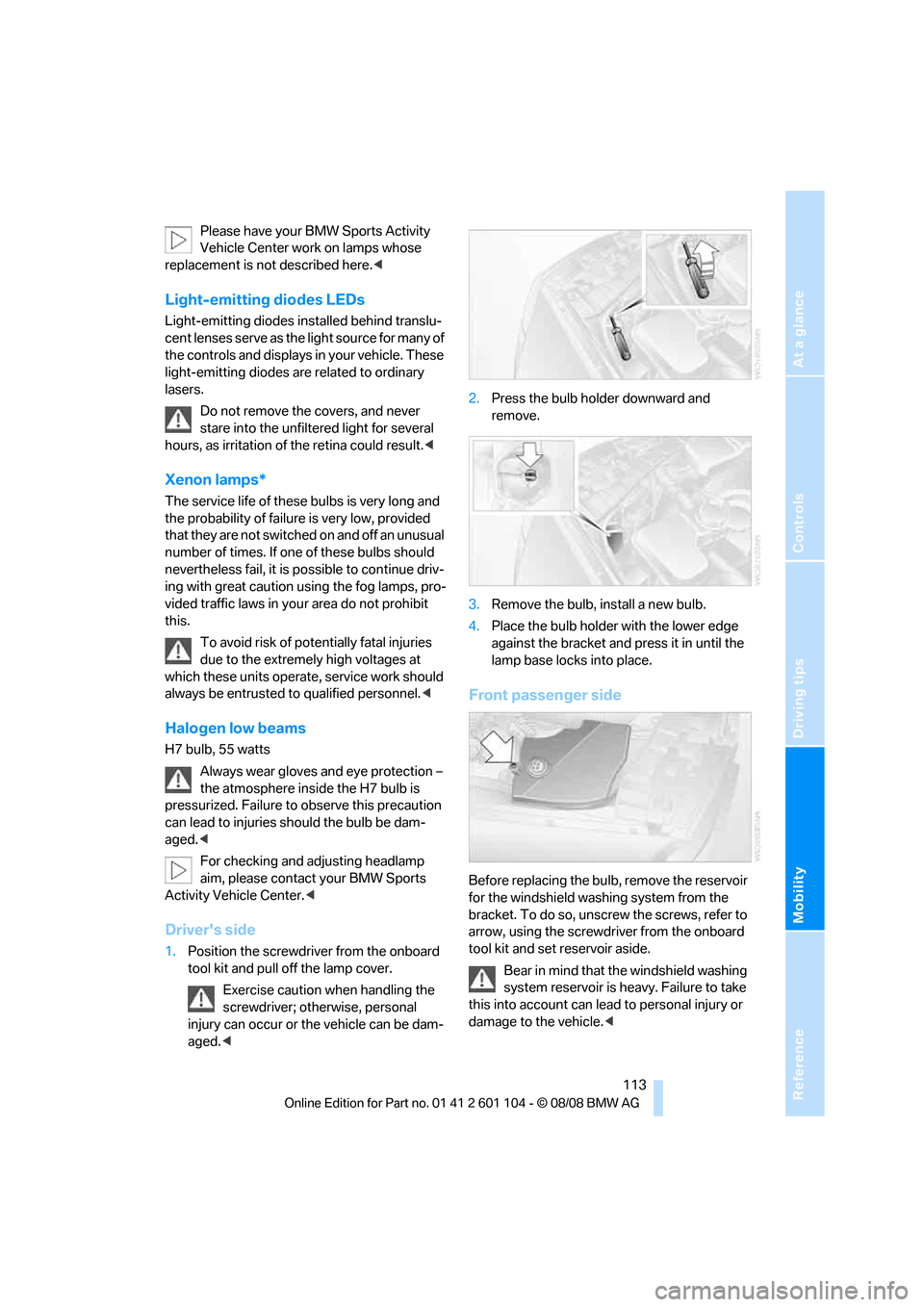
1.Position the screwdriver from the onboard
tool kit and pull off the lamp cover.
Exercise caution when handling the
screwdriver; otherwise, personal
injury can occur or the vehicle can be dam-
aged.<2.Press the bulb holder downward and
remove.
3.Remove the bulb, install a new bulb.
4.Place the bulb holder with the lower edge
against the bracket and press it in until the
lamp base locks into place.
Front passenger side
Before replacing the bulb, remove the reservoir
for the windshield washing system from the
bracket. To do so, unscrew the screws, refer to
arrow, using the screwdriver from the onboard
tool kit and set reservoir aside.
Bear in mind that the windshield washing
system reservoir is heavy. Failure to take
this into account can lead to personal injury or
damage to the vehicle.<
Page 120 of 146
Replacing components
118
Inserting compact wheel
The compact wheel is reinserted in the reverse
sequence of its removal.
When attaching the retaining strap to the
compact wheel, make sure the belt is
threaded through 2 rim openings, with one
unoccupied hole between them; otherwise, the
compact wheel could come loose in an acci-
dent.<
Preparing wheel change
1.Observe the safety precautions on
page117.
2.Secure the vehicle to prevent it from rolling:
Place the wheel chock behind the front
wheel on the side of the vehicle opposite
the side being raised. If the vehicle is parked
on a downward slope, place the wheel
chock securely in front of this wheel. If the
road surface is steeply inclined, take addi-
tional preventive steps to stop the vehicle
from rolling.
3.Loosen the wheel lugs by a half turn.
Jacking up vehicle
1.Position the vehicle jack at the jacking point
closest to the wheel so that the entire sur-
face of the jack base perpendicularly con-
tacts the ground under the jacking point.
The vehicle jack is designed for
changing wheels only. Do not attempt
to raise another vehicle model with it or to
raise any load of any kind. To do so could
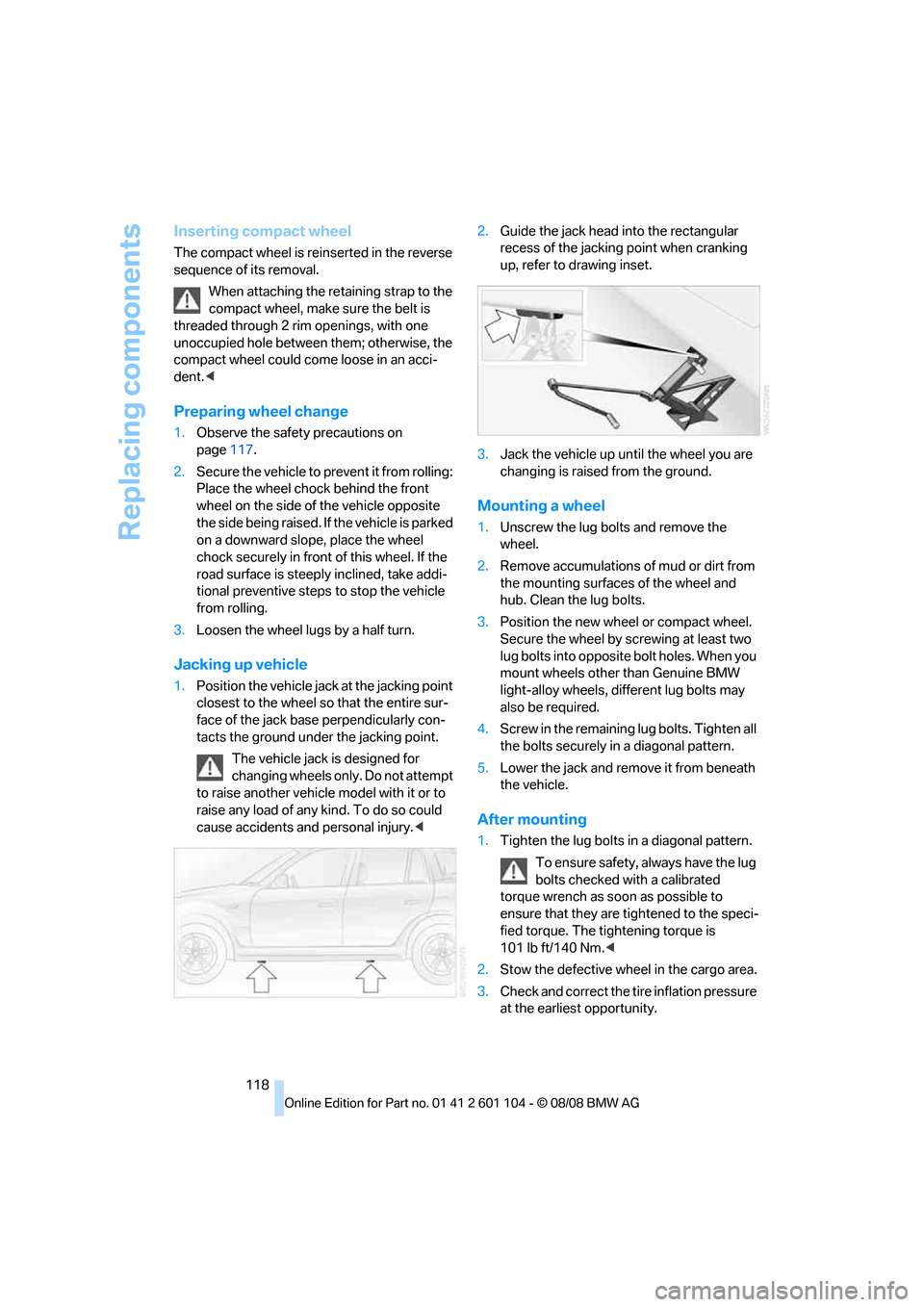
cause accidents and personal injury.<2.Guide the jack head into the rectangular
recess of the jacking point when cranking
up, refer to drawing inset.
3.Jack the vehicle up until the wheel you are
changing is raised from the ground.
Mounting a wheel
1.Unscrew the lug bolts and remove the
wheel.
2.Remove accumulations of mud or dirt from
the mounting surfaces of the wheel and
hub. Clean the lug bolts.
3.Position the new wheel or compact wheel.
Secure the wheel by screwing at least two
lug bolts into opposite bolt holes. When you
mount wheels other than Genuine BMW
light-alloy wheels, different lug bolts may
also be required.
4.Screw in the remaining lug bolts. Tighten all
the bolts securely in a diagonal pattern.
5.Lower the jack and remove it from beneath
the vehicle.
After mounting
1.Tighten the lug bolts in a diagonal pattern.
To ensure safety, always have the lug
bolts checked with a calibrated
torque wrench as soon as possible to
ensure that they are tightened to the speci-
fied torque. The tightening torque is
101 lb ft/140 Nm.<
2.Stow the defective wheel in the cargo area.
3.Check and correct the tire inflation pressure
at the earliest opportunity.
Page 121 of 146
Reference
At a glance
Controls
Driving tips
Mobility
119
Protect valve stems with valve stem
seal caps from dirt and contamina-
tion. Dirt in valve stems is a frequent source
of gradual air loss.<
4.Reinitialize the Flat Tire Monitor
* or reset
the Tire Pressure Monitor
*, refer to
pages54, 55.
Do not initialize the Flat Tire Monitor
when driving with a compact wheel.<
5.Replace the defective tire as soon as possi-
ble and have the new wheel/tire balanced.
Driving with compact wheel
Drive reservedly and do not exceed a speed of
50 mph/80 km/h.
Mounting the compact wheel can change the
driving characteristics. For example, it can
reduce tracking stability during braking, extend
braking distances, and alter self-steering char-
acteristics in the limit range. With winter tires,
these characteristics are more pronounced.
Only one compact wheel may be
mounted. You should re-equip with
wheels and tires of the original size as soon as
possible.<
Vehicle battery
Maintenance
The battery is 100 % maintenance-free, i.e., the
electrolyte will last for the life of the battery
when the vehicle is operated in a temperate cli-
mate. Your BMW Sports Activity Vehicle Center
will be happy to advise you on all questions con-
cerning the battery.
Warning lamp
The warning lamp lights up. The battery
is no longer being charged. The alterna-
tor V-belt is defective or there is a mal-
function in the charge current circuit of the
alternator. Have the system checked immedi-
ately.Do not continue driving if the V-belt is
defective. The engine could be damaged
due to overheating.
Moreover, an increased amount of force is
required for steering if there is a sharp drop in
the onboard supply voltage.<
Charging battery
Charge the battery in the vehicle only when the
engine has been switched off. For connections,
refer to Jump starting on page122.
Disposal
Have old batteries disposed of following
replacement at your BMW Sports Activity
Vehicle Center or bring them to a collection
point. Maintain the battery in an upright position
for transport and storage. Always secure the
battery to prevent it from tipping over during
transport.<
Power failure
After a temporary power supply interruption,
some equipment is subject to limited use and
must be reinitialized. Individual settings are also
lost and must be updated again:
>Panorama glass sunroof
It may be only possible to raise the sunroof.
The system must be initialized, refer to
page24.
>Power windows
The pinch protection system must be reini-
tialized, refer to page23.
>Seat and mirror memory
The positions must be stored again, refer to
page31.
>Time
Must be set again, refer to page47.
Page 123 of 146
Reference
At a glance
Controls
Driving tips
Mobility
121
Giving and receiving assistance
Receiving assistance
The Roadside Assistance of the BMW Group
offers you assistance in the event of a break-
down around the clock, as well as on weekends
and public holidays.
The phone numbers of the Roadside Assis-
tance control center in your home country can
be found in the Contact brochure.
In the case of vehicles with the corresponding
equipment, you can use buttons in the head-
liner to contact Roadside Assistance or initiate
an emergency request.
When the emergency request is initiated, a
telephone connection is established to the
BMW Assist Response Center.
In vehicles with BMW Assist enabled, if the cur-
rent position of your vehicle can be determined,
it will be transmitted to the BMW Assist
Response Center.
The conditions for initiating an emergency
request or contacting Roadside Assistance:
>Ignition key in position 1 or higher
>The car phone is logged on to a mobile tele-
phone network
>The emergency call system is operable
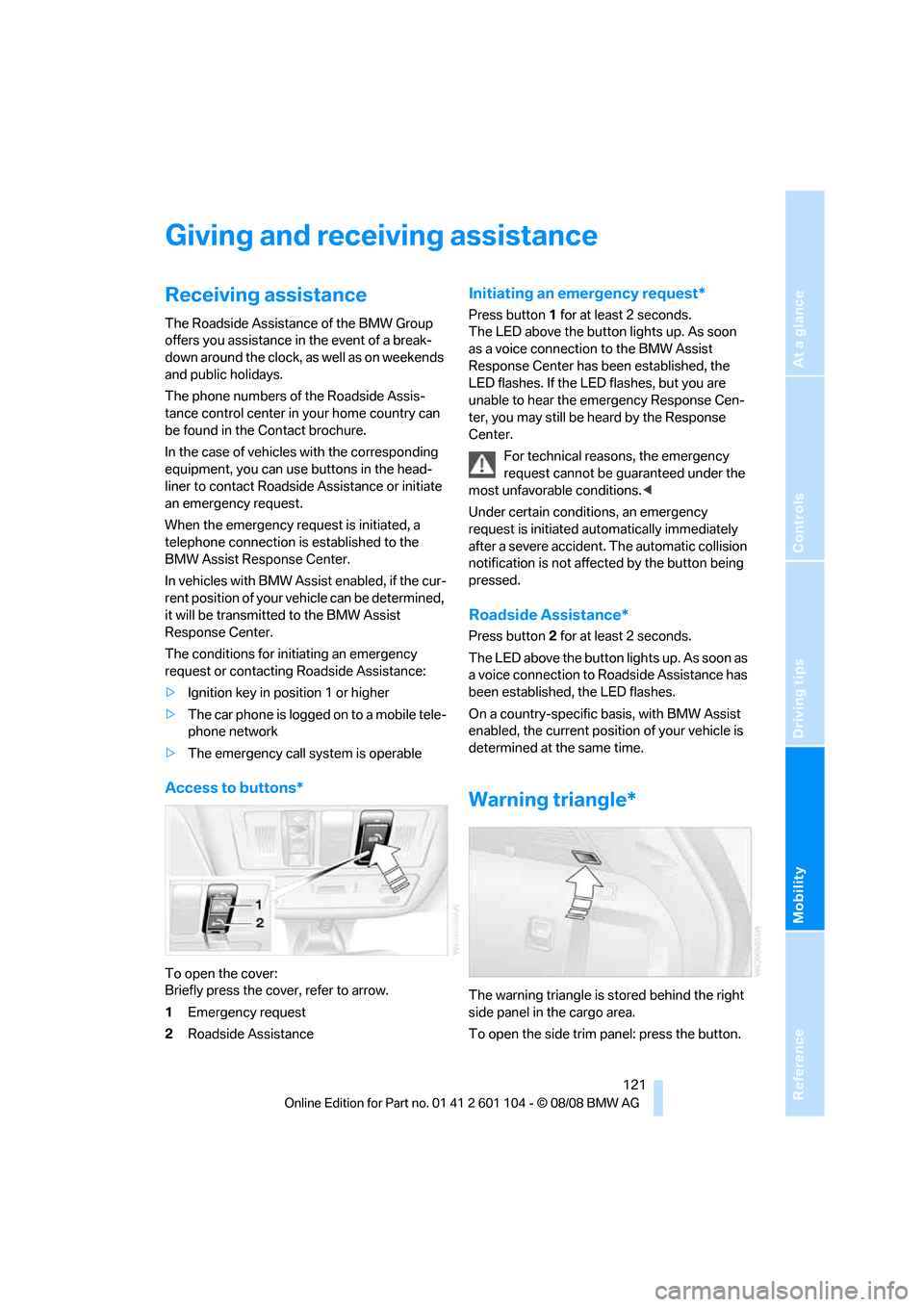
Access to buttons*
To open the cover:
Briefly press the cover, refer to arrow.
1Emergency request
2Roadside Assistance
Initiating an emergency request*
Press button 1 for at least 2 seconds.
The LED above the button lights up. As soon
as a voice connection to the BMW Assist
Response Center has been established, the
LED flashes. If the LED flashes, but you are
unable to hear the emergency Response Cen-
ter, you may still be heard by the Response
Center.
For technical reasons, the emergency
request cannot be guaranteed under the
most unfavorable conditions.<
Under certain conditions, an emergency
request is initiated automatically immediately
after a severe accident. The automatic collision
notification is not affected by the button being
pressed.
Roadside Assistance*
Press button 2 for at least 2 seconds.
The LED above the button lights up. As soon as
a voice connection to Roadside Assistance has
been established, the LED flashes.
On a country-specific basis, with BMW Assist
enabled, the current position of your vehicle is
determined at the same time.
Warning triangle*
The warning triangle is stored behind the right
side panel in the cargo area.
To open the side trim panel: press the button.
Page 125 of 146
Reference
At a glance
Controls
Driving tips
Mobility
123
Starting engine
1.Start the engine of the assisting vehicle and
let it run at a slightly elevated idling speed
for a few minutes.
2.Start the engine on the other vehicle in the
usual way.
If the first start attempt is not successful,
wait a few minutes before another attempt
in order to allow the discharged battery to
recharge.
3.Let the engines run for a few minutes.
4.Disconnect the jumper cables by reversing
the connection sequence.
If need be, have the battery checked and
recharged.
Never use spray fluids to start the
engine.<
Tow starting and towing
Obey all applicable laws and guidelines
for tow starting and towing.<
Do not allow any passengers other than
the driver to ride in a vehicle that is being
towed.<
Using tow fitting
The threaded tow fitting is stored in the
onboard tool kit, refer to page112, and must
always remain in the vehicle. It can be screwed
in at the front or rear of the BMW.
Only use the tow fitting that comes with
the vehicle and screw it in as far as it will
go. Use the tow fitting only for towing on roads.
Avoid lateral loading of the tow fitting, e.g. do
not lift the vehicle by the tow fitting. Otherwise,
the tow fitting and the vehicle can be dam-
aged.<
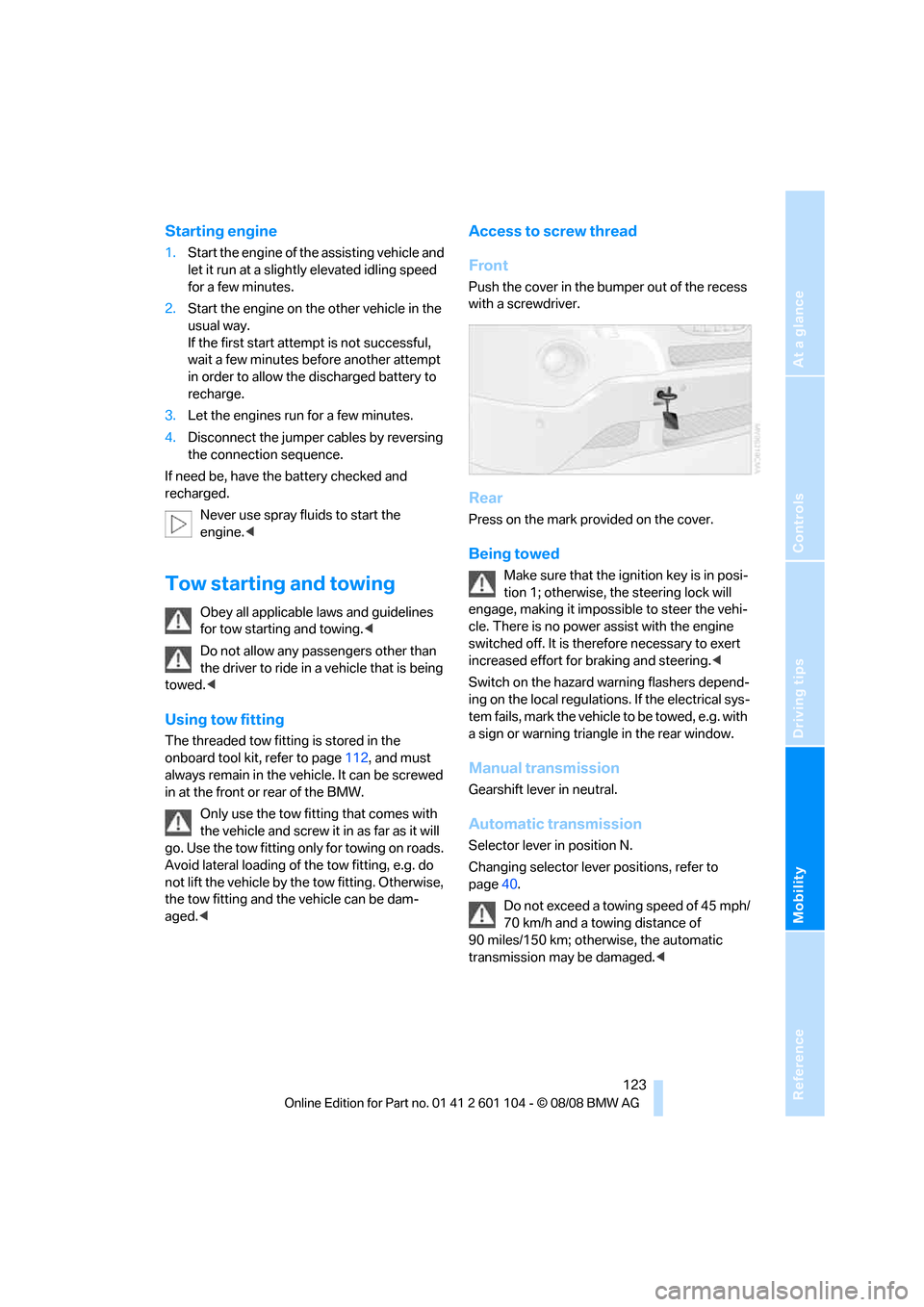
Access to screw thread
Front
Push the cover in the bumper out of the recess
with a screwdriver.
Rear
Press on the mark provided on the cover.
Being towed
Make sure that the ignition key is in posi-
tion 1; otherwise, the steering lock will
engage, making it impossible to steer the vehi-
cle. There is no power assist with the engine
switched off. It is therefore necessary to exert
increased effort for braking and steering.<
Switch on the hazard warning flashers depend-
ing on the local regulations. If the electrical sys-
tem fails, mark the vehicle to be towed, e.g. with
a sign or warning triangle in the rear window.
Manual transmission
Gearshift lever in neutral.
Automatic transmission
Selector lever in position N.
Changing selector lever positions, refer to
page40.
Do not exceed a towing speed of 45 mph/
70 km/h and a towing distance of
90 miles/150 km; otherwise, the automatic
transmission may be damaged.<
Page 126 of 146
Giving and receiving assistance
124
Towing methods
To avoid damage, do not lift the vehicle by
the tow fitting or body and suspension
parts.<
In some countries, towing with tow bars or
ropes on public roads is not permitted. Familiar-
ize yourself with the regulations on towing in the
specific country.
With tow bar
The towing vehicle must not be lighter
than the vehicle to be towed; otherwise,
it will not be possible to safely control vehicle
response.<
The tow fittings used should be on the same
side on both vehicles. Should it prove impossi-
ble to avoid mounting the tow bar at an offset
angle, please observe the following:
>Clearance and maneuvering capability will
be strictly limited in corners.
>When mounted at an angle, the tow bar will
exert lateral forces, tending to push the
vehicle sideways.
Secure the tow bar to the tow fittings
only. Otherwise, other vehicle parts could
be damaged.<
With tow-rope
When starting off in the towing vehicle, make
sure that the tow-rope is taut.
To avoid jerking and the associated
stresses on vehicle components when
towing, always use nylon ropes or nylon straps.
Secure the tow rope to the tow fittings only.
Otherwise, other vehicle parts could be dam-
aged.<
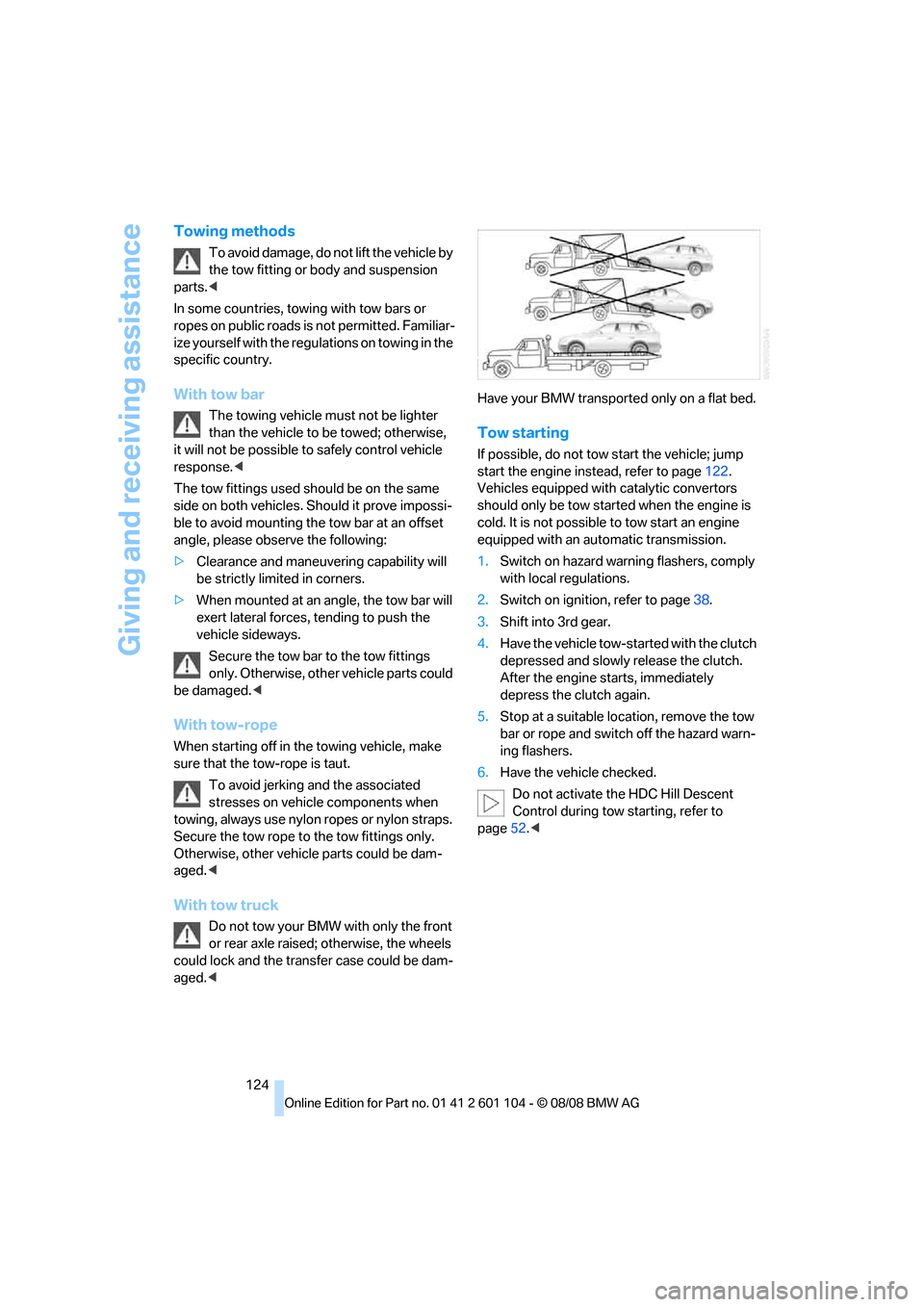
With tow truck
Do not tow your BMW with only the front
or rear axle raised; otherwise, the wheels
could lock and the transfer case could be dam-
aged.
If possible, do not tow start the vehicle; jump
start the engine instead, refer to page122.
Vehicles equipped with catalytic convertors
should only be tow started when the engine is
cold. It is not possible to tow start an engine
equipped with an automatic transmission.
1.Switch on hazard warning flashers, comply
with local regulations.
2.Switch on ignition, refer to page38.
3.Shift into 3rd gear.
4.Have the vehicle tow-started with the clutch
depressed and slowly release the clutch.
After the engine starts, immediately
depress the clutch again.
5.Stop at a suitable location, remove the tow
bar or rope and switch off the hazard warn-
ing flashers.
6.Have the vehicle checked.
Do not activate the HDC Hill Descent
Control during tow starting, refer to
page52.<
Page 134 of 146
Everything from A to Z
132
Everything from A to Z
Index
A
ABS Antilock Brake
System51
– indicator lamp12
Acceleration assistance
– refer to Acceleration
assistant53
– refer to DSC51
Acceleration assistant53
Accessories, refer to For your
own safety5
Accident, refer to Receiving
assistance121
Activated-charcoal filter68
Adaptive Head Light60
Adding engine oil104
Adjusting seats28
– electrically28
– mechanically28
– mechanically, Sports seat29
Airbags57
– deactivating front passenger
side35,57
– indicator lamp for front
passenger airbags58
– sitting safely27
– warning lamp58
Air circulation, refer to
Recirculated-air
mode64,68
Air conditioner63
Air distribution
– air conditioner64
– automatic climate control67
Airing, refer to
Ventilation65,68
Air outlets, refer to
Ventilation65,68
Air pressure, refer to Tire
inflation pressure94
Air vents, refer to
Ventilation65,68Air volume64
– adjusting manually67
AKI, refer to Fuel
specifications93
Alarm system25
– avoiding unintentional
alarms26
All-season tires, refer to
Special characteristics of
winter tires99
All wheel drive, refer to
xDrive52
Anchorage points78
Antifreeze
– coolant105
– washer fluid43
Antilock Brake System
ABS51
– indicator lamp12
Anti-theft alarm system, refer
to Alarm system25
Approved axle load, refer to
Weights130
Approved engine oils104
Approved gross vehicle
weight, refer to Weights130
Armrest
– front73
– rear73
Ashtray74
AUC Automatic recirculated-
air control68
Audio device, external74
Automatic
– air distribution67
– air volume67
– recirculated-air control
AUC68
Automatic climate control66
Automatic cruise control44
Automatic curb monitor33
Automatic deactivation of
front passenger airbags57Automatic headlamp
control60
Automatic transmission with
Steptronic40
– indicator lamp41
– interlock38
– selector lever interlock40
– shiftlock40
– towing123
– tow starting124
AUTO program67
Average fuel consumption49
– setting units48
Average speed49
– setting units48
Avoiding unintentional
alarms26
Axle weights, refer to
Weights130
B
Backrest, refer to Seats28
Backrest contour, refer to
Lumbar support29
Backup lamps, bulb
replacement115
Bandages, refer to First-aid
kit122
Bar, towing124
Battery119
– charging119
– disposal119
– indicator lamp12
– jump starting122
– power failure119
– remote control18
– warning lamp119
Belts, refer to Safety belts32
Beverage holder, refer to Cup
holders72