height BMW X3 XDRIVE 35I 2013 User Guide
[x] Cancel search | Manufacturer: BMW, Model Year: 2013, Model line: X3 XDRIVE 35I, Model: BMW X3 XDRIVE 35I 2013Pages: 211, PDF Size: 8.62 MB
Page 141 of 211
Do not remove the heat shields installed and
never apply undercoating to them. When driv‐
ing, standing at idle and while parking, take care
to avoid possible contact between the hot ex‐
haust system and any highly flammable materi‐
als such as hay, leaves, grass, etc. Such contact
could lead to a fire, and with it the risk of serious
personal injury as well as property damage.
Do not touch hot exhaust pipes; otherwise, there
is the danger of getting burned.◀
Mobile communication devices in the
vehicle
Mobile communication devices in the ve‐
hicle
It is advised that you do not use mobile commu‐
nication devices, e.g., mobile phones, inside the
vehicle without connecting them directly to the
external antenna. Otherwise, the vehicle elec‐
tronics and mobile communication devices can
interfere with each other. In addition, there is no
assurance that the radiation generated during
transmission will be discharged from the vehicle
interior.◀
Hydroplaning
On wet or slushy roads, a wedge of water can
form between the tires and road surface.
This phenomenon is referred to as hydroplan‐
ing. It is characterized by a partial or complete
loss of contact between the tires and the road
surface, ultimately undermining your ability to
steer and brake the vehicle.
Hydroplaning
When driving on wet or slushy roads, re‐
duce your speed to prevent hydroplaning.◀
Driving through water
Drive though calm water only if it is not deeper
than 19.6 inches/50 cm, and at this height no
faster than walking speed.Adhere to water depth and speed limita‐
tions
Do not exceed this water depth and walking
speed; otherwise, the vehicle's engine, the elec‐
trical systems and the transmission may be
damaged.◀
Braking safely
Your vehicle is equipped with ABS as a standard
feature.
Applying the brakes fully is the most effective
way of braking in situations when this is neces‐
sary.
The vehicle maintains steering responsiveness.
You can still avoid any obstacles with a minimum
of steering effort.
Pulsation of the brake pedal and sounds from
the hydraulic circuits indicate that ABS is in its
active mode.
Objects in the area around the pedals No objects in the area around the pedals
Keep floor mats, carpets, and any other
objects out of the area of motion of the pedals;
otherwise, the function of the pedals could be
impeded while driving
Do not place additional floor mats over existing
mats or other objects.
Only use floor mats that have been approved for
the vehicle and can be properly fixed in place.
Ensure that the floor mats are securely fastened
again after they were removed for cleaning, for
example.◀
Driving in wet conditions
When roads are wet or there is heavy rain, briefly
exert gentle pressure on the brake pedal every
few miles.
Ensure that this action does not endanger other
road users.
The heat generated in this process helps dry the
brake discs and pads.Seite 141Things to remember when drivingDriving tips141
Online Edition for Part no. 01 40 2 903 813 - 07 12 490
Page 160 of 211
Minimum tread depth
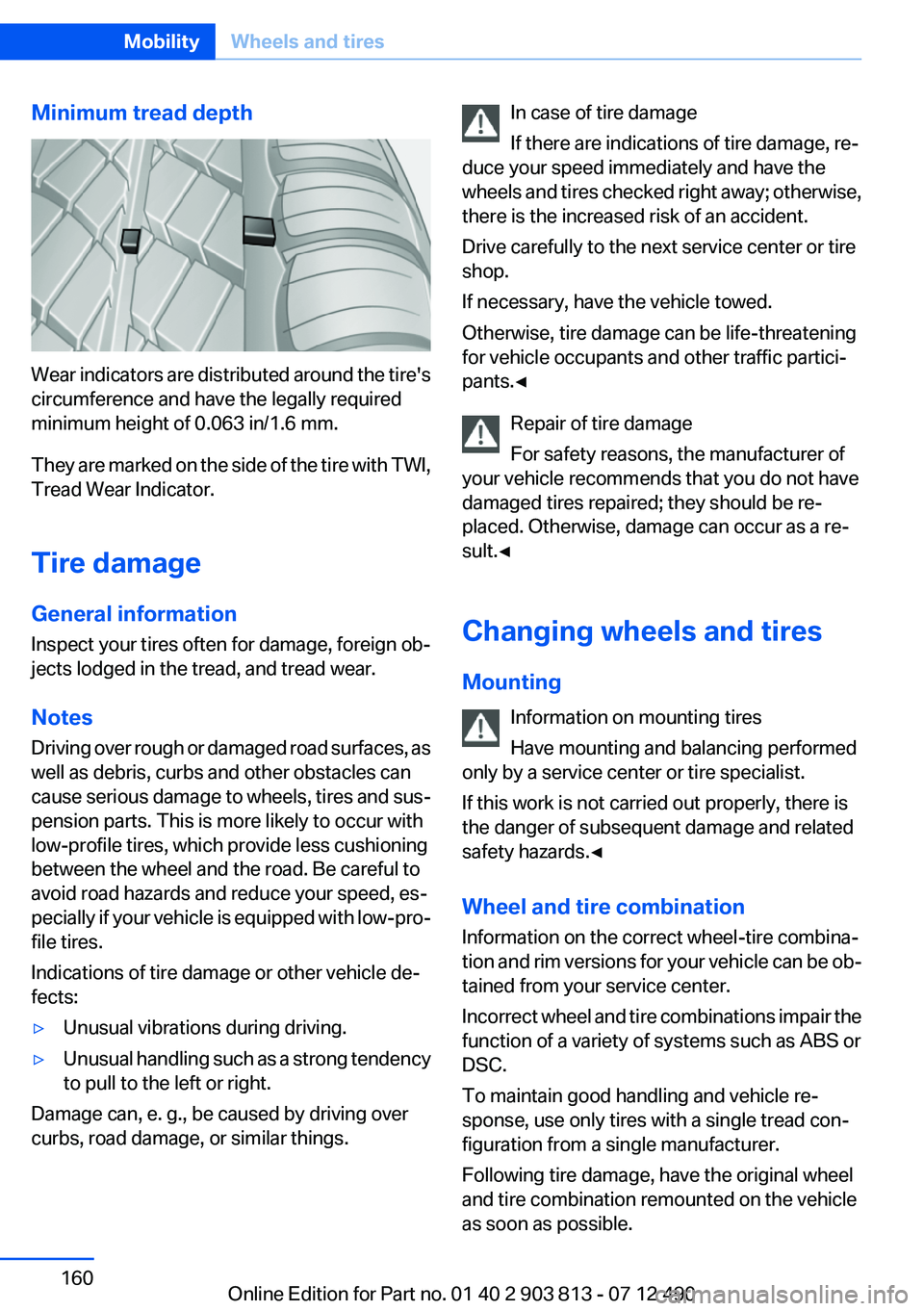
Wear indicators are distributed around the tire's
circumference and have the legally required
minimum height of 0.063 in/1.6 mm.
They are marked on the side of the tire with TWI,
Tread Wear Indicator.
Tire damage
General information
Inspect your tires often for damage, foreign ob‐
jects lodged in the tread, and tread wear.
Notes
Driving over rough or damaged road surfaces, as
well as debris, curbs and other obstacles can
cause serious damage to wheels, tires and sus‐
pension parts. This is more likely to occur with
low-profile tires, which provide less cushioning
between the wheel and the road. Be careful to
avoid road hazards and reduce your speed, es‐
pecially if your vehicle is equipped with low-pro‐
file tires.
Indications of tire damage or other vehicle de‐
fects:
▷Unusual vibrations during driving.▷Unusual handling such as a strong tendency
to pull to the left or right.
Damage can, e. g., be caused by driving over
curbs, road damage, or similar things.
In case of tire damage
If there are indications of tire damage, re‐
duce your speed immediately and have the
wheels and tires checked right away; otherwise,
there is the increased risk of an accident.
Drive carefully to the next service center or tire
shop.
If necessary, have the vehicle towed.
Otherwise, tire damage can be life-threatening
for vehicle occupants and other traffic partici‐
pants.◀
Repair of tire damage
For safety reasons, the manufacturer of
your vehicle recommends that you do not have
damaged tires repaired; they should be re‐
placed. Otherwise, damage can occur as a re‐
sult.◀
Changing wheels and tires
Mounting Information on mounting tires
Have mounting and balancing performed
only by a service center or tire specialist.
If this work is not carried out properly, there is
the danger of subsequent damage and related
safety hazards.◀
Wheel and tire combination
Information on the correct wheel-tire combina‐
tion and rim versions for your vehicle can be ob‐
tained from your service center.
Incorrect wheel and tire combinations impair the
function of a variety of systems such as ABS or
DSC.
To maintain good handling and vehicle re‐
sponse, use only tires with a single tread con‐
figuration from a single manufacturer.
Following tire damage, have the original wheel
and tire combination remounted on the vehicle
as soon as possible.Seite 160MobilityWheels and tires160
Online Edition for Part no. 01 40 2 903 813 - 07 12 490
Page 164 of 211
Never reach into the engine compartment
Never reach into the intermediate spaces
or gaps in the engine compartment. Otherwise,
there is risk of injury, e.g. from rotating or hot
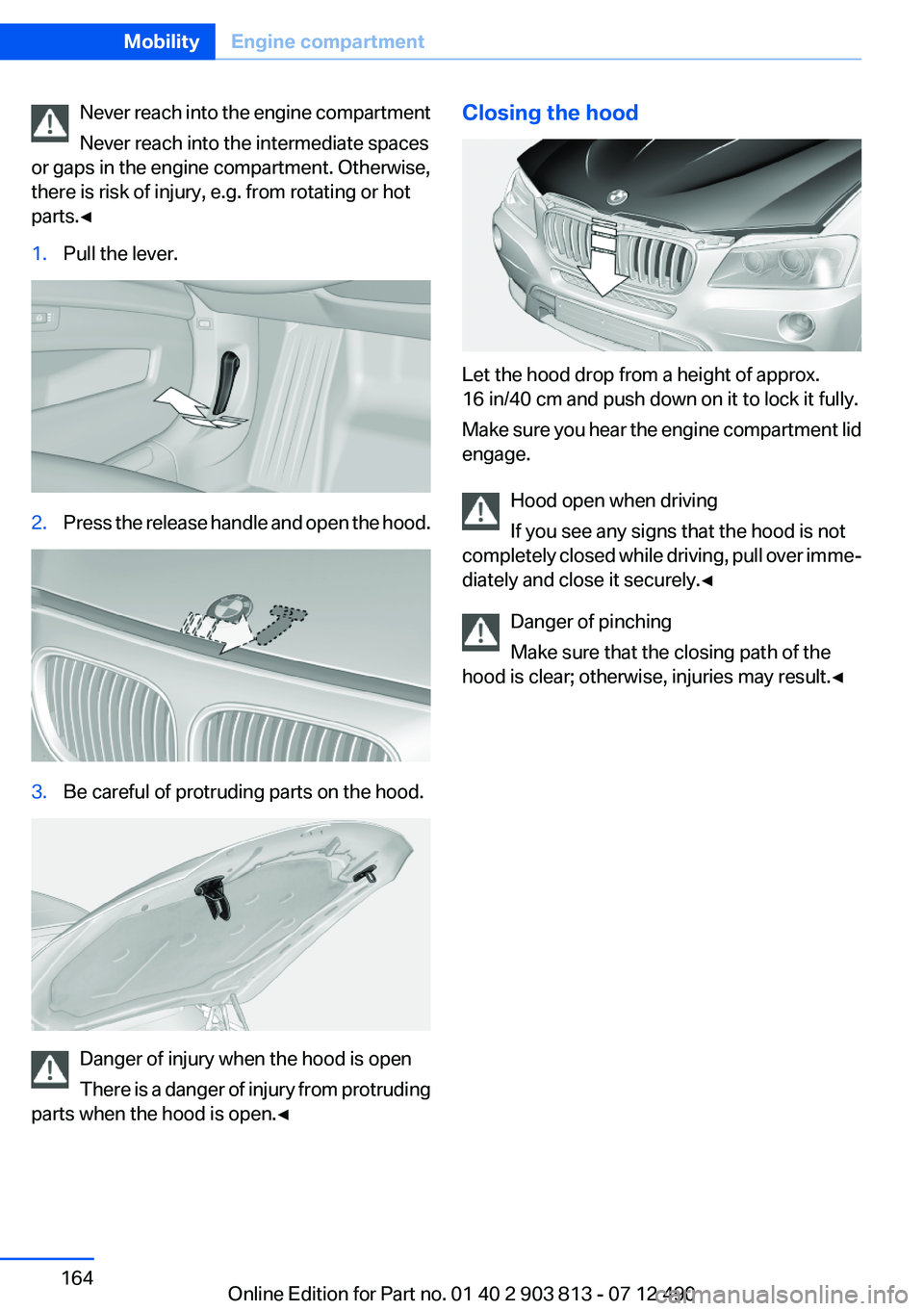
parts.◀1.Pull the lever.2.Press the release handle and open the hood.3.Be careful of protruding parts on the hood.
Danger of injury when the hood is open
There is a danger of injury from protruding
parts when the hood is open.◀
Closing the hood
Let the hood drop from a height of approx.
16 in/40 cm and push down on it to lock it fully.
Make sure you hear the engine compartment lid
engage.
Hood open when driving
If you see any signs that the hood is not
completely closed while driving, pull over imme‐
diately and close it securely.◀
Danger of pinching
Make sure that the closing path of the
hood is clear; otherwise, injuries may result.◀
Seite 164MobilityEngine compartment164
Online Edition for Part no. 01 40 2 903 813 - 07 12 490
Page 190 of 211
Technical dataVehicle equipment
All standard, country-specific and optional
equipment that is offered in the model series is
described in this chapter. Therefore, equipmentis also described that is not available in a vehicle,
e. g., because of the selected optional equip‐
ment or country variant. This also applies for
safety-related functions and systems.
Dimensions
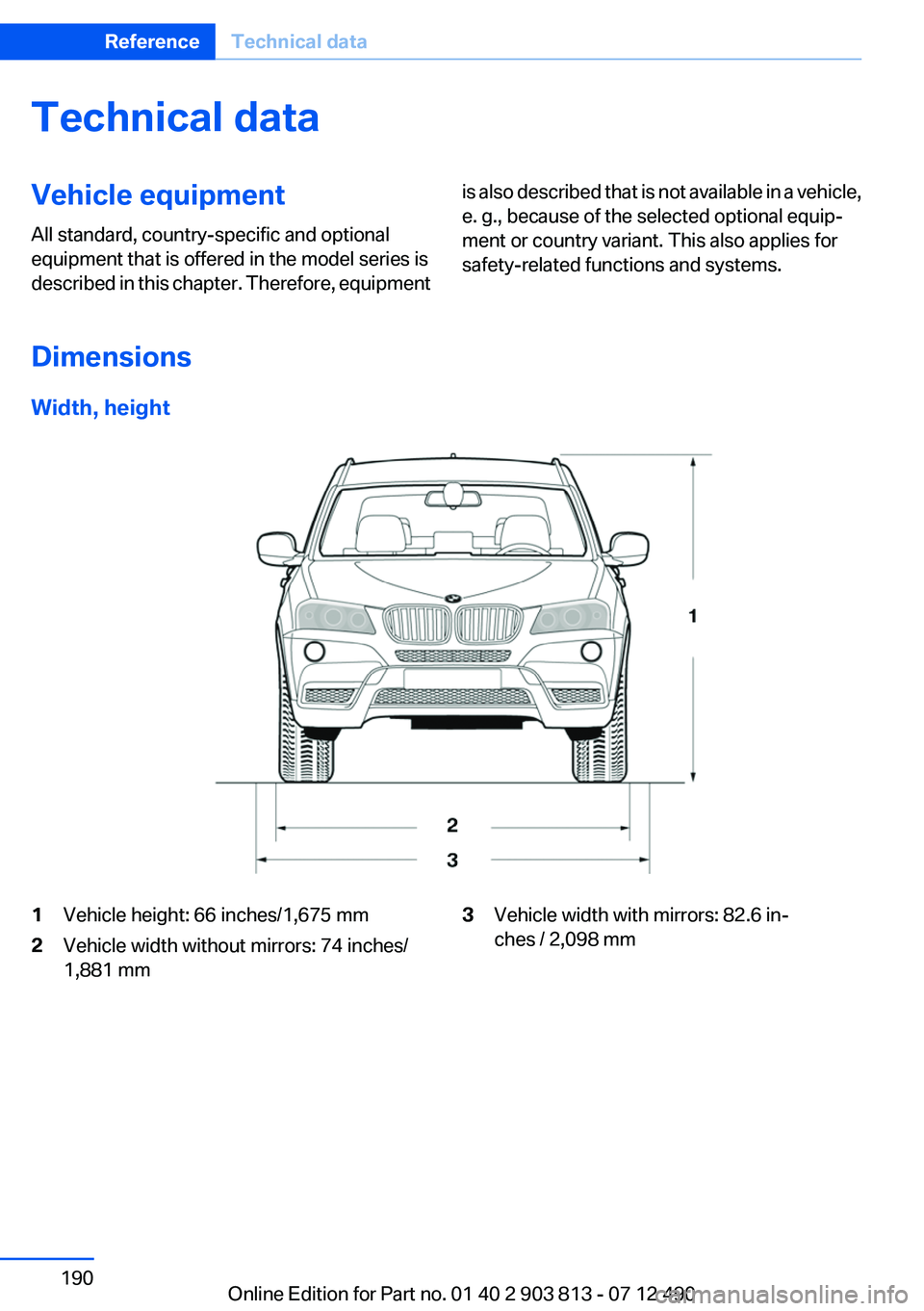
Width, height
1Vehicle height: 66 inches/1,675 mm2Vehicle width without mirrors: 74 inches/
1,881 mm3Vehicle width with mirrors: 82.6 in‐
ches / 2,098 mmSeite 190ReferenceTechnical data190
Online Edition for Part no. 01 40 2 903 813 - 07 12 490
Page 205 of 211
Front passenger airbags, au‐tomatic deactivation 93
Front passenger airbags, indi‐ cator lamp 93
FTM Flat Tire Monitor 97
Fuel cap 152
Fuel consumption, current 78
Fuel consumption, refer to Average fuel consump‐
tion 82
Fuel filler flap 152
Fuel gauge 76
Fuel quality 154
Fuel, tank capacity 192
Fuse 177
G
Garage door opener, refer to Integrated universal remote
control 127
Gasoline 154
Gasoline quality 154
Gear change, automatic trans‐ mission 69
General driving notes 140
Glass sunroof, refer to Panor‐ amic glass sunroof 43
Glove compartment 134
Gross vehicle weight, ap‐ proved 191
H
Handbrake, refer to Parking brake 63
Hand-held transmitter, alter‐ nating code 128
Hazard warning flashers 178
HDC Hill Descent Control 103
Head airbags 91
Headlamp control, auto‐ matic 87
Headlamp courtesy delay fea‐ ture 87 Headlamp courtesy delay fea‐
ture via remote control 35
Headlamp flasher 66
Headlamp flasher, bulb re‐ placement 173
Headlamp glass 172
Headlamps 172
Headlamps, care 184
Headlamp washer system 66
Headliner 15
Head restraints 46
Head restraints, front 50
Head restraints, rear 51
Head-up Display 118
Head-up Display, care 186
Heavy cargo, stowing 144
Height, vehicle 190
High-beam Assistant 88
High beams 66
High beams/low beams, refer to High-beam Assistant 88
High beams, bulb replace‐ ment 173
Hill Descent Control HDC 103
Hills 142
Hints 6
Holder for beverages 135
Homepage 6
Hood 163
Horn 12
Hot exhaust system 140
HUD Head-up Display 118
Hydroplaning 141
I
Ice warning, refer to External temperature warning 77
Icy roads, refer to External temperature warning 77
Identification marks, tires 158
Identification number, refer to Important features in the en‐
gine compartment 163
iDrive 16 Ignition key, refer to Remote
control 30
Ignition off 59
Ignition on 59
Indication of a flat tire 95, 98
Individual air distribu‐ tion 120, 123
Individual settings, refer to Personal Profile 31
Inflation pressure, tires 155
Inflation pressure warning, tires 97
Info display, refer to Com‐ puter 81
Initializing, Flat Tire Monitor FTM 98
Initializing, Tire Pressure Mon‐ itor TPM 95
Instrument cluster 72
Instrument cluster, electronic displays 73
Instrument lighting 89
Integrated key 30
Integrated universal remote control 127
Intensity, AUTO program 123
Interior equipment 127
Interior lamps 90
Interior lamps via remote con‐ trol 35
Interior motion sensor 42
Interior rearview mirror 54
Interior rearview mirror, auto‐ matic dimming feature 54
Internet page 6
Interval display, service re‐ quirements 78
J
Jacking points for the vehicle jack 176
Jack, refer to Vehicle jack 176
Joystick, automatic transmis‐ sion 69
Jump-starting 179 Seite 205Everything from A to ZReference205
Online Edition for Part no. 01 40 2 903 813 - 07 12 490