door lock BMW X5 2002 E53 Central Body Electronics User Guide
[x] Cancel search | Manufacturer: BMW, Model Year: 2002, Model line: X5, Model: BMW X5 2002 E53Pages: 64, PDF Size: 4.03 MB
Page 36 of 64
ZKE - 36
CAR/KEY CONFIGURATION AND THE ZCS CODING CONVERSION FEATURE
The ZCS Coding Conversion feature is still utilized for changing other system functions as
in the past. For example: The Language Display Change for the instrument cluster display
block is only available using the Coding Conversion feature.
CAR/KEY MEMORY SERVICE CONSIDERATIONS
Replacing Car or Key Memory Configured Control Modules:
If a Car/Key Memory capable control module becomes defective and needs replacement,
the specific customized data will be transferred over to the new replacement unit during the
ZCS encoding process.
If this is not possible due to extensive control module failure, the owner must be made
aware of the situation and requested to provide the options they originally selected. For this
reason, it is advantageous to print the selected features as mentioned in the CAR & KEY
MEMORY configuration procedures.
FZV Key Initialization Procedure:
Also mentioned in the FZV section of this manual, If FZV keys need re-initializing, make sure
they are initialized in the same order. Adhere to the colored label identification system for
proper key initialization sequencing.
Technician Awareness:
Car Memory/Key Memory Configuration obviously changes the functionality of the systems.
Before concluding a specific system is defective, review the Car/Key memory selection for
the vehicle you are working on. There may be an owner selected function activated that is
not a common selection, causing misunderstanding of the system's function.
When working on a Car/Key Memory capable vehicle, avoid using the FZV keys. Use the
driver’s door lock to lock and unlock the vehicle to maintain the owners memorized settings.
If settings had to be modified as part of repair procedure, inform service advisor of situation
to convey to vehicle owner.
Page 37 of 64
ZKE - 37
POWER WINDOWS
The power window operation on the E53 is similar to previous systems. Features of the
system include:
• Control of the front and rear door window motors is carried out directly by the GM.
• One-touch operation in both directions on all four windows.
• Cable type window regulator used for all windows.
• Anti-trap detection is provided by the pressure sensitive finger guard .
• Push/pull window switches
• The rear window switches located in the rear doors can be deactivated by the pressing
child lock out switch in the center console.
• Convenience closing/opening of the windows from the driver's lock cylinder or
convenience opening only from the FZV remote key (FZV operation can be owner
customized with the Car Memory Function).
• Window operation with the ignition switched off until a door is opened or 16 minutes has
elapsed after the key is switched off.
• Window load switching is through relays integral of the GM for rear windows and in the
respective door switchblock modules for the front windows. The current draw is
monitored for end limit position. The maximum run time for the window motors is limited
to 8 seconds. This allows the motors to be switched off if the end limit load sensing fails.
Page 39 of 64
ZKE - 39
WINDOW ANTI-TRAP DETECTION
The window anti-trap detection feature is only active in the one touch and convenience
close modes of operation. If the window switch is pushed/pulled and held, the Anti-trap
feature will not function.
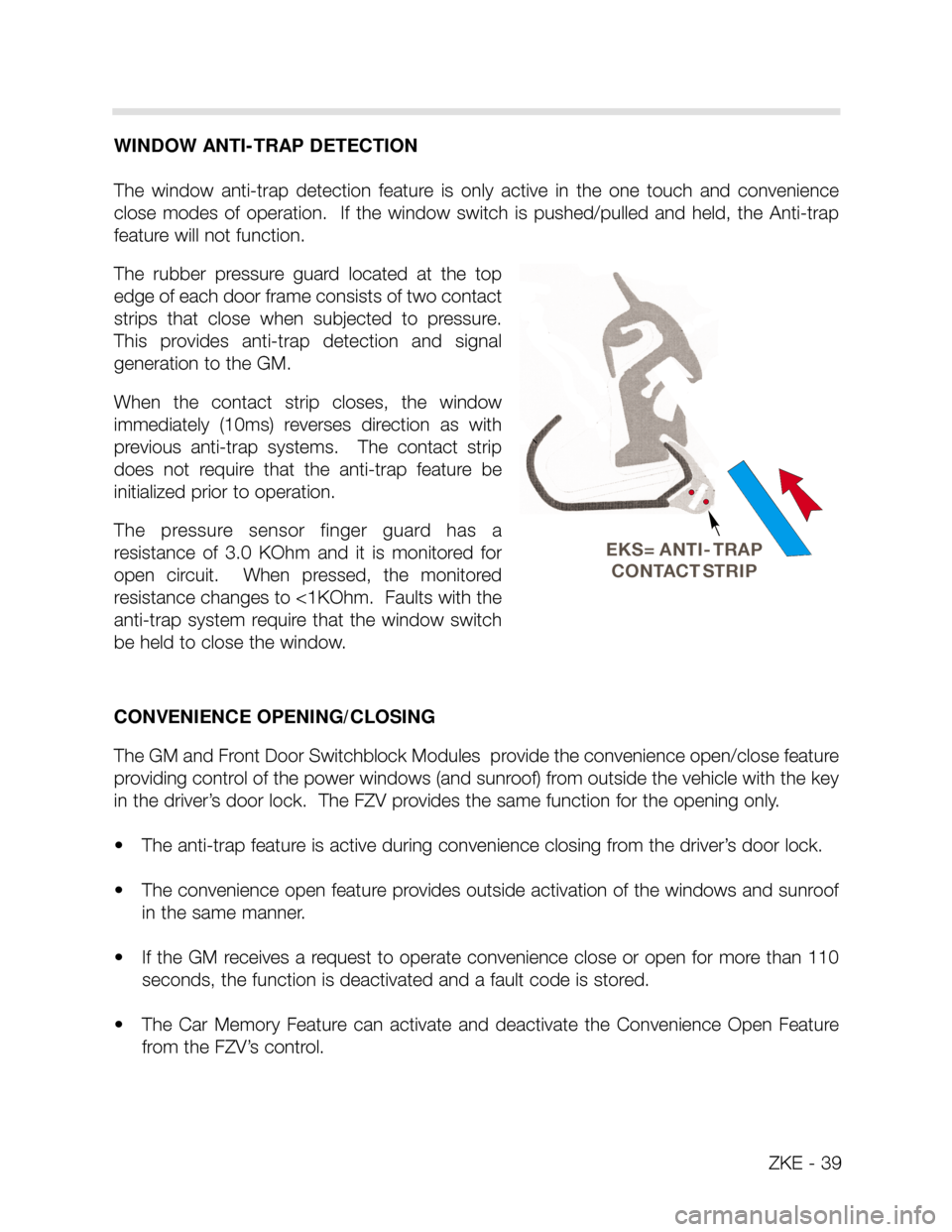
The rubber pressure guard located at the top
edge of each door frame consists of two contact
strips that close when subjected to pressure.
This provides anti-trap detection and signal
generation to the GM.
When the contact strip closes, the window
immediately (10ms) reverses direction as with
previous anti-trap systems. The contact strip
does not require that the anti-trap feature be
initialized prior to operation.
The pressure sensor finger guard has a
resistance of 3.0 KOhm and it is monitored for
open circuit. When pressed, the monitored
resistance changes to <1KOhm. Faults with the
anti-trap system require that the window switch
be held to close the window.
CONVENIENCE OPENING/CLOSING
The GM and Front Door Switchblock Modules provide the convenience open/close feature
providing control of the power windows (and sunroof) from outside the vehicle with the key
in the driver’s door lock. The FZV provides the same function for the opening only.
• The anti-trap feature is active during convenience closing from the driver’s door lock.
• The convenience open feature provides outside activation of the windows and sunroof
in the same manner.
• If the GM receives a request to operate convenience close or open for more than 110
seconds, the function is deactivated and a fault code is stored.
• The Car Memory Feature can activate and deactivate the Convenience Open Feature
from the FZV’s control.
Page 43 of 64
ZKE - 43
INTERIOR LIGHTING
The GM controls the interior lighting automatically with the status change of several moni-
tored inputs. The lighting can also be manually controlled using the interior light switch.
COMPONENTS
DOOR CONTACTS: The door lock actuators contain a hall effect sensor for the purpose
of monitoring door open/closed status (hall sensor 3 in the driver's door actuator). The hall
effect sensor is located directly behind the rotary latch plate encased in the actuator. The
sensor is activated by the rotary latch plate's position. A change in current flow informs the
General module when a door is opened or closed.
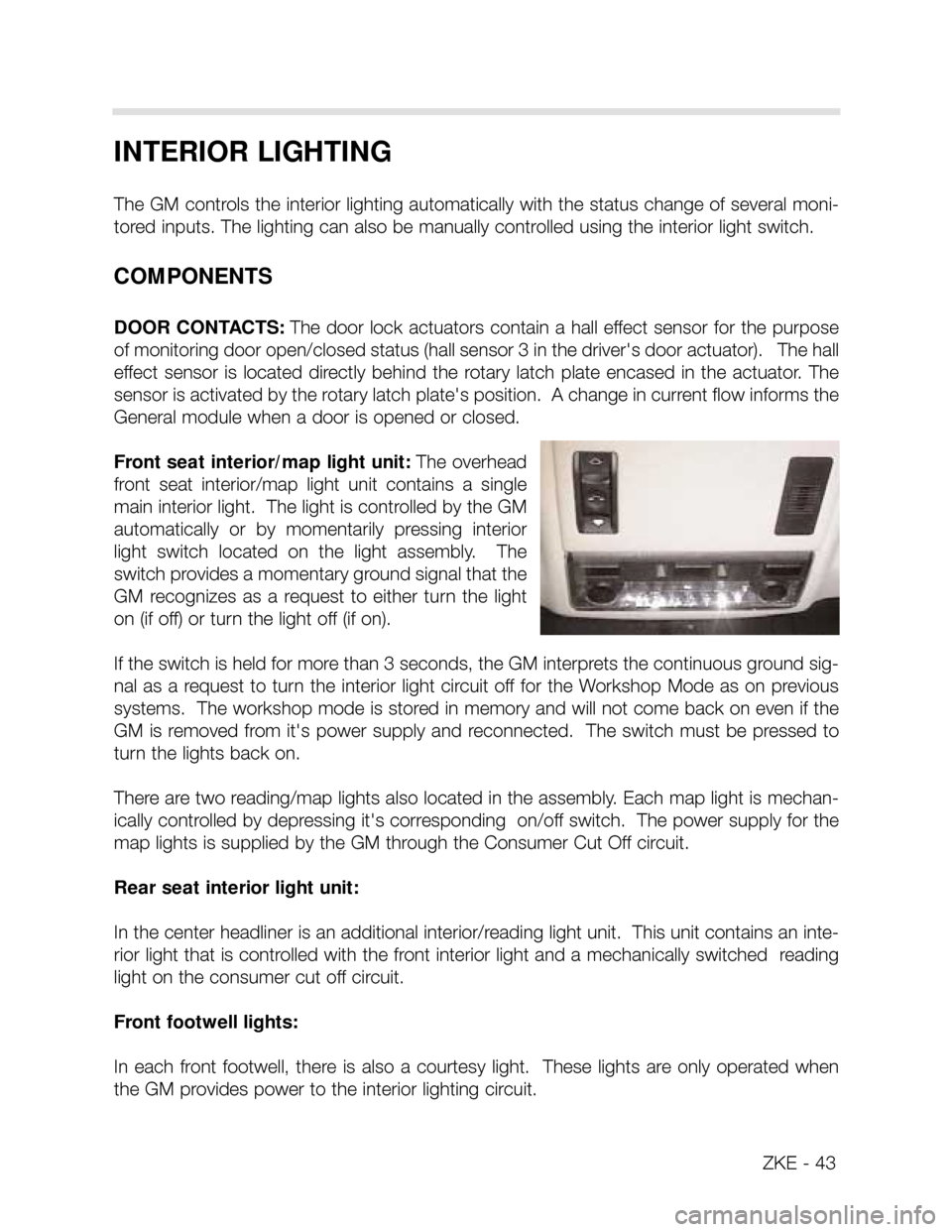
Front seat interior/map light unit: The overhead
front seat interior/map light unit contains a single
main interior light. The light is controlled by the GM
automatically or by momentarily pressing interior
light switch located on the light assembly. The
switch provides a momentary ground signal that the
GM recognizes as a request to either turn the light
on (if off) or turn the light off (if on).
If the switch is held for more than 3 seconds, the GM interprets the continuous ground sig-
nal as a request to turn the interior light circuit off for the Workshop Mode as on previous
systems. The workshop mode is stored in memory and will not come back on even if the
GM is removed from it's power supply and reconnected. The switch must be pressed to
turn the lights back on.
There are two reading/map lights also located in the assembly. Each map light is mechan-
ically controlled by depressing it's corresponding on/off switch. The power supply for the
map lights is supplied by the GM through the Consumer Cut Off circuit.
Rear seat interior light unit:
In the center headliner is an additional interior/reading light unit. This unit contains an inte-
rior light that is controlled with the front interior light and a mechanically switched reading
light on the consumer cut off circuit.
Front footwell lights:
In each front footwell, there is also a courtesy light. These lights are only operated when
the GM provides power to the interior lighting circuit.
Page 45 of 64
ZKE - 45
AUTOMATIC CONTROL FUNCTION
The GM provides 12 volts (linear application providing soft on feature) to the interior light-
ing circuit when the one of the following input signal statuses change:
• Door contact hall sensor active (door opened)
• An Unlock request from the driver's door key lock hall sensors are received. This only
occurs if the ignition switch is off.
• An Unlock request is from the FZV keyless entry system is received via the K bus. This
only occurs if the ignition switch is off as well.
• The ignition switch is switched off and the vehicle exterior lights (LCM III) have been on
for a minimum of 2 minutes prior. This information is provided to the GM via the K bus.
• Active crash signal from the MRS III control module.
• Lock button of FZV key is pressed with the vehicle is already locked (interior search
function).
The GM gradually reduces the full 12 volt power supply (linear reduction providing soft off)
until the lights are off when the following input signal statuses change:
• Immediately after the ignition switch is turned to KL R with the driver's door hall sensor
door contact closed.
• When the vehicle is locked (single or double) with the door contacts closed.
• When the vehicle door contacts are closed. The lights remain on for 20 seconds and
then go to soft off.
• After the interior search function is activated, the lights will automatically turn off (soft off)
after 8 seconds.
• After 16 minutes with a door contact active (open door) and the key off, the lights are
switched off (consumer cutoff function).
• The component activation function of the DIS also has the ability to switch the lights.
The Interior lighting output circuit of the GM is approximately 3.5 amps with all lights on.
Page 46 of 64
ZKE - 46
ANTI-THEFT (DWA) SYSTEM
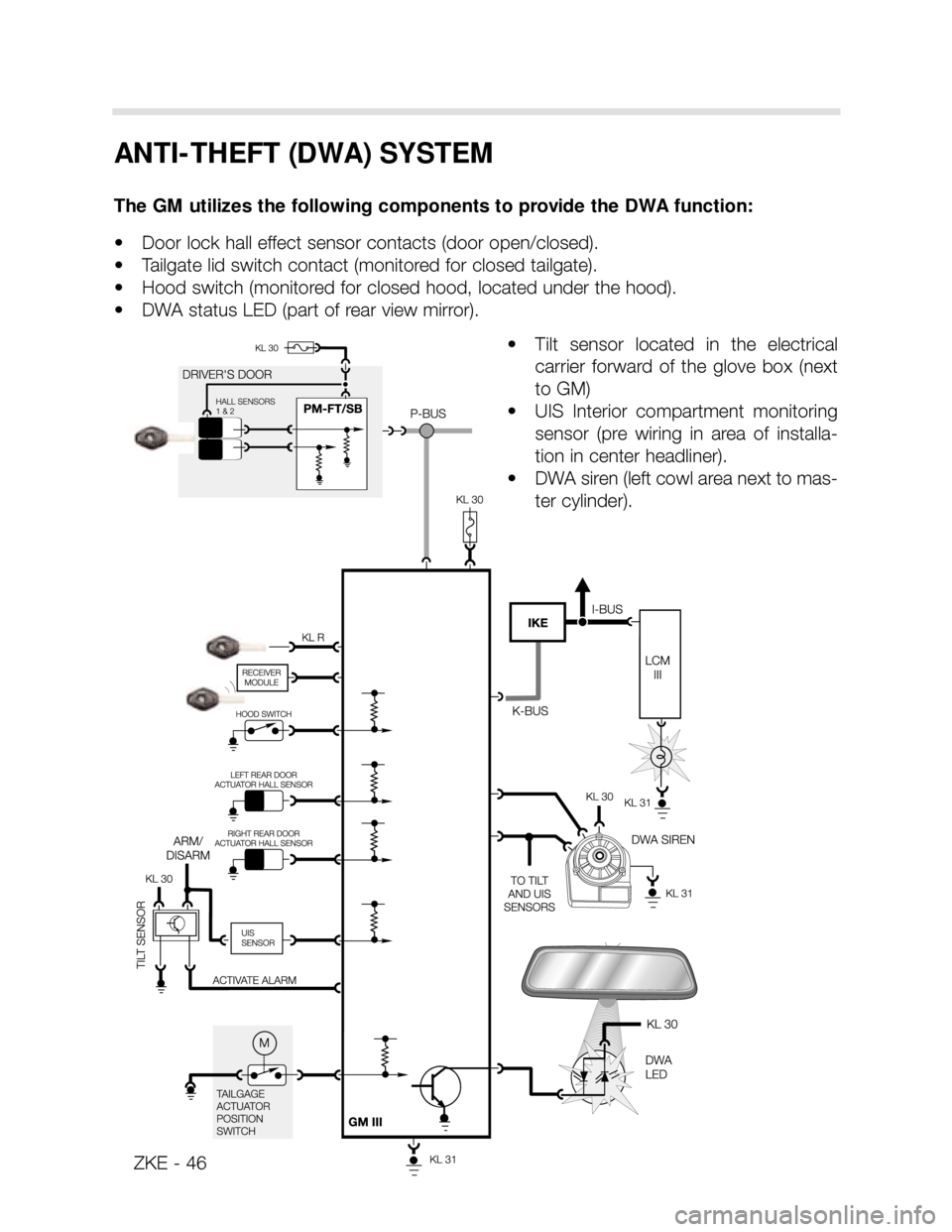
The GM utilizes the following components to provide the DWA function:
• Door lock hall effect sensor contacts (door open/closed).
• Tailgate lid switch contact (monitored for closed tailgate).
• Hood switch (monitored for closed hood, located under the hood).
• DWA status LED (part of rear view mirror).
• Tilt sensor located in the electrical
carrier forward of the glove box (next
to GM)
• UIS Interior compartment monitoring
sensor (pre wiring in area of installa-
tion in center headliner).
• DWA siren (left cowl area next to mas-
ter cylinder).
Page 47 of 64
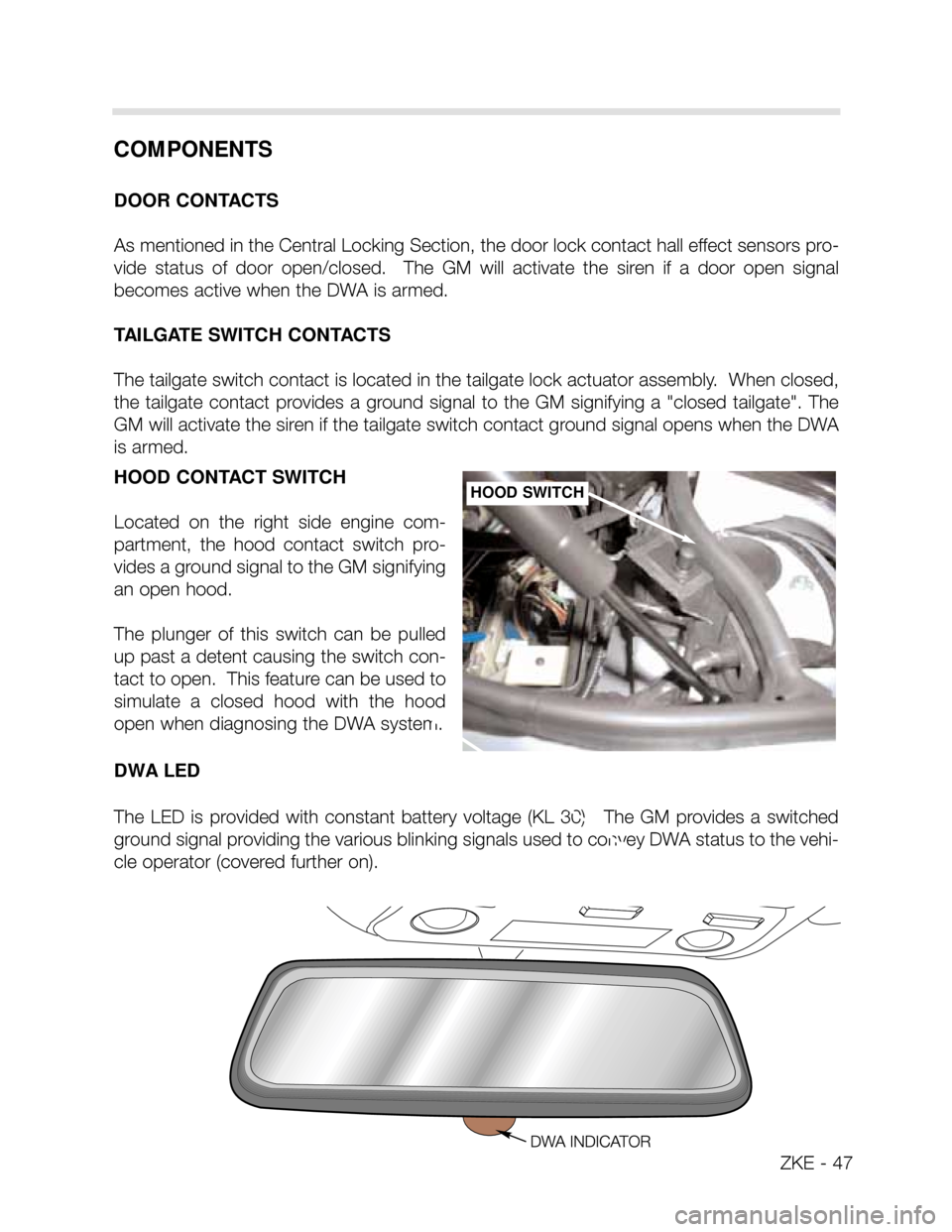
HOOD CONTACT SWITCH
Located on the right side engine com-
partment, the hood contact switch pro-
vides a ground signal to the GM signifying
an open hood.
The plunger of this switch can be pulled
up past a detent causing the switch con-
tact to open. This feature can be used to
simulate a closed hood with the hood
open when diagnosing the DWA system.
DWA LED
The LED is provided with constant battery voltage (KL 30). The GM provides a switched
ground signal providing the various blinking signals used to convey DWA status to the vehi-
cle operator (covered further on).HOOD SWITCH
COMPONENTS
DOOR CONTACTS
As mentioned in the Central Locking Section, the door lock contact hall effect sensors pro-
vide status of door open/closed. The GM will activate the siren if a door open signal
becomes active when the DWA is armed.
TAILGATE SWITCH CONTACTS
The tailgate switch contact is located in the tailgate lock actuator assembly. When closed,
the tailgate contact provides a ground signal to the GM signifying a "closed tailgate". The
GM will activate the siren if the tailgate switch contact ground signal opens when the DWA
is armed.
ZKE - 47
Page 51 of 64
ZKE - 51
DWA ARMING/DISARMING
• The DWA is armed every time the vehicle is locked from the outside with the door lock
cylinder or FZV key.
• The LED in the rear view mirror flashes as an acknowledgment along with the exterior
lights and a momentary chirp from the siren.
• The GM monitors all required input signals for closed status (door closed, tailgate
closed, etc.) The inputs must be in a closed status for a minimum of 3 seconds for the
GM to include them as an activation component. If after 3 seconds any input signal not
in the closed status is excluded (this is acknowledged by the DWA LED) preventing false
alarm activation's.
• If the DWA is armed a second time within 10 seconds, the tilt sensor and interior pro-
tection sensor are also excluded as alarm activation components. This function is use-
ful if the vehicle is transported on a train or flat bed truck to prevent false alarm activa-
tion's.
• While armed the tailgate can be opened with out the alarm being triggered as follows:
- If opened with the tailgate remote button via the FZV, the GM prevents the alarm
from activating. (This feature is customizable under the Car Memory function).
- If opened with the key at the tailgate lock cylinder the tailgate key position switch
signals the GM and in the same manner prevents the alarm from activating.
In either case, when the tailgate is returned to the closed position, it is no longer con-
sidered as an activation signal.
Panic Mode Operation: When the tailgate button is pressed and held, the GM is signaled
to activate the siren for the Panic Mode. The panic mode will function with either an armed
or disarmed DWA system.
EMERGENCY DISARMING
Emergency disarming occurs automatically if a key is used to turn the ignition switch on and
the EWS III accepts it. The EWS III signals the GM to unlock the doors and deactivate the
DWA.
Page 54 of 64
ZKE -54
DRIVER’S SEAT MEMORY (CAR Memory Influence)
The PM-SM can be encoded to recall a specific seat position for a vehicle user when the
GM signals the SM to automatically recall stored positions separate of the 1-2-3 button
selections.
This feature is encoded through the car memory function and activated by the key memo-
ry function. The PM-SM will monitor the seat position and store it in another area of it's
memory when the vehicle is locked with the remote keyless entry system. The GM sends
a request to memorize the seat position and store it for FZV key user 1,2,3 or 4.
If another user of the vehicle changes the seat position the PM-SM restores the memory
position the next time the specific key is used to unlock the vehicle.
This feature can be further modified to activate the position recall based on the owner's
selected activation scenario, for example: The owner can choose to :
• Disable this feature,
• Initiate memory recall when the unlock signal is initially sent before a door is opened.
• Initiate memory recall when the unlock signal is sent but only when the driver's door is
opened.
See Car Memory Key Memory for additional information.
POWER SEAT DIAGNOSIS
The PM-SM communicates with the DIS or MoDiC via the K bus - instrument cluster gate-
way - to the P-bus. The PM-SM monitors the seat motors and circuits as well as it's inter-
nal operation. Any detected faults are stored in the PM-SM fault memory and are called up
when diagnosing the system with the Fault Symptom diagnostic plan.
The PM-SM also provides status display to the DIS of its input and output control signals
as well as component activation.
Page 55 of 64
MIRROR OPERATION
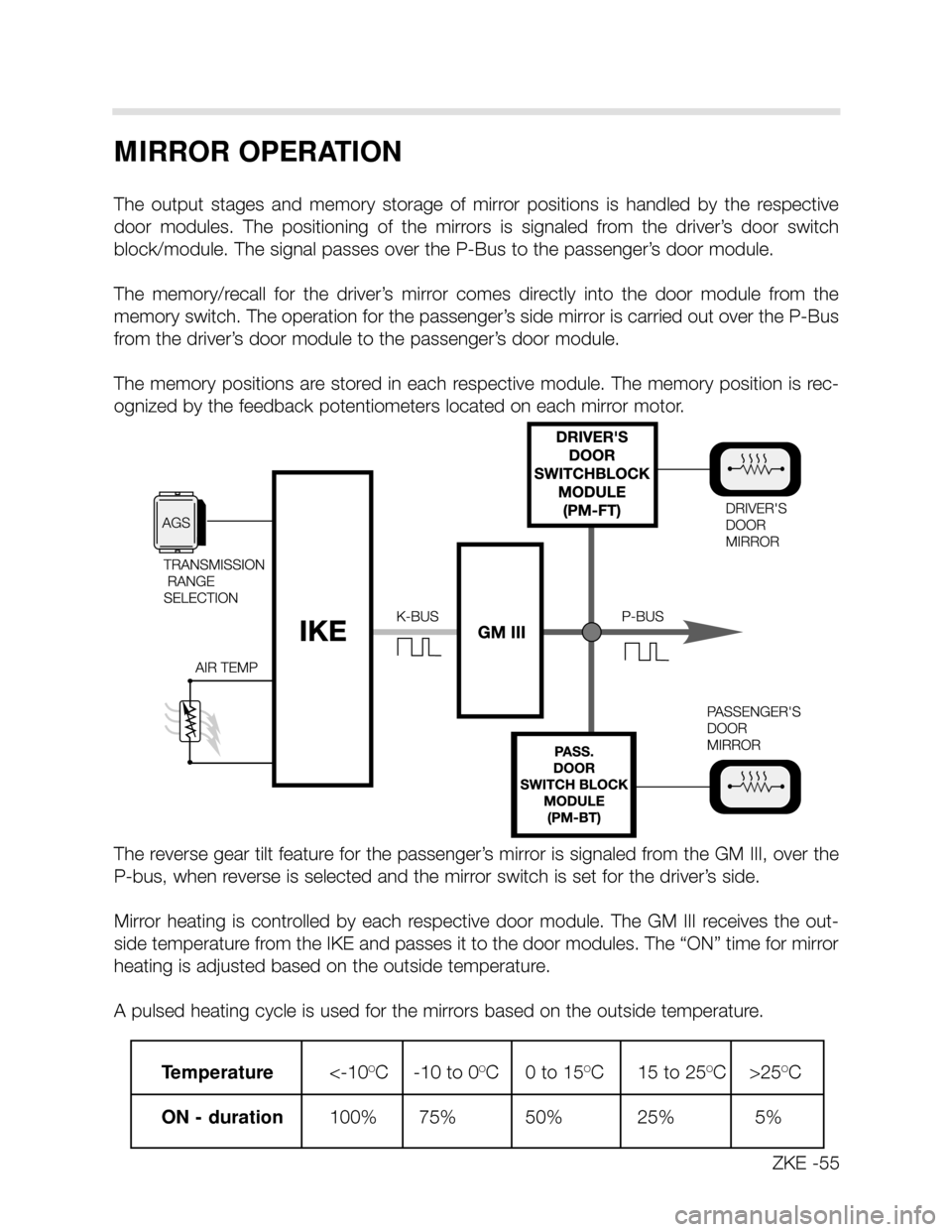
The output stages and memory storage of mirror positions is handled by the respective
door modules. The positioning of the mirrors is signaled from the driver’s door switch
block/module. The signal passes over the P-Bus to the passenger’s door module.
The memory/recall for the driver’s mirror comes directly into the door module from the
memory switch. The operation for the passenger’s side mirror is carried out over the P-Bus
from the driver’s door module to the passenger’s door module.
The memory positions are stored in each respective module. The memory position is rec-
ognized by the feedback potentiometers located on each mirror motor.
The reverse gear tilt feature for the passenger’s mirror is signaled from the GM III, over the
P-bus, when reverse is selected and the mirror switch is set for the driver’s side.
Mirror heating is controlled by each respective door module. The GM III receives the out-
side temperature from the IKE and passes it to the door modules. The “ON” time for mirror
heating is adjusted based on the outside temperature.
A pulsed heating cycle is used for the mirrors based on the outside temperature.
ZKE -55
Temperature<-10OC -10 to 0OC 0 to 15OC 15 to 25OC >25OC
ON - duration 100% 75% 50% 25% 5%