wheel BMW X5 2010 E70 Workshop Manual
[x] Cancel search | Manufacturer: BMW, Model Year: 2010, Model line: X5, Model: BMW X5 2010 E70Pages: 300, PDF Size: 12.41 MB
Page 211 of 300
209
Entertainment
Reference
At a glance
Controls
Driving tips Communications
Navigation
Mobility
1.Select the message that contains the
desired number.
2. "Call"
Messages from the concierge service
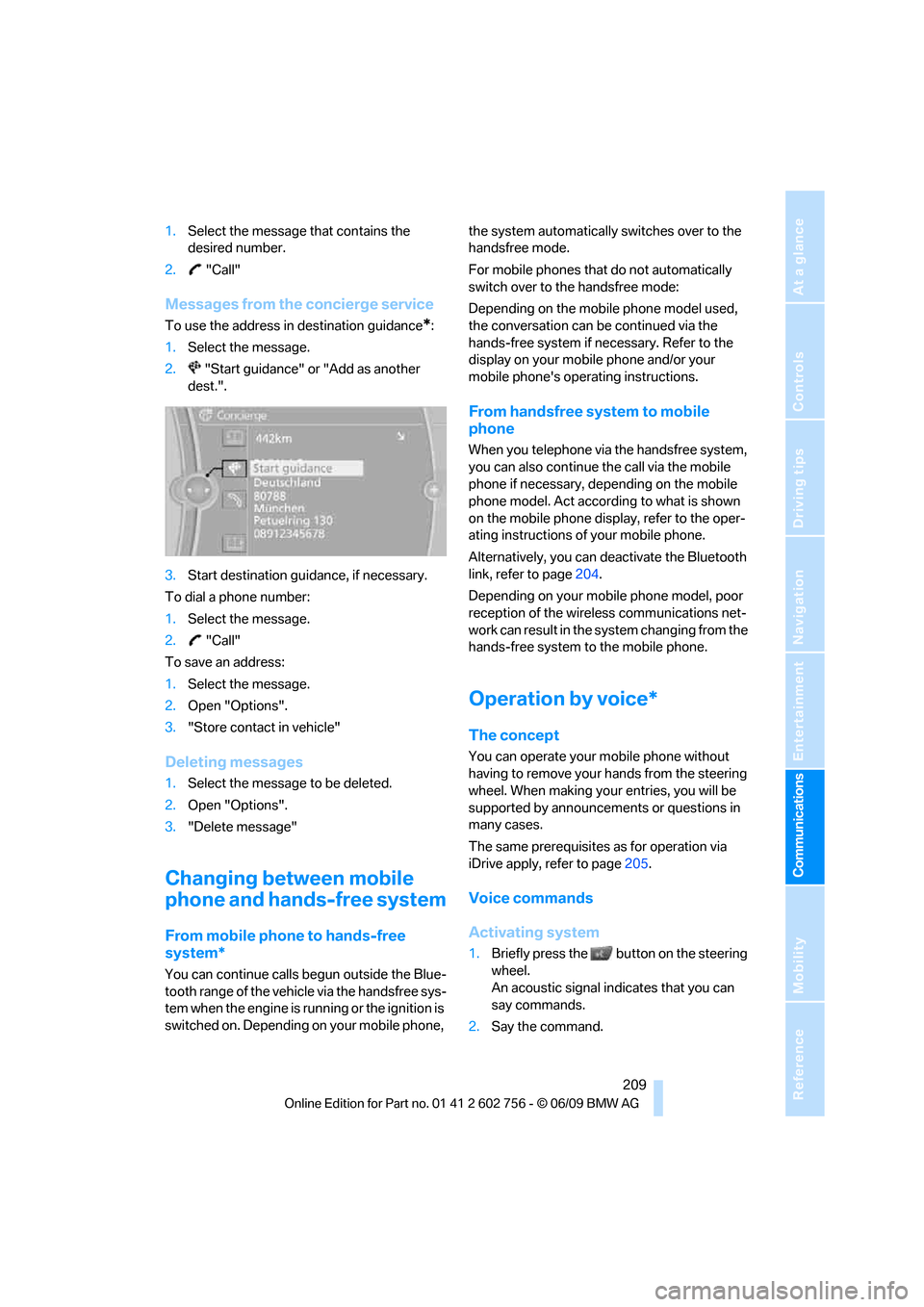
To use the address in destination guidance*:
1.Select the message.
2. "Start guidance" or "Add as another
dest.".
3.Start destination guidance, if necessary.
To dial a phone number:
1.Select the message.
2. "Call"
To save an address:
1.Select the message.
2.Open "Options".
3."Store contact in vehicle"
Deleting messages
1.Select the message to be deleted.
2.Open "Options".
3."Delete message"
Changing between mobile
phone and hands-free system
From mobile phone to hands-free
system*
You can continue calls begun outside the Blue-
tooth range of the vehicle via the handsfree sys-
tem when the engine is running or the ignition is
switched on. Depending on your mobile phone, the system automatically switches over to the
handsfree mode.
For mobile phones that do not automatically
switch over to the handsfree mode:
Depending on the mobile phone model used,
the conversation can be continued via the
hands-free system if necessary. Refer to the
display on your mobile phone and/or your
mobile phone's operating instructions.
From handsfree system to mobile
phone
When you telephone via the handsfree system,
you can also continue the call via the mobile
phone if necessary, depending on the mobile
phone model. Act according to what is shown
on the mobile phone display, refer to the oper-
ating instructions of your mobile phone.
Alternatively, you can deactivate the Bluetooth
link, refer to page204.
Depending on your mobile phone model, poor
reception of the wireless communications net-
work can result in the system changing from the
hands-free system to the mobile phone.
Operation by voice*
The concept
You can operate your mobile phone without
having to remove your hands from the steering
wheel. When making your entries, you will be
supported by announcements or questions in
many cases.
The same prerequisites as for operation via
iDrive apply, refer to page205.
Voice commands
Activating system
1.Briefly press the button on the steering
wheel.
An acoustic signal indicates that you can
say commands.
2.Say the command.
ba8_e70ag.book Seite 209 Freitag, 5. Juni 2009 11:42 11
Page 212 of 300
Telephone
210
Ending/canceling operation by voice
commands
Press the button on the steering wheel
or
In dialogs where text is spoken, e.g. a name
rather than a command, canceling is only possi-
ble using the button on the steering wheel.
Having possible commands read aloud
The system understands default commands
that must be spoken word for word. You can have the possible commands spoken
by the system at any point:
Using alternative commands
There are often a number of commands to run a
function, e.g.:
The system recognizes digits from zero to nine.
You can say each digit individually or group
them into a sequence to accelerate the input.
Example: dialing phone numbers
To start the dialog:
press the button on the steering wheel.
Adjusting the volume of the
instructions
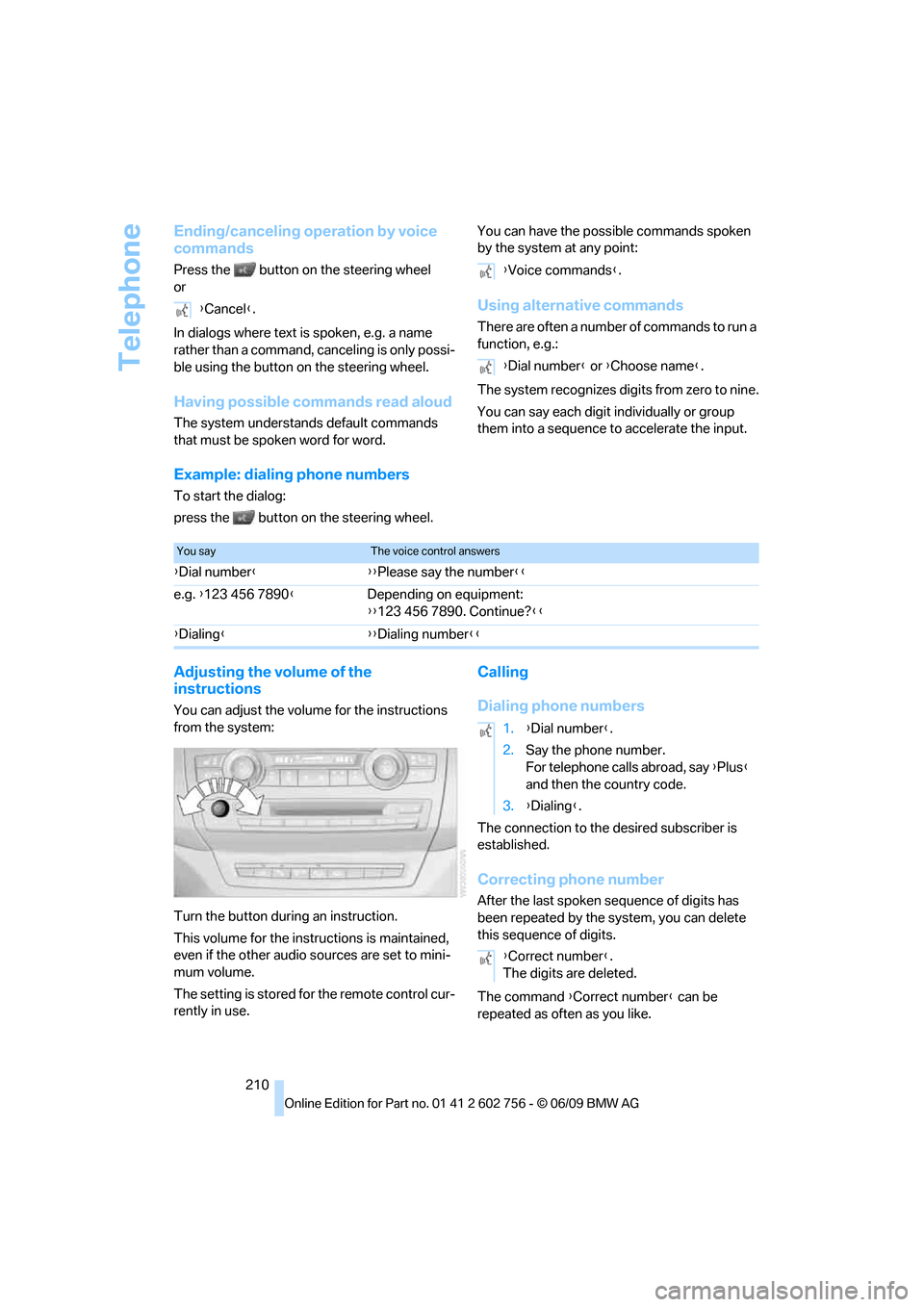
You can adjust the volume for the instructions
from the system:
Turn the button during an instruction.
This volume for the instructions is maintained,
even if the other audio sources are set to mini-
mum volume.
The setting is stored for the remote control cur-
rently in use.
Calling
Dialing phone numbers
The connection to the desired subscriber is
established.
Correcting phone number
After the last spoken sequence of digits has
been repeated by the system, you can delete
this sequence of digits.
The command {Correct number} can be
repeated as often as you like. {Cancel}.
{Voice commands}.
{Dial number} or {Choose name}.
You sayThe voice control answers
{Dial number}{{Please say the number}}
e.g. {123 456 7890}Depending on equipment:
{{123 456 7890. Continue?}}
{Dialing}{{Dialing number}}
1.{Dial number}.
2.Say the phone number.
For telephone calls abroad, say {Plus}
and then the country code.
3.{Dialing}.
{Correct number}.
The digits are deleted.
ba8_e70ag.book Seite 210 Freitag, 5. Juni 2009 11:42 11
Page 225 of 300
Mobility
This section helps you maintain your
mobility by supplying important information
on vital topics including fuels and lubricants,
wheels and tires, service, maintenance
and roadside assistance.
Mobility
ba8_e70ag.book Seite 223 Freitag, 5. Juni 2009 11:42 11
Page 231 of 300
Mobility
229Reference
At a glance
Controls
Driving tips
Communications
Navigation
Entertainment
Wheels and tires
Tire inflation pressure
Information for your safety
The condition of the tires and the maintenance
of the specified tire pressure are crucial not only
to the tire's service life, but also to driving com-
fort and most importantly, driving safety.
Checking pressure
Only check tire inflation pressure when the tires
are cold. This means after a maximum of
1.25 miles/2 km driving or when the vehicle has
been parked for at least 2 hours. When tires are
warm, the tire inflation pressure increases.
Check the tire inflation pressure regularly
and correct it as needed, even on the
compact tire
*: at least twice a month and before
starting long trips. If you fail to observe this pre-
caution, you may be driving on tires with incor-
rect tire pressures, a condition that can not only
compromise your vehicle's driving stability, but
also lead to tire damage and the risk of an acci-
dent. Do not drive with depressurized, i.e. flat
tires, except run-flat tires. A flat tire will seri-
ously impair your vehicle's handling and braking
response. Attempts to drive on a flat tire can
lead to a loss of control over the vehicle.<
After correcting the tire inflation pressure,
reinitialize the Flat Tire Monitor, refer to
page93, or reset the Tire Pressure Monitor,
refer to page94.<
Pressure specifications
The tables below provide all the correct inflation
pressures for the specified tire sizes at ambient
temperature.
The inflation pressures apply to the tire
sizes and tire brands respectively
approved and recommended by BMW; a list of
these is available from your BMW Sports Activ-
ity Vehicle Center.
ing:
>Tire sizes of your vehicle
>Load conditions
>Maximum allowable driving speed
Tire inflation pressures for speeds
up to 100 mph/160 km/h
For normal driving up to 100 mph/160 km/h,
adjust pressures to the respective tire inflation
pressures listed on the following pages in the
column Traveling speeds up to max. of
100 mph/160 km/h to achieve optimum driving
comfort.
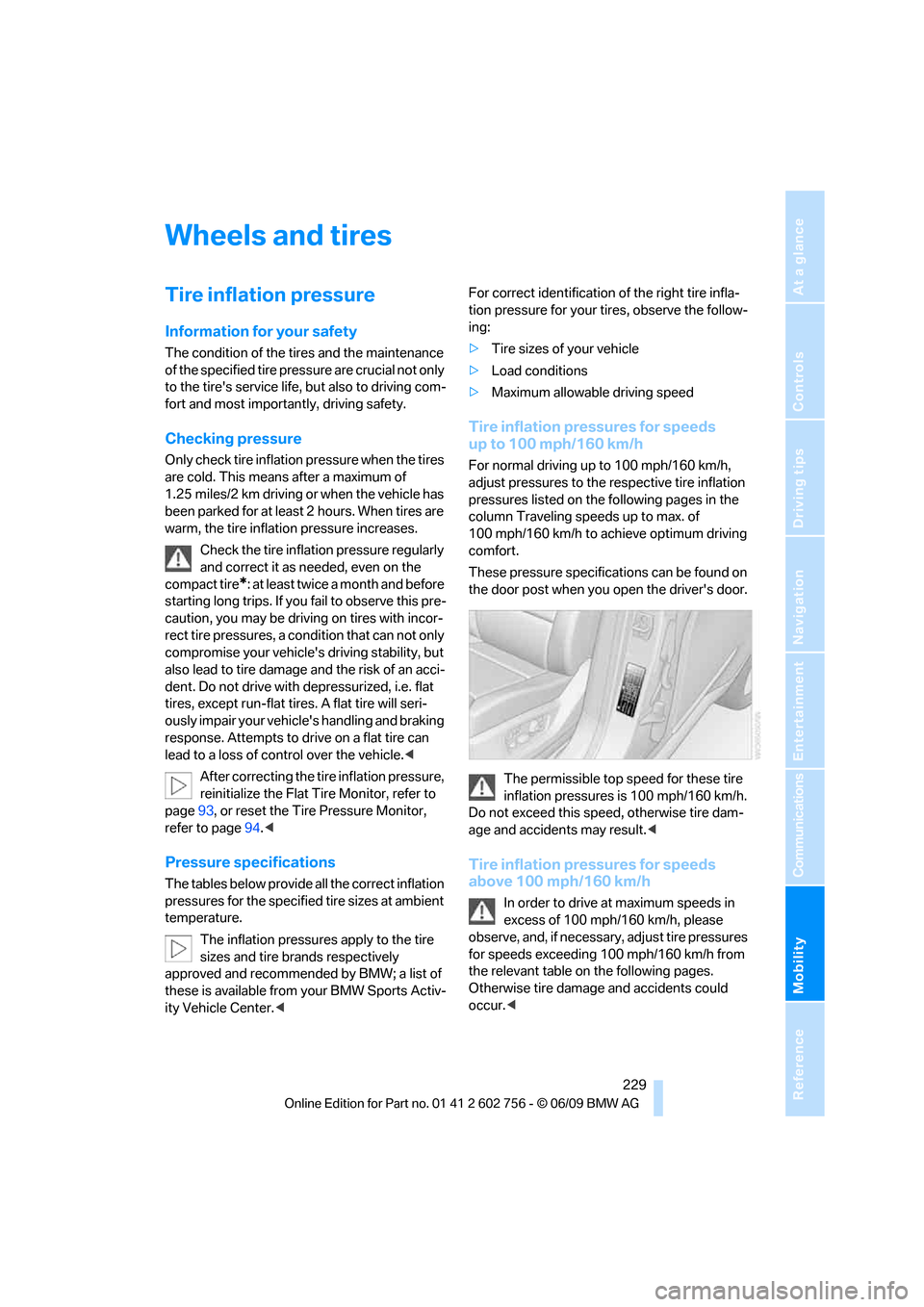
These pressure specifications can be found on
the door post when you open the driver's door.
The permissible top speed for these tire
inflation pressures is 100 mph/160 km/h.
Do not exceed this speed, otherwise tire dam-
age and accidents may result.<
Tire inflation pressures for speeds
above 100 mph/160 km/h
In order to drive at maximum speeds in
excess of 100 mph/160 km/h, please
observe, and, if necessary, adjust tire pressures
for speeds exceeding 100 mph/160 km/h from
the relevant table on the following pages.
Otherwise tire damage and accidents could
occur.<
ba8_e70ag.book Seite 229 Freitag, 5. Juni 2009 11:42 11
Page 232 of 300

Wheels and tires
230 Observe all national and local maximum speed
limits, otherwise violations of the law could
occur.
ba8_e70ag.book Seite 230 Freitag, 5. Juni 2009 11:42 11
Page 233 of 300
Mobility
231Reference
At a glance
Controls
Driving tips
Communications
Navigation
Entertainment
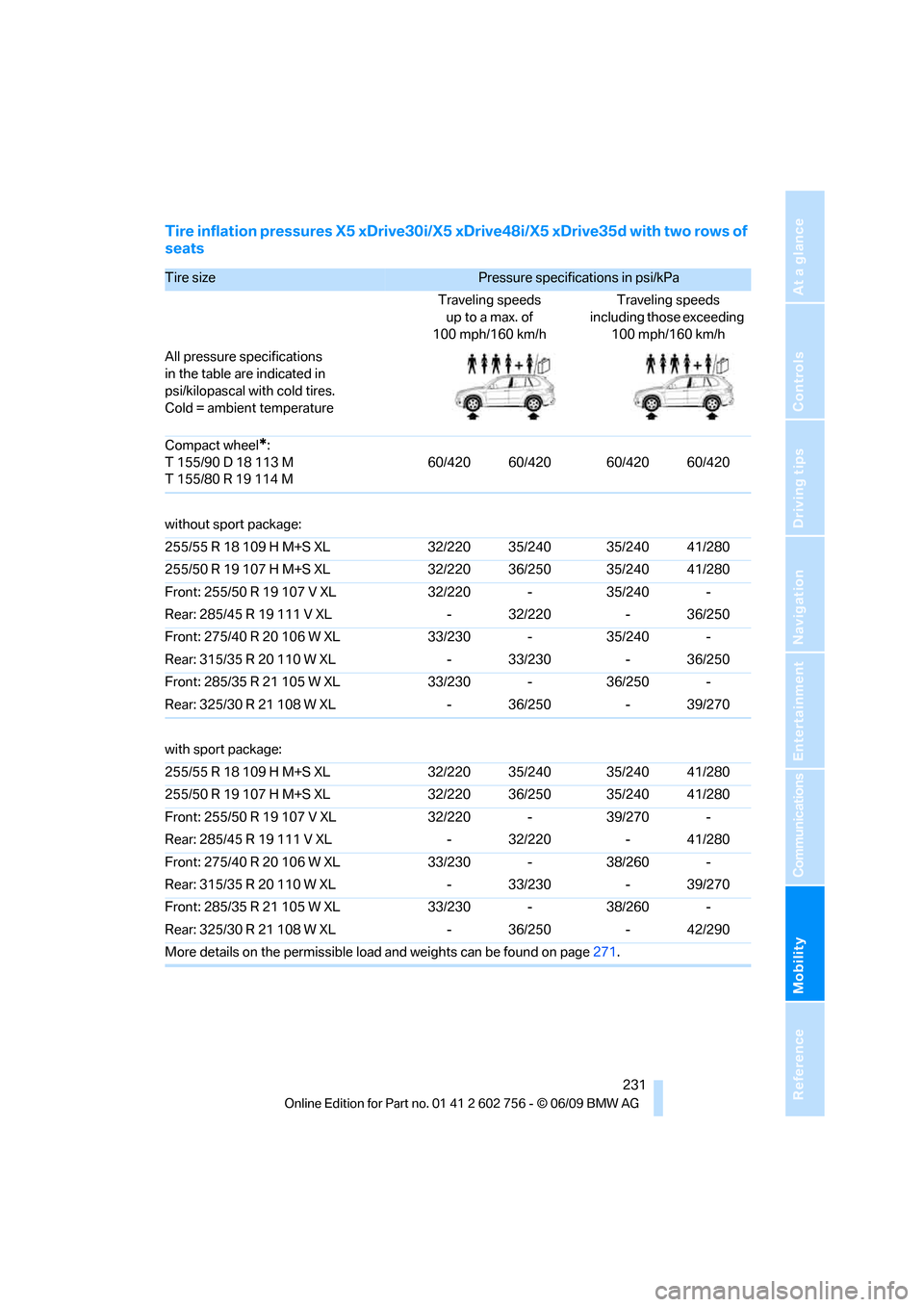
Tire inflation pressures X5 xDrive30i/X5 xDrive48i/X5 xDrive35d with two rows of
seats
Tire size Pressure specifications in psi/kPa
Traveling speeds
up to a max. of
100 mph/160 km/hTraveling speeds
including those exceeding
100 mph/160 km/h
All pressure specifications
in the table are indicated in
psi/kilopascal with cold tires.
Cold = ambient temperature
Compact wheel
*:
T 155/90 D 18 113 M
T 155/80 R 19 114 M60/420 60/420 60/420 60/420
without sport package:
255/55 R 18 109 H M+S XL 32/220 35/240 35/240 41/280
255/50 R 19 107 H M+S XL 32/220 36/250 35/240 41/280
Front: 255/50 R 19 107 V XL 32/220 - 35/240 -
Rear: 285/45 R 19 111 V XL - 32/220 - 36/250
Front: 275/40 R 20 106 W XL 33/230 - 35/240 -
Rear: 315/35 R 20 110 W XL - 33/230 - 36/250
Front: 285/35 R 21 105 W XL 33/230 - 36/250 -
Rear: 325/30 R 21 108 W XL - 36/250 - 39/270
with sport package:
255/55 R 18 109 H M+S XL 32/220 35/240 35/240 41/280
255/50 R 19 107 H M+S XL 32/220 36/250 35/240 41/280
Front: 255/50 R 19 107 V XL 32/220 - 39/270 -
Rear: 285/45 R 19 111 V XL - 32/220 - 41/280
Front: 275/40 R 20 106 W XL 33/230 - 38/260 -
Rear: 315/35 R 20 110 W XL - 33/230 - 39/270
Front: 285/35 R 21 105 W XL 33/230 - 38/260 -
Rear: 325/30 R 21 108 W XL - 36/250 - 42/290
More details on the permissible load and weights can be found on page271.
ba8_e70ag.book Seite 231 Freitag, 5. Juni 2009 11:42 11
Page 234 of 300
Wheels and tires
232
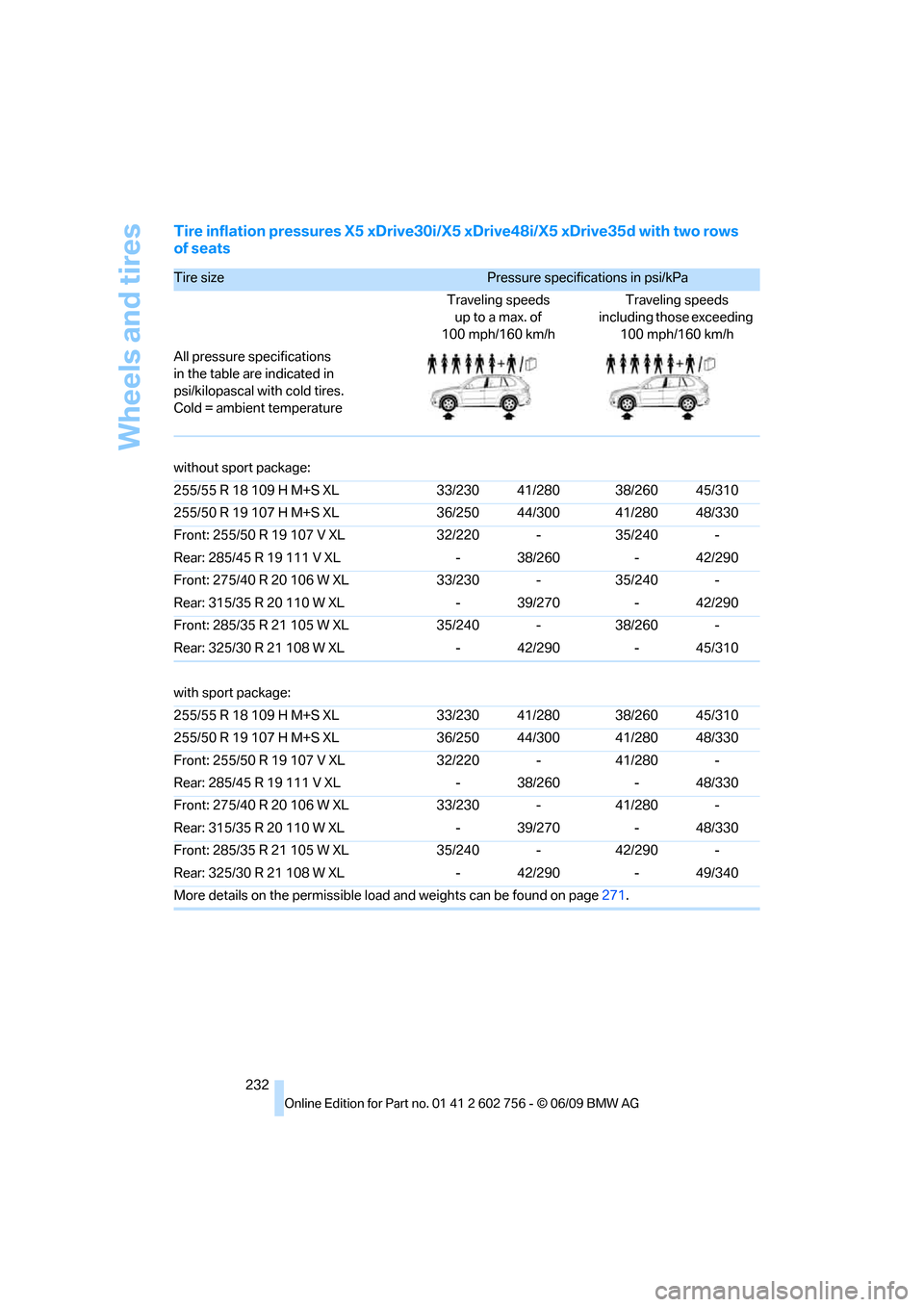
Tire inflation pressures X5 xDrive30i/X5 xDrive48i/X5 xDrive35d with two rows
of seats
Tire size Pressure specifications in psi/kPa
Traveling speeds
up to a max. of
100 mph/160 km/hTraveling speeds
including those exceeding
100 mph/160 km/h
All pressure specifications
in the table are indicated in
psi/kilopascal with cold tires.
Cold = ambient temperature
without sport package:
255/55 R 18 109 H M+S XL 33/230 41/280 38/260 45/310
255/50 R 19 107 H M+S XL 36/250 44/300 41/280 48/330
Front: 255/50 R 19 107 V XL 32/220 - 35/240 -
Rear: 285/45 R 19 111 V XL - 38/260 - 42/290
Front: 275/40 R 20 106 W XL 33/230 - 35/240 -
Rear: 315/35 R 20 110 W XL - 39/270 - 42/290
Front: 285/35 R 21 105 W XL 35/240 - 38/260 -
Rear: 325/30 R 21 108 W XL - 42/290 - 45/310
with sport package:
255/55 R 18 109 H M+S XL 33/230 41/280 38/260 45/310
255/50 R 19 107 H M+S XL 36/250 44/300 41/280 48/330
Front: 255/50 R 19 107 V XL 32/220 - 41/280 -
Rear: 285/45 R 19 111 V XL - 38/260 - 48/330
Front: 275/40 R 20 106 W XL 33/230 - 41/280 -
Rear: 315/35 R 20 110 W XL - 39/270 - 48/330
Front: 285/35 R 21 105 W XL 35/240 - 42/290 -
Rear: 325/30 R 21 108 W XL - 42/290 - 49/340
More details on the permissible load and weights can be found on page271.
ba8_e70ag.book Seite 232 Freitag, 5. Juni 2009 11:42 11
Page 235 of 300
Mobility
233Reference
At a glance
Controls
Driving tips
Communications
Navigation
Entertainment
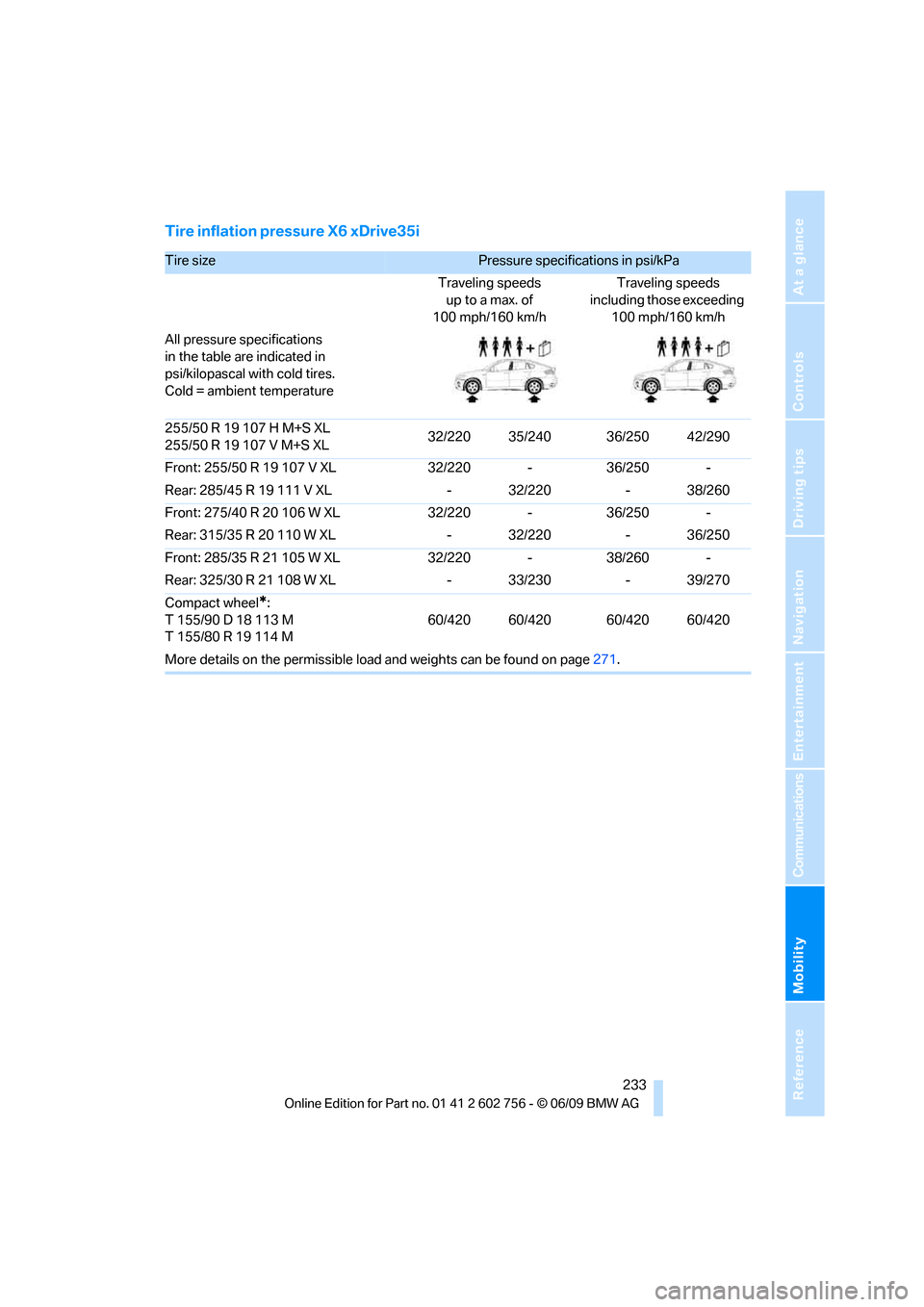
Tire inflation pressure X6 xDrive35i
Tire size Pressure specifications in psi/kPa
Traveling speeds
up to a max. of
100 mph/160 km/hTraveling speeds
including those exceeding
100 mph/160 km/h
All pressure specifications
in the table are indicated in
psi/kilopascal with cold tires.
Cold = ambient temperature
255/50 R 19 107 H M+S XL
255/50 R 19 107 V M+S XL32/220 35/240 36/250 42/290
Front: 255/50 R 19 107 V XL 32/220 - 36/250 -
Rear: 285/45 R 19 111 V XL - 32/220 - 38/260
Front: 275/40 R 20 106 W XL 32/220 - 36/250 -
Rear: 315/35 R 20 110 W XL - 32/220 - 36/250
Front: 285/35 R 21 105 W XL 32/220 - 38/260 -
Rear: 325/30 R 21 108 W XL - 33/230 - 39/270
Compact wheel
*:
T 155/90 D 18 113 M
T 155/80 R 19 114 M60/420 60/420 60/420 60/420
More details on the permissible load and weights can be found on page271.
ba8_e70ag.book Seite 233 Freitag, 5. Juni 2009 11:42 11
Page 236 of 300
Wheels and tires
234
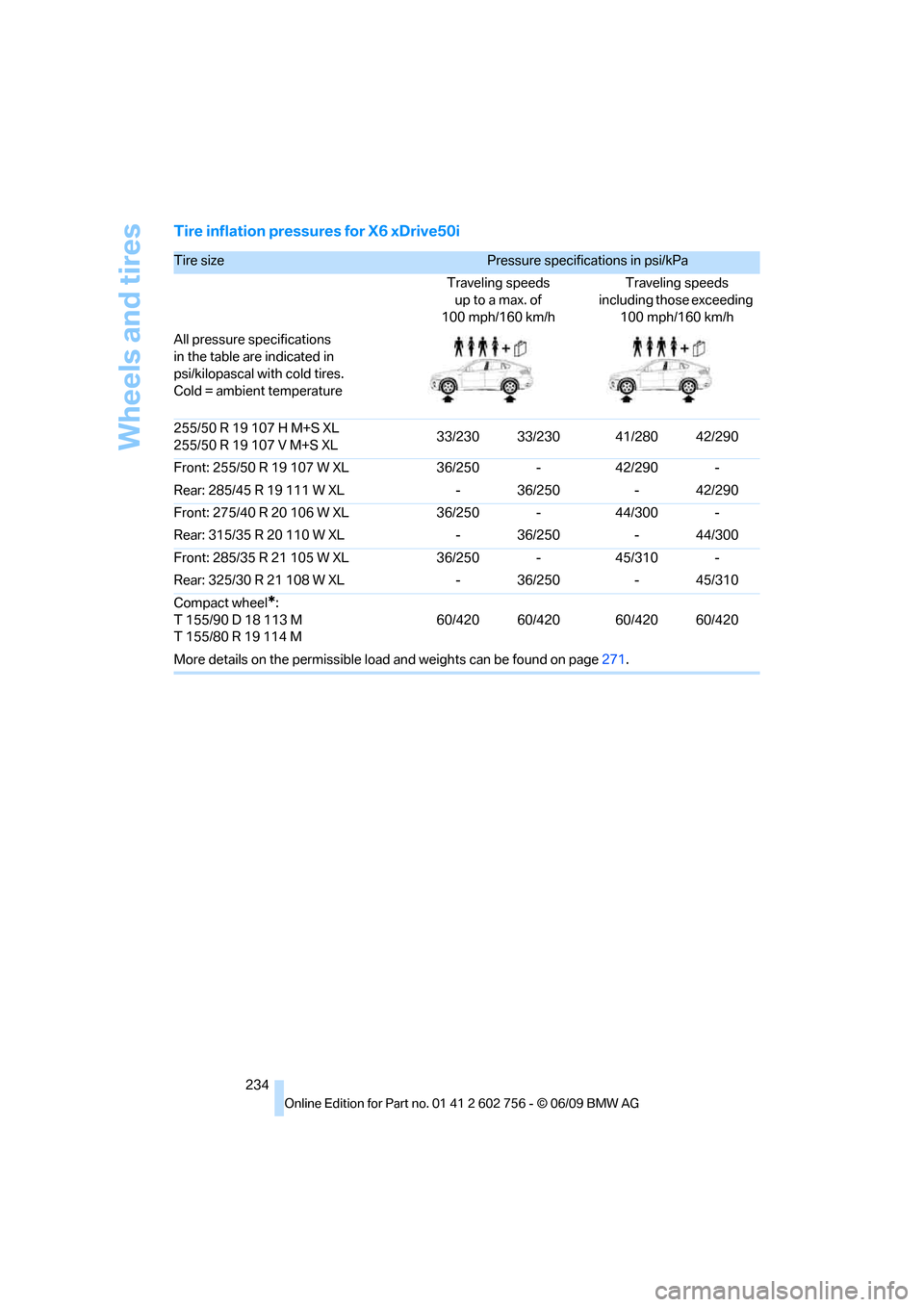
Tire inflation pressures for X6 xDrive50i
Tire size Pressure specifications in psi/kPa
Traveling speeds
up to a max. of
100 mph/160 km/hTraveling speeds
including those exceeding
100 mph/160 km/h
All pressure specifications
in the table are indicated in
psi/kilopascal with cold tires.
Cold = ambient temperature
255/50 R 19 107 H M+S XL
255/50 R 19 107 V M+S XL33/230 33/230 41/280 42/290
Front: 255/50 R 19 107 W XL 36/250 - 42/290 -
Rear: 285/45 R 19 111 W XL - 36/250 - 42/290
Front: 275/40 R 20 106 W XL 36/250 - 44/300 -
Rear: 315/35 R 20 110 W XL - 36/250 - 44/300
Front: 285/35 R 21 105 W XL 36/250 - 45/310 -
Rear: 325/30 R 21 108 W XL - 36/250 - 45/310
Compact wheel
*:
T 155/90 D 18 113 M
T 155/80 R 19 114 M60/420 60/420 60/420 60/420
More details on the permissible load and weights can be found on page271.
ba8_e70ag.book Seite 234 Freitag, 5. Juni 2009 11:42 11
Page 238 of 300
Wheels and tires
236
Temperature
The temperature grades are A, the highest, B,
and C, representing the tire's resistance to the
generation of heat and its ability to dissipate
heat when tested under controlled conditions
on a specified indoor laboratory test wheel.
Sustained high temperature can cause the
material of the tire to degenerate and reduce
tire life, and excessive temperature can lead to
sudden tire failure. The grade C corresponds to
a level of performance which all passenger car
tires must meet under the Federal Motor Vehi-
cle Safety Standard No. 109. Grades B and A
represent higher levels of performance on the
laboratory test wheel than the minimum
required by law.
The temperature grade for this tire is
established for a tire that is properly
inflated and not overloaded. Excessive speed,
underinflation, or excessive loading, either sep-
arately or in combination, can cause heat
buildup and possible tire failure.<
RSC – run-flat tires
You will recognize run-flat tires by a circular
symbol containing the letters RSC on the side
of the tire, refer to page237.
M+S
Winter and all-season tires.
These have better winter properties than sum-
mer tires.
XL
Indicates specially reinforced tires.
Tire condition
Inspect your tires frequently for tread wear,
signs of damage and for foreign objects lodged
in the tread. Check the tread depth.
Minimum tread depth
The tread depth should not drop below 0.12 in/
3mm, although, for example, European legisla-
tion only specifies a minimum tread depth of 0.063 in/1.6 mm. At tread depths below 0.12 in/
3 mm there is an increased risk of high-speed
hydroplaning, even when only small amounts of
water are present on the road surface.
When winter tires wear down past a tread depth
of 0.16 in/4 mm, they become perceptibly less
suitable for winter conditions. For the sake of
safety, new tires should be installed.
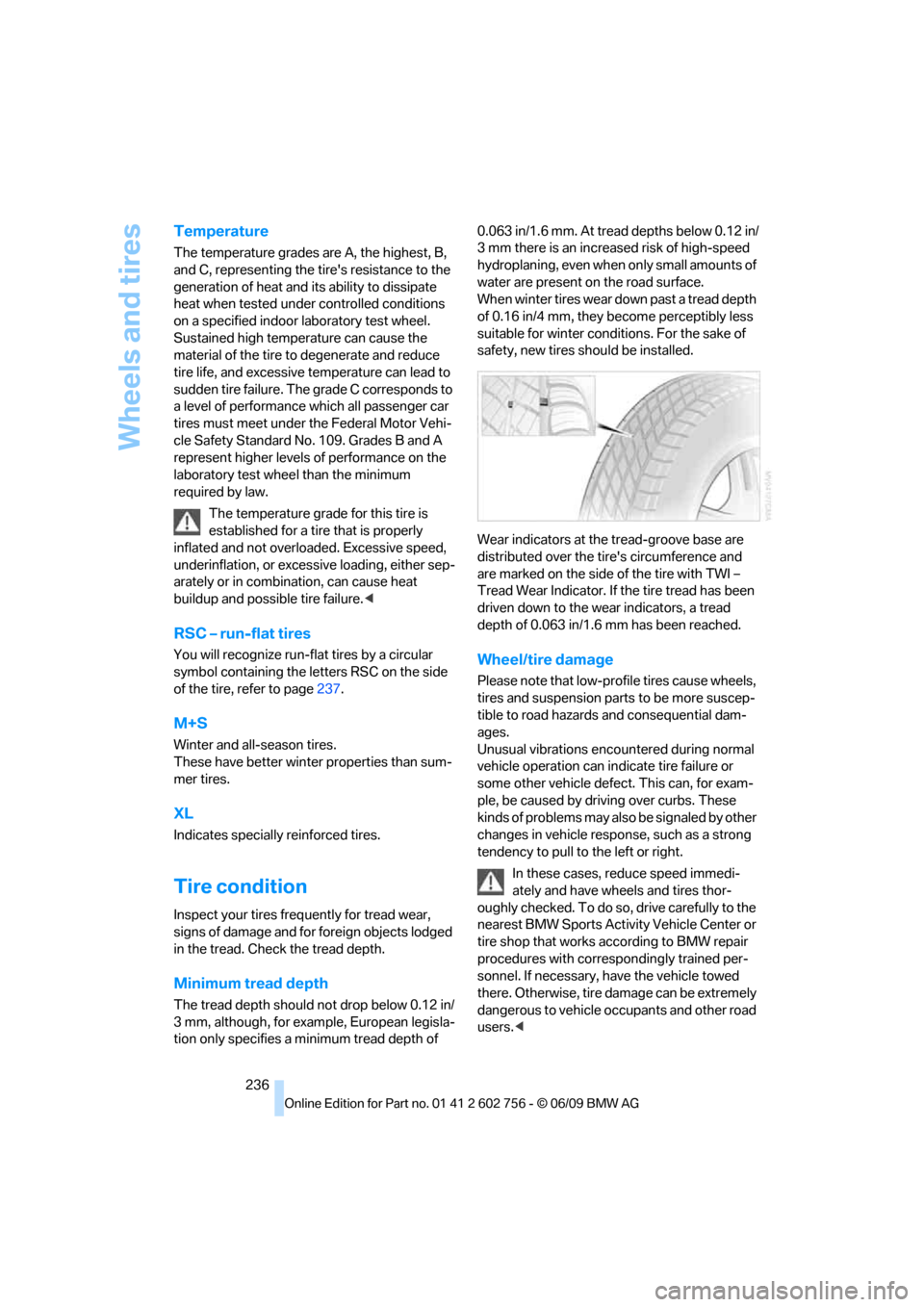
Wear indicators at the tread-groove base are
distributed over the tire's circumference and
are marked on the side of the tire with TWI –
Tread Wear Indicator. If the tire tread has been
driven down to the wear indicators, a tread
depth of 0.063 in/1.6 mm has been reached.
Wheel/tire damage
Please note that low-profile tires cause wheels,
tires and suspension parts to be more suscep-
tible to road hazards and consequential dam-
ages.
Unusual vibrations encountered during normal
vehicle operation can indicate tire failure or
some other vehicle defect. This can, for exam-
ple, be caused by driving over curbs. These
kinds of problems may also be signaled by other
changes in vehicle response, such as a strong
tendency to pull to the left or right.
In these cases, reduce speed immedi-
ately and have wheels and tires thor-
oughly checked. To do so, drive carefully to the
nearest BMW Sports Activity Vehicle Center or
tire shop that works according to BMW repair
procedures with correspondingly trained per-
sonnel. If necessary, have the vehicle towed
there. Otherwise, tire damage can be extremely
dangerous to vehicle occupants and other road
users.<
ba8_e70ag.book Seite 236 Freitag, 5. Juni 2009 11:42 11