rear entertainment BMW X5 2011 E70 Owner's Guide
[x] Cancel search | Manufacturer: BMW, Model Year: 2011, Model line: X5, Model: BMW X5 2011 E70Pages: 312, PDF Size: 8.91 MB
Page 137 of 312
Controls
135Reference
At a glance
Driving tips
Communications
Navigation
Entertainment
Mobility
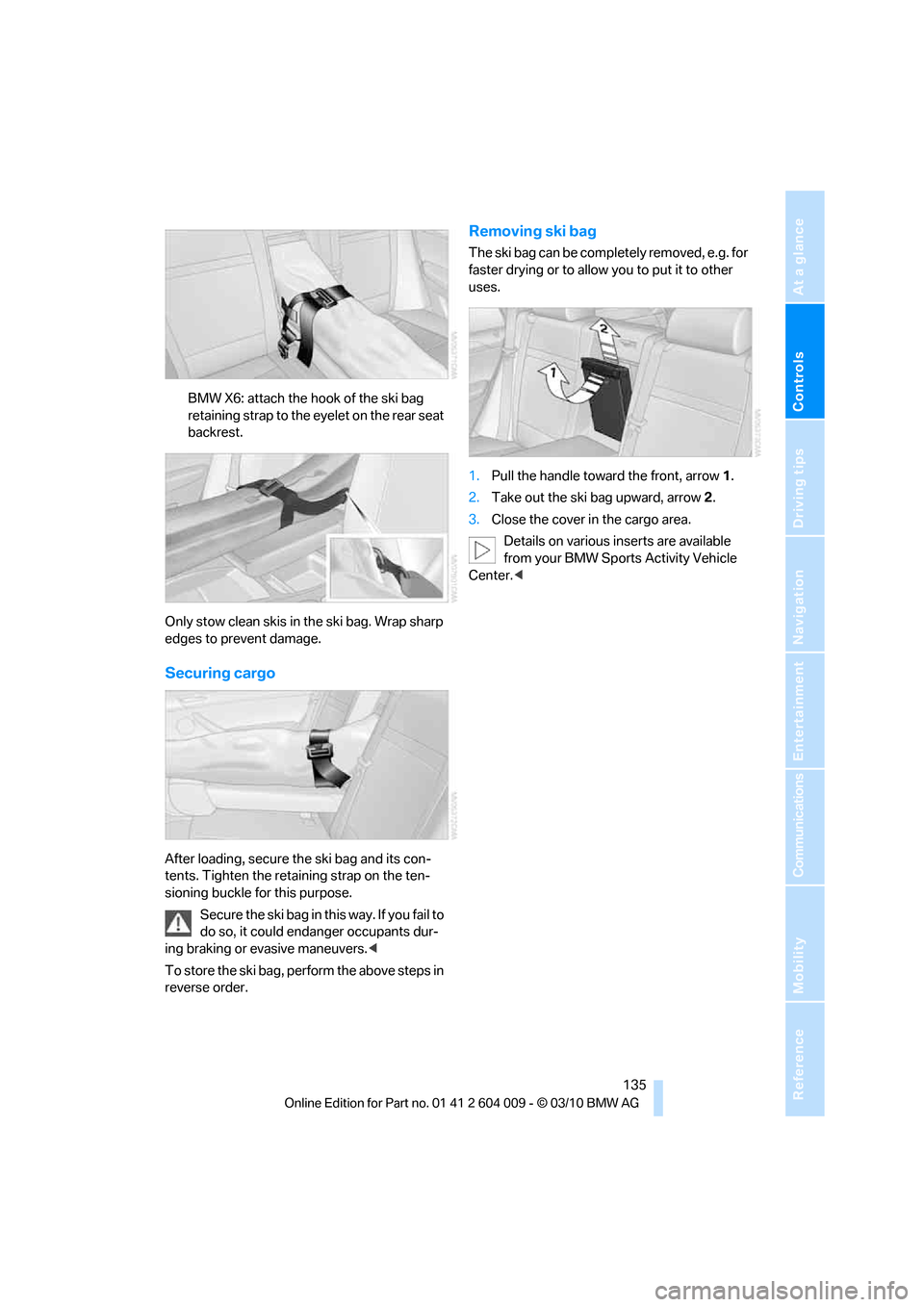
BMW X6: attach the hook of the ski bag
retaining strap to the eyelet on the rear seat
backrest.
Only stow clean skis in the ski bag. Wrap sharp
edges to prevent damage.
Securing cargo
After loading, secure the ski bag and its con-
tents. Tighten the retaining strap on the ten-
sioning buckle for this purpose.
Secure the ski bag in this way. If you fail to
do so, it could endanger occupants dur-
ing braking or evasive maneuvers.<
To store the ski bag, perform the above steps in
reverse order.
Removing ski bag
The ski bag can be completely removed, e.g. for
faster drying or to allow you to put it to other
uses.
1.Pull the handle toward the front, arrow1.
2.Take out the ski bag upward, arrow2.
3.Close the cover in the cargo area.
Details on various inserts are available
from your BMW Sports Activity Vehicle
Center.<
Page 141 of 312
Driving tips
139Reference
At a glance
Controls
Communications
Navigation
Entertainment
Mobility
speed. This is the fastest way for the cold
engine to reach its operating temperature.
Thinking ahead when driving
Avoid unnecessary acceleration and braking.
To do so, maintain the appropriate distance
from the vehicle in front of you. An anticipatory
and smooth driving style reduces fuel con-
sumption.
Avoiding high engine speeds
Driving at a low engine speed reduces fuel con-
sumption and minimizes wear.
Taking advantage of coasting
The flow of fuel is interrupted when coasting.
Switching off engine during longer
stops
Switch off the engine at longer stops such as
traffic signals, railroad crossings, or in traffic
congestions. You achieve fuel savings even if
the standing time is as short as approx.
4seconds.
Switching off functions currently not
required
Functions such as air conditioning, seat heat-
ing, or rear window defrosting consume a lot of
energy and require additional fuel. Their influ-
ence is particularly pronounced in city traffic
and stop & go operation. For this reason, it is a
good idea to switch these functions off when
they are not really needed.
Having maintenance carried out
Have the vehicle serviced regularly in order to
achieve the optimum economy and service life
of your vehicle. BMW recommends having the
maintenance performed by a BMW Sports
Activity Vehicle Center. Also pay attention to
the BMW maintenance system, refer to
page256.
General driving notes
Closing liftgate
Operate the vehicle only when the liftgate
is completely closed. Otherwise, exhaust
fumes could enter into the passenger compart-
ment.<
If it is absolutely necessary to drive with the lift-
gate open:
1.Close all windows as well as the glass sun-
roof
*/panoramic glass sunroof*.
2.Increase the air volume of the automatic cli-
mate control to a high level, refer to
page118.
Hot exhaust system
As in all vehicles, extremely high temper-
atures are generated on the exhaust sys-
tem. Do not remove the heat shields installed
adjacent to it, and never apply undercoating to
them. When driving, standing at idle and while
parking take care to avoid possible contact
between the hot exhaust system and any highly
flammable materials such as hay, leaves, grass,
etc. Such contact could lead to a fire, and with it
the risk of serious property damage as well as
personal injury. Do not touch hot tailpipes, as
otherwise there is a danger of burns.<
Diesel particulate filter*
Soot particles are collected in the diesel partic-
ulate filter and periodically burned away at high
temperatures. This cleaning process lasts a few
minutes. You will notice it sometimes by the
fact that the engine temporarily runs slightly
less smoothly and requires a slightly higher
engine speed to deliver the usual power. You
may also hear sounds and observe a slight
amount of smoke coming from the exhaust up
to even a few moments after the engine is
switched off.
Hydroplaning
When driving on wet or slushy roads,
reduce road speed. If you do not, a wedge
of water can form between tires and road sur-
face. This phenomenon is referred to as hydro-
Page 159 of 312
Navigation
Driving tips
157Reference
At a glance
Controls
Communications
Entertainment
Mobility
3.Enter the letters.
4."OK"
The trip is stored in the trip list under the
entered name.
Starting a stored trip
1."Navigation"
2."Stored trips"
3.Select the desired trip.
4."Start guidance"
Changing trips
Changing the trip direction
Intermediate destinations can be displayed in
reverse order after destination guidance is
started.
1."Map"
2."Guidance"
3.Open "Options".
4."Reverse order of trip dest."
Rearranging the intermediate
destinations
1."Map"
2."Guidance"
3."Display all trip destinations"
4.Select an intermediate destination.
5."Reposition dest. in the trip"
Deleting an intermediate destination
1."Map"
2."Guidance"
3."Display all trip destinations"
4.Select an intermediate destination.
5."Delete dest. in the trip"
Deleting a trip
1."Navigation"
2."Stored trips"
3.Select the desired trip.
4.Open "Options".5."Delete all trips" or "Delete trip".
Word-matching principle
The system supports the word matching princi-
ple to make it easier for you to enter the names
of streets or towns/cities. The system runs
ongoing checks, comparing your destination
entries with the data stored in the vehicle as the
basis for instant response. The user benefits
include:
>Names of specific locations can also vary
from the official versions if you are using a
spelling that is customary in another coun-
try.
Example:
Instead of "München", you can also enter
the English spelling "Munich" or the Italian
spelling "Monaco".
>When you are entering the names of towns/
cities and streets the system will complete
them automatically as soon as enough let-
ters are available to ensure unambiguous
identification.
>The system offers only those letters for
selection of name entries that are stored in
the vehicle. The system will not accept non
existent names and addresses.
Page 171 of 312
Navigation
Entertainment
Driving tips
169Reference
At a glance
Controls
Communications
Mobility
>"Fader": front/rear volume distribution
Adjustments
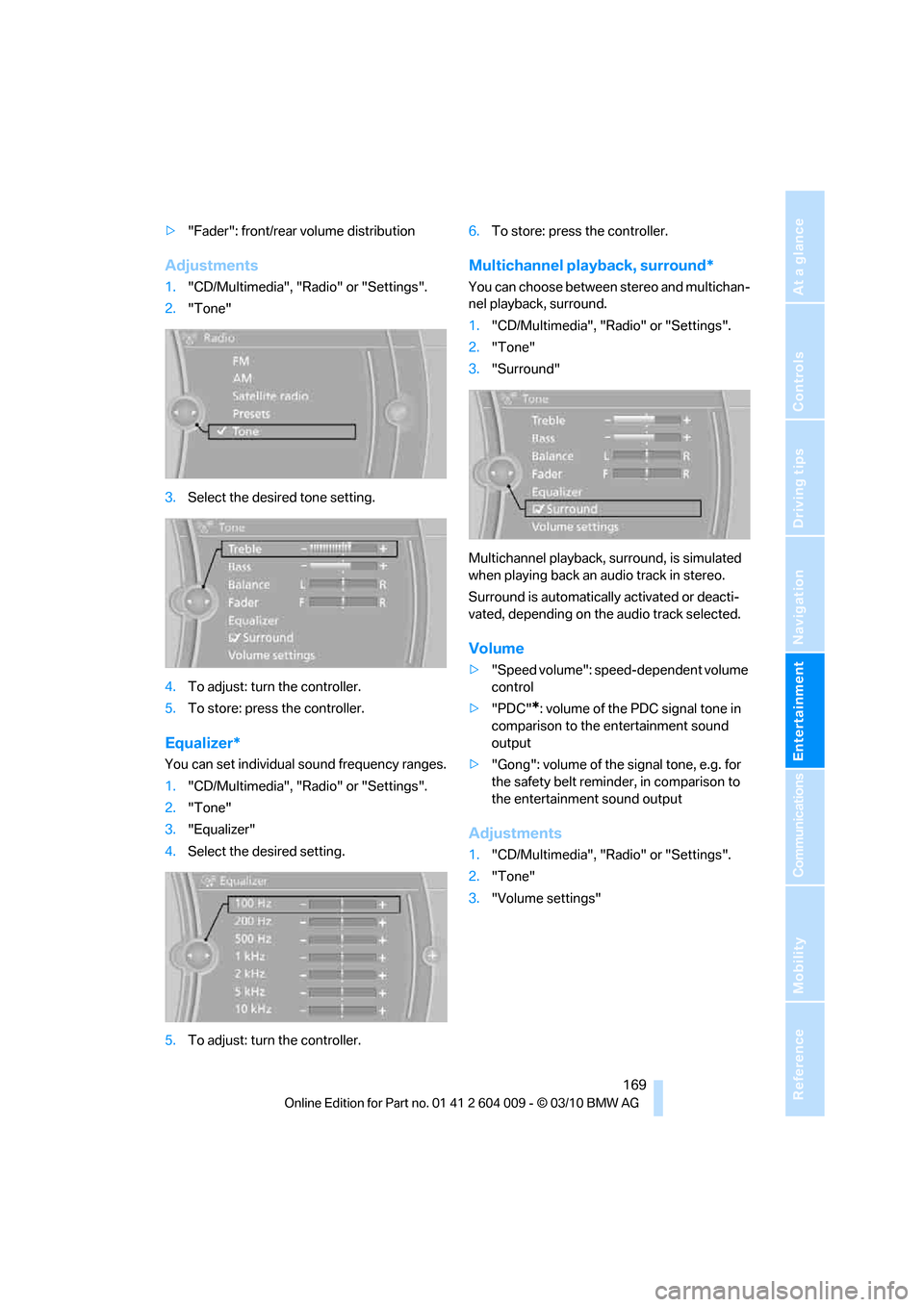
1."CD/Multimedia", "Radio" or "Settings".
2."Tone"
3.Select the desired tone setting.
4.To adjust: turn the controller.
5.To store: press the controller.
Equalizer*
You can set individual sound frequency ranges.
1."CD/Multimedia", "Radio" or "Settings".
2."Tone"
3."Equalizer"
4.Select the desired setting.
5.To adjust: turn the controller.6.To store: press the controller.
Multichannel playback, surround*
You can choose between stereo and multichan-
nel playback, surround.
1."CD/Multimedia", "Radio" or "Settings".
2."Tone"
3."Surround"
Multichannel playback, surround, is simulated
when playing back an audio track in stereo.
Surround is automatically activated or deacti-
vated, depending on the audio track selected.
Volume
>"Speed volume": speed-dependent volume
control
>"PDC"
*: volume of the PDC signal tone in
comparison to the entertainment sound
output
>"Gong": volume of the signal tone, e.g. for
the safety belt reminder, in comparison to
the entertainment sound output
Adjustments
1."CD/Multimedia", "Radio" or "Settings".
2."Tone"
3."Volume settings"
Page 243 of 312
Mobility
241Reference
At a glance
Controls
Driving tips
Communications
Navigation
Entertainment
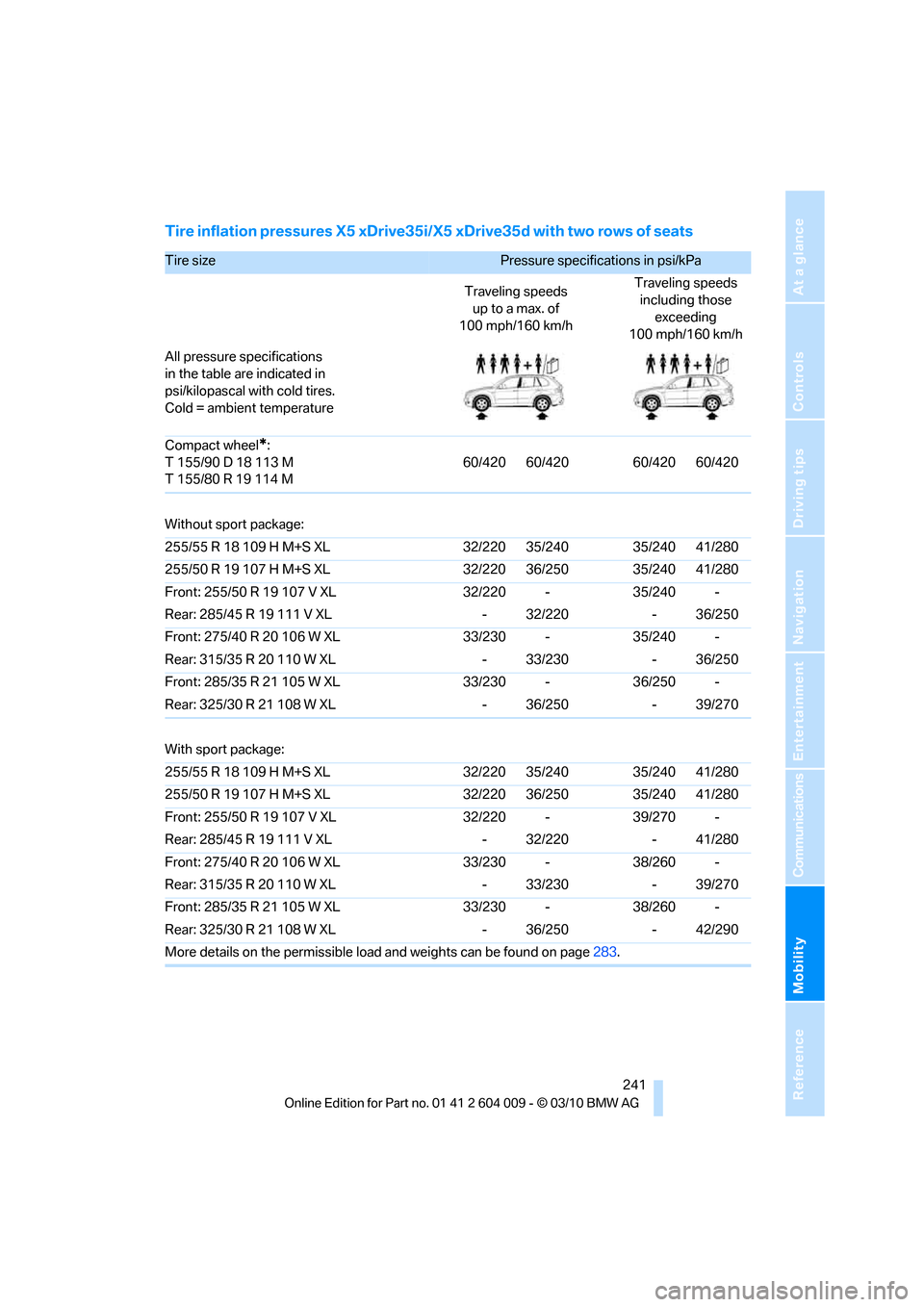
Tire inflation pressures X5 xDrive35i/X5 xDrive35d with two rows of seats
Tire size Pressure specifications in psi/kPa
Traveling speeds
up to a max. of
100 mph/160 km/hTraveling speeds
including those
exceeding
100 mph/160 km/h
All pressure specifications
in the table are indicated in
psi/kilopascal with cold tires.
Cold = ambient temperature
Compact wheel
*:
T 155/90 D 18 113 M
T 155/80 R 19 114 M60/420 60/420 60/420 60/420
Without sport package:
255/55 R 18 109 H M+S XL 32/220 35/240 35/240 41/280
255/50 R 19 107 H M+S XL 32/220 36/250 35/240 41/280
Front: 255/50 R 19 107 V XL 32/220 - 35/240 -
Rear: 285/45 R 19 111 V XL - 32/220 - 36/250
Front: 275/40 R 20 106 W XL 33/230 - 35/240 -
Rear: 315/35 R 20 110 W XL - 33/230 - 36/250
Front: 285/35 R 21 105 W XL 33/230 - 36/250 -
Rear: 325/30 R 21 108 W XL - 36/250 - 39/270
With sport package:
255/55 R 18 109 H M+S XL 32/220 35/240 35/240 41/280
255/50 R 19 107 H M+S XL 32/220 36/250 35/240 41/280
Front: 255/50 R 19 107 V XL 32/220 - 39/270 -
Rear: 285/45 R 19 111 V XL - 32/220 - 41/280
Front: 275/40 R 20 106 W XL 33/230 - 38/260 -
Rear: 315/35 R 20 110 W XL - 33/230 - 39/270
Front: 285/35 R 21 105 W XL 33/230 - 38/260 -
Rear: 325/30 R 21 108 W XL - 36/250 - 42/290
More details on the permissible load and weights can be found on page283.
Page 245 of 312
Mobility
243Reference
At a glance
Controls
Driving tips
Communications
Navigation
Entertainment
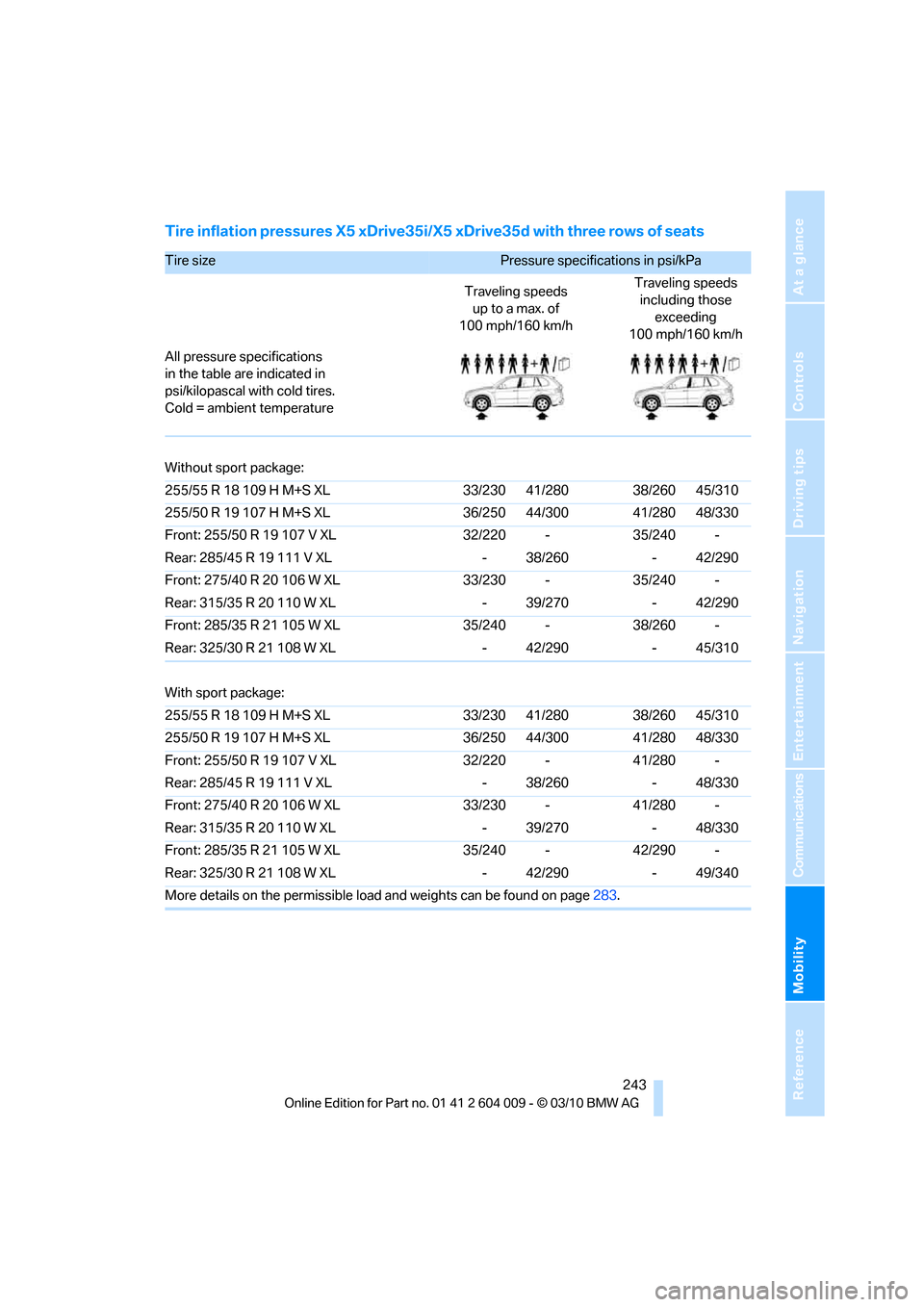
Tire inflation pressures X5 xDrive35i/X5 xDrive35d with three rows of seats
Tire size Pressure specifications in psi/kPa
Traveling speeds
up to a max. of
100 mph/160 km/hTraveling speeds
including those
exceeding
100 mph/160 km/h
All pressure specifications
in the table are indicated in
psi/kilopascal with cold tires.
Cold = ambient temperature
Without sport package:
255/55 R 18 109 H M+S XL 33/230 41/280 38/260 45/310
255/50 R 19 107 H M+S XL 36/250 44/300 41/280 48/330
Front: 255/50 R 19 107 V XL 32/220 - 35/240 -
Rear: 285/45 R 19 111 V XL - 38/260 - 42/290
Front: 275/40 R 20 106 W XL 33/230 - 35/240 -
Rear: 315/35 R 20 110 W XL - 39/270 - 42/290
Front: 285/35 R 21 105 W XL 35/240 - 38/260 -
Rear: 325/30 R 21 108 W XL - 42/290 - 45/310
With sport package:
255/55 R 18 109 H M+S XL 33/230 41/280 38/260 45/310
255/50 R 19 107 H M+S XL 36/250 44/300 41/280 48/330
Front: 255/50 R 19 107 V XL 32/220 - 41/280 -
Rear: 285/45 R 19 111 V XL - 38/260 - 48/330
Front: 275/40 R 20 106 W XL 33/230 - 41/280 -
Rear: 315/35 R 20 110 W XL - 39/270 - 48/330
Front: 285/35 R 21 105 W XL 35/240 - 42/290 -
Rear: 325/30 R 21 108 W XL - 42/290 - 49/340
More details on the permissible load and weights can be found on page283.
Page 247 of 312
Mobility
245Reference
At a glance
Controls
Driving tips
Communications
Navigation
Entertainment
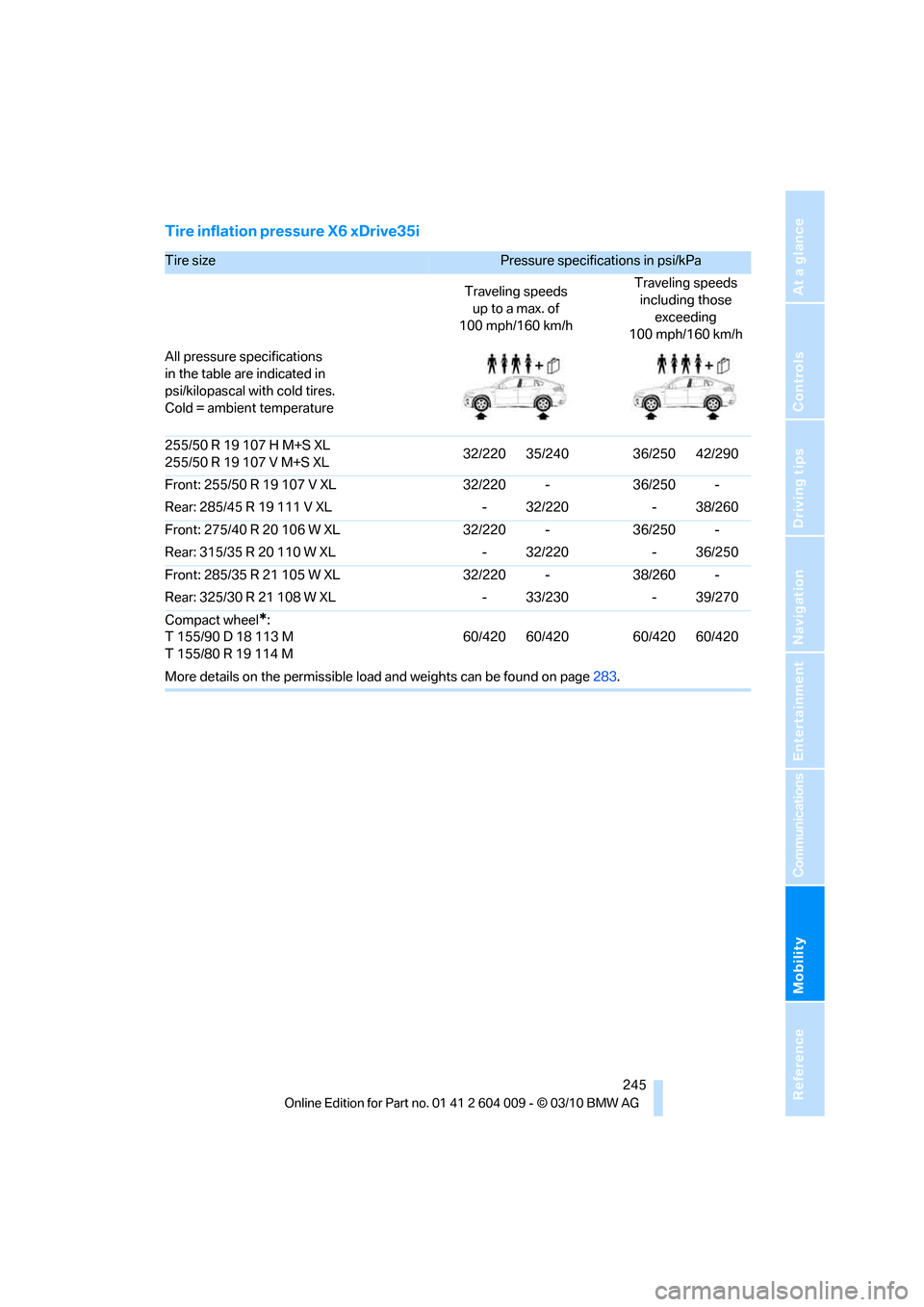
Tire inflation pressure X6 xDrive35i
Tire size Pressure specifications in psi/kPa
Traveling speeds
up to a max. of
100 mph/160 km/hTraveling speeds
including those
exceeding
100 mph/160 km/h
All pressure specifications
in the table are indicated in
psi/kilopascal with cold tires.
Cold = ambient temperature
255/50 R 19 107 H M+S XL
255/50 R 19 107 V M+S XL32/220 35/240 36/250 42/290
Front: 255/50 R 19 107 V XL 32/220 - 36/250 -
Rear: 285/45 R 19 111 V XL - 32/220 - 38/260
Front: 275/40 R 20 106 W XL 32/220 - 36/250 -
Rear: 315/35 R 20 110 W XL - 32/220 - 36/250
Front: 285/35 R 21 105 W XL 32/220 - 38/260 -
Rear: 325/30 R 21 108 W XL - 33/230 - 39/270
Compact wheel
*:
T 155/90 D 18 113 M
T 155/80 R 19 114 M60/420 60/420 60/420 60/420
More details on the permissible load and weights can be found on page283.
Page 261 of 312
Mobility
259Reference
At a glance
Controls
Driving tips
Communications
Navigation
Entertainment
Steam cleaners/high-pressure
cleaning jets
When using steam cleaners or high-pres-
sure cleaning jets, make sure to maintain
a sufficient distance and stay below a maximum
temperature of 1407/606.
Insufficient distance or excessive pressure or
temperature can damage parts of the vehicle or
can result in water penetration. Follow the oper-
ating instructions for the high-pressure clean-
ing jets.<
Do not spray the sensors and cameras,
e.g. of Park Distance Control, Top View,
or rear view camera, with high-pressure clean-
ers for long periods and keep the spray nozzle
at least 12 in/30 cm away from them.<
Hand washing
When washing the vehicle by hand, use plenty
of water and car washing shampoo. Clean the
vehicle with gentle pressure using a sponge or a
washing brush.
Before cleaning the windshield, deacti-
vate the rain sensor or switch off the igni-
tion to prevent unwanted wiper operation.<
Follow local guidelines for washing vehi-
cles by hand.<
Headlamps
Do not rub dry and never use abrasives or
strong solvents to clean the covers.
Loosen dirt, e.g. insects, with shampoo or
insect remover and wash away with plenty of
water.
Use a window de-icer to remove accumulated
ice and snow, not a scraper.
Windows
Use a glass cleaner to clean the inside and out-
side surfaces of the windows and the glass sur-
faces of the mirrors.
Do not use quartz-containing cleansers
to clean glass surfaces of the mirrors.<
Caring for the vehicle finish
Regular care helps your vehicle retain its value
and protects the paint from the long-term
effects of aggressive substances.
Regionally occurring environmental factors can
affect and damage vehicle finish. It is therefore
important to tailor the frequency and extent of
your car care accordingly.
Immediately remove particularly aggressive
substances such as spilled fuel, oil, grease,
brake fluid, tree resin, or bird droppings; other-
wise, they may damage your paint.
Repairing paint damage
Repair stone damage or scratches imme-
diately, depending on the severity of the
damage, to prevent the formation of rust.<
BMW recommends having paint damage pro-
fessionally repaired using Genuine BMW finish
materials in accordance with factory guidelines.
Waxing
Sealant is required when water no longer beads
on the clean surface of the paint. Use only prod-
ucts that contain carnauba wax or synthetic wax
to seal your finish.
Rubber gaskets
Treat only with water or a rubber care product.
To avoid noise or damage, do not use
products that contain silicone to care for
rubber gaskets.<
Chrome components
Particularly after exposure to road salt, thor-
oughly cleanse parts like the radiator grille, door
handles, or window frames with plenty of water
with shampoo added to it. For additional treat-
ment, use chrome polish.
Alloy wheels
Depending on your system, braking can gener-
ate dust, which settles on the light-alloy wheels.
Remove this dust regularly with acid-free wheel
cleaner.
Page 277 of 312
Mobility
275Reference
At a glance
Controls
Driving tips
Communications
Navigation
Entertainment
Your BMW has a special nut as body ground
or negative pole.
5.Attach the second end of the cable to the
negative terminal of the battery or to the
engine or body ground of the vehicle to be
started.
Starting engine
1.Start the engine on the assisting vehicle
and allow it to run at idle for several minutes
at slightly increased speed.
2.Start the engine on the other vehicle in the
usual way.
If the first starting attempt is not successful,
wait a few minutes before another attempt
in order to allow the discharged battery to
recharge.
3.Let the engines run for a few minutes.
4.Disconnect the jumper cables by reversing
the connection sequence.
Check the battery and recharge if necessary.
Never use spray fluids to start the
engine.<
Tow-starting and towing
Observe applicable laws and regulations
for tow-starting and towing.<
Do not transport any passengers other
than the driver in a vehicle that is being
towed.<
Transporting your vehicle
Note
Your vehicle is not permitted to be towed.
Therefore, contact a BMW Sports Activity Vehi-
cle Center in the event of a breakdown.
Have your vehicle transported on a load-
ing platform only; otherwise, damage may
occur.<
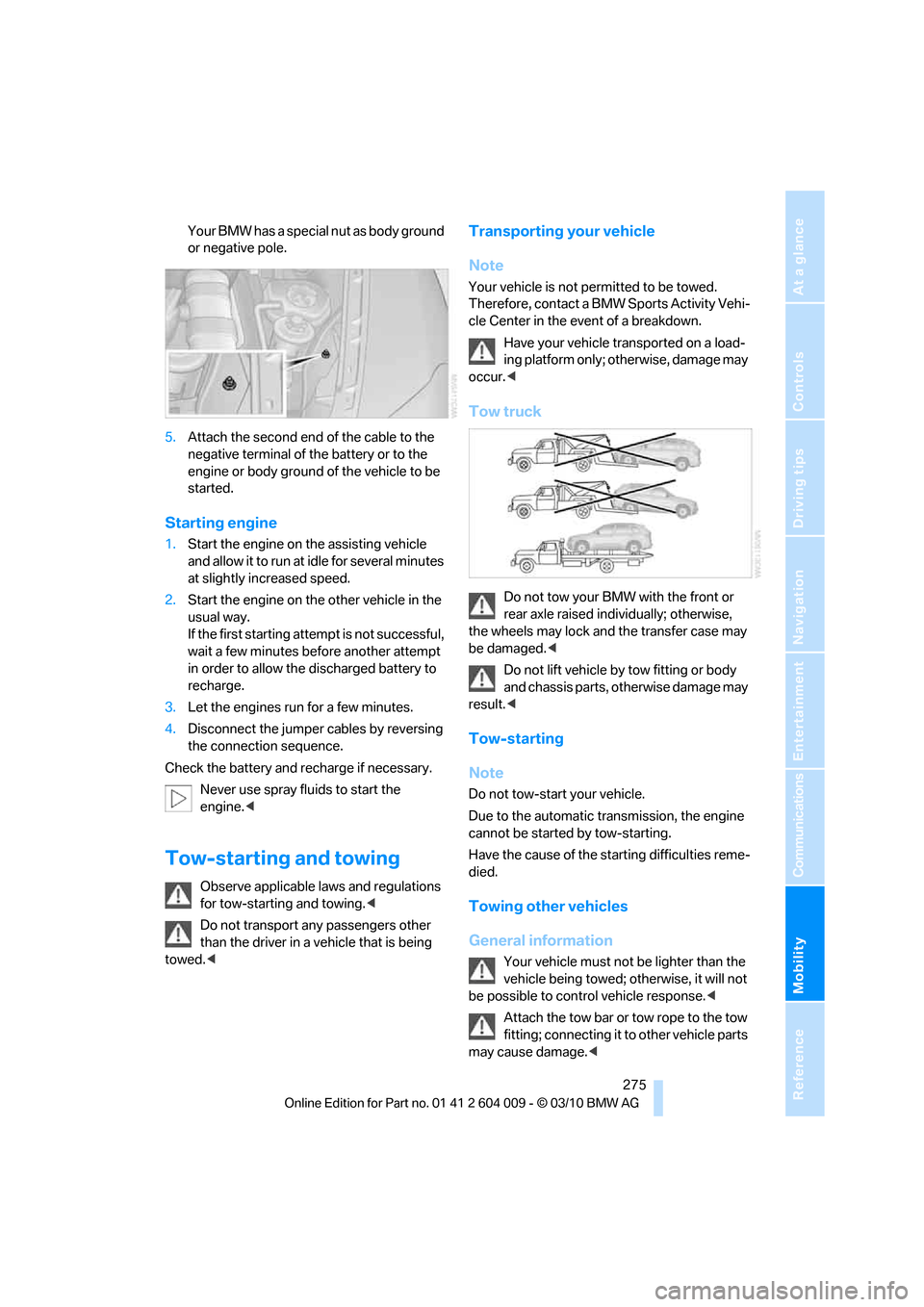
Tow truck
Do not tow your BMW with the front or
rear axle raised individually; otherwise,
the wheels may lock and the transfer case may
be damaged.<
Do not lift vehicle by tow fitting or body
and chassis parts, otherwise damage may
result.<
Tow-starting
Note
Do not tow-start your vehicle.
Due to the automatic transmission, the engine
cannot be started by tow-starting.
Have the cause of the starting difficulties reme-
died.
Towing other vehicles
General information
Your vehicle must not be lighter than the
vehicle being towed; otherwise, it will not
be possible to control vehicle response.<
Attach the tow bar or tow rope to the tow
fitting; connecting it to other vehicle parts
may cause damage.<
Page 285 of 312
Reference 283
At a glance
Controls
Driving tips
Communications
Navigation
Entertainment
Mobility
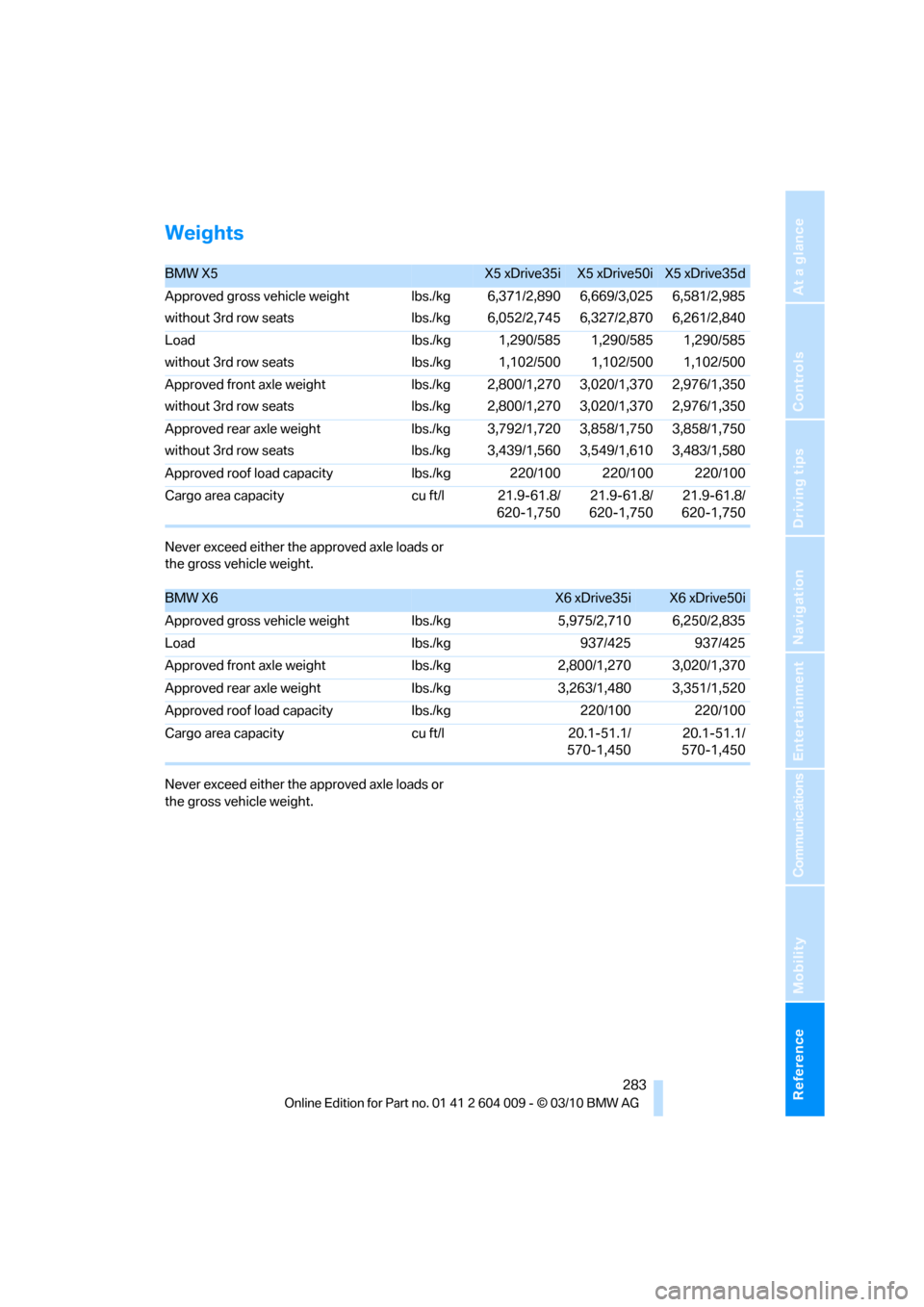
Weights
Never exceed either the approved axle loads or
the gross vehicle weight.
Never exceed either the approved axle loads or
the gross vehicle weight.
BMW X5X5 xDrive35iX5 xDrive50iX5 xDrive35d
Approved gross vehicle weight
without 3rd row seatslbs./kg
lbs./kg6,371/2,890
6,052/2,7456,669/3,025
6,327/2,8706,581/2,985
6,261/2,840
Load
without 3rd row seatsIbs./kg
Ibs./kg1,290/585
1,102/5001,290/585
1,102/5001,290/585
1,102/500
Approved front axle weight
without 3rd row seatslbs./kg
lbs./kg2,800/1,270
2,800/1,2703,020/1,370
3,020/1,3702,976/1,350
2,976/1,350
Approved rear axle weight
without 3rd row seatslbs./kg
lbs./kg3,792/1,720
3,439/1,5603,858/1,750
3,549/1,6103,858/1,750
3,483/1,580
Approved roof load capacity lbs./kg 220/100 220/100 220/100
Cargo area capacity cu ft/l 21.9-61.8/
620-1,75021.9-61.8/
620-1,75021.9-61.8/
620-1,750
BMW X6X6 xDrive35iX6 xDrive50i
Approved gross vehicle weightIbs./kg 5,975/2,710 6,250/2,835
Load Ibs./kg 937/425 937/425
Approved front axle weightIbs./kg 2,800/1,270 3,020/1,370
Approved rear axle weight Ibs./kg 3,263/1,480 3,351/1,520
Approved roof load capacity Ibs./kg 220/100 220/100
Cargo area capacity cu ft/l 20.1-51.1/
570-1,45020.1-51.1/
570-1,450