battery BMW X5 3.0I 2001 User Guide
[x] Cancel search | Manufacturer: BMW, Model Year: 2001, Model line: X5 3.0I, Model: BMW X5 3.0I 2001Pages: 223, PDF Size: 2.66 MB
Page 99 of 223
IndexDataTechnologyRepairsCar careControlsOverview
99n
Interior lamps Reading lampsFootwell lampsThe footwell lamps are controlled in the
same manner as the front interior
lighting. Front area lighting
*
This lighting system in the two exterior
mirrors lights the ground in the area
near the two front doors. It is also
controlled in the same manner as the
front interior lighting, but it does not
function while the vehicle is moving.
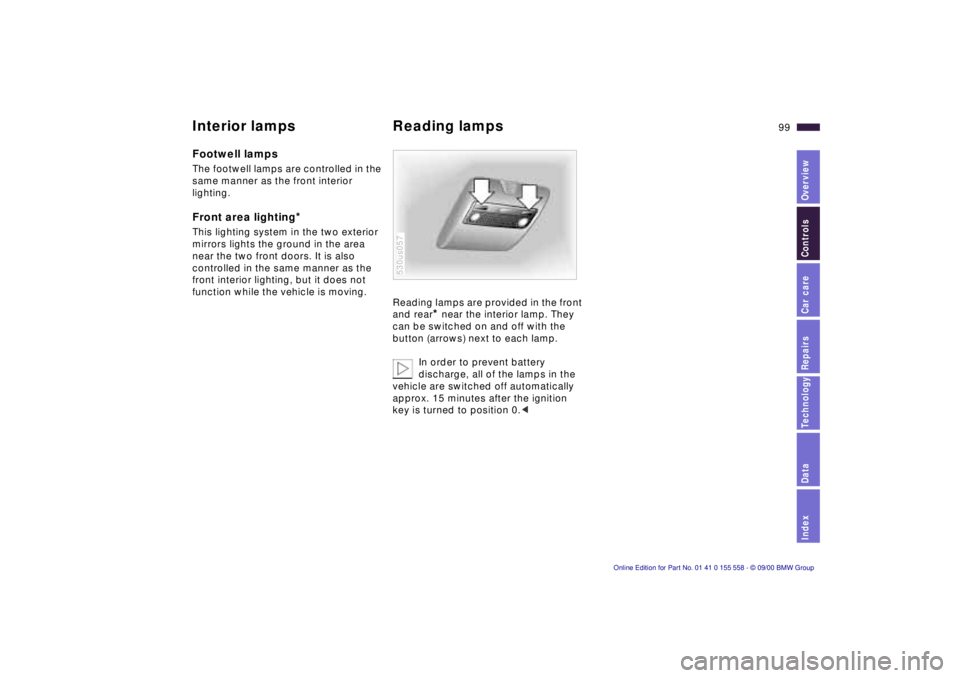
Reading lamps are provided in the front
and rear
* near the interior lamp. They
can be switched on and off with the
button (arrows) next to each lamp.
In order to prevent battery
discharge, all of the lamps in the
vehicle are switched off automatically
approx. 15 minutes after the ignition
key is turned to position 0.<
530us057
Page 110 of 223
110n
Automatic climate control
*
Automatic recirculated air
control (AUC)
If there are unpleasant
odors or pollutants in the
outside air, you can temporarily block
the airflow from the outside. The
system then recirculates the air
currently within the vehicle.
Press the button repeatedly to run
through the following control sequence:
>Indicator lamps off: outside airflow
operational.
>Left-hand indicator lamp on – AUC
mode: the system recognizes pollut-
ants in the outside air and blocks the
flow of air when necessary. The
system then recirculates the air
currently within the vehicle.
Depending on the air quality, the
automatic system then switches back
and forth between outside air supply
and recirculation of the air within the
vehicle.
>Right-hand indicator lamp on: the
flow of external air into the vehicle is
completely blocked. The system then
recirculates the air currently within
the vehicle.
If you have a multifunction steering
wheel with the button for recirculated
air (refer to page 26), you can also use
this button to switch between "Off" and
the recirculated air mode or AUC and
the recirculated air mode.
If the windows fog over in the
recirculated air mode, switch the
recirculated air off and increase the air
supply as required.< Rear window defroster
When the rear window
defroster is activated,
the indicator lamp comes on. The
rear window defroster switches off
automatically.
Residual heat mode
The heat which is stored in
the engine is utilized for
heating the interior when the engine
has been switched off (while waiting at
a railroad crossing, for instance). In
ignition key position 1, you can alter the
settings of the automatic climate
control. With the ignition key in posi-
tion 0, the system automatically directs
heated air to the windshield, side
windows and footwells.
This function may be activated
when the outside temperature is
below approx. +59 7 (+15 6), the
engine is at operating temperature, and
the battery is adequately charged. The
LED on the button will light up when all
conditions have been met.<
Page 114 of 223

114n
Independent ventilation system
*
You can use this system to ventilate the
interior and lower its temperature, using
the blower of the automatic climate
control.
The independent ventilation system is
operated via the Multi-Information
display (MID), refer to page 87 or via the
Onboard Computer, refer to the sepa-
rate Owner's Manual.
You can set two different times for the
system to start; it will remain active for
30 minutes. You can also turn it on and
off directly. Since the system uses a
substantial amount of electrical current,
you should refrain from activating it
twice in succession without allowing
the battery to be recharged in normal
operation between use. When a preselected activation time is
set, the independent ventilation system
is operational at outside temperatures
above +60 7 (+16 6), or by direct
switch activation. It cannot be switched
on when the vehicle is moving.
The air emerges via the air outlets for
the upper body. Therefore, the air
outlets must be open for the system to
operate.
Page 139 of 223
IndexDataTechnologyRepairsCar careControlsOverview
139n
Antilock Brake System (ABS) In the event of a fault
If the brake warning lamp
comes on red together with the
yellow indicator lamps for ABS
and DSC (refer to pages 22
to 24), ABS, CBC, DSC, DBC,
EBV and HDC have failed. You
may continue driving, but drive
defensively and with extra
caution. Avoid full brake applications
because the vehicle could become
unstable and go out of control.
Have the system checked by the
nearest BMW center.
If all three warning lamps come on
yellow:
ABS, CBC, DSC, DBC and HDC have
failed. The effect of the EBV Brake
Force Distribution at the rear wheels,
which achieves stable brake response,
is largely preserved. Optimum brake
force and braking stability are no longer
assured. Continue to drive; drive
cautiously and defensively and avoid
full brake applications.
Have the system checked by your BMW
center as soon as possible.
Following an interruption in
battery power, the ABS, CBC,
DSC, DBC and HDC systems are no
longer available. After you drive for only
a few yards or meters or if you turn the
steering wheel from stop to stop while
the vehicle is stationary and the engine
is running, the functions are activated
again and the three warning lamps will
go out.<
Indicator and warning lamps for
Canadian models.
Page 151 of 223
IndexDataTechnologyRepairsCar careControlsOverview
151n
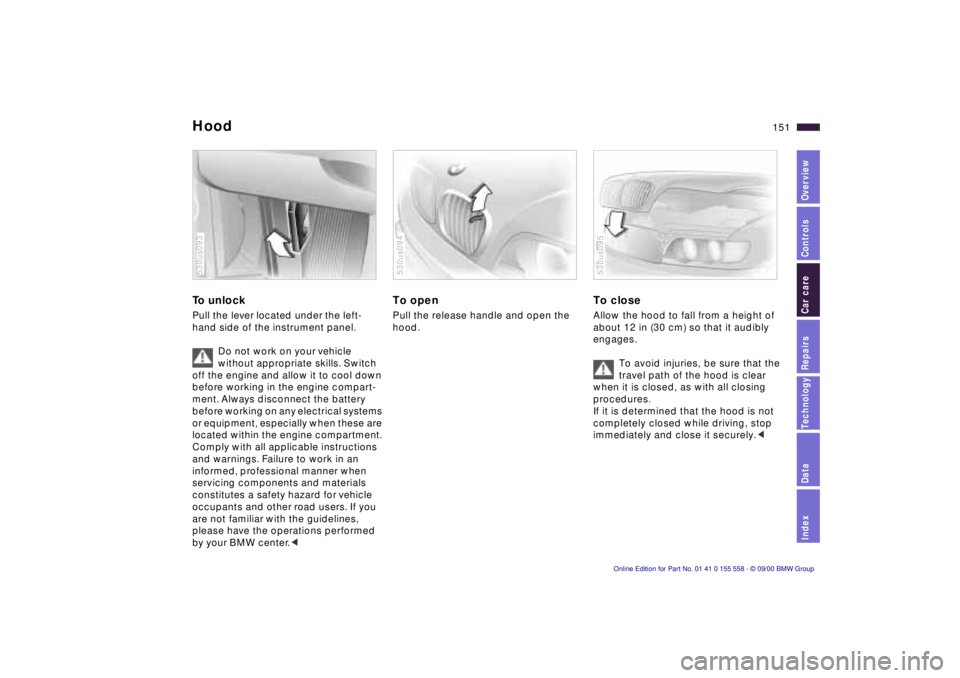
HoodTo unlock Pull the lever located under the left-
hand side of the instrument panel.
Do not work on your vehicle
without appropriate skills. Switch
off the engine and allow it to cool down
before working in the engine compart-
ment. Always disconnect the battery
before working on any electrical systems
or equipment, especially when these are
located within the engine compartment.
Comply with all applicable instructions
and warnings. Failure to work in an
informed, professional manner when
servicing components and materials
constitutes a safety hazard for vehicle
occupants and other road users. If you
are not familiar with the guidelines,
please have the operations performed
by your BMW center.< 530us093
To open Pull the release handle and open the
hood. 530us094
To close Allow the hood to fall from a height of
about 12 in (30 cm) so that it audibly
engages.
To avoid injuries, be sure that the
travel path of the hood is clear
when it is closed, as with all closing
procedures
.
If it is determined that the hood is not
completely closed while driving, stop
immediately and close it securely.< 530us095
Page 173 of 223
IndexDataTechnologyRepairsCar careControlsOverview
Overview
Controls and features
Operation, care
and maintenance
Owner service procedures
Technical data
Index Advanced technology
173n
Replacement procedures:
Onboard tool kit174
Windshield wiper blades174
Lamps and bulbs175
Changing a wheel181
Battery185
Fuses187
In case of electrical
malfunction:
Fuel filler door188
Sliding/Tilt sunroof188
Liftgate188
Tailgate189
Assistance, giving and
receiving:
Jump-starting190
Towing the vehicle191
Repairs
Page 175 of 223
IndexDataTechnologyRepairsCar careControlsOverview
175n
Lamps and bulbsThe lamps and bulbs are essential
factors contributing to the safety of your
vehicle. For this reason, follow the
instructions below carefully when
replacing a bulb. If you are not familiar
with any of the procedures, consult
your BMW center.
Do not touch the glass portion of a
new bulb with your bare hands
since even small amounts of impurities
burn into the surface and reduce the
service life of the bulb. Use a clean
cloth, paper napkin, or a similar mate-
rial, or hold the bulb by its metallic
base.<
A replacement bulb set is available from
your BMW center.
Whenever working on the elec-
trical system, switch off the elec-
trical accessory you are working on or
disconnect the cable from the negative
terminal of the battery. Failure to do this
could result in short circuits.
To prevent injuries and damage,
comply with any instructions provided
by the bulb manufacturer.<
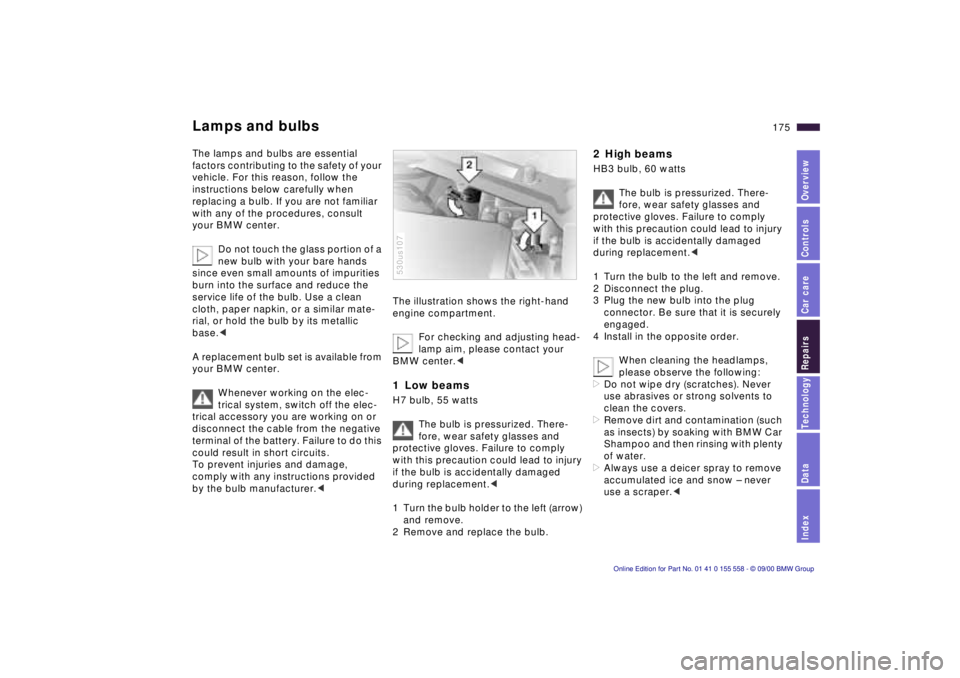
The illustration shows the right-hand
engine compartment.
For checking and adjusting head-
lamp aim, please contact your
BMW center.< 1 Low beams H7 bulb, 55 watts
The bulb is pressurized. There-
fore, wear safety glasses and
protective gloves. Failure to comply
with this precaution could lead to injury
if the bulb is accidentally damaged
during replacement.<
1 Turn the bulb holder to the left (arrow)
and remove.
2 Remove and replace the bulb. 530us107
2 High beamsHB3 bulb, 60 watts
The bulb is pressurized. There-
fore, wear safety glasses and
protective gloves. Failure to comply
with this precaution could lead to injury
if the bulb is accidentally damaged
during replacement.<
1 Turn the bulb to the left and remove.
2 Disconnect the plug.
3 Plug the new bulb into the plug
connector. Be sure that it is securely
engaged.
4 Install in the opposite order.
When cleaning the headlamps,
please observe the following:
>Do not wipe dry (scratches). Never
use abrasives or strong solvents to
clean the covers.
>Remove dirt and contamination (such
as insects) by soaking with BMW Car
Shampoo and then rinsing with plenty
of water.
>Always use a deicer spray to remove
accumulated ice and snow – never
use a scraper.<
Page 185 of 223
IndexDataTechnologyRepairsCar careControlsOverview
185n
Battery
Battery posts, terminals and
related accessories contain lead
and lead compounds. Wash hands after
handling.
Battery location The battery is located in the floor of the
vehicle below the spare wheel. Battery careThe battery is maintenance-free, that is,
the original electrolyte will normally last
for the service life of the battery under
moderate climatic conditions.
For all questions that regard the
battery, please consult your BMW
center. Since the battery is mainte-
nance-free, the following is for your
information only.<
SymbolsYou will find the following symbols on
your vehicle battery. To avoid injury,
please comply with the corresponding
precautions whenever you work with or
near the battery.
Before handling the battery,
please read the following infor-
mation.
Wear eye protection. Do not
allow particles containing
battery acid or lead to come into
contact with your eyes, your skin, or
your clothing.
Battery acid is extremely corro-
sive. Wear eye protection and
protective gloves. Do not tip the
battery. Battery acid can leak from the
ventilation openings.
Do not allow children to have
access to batteries and battery
acid.
Never allow sparks or open
flame near the battery. Do not
smoke in the vicinity of the
battery. Avoid sparks from electrical
cables or electrical equipment. Turn the
key to position 0 in the steering lock
when you are disconnecting or
connecting the battery. Never short-
circuit the battery terminals. This
creates a risk of injury from high-energy
sparks.
A highly-explosive gas is
generated when the battery is
charged.
If you happen to get acid in your
eyes, rinse thoroughly for
15 minutes with clear water.
Following that, consult a physician
immediately. If you get acid spray on
your skin or clothing, rinse with plenty
of water. If electrolyte is accidentally
swallowed, consult a physician immedi-
ately.
In order to protect the battery
case from ultraviolet radiation,
do not place it in direct sunlight.
A discharged battery can freeze. Store
the battery in areas where temperature
remains above freezing.
Page 186 of 223
186n
BatteryCharging the battery Charge the battery in the vehicle only
when the engine is not running. Use the
connections provided in the engine
compartment (for correct connections,
refer to "Jump-starting" on page 190).
The service life specified for the
battery can be achieved only if it
is always kept adequately charged.
Have the charge condition of the
battery checked frequently if the vehicle
is used primarily for driving short
distances.<
Before performing any work on
the electrical system, disconnect
the cable from the negative terminal. If
you do not, short circuits can create the
risk of fire or personal injury.<
If you plan to park the vehicle longer
than 4 weeks, have the battery discon-
nected from the vehicle's electrical
system by disconnecting the cable from
the negative terminal. Then have the
battery charged with an appropriate
battery charger.
If the vehicle will not be driven for a
period longer than 12 weeks, have the
battery removed, charged and store it
in a clean and cool (frost-free) area.
Recharge the battery at least every
three months during storage. Also,
recharge the battery before it is
installed. If you fail to do so, it will not
be serviceable. Every time the battery is
discharged, especially over extended
periods, its service life is reduced. Do not disconnect the battery
when the engine is running. If
you do so, the ensuing voltage surge
will damage the vehicle's onboard elec-
tronics.
Do not make any modifications in the
wires to the positive terminal. If you do
so, the protective function of the safety
battery terminal is no longer ensured.
Repair and disposal must be performed
by trained technicians only.<
Return used batteries to a recy-
cling point or your BMW center.
Maintain the battery in an upright posi-
tion for transport and storage. Secure
the battery against tilting during trans-
port.<
Page 190 of 223
190n
Do not use spray starter fluids to start
the engine.
If the battery is discharged, the engine
can be started with the use of two
jumper cables and the battery of
another vehicle. Always use jumper
cables with fully insulated handles on
the terminal clamps.
Do not touch the parts conducting
current while the engine is
running. Failure to comply with this
creates a risk of fatal injury.<
Carefully comply with the following
instructions to avoid personal injury and
damage to one or both vehicles:
1 Be sure that the battery on the
support vehicle is also rated at
12 volts, and that the capacities of
the two batteries (Ah) are roughly
comparable (printed on casing).
2 Leave your battery connected to the
vehicle's electrical system.
3 Make sure that there is no contact
between the bodywork of the two
vehicles – this creates a risk of short
circuits.
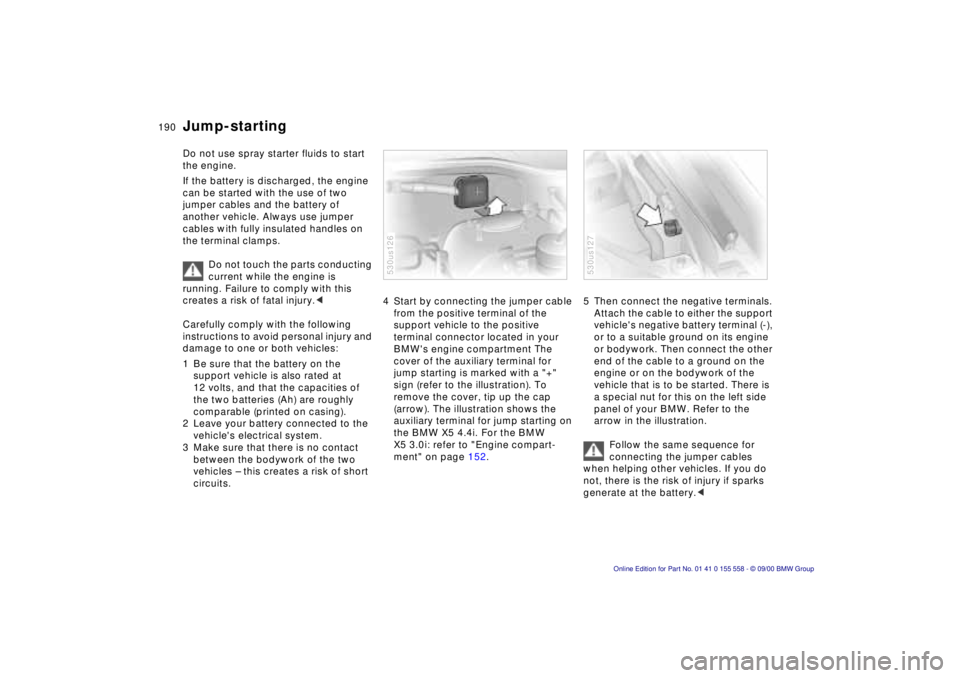
4 Start by connecting the jumper cable
from the positive terminal of the
support vehicle to the positive
terminal connector located in your
BMW's engine compartment The
cover of the auxiliary terminal for
jump starting is marked with a "+"
sign (refer to the illustration). To
remove the cover, tip up the cap
(arrow). The illustration shows the
auxiliary terminal for jump starting on
the BMW X5 4.4i. For the BMW
X5 3.0i: refer to "Engine compart-
ment" on page 152.530us126
5 Then connect the negative terminals.
Attach the cable to either the support
vehicle's negative battery terminal (-),
or to a suitable ground on its engine
or bodywork. Then connect the other
end of the cable to a ground on the
engine or on the bodywork of the
vehicle that is to be started. There is
a special nut for this on the left side
panel of your BMW. Refer to the
arrow in the illustration.
Follow the same sequence for
connecting the jumper cables
when helping other vehicles. If you do
not, there is the risk of injury if sparks
generate at the battery.< 530us127
Jump-starting