roof BMW X5 3.0I 2001 User Guide
[x] Cancel search | Manufacturer: BMW, Model Year: 2001, Model line: X5 3.0I, Model: BMW X5 3.0I 2001Pages: 223, PDF Size: 2.66 MB
Page 47 of 223
Index
Data
Technology
Repairs
Car care
Controls
Overview
47nSliding/Tilt sunroof with glass moonroof*
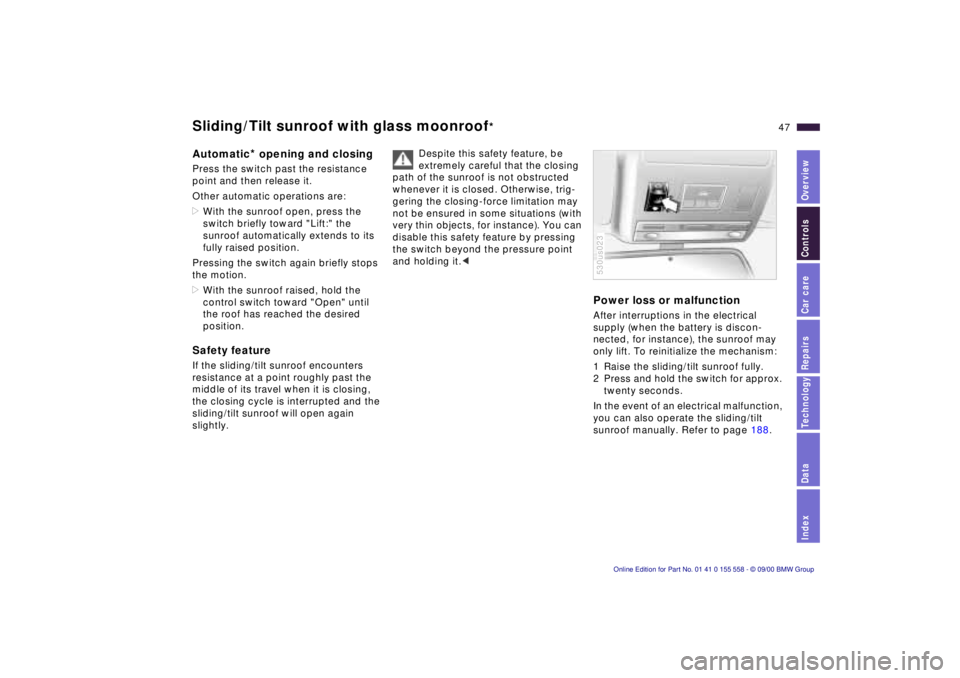
Automatic* opening and closing
Press the switch past the resistance
point and then release it.
Other automatic operations are:
>With the sunroof open, press the
switch briefly toward "Lift:" the
sunroof automatically extends to its
fully raised position.
Pressing the switch again briefly stops
the motion.
> With the sunroof raised, hold the
control switch toward "Open" until
the roof has reached the desired
position.
Safety feature
If the sliding/tilt sunroof encounters
resistance at a point roughly past the
middle of its travel when it is closing,
the closing cycle is interrupted and the
sliding/tilt sunroof will open again
slightly. Despite this safety feature, be
extremely careful that the closing
path of the sunroof is not obstructed
whenever it is closed. Otherwise, trig-
gering the closing-force limitation may
not be ensured in some situations (with
very thin objects, for instance). You can
disable this safety feature by pressing
the switch beyond the pressure point
and holding it. <
Power loss or malfunction
After interruptions in the electrical
supply (when the battery is discon-
nected, for instance), the sunroof may
only lift. To reinitialize the mechanism:
1 Raise the sliding/tilt sunroof fully.
2 Press and hold the switch for approx.
twenty seconds.
In the event of an electrical malfunction,
you can also operate the sliding/tilt
sunroof manually. Refer to page 188.
530us023
Page 125 of 223
IndexDataTechnologyRepairsCar careControlsOverview
125n
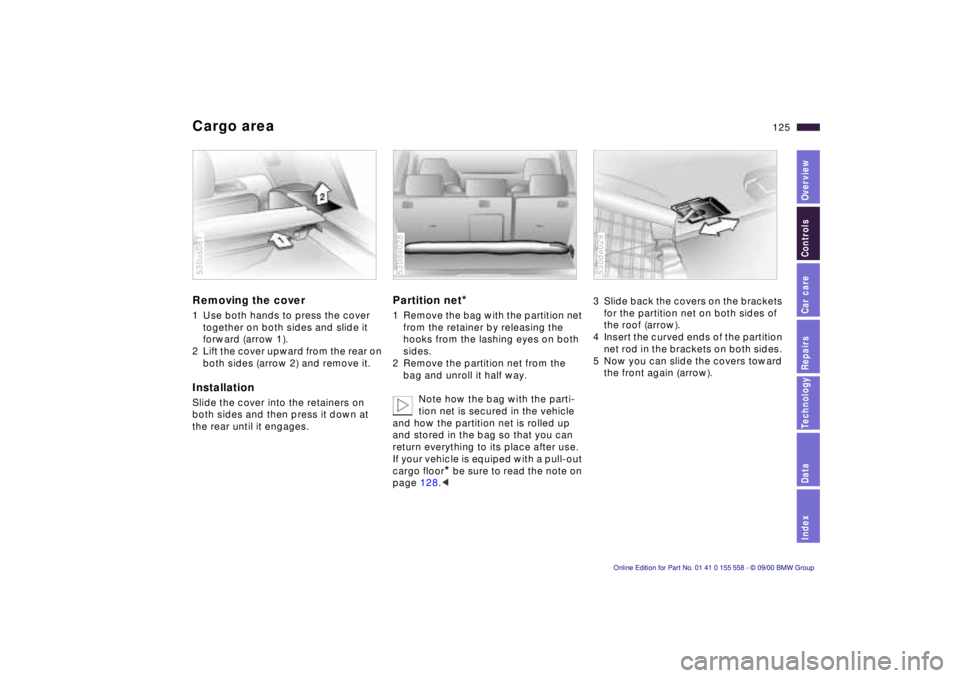
Cargo areaRemoving the cover 1 Use both hands to press the cover
together on both sides and slide it
forward (arrow 1).
2 Lift the cover upward from the rear on
both sides (arrow 2) and remove it.InstallationSlide the cover into the retainers on
both sides and then press it down at
the rear until it engages.530us081
Partition net
*
1 Remove the bag with the partition net
from the retainer by releasing the
hooks from the lashing eyes on both
sides.
2 Remove the partition net from the
bag and unroll it half way.
Note how the bag with the parti-
tion net is secured in the vehicle
and how the partition net is rolled up
and stored in the bag so that you can
return everything to its place after use.
If your vehicle is equiped with a pull-out
cargo floor
* be sure to read the note on
page 128.<
530de028
3 Slide back the covers on the brackets
for the partition net on both sides of
the roof (arrow).
4 Insert the curved ends of the partition
net rod in the brackets on both sides.
5 Now you can slide the covers toward
the front again (arrow). 530de029
Page 126 of 223
126n
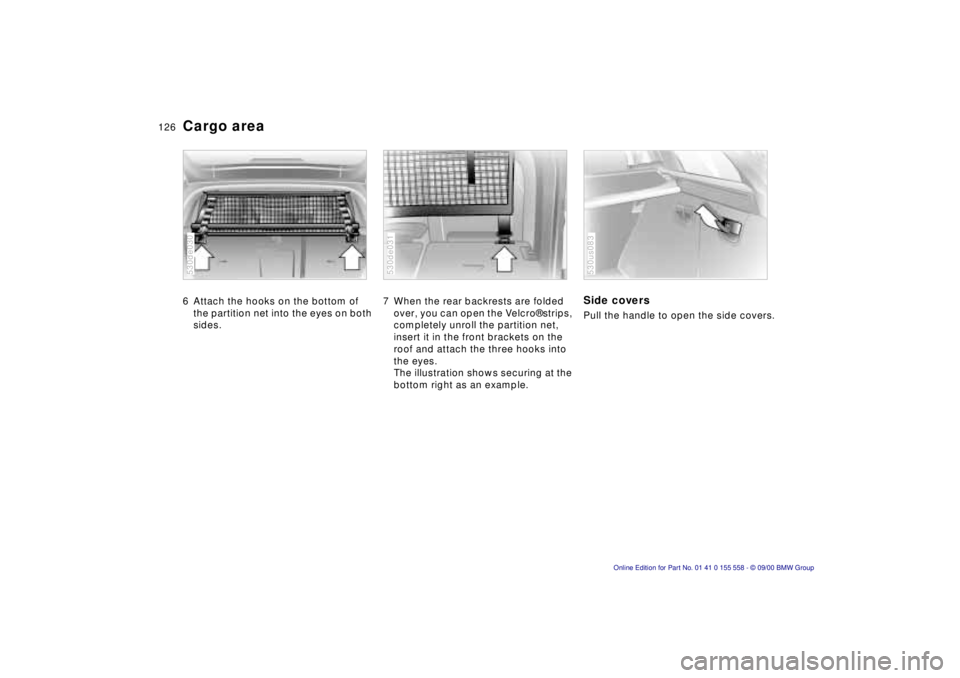
Cargo area 6 Attach the hooks on the bottom of
the partition net into the eyes on both
sides. 530de030
7 When the rear backrests are folded
over, you can open the Velcro® strips,
completely unroll the partition net,
insert it in the front brackets on the
roof and attach the three hooks into
the eyes.
The illustration shows securing at the
bottom right as an example. 530de031
Side coversPull the handle to open the side covers.530us083
Page 130 of 223

130n
Roof-mounted luggage rack
*
Roof-mounted luggage racks raise the
center of gravity of the vehicle when
they are loaded. For this reason, they
exercise a major effect on the vehicle's
handling and steering response.
You should therefore always remember
not to exceed the approved roof
weight, the approved gross vehicle
weight or the axle weights when
loading the rack. You will find the
specifications under "Technical Data"
on page 208.
Make sure that the load is not too
heavy, and attempt to distribute it
evenly. Always load the heaviest pieces
first (on the bottom). Be sure that
adequate clearance is maintained for
raising the sliding/tilt sunroof, and that
objects do not project into the opening
path of the liftgate. Secure the roof luggage correctly and
securely to prevent it from shifting or
being lost during driving (danger to
following traffic).
Drive smoothly. Avoid sudden accelera-
tion and braking maneuvers. Take
corners gently.
The roof load increases the aerody-
namic resistance. Increased fuel
consumption is the immediate results.
Page 162 of 223
162n
The BMW Maintenance System has
been designed as a reliable means of
providing maximum driving and oper-
ating safety – and as cost-effectively as
possible for you.
Please keep in mind that regular main-
tenance is not only necessary for the
safety of your vehicle, but also plays a
significant role in maintaining the resale
value of the vehicle.
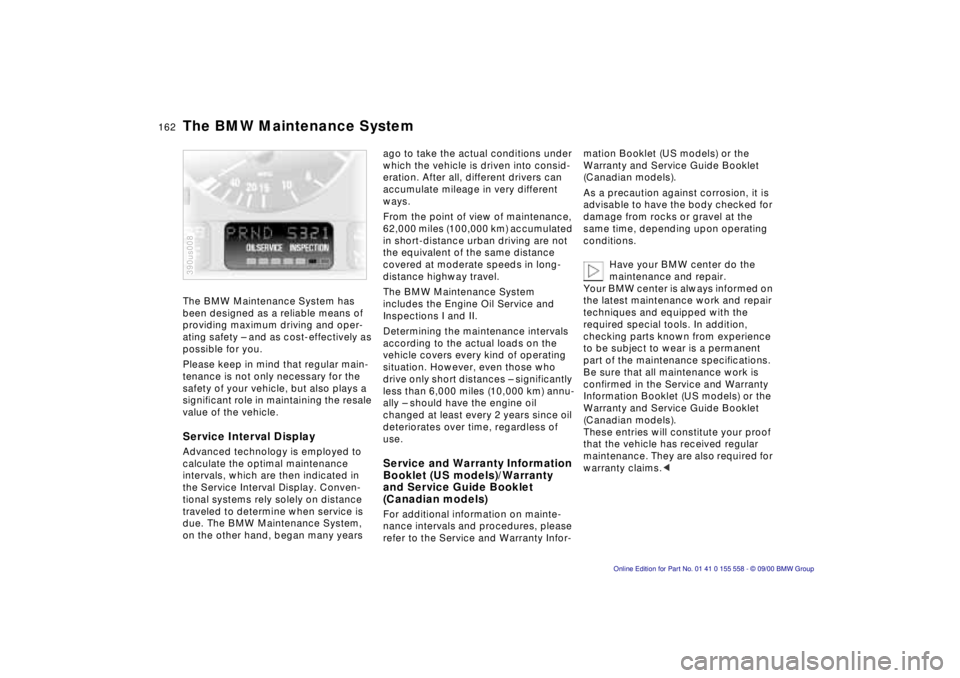
Service Interval DisplayAdvanced technology is employed to
calculate the optimal maintenance
intervals, which are then indicated in
the Service Interval Display. Conven-
tional systems rely solely on distance
traveled to determine when service is
due. The BMW Maintenance System,
on the other hand, began many years 390us008
ago to take the actual conditions under
which the vehicle is driven into consid-
eration. After all, different drivers can
accumulate mileage in very different
ways.
From the point of view of maintenance,
62,000 miles (100,000 km) accumulated
in short-distance urban driving are not
the equivalent of the same distance
covered at moderate speeds in long-
distance highway travel.
The BMW Maintenance System
includes the Engine Oil Service and
Inspections I and II.
Determining the maintenance intervals
according to the actual loads on the
vehicle covers every kind of operating
situation. However, even those who
drive only short distances – significantly
less than 6,000 miles (10,000 km) annu-
ally – should have the engine oil
changed at least every 2 years since oil
deteriorates over time, regardless of
use.Service and Warranty Information
Booklet (US models)/Warranty
and Service Guide Booklet
(Canadian models)For additional information on mainte-
nance intervals and procedures, please
refer to the Service and Warranty Infor-mation Booklet (US models) or the
Warranty and Service Guide Booklet
(Canadian models).
As a precaution against corrosion, it is
advisable to have the body checked for
damage from rocks or gravel at the
same time, depending upon operating
conditions.
Have your BMW center do the
maintenance and repair.
Your BMW center is always informed on
the latest maintenance work and repair
techniques and equipped with the
required special tools. In addition,
checking parts known from experience
to be subject to wear is a permanent
part of the maintenance specifications.
Be sure that all maintenance work is
confirmed in the Service and Warranty
Information Booklet (US models) or the
Warranty and Service Guide Booklet
(Canadian models).
These entries will constitute your proof
that the vehicle has received regular
maintenance. They are also required for
warranty claims.<
The BMW Maintenance System
Page 168 of 223
168n
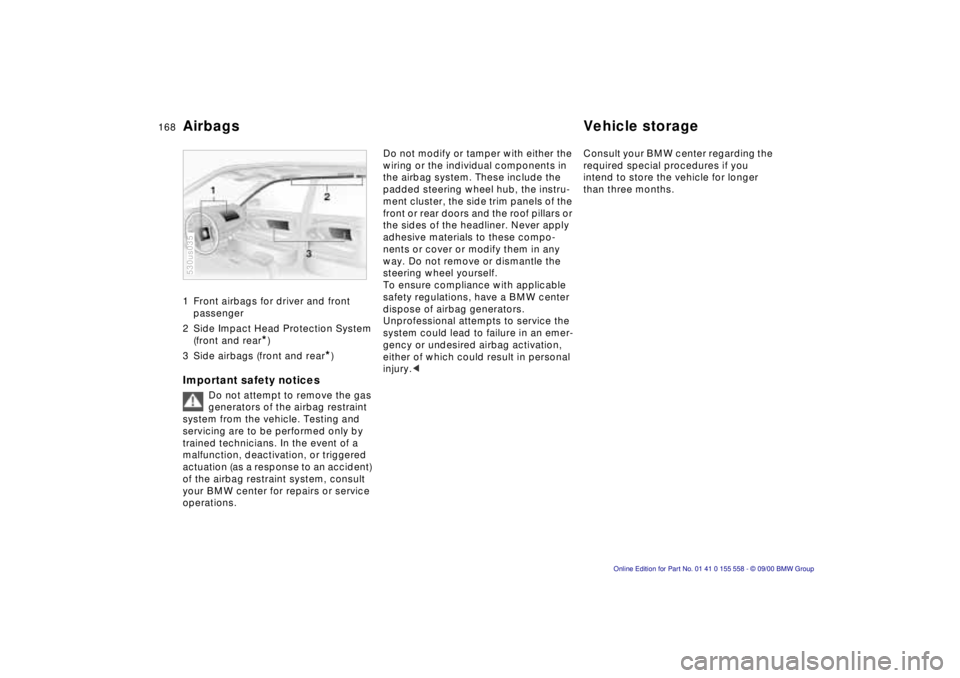
Airbags Vehicle storage1 Front airbags for driver and front
passenger
2 Side Impact Head Protection System
(front and rear
*)
3 Side airbags (front and rear
*)
Important safety notices
Do not attempt to remove the gas
generators of the airbag restraint
system from the vehicle. Testing and
servicing are to be performed only by
trained technicians. In the event of a
malfunction, deactivation, or triggered
actuation (as a response to an accident)
of the airbag restraint system, consult
your BMW center for repairs or service
operations.
530us035
Do not modify or tamper with either the
wiring or the individual components in
the airbag system. These include the
padded steering wheel hub, the instru-
ment cluster, the side trim panels of the
front or rear doors and the roof pillars or
the sides of the headliner. Never apply
adhesive materials to these compo-
nents or cover or modify them in any
way. Do not remove or dismantle the
steering wheel yourself.
To ensure compliance with applicable
safety regulations, have a BMW center
dispose of airbag generators.
Unprofessional attempts to service the
system could lead to failure in an emer-
gency or undesired airbag activation,
either of which could result in personal
injury.< Consult your BMW center regarding the
required special procedures if you
intend to store the vehicle for longer
than three months.
Page 173 of 223
IndexDataTechnologyRepairsCar careControlsOverview
Overview
Controls and features
Operation, care
and maintenance
Owner service procedures
Technical data
Index Advanced technology
173n
Replacement procedures:
Onboard tool kit174
Windshield wiper blades174
Lamps and bulbs175
Changing a wheel181
Battery185
Fuses187
In case of electrical
malfunction:
Fuel filler door188
Sliding/Tilt sunroof188
Liftgate188
Tailgate189
Assistance, giving and
receiving:
Jump-starting190
Towing the vehicle191
Repairs
Page 188 of 223
188n
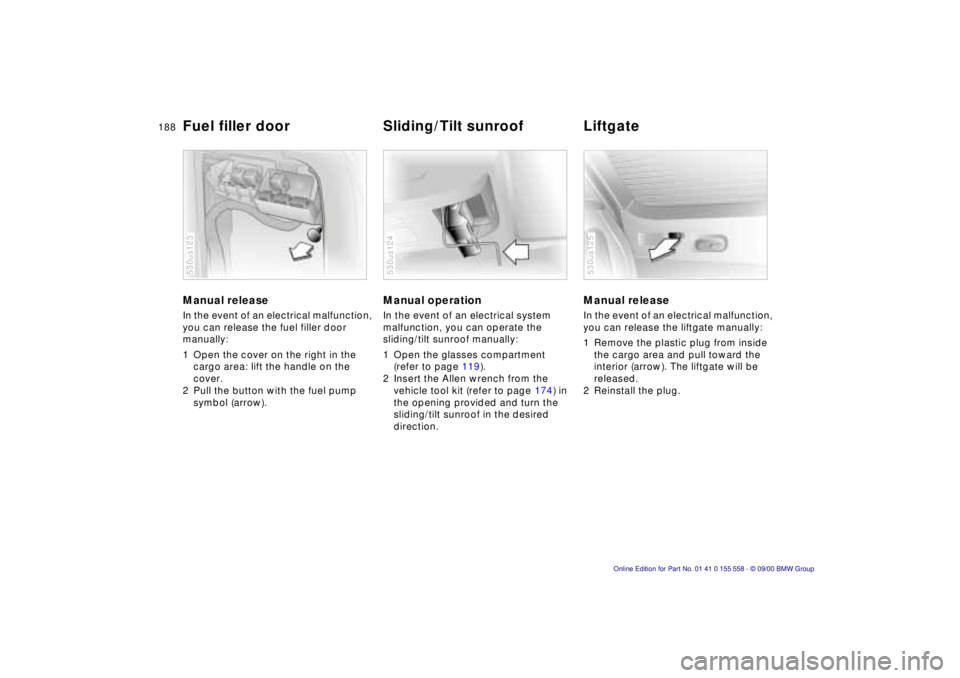
Manual release In the event of an electrical malfunction,
you can release the fuel filler door
manually:
1 Open the cover on the right in the
cargo area: lift the handle on the
cover.
2 Pull the button with the fuel pump
symbol (arrow). 530us123
Manual operationIn the event of an electrical system
malfunction, you can operate the
sliding/tilt sunroof manually:
1 Open the glasses compartment
(refer to page 119).
2 Insert the Allen wrench from the
vehicle tool kit (refer to page 174) in
the opening provided and turn the
sliding/tilt sunroof in the desired
direction.530us124
Manual release In the event of an electrical malfunction,
you can release the liftgate manually:
1 Remove the plastic plug from inside
the cargo area and pull toward the
interior (arrow). The liftgate will be
released.
2 Reinstall the plug. 530us125
Fuel filler door Sliding/Tilt sunroof Liftgate
Page 207 of 223
Index
Data
Technology
Repairs
Car care
Controls
Overview
207nDimensions
530de210
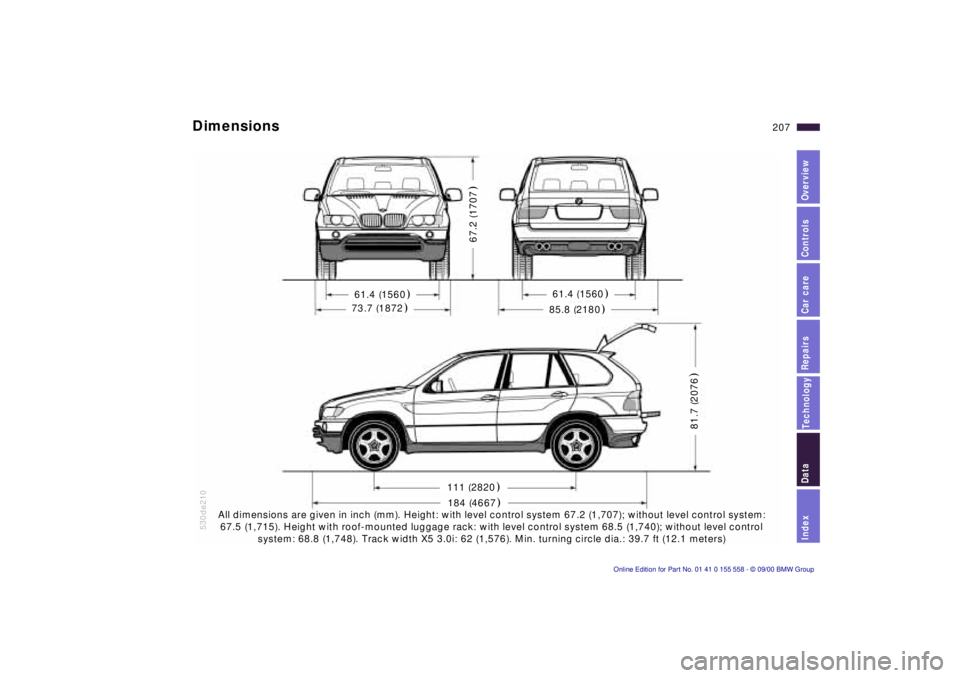
All dimensions are given in inch (mm). Height: with level control system 67.2 (1,707); without level control system:
67.5 (1,715). Height with roof-mounted luggage rack: with level control system 68.5 \
(1,740); without level control system: 68.8 (1,748). Track width X5 3.0i: 62 (1,576). Min. turning circle dia.: 39.7 ft (12\
.1 meters)
73.7 (1872)85.8 (2180)
61.4 (1560)61.4 (1560)
111 (2820)
184 (4667)
67.2 (1707
)
81.7 (2076
)
Page 208 of 223

with manual transmission
with automatic transmission lbs. (kg)
lbs.")
208nWeights
BMW X5 3.0i BMW X5 4.4i
Curb weight (with one person, ready for operation, full tank of fuel, o\
ptions not included)
with manual transmission
with automatic transmission lbs. (kg)
lbs. (kg)4,519 (2050)
4,563 (2070) –
4,795 (2,175)
Approved gross vehicle weight
with manual transmission
with automatic transmission lbs. (kg)
lbs. (kg)6,005 (2,724)
6,005 (2,724) –
6,005 (2,724)
Approved front axle weight lbs. (kg) 2,787 (1,264) 2,787 (1,264)
Approved rear axle weight lbs. (kg) 3,307 (1,500) 3,307 (1,500)
Approved roof load capacity lbs. (kg) 220 (100)
Never exceed either the approved axle weights or the gross vehicle weigh\
t.
Cargo area capacity cu ft (l) 16.1 - 54.4 (455 - 1,540)