lock BMW X5 3.0I 2001 Owner's Manual
[x] Cancel search | Manufacturer: BMW, Model Year: 2001, Model line: X5 3.0I, Model: BMW X5 3.0I 2001Pages: 223, PDF Size: 2.66 MB
Page 57 of 223
Index
Data
Technology
Repairs
Car care
Controls
Overview
57n
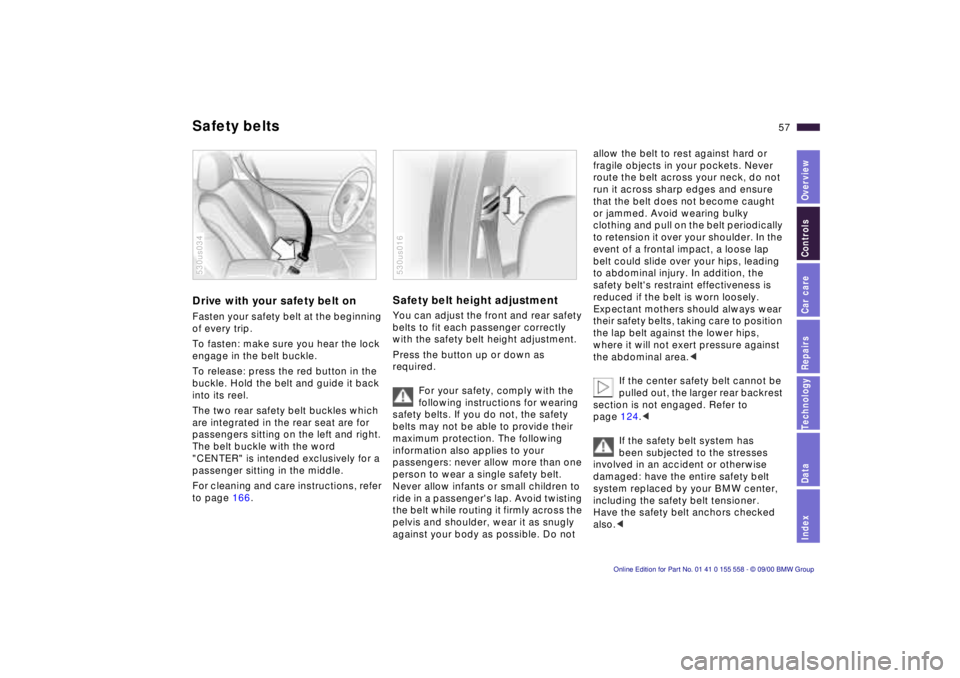
Drive with your safety belt on
Fasten your safety belt at the beginning
of every trip.
To fasten: make sure you hear the lock
engage in the belt buckle.
To release: press the red button in the
buckle. Hold the belt and guide it back
into its reel.
The two rear safety belt buckles which
are integrated in the rear seat are for
passengers sitting on the left and right.
The belt buckle with the word
"CENTER" is intended exclusively for a
passenger sitting in the middle.
For cleaning and care instructions, refer
to page 166.
530us034
Safety belt height adjustment
You can adjust the front and rear safety
belts to fit each passenger correctly
with the safety belt height adjustment.
Press the button up or down as
required.
For your safety, comply with the
following instructions for wearing
safety belts. If you do not, the safety
belts may not be able to provide their
maximum protection. The following
information also applies to your
passengers: never allow more than one
person to wear a single safety belt.
Never allow infants or small children to
ride in a passenger's lap. Avoid twisting
the belt while routing it firmly across the
pelvis and shoulder, wear it as snugly
against your body as possible. Do not
530us016
allow the belt to rest against hard or
fragile objects in your pockets. Never
route the belt across your neck, do not
run it across sharp edges and ensure
that the belt does not become caught
or jammed. Avoid wearing bulky
clothing and pull on the belt periodically
to retension it over your shoulder. In the
event of a frontal impact, a loose lap
belt could slide over your hips, leading
to abdominal injury. In addition, the
safety belt's restraint effectiveness is
reduced if the belt is worn loosely.
Expectant mothers should always wear
their safety belts, taking care to position
the lap belt against the lower hips,
where it will not exert pressure against
the abdominal area. <
If the center safety belt cannot be
pulled out, the larger rear backrest
section is not engaged. Refer to
page 124.<
If the safety belt system has
been subjected to the stresses
involved in an accident or otherwise
damaged: have the entire safety belt
system replaced by your BMW center,
including the safety belt tensioner.
Have the safety belt anchors checked
also. c
Safety belts
Page 62 of 223
62nTransporting children safely
Child seat security
All of the rear belt retractors and the
front passenger's safety belt can be
locked for mounting and securing child
restraint systems.
Information regarding this is located
near the buckle latch of each safety
belt.
530us104
To lock the belt
Pull the entire length of the belt from
the belt retractor. Allow the reel to
retract the belt somewhat and engage
the buckle, then tighten the belt against
the child restraint system. The retrac-
tion mechanism is now locked.
To release the belt
Release the buckle, remove the child-
restraint device and allow the belt
retractor to reel the belt completely in.
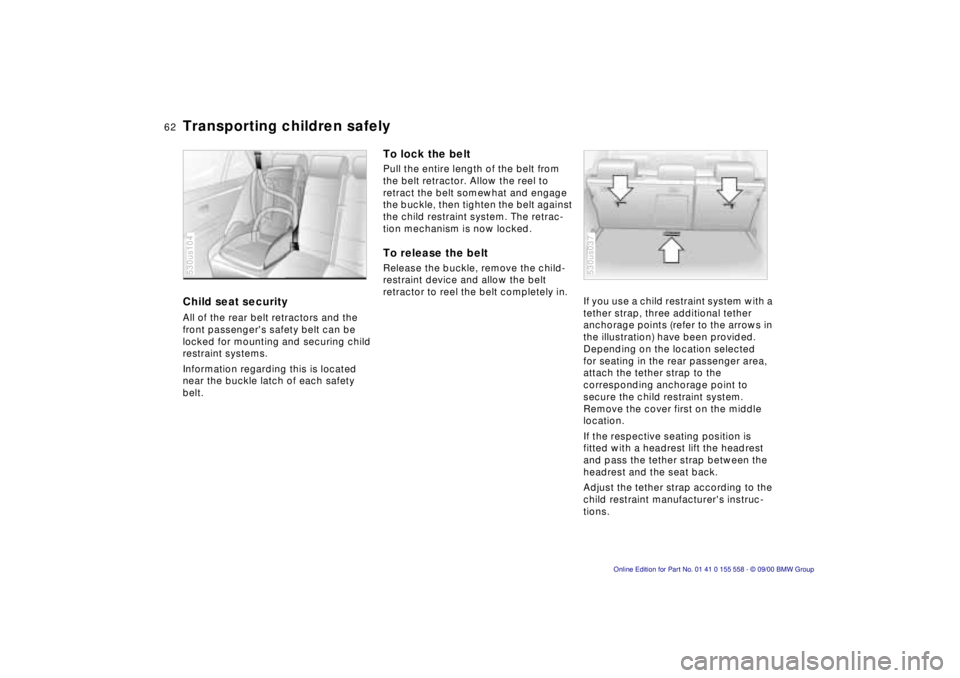
If you use a child restraint system with a
tether strap, three additional tether
anchorage points (refer to the arrows in
the illustration) have been provided.
Depending on the location selected
for seating in the rear passenger area,
attach the tether strap to the
corresponding anchorage point to
secure the child restraint system.
Remove the cover first on the middle
location.
If the respective seating position is
fitted with a headrest lift the headrest
and pass the tether strap between the
headrest and the seat back.
Adjust the tether strap according to the
child restraint manufacturer's instruc-
tions.530us037
Page 63 of 223
Index
Data
Technology
Repairs
Car care
Controls
Overview
63nTransporting children safely
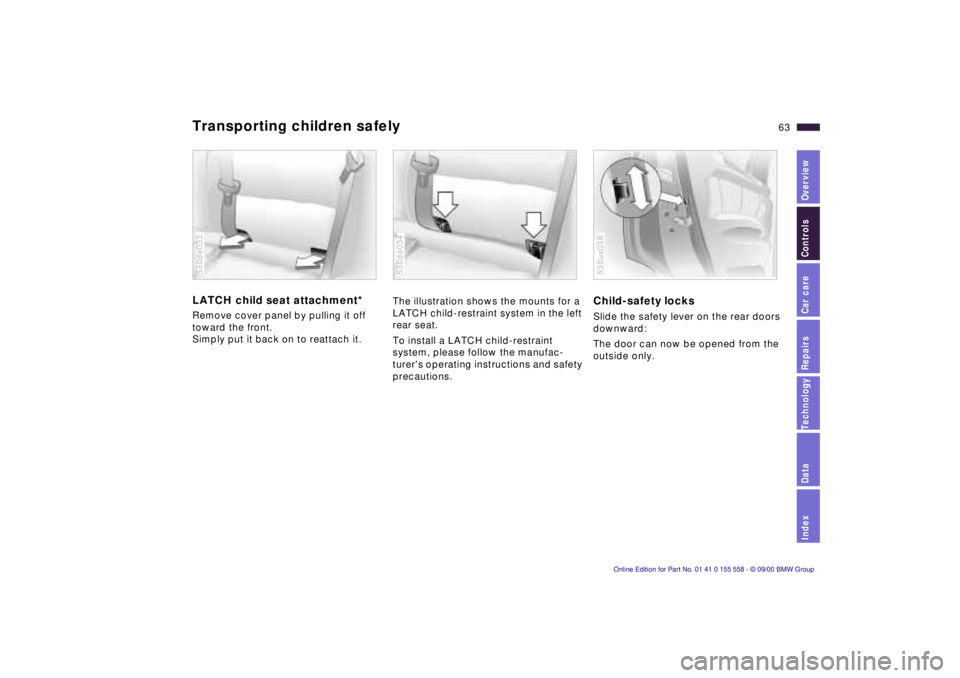
LATCH child seat attachment*
Remove cover panel by pulling it off
toward the front.
Simply put it back on to reattach it.
530de033
The illustration shows the mounts for a
LATCH child-restraint system in the left
rear seat.
To install a LATCH child-restraint
system, please follow the manufac-
turer's operating instructions and safety
precautions.
530de034
Child-safety locks
Slide the safety lever on the rear doors
downward:
The door can now be opened from the
outside only.
530us038
Page 64 of 223
64n
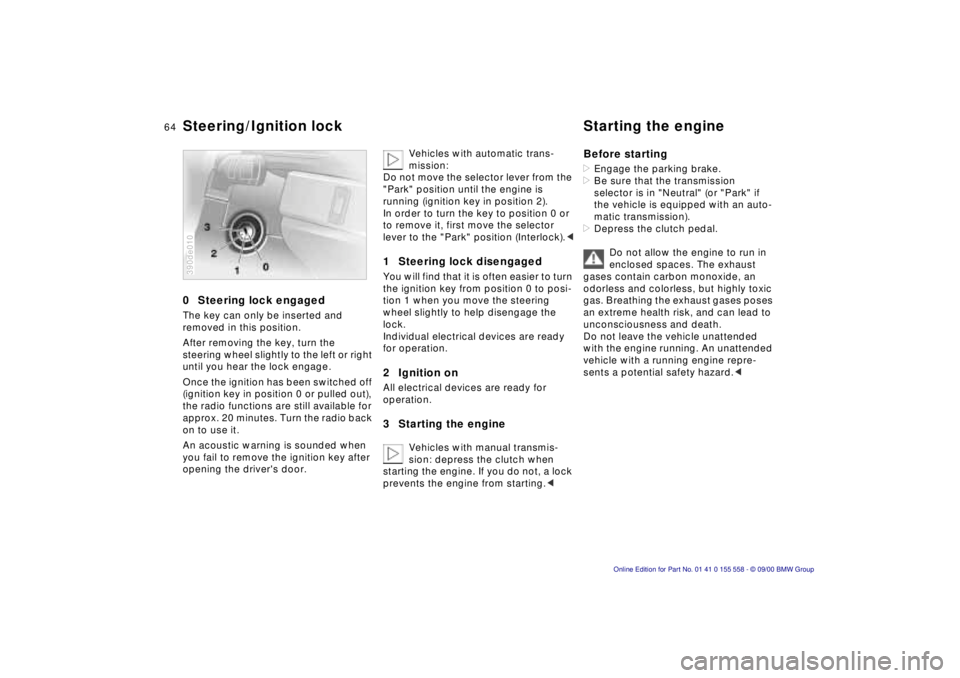
0 Steering lock engaged
The key can only be inserted and
removed in this position.
After removing the key, turn the
steering wheel slightly to the left or right
until you hear the lock engage.
Once the ignition has been switched off
(ignition key in position 0 or pulled out),
the radio functions are still available for
approx. 20 minutes. Turn the radio back
on to use it.
An acoustic warning is sounded when
you fail to remove the ignition key after
opening the driver's door.
390de010
Vehicles with automatic trans-
mission:
Do not move the selector lever from the
"Park" position until the engine is
running (ignition key in position 2).
In order to turn the key to position 0 or
to remove it, first move the selector
lever to the "Park" position (Interlock). <
1 Steering lock disengaged
You will find that it is often easier to turn
the ignition key from position 0 to posi-
tion 1 when you move the steering
wheel slightly to help disengage the
lock.
Individual electrical devices are ready
for operation.
2 Ignition on
All electrical devices are ready for
operation.
3 Starting the engine
Vehicles with manual transmis-
sion: depress the clutch when
starting the engine. If you do not, a lock
prevents the engine from starting. <
Before starting
> Engage the parking brake.
> Be sure that the transmission
selector is in "Neutral" (or "Park" if
the vehicle is equipped with an auto-
matic transmission).
> Depress the clutch pedal.
Do not allow the engine to run in
enclosed spaces. The exhaust
gases contain carbon monoxide, an
odorless and colorless, but highly toxic
gas. Breathing the exhaust gases poses
an extreme health risk, and can lead to
unconsciousness and death.
Do not leave the vehicle unattended
with the engine running. An unattended
vehicle with a running engine repre-
sents a potential safety hazard. <
Steering/Ignition lock Starting the engine
Page 65 of 223

Index
Data
Technology
Repairs
Car care
Controls
Overview
65nStarting the engine Switching off the engine
Do not press the accelerator pedal
while starting the engine.
BMW X5 3.0i:
Do not actuate the starter for too
short a time. Do not turn it for more
than approx. 20 seconds. Release the
ignition key immediately as soon as the
engine starts.
BMW X5 4.4i:
Your BMW is equipped with the conve-
nience starting feature. Simply turn the
key to position 3 (starter) and then
release it immediately.
The starter continues to operate auto-
matically.
The automatic starting mode will not
operate if the battery voltage is low.
The engine can be started by means of
jump-starting (refer to page 190).<
Do not allow the engine to warm up
by leaving it running while the vehicle
remains stationary. Instead, begin to
drive immediately at a moderate engine
speed.Should the engine fail to start on the
first attempt (if it is very hot or cold, for
instance):
> Press the accelerator pedal halfway
down while engaging the starter.
Cold starts at very low temperatures,
from approx. +5 7 (–15 6) and at alti-
tudes above 3,300 ft (1,000 meters):
> For the initial start attempt, allow the
starter to remain engaged somewhat
longer (approx. 10 seconds).
> Press the accelerator pedal halfway
down while engaging the starter.
Engine idle speed is controlled by the
engine computer system. Increased
speeds at startup are normal and
should decrease as the engine warms
up. If engine speed does not decrease,
service is required.
To prevent the battery from discharging,
always deactivate electrical devices
that are not in use. Switch the ignition
off when the vehicle is not being driven. Turn the ignition key to position 1 or 0.
Never remove the ignition key
while the vehicle is rolling. If you
did so, the ignition lock would engage
when the steering wheel is turned.
Always remove the ignition key and
engage the steering lock before leaving
the vehicle.
Vehicles with manual transmission:
Always engage the parking brake when
parking on slopes and inclined
surfaces. Even placing the lever in
1st gear or reverse may not provide
adequate resistance to rolling.
Vehicles with automatic transmission:
Place the selector lever in "Park." <
Vehicles with automatic transmission:
The vehicle must be stationary and the
selector lever in "Park" before you can
remove the ignition key.
Page 67 of 223
Index
Data
Technology
Repairs
Car care
Controls
Overview
67nManual transmission
Press the clutch pedal all the way down
each time you shift, pressing the
manual-shift gear lever into its proper
end position.
Depress the clutch when starting the
vehicle, too, otherwise, lockout will
prevent the engine from starting if the
clutch is not depressed.
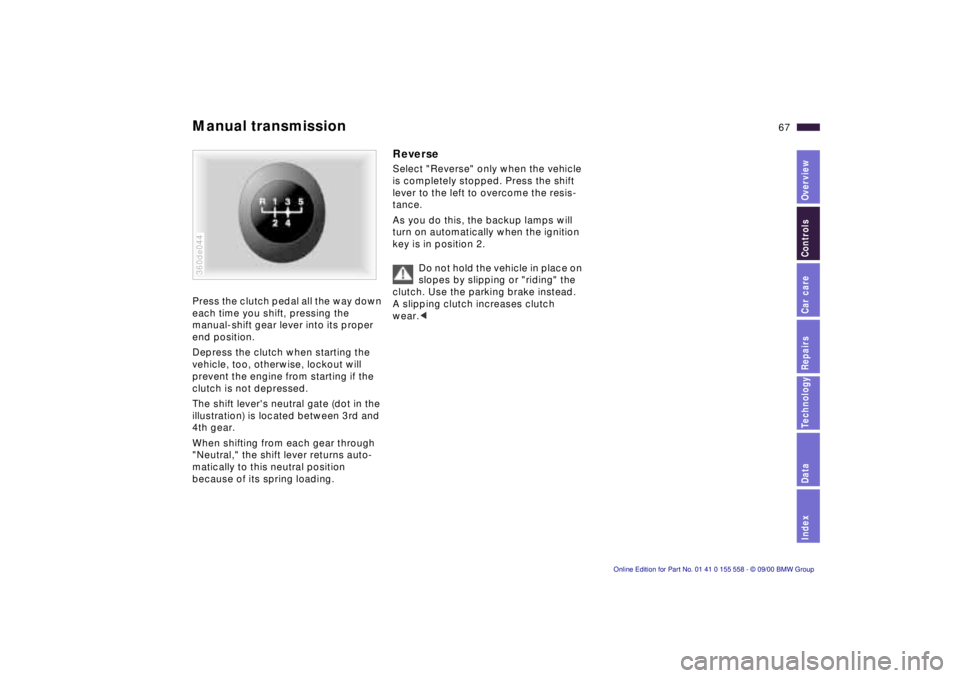
The shift lever's neutral gate (dot in the
illustration) is located between 3rd and
4th gear.
When shifting from each gear through
"Neutral," the shift lever returns auto-
matically to this neutral position
because of its spring loading.
360de044
Reverse
Select "Reverse" only when the vehicle
is completely stopped. Press the shift
lever to the left to overcome the resis-
tance.
As you do this, the backup lamps will
turn on automatically when the ignition
key is in position 2.
Do not hold the vehicle in place on
slopes by slipping or "riding" the
clutch. Use the parking brake instead.
A slipping clutch increases clutch
wear. <
Page 68 of 223
68nAutomatic transmission with Steptronic*
You can drive as with a normal auto-
matic transmission. In addition, you can
also shift manually.
When you move the selector lever from
the "D" position to the left into the M/S
range, the performance-oriented shift
programs of the automatic transmission
are engaged. As soon as you briefly
touch the selector lever in the "+" or "–"
direction, Steptronic changes the gear.
The manual mode is engaged. When
you wish to use the automatic transmis-
sion mode again, move the selector
lever to the right into the "D" position.
The automatic transmission of your
BMW is equipped with Adaptive Trans-
mission Control (ATC), a system which
reacts with precision to your individual
driving style and the driving conditions.
530us040
To achieve this, different shift programs
are automatically engaged.
For additional details concerning the
ATC, please refer to the chapter
describing "Advanced technology" on
page 196.
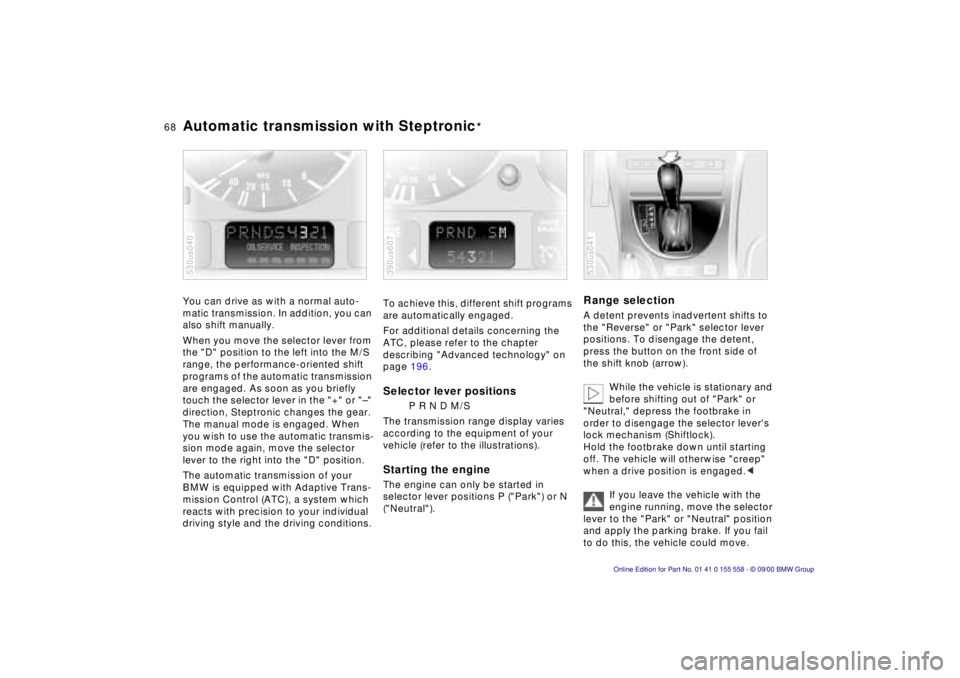
Selector lever positions
P R N D M/S
The transmission range display varies
according to the equipment of your
vehicle (refer to the illustrations).
Starting the engine
The engine can only be started in
selector lever positions P ("Park") or N
("Neutral").
390us607
Range selection
A detent prevents inadvertent shifts to
the "Reverse" or "Park" selector lever
positions. To disengage the detent,
press the button on the front side of
the shift knob (arrow).
While the vehicle is stationary and
before shifting out of "Park" or
"Neutral," depress the footbrake in
order to disengage the selector lever's
lock mechanism (Shiftlock).
Hold the footbrake down until starting
off. The vehicle will otherwise "creep"
when a drive position is engaged. <
If you leave the vehicle with the
engine running, move the selector
lever to the "Park" or "Neutral" position
and apply the parking brake. If you fail
to do this, the vehicle could move.
530us041
Page 69 of 223
Index
Data
Technology
Repairs
Car care
Controls
Overview
69nAutomatic transmission with Steptronic*
Do not leave the vehicle unattended
with the engine running. An unattended
vehicle with a running engine repre-
sents a potential safety hazard. <
P — Park
Select "Park" only when the vehicle is
completely stopped. The transmission
locks to prevent the rear wheels from
turning.
R — Reverse
Select "Reverse" only when the vehicle
is completely stopped.
N — Neutral
Select "Neutral" only if your journey is
interrupted for a longer period.
D — Drive
(automatic shift program)
This position is designed for driving
under all normal operating conditions.
All forward gears are available.
"Kickdown"
In the "Kickdown" mode, you achieve
maximum performance.
Depress the accelerator pedal past the
increased resistance point at the full-
throttle position.
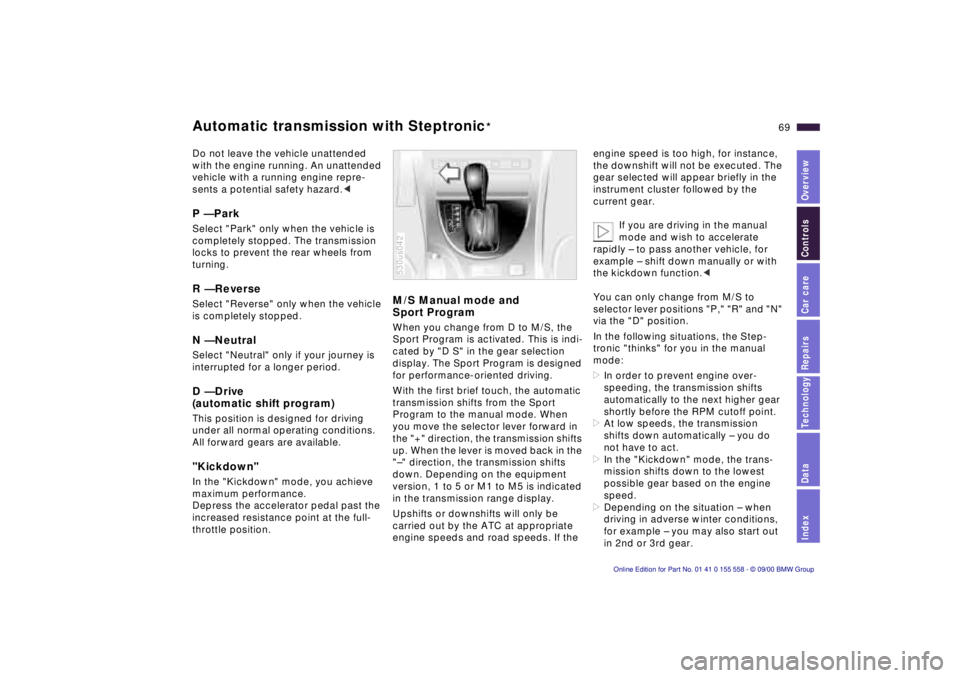
M/S Manual mode and
Sport Program
When you change from D to M/S, the
Sport Program is activated. This is indi-
cated by "D S" in the gear selection
display. The Sport Program is designed
for performance-oriented driving.
With the first brief touch, the automatic
transmission shifts from the Sport
Program to the manual mode. When
you move the selector lever forward in
the "+" direction, the transmission shifts
up. When the lever is moved back in the
"–" direction, the transmission shifts
down. Depending on the equipment
version, 1 to 5 or M1 to M5 is indicated
in the transmission range display.
Upshifts or downshifts will only be
carried out by the ATC at appropriate
engine speeds and road speeds. If the
530us042
engine speed is too high, for instance,
the downshift will not be executed. The
gear selected will appear briefly in the
instrument cluster followed by the
current gear.
If you are driving in the manual
mode and wish to accelerate
rapidly – to pass another vehicle, for
example – shift down manually or with
the kickdown function. <
You can only change from M/S to
selector lever positions "P," "R" and "N"
via the "D" position.
In the following situations, the Step-
tronic "thinks" for you in the manual
mode:
> In order to prevent engine over-
speeding, the transmission shifts
automatically to the next higher gear
shortly before the RPM cutoff point.
> At low speeds, the transmission
shifts down automatically – you do
not have to act.
> In the "Kickdown" mode, the trans-
mission shifts down to the lowest
possible gear based on the engine
speed.
> Depending on the situation – when
driving in adverse winter conditions,
for example – you may also start out
in 2nd or 3rd gear.
Page 79 of 223
Index
Data
Technology
Repairs
Car care
Controls
Overview
79nCheck Control
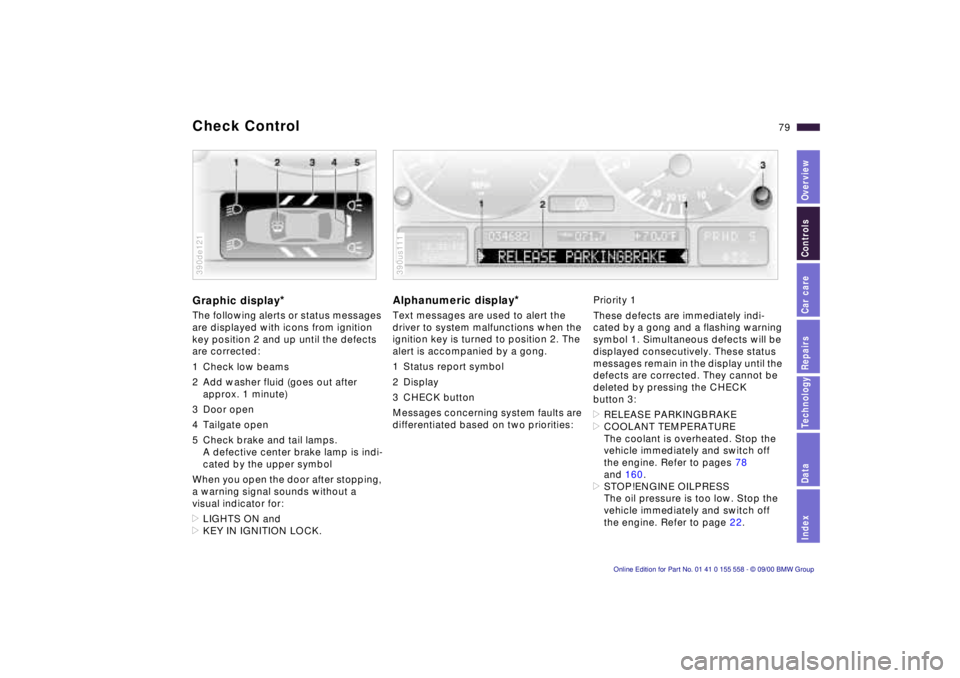
Graphic display*
The following alerts or status messages
are displayed with icons from ignition
key position 2 and up until the defects
are corrected:
1 Check low beams
2 Add washer fluid (goes out after
approx. 1 minute)
3 Door open
4 Tailgate open
5 Check brake and tail lamps. A defective center brake lamp is indi-
cated by the upper symbol
When you open the door after stopping,
a warning signal sounds without a
visual indicator for:
> LIGHTS ON and
> KEY IN IGNITION LOCK.
390de121
Alphanumeric display*
Text messages are used to alert the
driver to system malfunctions when the
ignition key is turned to position 2. The
alert is accompanied by a gong.
1 Status report symbol
2 Display
3 CHECK button
Messages concerning system faults are
differentiated based on two priorities:
390us111
Priority 1
These defects are immediately indi-
cated by a gong and a flashing warning
symbol 1. Simultaneous defects will be
displayed consecutively. These status
messages remain in the display until the
defects are corrected. They cannot be
deleted by pressing the CHECK
button 3:
> RELEASE PARKINGBRAKE
> COOLANT TEMPERATURE
The coolant is overheated. Stop the
vehicle immediately and switch off
the engine. Refer to pages 78
and 160.
> STOP!ENGINE OILPRESS
The oil pressure is too low. Stop the
vehicle immediately and switch off
the engine. Refer to page 22.
Page 81 of 223
Index
Data
Technology
Repairs
Car care
Controls
Overview
81nCheck Control
>TRANS. FAILSAFE PROG
Please consult the nearest BMW
center. Refer to page 70.
> CHECK BRAKE LININGS
Have the brake linings inspected by
your BMW center. Refer to page 141.
> CHECK COOLANT LEVEL
Coolant too low, top up at the next
opportunity. Refer to page 160.
> ENGINE FAILSAFE PROG
There is a fault in the engine's elec-
tronic control system.
You can continue to drive with
reduced engine output or engine
speed. Have the system checked by
your BMW center. Displays after completion of trip
All of the malfunctions registered during
the trip appear consecutively when the
ignition key is turned to position 0.
The following displays will appear when
appropriate:
>LIGHTS ON
> KEY IN IGNITION LOCK
> CHECK ENGINE OIL LEV
Add engine oil at the next opportunity
(next stop for fuel). Refer to
page 157.
This display appears when you open
the driver's door after parking the
vehicle. A supplementary gong is also
heard.
Status reports remain available for a
period of approx. three minutes after
the display goes out and the key is
removed from the ignition. Press the
CHECK button 3. If there were multiple
reports, press the CHECK button
repeatedly to view them all in
sequence.
To check the Check Control
Press the CHECK button 3 with the
ignition key in position 2: CHECK
CONTROL OK appears in the display.
No malfunctions are present in the
monitored systems.
Computer
You will find a description of the
computer in the Owner's Manual for
the Radio and Information System or
the Owner's Manual for the Onboard
Computer.
You can have the Check Control
and computer messages
displayed in a different language. <