window BMW X5 3.0I 2001 Owner's Manual
[x] Cancel search | Manufacturer: BMW, Model Year: 2001, Model line: X5 3.0I, Model: BMW X5 3.0I 2001Pages: 223, PDF Size: 2.66 MB
Page 110 of 223
110n
Automatic climate control
*
Automatic recirculated air
control (AUC)
If there are unpleasant
odors or pollutants in the
outside air, you can temporarily block
the airflow from the outside. The
system then recirculates the air
currently within the vehicle.
Press the button repeatedly to run
through the following control sequence:
>Indicator lamps off: outside airflow
operational.
>Left-hand indicator lamp on – AUC
mode: the system recognizes pollut-
ants in the outside air and blocks the
flow of air when necessary. The
system then recirculates the air
currently within the vehicle.
Depending on the air quality, the
automatic system then switches back
and forth between outside air supply
and recirculation of the air within the
vehicle.
>Right-hand indicator lamp on: the
flow of external air into the vehicle is
completely blocked. The system then
recirculates the air currently within
the vehicle.
If you have a multifunction steering
wheel with the button for recirculated
air (refer to page 26), you can also use
this button to switch between "Off" and
the recirculated air mode or AUC and
the recirculated air mode.
If the windows fog over in the
recirculated air mode, switch the
recirculated air off and increase the air
supply as required.< Rear window defroster
When the rear window
defroster is activated,
the indicator lamp comes on. The
rear window defroster switches off
automatically.
Residual heat mode
The heat which is stored in
the engine is utilized for
heating the interior when the engine
has been switched off (while waiting at
a railroad crossing, for instance). In
ignition key position 1, you can alter the
settings of the automatic climate
control. With the ignition key in posi-
tion 0, the system automatically directs
heated air to the windshield, side
windows and footwells.
This function may be activated
when the outside temperature is
below approx. +59 7 (+15 6), the
engine is at operating temperature, and
the battery is adequately charged. The
LED on the button will light up when all
conditions have been met.<
Page 113 of 223
IndexDataTechnologyRepairsCar careControlsOverview
113n
Seat heating
*
Steering wheel heating
*
Roller sun blind
*
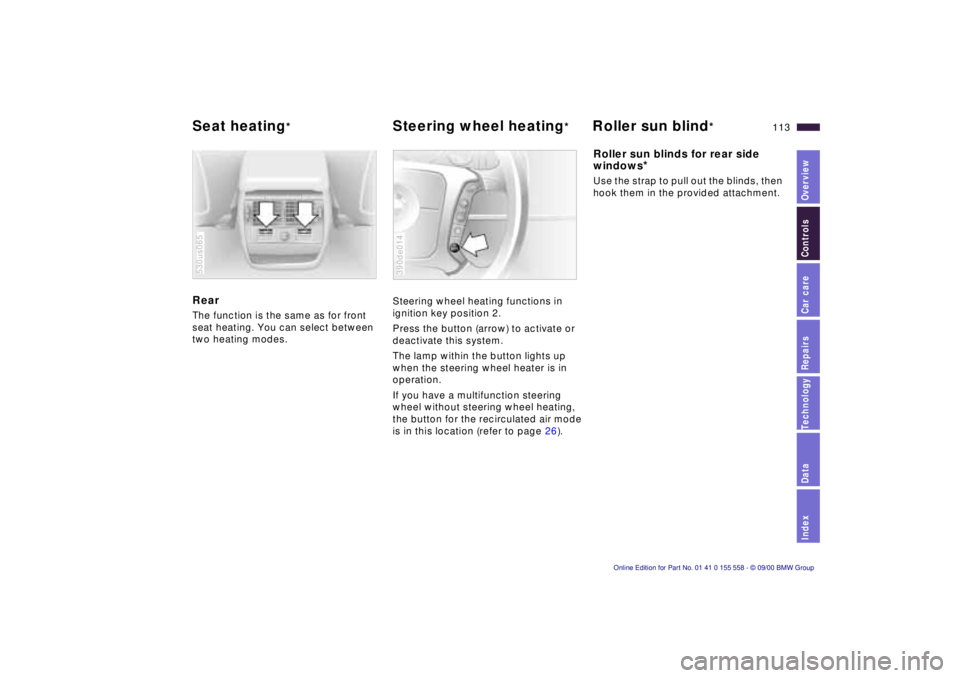
RearThe function is the same as for front
seat heating. You can select between
two heating modes.530us065
Steering wheel heating functions in
ignition key position 2.
Press the button (arrow) to activate or
deactivate this system.
The lamp within the button lights up
when the steering wheel heater is in
operation.
If you have a multifunction steering
wheel without steering wheel heating,
the button for the recirculated air mode
is in this location (refer to page 26).390de014
Roller sun blinds for rear side
windows
*
Use the strap to pull out the blinds, then
hook them in the provided attachment.
Page 156 of 223
156n
Washer fluid Washer nozzlesHeadlamp
* and windshield
washer system
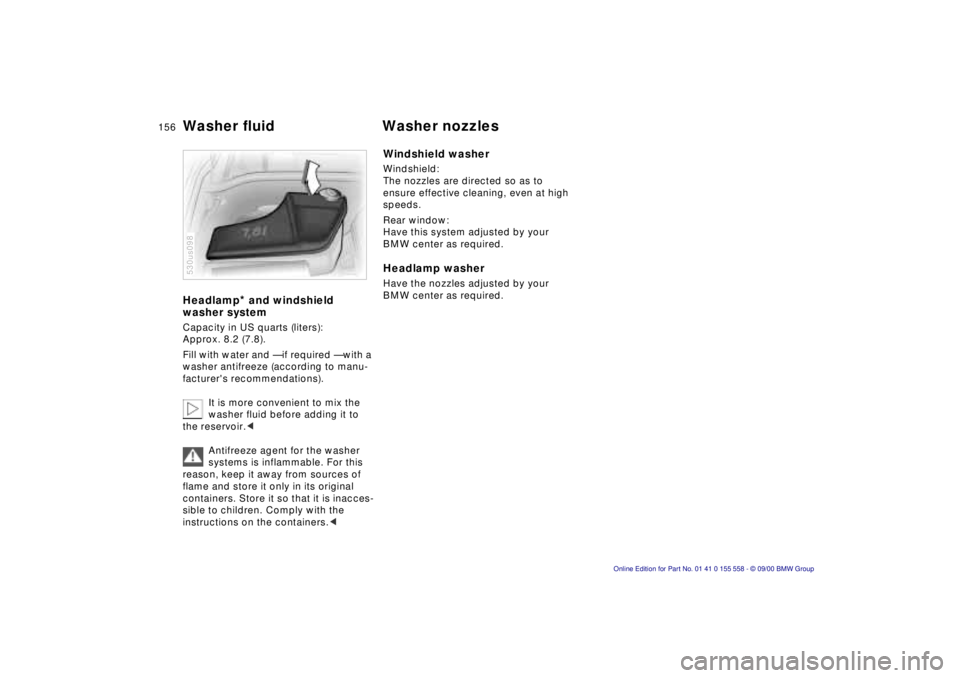
Capacity in US quarts (liters):
Approx. 8.2 (7.8).
Fill with water and — if required — with a
washer antifreeze (according to manu-
facturer's recommendations).
It is more convenient to mix the
washer fluid before adding it to
the reservoir.<
Antifreeze agent for the washer
systems is inflammable. For this
reason, keep it away from sources of
flame and store it only in its original
containers. Store it so that it is inacces-
sible to children. Comply with the
instructions on the containers.<530us098
Windshield washer Windshield:
The nozzles are directed so as to
ensure effective cleaning, even at high
speeds.
Rear window:
Have this system adjusted by your
BMW center as required. Headlamp washerHave the nozzles adjusted by your
BMW center as required.
Page 165 of 223

IndexDataTechnologyRepairsCar careControlsOverview
165n
Caring for your vehicleCaring for the vehicle finish Regular washing is a preventive
measure against long-term effects from
substances that are harmful to the
vehicle's finish, especially if you drive
your vehicle in areas with high levels of
air pollution or aggressive natural
substances (tree resins, pollen).
Nevertheless, you should immediately
remove especially aggressive
substances. Failure to do so can lead to
changes in the paint's chemical struc-
ture or to discoloration. Fuel spilled
during refueling, oil, grease and brake
fluid should always be cleaned away
immediately, as should bird droppings
(finish damage).
Any contamination remaining on the
surface of the vehicle will be especially
conspicuous after washing. Use
cleaning fluid or alcohol with a clean
cloth or cotton pad to remove these
stains. Remove tar spots with tar
remover. After cleaning, the affected
areas should be waxed to ensure
continued protection.
Waxing your vehicle Protect the finish using carnauba or
synthetic-based waxes only.
The best way to determine when the
finish needs to be waxed is by noting
when water stops beading on the
surface.
You can use a glass cleaner to remove
any wax or silicone that may have been
left on the windows during waxing.
Paint damageYou can touch up small areas of
damage with BMW spray paint or a
BMW touchup stick.
The color code of your vehicle is
provided on a tag on the right-hand
panel under the hood and on the first
page of the Service and Warranty Infor-
mation Booklet (US models) or the
Warranty and Service Guide Booklet
(Canadian models).
Damage caused by flying stones,
scratches, etc., must be touched up
without delay to prevent rust from
forming.
If corrosion has started to form in an
area with paint damage, remove all rust
and clean the area. Then prime the area
with a BMW Primer Stick. Finally, apply
the finish coat. After a few days, polish
and protect the touched-in areas.
More extensive paint damage should
be professionally repaired in accor-
dance with the manufacturer's instruc-
tions. Your BMW center uses original
BMW finish materials in accordance
with factory repair procedures.
A full range of car-care products is
available from your BMW center.<
Page 166 of 223

166n
Caring for your vehicleWindow care You can use window and glass cleaner
to clean inside window surfaces and
mirrors without smearing and streaking.
Never use polishing pastes or abrasive
(quartz) cleansers on mirror lenses.
Clean the wiper blades with soapy
water. The wiper blades should be
replaced twice a year, before and after
the cold season.
Use only wiper blades that have
been approved by BMW.<
Caring for other vehicle
components and materialsLight-alloy wheels should be treated
with alloy wheel cleaner, especially
during the winter months. However, do
not use aggressive products containing
acids, strong alkalis or abrasives. Do
not use steam cleaners operating at
temperatures above +140 7 (+60 6).
Follow the manufacturer's instructions.
If your vehicle has chrome parts
* such
as window moldings, door handles or
other items, clean these parts carefully
with ample clean water, especially if
they have an accumulation of road salt.
Use chrome polish as an additional
treatment.
Plastic components, vinyl upholstery,
headliners, lamp lenses, the clear cover
of the instrument cluster and compo-
nents with a sprayed dull black surface
can be cleaned with water (add plastic
cleaner as required). Do not allow mois-
ture to soak through the seats or head-
liner. Never use solvents such as
lacquer thinner, heavy-duty grease
remover, fuels, etc. Rubber components should be cleaned
with water only; a rubber treatment or
silicone spray may also be applied.
The safety belts should be cleaned with
a mild soap and water solution without
being removed from the vehicle. Never
attempt chemical or dry cleaning, as
damage to the belt fabric could result.
After cleaning, never allow the inertia
reel to retract the belts until they are
completely dry. Dirty safety belts
prevent the inertia reel mechanism from
retracting the strap properly, and thus
constitute a safety hazard.
Heavily soiled floor carpets and mats
*
can be cleaned with an interior cleaner.
The floor mats can be removed from
the vehicle for cleaning.
Please use only a damp cloth to clean
wooden fascia panels and components.
Follow up by drying with a soft cloth.
A full range of car-care products is
available from your BMW center.<
Page 167 of 223

IndexDataTechnologyRepairsCar careControlsOverview
167n
Caring for your vehicleLeather care The leather
* upholstery used by BMW
is a natural product of the highest
quality, processed using state-of-the-
art methods to ensure that it will main-
tain its high quality for years to come,
provided that it is properly cared for.
Because this product is manufactured
using natural materials, you must make
allowance for its special characteristics
as well as for the peculiarities of its use
and care.
Regular periodic cleaning and care are
essential, as dust and road dirt act as
abrasives in the pores and creases of
the material. This leads to wear spots
and premature brittleness on the
surface of the leather. We therefore
suggest that you clean the leather with
a vacuum cleaner or dust cloth at
frequent intervals.
For cleaning use BMW leather cleaning
foam.
Since dirt and grease gradually affect
the protective surface layer of the
leather, the cleaned surfaces should be
treated with a BMW leather care agent.
This also acts as an antistatic agent. For protection against dampness or
moisture, treat the leather with a BMW
impregnating agent.
We recommend that you perform this
procedure twice a year on leather
exposed to normal use.
Spills should be wiped up immediately.
Remove grease and oil stains without
rubbing, but rather by dabbing with
spot remover.
If the upholstery is to be exposed to
intense sunlight or if the vehicle is to be
stored for an extended period, cover all
leather surfaces (or, better yet, the
windows) to prevent fading.
A full range of car-care products is
available from your BMW center.<
Cleaning agents can contain
substances that are dangerous or
pose health risks. For this reason,
always read and comply with the warn-
ings and danger notices on the
package.
Open the doors or windows on your
vehicle before cleaning the interior.
Never clean your vehicle with cleaning
agents (or solvents) not specifically
intended for this purpose.<
Page 174 of 223
174n
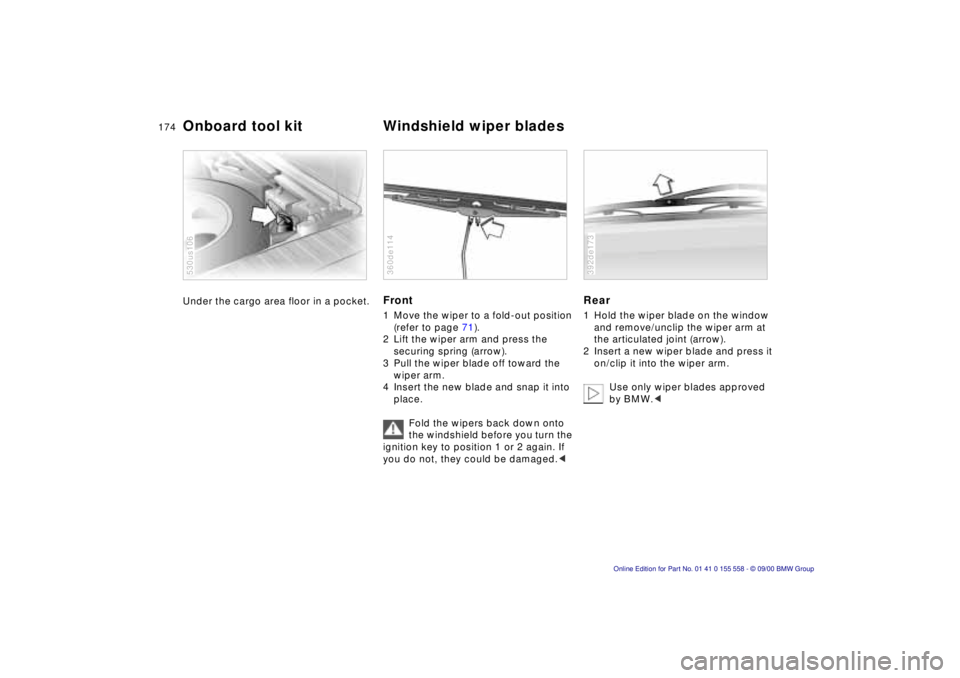
Under the cargo area floor in a pocket.
530us106
Front 1 Move the wiper to a fold-out position
(refer to page 71).
2 Lift the wiper arm and press the
securing spring (arrow).
3 Pull the wiper blade off toward the
wiper arm.
4 Insert the new blade and snap it into
place.
Fold the wipers back down onto
the windshield before you turn the
ignition key to position 1 or 2 again. If
you do not, they could be damaged.< 360de114
Rear
1 Hold the wiper blade on the window
and remove/unclip the wiper arm at
the articulated joint (arrow).
2 Insert a new wiper blade and press it
on/clip it into the wiper arm.
Use only wiper blades approved
by BMW.< 392de173
Onboard tool kit Windshield wiper blades
Page 191 of 223
IndexDataTechnologyRepairsCar careControlsOverview
191n
Jump-starting Towing the vehicle 6 Start the engine on the support
vehicle and let it run.
7 Start the engine on the vehicle
needing the jump-start, and allow it
to run as usual. If the first start
attempt is not successful, wait a few
minutes before another attempt in
order to allow the discharged battery
to recharge.
8 Before disconnecting the jumper
cables from your BMW, turn on the
rear window defroster and set the
blower to the highest speed;
allow the engine to run approx.
10 seconds. This will prevent a
voltage surge from the voltage regu-
lator to the electrical accessories.
9 Then disconnect the jumper cables in
reverse sequence.
Have the battery recharged if neces-
sary.
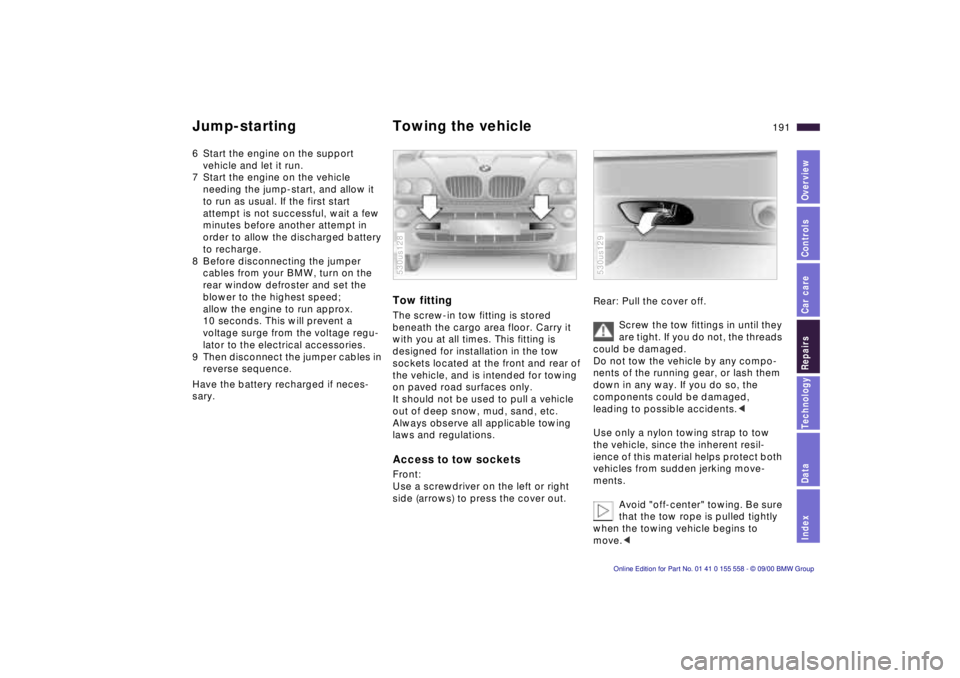
Tow fitting The screw-in tow fitting is stored
beneath the cargo area floor. Carry it
with you at all times. This fitting is
designed for installation in the tow
sockets located at the front and rear of
the vehicle, and is intended for towing
on paved road surfaces only.
It should not be used to pull a vehicle
out of deep snow, mud, sand, etc.
Always observe all applicable towing
laws and regulations. Access to tow sockets Front:
Use a screwdriver on the left or right
side (arrows) to press the cover out. 530us128
Rear: Pull the cover off.
Screw the tow fittings in until they
are tight. If you do not, the threads
could be damaged.
Do not tow the vehicle by any compo-
nents of the running gear, or lash them
down in any way. If you do so, the
components could be damaged,
leading to possible accidents.<
Use only a nylon towing strap to tow
the vehicle, since the inherent resil-
ience of this material helps protect both
vehicles from sudden jerking move-
ments.
Avoid "off-center" towing. Be sure
that the tow rope is pulled tightly
when the towing vehicle begins to
move.< 530us129
Page 192 of 223
192n
Towing the vehicle
The towed vehicle should always
be the lighter of the two vehicles.
If this is not the case, it is no longer
possible to control vehicle response.<
Tow-starting It is not possible to start the engine of a
vehicle equipped with an automatic
transmission by towing or pushing.
For instructions on jump starting: refer
to page 190.
Never attempt to use your vehicle to
push another car. If you do so, damage
to the energy-absorbing bumpers could
result.
Towing a vehicle with automatic
transmission1 Place the selector lever in position N.
2 Towing speed:
Max. 45 mph (70 km/h).
3 Towing distance:
Max. 95 miles (150 km).
4 Leave the ignition key at position 1 to
ensure that the brake lamps, turn
signals, horn and windshield wipers
remain operative, and to prevent the
steering lock from engaging.
5 Switch on the hazard warning
flashers (comply with country-
specific regulations).
Find some means of identifying the
vehicle in tow, for instance, place a sign
or warning triangle in the rear window.
Make sure that the ignition key
remains in position 1 even when
the electrical system has failed. This will
prevent the steering lock from
engaging. The steering and brakes are
without power assist when the engine is
not running. This means that increased
effort is required for steering and
braking.<
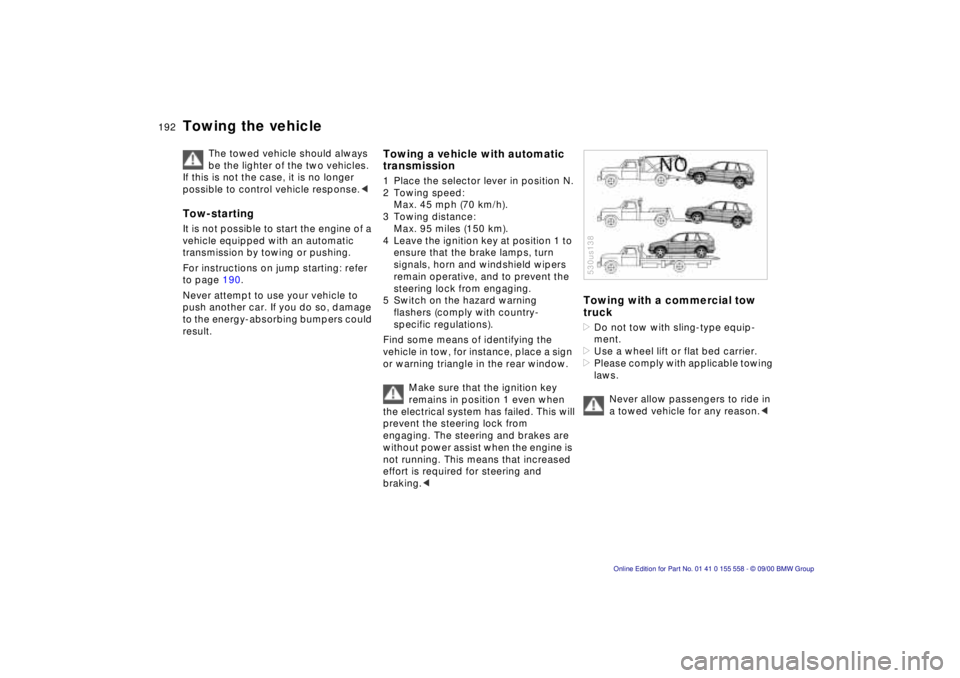
Towing with a commercial tow
truck>Do not tow with sling-type equip-
ment.
>Use a wheel lift or flat bed carrier.
>Please comply with applicable towing
laws.
Never allow passengers to ride in
a towed vehicle for any reason.< 530us138
Page 198 of 223
198nRadio reception Safety belt tensioner
Radio waves — mediumwave, long-
wave and shortwave — offer a wide
range of reception, because the broad-
cast signals travel not only along the
ground as surface waves, but also as
waves bounced back to earth from the
ionosphere.
Frequency-modulation (FM) provides
substantially better sound quality than
AM. However, because FM transmis-
sions rely on line-of-sight broadcast
waves, their effective reception range is
limited.
360de084
Although numerous factors combine
to impose inherent limitations on the
reception quality available from mobile
radios, specially designed systems can
be employed to minimize their effects:
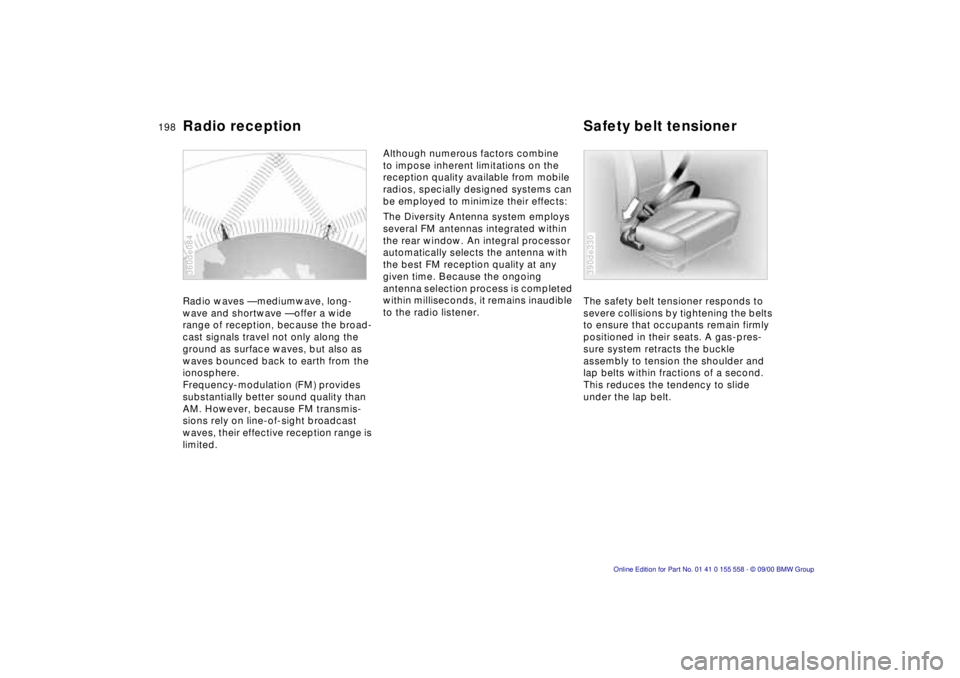
The Diversity Antenna system employs
several FM antennas integrated within
the rear window. An integral processor
automatically selects the antenna with
the best FM reception quality at any
given time. Because the ongoing
antenna selection process is completed
within milliseconds, it remains inaudible
to the radio listener. The safety belt tensioner responds to
severe collisions by tightening the belts
to ensure that occupants remain firmly
positioned in their seats. A gas-pres-
sure system retracts the buckle
assembly to tension the shoulder and
lap belts within fractions of a second.
This reduces the tendency to slide
under the lap belt.
390de330