transmission BMW X5 3.0I 2002 User Guide
[x] Cancel search | Manufacturer: BMW, Model Year: 2002, Model line: X5 3.0I, Model: BMW X5 3.0I 2002Pages: 185, PDF Size: 2.7 MB
Page 73 of 185
73n
OverviewControlsMaintenanceRepairsDataIndex
To interrupt the cruise control When the system is activated, press
button 1. The indicator lamp stays on.
You can use the cruise control again
whenever required by calling up the
speed that was stored last.
In addition, the system is automatically
deactivated in response to the following
conditions:
>When you apply pressure to the
brake pedal
>When you apply pressure to the
clutch pedal or when you move the
automatic transmission selector lever
from "Drive" to "Neutral"
>If you exceed or fall below the
controlled speed for an extended
period (by depressing the acceler-
ator, for example). To recall the stored setting Press button:
The vehicle accelerates to and main-
tains the last speed stored.
Page 94 of 185
94n
Hill Descent Control (HDC) The concept HDC is a system for driving downhill in
steep terrain. This system reduces
vehicle speed on steep downhill gradi-
ents, thus allowing you to maintain
control of your BMW under these
conditions.
The vehicle moves at slightly more than
walking speed without active interven-
tion from the driver.
HDC is available for activation at
vehicle speeds below approx. 20 mph
(35 km/h). When driving down steep
hills with a speed below approx.
20 mph (35 km/h), the vehicle reduces
speed automatically down to slightly
more than walking speed (approx.
5 mph/8 km/h) and then maintains this
speed at a constant.
You can use the accelerator or brakes
to vary this automatically controlled
speed within a range extending from
approx. 3 mph (5 km/h) to 15 mph
(25 km/h).
You can use the +/Ð button to set the
cruise control to a target speed in the
range from approx. 3 mph (5 km/h) to
15 mph (25 km/h).
HDC is automatically deactivated once
vehicle speed again exceeds approx.
35 mph (60 km/h).
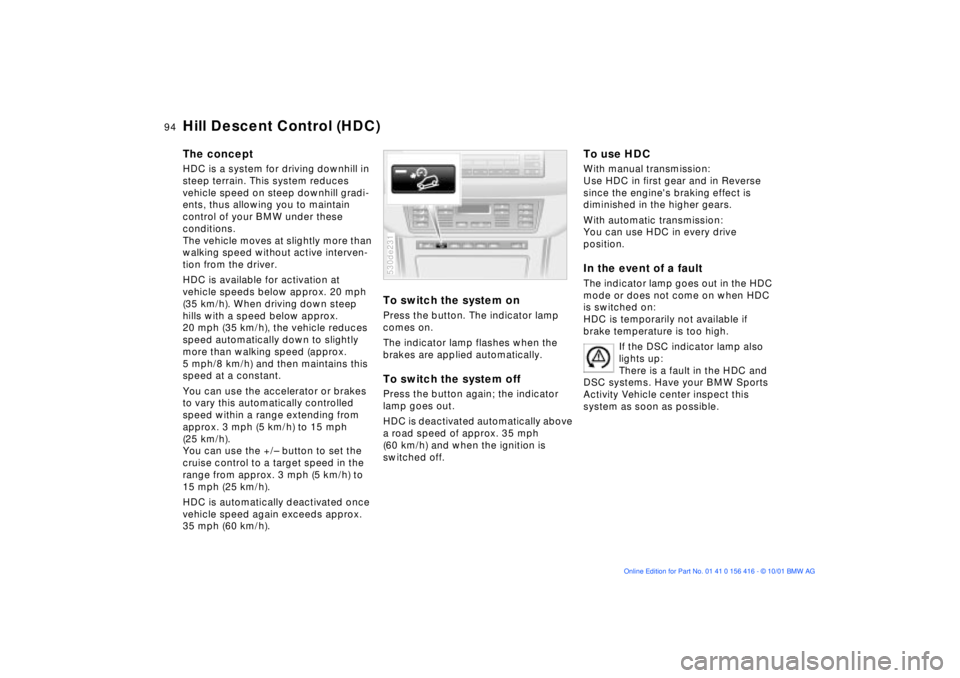
To switch the system onPress the button. The indicator lamp
comes on.
The indicator lamp flashes when the
brakes are applied automatically. To switch the system offPress the button again; the indicator
lamp goes out.
HDC is deactivated automatically above
a road speed of approx. 35 mph
(60 km/h) and when the ignition is
switched off. 530de231
To use HDC With manual transmission:
Use HDC in first gear and in Reverse
since the engine's braking effect is
diminished in the higher gears.
With automatic transmission:
You can use HDC in every drive
position. In the event of a faultThe indicator lamp goes out in the HDC
mode or does not come on when HDC
is switched on:
HDC is temporarily not available if
brake temperature is too high.
If the DSC indicator lamp also
lights up:
There is a fault in the HDC and
DSC systems. Have your BMW Sports
Activity Vehicle center inspect this
system as soon as possible.
Page 113 of 185
113n
OverviewControlsMaintenanceRepairsDataIndex
The concept The BMW Universal Transmitter
replaces up to three hand-held trans-
mitters of different devices such as
garage door openers, alarm systems, or
door locking systems. The BMW
Universal Transmitter recognizes and
"learns" the transmitted signal of each
of the original hand-held transmitters.
The signal of an original hand-held
transmitter can be programmed on one
of the three channel keys. Following
that, each of the devices can be actu-ated with the appropriately-programmed
channel key. The indicator lamp flashes
to confirm transmission of the signal.
If the vehicle is sold, the memory of the
channel keys should be cleared as
described on page 115.
During programming and before
every remote actuation of a
programmed device by the BMW
Universal Transmitter, check to be sure
that there are no persons, animals or
objects within the actuation range of
the device in order to prevent possible
injuries or damage. Also, comply with
the safety precautions of the original
hand-held transmitter.<
To Canadian residents:
During programming, your hand-
held transmitter may automatically stop
transmitting after two seconds. This
may not be long enough to program the
BMW Universal Transmitter. If you are
programming from one of these hand-
held transmitters, the Universal Trans-
mitter's light may begin to flash in a
series of double-blinks. If this occurs,
continue to hold the button of the
Universal Transmitter while you reacti-
vate your hand-held transmitter. You
may have to repeat this function several
times while programming.<
Before programming, read the
"User information" section on
page 115.<
Original hand-held transmitter
If this symbol is present on the
packaging or in the instructions
of the original hand-held trans-
mitter, it may be assumed that this
hand-held transmitter is compatible
with the BMW Universal Transmitter.
Checking for the conversion code To determine whether the original
hand-held transmitter is provided with
a conversion-code system, you may
either read the instructions for the orig-
inal hand-held transmitter or program a
channel key as described on the next
page (left-hand column under
"Programming").
Then press and hold the programmed
channel key of the BMW Universal
Transmitter. If the indicator lamp of the
BMW Universal Transmitter flashes for
two seconds and then comes on
steadily, the original hand-held trans-
mitter is provided with a conversion-
code system. With a conversion-code
system, program the channel keys as
described on the next page (right-hand
column under "Programming a hand-
held transmitter with conversion code").
If you have additional questions,
please consult your BMW Sports
Activity Vehicle center or call
1-800-355-3515.
You can also visit this website:
www.bmwusa.com.<
BMW Universal Transmitter
Page 114 of 185
114n
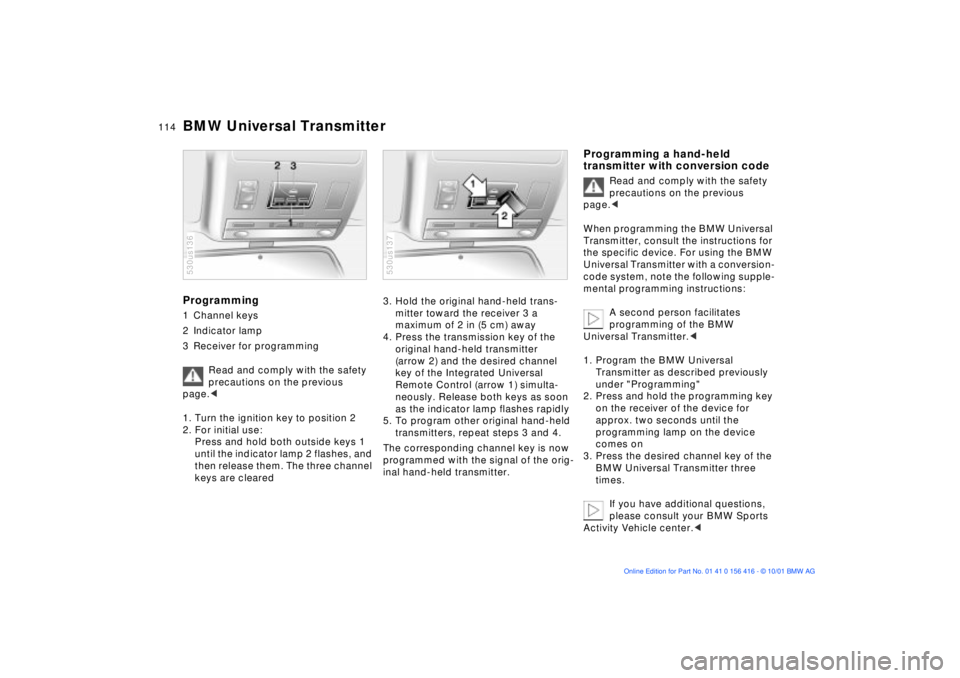
BMW Universal TransmitterProgramming 1 Channel keys
2 Indicator lamp
3 Receiver for programming
Read and comply with the safety
precautions on the previous
page.<
1. Turn the ignition key to position 2
2. For initial use:
Press and hold both outside keys 1
until the indicator lamp 2 flashes, and
then release them. The three channel
keys are cleared 530us136
3. Hold the original hand-held trans-
mitter toward the receiver 3 a
maximum of 2 in (5 cm) away
4. Press the transmission key of the
original hand-held transmitter
(arrow 2) and the desired channel
key of the Integrated Universal
Remote Control (arrow 1) simulta-
neously. Release both keys as soon
as the indicator lamp flashes rapidly
5. To program other original hand-held
transmitters, repeat steps 3 and 4.
The corresponding channel key is now
programmed with the signal of the orig-
inal hand-held transmitter. 530us137
Programming a hand-held
transmitter with conversion code
Read and comply with the safety
precautions on the previous
page.<
When programming the BMW Universal
Transmitter, consult the instructions for
the specific device. For using the BMW
Universal Transmitter with a conversion-
code system, note the following supple-
mental programming instructions:
A second person facilitates
programming of the BMW
Universal Transmitter.<
1. Program the BMW Universal
Transmitter as described previously
under "Programming"
2. Press and hold the programming key
on the receiver of the device for
approx. two seconds until the
programming lamp on the device
comes on
3. Press the desired channel key of the
BMW Universal Transmitter three
times.
If you have additional questions,
please consult your BMW Sports
Activity Vehicle center.<
Page 144 of 185
144n
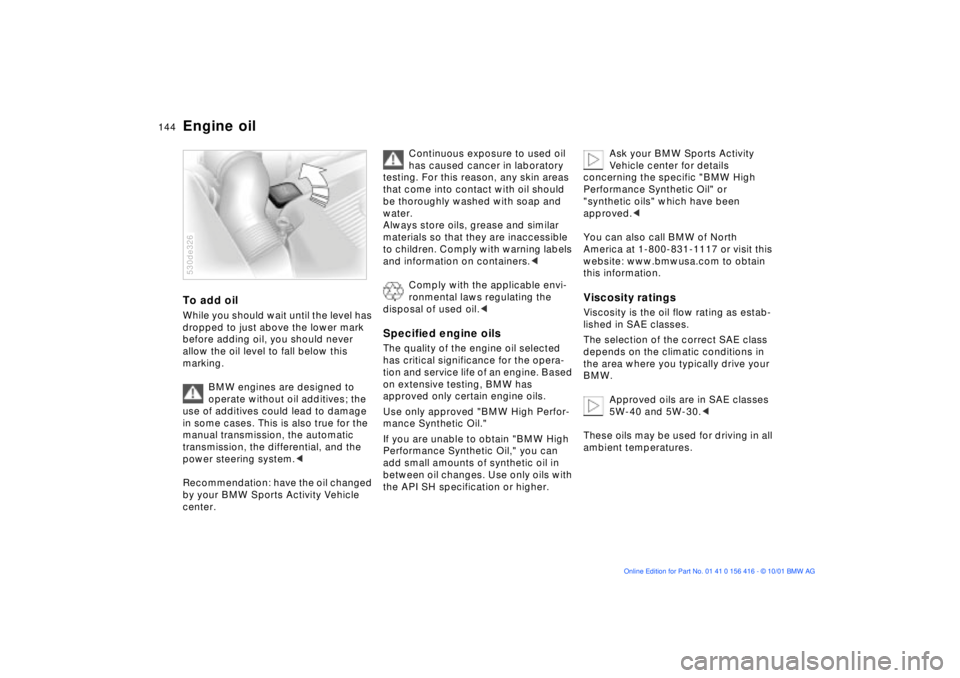
Engine oil To add oilWhile you should wait until the level has
dropped to just above the lower mark
before adding oil, you should never
allow the oil level to fall below this
marking.
BMW engines are designed to
operate without oil additives; the
use of additives could lead to damage
in some cases. This is also true for the
manual transmission, the automatic
transmission, the differential, and the
power steering system.<
Recommendation: have the oil changed
by your BMW Sports Activity Vehicle
center. 530de326
Continuous exposure to used oil
has caused cancer in laboratory
testing. For this reason, any skin areas
that come into contact with oil should
be thoroughly washed with soap and
water.
Always store oils, grease and similar
materials so that they are inaccessible
to children. Comply with warning labels
and information on containers.<
Comply with the applicable envi-
ronmental laws regulating the
disposal of used oil.<
Specified engine oils The quality of the engine oil selected
has critical significance for the opera-
tion and service life of an engine. Based
on extensive testing, BMW has
approved only certain engine oils.
Use only approved "BMW High Perfor-
mance Synthetic Oil."
If you are unable to obtain "BMW High
Performance Synthetic Oil," you can
add small amounts of synthetic oil in
between oil changes. Use only oils with
the API SH specification or higher.
Ask your BMW Sports Activity
Vehicle center for details
concerning the specific "BMW High
Performance Synthetic Oil" or
"synthetic oils" which have been
approved.<
You can also call BMW of North
America at 1-800-831-1117 or visit this
website: www.bmwusa.com to obtain
this information.
Viscosity ratings Viscosity is the oil flow rating as estab-
lished in SAE classes.
The selection of the correct SAE class
depends on the climatic conditions in
the area where you typically drive your
BMW.
Approved oils are in SAE classes
5W-40 and 5W-30.<
These oils may be used for driving in all
ambient temperatures.
Page 156 of 185
156n
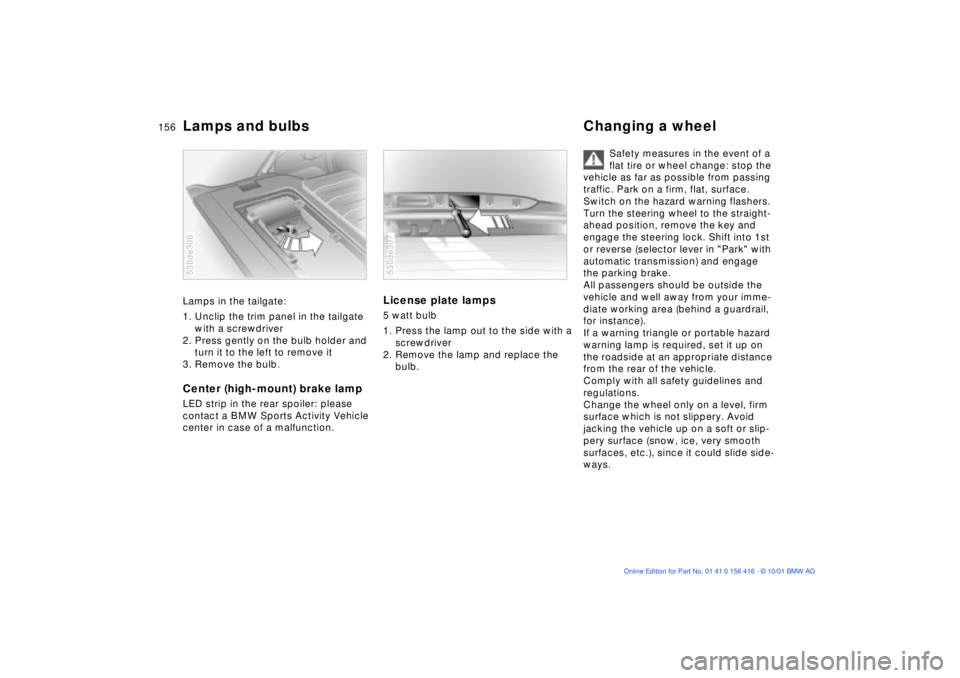
Lamps and bulbs Changing a wheel Lamps in the tailgate:
1. Unclip the trim panel in the tailgate
with a screwdriver
2. Press gently on the bulb holder and
turn it to the left to remove it
3. Remove the bulb. Center (high-mount) brake lamp LED strip in the rear spoiler: please
contact a BMW Sports Activity Vehicle
center in case of a malfunction. 530de306
License plate lamps 5 watt bulb
1. Press the lamp out to the side with a
screwdriver
2. Remove the lamp and replace the
bulb. 530de307
Safety measures in the event of a
flat tire or wheel change: stop the
vehicle as far as possible from passing
traffic. Park on a firm, flat, surface.
Switch on the hazard warning flashers.
Turn the steering wheel to the straight-
ahead position, remove the key and
engage the steering lock. Shift into 1st
or reverse (selector lever in "Park" with
automatic transmission) and engage
the parking brake.
All passengers should be outside the
vehicle and well away from your imme-
diate working area (behind a guardrail,
for instance).
If a warning triangle or portable hazard
warning lamp is required, set it up on
the roadside at an appropriate distance
from the rear of the vehicle.
Comply with all safety guidelines and
regulations.
Change the wheel only on a level, firm
surface which is not slippery. Avoid
jacking the vehicle up on a soft or slip-
pery surface (snow, ice, very smooth
surfaces, etc.), since it could slide side-
ways.
Page 166 of 185
166n
Towing the vehicle Tow fittingThe screw-in tow fitting is stored
beneath the cargo area floor. Carry it
with you at all times. This fitting is
designed for installation in the tow
sockets located at the front and rear of
the vehicle, and is intended for towing
on paved road surfaces only.
It should not be used to pull a vehicle
out of deep snow, mud, sand, etc.
Always observe all applicable towing
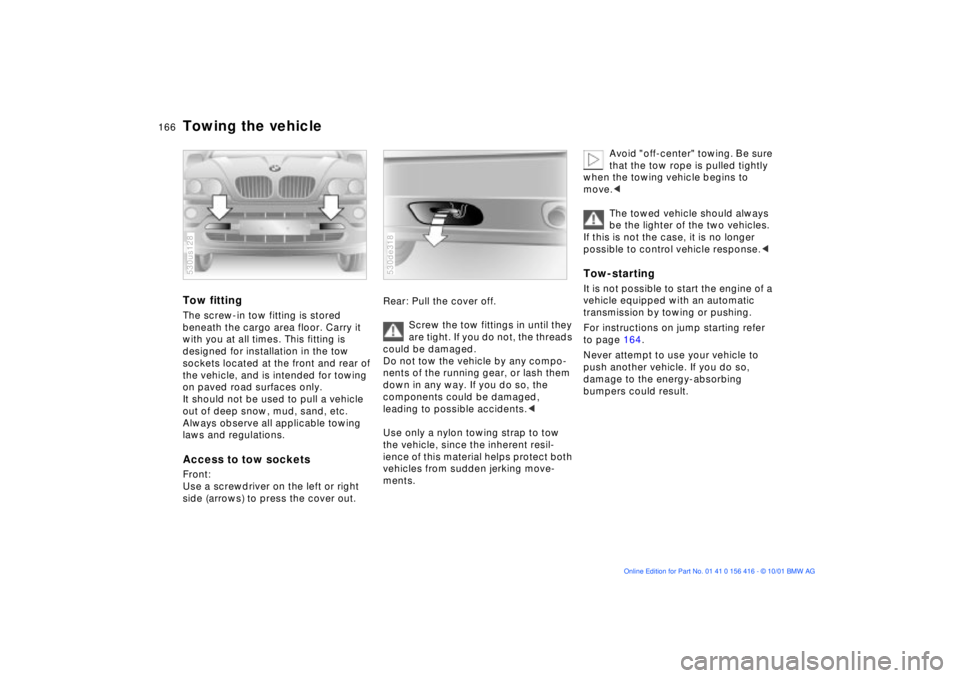
laws and regulations. Access to tow sockets Front:
Use a screwdriver on the left or right
side (arrows) to press the cover out. 530us128
Rear: Pull the cover off.
Screw the tow fittings in until they
are tight. If you do not, the threads
could be damaged.
Do not tow the vehicle by any compo-
nents of the running gear, or lash them
down in any way. If you do so, the
components could be damaged,
leading to possible accidents.<
Use only a nylon towing strap to tow
the vehicle, since the inherent resil-
ience of this material helps protect both
vehicles from sudden jerking move-
ments. 530de318
Avoid "off-center" towing. Be sure
that the tow rope is pulled tightly
when the towing vehicle begins to
move.<
The towed vehicle should always
be the lighter of the two vehicles.
If this is not the case, it is no longer
possible to control vehicle response.<
Tow-startingIt is not possible to start the engine of a
vehicle equipped with an automatic
transmission by towing or pushing.
For instructions on jump starting refer
to page 164.
Never attempt to use your vehicle to
push another vehicle. If you do so,
damage to the energy-absorbing
bumpers could result.
Page 167 of 185
167n
OverviewControlsMaintenanceRepairsDataIndex
Towing the vehicle Towing a vehicle with automatic
transmission1. Place the selector lever in position N
2. Towing speed:
Max. 45 mph (70 km/h)
3. Towing distance:
Max. 95 miles (150 km)
4. Leave the ignition key at position 1 to
ensure that the brake lamps, turn
signals, horn and windshield wipers
remain operative, and to prevent the
steering lock from engaging
5. Switch on the hazard warning
flashers (comply with country-
specific regulations).
Find some means of identifying the
vehicle in tow, for instance, place a sign
or warning triangle in the rear window.
Make sure that the ignition key
remains in position 1 even when
the electrical system has failed. This will
prevent the steering lock from
engaging. The steering and brakes are
without power assist when the engine is
not running. This means that increased
effort is required for steering and
braking.<
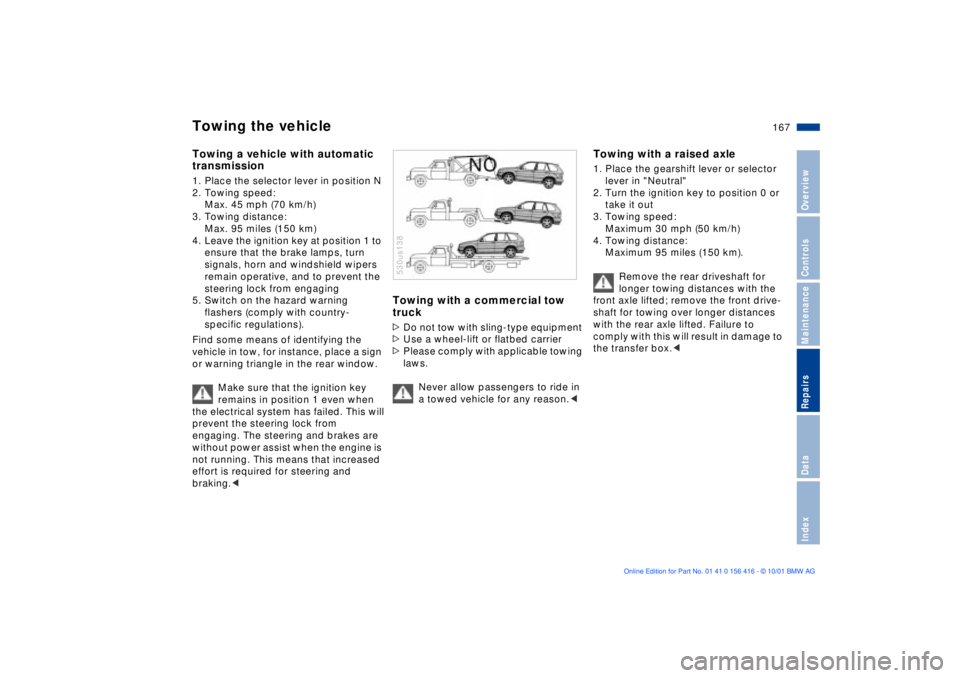
Towing with a commercial tow
truck >Do not tow with sling-type equipment
>Use a wheel-lift or flatbed carrier
>Please comply with applicable towing
laws.
Never allow passengers to ride in
a towed vehicle for any reason.< 530us138
Towing with a raised axle 1. Place the gearshift lever or selector
lever in "Neutral"
2. Turn the ignition key to position 0 or
take it out
3. Towing speed:
Maximum 30 mph (50 km/h)
4. Towing distance:
Maximum 95 miles (150 km).
Remove the rear driveshaft for
longer towing distances with the
front axle lifted; remove the front drive-
shaft for towing over longer distances
with the rear axle lifted. Failure to
comply with this will result in damage to
the transfer box.<
Page 172 of 185

172n
Weights BMW X5 3.0i BMW X5 4.4i BMW X5 4.6is
Curb weight (with one person, ready for operation, full tank of fuel, options not included)
with manual transmission
with automatic transmission Ibs (kg)
Ibs (kg)4533 (2056)
4586 (2080) Ð
4824 (2188) Ð
4824 (2188)
Approved gross vehicle weight
with manual transmission
with automatic transmission Ibs (kg)
Ibs (kg)6005 (2724)
6005 (2724) Ð
6005 (2724) Ð
6005 (2724)
Approved front axle load Ibs (kg)
2787 (1264) 2787 (1264) 2787 (1264)
Approved rear axle load Ibs (kg) 3307 (1500) 3307 (1500) 3307 (1500)
Approved roof load capacity Ibs (kg) 220 (100)
Never exceed either the approved axle loads or the gross vehicle weight .
Cargo area capacity cu ft (l) 16.4 Ð 54.4 (465 Ð 1540) Ð according to DIN
69.04 (1955) Ð according to SAE
Page 173 of 185
173n
OverviewControlsMaintenanceRepairsDataIndex
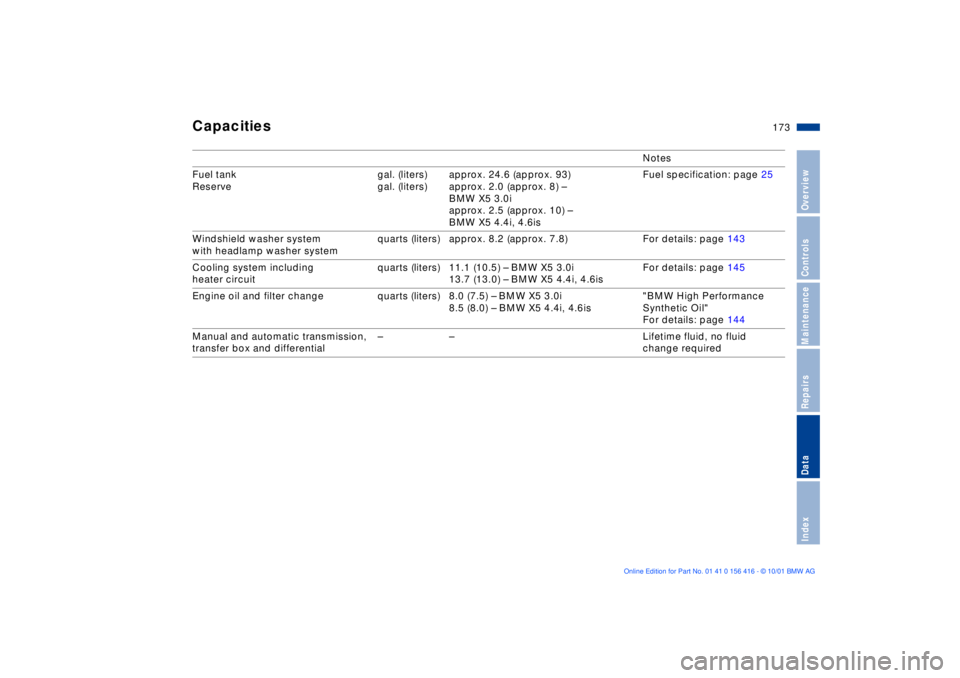
Capacities
Notes
Fuel tank
Reserve gal. (liters)
gal. (liters)approx. 24.6 (approx. 93)
approx. 2.0 (approx. 8) Ð
BMW X5 3.0i
approx. 2.5 (approx. 10) Ð
BMW X5 4.4i, 4.6isFuel specification: page 25
Windshield washer system
with headlamp washer system quarts (liters) approx. 8.2 (approx. 7.8) For details: page 143
Cooling system including
heater circuit quarts (liters) 11.1 (10.5) Ð BMW X5 3.0i
13.7 (13.0) Ð BMW X5 4.4i, 4.6isFor details: page 145
Engine oil and filter change quarts (liters) 8.0 (7.5) Ð BMW X5 3.0i
8.5 (8.0) Ð BMW X5 4.4i, 4.6is"BMW High Performance
Synthetic Oil"
For details: page 144
Manual and automatic transmission,
transfer box and differential Ð Ð Lifetime fluid, no fluid
change required