tow BMW X5 3.0I 2002 Owner's Manual
[x] Cancel search | Manufacturer: BMW, Model Year: 2002, Model line: X5 3.0I, Model: BMW X5 3.0I 2002Pages: 185, PDF Size: 2.7 MB
Page 132 of 185

132n
Break-in proceduresTo ensure that your vehicle provides
maximum economy throughout a long
service life, we request that you
observe the following instructions: Engine and axle drive Up to 1,200 miles (2,000 km):
Drive at varying engine speeds and
road speeds, but do not exceed
4,500 rpm and the following road
speeds during this initial period:
6-cylinder engines: 100 mph (160 km/h)
8-cylinder engines: 106 mph (170 km/h)
Obey your local and state maximum
speed limits.
Refrain from using full throttle and avoid
pressing the accelerator beyond the
kickdown point.
Once you have driven 1,200 miles
(2,000 km), engine and vehicle speeds
can gradually be increased.
You should also comply with these
break-in procedures if the engine or
one of the axle drives is replaced later
in the course of the vehicle service life.
TiresDue to technical factors associated
with their manufacture, tires do not
achieve their full traction potential until
an initial break-in period has elapsed.
For this reason, drive with extra care
during the initial 200 miles (300 km).
Obey your local and state maximum
speed limits.
When the vehicle is operated on
wet or slushy roads, a wedge of
water may form between the tire and
the road surface. This phenomenon is
referred to as aquaplaning, or hydro-
planing, and can lead to partial or
complete loss of traction, vehicle
control and braking effectiveness.
Reduce your speed on wet roads.<
Brake systemApprox. 300 miles (500 km) must
elapse before the brake pads and
rotors achieve the optimal pad-surface
and wear patterns required for trouble-
free operation and long service life later
on.
To break in the separate parking brake
drums, apply the parking brake lightly
when coasting to a standstill (at a traffic
signal, for instance), provided that
traffic conditions allow you to do so.
To avoid corrosion, repeat this proce-
dure from time to time.
The brake lamps do not light up
when the parking brake is applied.
Vacuum for the brake system servo unit
on your BMW is available only when the
engine is running. When you move the
vehicle with the engine switched off Ð
when towing, for instance Ð substan-
tially higher levels of pedal force will be
required to brake the vehicle.<
Page 137 of 185

137n
OverviewControlsMaintenanceRepairsDataIndex
Tire condition Tire replacement Proceed carefully to the nearest
BMW Sports Activity Vehicle center or
professional tire center, or have the
vehicle towed in to have it, its wheels
and tires inspected.
Tire damage (up to and including blow-
outs) can endanger the lives of both the
vehicle occupants and other road
users.< To maintain good handling and vehicle
response, use only tires of a single
tread configuration from a single manu-
facturer. BMW tests and approves
wheel/tire combinations.
DOT Quality GradesTread wear
Traction AA A B C
Temperature A B C
All passenger vehicle tires must
conform to Federal Safety
Requirements in addition to these
grades.< Tread wearThe tread wear grade is a comparative
rating based on the wear rate of the tire
when tested under controlled condi-
tions on a specified government test
course.
For example, a tire graded 150 would
wear one and one-half (1g) times as
well on the government course as a tire
graded 100. The relative performance
of tires depends upon the actual condi-
tions of their use, however, and may
depart significantly from the norm due
to variations in driving habits, service
practices and differences in road char-
acteristics and climate.
TractionThe traction grades, from highest to
lowest, are AA, A, B, and C.
Those grades represent the tire's ability
to stop on wet pavement as measured
under controlled conditions on speci-
fied government test surfaces of
asphalt and concrete. A tire marked C
may have poor traction performance.
The traction grade assigned to
this tire is based on straight-
ahead braking traction tests, and does
not include acceleration, cornering,
aquaplaning, or peak traction charac-
teristics.<
Page 143 of 185
143n
OverviewControlsMaintenanceRepairsDataIndex
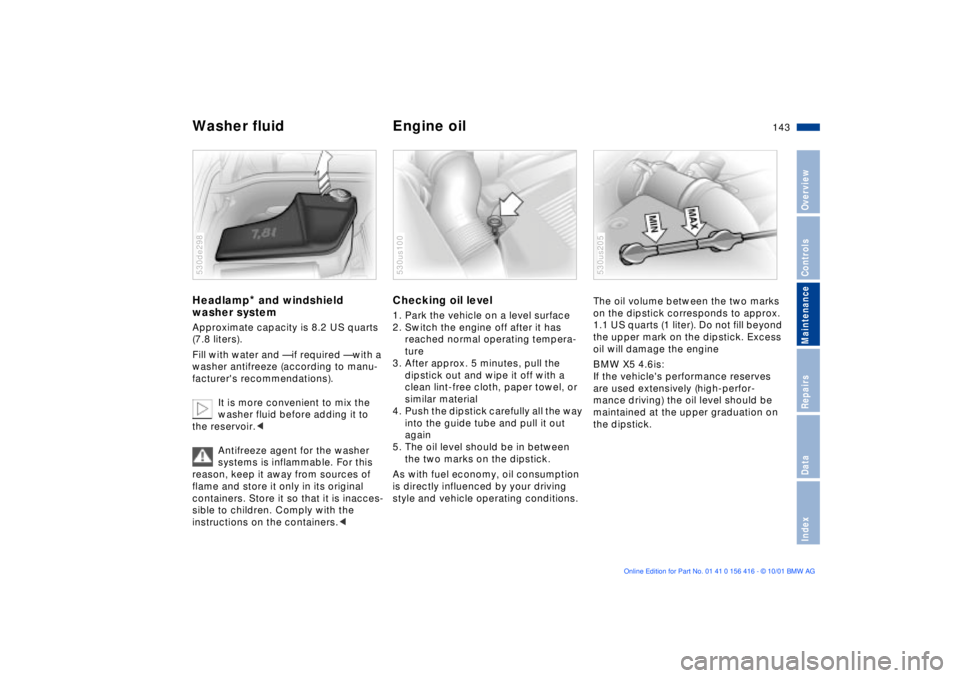
Washer fluid Engine oil Headlamp
* and windshield
washer system
Approximate capacity is 8.2 US quarts
(7.8 liters).
Fill with water and Ñ if required Ñ with a
washer antifreeze (according to manu-
facturer's recommendations).
It is more convenient to mix the
washer fluid before adding it to
the reservoir.<
Antifreeze agent for the washer
systems is inflammable. For this
reason, keep it away from sources of
flame and store it only in its original
containers. Store it so that it is inacces-
sible to children. Comply with the
instructions on the containers.< 530de298
Checking oil level 1. Park the vehicle on a level surface
2. Switch the engine off after it has
reached normal operating tempera-
ture
3. After approx. 5 minutes, pull the
dipstick out and wipe it off with a
clean lint-free cloth, paper towel, or
similar material
4. Push the dipstick carefully all the way
into the guide tube and pull it out
again
5. The oil level should be in between
the two marks on the dipstick.
As with fuel economy, oil consumption
is directly influenced by your driving
style and vehicle operating conditions. 530us100
The oil volume between the two marks
on the dipstick corresponds to approx.
1.1 US quarts (1 liter). Do not fill beyond
the upper mark on the dipstick. Excess
oil will damage the engine
BMW X5 4.6is:
If the vehicle's performance reserves
are used extensively (high-perfor-
mance driving) the oil level should be
maintained at the upper graduation on
the dipstick.530us205
Page 152 of 185
152n
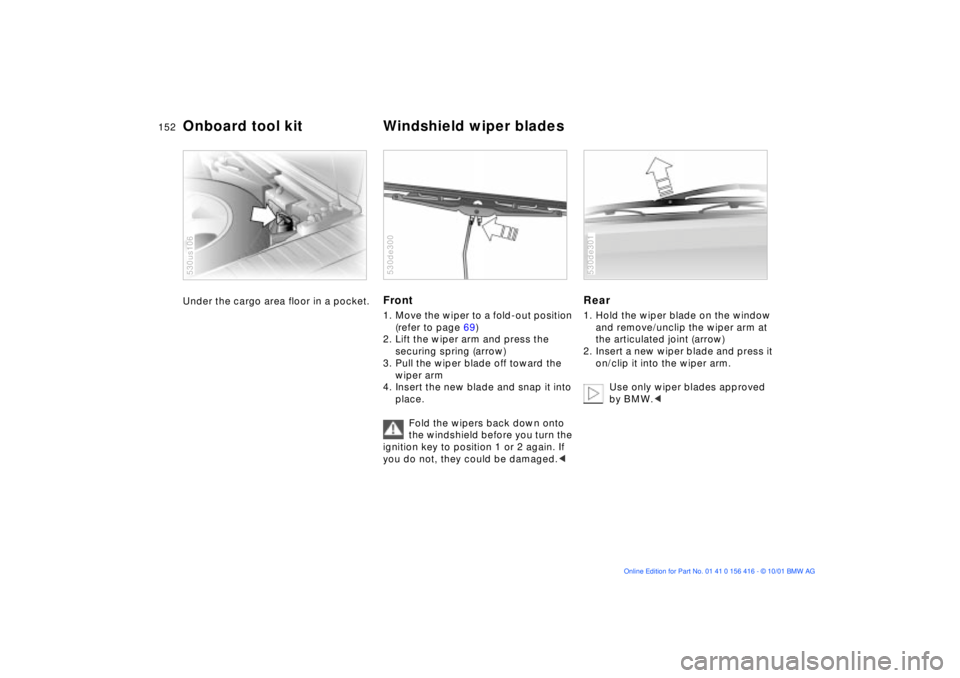
Under the cargo area floor in a pocket.
530us106
Front 1. Move the wiper to a fold-out position
(refer to page 69)
2. Lift the wiper arm and press the
securing spring (arrow)
3. Pull the wiper blade off toward the
wiper arm
4. Insert the new blade and snap it into
place.
Fold the wipers back down onto
the windshield before you turn the
ignition key to position 1 or 2 again. If
you do not, they could be damaged.< 530de300
Rear
1. Hold the wiper blade on the window
and remove/unclip the wiper arm at
the articulated joint (arrow)
2. Insert a new wiper blade and press it
on/clip it into the wiper arm.
Use only wiper blades approved
by BMW.< 530de301
Onboard tool kit Windshield wiper blades
Page 166 of 185
166n
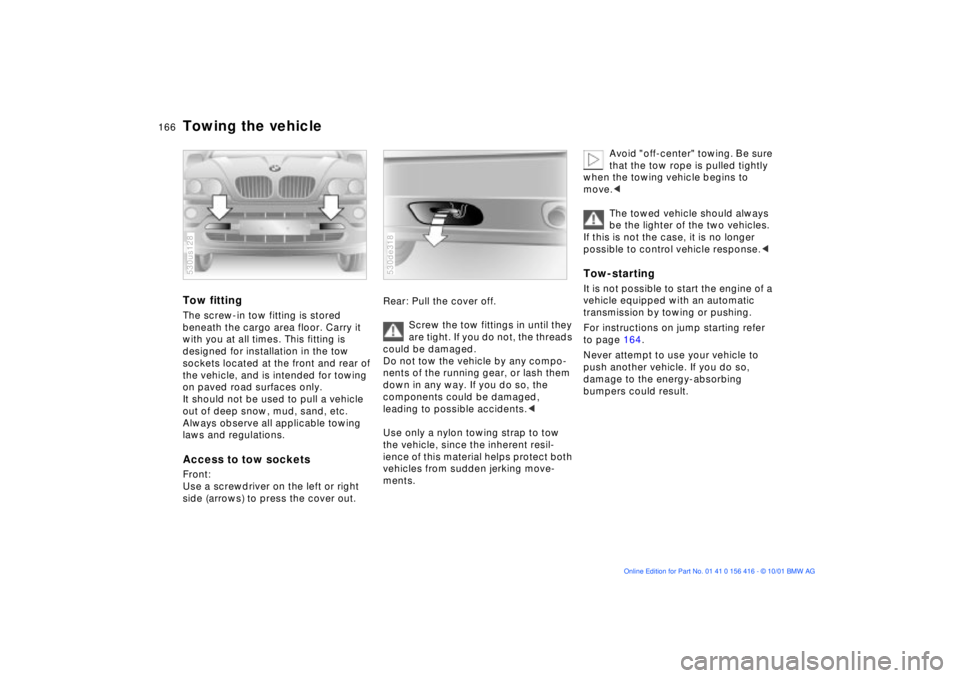
Towing the vehicle Tow fittingThe screw-in tow fitting is stored
beneath the cargo area floor. Carry it
with you at all times. This fitting is
designed for installation in the tow
sockets located at the front and rear of
the vehicle, and is intended for towing
on paved road surfaces only.
It should not be used to pull a vehicle
out of deep snow, mud, sand, etc.
Always observe all applicable towing
laws and regulations. Access to tow sockets Front:
Use a screwdriver on the left or right
side (arrows) to press the cover out. 530us128
Rear: Pull the cover off.
Screw the tow fittings in until they
are tight. If you do not, the threads
could be damaged.
Do not tow the vehicle by any compo-
nents of the running gear, or lash them
down in any way. If you do so, the
components could be damaged,
leading to possible accidents.<
Use only a nylon towing strap to tow
the vehicle, since the inherent resil-
ience of this material helps protect both
vehicles from sudden jerking move-
ments. 530de318
Avoid "off-center" towing. Be sure
that the tow rope is pulled tightly
when the towing vehicle begins to
move.<
The towed vehicle should always
be the lighter of the two vehicles.
If this is not the case, it is no longer
possible to control vehicle response.<
Tow-startingIt is not possible to start the engine of a
vehicle equipped with an automatic
transmission by towing or pushing.
For instructions on jump starting refer
to page 164.
Never attempt to use your vehicle to
push another vehicle. If you do so,
damage to the energy-absorbing
bumpers could result.
Page 167 of 185
167n
OverviewControlsMaintenanceRepairsDataIndex
Towing the vehicle Towing a vehicle with automatic
transmission1. Place the selector lever in position N
2. Towing speed:
Max. 45 mph (70 km/h)
3. Towing distance:
Max. 95 miles (150 km)
4. Leave the ignition key at position 1 to
ensure that the brake lamps, turn
signals, horn and windshield wipers
remain operative, and to prevent the
steering lock from engaging
5. Switch on the hazard warning
flashers (comply with country-
specific regulations).
Find some means of identifying the
vehicle in tow, for instance, place a sign
or warning triangle in the rear window.
Make sure that the ignition key
remains in position 1 even when
the electrical system has failed. This will
prevent the steering lock from
engaging. The steering and brakes are
without power assist when the engine is
not running. This means that increased
effort is required for steering and
braking.<
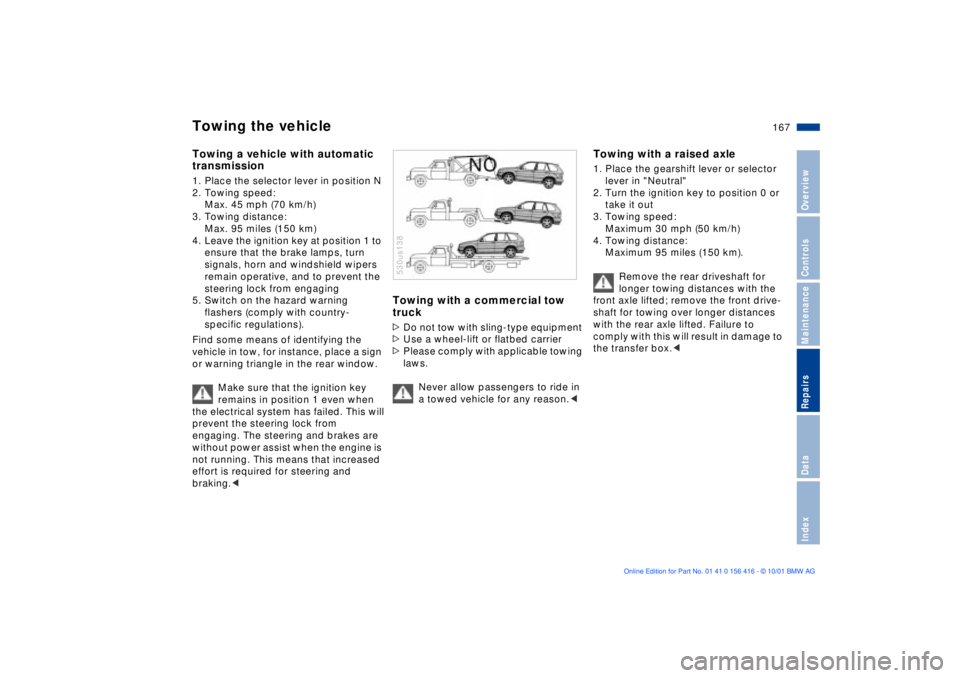
Towing with a commercial tow
truck >Do not tow with sling-type equipment
>Use a wheel-lift or flatbed carrier
>Please comply with applicable towing
laws.
Never allow passengers to ride in
a towed vehicle for any reason.< 530us138
Towing with a raised axle 1. Place the gearshift lever or selector
lever in "Neutral"
2. Turn the ignition key to position 0 or
take it out
3. Towing speed:
Maximum 30 mph (50 km/h)
4. Towing distance:
Maximum 95 miles (150 km).
Remove the rear driveshaft for
longer towing distances with the
front axle lifted; remove the front drive-
shaft for towing over longer distances
with the rear axle lifted. Failure to
comply with this will result in damage to
the transfer box.<
Page 178 of 185

Everything from A to ZEngine oil143t, 144
consumption143
grades144
level19
pressure18
Estimated time of arrival88
Exterior mirrors53
Exterior rearview mirrors,
automatic dimming
feature54FFailure of an electrical
accessory163t
Filling the windshield washer
reservoir143t
First-aid kit23t
Fittings, tow-starting and
towing166t
Flashlight116
Flat tire99, 136, 157t
Fog lamps101
bulb replacement155t
Folding rear backrest122
Footbrake135
Front area lighting102
Front fog lamps101
Front seat adjustment44Frost protection,
radiator145
Fuel25
capacity173
display75
gauge75
quality25
specifications25
Fuel consumption88
average88
Fuel filler door24
electrical malfunction24
Fuses163t
GGarage-door opener113
Gasoline25
General driving notes134
Glasses compartment118
Glove compartment116
Gross vehicle weight172
Ground clearance133HHandbrake64
Hands-free system117
Hazard warning flashers14
Hazard warning triangle23HDC (Hill Descent
Control)94
Head restraints47
Headlamp covers,
care154t
Headlamp flasher69
Headlamp washer
system70, 143
Heated seats51
Heated steering wheel53
Heating and
ventilation103, 106
Heating while stopped110
Heavy cargo127
Height171
Height adjustment
seats46
steering wheel52
High beams21, 101
bulb replacement153t
High-mount brake lamp156
Hill Descent Control
(HDC)94
Holder for cans, refer to
beverage holder117
Hood141t
Hood release141t
Hydraulic Brake Assistant
refer to DBC20
IIce warning74
Identification, tires139
Ignition key30
Ignition lock62
Imprint4
Independent ventilation
system85, 112
switching on and off85
Indicator lamps18
Inflation pressures,
tires136
monitoring98
INSPECTION76
Instrument cluster15, 17
Instrument lighting101
Instrument panel15, 17
Intensive cleaning
system70
Interior lamps102
remote control33
Interior mirror54
Interior motion sensor40
Interior rearview mirror,
automatic dimming
feature54
Interlock62
Intermittent wipe69
Page 181 of 185
Everything from A to Z
181n
OverviewControlsMaintenanceRepairsDataIndex
Socket
power supplies119t
vacuum cleaner119t
Spare key30
Spare tire158t
Spare wheel158
removal aid159t
Speaker117
Special features of winter
tires140
Special wash program70
Speed89
Speed control71
Speed limit86, 87
Speedometer15, 17
Sports seat45
Standing lamps101
Starting assistance164t
Starting
problems63t, 164t
Starting the engine62, 63
Steering wheel
adjustment52
adjustment, automatic52
heating53
lock62
memory50
Steering wheel with
multifunction buttons22
Steptronic66
Stopwatch84Storage compartments116
in the cargo area124
Summer tires139
Sunroof42
Sunshades112
Switching off the engine64
Switching off the vehicle64
Switch-on times
input85
Symbols8
Synthetic oils144
System malfunction
indicators77
TTachometer75
Tail lamps155t
bulb replacement155t
Tailgate37
opening from the
outside36
radio control operation33
release following an
electrical
malfunction38t
Tank capacity173
Technical
modifications10, 148
Telephone preparation117Temperature display,
outside
temperature74, 80
Temperature gauge76
Temperature
layering105, 110
Temperature setting108t
Thigh support
adjustment45
Third brake lamp156
Tilt alarm33
Tilt alarm sensor40
Tilt function, passenger side
mirror51
Time
calling up83
changing83
of arrival, estimated88
Timer
refer to Stopwatch
refer also to the Owner's
Manual for the Onboard
Computer
Tire136
damage136t
pressure monitoring98
renewal137
tread136
Tire inflation
pressures26, 136
monitoring98
table27Tire Pressure Monitor
(RDC)98
warning lamp18, 20
Tire Quality Grading138
Tools152t
Torque170
Tow fittings166t
Towing the vehicle166t
Tow-starting166t
Track width171
Traction Control System,
refer to DSC92
Transmission65, 66
Transporting children
safely58
Tread depth, tires136
Trip odometer74
Turn signal indicator69
bulb replacement154t
Turning circle171
UUniform Tire Quality Grading
(UTQR)138
Universal Transmitter113
Used batteries,
disposal162
Used oil, disposal144t