air condition BMW X5 3.0I 2002 Owners Manual
[x] Cancel search | Manufacturer: BMW, Model Year: 2002, Model line: X5 3.0I, Model: BMW X5 3.0I 2002Pages: 185, PDF Size: 2.7 MB
Page 5 of 185
5n
OverviewControlsMaintenanceRepairsDataIndex
Controls and features
Operation, maintenance
Technology for safety and
driving convenience:
Park Distance Control (PDC)91
Dynamic Stability Control
(DSC)92
Hill Descent Control (HDC)94
Variable Ride Height95
Variable Ride Height on both
axles95
Tire Pressure Monitor (RDC)98
Adaptive brake light99
Lamps:
Parking lamps/Low beams100
Instrument lighting101
High beams/Standing
lamps101
Fog lamps101
Interior lamps102
Reading lamps102
Controlling the climate for
pleasant driving:
Air conditioner103
Automatic climate control106
Sunshades
Independent ventilation
system112
Cabin convenience:
BMW Universal Transmitter113
Glove compartment116
Storage compartments116
Cellular phone117
Beverage holder117
Glasses compartment118
Ashtray, front118
Cigarette lighter, front118
Ashtray, rear119
Cigarette lighter, rear119
Loading and transporting:
Ski bag120
Cargo area
Fold the rear backrests
down122
Cargo area cover122
Partition net123
Cover panels in the cargo
area124
Power outlets125
Pull-out cargo floor126
Stowing cargo127
Roof-mounted luggage rack128
Special operating instructions:
Break-in procedures132
Driving your BMW X5133
General driving notes134
Antilock Brake System
(ABS)134
Brake system135
Wheels and tires:
Tire inflation pressures136
Tire condition136
Tire replacement137
Wheel and tire
combinations139
Winter tires140
Snow chains140
Page 10 of 185
10n
For your own safety
Use unleaded gasoline only. Fuels
containing up to and including
10 % ethanol or other oxygenates with
up to 2.8 % oxygen by weight (that is,
15 % MTBE or 3% methanol plus an
equivalent amount of co-solvent) will
not void the applicable warranties
respecting defects in materials or work-
manship. Field experience has indi-
cated significant differences in fuel
quality (volatility, composition, addi-
tives, etc.) among gasolines offered for
sale in the United States and Canada.
The use of poor-quality fuels may result
in driveability, starting and stalling
problems especially under certain envi-
ronmental conditions such as high
ambient temperature and high altitude.
Should you encounter driveability prob-
lems which you suspect could be
related to the fuel you are using, we
recommend that you respond by
switching to a recognized high-quality
brand.
Failure to comply with these recom-
mendations may result in unscheduled
maintenance.
Follow the relevant safety rules when
you are handling gasoline.
<
Important safety information.
For your own safety, use genuine parts
and accessories approved by BMW.
When you purchase accessories tested
and approved by BMW and Original
BMW Parts, you simultaneously acquire
the assurance that they have been thor-
oughly tested by BMW to ensure
optimum performance when installed
on your vehicle.
BMW warrants these parts to be free
from defects in material and workman-
ship.
BMW will not accept any liability for
damage resulting from installation of
parts and accessories not approved by
BMW.
BMW cannot test every product from
other manufacturers to verify if it can be
used on a BMW safely and without risk
to either the vehicle, its operation, or its
occupants.
Original BMW Parts, BMW Accessories
and other products approved by BMW,
together with professional advice on
using these items, are available from all
BMW Sports Activity Vehicle centers.
Installation and operation of non-BMW
approved accessories such as alarms,
radios, amplifiers, radar detectors,
wheels, suspension components, brake
dust shields, telephones (including
operation of any portable cellular phone
from within the vehicle without using an
externally mounted antenna) or trans-
ceiver equipment (for instance, CBs,
walkie-talkie, ham radio or similar
accessories) may cause extensive
damage to the vehicle, compromise its
safety, interfere with the vehicle's elec-
trical system or affect the validity of the
BMW Limited Warranty. Contact your
BMW Sports Activity Vehicle center for
additional information.
<
Maintenance, replacement, or
repair of the emission control
devices and systems may be performed
by any automotive repair establishment
or individual using any certified auto-
motive part.
<
Symbol on vehicle parts
Indicates that you should consult
the relevant section of this
Owner's Manual for information on a
particular part or assembly.
For your own safety
Page 22 of 185
22n
Steering wheel with multifunction buttons
The buttons integrated in the steering
wheel are provided so that you can
operate a number of accessories
quickly and without being distracted
from traffic conditions. You may
operate:
>
Selected control functions for the
radio along with CD and cassette
player
>
The recirculated-air mode of the air
conditioner or the steering-wheel
heating
*
>The cruise control,
>Selected phone functions
* and
>The voice entry
*
In order to operate a system, the
corresponding system must be
switched on.<
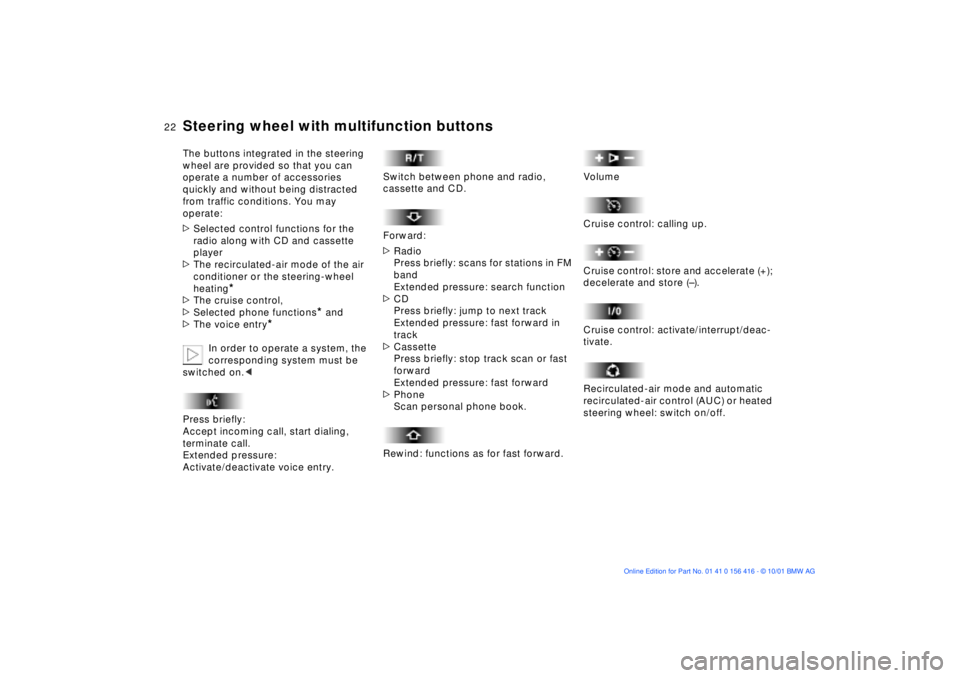
Press briefly:
Accept incoming call, start dialing,
terminate call.
Extended pressure:
Activate/deactivate voice entry.
Switch between phone and radio,
cassette and CD.
Forward:
>Radio
Press briefly: scans for stations in FM
band
Extended pressure: search function
>CD
Press briefly: jump to next track
Extended pressure: fast forward in
track
>Cassette
Press briefly: stop track scan or fast
forward
Extended pressure: fast forward
>Phone
Scan personal phone book.
Rewind: functions as for fast forward.
Volume
Cruise control: calling up.
Cruise control: store and accelerate (+);
decelerate and store (Ð).
Cruise control: activate/interrupt/deac-
tivate.
Recirculated-air mode and automatic
recirculated-air control (AUC) or heated
steering wheel: switch on/off.
Page 37 of 185
37n
OverviewControlsMaintenanceRepairsDataIndex
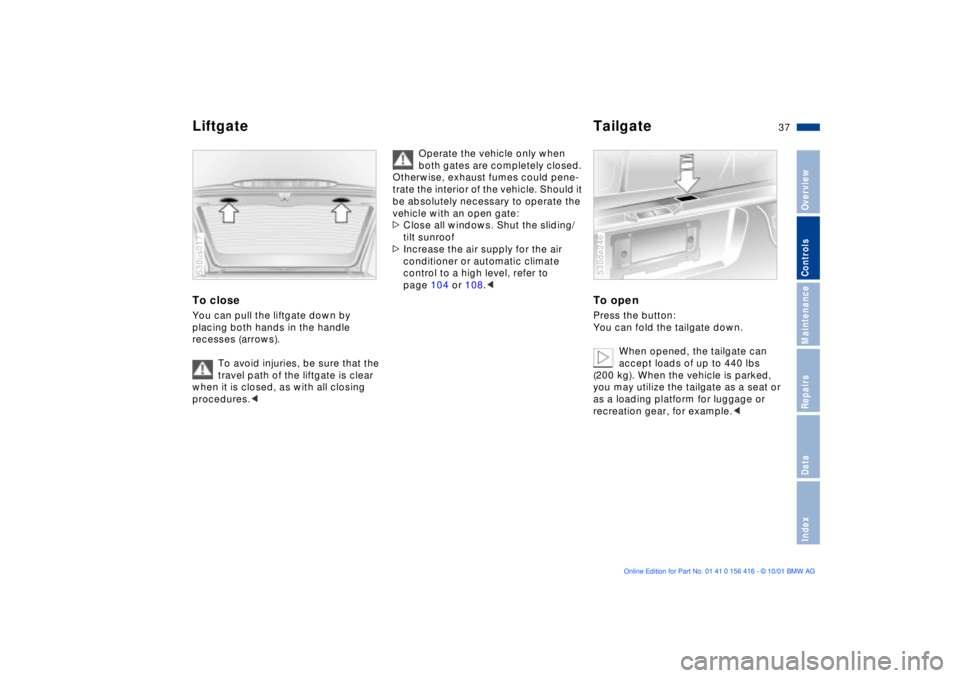
Liftgate TailgateTo close You can pull the liftgate down by
placing both hands in the handle
recesses (arrows).
To avoid injuries, be sure that the
travel path of the liftgate is clear
when it is closed, as with all closing
procedures.< 530us017
Operate the vehicle only when
both gates are completely closed.
Otherwise, exhaust fumes could pene-
trate the interior of the vehicle. Should it
be absolutely necessary to operate the
vehicle with an open gate:
>Close all windows. Shut the sliding/
tilt sunroof
>Increase the air supply for the air
conditioner or automatic climate
control to a high level, refer to
page 104 or 108.<
To openPress the button:
You can fold the tailgate down.
When opened, the tailgate can
accept loads of up to 440 lbs
(200 kg). When the vehicle is parked,
you may utilize the tailgate as a seat or
as a loading platform for luggage or
recreation gear, for example.< 530de246
Page 44 of 185
44n
The condition for relaxed, fatigue-free
driving is a seating position adjusted to
your needs. Together with the safety
belts and the airbags, the correct
seating position increases the passive
safety of the occupants in the case of
an accident. Therefore, observe the
following instructions, as otherwise the
protective function of the safety
systems may be impaired.
For additional information on trans-
porting children, refer to page 58.
Sitting correctly with airbags
Maintain a distance to the airbags.
Always hold the steering wheel by
the rim to keep any chance of injury to
hands or arms to an absolute minimum,
should the airbag be deployed. No one
and nothing is to come between the
airbags and the seat occupant. Do not
use the cover of the front airbag on the
front passenger side as a storage area
for objects, or as a rest for feet or
legs.<
For the location of the airbags and
additional information, refer to page 55.
Safe with safety belts
Never allow more than one person
to wear a single safety belt. Never
allow infants or small children to ride in
a passenger's lap. Avoid twisting the
belt while routing it firmly across the
pelvis and shoulder, wear it as snugly
against your body as possible. Do not
allow the belt to rest against hard or
fragile objects in your pockets. Never
route the belt across your neck, do not
run it across sharp edges and ensure
that the belt does not become caught
or jammed. Avoid wearing bulky
clothing and pull on the lap belt periodi-
cally to retension it over your shoulders.
In the event of a frontal impact, a loose
lap belt could slide over your hips,
leading to abdominal injury. In addition,
the safety belt's restraint effectiveness
is reduced if the belt is worn loosely.
Expectant mothers should always wear
their safety belts, taking care to position
the lap belt against the lower hips,
where it will not exert pressure against
the abdominal area.<
For instructions on operating the safety
belts, refer to page 49.
Observe the following before
adjusting
Never try to adjust your seat while
operating the vehicle. The seat
could respond with unexpected move-
ment, and the ensuing loss of vehicle
control could lead to an accident. Never
ride with the backrest reclined to an
extreme horizontal angle (especially
important for front passengers to
remember). Keep the backrest relatively
upright to minimize the risk of "sliding
under" the safety belt and sustaining
injury in an accident
.<
Seat adjustment>Mechanical seat adjustment, refer to
page 45
>Power seat adjustment, refer to
page 46
>Head restraints, refer to page 47
>Power rear backrest adjustment,
refer to page 48
Correct sitting posture Seats
Page 67 of 185
67n
OverviewControlsMaintenanceRepairsDataIndex
Automatic transmission with Steptronic
*
If you leave the vehicle with the
engine running, move the selector
lever to the "Park" or "Neutral" position
and apply the parking brake. If you fail
to do this, the vehicle could move.
Do not leave the vehicle unattended
with the engine running. An unattended
vehicle with a running engine repre-
sents a potential safety hazard.<
P Ñ Park Select only when the vehicle is
stationary. The transmission locks to
prevent the rear wheels from turning.R Ñ Reverse Select only when the vehicle is
stationary. N Ñ Neutral Select only if your journey is interrupted
for a longer period.
D Ñ Drive
(automatic shift program) This position is designed for driving
under all normal operating conditions.
All forward gears are available. Kickdown In the kickdown mode, you achieve
maximum acceleration and in
position D top speed.
Depress the accelerator pedal past the
increased resistance point at the full-
throttle position.
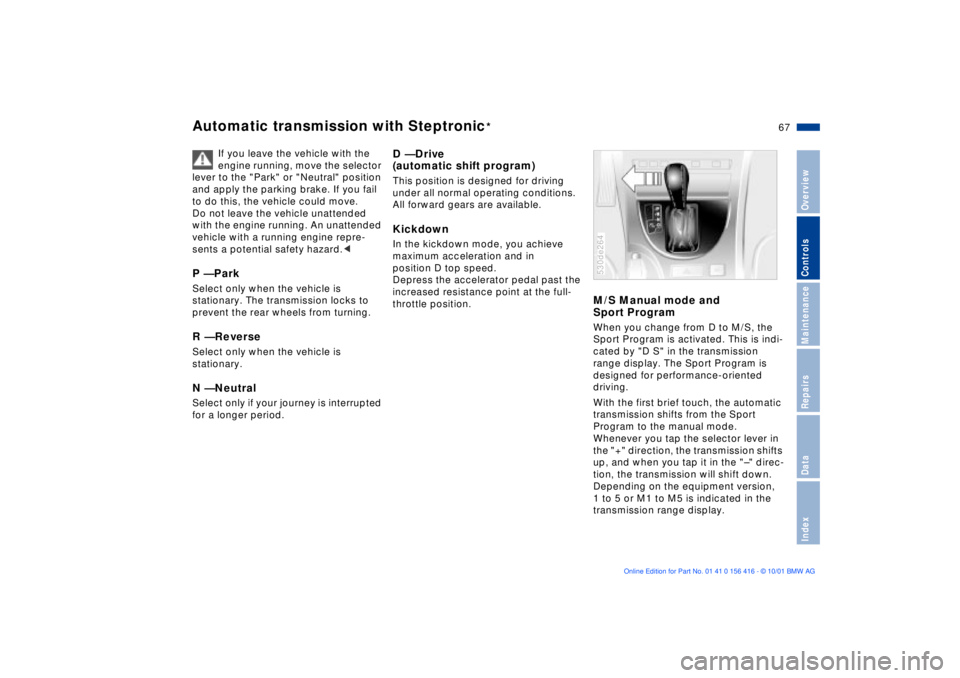
M/S Manual mode and
Sport Program When you change from D to M/S, the
Sport Program is activated. This is indi-
cated by "D S" in the transmission
range display. The Sport Program is
designed for performance-oriented
driving.
With the first brief touch, the automatic
transmission shifts from the Sport
Program to the manual mode.
Whenever you tap the selector lever in
the "+" direction, the transmission shifts
up, and when you tap it in the "Ð" direc-
tion, the transmission will shift down.
Depending on the equipment version,
1 to 5 or M1 to M5 is indicated in the
transmission range display.530de264
Page 73 of 185
73n
OverviewControlsMaintenanceRepairsDataIndex
To interrupt the cruise control When the system is activated, press
button 1. The indicator lamp stays on.
You can use the cruise control again
whenever required by calling up the
speed that was stored last.
In addition, the system is automatically
deactivated in response to the following
conditions:
>When you apply pressure to the
brake pedal
>When you apply pressure to the
clutch pedal or when you move the
automatic transmission selector lever
from "Drive" to "Neutral"
>If you exceed or fall below the
controlled speed for an extended
period (by depressing the acceler-
ator, for example). To recall the stored setting Press button:
The vehicle accelerates to and main-
tains the last speed stored.
Page 75 of 185
75n
OverviewControlsMaintenanceRepairsDataIndex
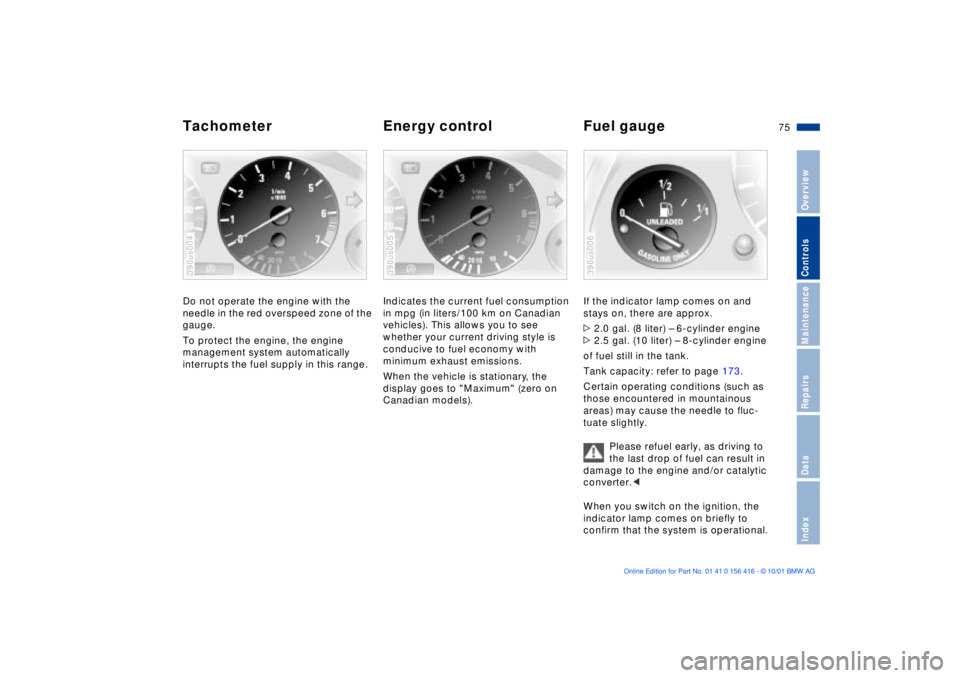
Tachometer Energy control Fuel gauge Do not operate the engine with the
needle in the red overspeed zone of the
gauge.
To protect the engine, the engine
management system automatically
interrupts the fuel supply in this range.390us004
Indicates the current fuel consumption
in mpg (in liters/100 km on Canadian
vehicles). This allows you to see
whether your current driving style is
conducive to fuel economy with
minimum exhaust emissions.
When the vehicle is stationary, the
display goes to "Maximum" (zero on
Canadian models).390us005
If the indicator lamp comes on and
stays on, there are approx.
>2.0 gal. (8 liter) Ð 6-cylinder engine
>2.5 gal. (10 liter) Ð 8-cylinder engine
of fuel still in the tank.
Tank capacity: refer to page 173.
Certain operating conditions (such as
those encountered in mountainous
areas) may cause the needle to fluc-
tuate slightly.
Please refuel early, as driving to
the last drop of fuel can result in
damage to the engine and/or catalytic
converter.<
When you switch on the ignition, the
indicator lamp comes on briefly to
confirm that the system is operational.390us006
Page 92 of 185
92n
PDC
* Dynamic Stability Control (DSC)
The PDC system does not remove
the driver's personal responsibility
for evaluating the distance between the
vehicle and any obstacles. Even when
sensors are involved, there is a blind
spot in which objects cannot be
detected. This applies especially in
those cases where the system
approaches the physical constraints of
ultrasonic measurement, as occurs with
tow bars and trailer couplings, and in
the vicinity of thin or wedge-shaped
objects.
Certain sources of sound, such as a
loud radio, could drown out the PDC
signal tone.<
Keep the sensors clean and free
of ice or snow in order to ensure
that they continue to operate effectively.
Do not apply high pressure spray to the
sensors for a prolonged period of time.
Maintain an adequate distance of more
than 4 in (10 cm).<
The concept DSC maintains vehicle stability, even in
critical driving situations.
The system optimizes vehicle stability
during acceleration and when starting
from a full stop, as well as optimizing
traction. In addition, it recognizes
unstable vehicle conditions, such as
understeering or oversteering, and, as
far as is possible within the laws of
physics, keeps the vehicle on a steady
course by adapting the rpms and brake
applications to the individual wheels.
The system starts up automatically
each time you start the engine.
Indicator lamp
The indicator lamp in the instru-
ment cluster goes out shortly
after you switch on the ignition,
refer to page 20.
Indicator lamp ßashes:
The system is active and governs drive
and braking force.
If the indicator lamp fails to go out after
the engine is started, or comes on
during normal driving and stays on:
The system is either defective or was
switched off with the button: the stabi-
lizing applications described to the left
are no longer available. The vehicle will
remain completely operational,
however, without DSC.
Consult your BMW Sports Activity
Vehicle center to have the system
repaired.
Page 95 of 185
95n
OverviewControlsMaintenanceRepairsDataIndex
Variable Ride Height
*
Variable Ride Height on both axles
*
The warning lamp for the Vari-
able Ride Height comes on, or
the message "SELFLEVEL
SUSP.INACT" appears in the Check
Control: there is a malfunction in the
Variable Ride Height.
Stop and inspect the vehicle. If it is
riding significantly lower in the rear than
in the front, or if it is sitting at an incline
(left rear compared to right rear),
consult the nearest BMW Sports
Activity Vehicle center. Drive with
appropriate caution in the meantime.
The vehicle has reduced ground clear-
ance or driving comfort is noticeably
reduced.
Even if the attitude of the vehicle is
normal, you should consult the nearest
BMW Sports Activity Vehicle center if
the warning lamp indicates a system
malfunction.
The conceptYour vehicle is equipped with Variable
Ride Height acting on both the front
and rear suspension. This system
combines automatic self-leveling,
which compensates for variations in
front-to-rear load-distribution patterns,
with a selection feature allowing drivers
to choose from among several ride-
height options.
You may choose from among the
following ride heights:
>Standard
The "standard" setting is intended for
most operating conditions, including
trailer towing
>Off-Road
Higher ride height for increased
ground clearance
>Access
Lowers vehicle for more convenient
cargo handling and easier passenger
ingress and exitsChanges in ride height are initiated
either manually, using the control
button (refer to page 96), or automati-
cally in response to specific speeds.
When the ride height is selected manu-
ally, the driver has the additional option
of revising the ride-height selection by
entering a new command during the
adjustment process.
When the vehicle is stationary, the
system executes ride-height changes in
both directions (up and down) when-
ever the doors are closed. The tailgate/
liftgate may be open. The system raises
the vehicle only when the engine is
running.
The system's automatic self-leveling
feature automatically compensates for
variations in the vehicle's load.
Frequent changes in ride height
initiated at short intervals can
overheat the compressor, causing the
system to briefly suspend active opera-
tion.<