steering BMW X5 3.0I 2006 E53 User Guide
[x] Cancel search | Manufacturer: BMW, Model Year: 2006, Model line: X5 3.0I, Model: BMW X5 3.0I 2006 E53Pages: 202, PDF Size: 4.13 MB
Page 53 of 202
53n
OverviewControlsMaintenanceRepairsDataIndex
Steering wheel Steering wheel heater
*
Mirrors
Automatic steering wheel
adjustmentonly in conjunction with seat, mirror and
steering wheel memory
In or der to m a ke it e asie r t o get in to an d
out of the vehicle, the steering wheel
automatically moves into the top posi-
tion and returns to the driving or mem-
ory position.
This automatic feature is influenced by
the position of the ignition key and by
the driver's door.
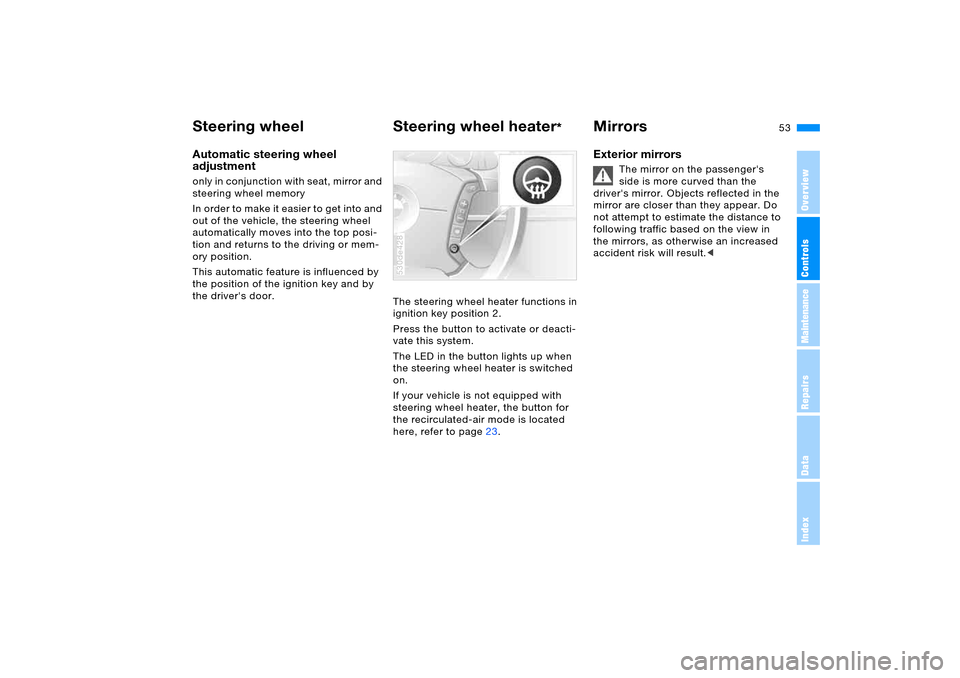
The steering wheel heater functions in
ignition key position 2.
Press the button to activate or deacti-
vate this system.
The LED in the button lights up when
the steering wheel heater is switched
on.
If your vehicle is not equipped with
steering wheel heater, the button for
the recirculated-air mode is located
here, refer to page23.
530de428
Exterior mirrors
The mirror on the passenger's
side is more curved than the
driver's mirror. Objects reflected in the
mirror are closer than they appear. Do
not attempt to estimate the distance to
following traffic based on the view in
the mirrors, as otherwise an increased
accident risk will result.<
Page 54 of 202
54n
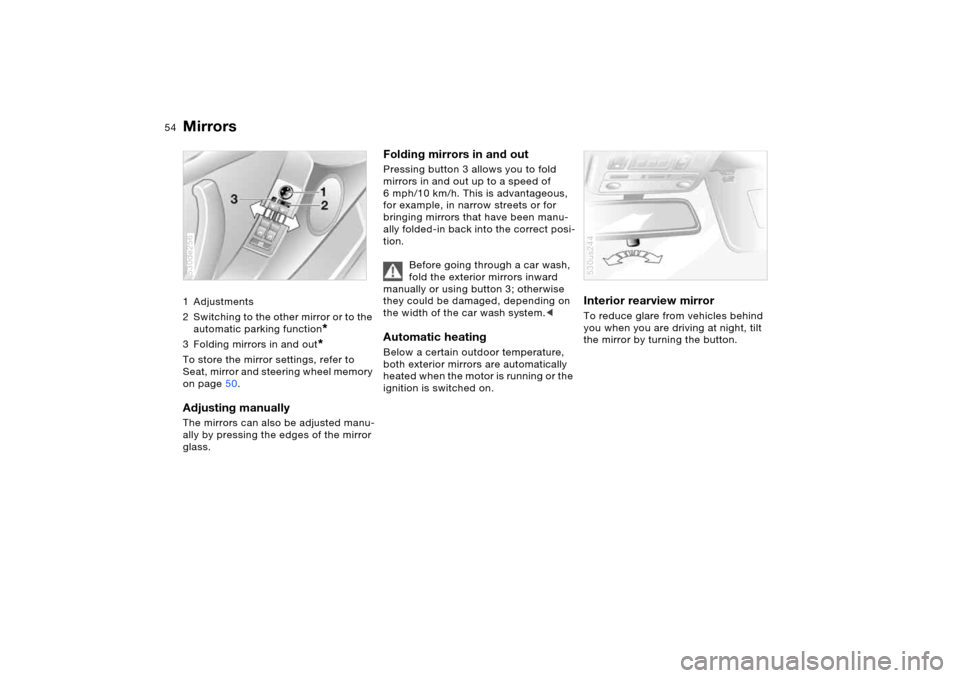
Mirrors1 Adjustments
2 Switching to the other mirror or to the
automatic parking function
*
3 Folding mirrors in and out
*
To store the mirror settings, refer to
Seat, mirror and steering wheel memory
on page50.Adjusting manuallyThe mirrors can also be adjusted manu-
ally by pressing the edges of the mirror
glass.530de256
Folding mirrors in and out Pressing button 3 allows you to fold
mirrors in and out up to a speed of
6 mph/10 km/h. This is advantageous,
for example, in narrow streets or for
bringing mirrors that have been manu-
ally folded-in back into the correct posi-
tion.
Before going through a car wash,
fold the exterior mirrors inward
manually or using button 3; otherwise
they could be damaged, depending on
the width of the car wash system.
heated when the motor is running or the
ignition is switched on.
Interior rearview mirror To reduce glare from vehicles behind
you when you are driving at night, tilt
the mirror by turning the button.530us244
Page 55 of 202
55n
OverviewControlsMaintenanceRepairsDataIndex
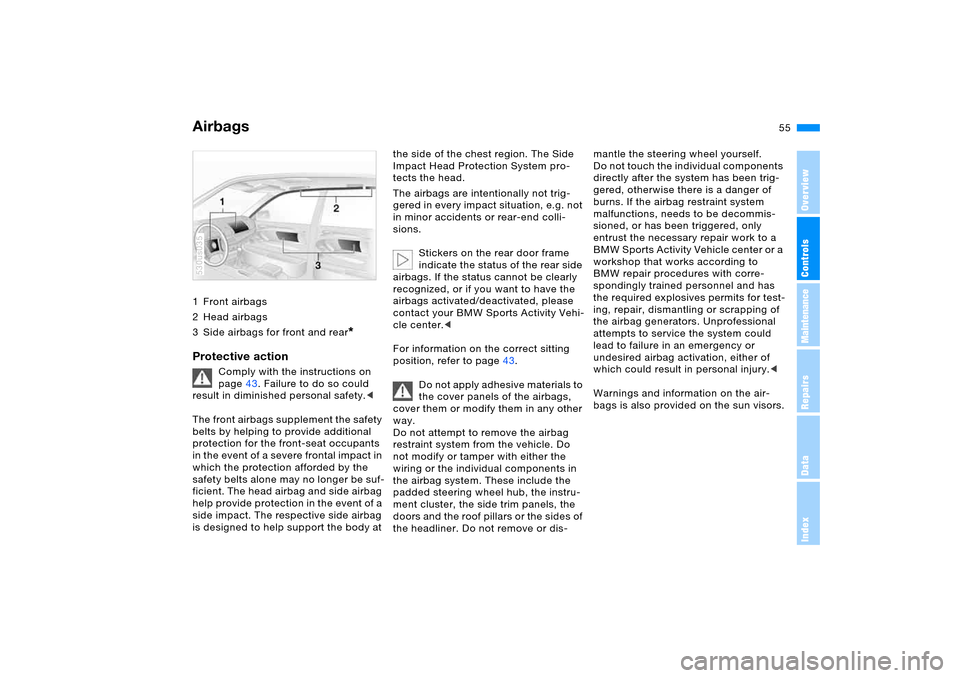
Airbags1 Front airbags
2 Head airbags
3 Side airbags for front and rear
*
Protective action
Comply with the instructions on
page43. Failure to do so could
result in diminished personal safety.<
The front airbags supplement the safety
belts by helping to provide additional
protection for the front-seat occupants
in the event of a severe frontal impact in
which the protection afforded by the
safety belts alone may no longer be suf-
ficient. The head airbag and side airbag
help provide protection in the event of a
side impact. The respective side airbag
is designed to help support the body at
530us035
the side of the chest region. The Side
Impact Head Protection System pro-
tects the head.
The airbags are intentionally not trig-
gered in every impact situation, e.g. not
in minor accidents or rear-end colli-
sions.
Stickers on the rear door frame
indicate the status of the rear side
airbags. If the status cannot be clearly
recognized, or if you want to have the
airbags activated/deactivated, please
contact your BMW Sports Activity Vehi-
cle center.<
For information on the correct sitting
position, refer to page43.
Do not apply adhesive materials to
the cover panels of the airbags,
cover them or modify them in any other
way.
Do not attempt to remove the airbag
restraint system from the vehicle. Do
not modify or tamper with either the
wiring or the individual components in
the airbag system. These include the
padded steering wheel hub, the instru-
ment cluster, the side trim panels, the
doors and the roof pillars or the sides of
the headliner. Do not remove or dis-
mantle the steering wheel yourself.
Do not touch the individual components
directly after the system has been trig-
gered, otherwise there is a danger of
burns. If the airbag restraint system
malfunctions, needs to be decommis-
sioned, or has been triggered, only
entrust the necessary repair work to a
BMW Sports Activity Vehicle center or a
workshop that works according to
BMW repair procedures with corre-
spondingly trained personnel and has
the required explosives permits for test-
ing, repair, dismantling or scrapping of
the airbag generators. Unprofessional
attempts to service the system could
lead to failure in an emergency or
undesired airbag activation, either of
which could result in personal injury.<
Warnings and information on the air-
bags is also provided on the sun visors.
Page 61 of 202
61n
OverviewControlsMaintenanceRepairsDataIndex
Vehicle Memory, Key Memory How the system functions You have probably frequently wished
that you could configure individual
functions of your vehicle meet your own
personal requirements. In developing
your vehicle, BMW has included several
user-defined functions in the vehicle's
design. Your BMW Sports Activity Vehi-
cle center can make these settings for
you.
There are vehicle and person-related
adjustments: Vehicle Memory and Key
Memory. You can have up to four differ-
ent basic positions configured for four
different persons. The only requirement
is that each person uses his or her own
remote control key.
When your vehicle is unlocked with the
remote control, the vehicle recognizes
the individual user by means of a data
exchange with the key, and makes
adjustments accordingly.
In order for you to distinguish between
the master keys with remote control,
color-coded decals are supplied
together with the keys.
What the system can doYour BMW Sports Activity Vehicle cen-
ter can provide you with details on the
capabilities of the Vehicle Memory and
Key Memory systems.
You will see this symbol through-
out the Owner's Manual. It is to
remind you at appropriate places of the
settings that are available to you.<
Following configuration of the
memory functions, vehicle opera-
tion may differ from the description in
the Owner's Manual. Should you want
to sell your BMW some day, please
remember to have the memory func-
tions reset to the default state.<
Examples for Vehicle Memory:
>Various signals that can serve as
acknowledgment for locking and
unlocking the vehicle, refer to
pages31, 33
>Deactivating/activating the Pathway
lighting function, refer to page100.
Examples for Key Memory:
>Automatic adjustment of the driver's
seat, exterior mirror and steering
wheel with settings stored in the
memory for the individual driver when
the vehicle is unlocked, refer to
page51
>Calling up customized settings for
the automatic climate control when
unlocking the vehicle, refer to
page109.
Page 62 of 202
62n
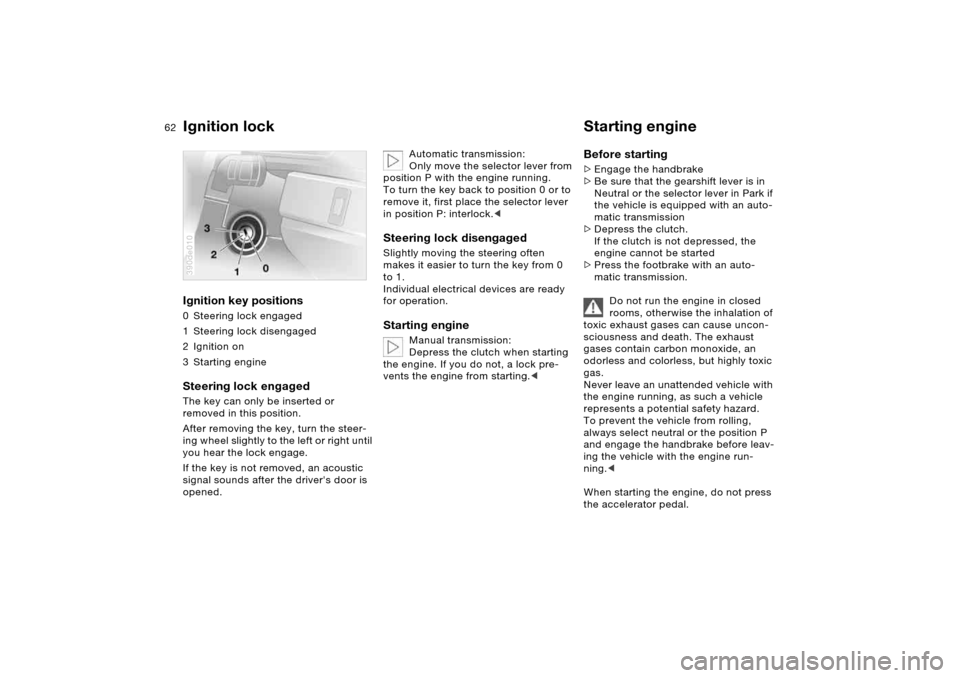
Ignition lock Starting engine Ignition key positions 0 Steering lock engaged
1Steering lock disengaged
2 Ignition on
3Starting engineSteering lock engaged The key can only be inserted or
removed in this position.
After removing the key, turn the steer-
ing wheel slightly to the left or right until
you hear the lock engage.
If the key is not removed, an acoustic
signal sounds after the driver's door is
opened.390de010
Automatic transmission:
Only move the selector lever from
position P with the engine running.
To turn the key back to position 0 or to
remove it, first place the selector lever
in position P: interlock.<
Steering lock disengaged Slightly moving the steering often
makes it easier to turn the key from 0
to 1.
Individual electrical devices are ready
for operation. Starting engine
Manual transmission:
Depress the clutch when starting
the engine. If you do not, a lock pre-
vents the engine from starting.<
Before starting >Engage the handbrake
>Be sure that the gearshift lever is in
Neutral or the selector lever in Park if
the vehicle is equipped with an auto-
matic transmission
>Depress the clutch.
If the clutch is not depressed, the
engine cannot be started
>Press the footbrake with an auto-
matic transmission.
Do not run the engine in closed
rooms, otherwise the inhalation of
toxic exhaust gases can cause uncon-
sciousness and death. The exhaust
gases contain carbon monoxide, an
odorless and colorless, but highly toxic
gas.
Never leave an unattended vehicle with
the engine running, as such a vehicle
represents a potential safety hazard.
To prevent the vehicle from rolling,
always select neutral or the position P
and engage the handbrake before leav-
ing the vehicle with the engine run-
ning.<
When starting the engine, do not press
the accelerator pedal.
Page 63 of 202
OverviewControlsMaintenanceRepairsDataIndex
63n
Starting engine Switching off engineDo not allow the engine to warm up by
leaving it running while the vehicle
remains stationary. Instead, begin to
drive immediately at a moderate engine
speed.
X5 3.0i:
Do not end the starting procedure too
soon, but do not continue for longer
than approx. 20 seconds. Release the
ignition key immediately as soon as the
engine starts.
X5 4.4i, 4.8is:
Your BMW is equipped with the conve-
nience starting feature. With this fea-
ture, it is sufficient to turn the ignition
key only briefly to position 3 'Start
engine' and to let go of it right away.
The starter actuation continues to oper-
ate automatically for a certain period of
time and is stopped automatically as
soon as the engine has started.
The automatic starting mode will not
operate or will be canceled if the bat-
tery voltage is insufficient. The engine
can be jump started, refer to page174.Should the engine fail to start on the
first attempt, if it is very hot or cold, for
instance:
>Press the accelerator pedal halfway
down while engaging the starter.
Cold starts at altitudes above 3,300 ft/
1,000 meters and at very low tempera-
tures, from approx. +57/–156:
>For the initial starting attempt, allow
the starter to remain engaged some-
what longer, approx. 10 seconds.
Engine idle speed is controlled by the
engine computer system. Increased
speeds at startup are normal and
should decrease as the engine warms
up. If engine speed does not decrease,
service is required.
To prevent the battery from being
drained, always switch off electrical
devices that are not in use. Switch the
ignition off when the vehicle is not
being driven.
Extended starting attempts, char-
acterized by excessively frequent
or long periods with the starter
engaged, can lead to damage of the
catalytic converter.<
Manual transmission:
1. Turn the ignition key to position 1
or 0
2. Shift into first gear or reverse.
Automatic transmission:
1. Shift into selector lever position P
2. Turn the ignition key to position 1
or 0.
Do not remove the ignition key
when the vehicle is moving, other-
wise, the steering could lock.
When leaving the vehicle, always
remove the ignition key and lock the
steering.
Manual transmission:
Always engage the handbrake when
parking on slopes and inclined sur-
faces. Even placing the gearshift lever
in 1st gear or reverse may not provide
adequate resistance to rolling.
Automatic transmission:
Place the selector lever in the P posi-
tion.<
Automatic transmission:
The vehicle must be stationary and the
selector lever in Park before you can
remove the ignition key.
Page 71 of 202
OverviewControlsMaintenanceRepairsDataIndex
71n
Washer/wiper system/rain sensor
*
Cruise control
*
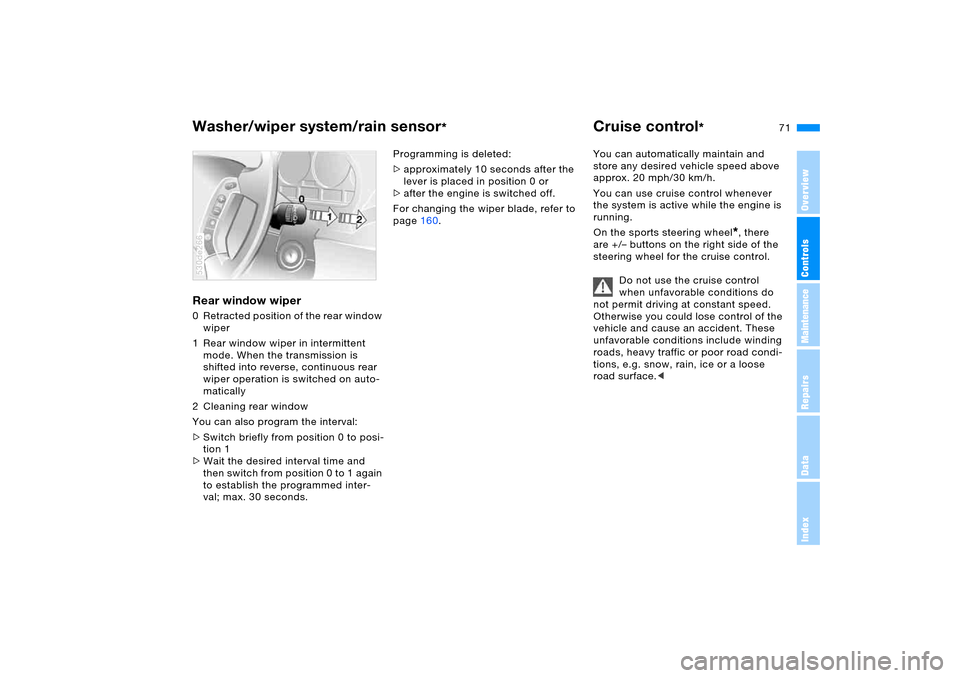
Rear window wiper 0 Retracted position of the rear window
wiper
1 Rear window wiper in intermittent
mode. When the transmission is
shifted into reverse, continuous rear
wiper operation is switched on auto-
matically
2 Cleaning rear window
You can also program the interval:
>Switch briefly from position 0 to posi-
tion 1
>Wait the desired interval time and
th en sw itc h fr om p osit ion 0 to 1 again
to establish the programmed inter-
val; max. 30 seconds. 530de266
Programming is deleted:
>approximately 10 seconds after the
lever is placed in position 0 or
>after the engine is switched off.
For changing the wiper blade, refer to
page160.You can automatically maintain and
store any desired vehicle speed above
approx. 20 mph/30 km/h.
You can use cruise control whenever
the system is active while the engine is
running.
On the sports steering wheel
*, there
are +/– buttons on the right side of the
steering wheel for the cruise control.
Do not use the cruise control
when unfavorable conditions do
not permit driving at constant speed.
Otherwise you could lose control of the
vehicle and cause an accident. These
unfavorable conditions include winding
roads, heavy traffic or poor road condi-
tions, e.g. snow, rain, ice or a loose
road surface.<
Page 91 of 202
91n
OverviewControlsMaintenanceRepairsDataIndex
PDC Park Distance Control
* Antilock Brake System
Signal tones The distance from an object is indicated
in front with a higher intermittent tone,
and at the rear with a lower intermittent
tone. As the distance between vehicle
and object decreases, the intervals
between the tones become shorter.
The signal tone becomes continuous
once the distance to the nearest object
falls to below roughly 1 ft/30 cm.
The warning signal is canceled after
approx. 3 seconds if you are moving
parallel to a wall. MalfunctionsThe LED flashes and a short steady sig-
nal tone is sounded
>if you activate PDC with the button
>when you select reverse for the first
time after switching on the ignition
>if a malfunction occurs while the PDC
system is active.
Switch the system off and have the
cause of the malfunction corrected by
your BMW Sports Activity Vehicle cen-
ter.
System limits
Even with PDC, final responsibility
for estimating the distance
between the vehicle and any obstruc-
tions always remains with the driver.
Even when sensors are involved, there
is a blind spot in which objects cannot
be detected. This applies especially in
those cases where the system
approaches the physical constraints of
ultrasonic measurement, as occurs with
tow bars and trailer couplings, and in
the vicinity of thin or wedge-shaped
objects. It is also possible that low
objects already displayed, such as curb
edges, may come into the blind spot of
the sensors before a continuous signal
sounds or that higher, protruding
objects, such as ledges, will not be
detected.
Loud sources of sound, inside and out-
side the vehicle, could drown out the
PDC signal tone.<
Keep the sensors clean and free
of ice or snow in order to ensure
that they will continue to operate effec-
tively.
When using high-pressure washers, do
not spray sensors for long periods and
keep the sprayer at least 4 in/10 cm
away from the sensors.<
The concept The ABS Antilock Brake System pre-
vents the wheel brakes from locking
during braking. Safe steering response
is maintained even during full braking.
This increases active safety.
The ABS is operational every time you
start the engine. Safe braking, refer to
page 140.EBV Electronic brake-force
distribution EBV controls the brake system's appli-
cation pressure at the rear wheels to
ensure stable deceleration.DBC Dynamic Brake Control When the brake pedal is depressed
rapidly, this system automatically gen-
erates a maximum boost of braking
force and thus aids in keeping braking
distances as short as possible during
full braking. This system exploits all of
the benefits provided by ABS.
Do not reduce the pressure on the
brake pedal for the duration of the
brake application. DBC is deactivated
when you release the brake pedal.
Page 99 of 202
99n
OverviewControlsMaintenanceRepairsDataIndex
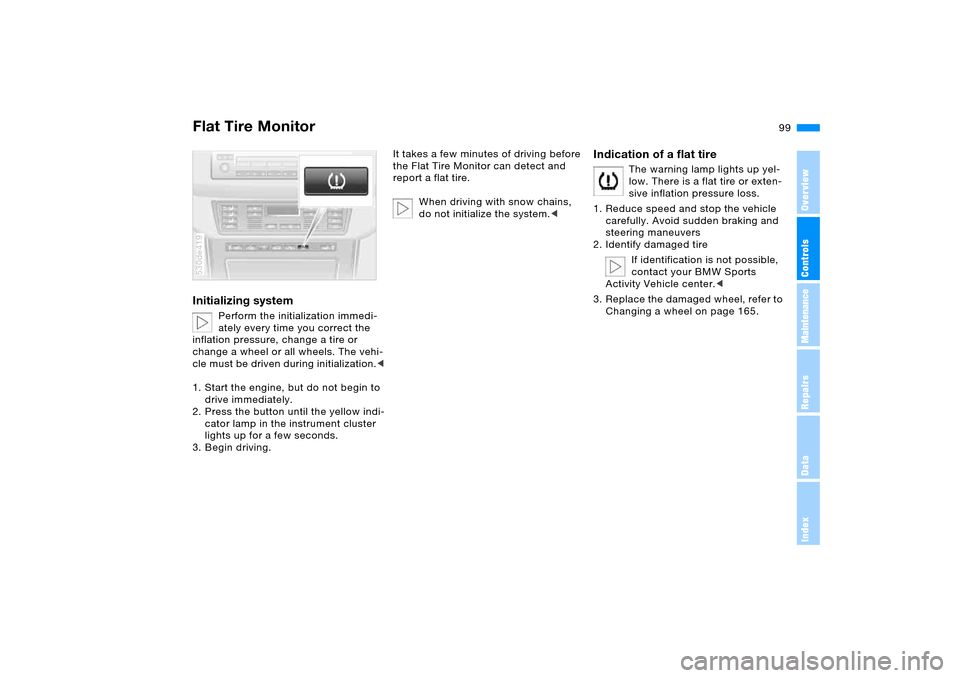
Flat Tire MonitorInitializing system
Perform the initialization immedi-
ately every time you correct the
inflation pressure, change a tire or
change a wheel or all wheels. The vehi-
cle must be driven during initialization.<
1. Start the engine, but do not begin to
drive immediately.
2. Press the button until the yellow indi-
cator lamp in the instrument cluster
lights up for a few seconds.
3. Begin driving.
530de419
It takes a few minutes of driving before
the Flat Tire Monitor can detect and
report a flat tire.
When driving with snow chains,
do not initialize the system.<
Indication of a flat tire
The warning lamp lights up yel-
low. There is a flat tire or exten-
sive inflation pressure loss.
1. Reduce speed and stop the vehicle
carefully. Avoid sudden braking and
steering maneuvers
2. Identify damaged tire
If identification is not possible,
contact your BMW Sports
Activity Vehicle center.<
3. Replace the damaged wheel, refer to
Changing a wheel on page 165.
Page 101 of 202
101n
OverviewControlsMaintenanceRepairsDataIndex
Adaptive Head Light
*
High beams/roadside parking lamps
The concept Adaptive Head Light is a variable head-
lamp control system that enables better
illumination of the road surface.
Depending on the steering angle and
other assumptions, the light from the
headlamp follows the course of the
road.Activating Adaptive Head Light
In ignition key position 2, turn
the light switch to the position
'Automatic headlamp control',
refer to page100.
To avoid blinding oncoming traffic, the
Adaptive Head Light
>is not active when driving in reverse
>is active only when pointing toward
the passenger side.
MalfunctionsThe LED next to the symbol for auto-
matic headlamp control flashes. Adap-
tive Head Light is faulty or has failed.
Have the system checked as soon as
possible.
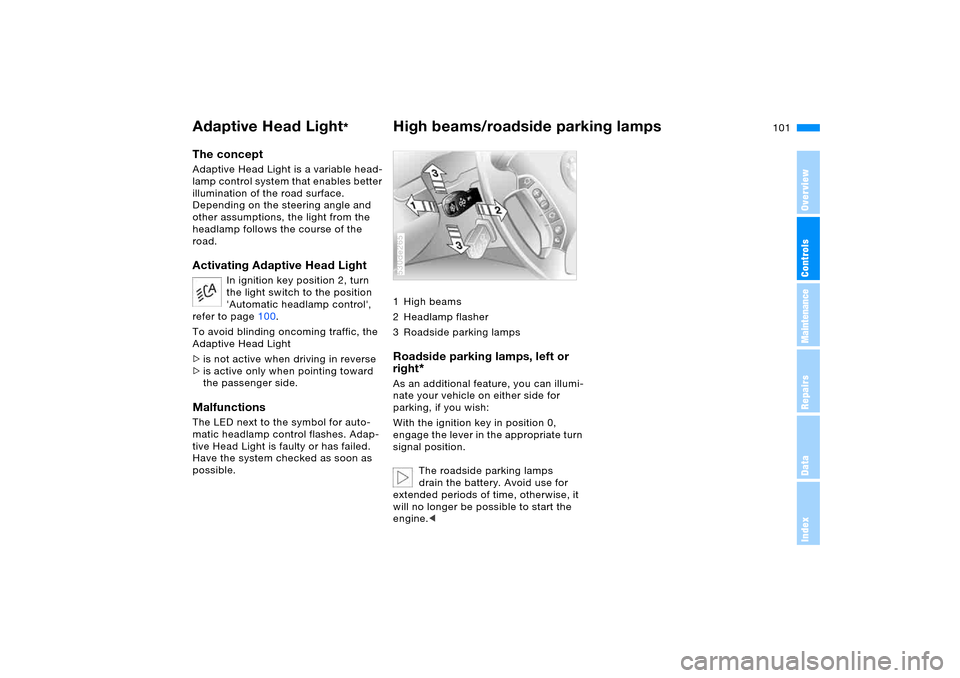
1High beams
2Headlamp flasher
3 Roadside parking lamps Roadside parking lamps, left or
right
*
As an additional feature, you can illumi-
nate your vehicle on either side for
parking, if you wish:
With the ignition key in position 0,
engage the lever in the appropriate turn
signal position.
The roadside parking lamps
drain the battery. Avoid use for
extended periods of time, otherwise, it
will no longer be possible to start the
engine.<530de265