service BMW X5 4.4I 2000 User Guide
[x] Cancel search | Manufacturer: BMW, Model Year: 2000, Model line: X5 4.4I, Model: BMW X5 4.4I 2000Pages: 201, PDF Size: 1.93 MB
Page 32 of 201
32n
Locks and security systems:
Keys34
Electronic vehicle
immobilizer35
Central locking system36
Opening and closing
Ð from the outside36
Using the key36
Using the remote control37
Opening and closing
Ð from the inside40
Liftgate41
Tailgate41
Alarm system43
Electric power windows45
Sliding/Tilt sunroof with glass
moonroof46
Adjustments:
Seats48
Steering wheel51
Mirrors52
Seat, mirror and steering wheel
memory54
Car Memory, Key Memory55
Passenger safety systems:
Safety belts56
Airbags57
Child restraints60
Child seat security61
Child-safety locks62Driving:
Steering/Ignition lock63
Starting the engine64
Switching off the engine65
Parking brake65
Automatic transmission with
Steptronic66
Turn signal indicator/Headlamp
flasher69
Washer/Wiper system/Rain
sensor69
Rear window defroster71
Cruise control72
Everything under control:
Odometer, outside temperature
display74
Tachometer75
Energy control75
Fuel gauge75
Coolant temperature gauge76
Service Interval Display76
Check Control77
Onboard computer80
Technology for safety and
driving convenience:
Park Distance Control (PDC)82
Dynamic Stability Control
(DSC)83
Hill Descent Control (HDC)84
Controls
Page 33 of 201
IndexDataTechnologyRepairsCar careControlsOverview
Overview
Controls and features
Operation, care
and maintenance
Owner service procedures
Technical data
Index Advanced technology
33n
Lamps:
Side lamps/Low beams86
Instrument lightning86
High beams/Parking lamps87
Fog lamps87
Interior lamps87
Reading lamps88
Controlling the climate for
pleasant driving:
Automatic climate control90
Seat heating96
Steering wheel heating96
Roller sun blind97
Independent ventilation
system97
Cabin convenience:
BMW Universal Transmitter98
Glove compartment101
Storage compartments101
Cellular phone102
Cup holders102
Glasses compartment102
Ashtray, front103
Cigarette lighter103
Ashtray, rear104Loading and transporting:
Ski bag105
Cargo area
Fold the rear backrests
down107
Cargo area cover107
Partition net108
Cover panels in the cargo
area109
Power outlets110
Pull-out cargo floor111
Cargo loading112
Roof-mounted luggage rack113
Page 64 of 201

64n
Starting the engine Before starting >Engage the parking brake.
>Be sure that the selector lever is in
"Park" position.
Do not allow the engine to run in
enclosed spaces. The exhaust
gases contain carbon monoxide, an
odorless and colorless, but highly toxic
gas. Breathing the exhaust gases poses
an extreme health risk, and can lead to
unconsciousness and death.
Do not leave the vehicle unattended
with the engine running. An unattended
vehicle with a running engine repre-
sents a potential safety hazard.<
Do not press the accelerator pedal
while starting the engine.
Your BMW is equipped with the
convenience starting feature. Sim-
ply turn the key to position 3 (starter)
and then release it immediately. The
starter continues to operate automati-
cally.
The automatic starting mode will not
operate if the battery voltage is low.
The engine can be started by means of
jump-starting (refer to page 170).<
Do not allow the engine to warm up by
leaving it running while the vehicle re-
mains stationary. Instead, begin to drive
immediately at a moderate engine
speed.
Should the engine fail to start on the
first attempt (if it is very hot or cold, for
instance):
>Press the accelerator pedal halfway
down while the starter is engaged.
Engine idle speed is controlled by the
engine computer system. Increased
speeds at startup are normal and
should decrease as the engine warms
up. If engine speed does not decrease,
service is required.
To prevent the battery from discharg-
ing, always deactivate electrical de-
vices that are not in use. Switch the ig-
nition off when the vehicle is not being
driven.
Page 76 of 201
76n
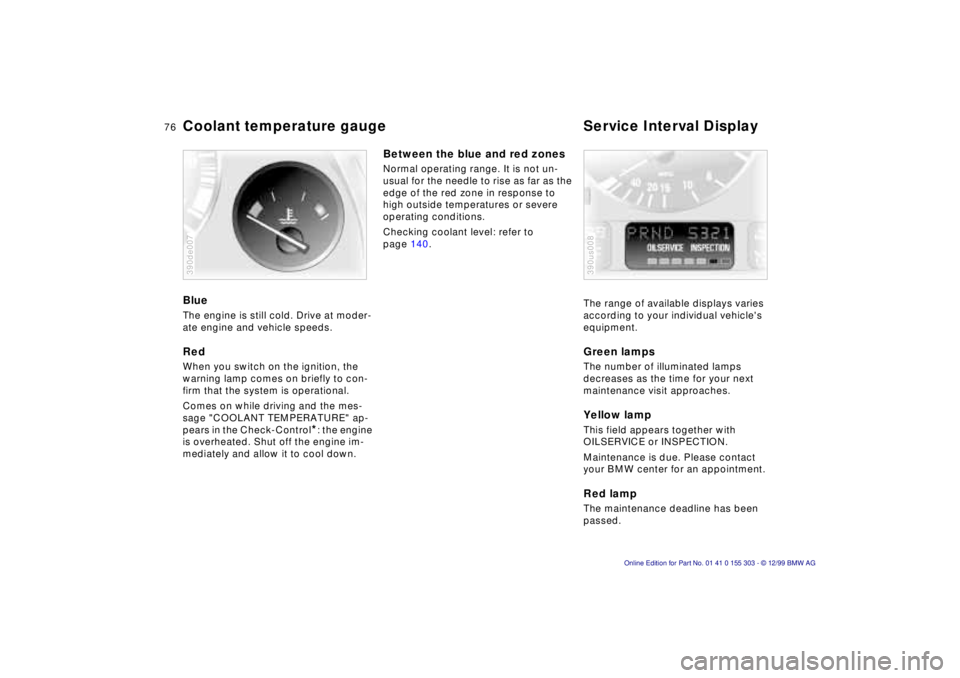
Coolant temperature gauge Service Interval Display Blue The engine is still cold. Drive at moder-
ate engine and vehicle speeds. Red When you switch on the ignition, the
warning lamp comes on briefly to con-
firm that the system is operational.
Comes on while driving and the mes-
sage "COOLANT TEMPERATURE" ap-
pears in the Check-Control
*: the engine
is overheated. Shut off the engine im-
mediately and allow it to cool down.
390de007
Between the blue and red zones Normal operating range. It is not un-
usual for the needle to rise as far as the
edge of the red zone in response to
high outside temperatures or severe
operating conditions.
Checking coolant level: refer to
page 140.
The range of available displays varies
according to your individual vehicle's
equipment.
Green lamps The number of illuminated lamps
decreases as the time for your next
maintenance visit approaches. Yellow lamp This field appears together with
OILSERVICE or INSPECTION.
Maintenance is due. Please contact
your BMW center for an appointment. Red lamp The maintenance deadline has been
passed. 390us008
Page 115 of 201
IndexDataTechnologyRepairsCar careControlsOverview
Overview
Controls and features
Operation, care
and maintenance
Owner service procedures
Technical data
Index Advanced technology
115n
Car care Special operating instructions:
Break-in procedures116
Driving your BMW X5117
General driving notes118
Catalytic converter118
Antilock Brake System
(ABS)119
Disc brakes122
Brake system123
Winter operation123
Power steering125
Level control system125
Cellular phone126
Radio reception126
Wheels and tires:
Tire inflation pressure127
Tire condition127
Tire replacement128
Tire rotation129
Wheel and tire
combinations130
Winter tires131
Snow chains131
Approved wheel and tire
specifications132Under the hood:
Hood133
Engine compartment134
Washer fluid136
Washer nozzles136
Engine oil137
Coolant140
Brake fluid141
Vehicle Identification No.141
Care and maintenance:
The BMW Maintenance
System142
Caring for your vehicle143
Airbags148
Vehicle storage148
Laws and regulations:
Technical modifications149
OBD interface socket150
Page 116 of 201

116n
Break-in procedures To ensure that your vehicle provides
maximum economy throughout a long
service life, we request that you ob-
serve the following suggestions: Engine and axle drive Up to 1,200 miles (2,000 km):
Drive at varying engine speeds and
road speeds, but do not exceed
4,500 rpm and a road speed of
106 mph (170 km/h) during this initial
period:
Obey your local and state maximum
speed limits.
Refrain from using full throttle and avoid
pressing the accelerator beyond the
kickdown point.
Once you have driven 1,200 miles
(2,000 km), engine and vehicle speeds
can gradually be increased.
You should also comply with these
break-in procedures if the engine or
one of the axle drives is replaced later
in the course of the vehicle service life.
Tires Due to technical factors associated
with their manufacture, tires do not
achieve their full traction potential until
an initial break-in period has elapsed.
For this reason, drive with extra care
during the initial 200 miles (300 km).
Obey your local and state maximum
speed limits.
When the vehicle is operated on
wet or slushy roads, a wedge of
water may form between the tire and
the road surface. This phenomenon is
referred to as aquaplaning, or hydro-
planing, and can lead to partial or com-
plete loss of traction, vehicle control
and braking effectiveness. Reduce your
speed on wet roads.<
Brake system Approximately 300 miles (500 km) must
elapse before the brake pads and ro-
tors achieve the optimal pad-surface
and wear patterns required for trouble-
free operation and long service life later
on.
To break in the separate parking brake
drums, apply the parking brake lightly
when coasting to a standstill (at a traffic
signal, for instance), provided that traf-
fic conditions allow you to do so.
To avoid corrosion, repeat this proce-
dure from time to time.
The brake lamps do not light up
when the parking brake is applied.
Vacuum for the brake system servo unit
on your BMW is available only when the
engine is running. When you move the
vehicle with the engine shut off Ð when
towing, for instance Ð substantially
higher levels of pedal force will be re-
quired to brake the vehicle.<
Page 120 of 201

120n
Antilock Brake System (ABS) should adapt road speed to the road
conditions.
On road surfaces that have a loose sur-
face layer on a firm base with good
traction (on gravel, deep sand or snow,
for example), braking distances may be
longer than with locked wheels.This is
also true if snow chains are mounted.
However, ABS continues to provide en-
hanced vehicle stability and steering re-
sponse under these conditions. Information for your safety Not even ABS can suspend the laws of
physics. ABS alone cannot prevent
accidents when the brakes are applied
without an adequate safety distance
between vehicles, if the vehicle is
driven with excessive speed, or if aqua-
planing occurs. Responsibility for these
types of situations remains in the hands
(and at the feet) of the driver. You
should never allow the added safety of
ABS to lull you into a false sense of
security, or mislead you into taking
increased risks that could affect your
own safety and that of others.
Do not make any modifications to
the ABS system.
Service procedures on ABS are to be
performed by authorized technicians
only.<
Cornering Brake Control (CBC) CBC is an advanced engineering de-
sign of the ABS. When braking during
cornering with high lateral accelera-
tion, or when braking during a lane
change, vehicle stability is further im-
proved and the steering response is
enhanced. Electronic Brake Force Distribu-
tion (EBV) EBV governs brake application pres-
sure at the rear wheels to achieve sta-
ble brake response.
If the EBV fails (refer to the next
page), avoid full or "panic" brake
applications. Full or panic brake appli-
cations can result in overbraking at the
rear axle, and braking stability is no
longer ensured.<
Dynamic Brake Control (DBC)
If you apply the brakes rapidly, this sys-
tem automatically produces the maxi-
mum braking force boost and thus
helps to achieve the shortest possible
braking distance during "panic stops."
All of the benefits of the ABS system
are exploited under these circum-
stances.
Do not reduce the pressure on the
brake pedal for the duration of the
brake application. When the brake
pedal is released, the DBC is deacti-
vated.
In the event of a malfunction,
the yellow warning lamp comes
on. Have the system checked
and repaired at your BMW cen-
ter as soon as possible.
Refer to the "Information for your
safety" covering the ABS system.
This information also applies in general
for DBC.<
Page 127 of 201
IndexDataTechnologyRepairsCar careControlsOverview
127n
Information for your safety The factory-approved radial tires are
matched to the vehicle and have been
selected to provide optimum safety and
driving comfort on your vehicle.
It is not merely the tire's service life, but
also driving comfort and Ð above all else
Ð driving safety which depend on the
condition of the tires and the mainte-
nance of the specified tire pressure.
Incorrect inflation pressure is a frequent
cause of tire damage. It also signifi-
cantly influences the roadholding ability
of your BMW.
Check tire inflation pressures Ð
including the spare wheel Ð regu-
larly, at least every two weeks and
before beginning a longer trip. If this is
not done, incorrect tire pressures can
cause driving instability and tire
damage, ultimately resulting in an
accident.<
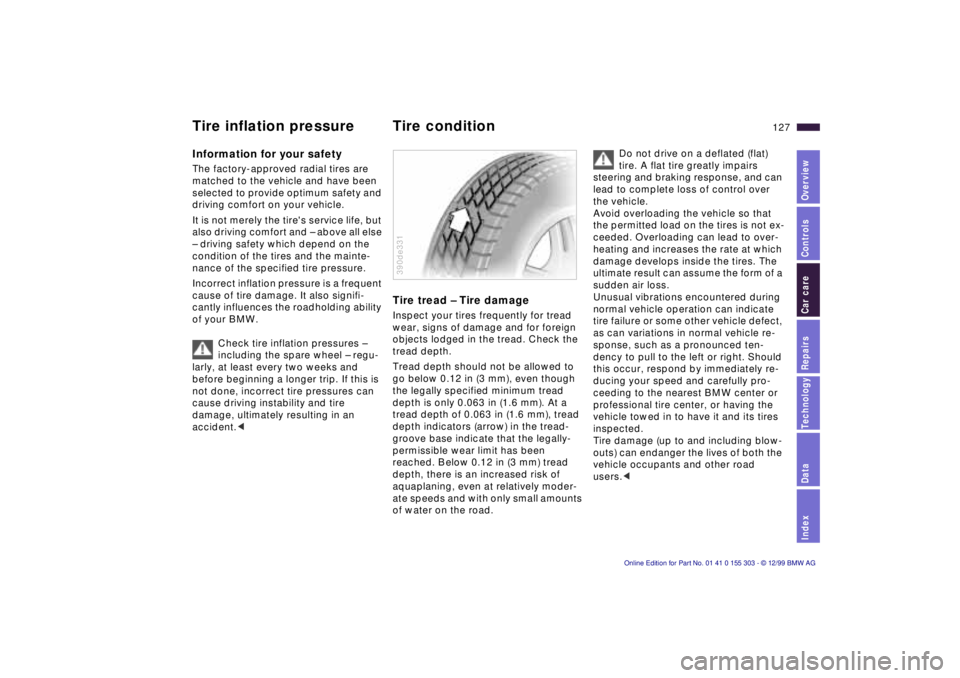
Tire tread Ð Tire damage Inspect your tires frequently for tread
wear, signs of damage and for foreign
objects lodged in the tread. Check the
tread depth.
Tread depth should not be allowed to
go below 0.12 in (3 mm), even though
the legally specified minimum tread
depth is only 0.063 in (1.6 mm). At a
tread depth of 0.063 in (1.6 mm), tread
depth indicators (arrow) in the tread-
groove base indicate that the legally-
permissible wear limit has been
reached. Below 0.12 in (3 mm) tread
depth, there is an increased risk of
aquaplaning, even at relatively moder-
ate speeds and with only small amounts
of water on the road. 390de331
Do not drive on a deflated (flat)
tire. A flat tire greatly impairs
steering and braking response, and can
lead to complete loss of control over
the vehicle.
Avoid overloading the vehicle so that
the permitted load on the tires is not ex-
ceeded. Overloading can lead to over-
heating and increases the rate at which
damage develops inside the tires. The
ultimate result can assume the form of a
sudden air loss.
Unusual vibrations encountered during
normal vehicle operation can indicate
tire failure or some other vehicle defect,
as can variations in normal vehicle re-
sponse, such as a pronounced ten-
dency to pull to the left or right. Should
this occur, respond by immediately re-
ducing your speed and carefully pro-
ceeding to the nearest BMW center or
professional tire center, or having the
vehicle towed in to have it and its tires
inspected.
Tire damage (up to and including blow-
outs) can endanger the lives of both the
vehicle occupants and other road
users.<
Tire inflation pressure Tire condition
Page 128 of 201

128n
Tire replacement To maintain good handling and vehicle
response, use only tires of a single
tread configuration from a single manu-
facturer. BMW tests and approves
wheel/tire combinations. Refer to
page 130. DOT Quality Grades Treadwear
Traction AA A B C
Temperature A B C
All passenger car tires must con-
form to Federal Safety Require-
ments in addition to these grades.< Treadwear The treadwear grade is a comparative
rating based on the wear rate of the tire
when tested under controlled condi-
tions on a specified government test
course.
For example, a tire graded 150 would
wear one and one-half (1 1/2) times as
well on the government course as a tire
graded 100. The relative performance
of tires depends upon the actual condi-
tions of their use, however, and may
depart significantly from the norm due
to variations in driving habits, service
practices and differences in road char-
acteristics and climate.
Traction The traction grades, from highest to
lowest, are AA, A, B, and C.
Those grades represent the tire's ability
to stop on wet pavement as measured
under controlled conditions on speci-
fied government test surfaces of as-
phalt and concrete. A tire marked C
may have poor traction performance.
The traction grade assigned to
this tire is based on straight-
ahead braking traction tests, and does
not include acceleration, cornering, hy-
droplaning, or peak traction character-
istics.< Temperature The temperature grades are A (the
highest), B, and C, representing the
tire's resistance to the generation of
heat and its ability to dissipate heat
when tested under controlled condi-
tions on a specified indoor laboratory
test wheel.
Sustained high temperature can cause
the material of the tire to degenerate
and reduce tire life, and excessive tem-
perature can lead to sudden tire failure.
The grade C corresponds to a level of
performance which all passenger car
tires must meet under the Federal Mo-
tor Vehicle Safety Standard No. 109.
Grades B and A represent higher levels
of performance on the laboratory test
wheel than the minimum required by
law.
The temperature grade for this tire
is established for a tire that is
properly inflated and not overloaded.
Excessive speed, underinflation, or ex-
cessive loading, either separately or in
combination, can cause heat buildup
and possible tire failure.< Uniform Tire Quality Grading Quality grades can be found where ap-
plicable on the tire sidewall between
tread shoulder and maximum section
width. For example:
Treadwear 200 Traction AA
Temperature A
Do not use retreaded tires, since
driving safety may be impaired by
their use. This is due to the possible
variations in casing structures and, in
some cases, to their extreme age,
which can lead to a decrease in their
durability.<
Page 131 of 201

IndexDataTechnologyRepairsCar careControlsOverview
131n
Winter tires Snow chains
*
Choosing the right tire BMW recommends special winter tires
(M+S radial tires) for driving in adverse
winter road conditions. While the All-
Season tires with M+S designation that
are mounted as standard equipment
provide better winter traction than sum-
mer tires, they generally do not achieve
the performance of winter tires.
For safe tracking and steering re-
sponse, install winter tires made by the
same manufacturer having the same
tread configuration on all four wheels.
Mount only winter tires approved by
BMW. Any BMW center will be glad to
provide you with information for select-
ing the best winter tires for your partic-
ular driving conditions.
Do not exceed specified
maximum speeds
Never exceed the maximum
speed for which winter tires are
rated.
Unprofessional attempts by laymen to
service tires can lead to damage and
accidents.
Have this work performed by skilled
professionals only. Any BMW center
has the required technical knowledge
and the proper equipment and will be
happy to assist you.<
Tire condition, tire pressure Once winter tires wear to a tread depth
below 0.16 in (4 mm), their performance
under winter driving conditions deterio-
rates noticeably. Worn tires should
therefore be replaced for safety consid-
erations.
Comply with the specified tire inflation
pressures Ñ and be sure to have the
wheel and tire assemblies balanced
every time you change the tires. Storage Store tires in a cool, dry place, away
from light whenever possible. Protect
the tires against contact with oil, grease
and fuel.
The use of narrow-link BMW snow
chains is approved only in pairs on the
rear wheels and only with tire size
235/65 R 17. Comply with all manufac-
turer's safety precautions when mount-
ing the chains.