warning BMW X5 4.4I 2000 Owner's Manual
[x] Cancel search | Manufacturer: BMW, Model Year: 2000, Model line: X5 4.4I, Model: BMW X5 4.4I 2000Pages: 201, PDF Size: 1.93 MB
Page 107 of 201
IndexDataTechnologyRepairsCar careControlsOverview
107n
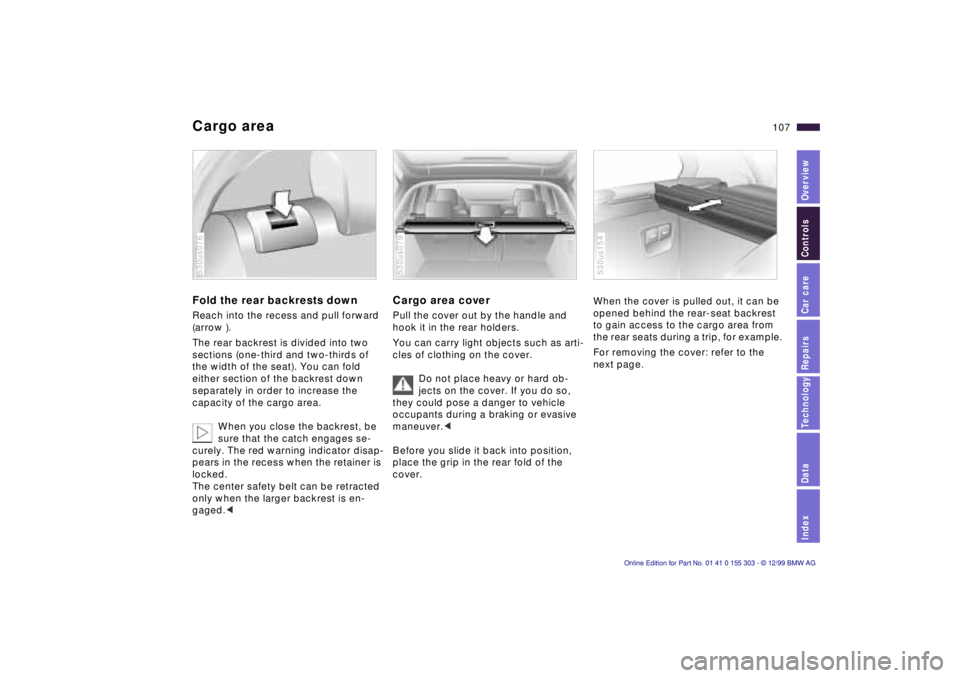
Cargo area Fold the rear backrests down Reach into the recess and pull forward
(arrow ).
The rear backrest is divided into two
sections (one-third and two-thirds of
the width of the seat). You can fold
either section of the backrest down
separately in order to increase the
capacity of the cargo area.
When you close the backrest, be
sure that the catch engages se-
curely. The red warning indicator disap-
pears in the recess when the retainer is
locked.
The center safety belt can be retracted
only when the larger backrest is en-
gaged.< 530us076
Cargo area cover Pull the cover out by the handle and
hook it in the rear holders.
You can carry light objects such as arti-
cles of clothing on the cover.
Do not place heavy or hard ob-
jects on the cover. If you do so,
they could pose a danger to vehicle
occupants during a braking or evasive
maneuver.<
Before you slide it back into position,
place the grip in the rear fold of the
cover. 530us079
When the cover is pulled out, it can be
opened behind the rear-seat backrest
to gain access to the cargo area from
the rear seats during a trip, for example.
For removing the cover: refer to the
next page. 530us154
Page 120 of 201
120n
Antilock Brake System (ABS) should adapt road speed to the road
conditions.
On road surfaces that have a loose sur-
face layer on a firm base with good
traction (on gravel, deep sand or snow,
for example), braking distances may be
longer than with locked wheels.This is
also true if snow chains are mounted.
However, ABS continues to provide en-
hanced vehicle stability and steering re-
sponse under these conditions. Information for your safety Not even ABS can suspend the laws of
physics. ABS alone cannot prevent
accidents when the brakes are applied
without an adequate safety distance
between vehicles, if the vehicle is
driven with excessive speed, or if aqua-
planing occurs. Responsibility for these
types of situations remains in the hands
(and at the feet) of the driver. You
should never allow the added safety of
ABS to lull you into a false sense of
security, or mislead you into taking
increased risks that could affect your
own safety and that of others.
Do not make any modifications to
the ABS system.
Service procedures on ABS are to be
performed by authorized technicians
only.<
Cornering Brake Control (CBC) CBC is an advanced engineering de-
sign of the ABS. When braking during
cornering with high lateral accelera-
tion, or when braking during a lane
change, vehicle stability is further im-
proved and the steering response is
enhanced. Electronic Brake Force Distribu-
tion (EBV) EBV governs brake application pres-
sure at the rear wheels to achieve sta-
ble brake response.
If the EBV fails (refer to the next
page), avoid full or "panic" brake
applications. Full or panic brake appli-
cations can result in overbraking at the
rear axle, and braking stability is no
longer ensured.<
Dynamic Brake Control (DBC)
If you apply the brakes rapidly, this sys-
tem automatically produces the maxi-
mum braking force boost and thus
helps to achieve the shortest possible
braking distance during "panic stops."
All of the benefits of the ABS system
are exploited under these circum-
stances.
Do not reduce the pressure on the
brake pedal for the duration of the
brake application. When the brake
pedal is released, the DBC is deacti-
vated.
In the event of a malfunction,
the yellow warning lamp comes
on. Have the system checked
and repaired at your BMW cen-
ter as soon as possible.
Refer to the "Information for your
safety" covering the ABS system.
This information also applies in general
for DBC.<
Page 121 of 201
IndexDataTechnologyRepairsCar careControlsOverview
121n
Antilock Brake System (ABS) In the event of a fault
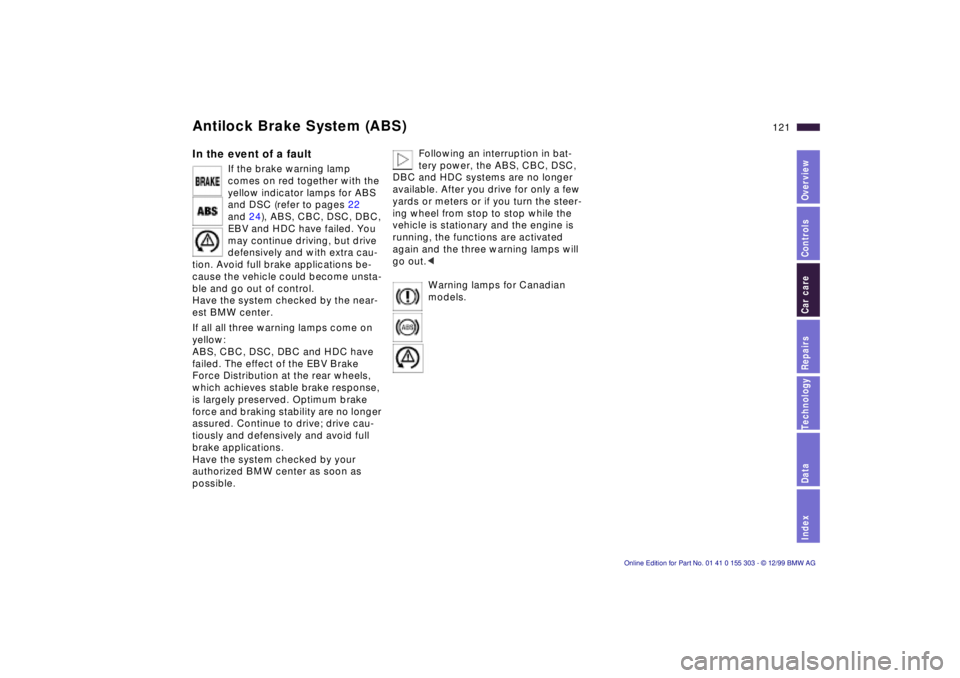
If the brake warning lamp
comes on red together with the
yellow indicator lamps for ABS
and DSC (refer to pages 22
and 24), ABS, CBC, DSC, DBC,
EBV and HDC have failed. You
may continue driving, but drive
defensively and with extra cau-
tion. Avoid full brake applications be-
cause the vehicle could become unsta-
ble and go out of control.
Have the system checked by the near-
est BMW center.
If all all three warning lamps come on
yellow:
ABS, CBC, DSC, DBC and HDC have
failed. The effect of the EBV Brake
Force Distribution at the rear wheels,
which achieves stable brake response,
is largely preserved. Optimum brake
force and braking stability are no longer
assured. Continue to drive; drive cau-
tiously and defensively and avoid full
brake applications.
Have the system checked by your
authorized BMW center as soon as
possible.
Following an interruption in bat-
tery power, the ABS, CBC, DSC,
DBC and HDC systems are no longer
available. After you drive for only a few
yards or meters or if you turn the steer-
ing wheel from stop to stop while the
vehicle is stationary and the engine is
running, the functions are activated
again and the three warning lamps will
go out.<
Warning lamps for Canadian
models.
Page 123 of 201
IndexDataTechnologyRepairsCar careControlsOverview
123n
Brake system Winter operation Brake fluid level
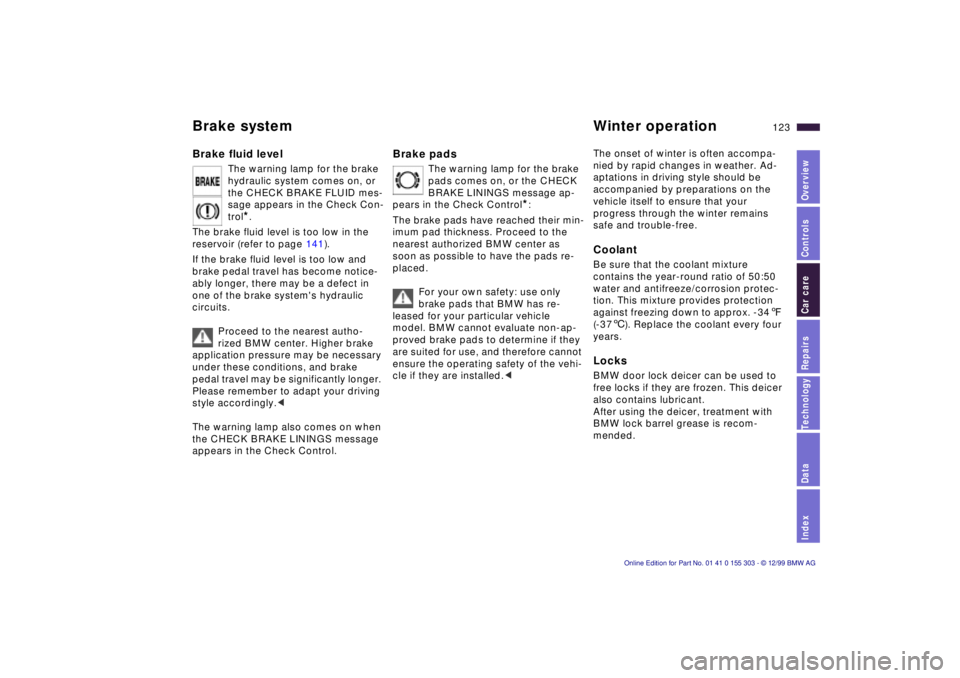
The warning lamp for the brake
hydraulic system comes on, or
the CHECK BRAKE FLUID mes-
sage appears in the Check Con-
trol
*.
The brake fluid level is too low in the
reservoir (refer to page 141).
If the brake fluid level is too low and
brake pedal travel has become notice-
ably longer, there may be a defect in
one of the brake system's hydraulic
circuits.
Proceed to the nearest autho-
rized BMW center. Higher brake
application pressure may be necessary
under these conditions, and brake
pedal travel may be significantly longer.
Please remember to adapt your driving
style accordingly.<
The warning lamp also comes on when
the CHECK BRAKE LININGS message
appears in the Check Control.
Brake pads
The warning lamp for the brake
pads comes on, or the CHECK
BRAKE LININGS message ap-
pears in the Check Control
*:
The brake pads have reached their min-
imum pad thickness. Proceed to the
nearest authorized BMW center as
soon as possible to have the pads re-
placed.
For your own safety: use only
brake pads that BMW has re-
leased for your particular vehicle
model. BMW cannot evaluate non-ap-
proved brake pads to determine if they
are suited for use, and therefore cannot
ensure the operating safety of the vehi-
cle if they are installed.<
The onset of winter is often accompa-
nied by rapid changes in weather. Ad-
aptations in driving style should be
accompanied by preparations on the
vehicle itself to ensure that your
progress through the winter remains
safe and trouble-free. Coolant Be sure that the coolant mixture
contains the year-round ratio of 50:50
water and antifreeze/corrosion protec-
tion. This mixture provides protection
against freezing down to approx. -347
(-376). Replace the coolant every four
years. Locks BMW door lock deicer can be used to
free locks if they are frozen. This deicer
also contains lubricant.
After using the deicer, treatment with
BMW lock barrel grease is recom-
mended.
Page 125 of 201

IndexDataTechnologyRepairsCar careControlsOverview
125n
Winter operation Power steering Level control system
Skid control Release the accelerator pedal. Coun-
tersteer carefully and attempt to regain
control of the vehicle.Parking Place the selector lever in "Park." and
apply the parking brake when parking
on inclined surfaces. In order to prevent
the parking brake linings from locking
due to frost or corrosion, dry them by
gently applying the parking brake as the
vehicle is coming to a stop. Make sure
that following traffic is not endangered.
The brake lamps do not light up
when the parking brake is ap-
plied.<
If there is a change in steering response
(difficult steering, for example) or, espe-
cially on vehicles with Servotronic
*, if
the steering "drifts" or "floats" at in-
creasing speeds:
Have your authorized BMW center in-
spect this system as soon as possible.
If the power steering fails, in-
creased effort will be required to
steer the vehicle.<
The warning lamp for the level
control system comes on, or the
message LEVEL CONTROL IN-
ACTIVE appears in the Check Control
*:
There is a malfunction in the level con-
trol system.
Stop and inspect the vehicle. If it is
riding significantly lower in the rear than
in the front, or if it is sitting at an incline
(left rear compared to right rear), con-
sult the nearest authorized BMW cen-
ter. Drive with appropriate caution in
the meantime, especially if you are driv-
ing under poor road-surface conditions.
The vehicle has reduced ground clear-
ance or driving comfort is noticeably re-
duced.
Even if the attitude of the vehicle is nor-
mal, you should consult the nearest au-
thorized BMW center if the warning
lamp indicates a system fault.
Page 133 of 201
IndexDataTechnologyRepairsCar careControlsOverview
133n
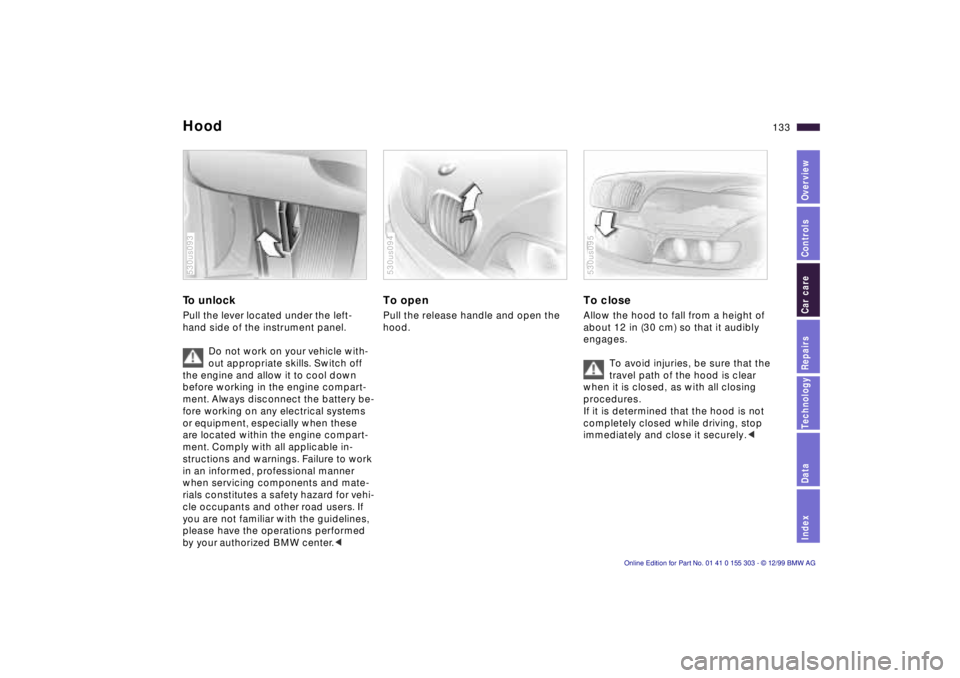
Hood To unlock Pull the lever located under the left-
hand side of the instrument panel.
Do not work on your vehicle with-
out appropriate skills. Switch off
the engine and allow it to cool down
before working in the engine compart-
ment. Always disconnect the battery be-
fore working on any electrical systems
or equipment, especially when these
are located within the engine compart-
ment. Comply with all applicable in-
structions and warnings. Failure to work
in an informed, professional manner
when servicing components and mate-
rials constitutes a safety hazard for vehi-
cle occupants and other road users. If
you are not familiar with the guidelines,
please have the operations performed
by your authorized BMW center.< 530us093
To open Pull the release handle and open the
hood. 530us094
To close Allow the hood to fall from a height of
about 12 in (30 cm) so that it audibly
engages.
To avoid injuries, be sure that the
travel path of the hood is clear
when it is closed, as with all closing
procedures.
If it is determined that the hood is not
completely closed while driving, stop
immediately and close it securely.< 530us095
Page 139 of 201

IndexDataTechnologyRepairsCar careControlsOverview
139n
Engine oil
Comply with the applicable envi-
ronmental laws regulating the dis-
posal of used oil.<
Recommendation: have the oil changed
by your BMW center.
Continuous exposure to used oil
has caused cancer in laboratory
testing. For this reason, any skin areas
that come into contact with oil should
be thoroughly washed with soap and
water.
Always store oils, grease and similar
materials so that they are inaccessible
to children. Comply with warning labels
and information on containers.<
Page 141 of 201
IndexDataTechnologyRepairsCar careControlsOverview
141n
Brake fluid Vehicle IdentiÞcation No.
If the indicator lamp for the
brake hydraulic system appears
or if the CHECK BRAKE FLUID
warning appears in the Check
Control
*: the brake fluid level is
too low in the reservoir.
The brake fluid reservoir is located un-
der the microfilter housing trim panel
on the driver's side of the vehicle. For
adding brake fluid or for determining
and correcting the cause of brake fluid
loss, consult your BMW center. Your
BMW center is familiar with the specifi-
cations for factory-approved brake
fluids (DOT 4).
Brake fluid loss may result in extended
brake pedal travel. For this situation,
refer to the notes on page 123.
Brake fluid is hygroscopic, that is,
it absorbs moisture from the air
over time.
In order to ensure the safety and reli-
ability of the brake system, have the
brake fluid changed every two years by
an authorized BMW center. Refer also
to the Service and Warranty Information
Booklet (US models) or the Warranty
and Service Guide Booklet (Canadian
models).
Brake fluid is toxic and damages the
vehicle's paint. You should always store
it in its original container and in a loca-
tion which is out of reach of children.
Do not spill the fluid and do not fill the
brake fluid reservoir beyond the "MAX"
mark. The brake fluid could ignite upon
contact with hot engine parts and
cause serious burns.<
Comply with the applicable envi-
ronmental laws regulating the dis-
posal of brake fluid.<
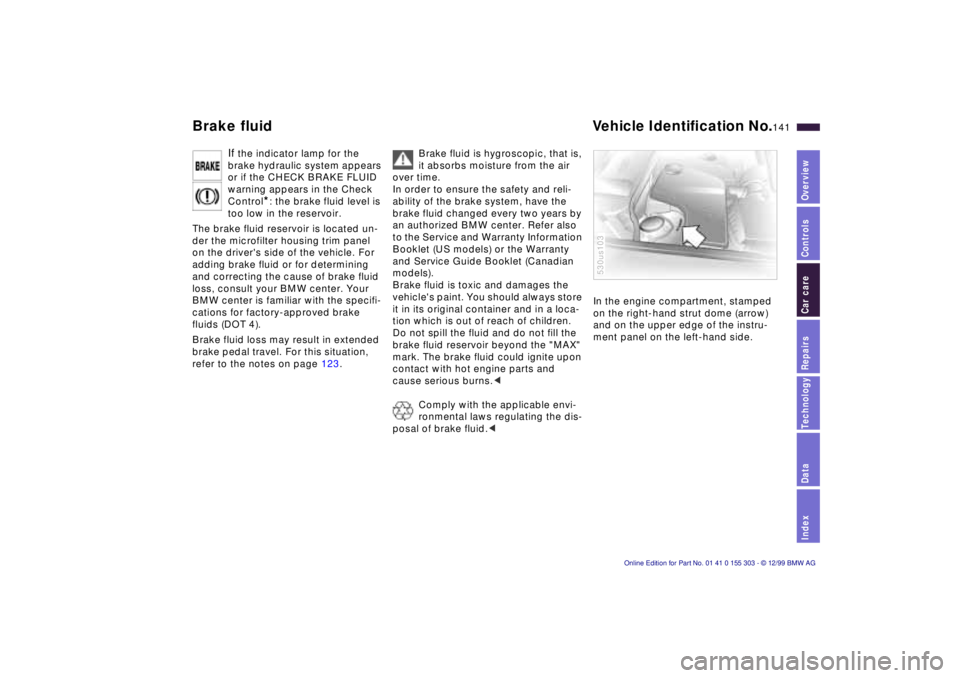
In the engine compartment, stamped
on the right-hand strut dome (arrow)
and on the upper edge of the instru-
ment panel on the left-hand side. 530us103
Page 150 of 201
150n
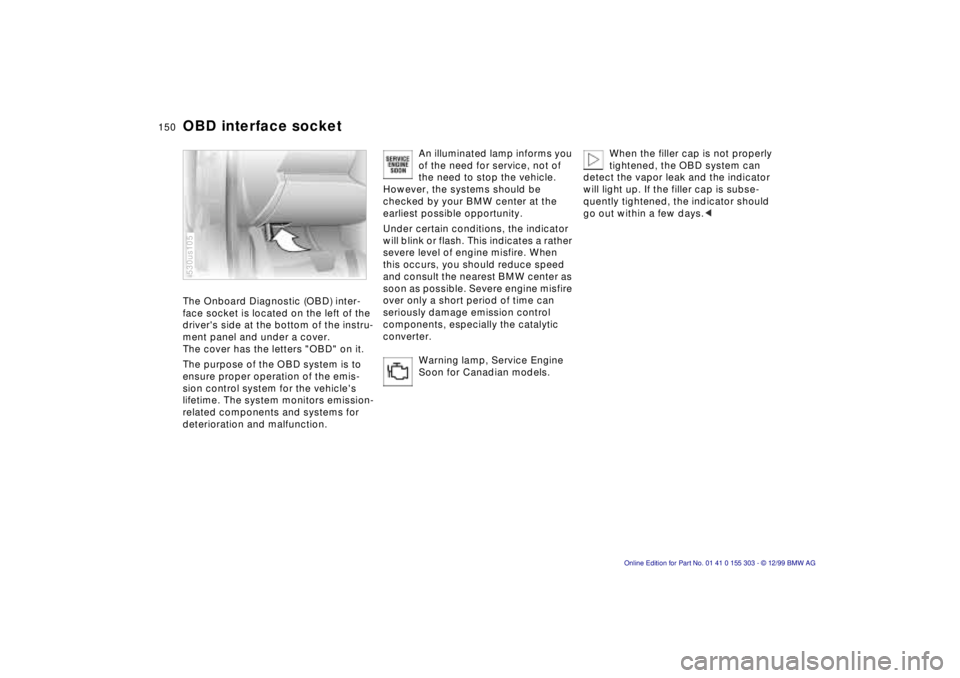
OBD interface socket The Onboard Diagnostic (OBD) inter-
face socket is located on the left of the
driver's side at the bottom of the instru-
ment panel and under a cover.
The cover has the letters "OBD" on it.
The purpose of the OBD system is to
ensure proper operation of the emis-
sion control system for the vehicle's
lifetime. The system monitors emission-
related components and systems for
deterioration and malfunction. 530us105
An illuminated lamp informs you
of the need for service, not of
the need to stop the vehicle.
However, the systems should be
checked by your BMW center at the
earliest possible opportunity.
Under certain conditions, the indicator
will blink or flash. This indicates a rather
severe level of engine misfire. When
this occurs, you should reduce speed
and consult the nearest BMW center as
soon as possible. Severe engine misfire
over only a short period of time can
seriously damage emission control
components, especially the catalytic
converter.
Warning lamp, Service Engine
Soon for Canadian models.
When the filler cap is not properly
tightened, the OBD system can
detect the vapor leak and the indicator
will light up. If the filler cap is subse-
quently tightened, the indicator should
go out within a few days.<
Page 160 of 201
160n
Changing a wheel
Safety measures in the event of a
ßat tire or wheel change:
Stop the vehicle as far as possible from
passing trafÞc. Park on a Þrm, ßat, sur-
face. Switch on the hazard ßashers.
Turn the steering wheel to the straight-
ahead position, remove the key and en-
gage the steering lock. Select ÒParkÒ po-
sition and engage the parking brake. All
passengers should be outside the vehi-
cle and well away from your immediate
working area (behind a guardrail, for in-
stance). If a warning triangle or portable
hazard warning lamp is available, set it
up on the roadside at an appropriate
distance from the rear of the vehicle.
Comply with all safety guidelines and
regulations. Change the wheel only on a
level, Þrm surface which is not slippery.
Avoid jacking the vehicle up on a soft or
slippery surface (snow, ice, very smooth
surfaces, etc.), since it could slide side-
ways. Position the jack on a Þrm support
surface. Do not place wooden blocks or
similar objects under the jack. If this is
done, the jack might not be able to
reach its full support capacity because
of the limited height. Do not lie under
the vehicle or start the engine when the
vehicle is supported by the jack. Failure
to comply with this creates a risk of fatal
injury.<
What you will need In order to avoid rattling noises later,
note the position of the tools when you
remove them and return them to their
original position when you are through
using them.
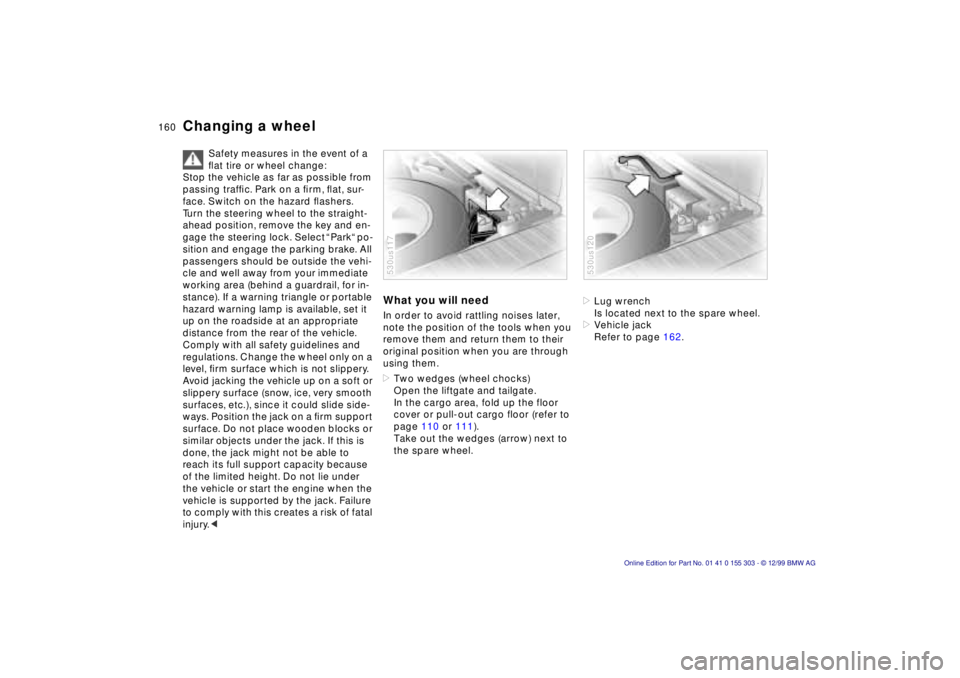
>Two wedges (wheel chocks)
Open the liftgate and tailgate.
In the cargo area, fold up the floor
cover or pull-out cargo floor (refer to
page 110 or 111).
Take out the wedges (arrow) next to
the spare wheel. 530us117
>Lug wrench
Is located next to the spare wheel.
>Vehicle jack
Refer to page 162.530us120