coolant level BMW X5 4.4I 2000 Owners Manual
[x] Cancel search | Manufacturer: BMW, Model Year: 2000, Model line: X5 4.4I, Model: BMW X5 4.4I 2000Pages: 201, PDF Size: 1.93 MB
Page 12 of 201

Contents
Operation, care and maintenance
Owner service procedures
Advanced technology
Under the hood:
Hood133
Engine compartment134
Washer fluid136
Washer nozzles136
Engine oil137
Coolant140
Brake fluid141
Vehicle Identification No.141
Care and maintenance:
The BMW Maintenance
System142
Caring for your vehicle143
Airbags148
Vehicle storage148
Laws and regulations:
Technical modifications149
OBD interface socket150
Replacement procedures:
Onboard tool kit154
Wiper blades154
Lamps and bulbs155
Changing a wheel160
Battery165
Fuses167
In case of electrical
malfunction:
Fuel filler door168
Sliding/Tilt sunroof168
Liftgate168
Tailgate169
Assistance, giving and
receiving:
Jump-starting170
Towing the vehicle171Airbags176
Adaptive Transmission Control
(ATC)176
Four-wheel drive177
Dynamic Stability Control
(DSC)177
Radio reception178
Safety belt tensioner178
DSP sound system179
Rearview mirrors with automatic
dimmer179
Rain sensor180
Integrated rear suspension180
Level control system181
Xenon lamps181
Page 19 of 201

IndexDataTechnologyRepairsCar careControlsOverview
19n
Instrument cluster
There are two versions, depending on
the equipment on your vehicle.
1 Fuel gauge with indicator lamp for
fuel reserve75
2 Indicator lamp for turn signal
indicator24
3 Speedometer
4 Indicator lamp for high beams24
5 Tachometer and Energy Control75
6 Engine coolant thermometer with
"Coolant temperature too high"
indicator76
7 Indicator and warning lamps (clock-
wise) for:
>
Parking brake/Brake hydraulic
system, Dynamic Brake Control
(DBC)22, 24
>
Antilock Brake System (ABS)23
>
Brake pads24
>
Airbags23
>
Automatic transmission24
>
Please fasten safety belts23
>
Cruise control25
8 Selector lever and program display
for automatic transmission66
9 Service Interval Display7610 Onboard computer display Ð
Operation via the turn signal lever:
Refer to page 80:
>
Outside temperature
>
Average fuel consumption
>
Cruising range
>
Average speed
11 Indicator lamp for Dynamic Stability
Control (DSC)24
12 Indicator lamp for level control
system24
13 Odometer and trip odometer74
14 Indicator for Check Control77
15 Reset button for trip odometer74
16 Indicator and warning lamps
(clockwise) for:
>
Fog lamps25
>
Battery charge current22
>
Engine oil level/Engine oil
pressure24, 22
>
Engine Power Control24
>
Service Engine Soon24
Page 76 of 201
76n
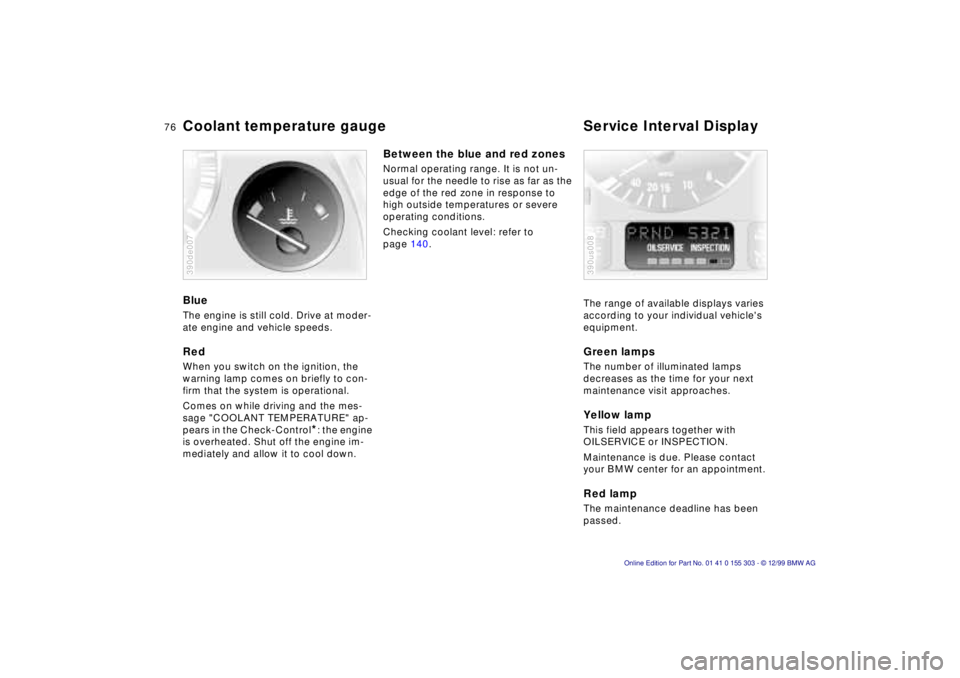
Coolant temperature gauge Service Interval Display Blue The engine is still cold. Drive at moder-
ate engine and vehicle speeds. Red When you switch on the ignition, the
warning lamp comes on briefly to con-
firm that the system is operational.
Comes on while driving and the mes-
sage "COOLANT TEMPERATURE" ap-
pears in the Check-Control
*: the engine
is overheated. Shut off the engine im-
mediately and allow it to cool down.
390de007
Between the blue and red zones Normal operating range. It is not un-
usual for the needle to rise as far as the
edge of the red zone in response to
high outside temperatures or severe
operating conditions.
Checking coolant level: refer to
page 140.
The range of available displays varies
according to your individual vehicle's
equipment.
Green lamps The number of illuminated lamps
decreases as the time for your next
maintenance visit approaches. Yellow lamp This field appears together with
OILSERVICE or INSPECTION.
Maintenance is due. Please contact
your BMW center for an appointment. Red lamp The maintenance deadline has been
passed. 390us008
Page 79 of 201

IndexDataTechnologyRepairsCar careControlsOverview
79n
Check Control >TRANS. FAILSAFE PROG
Please consult the nearest authorized
BMW center. Refer to page 68.
>CHECK BRAKE LININGS
Have the brake linings inspected by
your BMW center. Refer to page 123.
>CHECK COOLANT LEVEL
Coolant too low, top up at the next
opportunity. Refer to page 140.
>ENGINE FAILSAFE PROG
There is a fault in the engine's elec-
tronic control system. When braking,
higher brake application pressure
may be necessary and brake pedal
travel may be significantly longer.
Have the fault checked by your
authorized BMW center.
Displays after completion of trip All of the malfunctions registered during
the trip appear consecutively when the
key is turned to position 0.
The following displays will appear when
appropriate:
>LIGHTS ON
>KEY IN IGNITION LOCK
>CHECK ENGINE OIL LEV
Add engine oil at the next opportunity
(next stop for fuel). Refer to
page 137.
These displays appear when you open
the driver's door after parking the vehi-
cle. A supplementary gong is also
heard.
Status reports remain available for a
period of approx. three minutes after
the display goes out and the key is
removed from the ignition. Press the
CHECK button 3. If there were multiple
reports, press the CHECK button re-
peatedly to view them all in sequence.
To check the Check Control Press the CHECK button 3 with the
ignition key in position 2: CHECK
CONTROL OK appears in the display.
No malfunctions are present in the
monitored systems. Onboard computer
*
You will find a description of the
onboard computer in the Owner's
Manual for the Radio and Information
System or the Owner's Manual for the
onboard monitor.
You can have the Check Control
and onboard computer messages
displayed in a different language.<
Page 115 of 201
IndexDataTechnologyRepairsCar careControlsOverview
Overview
Controls and features
Operation, care
and maintenance
Owner service procedures
Technical data
Index Advanced technology
115n
Car care Special operating instructions:
Break-in procedures116
Driving your BMW X5117
General driving notes118
Catalytic converter118
Antilock Brake System
(ABS)119
Disc brakes122
Brake system123
Winter operation123
Power steering125
Level control system125
Cellular phone126
Radio reception126
Wheels and tires:
Tire inflation pressure127
Tire condition127
Tire replacement128
Tire rotation129
Wheel and tire
combinations130
Winter tires131
Snow chains131
Approved wheel and tire
specifications132Under the hood:
Hood133
Engine compartment134
Washer fluid136
Washer nozzles136
Engine oil137
Coolant140
Brake fluid141
Vehicle Identification No.141
Care and maintenance:
The BMW Maintenance
System142
Caring for your vehicle143
Airbags148
Vehicle storage148
Laws and regulations:
Technical modifications149
OBD interface socket150
Page 117 of 201

IndexDataTechnologyRepairsCar careControlsOverview
117n
Driving your BMW X5 Your BMW is right at home on all roads
and byways Ð even where the pavement
ends. It combines permanent four-
wheel drive with the agility of a typical
passenger car. On bad roads When you are driving on bad roads,
there are a few points which you should
strictly heed Ñ for your own safety, for
that of your passengers, and for the
safekeeping of the vehicle:
>Familiarize yourself with the vehicle
before you begin driving. Do not take
risks with the vehicle under any cir-
cumstances.
>Always adapt vehicle speed to road
conditions Ð the steeper and more
uneven the road surface is, the
slower the vehicle's speed should be.
>You can operate your vehicle on up-
hill and downhill gradients with a
maximum slope of 50 %. If you intend
to drive on either an uphill or downhill
gradient of this steepness, check to
be sure in advance that the engine oil
and coolant levels are both near the
"max" mark. Refer to page 137
and 140.
When driving down steep slopes, use
the Hill Descent Control (HDC). Refer
to page 84. Starting from a full stop is possible on
uphill gradients of up to 32 %.
The permitted side tilt is also 50 %.
>While driving, watch carefully for ob-
stacles such as rocks or holes. Try to
avoid these obstacles whenever pos-
sible.
>On hill crests and bumpy roads, for
example, be careful to prevent the
body from "bottoming" (contact be-
tween the body and the ground).
The ground clearance of the vehicle
is:
Ð 8 inches (200 mm) with up to four
passengers
Ð 7 inches (180 mm) fully loaded.
>Do not drive in water that is deeper
than 20 inches (50 cm). If you must
drive through water up to that depth,
drive at a walking speed and do not
stop.
After leaving the water, press on the
footbrake gently several times while
driving at a low speed. The brake ap-
plications will help to dry the brakes,
thus preventing a reduction in brak-
ing performance caused by the mois-
ture.
Back onto the paved road In recommending that you observe the
following points after driving on adverse
road surfaces, it is not as a "beauty
treatment" for your BMW. Instead, it is
intended for the maintenance of driving
safety:
>Clean accumulations of dirt from the
body and check the undercarriage for
damage.
>Clean mud, snow, ice and other ma-
terials from the wheels and tires.
Check the tires for damage.
>Check to determine whether rocks,
gravel or accumulations of dirt on the
brake rotors and calipers could influ-
ence braking performance. Remove
all such foreign objects.
>In order to clean the brake rotors,
apply the footbrake gently several
times while driving at a low speed. Be
sure that following traffic is not en-
dangered by this.
>For cleaning the parking brake, apply
the lever slightly at approx. 25 mph
(40 km/h) and continue to drive for
approx. 200 yards (200 meters), pro-
vided that traffic conditions allow you
to do so.
Page 123 of 201
IndexDataTechnologyRepairsCar careControlsOverview
123n
Brake system Winter operation Brake fluid level
The warning lamp for the brake
hydraulic system comes on, or
the CHECK BRAKE FLUID mes-
sage appears in the Check Con-
trol
*.
The brake fluid level is too low in the
reservoir (refer to page 141).
If the brake fluid level is too low and
brake pedal travel has become notice-
ably longer, there may be a defect in
one of the brake system's hydraulic
circuits.
Proceed to the nearest autho-
rized BMW center. Higher brake
application pressure may be necessary
under these conditions, and brake
pedal travel may be significantly longer.
Please remember to adapt your driving
style accordingly.<
The warning lamp also comes on when
the CHECK BRAKE LININGS message
appears in the Check Control.
Brake pads
The warning lamp for the brake
pads comes on, or the CHECK
BRAKE LININGS message ap-
pears in the Check Control
*:
The brake pads have reached their min-
imum pad thickness. Proceed to the
nearest authorized BMW center as
soon as possible to have the pads re-
placed.
For your own safety: use only
brake pads that BMW has re-
leased for your particular vehicle
model. BMW cannot evaluate non-ap-
proved brake pads to determine if they
are suited for use, and therefore cannot
ensure the operating safety of the vehi-
cle if they are installed.<
The onset of winter is often accompa-
nied by rapid changes in weather. Ad-
aptations in driving style should be
accompanied by preparations on the
vehicle itself to ensure that your
progress through the winter remains
safe and trouble-free. Coolant Be sure that the coolant mixture
contains the year-round ratio of 50:50
water and antifreeze/corrosion protec-
tion. This mixture provides protection
against freezing down to approx. -347
(-376). Replace the coolant every four
years. Locks BMW door lock deicer can be used to
free locks if they are frozen. This deicer
also contains lubricant.
After using the deicer, treatment with
BMW lock barrel grease is recom-
mended.
Page 140 of 201
140n
Coolant
Do not add coolant to the cooling
system when the engine is hot. If
you attempt to do so, escaping coolant
can cause burns.
To avoid the possibility of damage later
on, never use anything other than fac-
tory-approved, nitrite and amino-free
extended-duty antifreeze with corrosion
inhibitor. Your authorized BMW center
is familiar with the factory specifica-
tions.
Antifreeze and anticorrosion agents are
hazardous to health. You should always
store them in their original container
and in a location which is inaccessible
to children.
Extended-duty antifreeze with corro-
sion inhibitor contains the flammable
substance ethyleneÐglycol. For this rea-
son, do not spill antifreeze with corro-
sion inhibitor on hot engine parts. It
could ignite and cause serious burns.<
Comply with the applicable envi-
ronmental laws regulating the dis-
posal of extended-duty antifreeze with
corrosion inhibitor.<
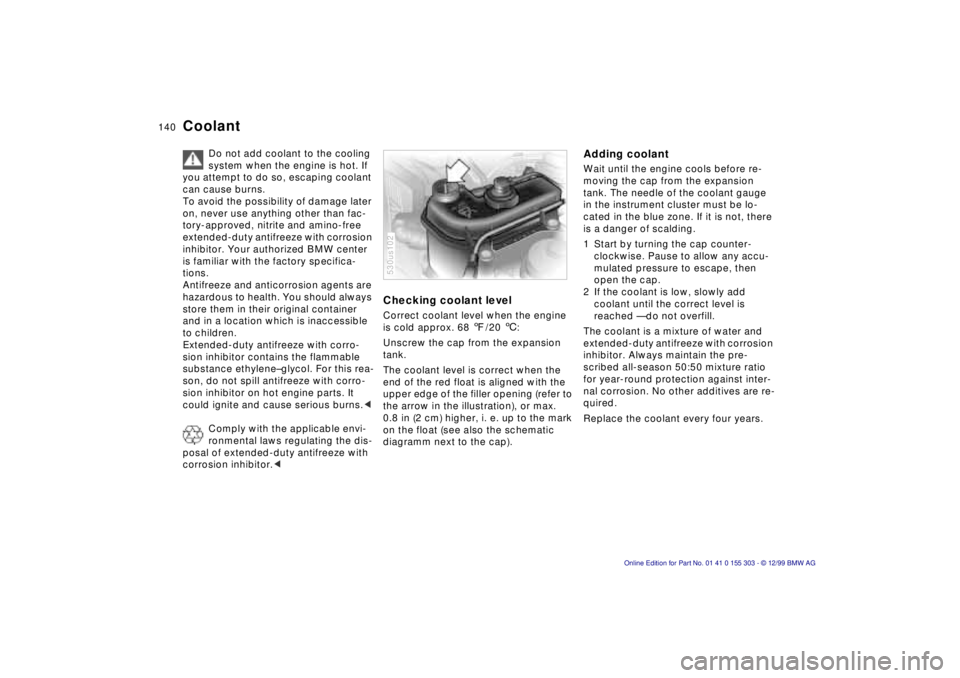
Checking coolant level Correct coolant level when the engine
is cold approx. 68 7/20 6:
Unscrew the cap from the expansion
tank.
The coolant level is correct when the
end of the red float is aligned with the
upper edge of the filler opening (refer to
the arrow in the illustration), or max.
0.8 in (2 cm) higher, i. e. up to the mark
on the float (see also the schematic
diagramm next to the cap). 530us102
Adding coolant Wait until the engine cools before re-
moving the cap from the expansion
tank. The needle of the coolant gauge
in the instrument cluster must be lo-
cated in the blue zone. If it is not, there
is a danger of scalding.
1 Start by turning the cap counter-
clockwise. Pause to allow any accu-
mulated pressure to escape, then
open the cap.
2 If the coolant is low, slowly add
coolant until the correct level is
reached Ñ do not overfill.
The coolant is a mixture of water and
extended-duty antifreeze with corrosion
inhibitor. Always maintain the pre-
scribed all-season 50:50 mixture ratio
for year-round protection against inter-
nal corrosion. No other additives are re-
quired.
Replace the coolant every four years.
Page 193 of 201

Everything from A to Z
193n
IndexDataTechnologyRepairsCar careControlsOverview
Cold start64
Comfort seat50
Compartments101
Computer80
Configuring the settings55
Contamination on
paintwork144
Convenience operation of
windows and sliding/tilt
sunroof36
Convenience starting
feature64
Coolant123, 140
Coolant, antifreeze123
Cornering Brake Control
(CBC)120
Cruise control72
Cup holder102
Curb weight186DDashboard16
Data link connector for On-
Board Diagnostics150
Date, refer to the Radio or
Onboard Computer
Owner's Manual
Daytime-driving lamp86
DBC (Dynamic Brake
Control)24, 120Deep water117
Defrosting the windows93
Digital clock, refer to the
Radio or Onboard
Computer Owner's Manual
Digital sound processor179
Dimensions185
Dipstick, engine oil137
Disc brakes122
Displacement184
Display lighting86
Displays18, 20
Distance warning82
Diversity Antenna
system178
Divided rear backrest107
Door keys34
Door locks, care123
Doors
Manual operation36
Remote control38
Unlocking and locking36
Drive belts188
Driving through water117
Driving your BMW X5117
DSC (Dynamic Stability
Control)24, 83, 177
DSP amplifier, refer to the
Radio Owner's ManualDynamic Brake Control
(DBC)24, 120
Dynamic Stability Control
(DSC)24, 83, 177
EEBV (Electronic Brake Force
Distribution)120
Electric power windows45
Electrical malfunction
Fuel filler door168
Liftgate168
Sliding/Tilt sunroof168
Tailgate169
Electrical system188
Electronic Brake Force
Distribution (EBV)120
Electronic immobilizer35
Elements of operation16
Emergency operation
Doors36
Fuel filler door168
Sliding/Tilt sunroof168
Tailgate168
Energy Control75
Engine compartment134
Engine coolant140
Engine knock control30
Engine oil consumption137
Engine oil grades138
Engine oil level24Engine oil pressure22
Engine output184
Engine specifications184
Error indicators77
Exterior finish144
Exterior mirrors52
FFailure of an electrical
accessory167
Failure warnings77
Filler cap cover29
First-aid kit28
Fittings, tow-starting and
towing171
Flashlight101
Flat tire127, 160
Fog lamps87
Bulb replacement156
Folding rear backrest107
Footbrake122
Footwell lamps88
Bulb replacement158
Front area lighting88
Front fog lamps87
Front seat adjustment48
Frost protection,
radiator140
Fuel30
Fuel capacity187
Fuel display75
Page 198 of 201
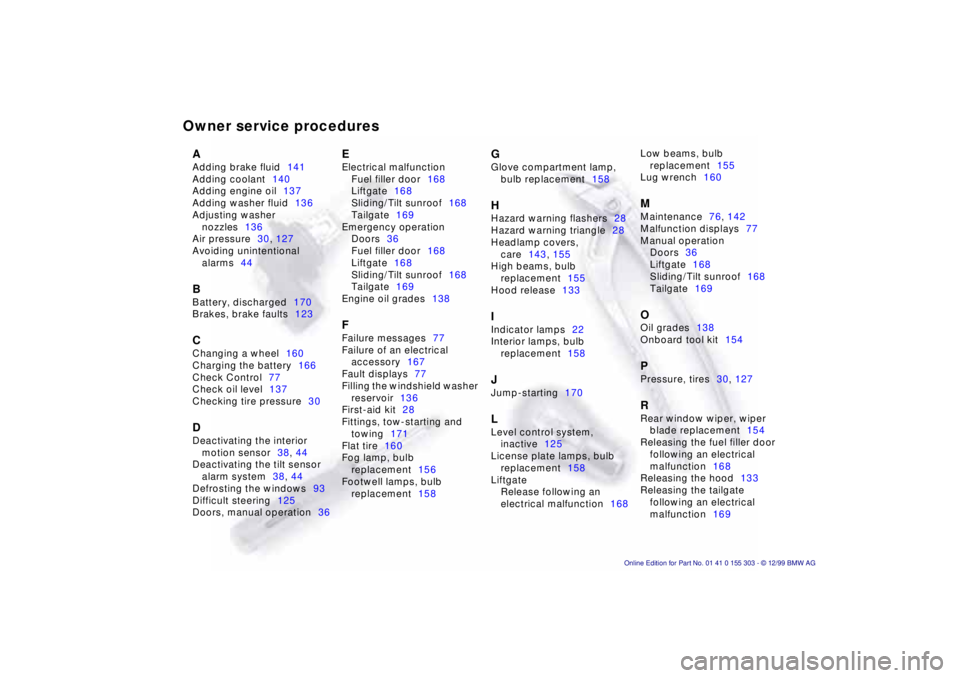
Owner service proceduresAAdding brake fluid141
Adding coolant140
Adding engine oil137
Adding washer fluid136
Adjusting washer
nozzles136
Air pressure30, 127
Avoiding unintentional
alarms44BBattery, discharged170
Brakes, brake faults123CChanging a wheel160
Charging the battery166
Check Control77
Check oil level137
Checking tire pressure30DDeactivating the interior
motion sensor38, 44
Deactivating the tilt sensor
alarm system38, 44
Defrosting the windows93
Difficult steering125
Doors, manual operation36
EElectrical malfunction
Fuel filler door168
Liftgate168
Sliding/Tilt sunroof168
Tailgate169
Emergency operation
Doors36
Fuel filler door168
Liftgate168
Sliding/Tilt sunroof168
Tailgate169
Engine oil grades138FFailure messages77
Failure of an electrical
accessory167
Fault displays77
Filling the windshield washer
reservoir136
First-aid kit28
Fittings, tow-starting and
towing171
Flat tire160
Fog lamp, bulb
replacement156
Footwell lamps, bulb
replacement158
GGlove compartment lamp,
bulb replacement158HHazard warning flashers28
Hazard warning triangle28
Headlamp covers,
care143, 155
High beams, bulb
replacement155
Hood release133IIndicator lamps22
Interior lamps, bulb
replacement158JJump-starting170LLevel control system,
inactive125
License plate lamps, bulb
replacement158
Liftgate
Release following an
electrical malfunction168Low beams, bulb
replacement155
Lug wrench160
MMaintenance76, 142
Malfunction displays77
Manual operation
Doors36
Liftgate168
Sliding/Tilt sunroof168
Tailgate169OOil grades138
Onboard tool kit154PPressure, tires30, 127RRear window wiper, wiper
blade replacement154
Releasing the fuel filler door
following an electrical
malfunction168
Releasing the hood133
Releasing the tailgate
following an electrical
malfunction169