parking brake BMW X5 4.4I 2000 Owners Manual
[x] Cancel search | Manufacturer: BMW, Model Year: 2000, Model line: X5 4.4I, Model: BMW X5 4.4I 2000Pages: 201, PDF Size: 1.93 MB
Page 10 of 201

Contents
Overview
Controls and features
Cockpit16
Instrument cluster18
Indicator and warning lamps22
Multifunction steering wheel26
Sports steering wheel27
Hazard warning flashers28
Warning triangle28
First-aid kit28
Refueling29
Fuel specifications30
Tire inflation pressure30
Locks and security systems:
Keys34
Electronic vehicle
immobilizer35
Central locking system36
Opening and closing
Ð from the outside36
Using the key36
Using the remote control37
Opening and closing
Ð from the inside40
Liftgate41
Tailgate41
Alarm system43
Electric power windows45
Sliding/Tilt sunroof with glass
moonroof46
Adjustments:
Seats48
Steering wheel51
Mirrors52
Seat, mirror and steering wheel
memory54
Car Memory, Key Memory55
Passenger safety systems:
Safety belts56
Airbags57
Child restraints60
Child seat security61
Child-safety locks62
Driving:
Steering/Ignition lock63
Starting the engine64
Switching off the engine65
Parking brake65
Automatic transmission with
Steptronic66
Turn signal indicator/Headlamp
flasher69
Washer/Wiper system/Rain
sensor69
Rear window defroster71
Cruise control72
Everything under control:
Odometer, outside temperature
display74
Tachometer75
Energy control75
Fuel gauge75
Coolant temperature gauge76
Service Interval Display76
Check Control77
Onboard computer80
Technology for safety and
driving convenience:
Park Distance Control (PDC)82
Dynamic Stability Control
(DSC)83
Hill Descent Control (HDC)84
Contents
Page 11 of 201

11n
Controls and features
Operation, care and maintenance
Lamps:
Side lamps/Low beams86
Instrument lightning86
High beams/Parking lamps87
Fog lamps87
Interior lamps87
Reading lamps88
Controlling the climate for
pleasant driving:
Automatic climate control90
Seat heating96
Steering wheel heating96
Roller sun blind97
Independent ventilation
system97
Cabin convenience:
BMW Universal Transmitter98
Glove compartment101
Storage compartments101
Cellular phone102
Cup holders102
Ashtray, front103
Cigarette lighter103
Ashtray, rear104
Loading and transporting:
Ski bag105
Cargo area
Fold the rear backrests
down107
Cargo area cover107
Partition net108
Cover panels in the cargo
area109
Power outlets110
Pull-out cargo floor111
Cargo loading112
Roof-mounted luggage rack113
Special operating instructions:
Break-in procedures116
Driving your BMW X5117
General driving notes118
Catalytic converter118
Antilock Brake System
(ABS)119
Disc brakes122
Brake system123
Winter operation123
Power steering125
Level control system125
Cellular phone126
Radio reception126
Wheels and tires:
Tire inflation pressure127
Tire condition127
Tire replacement128
Tire rotation129
Wheel and tire
combinations130
Winter tires131
Snow chains131
Approved wheel and tire
specifications132
Page 19 of 201

IndexDataTechnologyRepairsCar careControlsOverview
19n
Instrument cluster
There are two versions, depending on
the equipment on your vehicle.
1 Fuel gauge with indicator lamp for
fuel reserve75
2 Indicator lamp for turn signal
indicator24
3 Speedometer
4 Indicator lamp for high beams24
5 Tachometer and Energy Control75
6 Engine coolant thermometer with
"Coolant temperature too high"
indicator76
7 Indicator and warning lamps (clock-
wise) for:
>
Parking brake/Brake hydraulic
system, Dynamic Brake Control
(DBC)22, 24
>
Antilock Brake System (ABS)23
>
Brake pads24
>
Airbags23
>
Automatic transmission24
>
Please fasten safety belts23
>
Cruise control25
8 Selector lever and program display
for automatic transmission66
9 Service Interval Display7610 Onboard computer display Ð
Operation via the turn signal lever:
Refer to page 80:
>
Outside temperature
>
Average fuel consumption
>
Cruising range
>
Average speed
11 Indicator lamp for Dynamic Stability
Control (DSC)24
12 Indicator lamp for level control
system24
13 Odometer and trip odometer74
14 Indicator for Check Control77
15 Reset button for trip odometer74
16 Indicator and warning lamps
(clockwise) for:
>
Fog lamps25
>
Battery charge current22
>
Engine oil level/Engine oil
pressure24, 22
>
Engine Power Control24
>
Service Engine Soon24
Page 21 of 201

IndexDataTechnologyRepairsCar careControlsOverview
21n
Instrument cluster
*
There are two versions, depending on
the equipment on your vehicle
1 Fuel gauge with indicator lamp for
fuel reserve75
2 Indicator lamp for turn signal
indicator25
3 Speedometer
4 Indicator lamp for high beams25
5 Tachometer and Energy Control75
6 Engine coolant temperature
gauge76
7 Indicator and warning lamps
(clockwise) for:
>
Parking brake23
>
Brake hydraulic system/Dynamic
Brake Control (DBC)22, 24
>
Antilock Brake System (ABS)23
>
Airbags23
>
Please fasten safety belts23
>
Cruise control25
8 CHECK button77
9 Selector lever and program display
for automatic transmission6610 Outside temperature display74
11 Indicator lamp for Dynamic Stability
Control (DSC)24
12 Trip odometer74
13 Indicator for Check Control
*
77
14 Odometer74
15 Service Interval Display76
16 Reset button for trip odometer74
17 Indicator and warning lamps
(clockwise) for:
>
Fog lamps25
>
Battery charge current22
>
Engine oil pressure22
>
Service Engine Soon24
Page 22 of 201
22n
Indicator and warning lamps
Technology that monitors itself
Many of the systems of your BMW
monitor themselves automatically, both
during engine starts and while you are
driving. Indicator and warning lamps
that are identified by "
l
" are tested for
proper functioning whenever the igni-
tion key is turned. They each light up
once for different periods of time.
If a fault should occur in one of these
systems, the corresponding lamp does
not go out after the engine is started or
it lights up while the vehicle is moving.
You will see how to react to this below.
Red: stop immediately
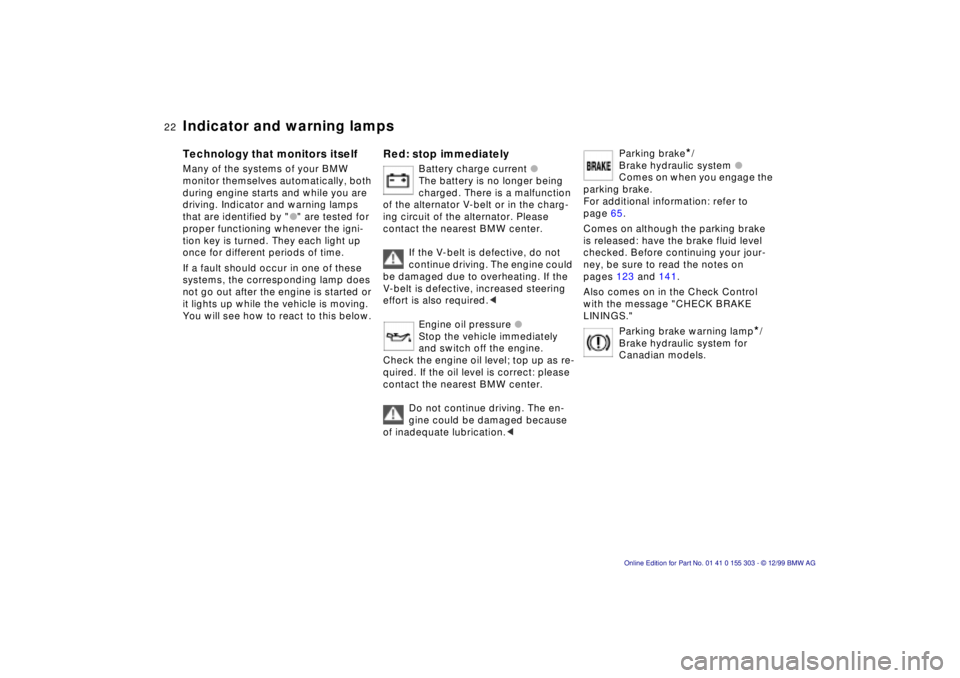
Battery charge current
l
The battery is no longer being
charged. There is a malfunction
of the alternator V-belt or in the charg-
ing circuit of the alternator. Please
contact the nearest BMW center.
If the V-belt is defective, do not
continue driving. The engine could
be damaged due to overheating. If the
V-belt is defective, increased steering
effort is also required.
<
Engine oil pressure
l
Stop the vehicle immediately
and switch off the engine.
Check the engine oil level; top up as re-
quired. If the oil level is correct: please
contact the nearest BMW center.
Do not continue driving. The en-
gine could be damaged because
of inadequate lubrication.
<
Parking brake
*/
Brake hydraulic system l
Comes on when you engage the
parking brake.
For additional information: refer to
page 65.
Comes on although the parking brake
is released: have the brake fluid level
checked. Before continuing your jour-
ney, be sure to read the notes on
pages 123 and 141.
Also comes on in the Check Control
with the message "CHECK BRAKE
LININGS."
Parking brake warning lamp
*/
Brake hydraulic system for
Canadian models.
Page 23 of 201
IndexDataTechnologyRepairsCar careControlsOverview
23n
Indicator and warning lamps Yellow: stop immediately
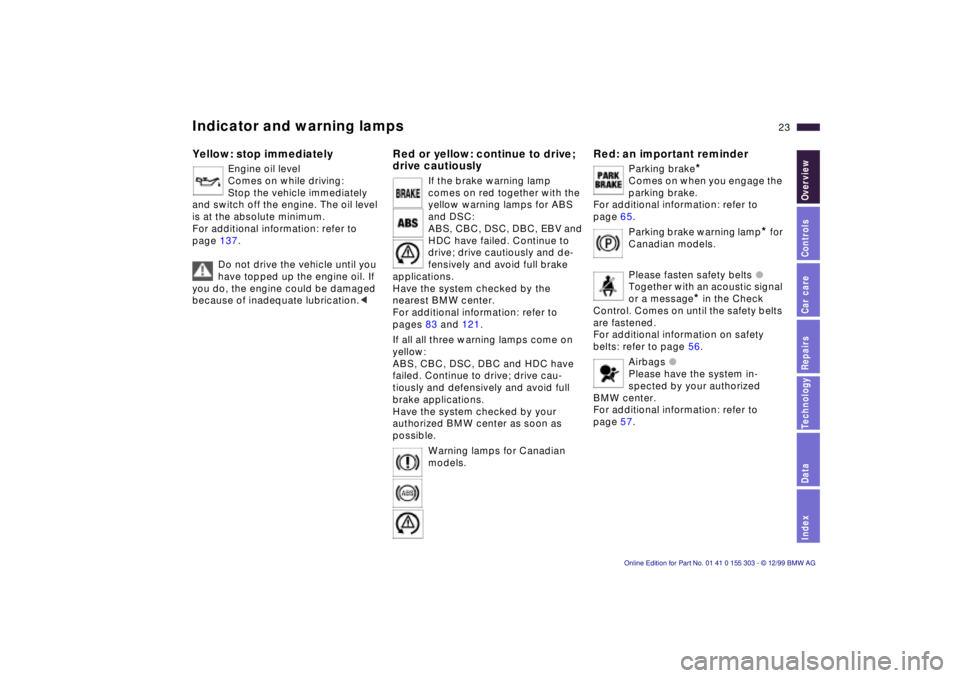
Engine oil level
Comes on while driving:
Stop the vehicle immediately
and switch off the engine. The oil level
is at the absolute minimum.
For additional information: refer to
page 137.
Do not drive the vehicle until you
have topped up the engine oil. If
you do, the engine could be damaged
because of inadequate lubrication.<
Red or yellow: continue to drive;
drive cautiously
If the brake warning lamp
comes on red together with the
yellow warning lamps for ABS
and DSC:
ABS, CBC, DSC, DBC, EBV and
HDC have failed. Continue to
drive; drive cautiously and de-
fensively and avoid full brake
applications.
Have the system checked by the
nearest BMW center.
For additional information: refer to
pages 83 and 121.
If all all three warning lamps come on
yellow:
ABS, CBC, DSC, DBC and HDC have
failed. Continue to drive; drive cau-
tiously and defensively and avoid full
brake applications.
Have the system checked by your
authorized BMW center as soon as
possible.
Warning lamps for Canadian
models.
Red: an important reminder
Parking brake
*
Comes on when you engage the
parking brake.
For additional information: refer to
page 65.
Parking brake warning lamp
* for
Canadian models.
Please fasten safety belts l
Together with an acoustic signal
or a message
* in the Check
Control. Comes on until the safety belts
are fastened.
For additional information on safety
belts: refer to page 56.
Airbags l
Please have the system in-
spected by your authorized
BMW center.
For additional information: refer to
page 57.
Page 32 of 201
32n
Locks and security systems:
Keys34
Electronic vehicle
immobilizer35
Central locking system36
Opening and closing
Ð from the outside36
Using the key36
Using the remote control37
Opening and closing
Ð from the inside40
Liftgate41
Tailgate41
Alarm system43
Electric power windows45
Sliding/Tilt sunroof with glass
moonroof46
Adjustments:
Seats48
Steering wheel51
Mirrors52
Seat, mirror and steering wheel
memory54
Car Memory, Key Memory55
Passenger safety systems:
Safety belts56
Airbags57
Child restraints60
Child seat security61
Child-safety locks62Driving:
Steering/Ignition lock63
Starting the engine64
Switching off the engine65
Parking brake65
Automatic transmission with
Steptronic66
Turn signal indicator/Headlamp
flasher69
Washer/Wiper system/Rain
sensor69
Rear window defroster71
Cruise control72
Everything under control:
Odometer, outside temperature
display74
Tachometer75
Energy control75
Fuel gauge75
Coolant temperature gauge76
Service Interval Display76
Check Control77
Onboard computer80
Technology for safety and
driving convenience:
Park Distance Control (PDC)82
Dynamic Stability Control
(DSC)83
Hill Descent Control (HDC)84
Controls
Page 64 of 201

64n
Starting the engine Before starting >Engage the parking brake.
>Be sure that the selector lever is in
"Park" position.
Do not allow the engine to run in
enclosed spaces. The exhaust
gases contain carbon monoxide, an
odorless and colorless, but highly toxic
gas. Breathing the exhaust gases poses
an extreme health risk, and can lead to
unconsciousness and death.
Do not leave the vehicle unattended
with the engine running. An unattended
vehicle with a running engine repre-
sents a potential safety hazard.<
Do not press the accelerator pedal
while starting the engine.
Your BMW is equipped with the
convenience starting feature. Sim-
ply turn the key to position 3 (starter)
and then release it immediately. The
starter continues to operate automati-
cally.
The automatic starting mode will not
operate if the battery voltage is low.
The engine can be started by means of
jump-starting (refer to page 170).<
Do not allow the engine to warm up by
leaving it running while the vehicle re-
mains stationary. Instead, begin to drive
immediately at a moderate engine
speed.
Should the engine fail to start on the
first attempt (if it is very hot or cold, for
instance):
>Press the accelerator pedal halfway
down while the starter is engaged.
Engine idle speed is controlled by the
engine computer system. Increased
speeds at startup are normal and
should decrease as the engine warms
up. If engine speed does not decrease,
service is required.
To prevent the battery from discharg-
ing, always deactivate electrical de-
vices that are not in use. Switch the ig-
nition off when the vehicle is not being
driven.
Page 65 of 201
IndexDataTechnologyRepairsCar careControlsOverview
65n
Switching off the engine Parking brake Turn the ignition key to position 1 or 0.
Never remove the ignition key
while the vehicle is rolling. If you
did so, the ignition lock would engage
when the steering wheel is turned.
Always remove the ignition key and en-
gage the steering lock before leaving
the vehicle.
Always engage the parking brake and
place the selector lever in "Park" when
parking on slopes and inclined sur-
faces.<
The vehicle must be stationary and the
selector lever in "Park" before you can
remove the ignition key.
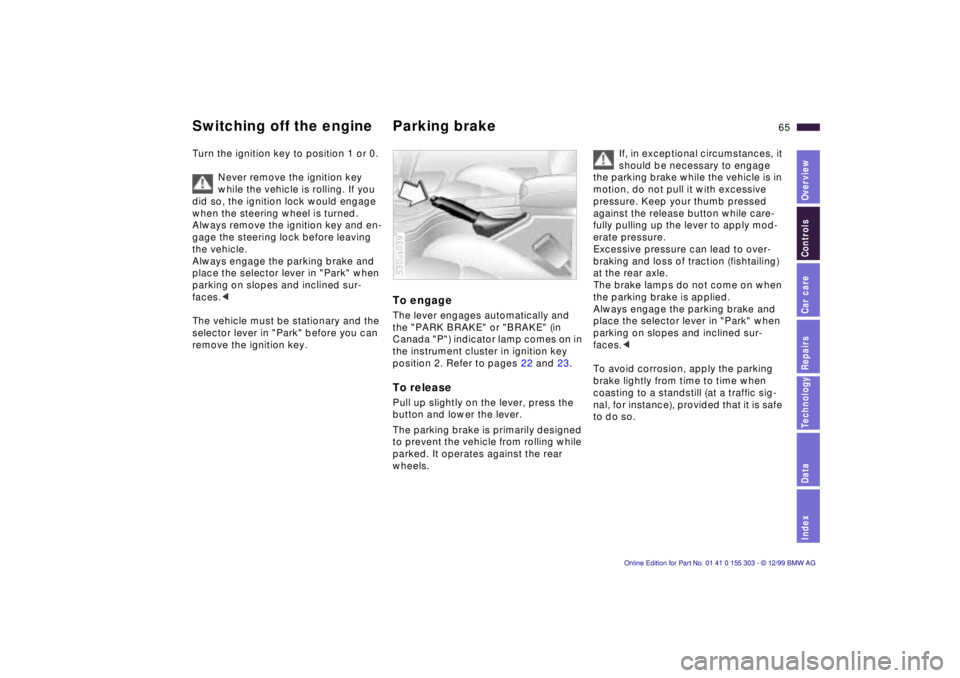
To engage The lever engages automatically and
the "PARK BRAKE" or "BRAKE" (in
Canada "P") indicator lamp comes on in
the instrument cluster in ignition key
position 2. Refer to pages 22 and 23. To release Pull up slightly on the lever, press the
button and lower the lever.
The parking brake is primarily designed
to prevent the vehicle from rolling while
parked. It operates against the rear
wheels. 530us039
If, in exceptional circumstances, it
should be necessary to engage
the parking brake while the vehicle is in
motion, do not pull it with excessive
pressure. Keep your thumb pressed
against the release button while care-
fully pulling up the lever to apply mod-
erate pressure.
Excessive pressure can lead to over-
braking and loss of traction (fishtailing)
at the rear axle.
The brake lamps do not come on when
the parking brake is applied.
Always engage the parking brake and
place the selector lever in "Park" when
parking on slopes and inclined sur-
faces.<
To avoid corrosion, apply the parking
brake lightly from time to time when
coasting to a standstill (at a traffic sig-
nal, for instance), provided that it is safe
to do so.
Page 67 of 201
IndexDataTechnologyRepairsCar careControlsOverview
67n
Automatic transmission with Steptronic
If you leave the vehicle with the
engine running, move the selector
lever to the "Park" or "Neutral" position
and apply the parking brake. If you fail
to do this, the vehicle could move.
Do not leave the vehicle unattended
with the engine running. An unattended
vehicle with a running engine repre-
sents a potential safety hazard.<
P Ñ Park Select "Park" only when the vehicle is
completely stopped. The transmission
locks to prevent the rear wheels from
turning. R Ñ Reverse Select "Reverse" only when the vehicle
is completely stopped.
When you select "Reverse", the backup
lamps will turn on automatically when
the ignition key is in position 2. N Ñ Neutral Select "Neutral" only if your journey is
interrupted for a longer period.
D Ñ Drive
(automatic shift program) This position is designed for driving
under all normal operating conditions.
All forward gears are available. "Kickdown" In the "Kickdown" mode, you achieve
maximum performance.
Depress the accelerator pedal past the
increased resistance point at the full-
throttle position.
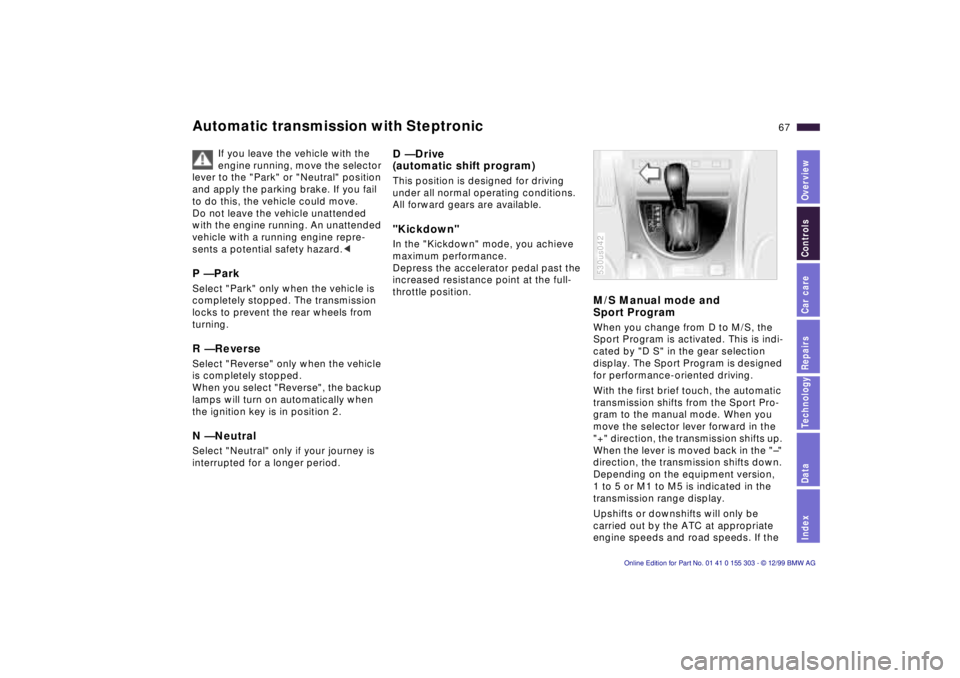
M/S Manual mode and
Sport Program When you change from D to M/S, the
Sport Program is activated. This is indi-
cated by "D S" in the gear selection
display. The Sport Program is designed
for performance-oriented driving.
With the first brief touch, the automatic
transmission shifts from the Sport Pro-
gram to the manual mode. When you
move the selector lever forward in the
"+" direction, the transmission shifts up.
When the lever is moved back in the "Ð"
direction, the transmission shifts down.
Depending on the equipment version,
1 to 5 or M1 to M5 is indicated in the
transmission range display.
Upshifts or downshifts will only be
carried out by the ATC at appropriate
engine speeds and road speeds. If the 530us042