towing BMW X5 4.4I 2000 Owners Manual
[x] Cancel search | Manufacturer: BMW, Model Year: 2000, Model line: X5 4.4I, Model: BMW X5 4.4I 2000Pages: 201, PDF Size: 1.93 MB
Page 12 of 201

Contents
Operation, care and maintenance
Owner service procedures
Advanced technology
Under the hood:
Hood133
Engine compartment134
Washer fluid136
Washer nozzles136
Engine oil137
Coolant140
Brake fluid141
Vehicle Identification No.141
Care and maintenance:
The BMW Maintenance
System142
Caring for your vehicle143
Airbags148
Vehicle storage148
Laws and regulations:
Technical modifications149
OBD interface socket150
Replacement procedures:
Onboard tool kit154
Wiper blades154
Lamps and bulbs155
Changing a wheel160
Battery165
Fuses167
In case of electrical
malfunction:
Fuel filler door168
Sliding/Tilt sunroof168
Liftgate168
Tailgate169
Assistance, giving and
receiving:
Jump-starting170
Towing the vehicle171Airbags176
Adaptive Transmission Control
(ATC)176
Four-wheel drive177
Dynamic Stability Control
(DSC)177
Radio reception178
Safety belt tensioner178
DSP sound system179
Rearview mirrors with automatic
dimmer179
Rain sensor180
Integrated rear suspension180
Level control system181
Xenon lamps181
Page 68 of 201
68n
Automatic transmission with Steptronic engine speed is too high, for instance,
the downshift will not be executed. The
gear selected will appear briefly in the
instrument cluster followed by the
current gear.
If you are driving in the manual
mode and wish to accelerate rap-
idly Ð to pass another vehicle, for exam-
ple Ð shift down manually or with the
kickdown function.<
You can only change from M/S to se-
lector lever positions "P," "R" and "N"
via the "D" position.
In the following situations, the Step-
tronic "thinks" for you in the manual
mode:
>In order to prevent engine over-
speeding, the transmission shifts
automatically to the next higher gear
shortly before the RPM cutoff point.
>At low speeds, the transmission
shifts down automatically Ð you do
not have to act.
>In the "Kickdown" mode, the trans-
mission shifts down to the lowest
possible gear based on the engine
speed.
>Depending on the situation Ð when
driving in adverse winter conditions,
for example Ð you may also start out
in 2nd or 3rd gear.
Electronic transmission control
module
If the indicator lamp comes on
or the message "TRANS.FAIL-
SAFE PROG" appears in the
Check Control
*, there is a fault in the
transmission system.
Bring the vehicle to a stop. Move the
transmission selector lever to "P." Set
the parking brake and turn the engine
off (ignition key to position 0).
Wait a few seconds, then start the en-
gine.
If the indicator lamp goes out after a
few seconds, normal transmission per-
formance has been restored. You may
continue to drive as usual. If the indica-
tor lamp does not go out, you can place
the selector lever in all positions. How-
ever, the vehicle will now only drive for-
ward with limited gear selection.
If this should occur, avoid extreme en-
gine loads and consult the nearest au-
thorized BMW center.
Do not work in the engine com-
partment when a drive gear (for-
ward or reverse) is engaged. If you do
this, the vehicle could move.<
Information on jump-starting, tow-start-
ing and towing begins on page 170.
Page 112 of 201
112n
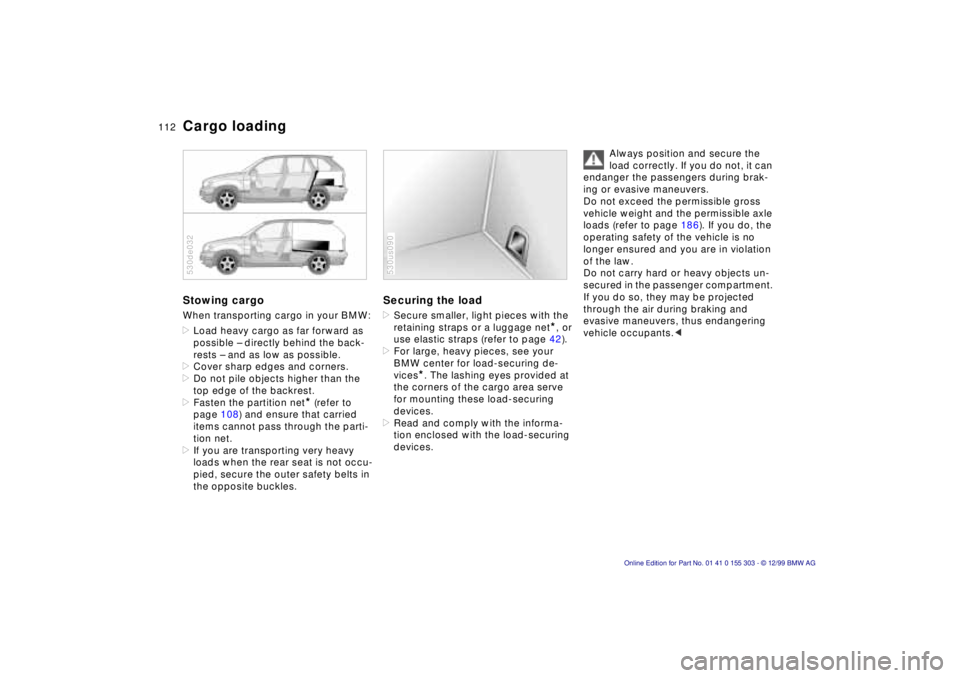
Cargo loading Stowing cargo When transporting cargo in your BMW:
>Load heavy cargo as far forward as
possible Ð directly behind the back-
rests Ð and as low as possible.
>Cover sharp edges and corners.
>Do not pile objects higher than the
top edge of the backrest.
>Fasten the partition net
* (refer to
page 108) and ensure that carried
items cannot pass through the parti-
tion net.
>If you are transporting very heavy
loads when the rear seat is not occu-
pied, secure the outer safety belts in
the opposite buckles.
530de032
Securing the load >Secure smaller, light pieces with the
retaining straps or a luggage net
*, or
use elastic straps (refer to page 42).
>For large, heavy pieces, see your
BMW center for load-securing de-
vices
*. The lashing eyes provided at
the corners of the cargo area serve
for mounting these load-securing
devices.
>Read and comply with the informa-
tion enclosed with the load-securing
devices.
530us090
Always position and secure the
load correctly. If you do not, it can
endanger the passengers during brak-
ing or evasive maneuvers.
Do not exceed the permissible gross
vehicle weight and the permissible axle
loads (refer to page 186). If you do, the
operating safety of the vehicle is no
longer ensured and you are in violation
of the law.
Do not carry hard or heavy objects un-
secured in the passenger compartment.
If you do so, they may be projected
through the air during braking and
evasive maneuvers, thus endangering
vehicle occupants.<
Page 116 of 201

116n
Break-in procedures To ensure that your vehicle provides
maximum economy throughout a long
service life, we request that you ob-
serve the following suggestions: Engine and axle drive Up to 1,200 miles (2,000 km):
Drive at varying engine speeds and
road speeds, but do not exceed
4,500 rpm and a road speed of
106 mph (170 km/h) during this initial
period:
Obey your local and state maximum
speed limits.
Refrain from using full throttle and avoid
pressing the accelerator beyond the
kickdown point.
Once you have driven 1,200 miles
(2,000 km), engine and vehicle speeds
can gradually be increased.
You should also comply with these
break-in procedures if the engine or
one of the axle drives is replaced later
in the course of the vehicle service life.
Tires Due to technical factors associated
with their manufacture, tires do not
achieve their full traction potential until
an initial break-in period has elapsed.
For this reason, drive with extra care
during the initial 200 miles (300 km).
Obey your local and state maximum
speed limits.
When the vehicle is operated on
wet or slushy roads, a wedge of
water may form between the tire and
the road surface. This phenomenon is
referred to as aquaplaning, or hydro-
planing, and can lead to partial or com-
plete loss of traction, vehicle control
and braking effectiveness. Reduce your
speed on wet roads.<
Brake system Approximately 300 miles (500 km) must
elapse before the brake pads and ro-
tors achieve the optimal pad-surface
and wear patterns required for trouble-
free operation and long service life later
on.
To break in the separate parking brake
drums, apply the parking brake lightly
when coasting to a standstill (at a traffic
signal, for instance), provided that traf-
fic conditions allow you to do so.
To avoid corrosion, repeat this proce-
dure from time to time.
The brake lamps do not light up
when the parking brake is applied.
Vacuum for the brake system servo unit
on your BMW is available only when the
engine is running. When you move the
vehicle with the engine shut off Ð when
towing, for instance Ð substantially
higher levels of pedal force will be re-
quired to brake the vehicle.<
Page 153 of 201
IndexDataTechnologyRepairsCar careControlsOverview
Overview
Controls and features
Operation, care
and maintenance
Owner service procedures
Technical data
Index Advanced technology
153n
Replacement procedures:
Onboard tool kit154
Wiper blades154
Lamps and bulbs155
Changing a wheel161
Battery165
Fuses167
In case of electrical
malfunction:
Fuel filler door168
Sliding/Tilt sunroof168
Liftgate168
Tailgate169
Assistance, giving and
receiving:
Jump-starting170
Towing the vehicle171
Repairs
Page 171 of 201
IndexDataTechnologyRepairsCar careControlsOverview
171n
Jump-starting Towing the vehicle 6 Start the engine on the support
vehicle and let it run.
7 Start the engine on the vehicle need-
ing the jump-start, and allow it to run
as usual. If the first start attempt is
not successful, wait a few minutes
before another attempt in order to
allow the discharged battery to
recharge.
8 Before disconnecting the jumper ca-
bles from your BMW, turn on the rear
window defroster and set the blower
to the highest speed; allow the en-
gine to run approx. 10 seconds. This
will prevent a voltage surge from the
voltage regulator to the electrical ac-
cessories.
9 Then disconnect the jumper cables in
reverse sequence.
Have the battery recharged if neces-
sary.
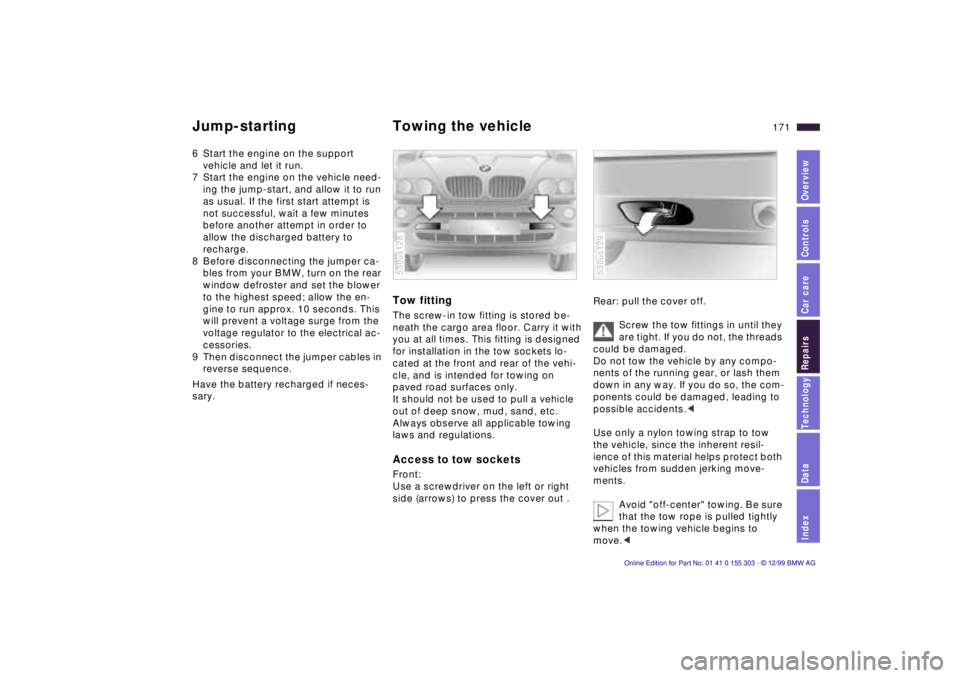
Tow fitting The screw-in tow fitting is stored be-
neath the cargo area floor. Carry it with
you at all times. This fitting is designed
for installation in the tow sockets lo-
cated at the front and rear of the vehi-
cle, and is intended for towing on
paved road surfaces only.
It should not be used to pull a vehicle
out of deep snow, mud, sand, etc.
Always observe all applicable towing
laws and regulations. Access to tow sockets Front:
Use a screwdriver on the left or right
side (arrows) to press the cover out . 530us128
Rear: pull the cover off.
Screw the tow fittings in until they
are tight. If you do not, the threads
could be damaged.
Do not tow the vehicle by any compo-
nents of the running gear, or lash them
down in any way. If you do so, the com-
ponents could be damaged, leading to
possible accidents.<
Use only a nylon towing strap to tow
the vehicle, since the inherent resil-
ience of this material helps protect both
vehicles from sudden jerking move-
ments.
Avoid "off-center" towing. Be sure
that the tow rope is pulled tightly
when the towing vehicle begins to
move.< 530us129
Page 172 of 201
172n
Towing the vehicle
The towed vehicle should always
be the lighter of the two vehicles.
If this is not the case, it is no longer
possible to control vehicle response.<
Tow-starting It is not possible to start the engine of a
vehicle equipped with automatic trans-
mission by towing or pushing.
For instructions on jump starting: refer
to page 170.
Never attempt to use your vehicle to
push another car. If you do so, damage
to the energy-absorbing bumpers could
result.
Towing 1 Place the selector lever in "Neutral".
2 Towing speed:
Max. 45 mph (70 km/h).
3 Towing distance:
Max. 95 miles (150 km).
4 Leave the ignition key at position 1 to
ensure that the brake lamps, turn sig-
nals, horn and windshield wipers re-
main operative, and to prevent the
steering lock detent from engaging.
5 Switch on the hazard-warning system
(comply with country-specific regula-
tions).
Find some means of identifying the ve-
hicle in tow, for instance, place a sign
or warning triangle in the rear window.
Make sure that the ignition key re-
mains in position 1 even when the
electrical system has failed. This will
prevent the steering lock from engag-
ing. The steering and brakes are with-
out power assist when the engine is not
running. This means that increased ef-
fort is required for steering and brak-
ing.<
Towing with a commercial tow
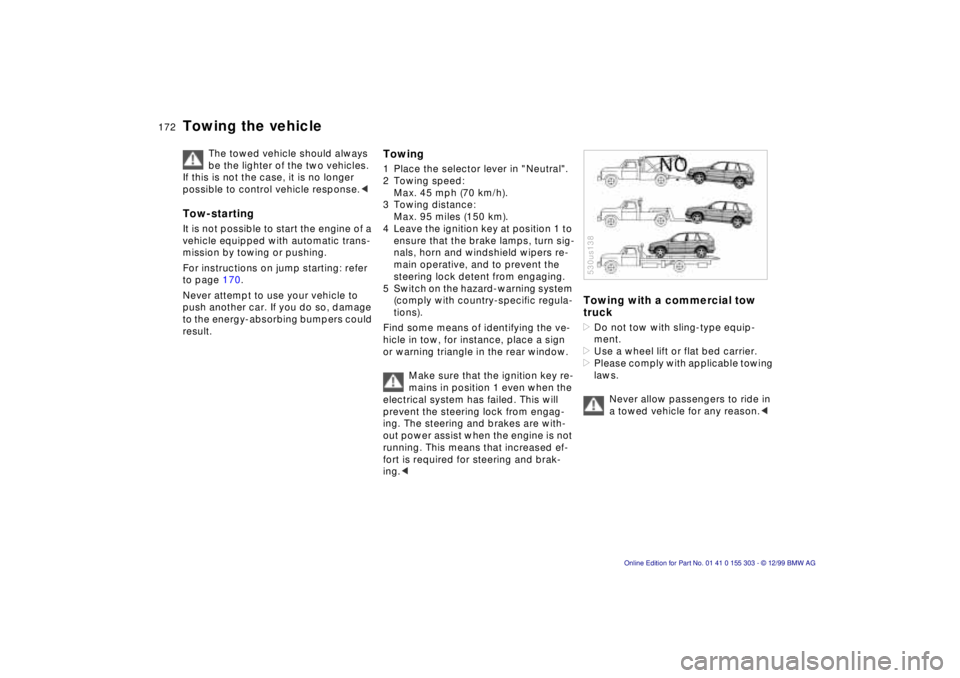
truck >Do not tow with sling-type equip-
ment.
>Use a wheel lift or flat bed carrier.
>Please comply with applicable towing
laws.
Never allow passengers to ride in
a towed vehicle for any reason.< 530us138
Page 173 of 201

IndexDataTechnologyRepairsCar careControlsOverview
173n
Towing the vehicle Towing with a raised axle 1 Place the selector lever in "Neutral".
2 Switch off the engine.
3 Towing speed:
Maximum 30 mph (50 km/h).
4 Towing distance:
Maximum 95 miles (150 km).
Remove the rear driveshaft for
longer towing distances with the
front axle lifted; remove the front drive-
shaft for towing over longer distances
with the rear axle lifted. Failure to com-
ply with this will result in damage to the
transfer box.<
Page 193 of 201

Everything from A to Z
193n
IndexDataTechnologyRepairsCar careControlsOverview
Cold start64
Comfort seat50
Compartments101
Computer80
Configuring the settings55
Contamination on
paintwork144
Convenience operation of
windows and sliding/tilt
sunroof36
Convenience starting
feature64
Coolant123, 140
Coolant, antifreeze123
Cornering Brake Control
(CBC)120
Cruise control72
Cup holder102
Curb weight186DDashboard16
Data link connector for On-
Board Diagnostics150
Date, refer to the Radio or
Onboard Computer
Owner's Manual
Daytime-driving lamp86
DBC (Dynamic Brake
Control)24, 120Deep water117
Defrosting the windows93
Digital clock, refer to the
Radio or Onboard
Computer Owner's Manual
Digital sound processor179
Dimensions185
Dipstick, engine oil137
Disc brakes122
Displacement184
Display lighting86
Displays18, 20
Distance warning82
Diversity Antenna
system178
Divided rear backrest107
Door keys34
Door locks, care123
Doors
Manual operation36
Remote control38
Unlocking and locking36
Drive belts188
Driving through water117
Driving your BMW X5117
DSC (Dynamic Stability
Control)24, 83, 177
DSP amplifier, refer to the
Radio Owner's ManualDynamic Brake Control
(DBC)24, 120
Dynamic Stability Control
(DSC)24, 83, 177
EEBV (Electronic Brake Force
Distribution)120
Electric power windows45
Electrical malfunction
Fuel filler door168
Liftgate168
Sliding/Tilt sunroof168
Tailgate169
Electrical system188
Electronic Brake Force
Distribution (EBV)120
Electronic immobilizer35
Elements of operation16
Emergency operation
Doors36
Fuel filler door168
Sliding/Tilt sunroof168
Tailgate168
Energy Control75
Engine compartment134
Engine coolant140
Engine knock control30
Engine oil consumption137
Engine oil grades138
Engine oil level24Engine oil pressure22
Engine output184
Engine specifications184
Error indicators77
Exterior finish144
Exterior mirrors52
FFailure of an electrical
accessory167
Failure warnings77
Filler cap cover29
First-aid kit28
Fittings, tow-starting and
towing171
Flashlight101
Flat tire127, 160
Fog lamps87
Bulb replacement156
Folding rear backrest107
Footbrake122
Footwell lamps88
Bulb replacement158
Front area lighting88
Front fog lamps87
Front seat adjustment48
Frost protection,
radiator140
Fuel30
Fuel capacity187
Fuel display75
Page 196 of 201

Everything from A to ZRestraint system57
Reverse67
Rims130
Roof load capacity186
Roof-mounted luggage
rack113
Rubber parts124SSafety belt height
adjustment56
Safety belt tensioner178
Safety belts56
Safety lock buttons40
Seat heating96
Seat memory54
Seat, power48
Securing cargo42, 112
Securing the load112
Selector lever, automatic
transmission66
Service and Warranty
Information Booklet (US
models)142
Service Interval
Display76, 142
Servotronic125
Shiftlock66
Shoulder support50
Shutting off the engine65
Side airbags57
Side Impact Head Protection
System57Side lamps86
Bulb replacement156
Ski bag105
Skidcontrol125
Sliding/Tilt sunroof46
Closing following an
electrical malfunction168
Convenience
operation36
Power loss47
Remote control38
Slippery roads124
Snow chains124, 131
Socket104
Spare key34
Spare tire161
Spare wheel161
Spark plugs188
Speaker102
Special wash program70
Speed control72
Speedometer18, 20
Sports seat50
Starting64
Starting problems
64, 118, 170, 171
Steering125
Steering wheel
adjustment51
Automatic52
Steering wheel heating96
Steering wheel lock63
Steering wheel memory54Steptronic66
Storage compartments101
Storage compartments in the
cargo area109
Storing the vehicle148
Summer tires130
Sun visors53
Switching off the vehicle65
Symbols4
Synthetic oils138
TTachometer75
Tail lamps157
Bulb replacement157
Tailgate42
Opening from the
inside41
Opening from the
outside41
Radio control
operation39
Release following an
electrical malfunction168
Technical
modifications6, 149
Telephone hookup102
Telephone, refer to the
separate Owner's Manual
Temperature display,
outside
temperature74, 80
Temperature gauge76Temperature layering94
Thigh support
adjustment50
Third brake lamp157
Tilt alarm38, 44
Tilt function, passenger side
mirror54
Timer, refer to the Radio
Owner's Manual
Tire code130
Tire damage127
Tire inflation
pressure31, 127
Tire renewal128
Tire rotation between front
and rear129
Tire specifications132
Tire tread127
Tools154
Torque184
Tow fittings171
Towing171
Tow-starting172
Track width185
Traction Control System
refer to DSC83
Transmission66
Tread depth, tires127
Trip odometer74
Turn signal indicator69
Bulb
replacement156, 157
Turning circle185