ECO mode BMW X5 4.4I 2001 User Guide
[x] Cancel search | Manufacturer: BMW, Model Year: 2001, Model line: X5 4.4I, Model: BMW X5 4.4I 2001Pages: 223, PDF Size: 2.66 MB
Page 110 of 223
110n
Automatic climate control
*
Automatic recirculated air
control (AUC)
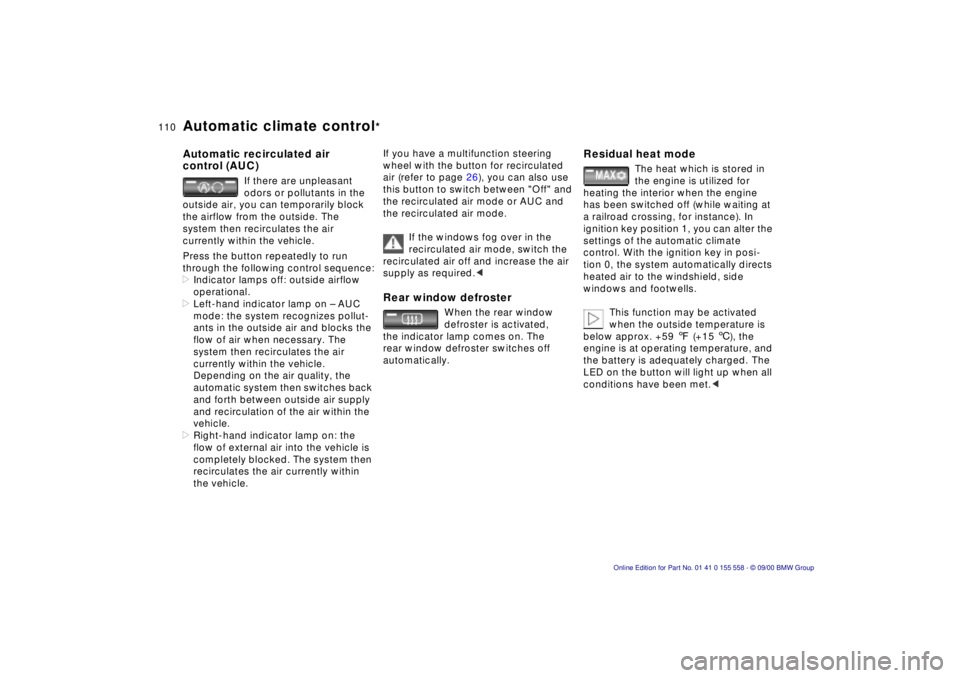
If there are unpleasant
odors or pollutants in the
outside air, you can temporarily block
the airflow from the outside. The
system then recirculates the air
currently within the vehicle.
Press the button repeatedly to run
through the following control sequence:
>Indicator lamps off: outside airflow
operational.
>Left-hand indicator lamp on – AUC
mode: the system recognizes pollut-
ants in the outside air and blocks the
flow of air when necessary. The
system then recirculates the air
currently within the vehicle.
Depending on the air quality, the
automatic system then switches back
and forth between outside air supply
and recirculation of the air within the
vehicle.
>Right-hand indicator lamp on: the
flow of external air into the vehicle is
completely blocked. The system then
recirculates the air currently within
the vehicle.
If you have a multifunction steering
wheel with the button for recirculated
air (refer to page 26), you can also use
this button to switch between "Off" and
the recirculated air mode or AUC and
the recirculated air mode.
If the windows fog over in the
recirculated air mode, switch the
recirculated air off and increase the air
supply as required.< Rear window defroster
When the rear window
defroster is activated,
the indicator lamp comes on. The
rear window defroster switches off
automatically.
Residual heat mode
The heat which is stored in
the engine is utilized for
heating the interior when the engine
has been switched off (while waiting at
a railroad crossing, for instance). In
ignition key position 1, you can alter the
settings of the automatic climate
control. With the ignition key in posi-
tion 0, the system automatically directs
heated air to the windshield, side
windows and footwells.
This function may be activated
when the outside temperature is
below approx. +59 7 (+15 6), the
engine is at operating temperature, and
the battery is adequately charged. The
LED on the button will light up when all
conditions have been met.<
Page 113 of 223
IndexDataTechnologyRepairsCar careControlsOverview
113n
Seat heating
*
Steering wheel heating
*
Roller sun blind
*
RearThe function is the same as for front
seat heating. You can select between
two heating modes.530us065
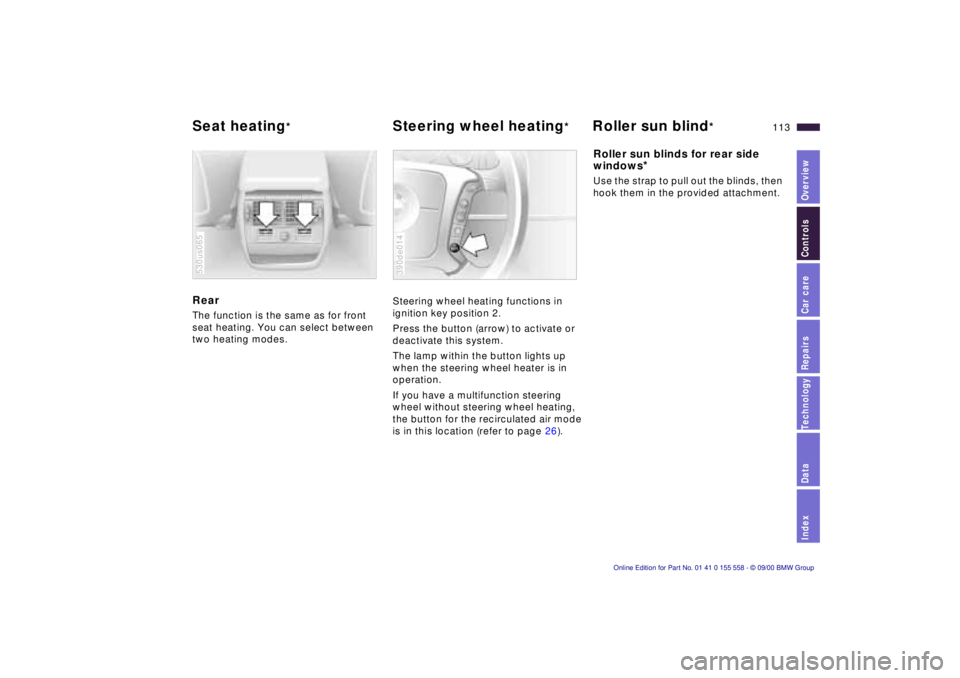
Steering wheel heating functions in
ignition key position 2.
Press the button (arrow) to activate or
deactivate this system.
The lamp within the button lights up
when the steering wheel heater is in
operation.
If you have a multifunction steering
wheel without steering wheel heating,
the button for the recirculated air mode
is in this location (refer to page 26).390de014
Roller sun blinds for rear side
windows
*
Use the strap to pull out the blinds, then
hook them in the provided attachment.
Page 117 of 223
IndexDataTechnologyRepairsCar careControlsOverview
117n
BMW Universal Transmitter Glove compartment Clearing the channel keys
Read and comply with the safety
precautions on page 115.<
The memory of individual channel keys
cannot be deleted. However, the three
channel keys can be cleared together
as follows:
>Press and hold both outside keys of
the BMW Universal Transmitter until
the indicator lamp flashes, and then
release them.
All of the channel keys are cleared.
User informationDo not use this BMW Universal Trans-
mitter with any garage door opener that
lacks safety "stop" and "reverse"
features as required by federal safety
standards (this includes any garage
door opener model manufactured
before April 1, 1982).
This device complies with Section 15 of
the FCC Rules. Operation is subject to
the following two conditions: as defined
in the regulations, this device must not
emit harmful interference, and must be
shielded against interference from
external sources to prevent unautho-
rized or inadvertent activation.
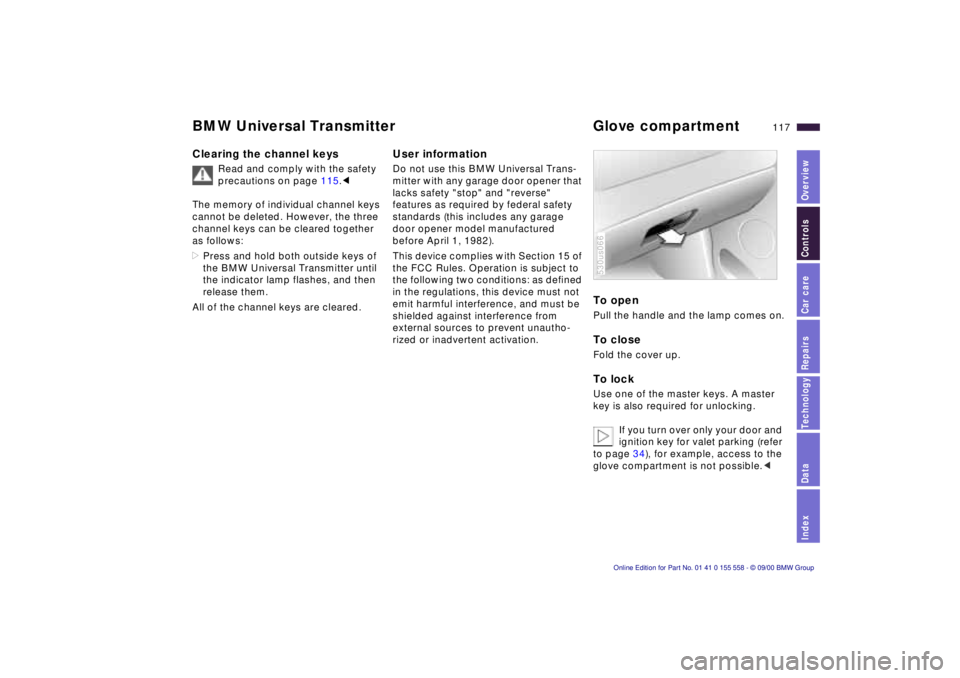
To openPull the handle and the lamp comes on.To closeFold the cover up.To lockUse one of the master keys. A master
key is also required for unlocking.
If you turn over only your door and
ignition key for valet parking (refer
to page 34), for example, access to the
glove compartment is not possible.< 530us066
Page 139 of 223
IndexDataTechnologyRepairsCar careControlsOverview
139n
Antilock Brake System (ABS) In the event of a fault
If the brake warning lamp
comes on red together with the
yellow indicator lamps for ABS
and DSC (refer to pages 22
to 24), ABS, CBC, DSC, DBC,
EBV and HDC have failed. You
may continue driving, but drive
defensively and with extra
caution. Avoid full brake applications
because the vehicle could become
unstable and go out of control.
Have the system checked by the
nearest BMW center.
If all three warning lamps come on
yellow:
ABS, CBC, DSC, DBC and HDC have
failed. The effect of the EBV Brake
Force Distribution at the rear wheels,
which achieves stable brake response,
is largely preserved. Optimum brake
force and braking stability are no longer
assured. Continue to drive; drive
cautiously and defensively and avoid
full brake applications.
Have the system checked by your BMW
center as soon as possible.
Following an interruption in
battery power, the ABS, CBC,
DSC, DBC and HDC systems are no
longer available. After you drive for only
a few yards or meters or if you turn the
steering wheel from stop to stop while
the vehicle is stationary and the engine
is running, the functions are activated
again and the three warning lamps will
go out.<
Indicator and warning lamps for
Canadian models.
Page 141 of 223
IndexDataTechnologyRepairsCar careControlsOverview
141n
Brake system Winter operationBrake fluid level
The warning lamp for the brake
hydraulic system comes on, or
the CHECK BRAKE FLUID
message appears in the Check
Control.
The brake fluid level is too low in the
reservoir (refer to page 161).
If the brake fluid level is too low and
brake pedal travel has become notice-
ably longer, there may be a defect in
one of the brake system's hydraulic
circuits.
Proceed to the nearest BMW
center. Higher brake application
pressure may be necessary under these
conditions, and brake pedal travel may
be significantly longer. Please
remember to adapt your driving style
accordingly.<
The warning lamp also comes on when
the CHECK BRAKE LININGS message
appears in the Check Control.
Brake pads
The warning lamp for the brake
pads comes on, or the CHECK
BRAKE LININGS message
appears in the Check Control:
The brake pads have reached their
minimum pad thickness. Proceed to the
nearest BMW center as soon as
possible to have the pads replaced.
For your own safety: use only
brake pads that BMW has
released for your particular vehicle
model. BMW cannot evaluate non-
approved brake pads to determine if
they are suited for use, and therefore
cannot ensure the operating safety of
the vehicle if they are installed.<
The onset of winter is often accompa-
nied by rapid changes in weather.
Adaptations in driving style should be
accompanied by preparations on the
vehicle itself to ensure that your
progress through the winter remains
safe and trouble-free. CoolantBe sure that the coolant mixture
contains the year-round ratio of 50:50
water and antifreeze/corrosion protec-
tion. This mixture provides protection
against freezing down to approx. –347
(–376). Replace the coolant every four
years. LocksBMW door lock deicer can be used to
free locks if they are frozen. This deicer
also contains lubricant.
After using the deicer, treatment with
BMW lock barrel grease is recom-
mended.
Page 145 of 223
IndexDataTechnologyRepairsCar careControlsOverview
145n
Information for your safetyThe factory-approved radial tires are
matched to the vehicle and have been
selected to provide optimum safety and
driving comfort on your vehicle.
It is not merely the tire's service life, but
also driving comfort and – above all else
– driving safety which depend on the
condition of the tires and the mainte-
nance of the specified tire pressure.
Incorrect inflation pressure is a frequent
cause of tire damage. It also signifi-
cantly influences the roadholding ability
of your BMW.
Check tire inflation pressures –
including the spare wheel – regu-
larly (refer to page 30), at least every
two weeks and before beginning a
longer trip. If this is not done, incorrect
tire pressures can cause driving insta-
bility and tire damage, ultimately
resulting in an accident.<
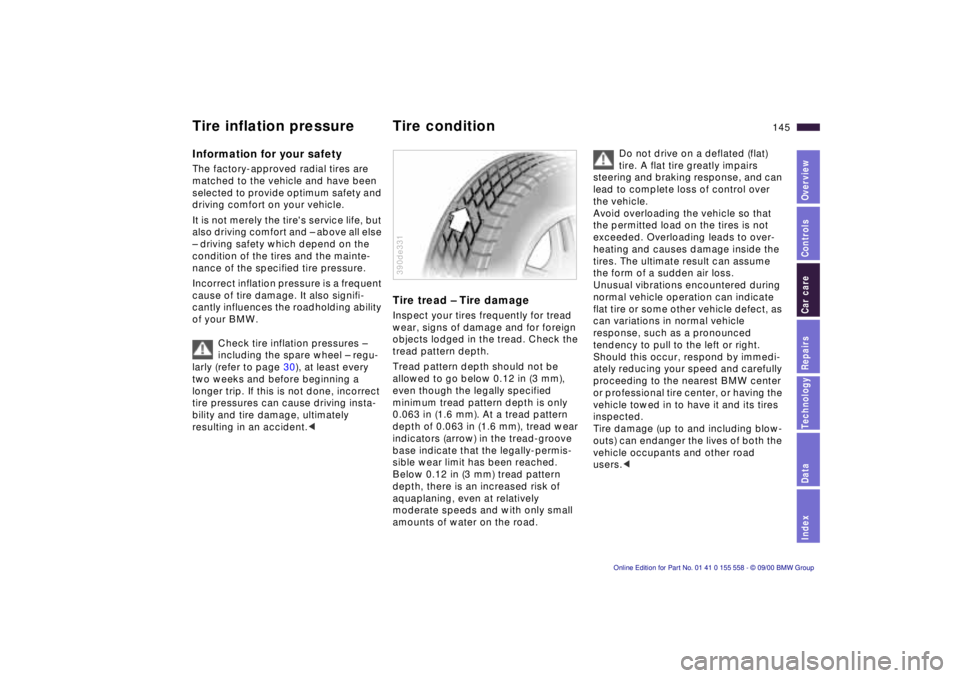
Tire tread – Tire damageInspect your tires frequently for tread
wear, signs of damage and for foreign
objects lodged in the tread. Check the
tread pattern depth.
Tread pattern depth should not be
allowed to go below 0.12 in (3 mm),
even though the legally specified
minimum tread pattern depth is only
0.063 in (1.6 mm). At a tread pattern
depth of 0.063 in (1.6 mm), tread wear
indicators (arrow) in the tread-groove
base indicate that the legally-permis-
sible wear limit has been reached.
Below 0.12 in (3 mm) tread pattern
depth, there is an increased risk of
aquaplaning, even at relatively
moderate speeds and with only small
amounts of water on the road. 390de331
Do not drive on a deflated (flat)
tire. A flat tire greatly impairs
steering and braking response, and can
lead to complete loss of control over
the vehicle.
Avoid overloading the vehicle so that
the permitted load on the tires is not
exceeded. Overloading leads to over-
heating and causes damage inside the
tires. The ultimate result can assume
the form of a sudden air loss.
Unusual vibrations encountered during
normal vehicle operation can indicate
flat tire or some other vehicle defect, as
can variations in normal vehicle
response, such as a pronounced
tendency to pull to the left or right.
Should this occur, respond by immedi-
ately reducing your speed and carefully
proceeding to the nearest BMW center
or professional tire center, or having the
vehicle towed in to have it and its tires
inspected.
Tire damage (up to and including blow-
outs) can endanger the lives of both the
vehicle occupants and other road
users.<
Tire inflation pressure Tire condition
Page 161 of 223
IndexDataTechnologyRepairsCar careControlsOverview
161n
Brake fluid Vehicle Identification
If the indicator lamp for the
brake hydraulic system appears
or if the CHECK BRAKE FLUID
warning appears in the Check
Control: the brake fluid level is
too low in the reservoir.
The brake fluid reservoir is located
under the microfilter housing trim panel
on the driver's side of the vehicle. For
adding brake fluid or for determining
and correcting the cause of brake fluid
loss, consult your BMW center. Your
BMW center is familiar with the specifi-
cations for factory-approved brake
fluids (DOT 4).
Brake fluid loss may result in extended
brake pedal travel. For this situation,
refer to the notes on page 141.
Brake fluid is hygroscopic, that is,
it absorbs moisture from the air
over time.
In order to ensure the safety and reli-
ability of the brake system, have the
brake fluid changed every two years by
a BMW center. Refer also to the Service
and Warranty Information Booklet (US
models) or the Warranty and Service
Guide Booklet (Canadian models).
Brake fluid is toxic and damages the
vehicle's paint. You should always store
it in its original container and in a loca-
tion which is out of reach of children.
Do not spill the fluid and do not fill the
brake fluid reservoir beyond the "MAX"
mark. The brake fluid could ignite upon
contact with hot engine parts and
cause serious burns.<
Comply with the applicable envi-
ronmental laws regulating the
disposal of brake fluid.<
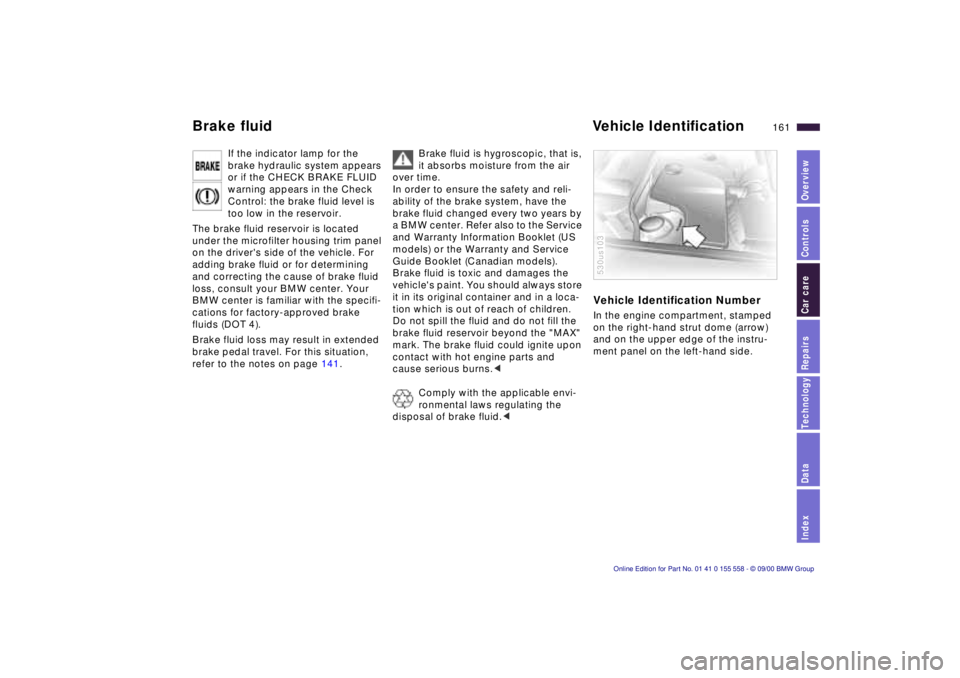
Vehicle Identification NumberIn the engine compartment, stamped
on the right-hand strut dome (arrow)
and on the upper edge of the instru-
ment panel on the left-hand side. 530us103
Page 165 of 223

IndexDataTechnologyRepairsCar careControlsOverview
165n
Caring for your vehicleCaring for the vehicle finish Regular washing is a preventive
measure against long-term effects from
substances that are harmful to the
vehicle's finish, especially if you drive
your vehicle in areas with high levels of
air pollution or aggressive natural
substances (tree resins, pollen).
Nevertheless, you should immediately
remove especially aggressive
substances. Failure to do so can lead to
changes in the paint's chemical struc-
ture or to discoloration. Fuel spilled
during refueling, oil, grease and brake
fluid should always be cleaned away
immediately, as should bird droppings
(finish damage).
Any contamination remaining on the
surface of the vehicle will be especially
conspicuous after washing. Use
cleaning fluid or alcohol with a clean
cloth or cotton pad to remove these
stains. Remove tar spots with tar
remover. After cleaning, the affected
areas should be waxed to ensure
continued protection.
Waxing your vehicle Protect the finish using carnauba or
synthetic-based waxes only.
The best way to determine when the
finish needs to be waxed is by noting
when water stops beading on the
surface.
You can use a glass cleaner to remove
any wax or silicone that may have been
left on the windows during waxing.
Paint damageYou can touch up small areas of
damage with BMW spray paint or a
BMW touchup stick.
The color code of your vehicle is
provided on a tag on the right-hand
panel under the hood and on the first
page of the Service and Warranty Infor-
mation Booklet (US models) or the
Warranty and Service Guide Booklet
(Canadian models).
Damage caused by flying stones,
scratches, etc., must be touched up
without delay to prevent rust from
forming.
If corrosion has started to form in an
area with paint damage, remove all rust
and clean the area. Then prime the area
with a BMW Primer Stick. Finally, apply
the finish coat. After a few days, polish
and protect the touched-in areas.
More extensive paint damage should
be professionally repaired in accor-
dance with the manufacturer's instruc-
tions. Your BMW center uses original
BMW finish materials in accordance
with factory repair procedures.
A full range of car-care products is
available from your BMW center.<
Page 185 of 223
IndexDataTechnologyRepairsCar careControlsOverview
185n
Battery
Battery posts, terminals and
related accessories contain lead
and lead compounds. Wash hands after
handling.
Battery location The battery is located in the floor of the
vehicle below the spare wheel. Battery careThe battery is maintenance-free, that is,
the original electrolyte will normally last
for the service life of the battery under
moderate climatic conditions.
For all questions that regard the
battery, please consult your BMW
center. Since the battery is mainte-
nance-free, the following is for your
information only.<
SymbolsYou will find the following symbols on
your vehicle battery. To avoid injury,
please comply with the corresponding
precautions whenever you work with or
near the battery.
Before handling the battery,
please read the following infor-
mation.
Wear eye protection. Do not
allow particles containing
battery acid or lead to come into
contact with your eyes, your skin, or
your clothing.
Battery acid is extremely corro-
sive. Wear eye protection and
protective gloves. Do not tip the
battery. Battery acid can leak from the
ventilation openings.
Do not allow children to have
access to batteries and battery
acid.
Never allow sparks or open
flame near the battery. Do not
smoke in the vicinity of the
battery. Avoid sparks from electrical
cables or electrical equipment. Turn the
key to position 0 in the steering lock
when you are disconnecting or
connecting the battery. Never short-
circuit the battery terminals. This
creates a risk of injury from high-energy
sparks.
A highly-explosive gas is
generated when the battery is
charged.
If you happen to get acid in your
eyes, rinse thoroughly for
15 minutes with clear water.
Following that, consult a physician
immediately. If you get acid spray on
your skin or clothing, rinse with plenty
of water. If electrolyte is accidentally
swallowed, consult a physician immedi-
ately.
In order to protect the battery
case from ultraviolet radiation,
do not place it in direct sunlight.
A discharged battery can freeze. Store
the battery in areas where temperature
remains above freezing.
Page 220 of 223

Everything from A to Z
renewal146
rotation between front and
rear 147
specifications 150
tread 145
Tire Quality Grading 146
Tools 174t
Torque 206
Tow fittings 191t
Towing the vehicle 191t
Tow-starting 192t
Track width 207
Traction Control System, refer to DSC 94
Transmission 67, 68
Transporting children safely 61
Tread depth, tires 145
Trip odometer 76
Turn signal indicator 70
bulb replacement 176t
Turning circle 207
U
Uniform Tire Quality Grading
(UTQR) 146
Universal Transmitter 115
Used batteries, disposal 186t
Used oil, disposal 159t
V
Vacuum cleaner
power outlet 127t
socket 121t
Valve caps 148
Vanity mirror 54
Vehicle battery 185, 210
Vehicle care, interior 166
Vehicle Identification Number 161
Vehicle immobilizer 35
Vehicle removal from service 168
Vehicle storage 168
Ventilation 100, 104 , 111
draft-free 103, 111
in the rear 103, 111
while parked 114
Ventilation while parked
Vinyl care 166
Viscosity 158
Voice recognition 26, 27
refer also to the separate
Owner's Manual
W
Warm feet – cool head 103
Warning lamps 22
Warning messages 79t
Warning triangle 28Warnings
79
Warranty and Service Guide (Canadian models) 162
Washer fluid 156
Washer reservoir, filling 156t
Washer/wiper system 71
Washing your vehicle 163
Waxing, paintwork 165
Weights 208
Wheelbase 207
Wheels and tires 148, 150
Width 207
Windows 45
care 166t
convenience operation 36
remote control 38
Windshield cleaning 72
intensive cleaning
program 71
special wash program 71
Windshield washer filling reservoir 156t
nozzle adjustment 156t
Windshield wiper 71
blade replacement 174t
Winter driving 142
Winter operation 141
Winter tires 148, 149 Wiper blade
replacement 174t
Wipers 71
Work in the engine compartment 151t
X
Xenon lamps 176, 202