air condition BMW X5 4.4I 2001 User Guide
[x] Cancel search | Manufacturer: BMW, Model Year: 2001, Model line: X5 4.4I, Model: BMW X5 4.4I 2001Pages: 223, PDF Size: 2.66 MB
Page 75 of 223
Index
Data
Technology
Repairs
Car care
Controls
Overview
75nCruise control
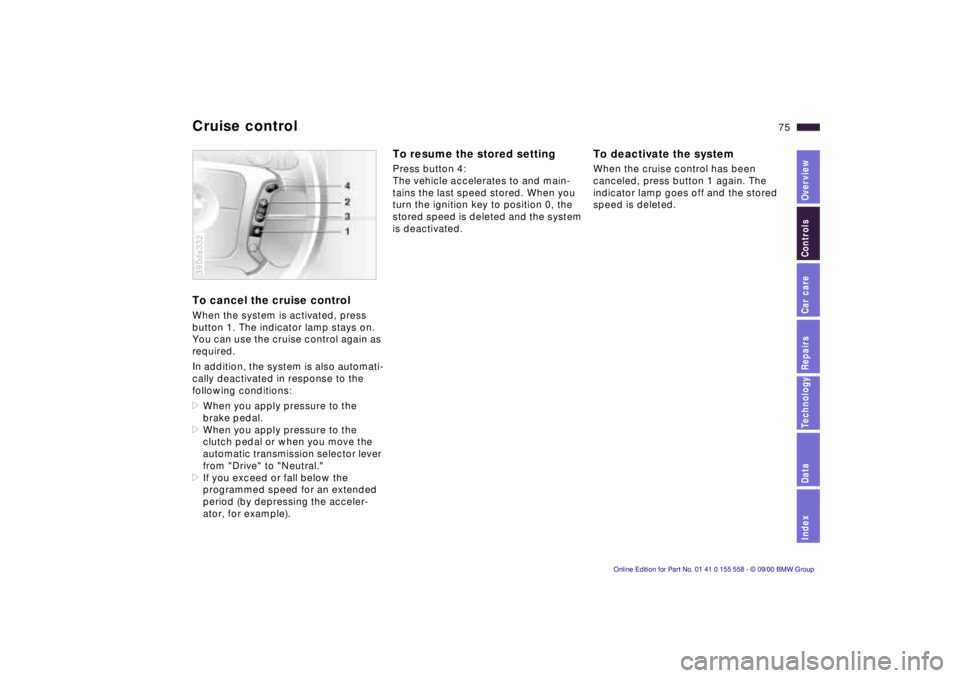
To cancel the cruise control
When the system is activated, press
button 1. The indicator lamp stays on.
You can use the cruise control again as
required.
In addition, the system is also automati-
cally deactivated in response to the
following conditions:
>When you apply pressure to the
brake pedal.
> When you apply pressure to the
clutch pedal or when you move the
automatic transmission selector lever
from "Drive" to "Neutral."
> If you exceed or fall below the
programmed speed for an extended
period (by depressing the acceler-
ator, for example).
390de332
To resume the stored setting
Press button 4:
The vehicle accelerates to and main-
tains the last speed stored. When you
turn the ignition key to position 0, the
stored speed is deleted and the system
is deactivated.
To deactivate the system
When the cruise control has been
canceled, press button 1 again. The
indicator lamp goes off and the stored
speed is deleted.
Page 77 of 223
Index
Data
Technology
Repairs
Car care
Controls
Overview
77nTachometer Energy control Fuel gauge
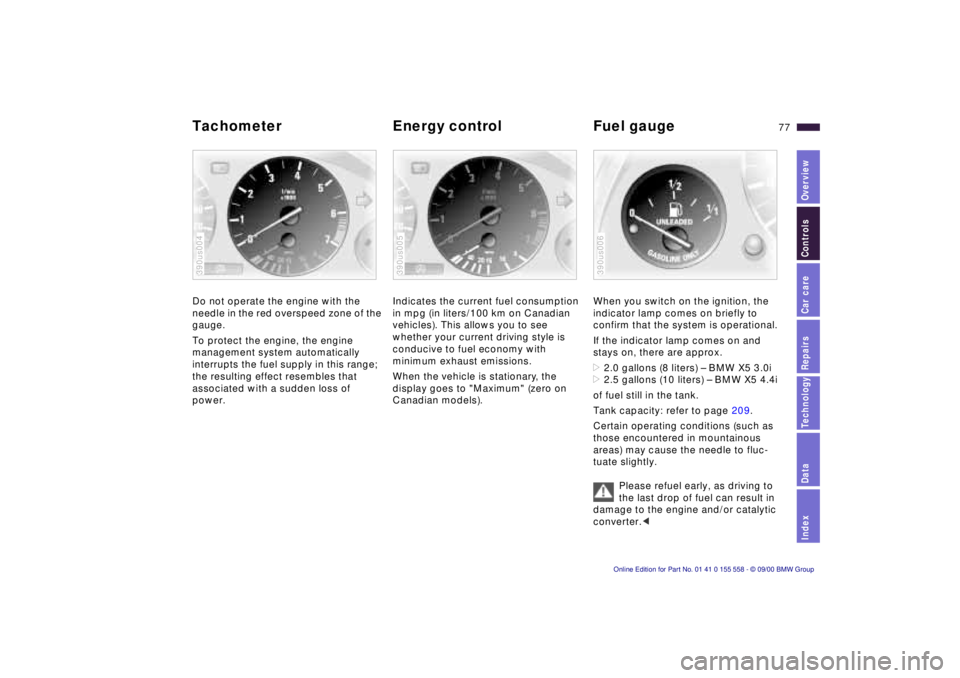
Do not operate the engine with the
needle in the red overspeed zone of the
gauge.
To protect the engine, the engine
management system automatically
interrupts the fuel supply in this range;
the resulting effect resembles that
associated with a sudden loss of
power.
390us004
Indicates the current fuel consumption
in mpg (in liters/100 km on Canadian
vehicles). This allows you to see
whether your current driving style is
conducive to fuel economy with
minimum exhaust emissions.
When the vehicle is stationary, the
display goes to "Maximum" (zero on
Canadian models).
390us005
When you switch on the ignition, the
indicator lamp comes on briefly to
confirm that the system is operational.
If the indicator lamp comes on and
stays on, there are approx.
>2.0 gallons (8 liters) – BMW X5 3.0i
> 2.5 gallons (10 liters) – BMW X5 4.4i
of fuel still in the tank.
Tank capacity: refer to page 209.
Certain operating conditions (such as
those encountered in mountainous
areas) may cause the needle to fluc-
tuate slightly.
Please refuel early, as driving to
the last drop of fuel can result in
damage to the engine and/or catalytic
converter. <
390us006
Page 94 of 223
94n
PDC
*
Dynamic Stability Control (DSC)
The PDC system does not remove
the driver's personal responsibility
for evaluating the distance between the
vehicle and any obstacles. Even when
sensors are involved, there is a blind
spot in which objects cannot be
detected. This applies especially in
those cases where the system
approaches the physical constraints of
ultrasonic measurement, as occurs with
tow bars and trailer couplings, and in
the vicinity of thin and painted objects.
Certain sources of sound, such as a
loud radio, could drown out the PDC
signal tone.<
Keep the sensors clean and free
of ice or snow in order to ensure
that they continue to operate effectively.
Do not apply high pressure spray to the
sensors for a prolonged period of time.
Maintain an adequate distance of more
than 4 in (10 cm).<
The concept DSC maintains vehicle stability, even in
critical driving situations.
The system optimizes vehicle stability
during acceleration and when starting
from a full stop, as well as optimizing
traction. In addition, it recognizes
unstable vehicle conditions, such as
understeering or oversteering, and, as
far as is possible within the laws of
physics, keeps the car on a steady
course by adapting the RPMs and
brake applications to the individual
wheels.
The system starts up automatically
each time you start the engine.
Indicator lamp
The indicator lamp in the instru-
ment cluster goes out shortly
after you switch on the ignition.
Refer to page 24.
Indicator lamp flashes:
The system is active and governs drive
and braking force.
If the indicator lamp fails to go out after
the engine is started, or comes on
during normal driving and stays on:
The system is either defective or was
switched off with the button: the stabi-
lizing applications described to the left
are no longer available. The vehicle will
remain completely operational,
however, without DSC.
Consult your BMW center to have the
system repaired.
Page 95 of 223
IndexDataTechnologyRepairsCar careControlsOverview
95n
Dynamic Stability Control (DSC)
Hill Descent Control
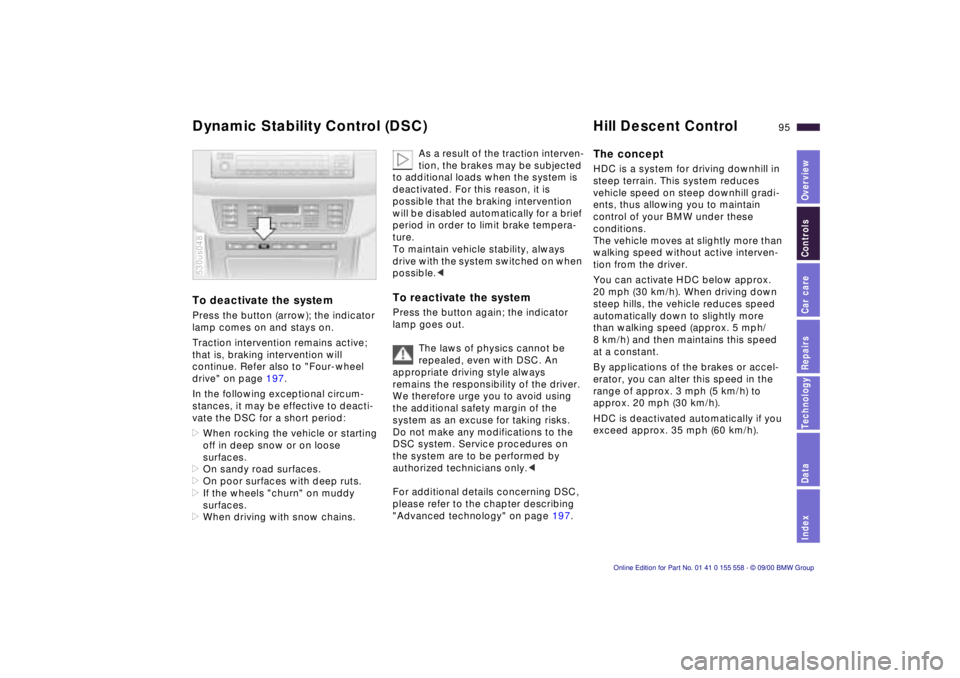
To deactivate the system Press the button (arrow); the indicator
lamp comes on and stays on.
Traction intervention remains active;
that is, braking intervention will
continue. Refer also to "Four-wheel
drive" on page 197.
In the following exceptional circum-
stances, it may be effective to deacti-
vate the DSC for a short period:
>When rocking the vehicle or starting
off in deep snow or on loose
surfaces.
>On sandy road surfaces.
>On poor surfaces with deep ruts.
>If the wheels "churn" on muddy
surfaces.
>When driving with snow chains. 530us048
As a result of the traction interven-
tion, the brakes may be subjected
to additional loads when the system is
deactivated. For this reason, it is
possible that the braking intervention
will be disabled automatically for a brief
period in order to limit brake tempera-
ture.
To maintain vehicle stability, always
drive with the system switched on when
possible.<
To reactivate the systemPress the button again; the indicator
lamp goes out.
The laws of physics cannot be
repealed, even with DSC. An
appropriate driving style always
remains the responsibility of the driver.
We therefore urge you to avoid using
the additional safety margin of the
system as an excuse for taking risks.
Do not make any modifications to the
DSC system. Service procedures on
the system are to be performed by
authorized technicians only.<
For additional details concerning DSC,
please refer to the chapter describing
"Advanced technology" on page 197.
The concept HDC is a system for driving downhill in
steep terrain. This system reduces
vehicle speed on steep downhill gradi-
ents, thus allowing you to maintain
control of your BMW under these
conditions.
The vehicle moves at slightly more than
walking speed without active interven-
tion from the driver.
You can activate HDC below approx.
20 mph (30 km/h). When driving down
steep hills, the vehicle reduces speed
automatically down to slightly more
than walking speed (approx. 5 mph/
8 km/h) and then maintains this speed
at a constant.
By applications of the brakes or accel-
erator, you can alter this speed in the
range of approx. 3 mph (5 km/h) to
approx. 20 mph (30 km/h).
HDC is deactivated automatically if you
exceed approx. 35 mph (60 km/h).
Page 100 of 223

100n
530us139Air conditioner
Page 101 of 223

IndexDataTechnologyRepairsCar careControlsOverview
101n
Air conditioner 1 Airflow directed toward the wind-
shield and side windows
2 Airflow for the upper body
The side rotary dials allow you to
open and close the air supply
through an infinitely-variable range,
while the levers change the airflow
direction. The center rotary dial
controls the temperature of the air
as it flows out. Refer to page 103
3 Front footwell ventilation
4 Rear footwell ventilation
5 Air flow for the upper body in the
rear seat103
6 Temperature102
7 Air distribution toward
>the windows
>the upper body
>the footwell
An infinitely-variable range of
intermediate settings is also
available. Refer to page 102
8 Air supply102
The climate control is active when
the blower is switched on.
9 Rear window defroster73, 102
10 Cooling102
11 Recirculated air mode103
Page 102 of 223

102n
Air conditioner Suggestions for your personal
comfortFor the temperature 6, we recommend
+72 7 (+22 6) as a comfortable
setting. Turn the air distribution 7 to the
"6 o'clock" position. Adjust the air
supply 8 to the center setting. Set the
outlets 2 so that the air flows past you
and is not directed straight at you. Set
the rotary dial between the outlets 2 for
the upper body to a central position so
that cooler air will help to prevent
fatigue during the journey.
The following description will lead you
through additional individual adjust-
ments.Temperature
The graduations on the dial
provide general reference
values for the interior temper-
ature. We recommend +72 7
(+22 6) as a comfortable setting. When
you start the vehicle, the system
adjusts the air to the selected tempera-
ture as quickly as possible, and then
maintains that temperature constantly.
Air distribution
You can direct air to flow onto
the windows , toward the
upper body and into the
footwell . All intermediate
settings are possible. In the setting,
there is a low flow of air onto the
windows to keep them free of conden-
sation. The "6 o'clock" setting is recom-
mended for normal conditions (refer
also to the illustration and overview on
page 100).
Air supply
You can adjust the air supply
through an infinitely-variable
range. The heating and venti-
lation become more and more
effective as the air supply settings are
increased. In the "0" setting, the blower
and climate control are switched off
and the outside air supply is blocked.
Rear window defroster
When the rear window
defroster is activated, the indi-
cator lamp comes on. The rear window
defroster switches off automatically.
Cooling
The air is cooled and dehu-
midified and — depending on
the temperature setting — warmed
again when the air conditioner system
is switched on.
Depending on the weather, the wind-
shield may fog over briefly when the
engine is started.
Switch off the air conditioner at outside
temperatures below approx. +41 7
(+5 6). This will help to prevent the
windows from fogging up.
If the windows fog over after switching
the air conditioner off, switch it back
on.
Condensation forms in the air
conditioner system during opera-
tion, which then exits under the vehicle.
Traces of condensed water of this kind
are thus normal.<
Page 103 of 223
IndexDataTechnologyRepairsCar careControlsOverview
103n
Air conditionerRecirculated air mode
You can respond to
unpleasant odors outside the
vehicle by temporarily switching off the
outside air. The system then recircu-
lates the air currently within the vehicle.
If you have a multifunction steering
wheel with the button for recirculated
air, you can also use this button to
switch to the recirculated air mode
(refer to page 26).
If the windows fog over in the
recirculated air mode, switch the
recirculated air off and increase the air
supply as required.<
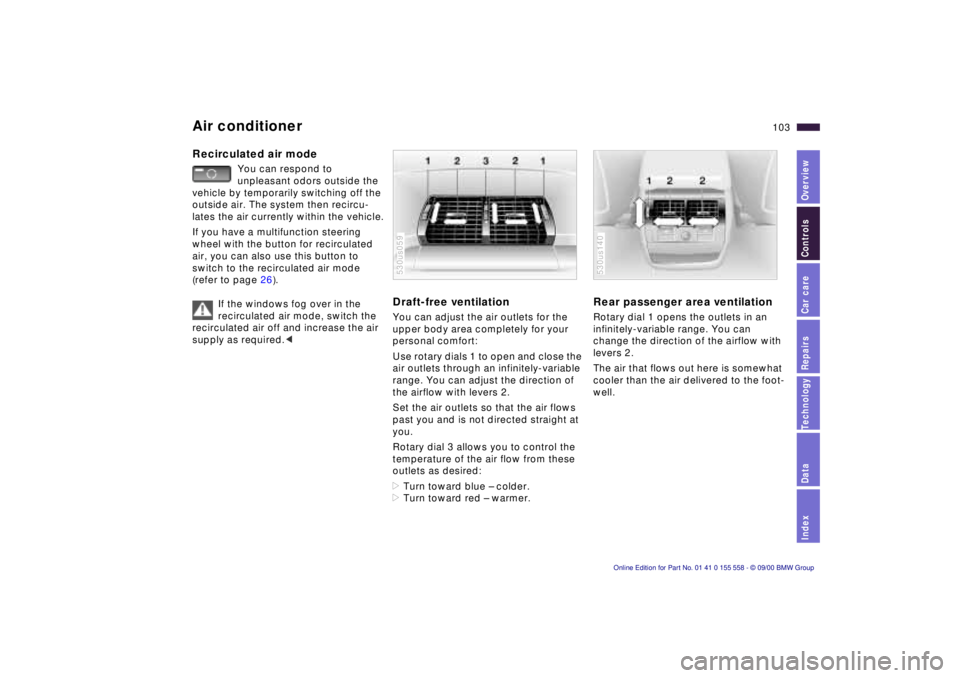
Draft-free ventilation You can adjust the air outlets for the
upper body area completely for your
personal comfort:
Use rotary dials 1 to open and close the
air outlets through an infinitely-variable
range. You can adjust the direction of
the airflow with levers 2.
Set the air outlets so that the air flows
past you and is not directed straight at
you.
Rotary dial 3 allows you to control the
temperature of the air flow from these
outlets as desired:
>Turn toward blue – colder.
>Turn toward red – warmer.530us059
Rear passenger area ventilationRotary dial 1 opens the outlets in an
infinitely-variable range. You can
change the direction of the airflow with
levers 2.
The air that flows out here is somewhat
cooler than the air delivered to the foot-
well.530us140
Page 104 of 223

104n
Air conditionerMicrofilter The microfilter removes dust and pollen
from the incoming air. It is replaced by
your BMW center during regular main-
tenance. A substantial reduction in air
supply indicates that the filter must be
replaced before normal maintenance.
Cooling1 You can specify an interior tempera-
ture that is comfortable for you with
the rotary temperature dial. A good
starting point is +72 7 (+22 6).
2 Switch on the air conditioner.
3 Set the air distribution rotary dial
to .
4 Set the blower/air supply rotary dial
to the middle zone.
5 Open the air outlets for the upper
body.
6 Select a temperature that is comfort-
able for you with rotary dial 3. Refer
to "Draft-free ventilation" on
page 103.530us146
Rapid ventilation1 You can specify an interior tempera-
ture that is comfortable for you with
the rotary temperature dial. A good
starting point is +72 7 (+22 6).
2 Switch on the air conditioner and
recirculated air mode.
3 Set the air distribution rotary dial
to .
4 Set the blower/air supply rotary dial
completely to the right.
5 Open the air outlets for the upper
body.
6 Set rotary dial 3 to cold (blue). Refer
to page 103.530us147
Page 105 of 223

IndexDataTechnologyRepairsCar careControlsOverview
105n
Air conditionerRapid heating 1 You can specify an interior tempera-
ture that is comfortable for you with
the rotary temperature dial. A good
starting point is +72 7 (+22 6).
2 Set the air distribution rotary dial
to .
3 Set the blower/air supply rotary dial
completely to the right.
4 Close the air outlets in the rear
seating area.530us148
To defrost windows and remove
condensation 1 You can specify an interior tempera-
ture that is comfortable for you with
the rotary temperature dial. A good
starting point is +72 7 (+22 6).
2 Set the air distribution rotary dial
to .
3 Set the blower/air supply rotary dial
completely to the right.
4 Close the air outlets in the rear
seating area.
5 Switch on the rear window defroster
to defrost the rear window. 530us149
HeatingWhen the windows are free of ice and
condensation, we recommend the
following settings:
1 You can specify an interior tempera-
ture that is comfortable for you with
the rotary temperature dial. A good
starting point is +72 7 (+22 6).
2 Set the air distribution rotary dial
to .
3 Set the blower/air supply rotary dial
to the middle zone.
4 Close the air outlets in the rear
seating area.
390de127
530us150