belt BMW X5 4.4I 2001 User Guide
[x] Cancel search | Manufacturer: BMW, Model Year: 2001, Model line: X5 4.4I, Model: BMW X5 4.4I 2001Pages: 223, PDF Size: 2.66 MB
Page 57 of 223
Index
Data
Technology
Repairs
Car care
Controls
Overview
57n
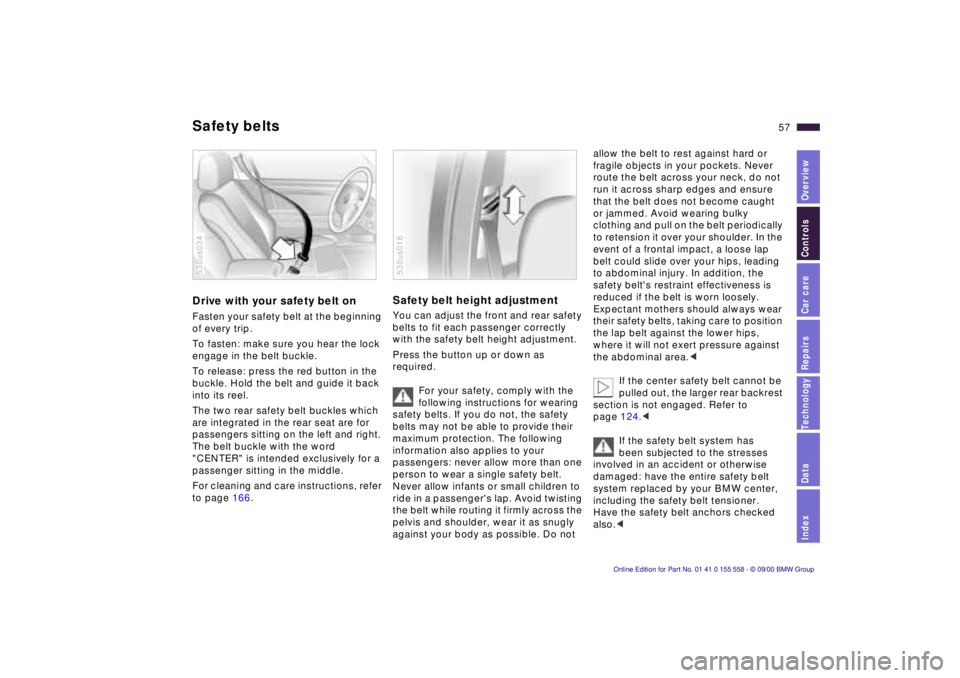
Drive with your safety belt on
Fasten your safety belt at the beginning
of every trip.
To fasten: make sure you hear the lock
engage in the belt buckle.
To release: press the red button in the
buckle. Hold the belt and guide it back
into its reel.
The two rear safety belt buckles which
are integrated in the rear seat are for
passengers sitting on the left and right.
The belt buckle with the word
"CENTER" is intended exclusively for a
passenger sitting in the middle.
For cleaning and care instructions, refer
to page 166.
530us034
Safety belt height adjustment
You can adjust the front and rear safety
belts to fit each passenger correctly
with the safety belt height adjustment.
Press the button up or down as
required.
For your safety, comply with the
following instructions for wearing
safety belts. If you do not, the safety
belts may not be able to provide their
maximum protection. The following
information also applies to your
passengers: never allow more than one
person to wear a single safety belt.
Never allow infants or small children to
ride in a passenger's lap. Avoid twisting
the belt while routing it firmly across the
pelvis and shoulder, wear it as snugly
against your body as possible. Do not
530us016
allow the belt to rest against hard or
fragile objects in your pockets. Never
route the belt across your neck, do not
run it across sharp edges and ensure
that the belt does not become caught
or jammed. Avoid wearing bulky
clothing and pull on the belt periodically
to retension it over your shoulder. In the
event of a frontal impact, a loose lap
belt could slide over your hips, leading
to abdominal injury. In addition, the
safety belt's restraint effectiveness is
reduced if the belt is worn loosely.
Expectant mothers should always wear
their safety belts, taking care to position
the lap belt against the lower hips,
where it will not exert pressure against
the abdominal area. <
If the center safety belt cannot be
pulled out, the larger rear backrest
section is not engaged. Refer to
page 124.<
If the safety belt system has
been subjected to the stresses
involved in an accident or otherwise
damaged: have the entire safety belt
system replaced by your BMW center,
including the safety belt tensioner.
Have the safety belt anchors checked
also. c
Safety belts
Page 58 of 223
58nAirbags
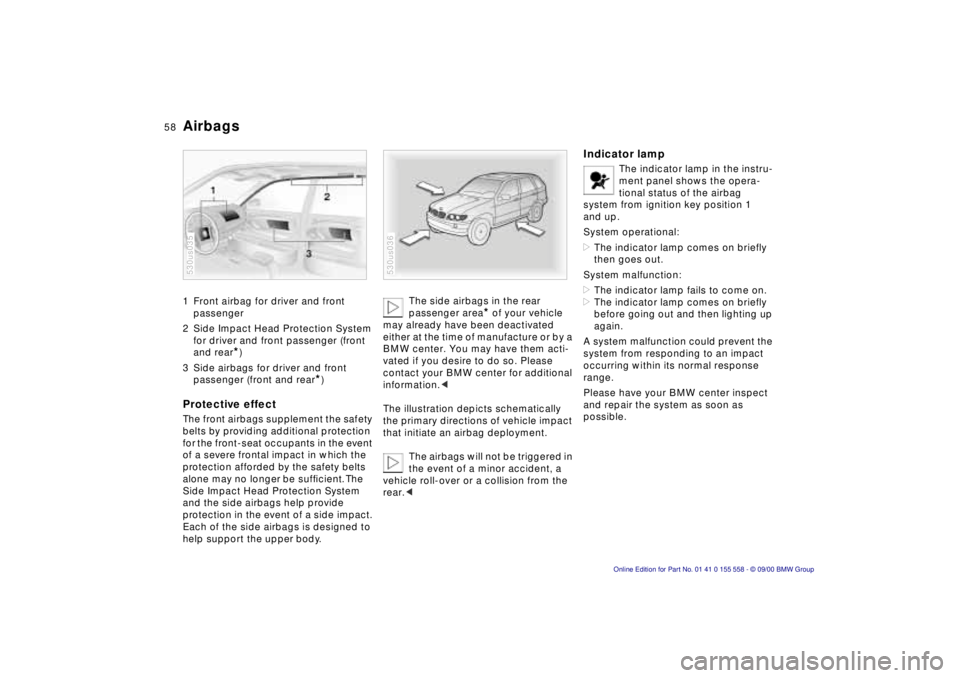
1 Front airbag for driver and front
passenger
2 Side Impact Head Protection System for driver and front passenger (front
and rear
*)
3 Side airbags for driver and front passenger (front and rear
*)
Protective effect
The front airbags supplement the safety
belts by providing additional protection
for the front-seat occupants in the event
of a severe frontal impact in which the
protection afforded by the safety belts
alone may no longer be sufficient. The
Side Impact Head Protection System
and the side airbags help provide
protection in the event of a side impact.
Each of the side airbags is designed to
help support the upper body.
530us035
The side airbags in the rear
passenger area
* of your vehicle
may already have been deactivated
either at the time of manufacture or by a
BMW center. You may have them acti-
vated if you desire to do so. Please
contact your BMW center for additional
information. <
The illustration depicts schematically
the primary directions of vehicle impact
that initiate an airbag deployment. The airbags will not be triggered in
the event of a minor accident, a
vehicle roll-over or a collision from the
rear. <
530us036
Indicator lamp
The indicator lamp in the instru-
ment panel shows the opera-
tional status of the airbag
system from ignition key position 1
and up.
System operational:
> The indicator lamp comes on briefly
then goes out.
System malfunction:
> The indicator lamp fails to come on.
> The indicator lamp comes on briefly
before going out and then lighting up
again.
A system malfunction could prevent the
system from responding to an impact
occurring within its normal response
range.
Please have your BMW center inspect
and repair the system as soon as
possible.
Page 59 of 223
Index
Data
Technology
Repairs
Car care
Controls
Overview
59nAirbags
Sitting correctly with airbags
For your safety, comply with the
following instructions for the
airbags. If you do not, the airbags may
not be able to provide their maximum
protection. All passengers in the vehicle
should be aware of and comply with
this information:
Even though there is an airbag, wear a
safety belt every time you get in the
vehicle, because airbags enhance
safety by providing added protection.
Make sure you are seated comfortably
in your seat, in such a way that you
always maintain control, and are not too
close to the steering wheel.
Always hold the steering wheel by the
rim to keep any chance of injury to
hands or arms to an absolute minimum,
should the airbag be deployed.
No one and nothing is to come between
the airbag and the seat occupant.
Do not use the cover panel above the
front passenger-side airbag as a
storage area.
Do not apply adhesive materials to the
cover panels of the airbags, cover them
or modify them in any other way.
Do not install a rear-facing child
restraint system in the front passenger
seat of this car.
Children under 13 years of age and
children less than 5 feet (150 cm) tall
should ride only in the rear seat.
Infants or small children should never
be held on the lap of a passenger.
If your car is equipped with side airbags
in the rear passenger area, be sure that
child restraints are mounted correctly
and provided with the greatest-possible
distance between the airbags in the
side trim panels. Do not allow children
to lean out of the child's seat in the
direction of the side trim panels. If they
do so, serious injuries can occur if the
airbag is triggered. < At all times, occupants should sit
upright and be properly restrained
(infants and small children in appro-
priate child restraint systems; larger
children and adults using the safety
belts). Never let an occupant's head
rest near or on a side airbag because
the inflating airbag could cause a
serious or fatal injury. Please note that
the word "Airbag" imprinted on the door
trim panel indicates the airbag's loca-
tion.
Accident research shows that the
safest place for children in an auto-
mobile is in the rear seat. However, a
child sitting in the rear seat and not
properly restrained may place his or her
head on or near the airbag, if so
equipped.
For example, a child — even though
belted — may fall asleep with his or her
head against the side airbag. It may be
difficult for a driver to ensure that chil-
dren in the rear seat will remain prop-
erly positioned at all times and do not
place their heads on or near the side
airbag. Therefore, we recommend that
the rear side airbags, if provided, be
deactivated if you plan to transport
children in the rear seat.
Page 60 of 223
60nAirbags
The rear seat side airbags may already
have been deactivated, either at the
time of manufacture or by a BMW
center. Labels in the rear door opening
should indicate the status of your rear
seat side airbags. If you are uncertain of
their status, or wish to have the airbags
activated or deactivated, please
contact your BMW center. <
Even when all these guidelines are
observed, there is still a small residual
risk of injuries to the face, hands and
arms occurring from airbag deployment
in isolated instances. The ignition and
inflation noise may provoke a mild
temporary hearing loss in extremely
sensitive individuals.
Airbag warning information is also
provided on the sun visors.
For additional information concerning
the airbag system, refer to pages 168
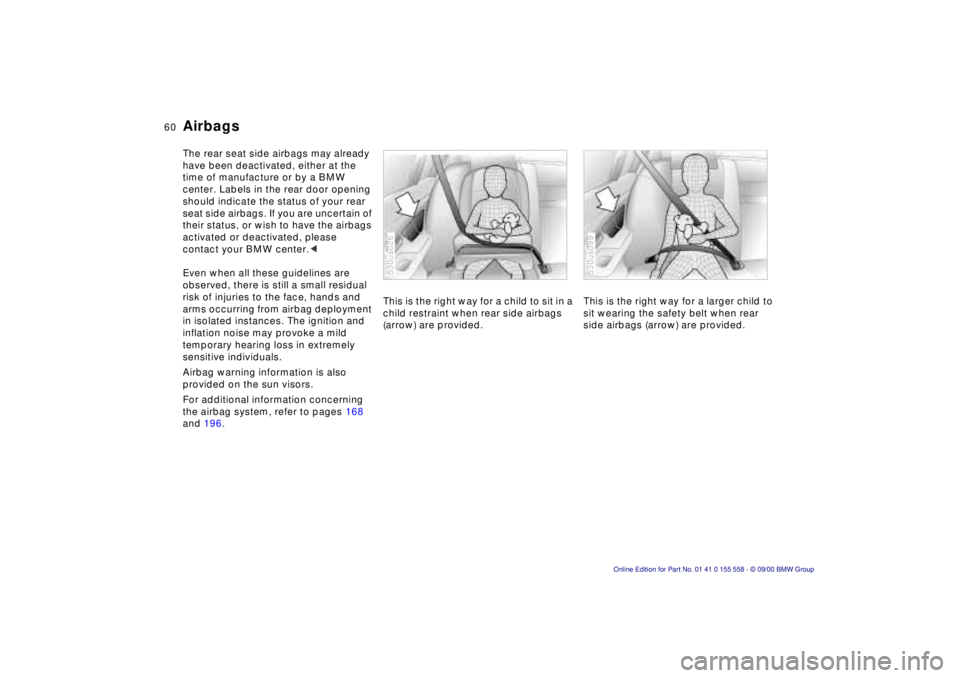
and 196. This is the right way for a child to sit in a
child restraint when rear side airbags
(arrow) are provided.
530us026
This is the right way for a larger child to
sit wearing the safety belt when rear
side airbags (arrow) are provided.
530us099
Page 61 of 223
Index
Data
Technology
Repairs
Car care
Controls
Overview
61nTransporting children safely
Child restraint systems*
Commercially-available child restraint
systems are designed to be secured
with a lap belt or with the lap belt
portion of a combination lap/shoulder
belt. Improperly or inadequately
installed restraint systems can increase
the risk of injury to children. Always
read and follow the instructions that
come with the system. Before installing any child restraint
device or child seat, please read
the following:
Never install a rear-facing child restraint
system in the front passenger seat of
this vehicle.
Your vehicle is equipped with an airbag
supplemental restraint system for the
front passenger. Because the backrest
on any rear-facing child restraint
system (of the kind designed for infants
under 1 year and 20 Ibs./9 kg) would be
within the airbag's deployment range,
you should never mount such a device
in the front passenger seat, since the
impact of the airbag against the child
restraint's backrest could lead to
serious or fatal injuries.
If it is necessary for a child (not an
infant) to ride in the front seat, certain
precautions should be taken. First,
move the passenger seat as far away
from the dashboard as possible. This
important precaution is intended to
maximize the distance between the
airbag and the child. Older children
should be tightly secured with a safety
belt.
Younger children should be secured in
an appropriate forward-facing child
restraint system that has first been
properly secured with a safety belt.
Never install a rear-facing child restraint
system in the front passenger seat.
We strongly urge you to carefully read
and comply with the instructions for
installation and use provided by the
child restraint's manufacturer when-
ever you use such a device.
Be sure that all occupants (of all ages)
remain properly and securely restrained
at all times. <
All rear seating positions in your vehicle
meet the recommendations of SAE
J1819, an industry-recommended prac-
tice for securing child restraint systems
in motor vehicles.
Page 62 of 223
62nTransporting children safely
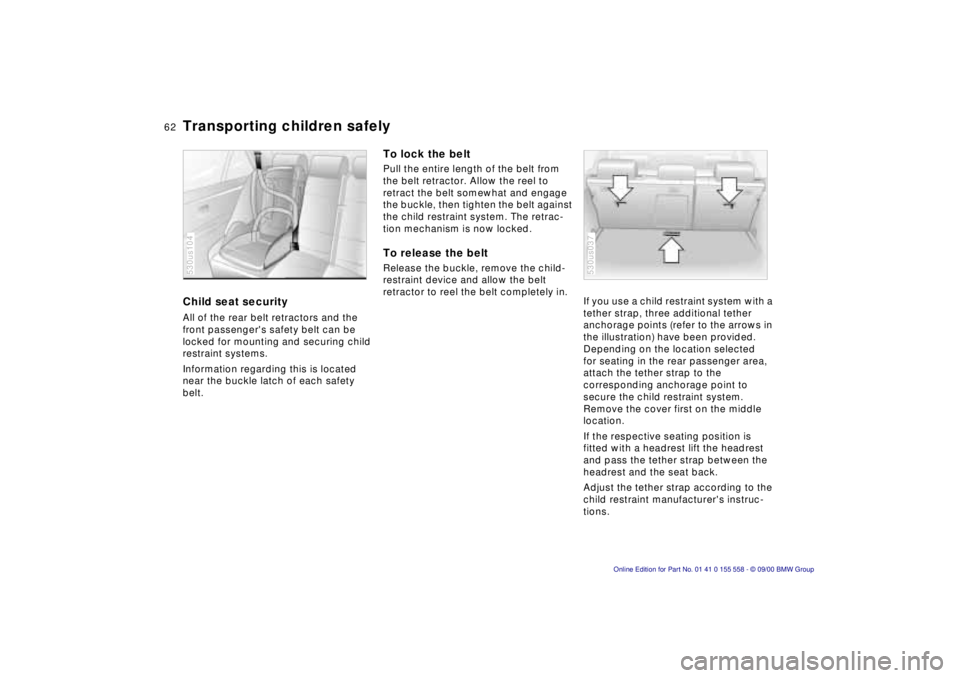
Child seat security
All of the rear belt retractors and the
front passenger's safety belt can be
locked for mounting and securing child
restraint systems.
Information regarding this is located
near the buckle latch of each safety
belt.
530us104
To lock the belt
Pull the entire length of the belt from
the belt retractor. Allow the reel to
retract the belt somewhat and engage
the buckle, then tighten the belt against
the child restraint system. The retrac-
tion mechanism is now locked.
To release the belt
Release the buckle, remove the child-
restraint device and allow the belt
retractor to reel the belt completely in.
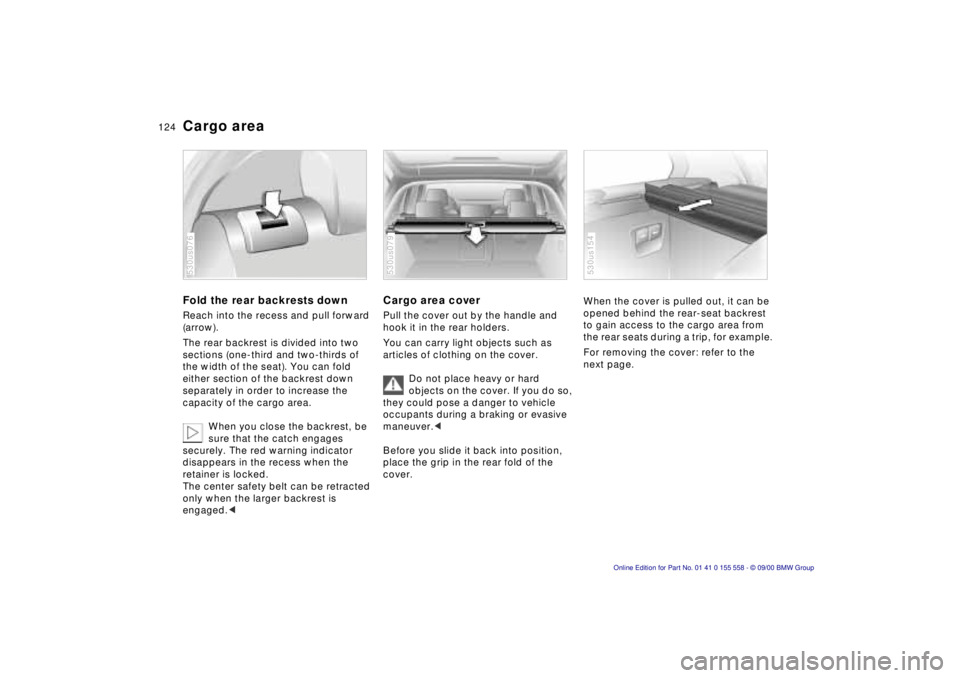
If you use a child restraint system with a
tether strap, three additional tether
anchorage points (refer to the arrows in
the illustration) have been provided.
Depending on the location selected
for seating in the rear passenger area,
attach the tether strap to the
corresponding anchorage point to
secure the child restraint system.
Remove the cover first on the middle
location.
If the respective seating position is
fitted with a headrest lift the headrest
and pass the tether strap between the
headrest and the seat back.
Adjust the tether strap according to the
child restraint manufacturer's instruc-
tions.530us037
Page 124 of 223
124n
Cargo areaFold the rear backrests downReach into the recess and pull forward
(arrow).
The rear backrest is divided into two
sections (one-third and two-thirds of
the width of the seat). You can fold
either section of the backrest down
separately in order to increase the
capacity of the cargo area.
When you close the backrest, be
sure that the catch engages
securely. The red warning indicator
disappears in the recess when the
retainer is locked.
The center safety belt can be retracted
only when the larger backrest is
engaged.< 530us076
Cargo area coverPull the cover out by the handle and
hook it in the rear holders.
You can carry light objects such as
articles of clothing on the cover.
Do not place heavy or hard
objects on the cover. If you do so,
they could pose a danger to vehicle
occupants during a braking or evasive
maneuver.<
Before you slide it back into position,
place the grip in the rear fold of the
cover.530us079
When the cover is pulled out, it can be
opened behind the rear-seat backrest
to gain access to the cargo area from
the rear seats during a trip, for example.
For removing the cover: refer to the
next page. 530us154
Page 129 of 223
IndexDataTechnologyRepairsCar careControlsOverview
129n
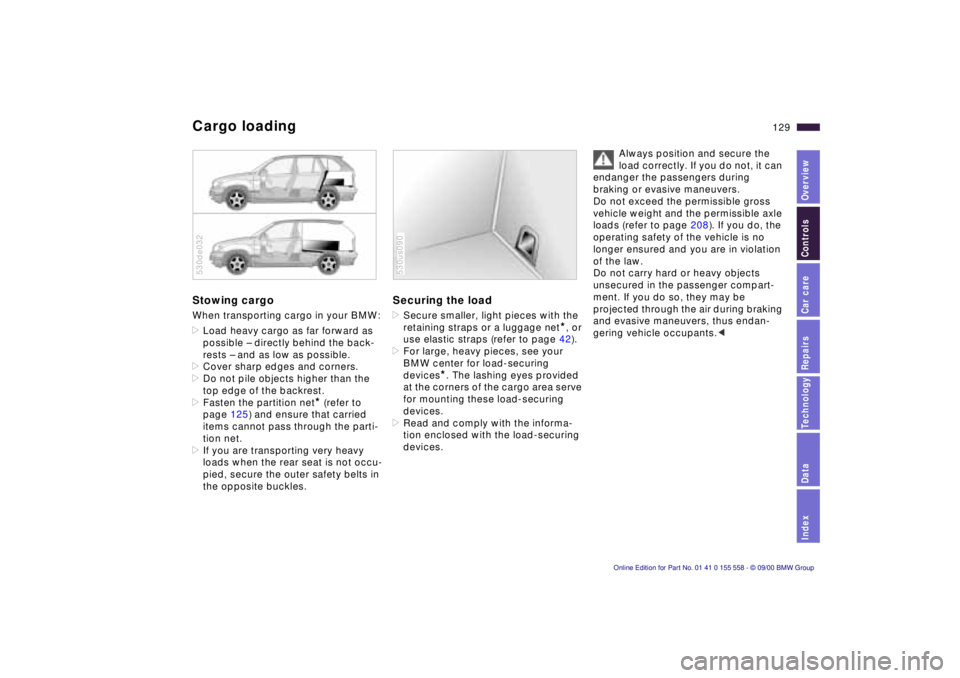
Cargo loadingStowing cargo When transporting cargo in your BMW:
>Load heavy cargo as far forward as
possible – directly behind the back-
rests – and as low as possible.
>Cover sharp edges and corners.
>Do not pile objects higher than the
top edge of the backrest.
>Fasten the partition net
* (refer to
page 125) and ensure that carried
items cannot pass through the parti-
tion net.
>If you are transporting very heavy
loads when the rear seat is not occu-
pied, secure the outer safety belts in
the opposite buckles.
530de032
Securing the load >Secure smaller, light pieces with the
retaining straps or a luggage net
*, or
use elastic straps (refer to page 42).
>For large, heavy pieces, see your
BMW center for load-securing
devices
*. The lashing eyes provided
at the corners of the cargo area serve
for mounting these load-securing
devices.
>Read and comply with the informa-
tion enclosed with the load-securing
devices.
530us090
Always position and secure the
load correctly. If you do not, it can
endanger the passengers during
braking or evasive maneuvers.
Do not exceed the permissible gross
vehicle weight and the permissible axle
loads (refer to page 208). If you do, the
operating safety of the vehicle is no
longer ensured and you are in violation
of the law.
Do not carry hard or heavy objects
unsecured in the passenger compart-
ment. If you do so, they may be
projected through the air during braking
and evasive maneuvers, thus endan-
gering vehicle occupants.<
Page 148 of 223
148n
Wheel and tire combinationsThe right choice
Use only wheels and tires
approved by BMW for the corre-
sponding vehicle model, as otherwise
the tires may make contact with the
body as the result of tolerances despite
the same nominal size being used,
resulting in serious accidents. If non-
approved wheels and tires are used,
BMW cannot evaluate their suitability,
and therefore cannot be held liable for
driving safety.<
For wheel and tire specifications
approved by BMW, refer to page 150.
The correct wheel-tire combina-
tion affects different systems such
as ABS, ATC and DSC. The function of
these systems is impaired if improper
wheel-tire combinations are used.
For this reason, use only tires of the
same brand and tread pattern on the
vehicle and, for example, restore the
approved wheel-tire combination
following a flat tire as soon as
possible.<
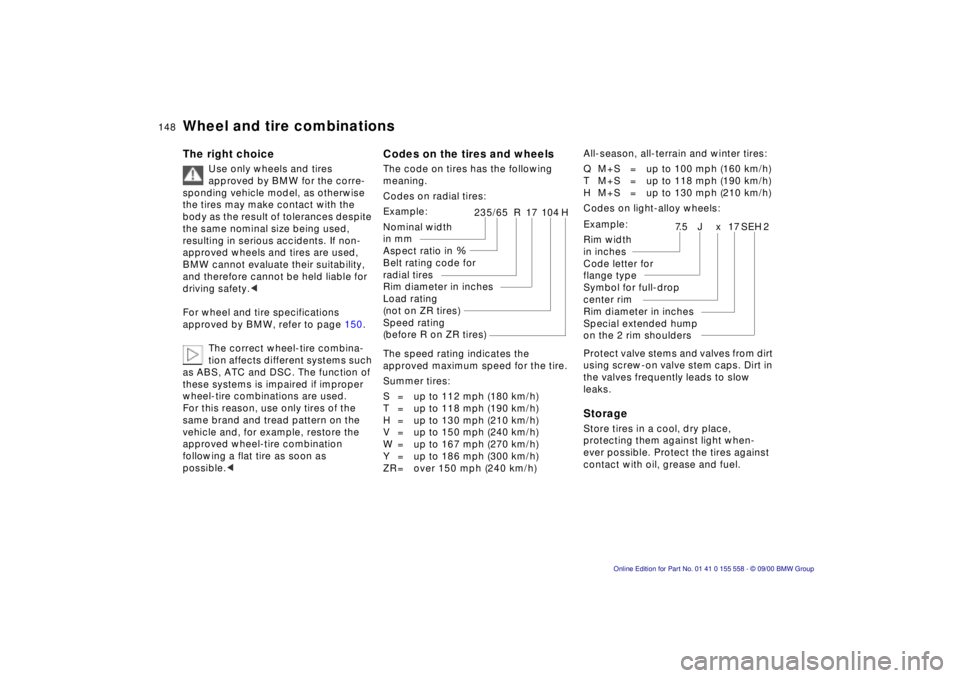
Codes on the tires and wheels The code on tires has the following
meaning.
Codes on radial tires:
The speed rating indicates the
approved maximum speed for the tire.
Summer tires:
S = up to 112 mph (180 km/h)
T = up to 118 mph (190 km/h)
H = up to 130 mph (210 km/h)
V = up to 150 mph (240 km/h)
W = up to 167 mph (270 km/h)
Y = up to 186 mph (300 km/h)
ZR= over 150 mph (240 km/h) Example:
Nominal width
in mm
Aspect ratio in X
Belt rating code for
radial tires
Rim diameter in inches
Load rating
(not on ZR tires)
Speed rating
(before R on ZR tires)
235/65 R 17 104 H
All-season, all-terrain and winter tires:
Q M+S = up to 100 mph (160 km/h)
T M+S = up to 118 mph (190 km/h)
H M+S = up to 130 mph (210 km/h)
Codes on light-alloy wheels:
Protect valve stems and valves from dirt
using screw-on valve stem caps. Dirt in
the valves frequently leads to slow
leaks. Storage Store tires in a cool, dry place,
protecting them against light when-
ever possible. Protect the tires against
contact with oil, grease and fuel. Example:
Rim width
in inches
Code letter for
flange type
Symbol for full-drop
center rim
Rim diameter in inches
Special extended hump
on the 2 rim shoulders
7.5 x 17 SEH 2
J
Page 150 of 223
150n
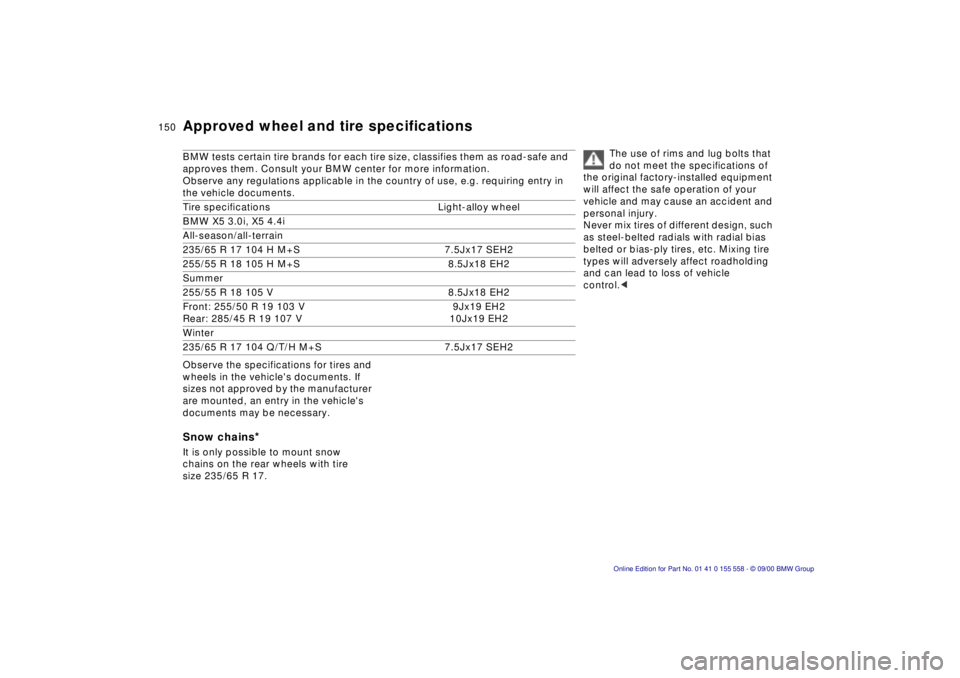
Approved wheel and tire specifications Observe the specifications for tires and
wheels in the vehicle's documents. If
sizes not approved by the manufacturer
are mounted, an entry in the vehicle's
documents may be necessary. Snow chains
*
It is only possible to mount snow
chains on the rear wheels with tire
size 235/65 R 17. BMW tests certain tire brands for each tire size, classifies them as road-safe and
approves them. Consult your BMW center for more information.
Observe any regulations applicable in the country of use, e.g. requiring entry in
the vehicle documents.
Tire specifications Light-alloy wheel
BMW X5 3.0i, X5 4.4i
All-season/all-terrain
235/65 R 17 104 H M+S 7.5Jx17 SEH2
255/55 R 18 105 H M+S 8.5Jx18 EH2
Summer
255/55 R 18 105 V 8.5Jx18 EH2
Front: 255/50 R 19 103 V
Rear: 285/45 R 19 107 V9Jx19 EH2
10Jx19 EH2
Winter
235/65 R 17 104 Q/T/H M+S 7.5Jx17 SEH2
The use of rims and lug bolts that
do not meet the specifications of
the original factory-installed equipment
will affect the safe operation of your
vehicle and may cause an accident and
personal injury.
Never mix tires of different design, such
as steel-belted radials with radial bias
belted or bias-ply tires, etc. Mixing tire
types will adversely affect roadholding
and can lead to loss of vehicle
control.<