brakes BMW X5 4.4I 2001 Owners Manual
[x] Cancel search | Manufacturer: BMW, Model Year: 2001, Model line: X5 4.4I, Model: BMW X5 4.4I 2001Pages: 223, PDF Size: 2.66 MB
Page 11 of 223

11n
Controls and features
Operation, care and maintenance
Technology for safety and
driving convenience:
Park Distance Control (PDC) 93
Dynamic Stability Control (DSC) 94
Hill Descent Control (HDC) 95
Lamps:
Side lamps/Low beams97
Instrument lighting 97
High beams/Parking lamps 98
Fog lamps 98
Interior lamps 98
Reading lamps 99
Controlling the climate for
pleasant driving:
Air conditioner100
Automatic climate control 106
Seat heating 112
Steering wheel heating 113
Roller sun blind 113
Independent ventilation system 114
Cabin convenience:
BMW Universal Transmitter 115
Glove compartment 117
Storage compartments 118
Cellular phone 118
Cup holders 119
Glasses compartment 119
Ashtray, front 120
Cigarette lighter, front 120
Ashtray, rear 121
Cigarette lighter, rear 121
Loading and transporting:
Ski bag122
Cargo area Fold the rear backrests
down 124
Cargo area cover 124
Partition net 125
Cover panels in the cargo
area 126
Power outlets 127
Pull-out cargo floor 128
Cargo loading 129
Roof-mounted luggage rack 130
Special operating instructions:
Break-in procedures134
Driving your BMW X5 135
General driving notes 136
Catalytic converter 136
Antilock Brake System (ABS) 137
Disc brakes 140
Brake system 141
Winter operation 141
Power steering 143
Level control system 143
Cellular phone 144
Radio reception 144
Wheels and tires:
Tire inflation pressure 145
Tire condition 145
Tire replacement 146
Tire rotation 147
Wheel and tire combinations 148
Special features of winter tires 149
Snow chains 149
Approved wheel and tire
specifications 150
Page 95 of 223
IndexDataTechnologyRepairsCar careControlsOverview
95n
Dynamic Stability Control (DSC)
Hill Descent Control
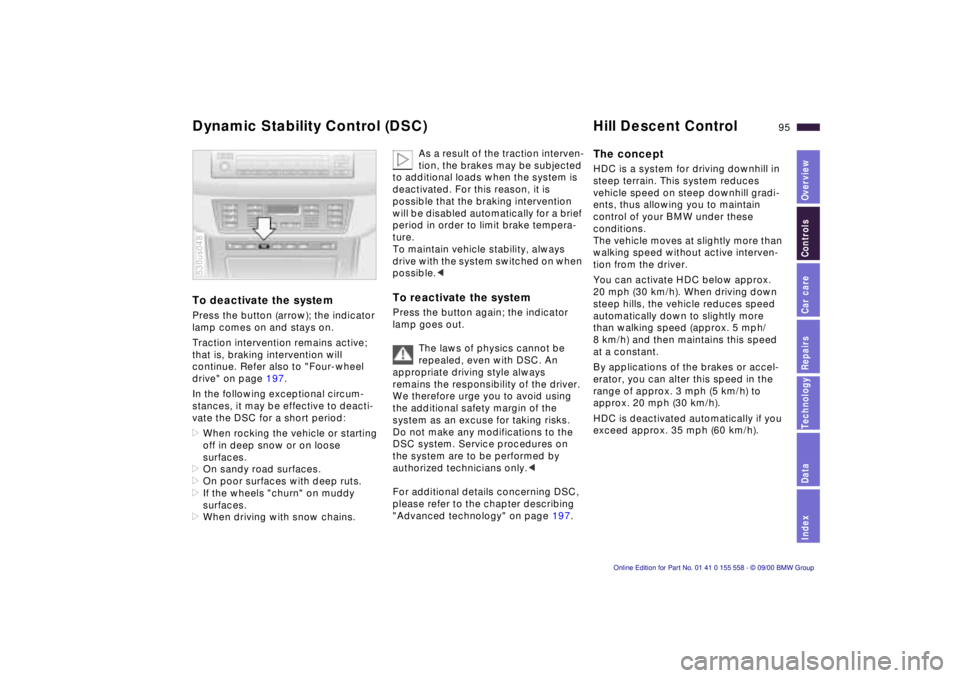
To deactivate the system Press the button (arrow); the indicator
lamp comes on and stays on.
Traction intervention remains active;
that is, braking intervention will
continue. Refer also to "Four-wheel
drive" on page 197.
In the following exceptional circum-
stances, it may be effective to deacti-
vate the DSC for a short period:
>When rocking the vehicle or starting
off in deep snow or on loose
surfaces.
>On sandy road surfaces.
>On poor surfaces with deep ruts.
>If the wheels "churn" on muddy
surfaces.
>When driving with snow chains. 530us048
As a result of the traction interven-
tion, the brakes may be subjected
to additional loads when the system is
deactivated. For this reason, it is
possible that the braking intervention
will be disabled automatically for a brief
period in order to limit brake tempera-
ture.
To maintain vehicle stability, always
drive with the system switched on when
possible.<
To reactivate the systemPress the button again; the indicator
lamp goes out.
The laws of physics cannot be
repealed, even with DSC. An
appropriate driving style always
remains the responsibility of the driver.
We therefore urge you to avoid using
the additional safety margin of the
system as an excuse for taking risks.
Do not make any modifications to the
DSC system. Service procedures on
the system are to be performed by
authorized technicians only.<
For additional details concerning DSC,
please refer to the chapter describing
"Advanced technology" on page 197.
The concept HDC is a system for driving downhill in
steep terrain. This system reduces
vehicle speed on steep downhill gradi-
ents, thus allowing you to maintain
control of your BMW under these
conditions.
The vehicle moves at slightly more than
walking speed without active interven-
tion from the driver.
You can activate HDC below approx.
20 mph (30 km/h). When driving down
steep hills, the vehicle reduces speed
automatically down to slightly more
than walking speed (approx. 5 mph/
8 km/h) and then maintains this speed
at a constant.
By applications of the brakes or accel-
erator, you can alter this speed in the
range of approx. 3 mph (5 km/h) to
approx. 20 mph (30 km/h).
HDC is deactivated automatically if you
exceed approx. 35 mph (60 km/h).
Page 96 of 223
96n
Hill Descent Control (HDC)To activate the system
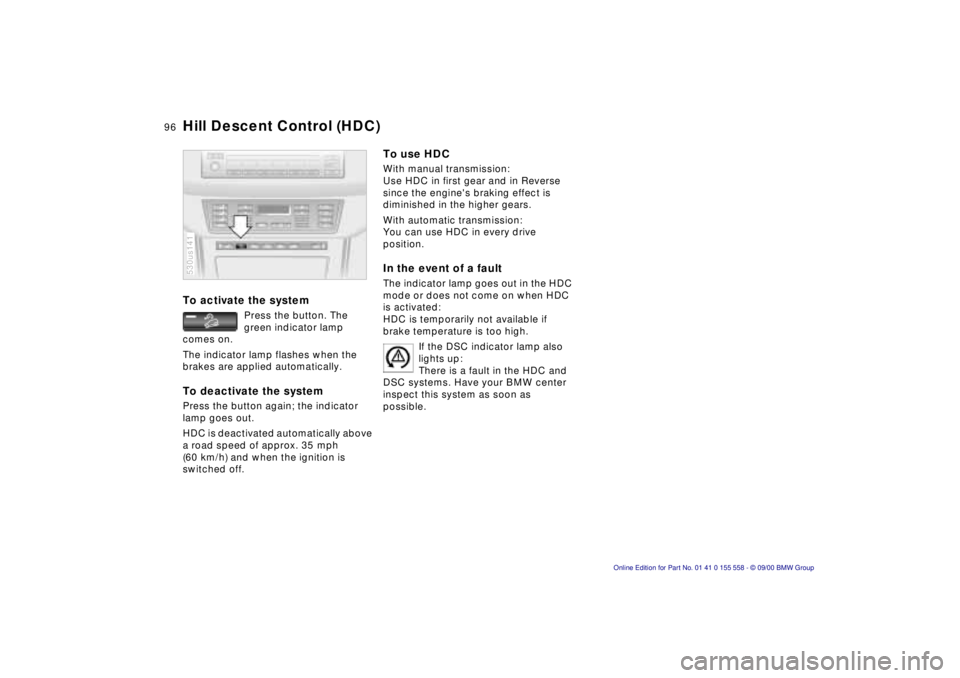
Press the button. The
green indicator lamp
comes on.
The indicator lamp flashes when the
brakes are applied automatically.
To deactivate the system Press the button again; the indicator
lamp goes out.
HDC is deactivated automatically above
a road speed of approx. 35 mph
(60 km/h) and when the ignition is
switched off. 530us141
To use HDCWith manual transmission:
Use HDC in first gear and in Reverse
since the engine's braking effect is
diminished in the higher gears.
With automatic transmission:
You can use HDC in every drive
position. In the event of a faultThe indicator lamp goes out in the HDC
mode or does not come on when HDC
is activated:
HDC is temporarily not available if
brake temperature is too high.
If the DSC indicator lamp also
lights up:
There is a fault in the HDC and
DSC systems. Have your BMW center
inspect this system as soon as
possible.
Page 133 of 223
IndexDataTechnologyRepairsCar careControlsOverview
Overview
Controls and features
Operation, care
and maintenance
Owner service procedures
Technical data
Index Advanced technology
133n
Under the hood:
Hood151
Engine compartment152
Washer fluid156
Washer nozzles156
Engine oil157
Coolant160
Brake fluid161
Vehicle Identification
Number161
Care and maintenance:
The BMW Maintenance
System162
Caring for your vehicle163
Airbags168
Vehicle storage168
Laws and regulations:
Technical modifications169
California Proposition
65 Warning169
OBD interface socket170
Car care Special operating instructions:
Break-in procedures134
Driving your BMW X5135
General driving notes136
Catalytic converter136
Antilock Brake System
(ABS)137
Disc brakes140
Brake system141
Winter operation141
Power steering143
Level control system143
Cellular phone144
Radio reception144
Wheels and tires:
Tire inflation pressure145
Tire condition145
Tire replacement146
Tire rotation147
Wheel and tire
combinations148
Special features of winter
tires149
Snow chains149
Approved wheel and tire
specifications150
Page 135 of 223

IndexDataTechnologyRepairsCar careControlsOverview
135n
Driving your BMW X5 Your BMW is right at home on all roads
and byways – even where the pavement
ends. It combines permanent four-
wheel drive with the agility of a typical
passenger car. On bad roadsWhen you are driving on bad roads,
there are a few points which you should
strictly heed — for your own safety, for
that of your passengers, and for the
safekeeping of the vehicle:
>Familiarize yourself with the vehicle
before you begin driving. Do not take
risks with the vehicle under any
circumstances.
>Always adapt vehicle speed to road
conditions – the steeper and more
uneven the road surface is, the
slower the vehicle's speed should be.
>You can operate your vehicle on
uphill and downhill gradients with a
maximum slope of 50 %. If you intend
to drive on either an uphill or downhill
gradient of this steepness, check to
be sure in advance that the engine oil
and coolant levels are both near the
"MAX" mark. Refer to pages 157
and 160.
When driving down steep slopes, use
the Hill Descent Control (HDC). Refer
to page 95. Starting from a full stop is possible on
uphill gradients of up to 32 %.
The permitted side tilt is also 50 %.
>While driving, watch carefully for
obstacles such as rocks or holes. Try
to avoid these obstacles whenever
possible.
>On hill crests and bumpy roads, for
example, be careful to prevent the
body from "bottoming" (contact
between the body and the ground).
The ground clearance of the vehicle
is:
– 8 inches (200 mm) with up to four
passengers
– 7 inches (180 mm) fully loaded.
>Do not drive in water that is deeper
than 20 inches (50 cm). If you must
drive through water up to that depth,
drive at a walking speed and do not
stop.
After leaving the water, press on the
footbrake gently several times while
driving at a low speed. The brake
applications will help to dry the
brakes, thus preventing a reduction in
braking performance caused by the
moisture.
Back onto the paved road In recommending that you observe the
following points after driving on adverse
road surfaces, it is not as a "beauty
treatment" for your BMW. Instead, it is
intended for the maintenance of driving
safety:
>Clean accumulations of dirt from the
body and check the undercarriage for
damage.
>Clean mud, snow, ice and other
materials from the wheels and tires.
Check the tires for damage.
>Check to determine whether rocks,
gravel or accumulations of dirt on the
brake discs and calipers could influ-
ence braking performance. Remove
all such foreign objects.
>In order to clean the brake discs,
apply the footbrake gently several
times while driving at a low speed. Be
sure that following traffic is not
endangered by this.
>For cleaning the parking brake, apply
the lever slightly at approx. 25 mph
(40 km/h) and continue to drive for
approx. 200 yards (200 meters),
provided that traffic conditions allow
you to do so.
Page 136 of 223

136n
General driving notes Catalytic converter
Brakes:
Do not drive with your foot resting
on the brake pedal. Even light but
consistent pedal pressure can lead to
high temperatures, brake wear and
possibly even brake failure.
Aquaplaning:
When driving on wet or slushy roads,
reduce vehicle speed. If you do not, a
wedge of water may form between the
tires and the road surface. This
phenomenon is referred to as aqua-
planing or hydroplaning. It is character-
ized by a partial or complete loss of
contact between the tires and the road
surface. The ultimate results are loss of
steering and braking control.
Cargo area cover:
Do not place heavy or hard objects on
the cargo area cover. These objects
could endanger vehicle occupants
during heavy brake applications or
evasive maneuvers.
Clothes hooks:
When suspending articles of clothing
from the hooks, be sure that they will
not obstruct the driver's vision. Do not
hang heavy objects on the hooks. If you
do so, they could cause personal injury
during braking or evasive maneuvers.< The catalytic converter reduces harmful
exhaust emissions.
It is designed for use with unleaded fuel
only. Even minute quantities of lead
would be enough to permanently
damage both the catalytic converter
and the system oxygen sensor.
To ensure efficient, trouble-free engine
operation and avoid potential damage:
>Be sure to comply with the scheduled
maintenance requirements.
>Fill the fuel tank well before it is
empty.
>Tow-start the vehicle only when the
engine is cold, since unburned fuel
may otherwise reach the catalytic
converter. It is better to start the
vehicle with an outside starting aid.
>Avoid other situations in which the
fuel is not burned, or burns incom-
pletely, such as engaging the starter
frequently or for extended periods, or
repeated start attempts in which the
engine does not start (stopping and
restarting an engine which is running
properly does not present a problem).
Never allow the engine to run with
any of the spark plug cables discon-
nected.
Page 138 of 223

138n
Antilock Brake System (ABS)should adapt road speed to the road
conditions.
On road surfaces that have a loose
surface layer on a firm base with good
traction (on gravel, deep sand or snow,
for example), braking distances may be
longer than with locked wheels.This is
also true if snow chains are mounted.
However, ABS continues to provide
enhanced vehicle stability and steering
response under these conditions. Information for your safety Not even ABS can suspend the laws of
physics. ABS alone cannot prevent
accidents when the brakes are applied
without an adequate safety distance
between vehicles, if the vehicle is
driven with excessive speed, or if aqua-
planing occurs. Responsibility for these
types of situations remains in the hands
(and at the feet) of the driver. You
should never allow the added safety of
ABS to lull you into a false sense of
security, or mislead you into taking
increased risks that could affect your
own safety and that of others.
Do not make any modifications to
the ABS system.
Service procedures on ABS are to be
performed by authorized technicians
only.<
Cornering Brake Control (CBC) CBC is an advanced engineering
design of the ABS. When braking
during cornering with high lateral accel-
eration, or when braking during a lane
change, vehicle stability is further
improved and the steering response is
enhanced. Electronic Brake Force
Distribution (EBV) EBV governs brake application pres-
sure at the rear wheels to achieve
stable brake response.
If the EBV fails (refer to the next
page), avoid full or "panic" brake
applications. Full or panic brake appli-
cations can result in overbraking at the
rear axle, and braking stability is no
longer ensured.<
Dynamic Brake Control (DBC)
If you apply the brakes rapidly, this
system automatically produces the
maximum braking force boost and thus
helps to achieve the shortest possible
braking distance during "panic stops."
All of the benefits of the ABS system
are exploited under these circum-
stances.
Do not reduce the pressure on the
brake pedal for the duration of the
brake application. When the brake
pedal is released, the DBC is deacti-
vated.
In the event of a malfunction,
the yellow warning lamp comes
on. Have the system checked
and repaired at your BMW
center as soon as possible.
Refer to the "Information for your
safety" covering the ABS system.
This information also applies in general
for DBC.<
Page 140 of 223

140n
Disc brakes Disc brakes furnish optimum decelera-
tion and braking control and greater
fade resistance under heavy use.
When the vehicle is driven only occa-
sionally, during extended periods when
the vehicle is not used at all, and in
operating conditions where brake appli-
cations are less frequent, there is an
increased tendency for corrosion of the
discs and accumulation of contamina-
tion on the brake pads. This occurs
because the minimal pressure which
must be exerted by the pads to clean
the discs by brake applications is not
reached.
If the brake discs are corroded, they will
tend to respond to braking with a
pulsating effect which even extended
application will fail to cure.
For your own safety: use only
brake pads that BMW has
released for your particular vehicle
model. BMW cannot evaluate non-
approved brake pads to determine if
they are suited for use, and therefore
cannot ensure the operating safety of
the vehicle if they are installed.<
Driving notes When driving in wet conditions and in
heavy rain, it is advisable to apply light
pressure to the brake pedal every few
miles (kilometers). Watch traffic condi-
tions to ensure that this maneuver does
not endanger other road users. The
heat which is generated by the brake
applications helps to dry the brake
pads and discs.
Maximum braking force is obtained
while the wheels continue to rotate,
peaking when the wheels remain on the
verge of locking without actually doing
so. ABS maintains this state automati-
cally. If the ABS fails, you should revert
to the staggered braking technique
(refer to page 142).
Extended or steep mountain descents
should be driven in the gear in which
only minimal periodic brake applica-
tions is required. This avoids excessive
strain on the brakes and possible
impairment of the braking effect.
You can further increase the engine's
braking effect by selecting a lower gear,
downshifting as far as first gear.
When driving a vehicle with automatic
transmission, you can still downshift
into first gear. Refer to page 69.If engine braking should prove to be
inadequate, you should still avoid
extended, continuous braking. Instead
of maintaining low to moderate pres-
sure over an extended period of time,
you should decelerate by applying
more substantial pressure to the brake
pedal (watch for following traffic), then
releasing the pedal, then repeating the
application. This staggered braking
technique allows the brakes to cool in
the intervals between active braking
phases, preventing overheating and
ensuring that full braking capacity
remains available at all times.
Do not coast with the clutch
depressed or with the transmis-
sion or selector lever in neutral. Do not
drive with the engine shut off. The
engine provides no braking effect when
the clutch is depressed or the transmis-
sion is in neutral, and there is no
power-assist for braking or steering
when the engine is not running.
Have brake inspections performed at
an BMW center only. If you do not,
parts of the four-wheel drive system
could be damaged. Never allow floor
mats, carpets or any other objects to
protrude into the area around the accel-
erator, clutch and brake pedals and
obstruct their movement.<
Page 163 of 223

IndexDataTechnologyRepairsCar careControlsOverview
163n
Caring for your vehicleWashing your vehicle You can have your new BMW washed
in an automatic car wash. Car wash
systems that do not employ brushes
are preferable.
Wipe away tough dirt and loosen and
remove dead insects before washing
the vehicle.
To prevent spots, avoid washing when
the hood is still warm, or immediately
after and during exposure to strong
sunlight.
When using an automatic car wash, be
sure that:
>The car wash system is suited for the
dimensions of your vehicle.
Before washing the vehicle in a
car wash, fold in the exterior
mirrors manually, otherwise they may
be damaged on account of the width of
the vehicle.<
>No damage will occur on vehicles
with attached body accessories (such
as spoilers or antennas). If you are
uncertain, consult the manager of the
car wash.
>The wheels and tires of your vehicle
cannot be damaged by the convey-
ance devices of the car wash system.
>The vehicle is cleaned with minimum
brush pressure, and that ample water
is available for washing and rinsing.
Vehicles with rain sensor
*:
Clean the windshield regularly. Wax
from automatic car washes or insects,
for example, can cause malfunctions in
the function of the rain sensor.
Deactivate the rain sensor in auto-
matic car washes. If you do not,
damage may occur if the wipers switch
on unintentionally.<
Parts of the vehicle that are inacces-
sible to the automatic car wash — such
as door sills, door and hood edges, etc.
— should be cleaned by hand.
In the winter months, it is especially
important to ensure that the vehicle is
washed on a regular basis. Large quan-
tities of dirt and road salt are difficult to
remove, and they also cause damage to
the vehicle.
If spray wands or high-pressure
washers are used, be sure to
maintain an adequate distance between
the spray source and the vehicle's
surface. Inadequate distance and
excessive pressure can damage or
weaken the finish, making it more
susceptible to subsequent attack. In
addition, moisture could penetrate to
vehicle components, leading to long-
term damage.<
When cleaning the headlamps,
please observe the following:
>Do not wipe dry (scratches). Never
use abrasives or strong solvents to
clean the covers.
>Remove dirt and contamination (such
as insects) by soaking with BMW Car
Shampoo and then rinsing with plenty
of water.
>Always use a deicer spray to remove
accumulated ice and snow – never
use a scraper.<
After washing the vehicle, apply
the brakes briefly to dry them.
Braking efficiency might otherwise be
reduced by the moisture and the brake
rotors could also be corroded.<
Page 192 of 223
192n
Towing the vehicle
The towed vehicle should always
be the lighter of the two vehicles.
If this is not the case, it is no longer
possible to control vehicle response.<
Tow-starting It is not possible to start the engine of a
vehicle equipped with an automatic
transmission by towing or pushing.
For instructions on jump starting: refer
to page 190.
Never attempt to use your vehicle to
push another car. If you do so, damage
to the energy-absorbing bumpers could
result.
Towing a vehicle with automatic
transmission1 Place the selector lever in position N.
2 Towing speed:
Max. 45 mph (70 km/h).
3 Towing distance:
Max. 95 miles (150 km).
4 Leave the ignition key at position 1 to
ensure that the brake lamps, turn
signals, horn and windshield wipers
remain operative, and to prevent the
steering lock from engaging.
5 Switch on the hazard warning
flashers (comply with country-
specific regulations).
Find some means of identifying the
vehicle in tow, for instance, place a sign
or warning triangle in the rear window.
Make sure that the ignition key
remains in position 1 even when
the electrical system has failed. This will
prevent the steering lock from
engaging. The steering and brakes are
without power assist when the engine is
not running. This means that increased
effort is required for steering and
braking.<
Towing with a commercial tow
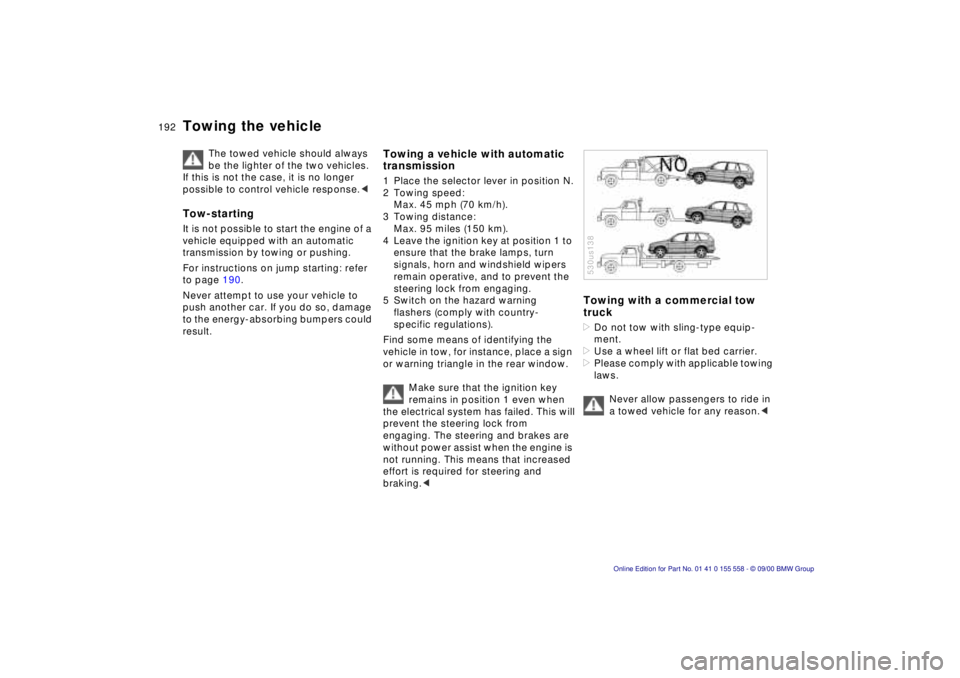
truck>Do not tow with sling-type equip-
ment.
>Use a wheel lift or flat bed carrier.
>Please comply with applicable towing
laws.
Never allow passengers to ride in
a towed vehicle for any reason.< 530us138