inflation pressure BMW X5 4.4I 2001 Owners Manual
[x] Cancel search | Manufacturer: BMW, Model Year: 2001, Model line: X5 4.4I, Model: BMW X5 4.4I 2001Pages: 223, PDF Size: 2.66 MB
Page 10 of 223
Contents
Overview
Controls and features
Cockpit 16
Instrument cluster 18
Indicator and warning lamps 22
Multifunction steering wheel 26
Sports steering wheel 27
Hazard warning flashers 28
Warning triangle 28
First-aid kit 28
Refueling 29
Fuel specifications 30
Tire inflation pressure 30
Locks and security systems:
Keys34
Electronic vehicle immobilizer 35
Central locking system 36
Opening and closing – from the outside 36
Using the key 36
Using the remote control 37
Opening and closing – from the inside 40
Liftgate 41
Tailgate 41
Alarm system 43
Electric power windows 45
Sliding/Tilt sunroof with glass moonroof 46
Adjustments:
Seats48
Steering wheel 52
Mirrors 53
Seat, mirror and steering wheel memory 55
Car Memory, Key Memory 56
Passenger safety systems:
Safety belts57
Airbags 58
Transporting children safely 61
Driving:
Steering/Ignition lock64
Starting the engine 64
Switching off the engine 65
Parking brake 66
Manual transmission 67
Automatic transmission with Steptronic 68
Turn signal indicator/Headlamp flasher 70
Washer/Wiper system 71
Rear window defroster 73
Cruise control 74
Everything under control:
Odometer, outside temperature
display 76
Tachometer 77
Energy control 77
Fuel gauge 77
Coolant temperature gauge 78
Service Interval Display 78
Check Control 79
Computer 82
Multi-Information display (MID) 84
Digital clock in the MID 85
Computer in the MID 88
Contents
Page 11 of 223
11n
Controls and features
Operation, care and maintenance
Technology for safety and
driving convenience:
Park Distance Control (PDC) 93
Dynamic Stability Control (DSC) 94
Hill Descent Control (HDC) 95
Lamps:
Side lamps/Low beams97
Instrument lighting 97
High beams/Parking lamps 98
Fog lamps 98
Interior lamps 98
Reading lamps 99
Controlling the climate for
pleasant driving:
Air conditioner100
Automatic climate control 106
Seat heating 112
Steering wheel heating 113
Roller sun blind 113
Independent ventilation system 114
Cabin convenience:
BMW Universal Transmitter 115
Glove compartment 117
Storage compartments 118
Cellular phone 118
Cup holders 119
Glasses compartment 119
Ashtray, front 120
Cigarette lighter, front 120
Ashtray, rear 121
Cigarette lighter, rear 121
Loading and transporting:
Ski bag122
Cargo area Fold the rear backrests
down 124
Cargo area cover 124
Partition net 125
Cover panels in the cargo
area 126
Power outlets 127
Pull-out cargo floor 128
Cargo loading 129
Roof-mounted luggage rack 130
Special operating instructions:
Break-in procedures134
Driving your BMW X5 135
General driving notes 136
Catalytic converter 136
Antilock Brake System (ABS) 137
Disc brakes 140
Brake system 141
Winter operation 141
Power steering 143
Level control system 143
Cellular phone 144
Radio reception 144
Wheels and tires:
Tire inflation pressure 145
Tire condition 145
Tire replacement 146
Tire rotation 147
Wheel and tire combinations 148
Special features of winter tires 149
Snow chains 149
Approved wheel and tire
specifications 150
Page 15 of 223
Index
Data
Technology
Repairs
Car care
Controls
Overview
Overview
Controls and features Operation, care
and maintenance
Owner service procedures
Technical dataIndex
Advanced technology
15
n
Cockpit 16
Instrument cluster 18
Indicator and warning lamps 22
Multifunction steering wheel 26
Sports steering wheel 27
Hazard warning flashers 28
Warning triangle 28
First-aid kit 28
Refueling 29
Fuel specifications 30
Tire inflation pressure 30
Overview
Page 30 of 223
30nFuel specifications Tire inflation pressure
The engine uses lead-free gasoline
only.
Required fuel:
>Premium Unleaded Gasoline,
min. 91 AKI.
AKI = Anti Knock Index
Do not use leaded fuels. The use
of leaded fuels will cause perma-
nent damage to the system's oxygen
sensor and the catalytic converter. <
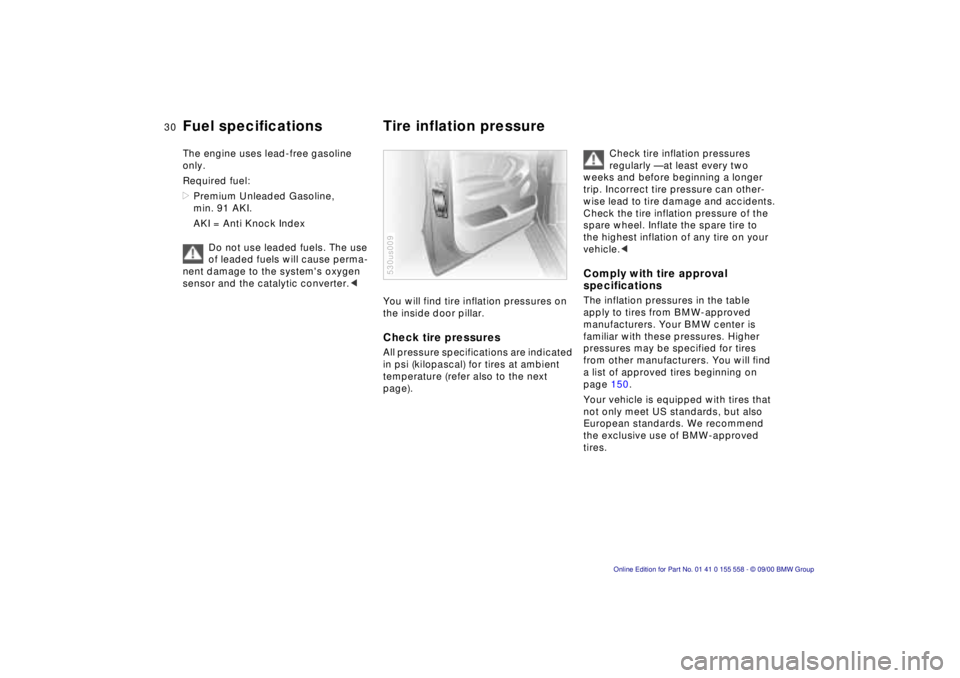
You will find tire inflation pressures on
the inside door pillar.
Check tire pressures
All pressure specifications are indicated
in psi (kilopascal) for tires at ambient
temperature (refer also to the next
page).
530us009
Check tire inflation pressures
regularly — at least every two
weeks and before beginning a longer
trip. Incorrect tire pressure can other-
wise lead to tire damage and accidents.
Check the tire inflation pressure of the
spare wheel. Inflate the spare tire to
the highest inflation of any tire on your
vehicle. <
Comply with tire approval
specifications
The inflation pressures in the table
apply to tires from BMW-approved
manufacturers. Your BMW center is
familiar with these pressures. Higher
pressures may be specified for tires
from other manufacturers. You will find
a list of approved tires beginning on
page 150.
Your vehicle is equipped with tires that
not only meet US standards, but also
European standards. We recommend
the exclusive use of BMW-approved
tires.
Page 31 of 223

Index
Data
Technology
Repairs
Car care
Controls
Overview
31nTire inflation pressure
BMW Tires
All pressure specifications in
the table are indicated in psi
(kilopascal) with cold tires
(cold = ambient temperature)
X5 All sizes 32 (220) 32 (220) 32 (220) 39 (270)
Page 133 of 223
IndexDataTechnologyRepairsCar careControlsOverview
Overview
Controls and features
Operation, care
and maintenance
Owner service procedures
Technical data
Index Advanced technology
133n
Under the hood:
Hood151
Engine compartment152
Washer fluid156
Washer nozzles156
Engine oil157
Coolant160
Brake fluid161
Vehicle Identification
Number161
Care and maintenance:
The BMW Maintenance
System162
Caring for your vehicle163
Airbags168
Vehicle storage168
Laws and regulations:
Technical modifications169
California Proposition
65 Warning169
OBD interface socket170
Car care Special operating instructions:
Break-in procedures134
Driving your BMW X5135
General driving notes136
Catalytic converter136
Antilock Brake System
(ABS)137
Disc brakes140
Brake system141
Winter operation141
Power steering143
Level control system143
Cellular phone144
Radio reception144
Wheels and tires:
Tire inflation pressure145
Tire condition145
Tire replacement146
Tire rotation147
Wheel and tire
combinations148
Special features of winter
tires149
Snow chains149
Approved wheel and tire
specifications150
Page 145 of 223
IndexDataTechnologyRepairsCar careControlsOverview
145n
Information for your safetyThe factory-approved radial tires are
matched to the vehicle and have been
selected to provide optimum safety and
driving comfort on your vehicle.
It is not merely the tire's service life, but
also driving comfort and – above all else
– driving safety which depend on the
condition of the tires and the mainte-
nance of the specified tire pressure.
Incorrect inflation pressure is a frequent
cause of tire damage. It also signifi-
cantly influences the roadholding ability
of your BMW.
Check tire inflation pressures –
including the spare wheel – regu-
larly (refer to page 30), at least every
two weeks and before beginning a
longer trip. If this is not done, incorrect
tire pressures can cause driving insta-
bility and tire damage, ultimately
resulting in an accident.<
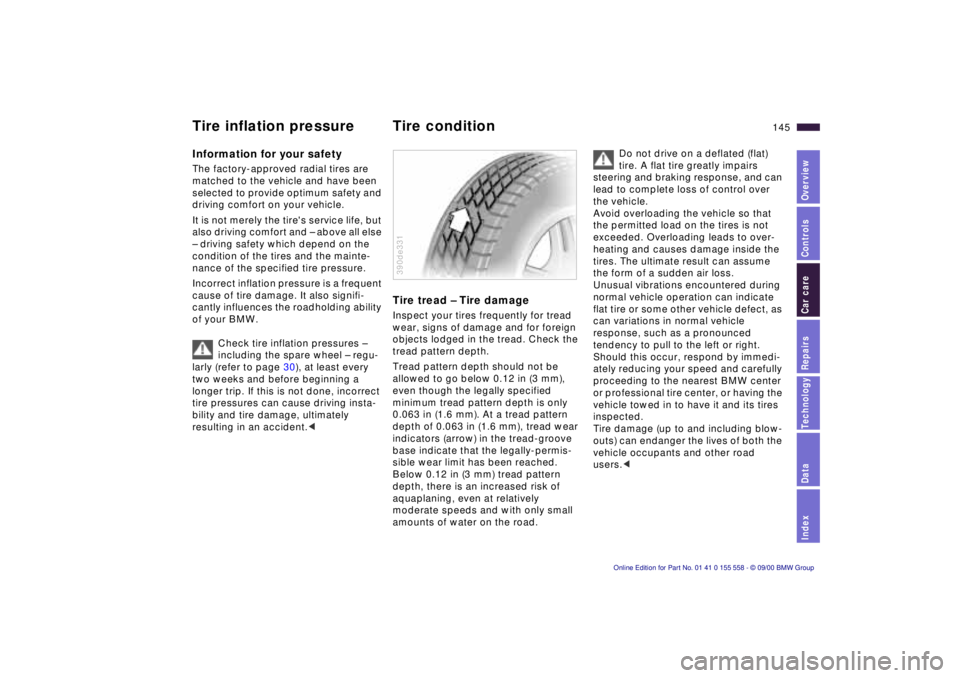
Tire tread – Tire damageInspect your tires frequently for tread
wear, signs of damage and for foreign
objects lodged in the tread. Check the
tread pattern depth.
Tread pattern depth should not be
allowed to go below 0.12 in (3 mm),
even though the legally specified
minimum tread pattern depth is only
0.063 in (1.6 mm). At a tread pattern
depth of 0.063 in (1.6 mm), tread wear
indicators (arrow) in the tread-groove
base indicate that the legally-permis-
sible wear limit has been reached.
Below 0.12 in (3 mm) tread pattern
depth, there is an increased risk of
aquaplaning, even at relatively
moderate speeds and with only small
amounts of water on the road. 390de331
Do not drive on a deflated (flat)
tire. A flat tire greatly impairs
steering and braking response, and can
lead to complete loss of control over
the vehicle.
Avoid overloading the vehicle so that
the permitted load on the tires is not
exceeded. Overloading leads to over-
heating and causes damage inside the
tires. The ultimate result can assume
the form of a sudden air loss.
Unusual vibrations encountered during
normal vehicle operation can indicate
flat tire or some other vehicle defect, as
can variations in normal vehicle
response, such as a pronounced
tendency to pull to the left or right.
Should this occur, respond by immedi-
ately reducing your speed and carefully
proceeding to the nearest BMW center
or professional tire center, or having the
vehicle towed in to have it and its tires
inspected.
Tire damage (up to and including blow-
outs) can endanger the lives of both the
vehicle occupants and other road
users.<
Tire inflation pressure Tire condition
Page 147 of 223

Index
Data
Technology
Repairs
Car care
Controls
Overview
147nTire replacement Tire rotation
Tire age
The date on which the tire was manu-
factured is indicated by the code on the
sidewall:
DOT ... 4100 indicates that the tire was
manufactured in week 41 of 2000.
BMW recommends the replacement of
all tires when the tires are no more than
6 years old, even if a tire life of 10 years
is possible.
Although tires may have a theoretical
service life of up to 10 years, BMW
strongly recommends that you replace
all tires after an absolute maximum of
6 years.
Between the axles
The tread wear patterns at the front-
and rear axle are different and will vary
according to individual driving condi-
tions. In the interests of safety and
maintaining optimal handling character-
istics, tire rotation is not recommended.
When considering the potential
economic benefits of interaxle tire rota-
tion, you must decide whether the
expense of having the tires rotated is
likely to be amortized during the antici-
pated extension in tire life. In principle,
interaxle tire rotation should be
performed at short intervals, with a
maximum of 3,000 miles (5,000 km).
Consult your BMW center for more
information.
Should you decide to rotate the tires, it
is essential that you comply with the
following:
Rotate tires on the same side only,
since braking characteristics and road
grip could otherwise be adversely
affected.
Following tire rotation, correct the tire
inflation pressure. If different tire sizes are mounted
on the front and rear axles (refer to
page 150), the wheels may not be
rotated from one axle to the other. <
Page 149 of 223
IndexDataTechnologyRepairsCar careControlsOverview
149n
Special features of winter tires Snow chains
*
Choosing the right tireBMW recommends winter tires (M+S
radial tires) for operation under inclem-
ent winter driving conditions. While
so-called all-season tires (M+S desig-
nation) provide better winter traction
than summer tires with the load ratings
H, V, W, Y and ZR, they generally do
not achieve the performance of winter
tires.
In the interests of safe tracking and
steering response, install radial tires
made by the same manufacturer and
with the same tread configuration on all
four wheels if you elect to mount winter
tires.
Do not exceed specified
maximum speeds
Never exceed the maximum speed
for which the tires are rated.
Unprofessional attempts by laymen to
service tires can lead to damage and
accidents.
Have this work performed by skilled
professionals only. Your BMW center
will be glad to assist you with both their
expertise and the proper equipment for
your vehicle.<
Tire condition, tire pressureWinter tires display a perceptible loss in
their ability to cope with winter driving
conditions once the tread wears to
below 0.16 in (4 mm), and should thus
be replaced.
Comply with the specified tire inflation
pressures — and be sure to have the
wheel and tire assemblies balanced
every time you change the tires.
The use of narrow-link BMW snow
chains is approved only in pairs on the
rear wheels and only with tire size
235/65 R 17. Comply with all manufac-
turer's safety precautions when
mounting the chains.
Page 184 of 223
184n
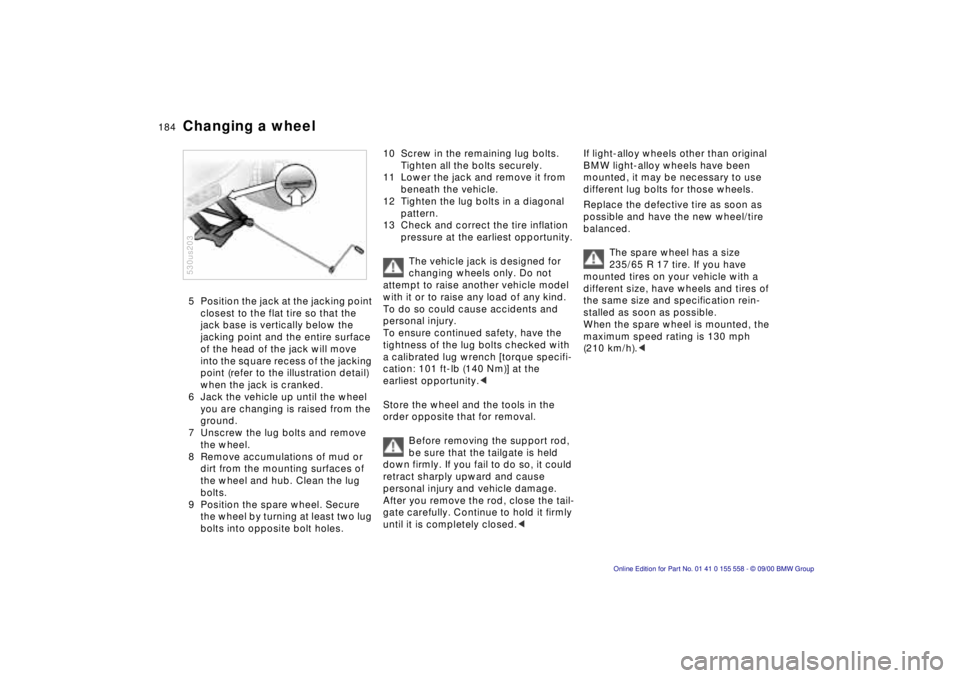
Changing a wheel5 Position the jack at the jacking point
closest to the flat tire so that the
jack base is vertically below the
jacking point and the entire surface
of the head of the jack will move
into the square recess of the jacking
point (refer to the illustration detail)
when the jack is cranked.
6 Jack the vehicle up until the wheel
you are changing is raised from the
ground.
7 Unscrew the lug bolts and remove
the wheel.
8 Remove accumulations of mud or
dirt from the mounting surfaces of
the wheel and hub. Clean the lug
bolts.
9 Position the spare wheel. Secure
the wheel by turning at least two lug
bolts into opposite bolt holes.530us203
10 Screw in the remaining lug bolts.
Tighten all the bolts securely.
11 Lower the jack and remove it from
beneath the vehicle.
12 Tighten the lug bolts in a diagonal
pattern.
13 Check and correct the tire inflation
pressure at the earliest opportunity.
The vehicle jack is designed for
changing wheels only. Do not
attempt to raise another vehicle model
with it or to raise any load of any kind.
To do so could cause accidents and
personal injury.
To ensure continued safety, have the
tightness of the lug bolts checked with
a calibrated lug wrench [torque specifi-
cation: 101 ft-lb (140 Nm)] at the
earliest opportunity.<
Store the wheel and the tools in the
order opposite that for removal.
Before removing the support rod,
be sure that the tailgate is held
down firmly. If you fail to do so, it could
retract sharply upward and cause
personal injury and vehicle damage.
After you remove the rod, close the tail-
gate carefully. Continue to hold it firmly
until it is completely closed.<
If light-alloy wheels other than original
BMW light-alloy wheels have been
mounted, it may be necessary to use
different lug bolts for those wheels.
Replace the defective tire as soon as
possible and have the new wheel/tire
balanced.
The spare wheel has a size
235/65 R 17 tire. If you have
mounted tires on your vehicle with a
different size, have wheels and tires of
the same size and specification rein-
stalled as soon as possible.
When the spare wheel is mounted, the
maximum speed rating is 130 mph
(210 km/h).<