power steering BMW X5 4.4I 2001 Owners Manual
[x] Cancel search | Manufacturer: BMW, Model Year: 2001, Model line: X5 4.4I, Model: BMW X5 4.4I 2001Pages: 223, PDF Size: 2.66 MB
Page 10 of 223

Contents
Overview
Controls and features
Cockpit 16
Instrument cluster 18
Indicator and warning lamps 22
Multifunction steering wheel 26
Sports steering wheel 27
Hazard warning flashers 28
Warning triangle 28
First-aid kit 28
Refueling 29
Fuel specifications 30
Tire inflation pressure 30
Locks and security systems:
Keys34
Electronic vehicle immobilizer 35
Central locking system 36
Opening and closing – from the outside 36
Using the key 36
Using the remote control 37
Opening and closing – from the inside 40
Liftgate 41
Tailgate 41
Alarm system 43
Electric power windows 45
Sliding/Tilt sunroof with glass moonroof 46
Adjustments:
Seats48
Steering wheel 52
Mirrors 53
Seat, mirror and steering wheel memory 55
Car Memory, Key Memory 56
Passenger safety systems:
Safety belts57
Airbags 58
Transporting children safely 61
Driving:
Steering/Ignition lock64
Starting the engine 64
Switching off the engine 65
Parking brake 66
Manual transmission 67
Automatic transmission with Steptronic 68
Turn signal indicator/Headlamp flasher 70
Washer/Wiper system 71
Rear window defroster 73
Cruise control 74
Everything under control:
Odometer, outside temperature
display 76
Tachometer 77
Energy control 77
Fuel gauge 77
Coolant temperature gauge 78
Service Interval Display 78
Check Control 79
Computer 82
Multi-Information display (MID) 84
Digital clock in the MID 85
Computer in the MID 88
Contents
Page 11 of 223

11n
Controls and features
Operation, care and maintenance
Technology for safety and
driving convenience:
Park Distance Control (PDC) 93
Dynamic Stability Control (DSC) 94
Hill Descent Control (HDC) 95
Lamps:
Side lamps/Low beams97
Instrument lighting 97
High beams/Parking lamps 98
Fog lamps 98
Interior lamps 98
Reading lamps 99
Controlling the climate for
pleasant driving:
Air conditioner100
Automatic climate control 106
Seat heating 112
Steering wheel heating 113
Roller sun blind 113
Independent ventilation system 114
Cabin convenience:
BMW Universal Transmitter 115
Glove compartment 117
Storage compartments 118
Cellular phone 118
Cup holders 119
Glasses compartment 119
Ashtray, front 120
Cigarette lighter, front 120
Ashtray, rear 121
Cigarette lighter, rear 121
Loading and transporting:
Ski bag122
Cargo area Fold the rear backrests
down 124
Cargo area cover 124
Partition net 125
Cover panels in the cargo
area 126
Power outlets 127
Pull-out cargo floor 128
Cargo loading 129
Roof-mounted luggage rack 130
Special operating instructions:
Break-in procedures134
Driving your BMW X5 135
General driving notes 136
Catalytic converter 136
Antilock Brake System (ABS) 137
Disc brakes 140
Brake system 141
Winter operation 141
Power steering 143
Level control system 143
Cellular phone 144
Radio reception 144
Wheels and tires:
Tire inflation pressure 145
Tire condition 145
Tire replacement 146
Tire rotation 147
Wheel and tire combinations 148
Special features of winter tires 149
Snow chains 149
Approved wheel and tire
specifications 150
Page 32 of 223
32n
Locks and security systems:
Keys 34
Electronic vehicle immobilizer 35
Central locking system 36
Opening and closing – from the outside 36
Using the key 36
Using the remote control 37
Opening and closing – from the inside 40
Liftgate 41
Tailgate 41
Alarm system 43
Electric power windows 45
Sliding/Tilt sunroof with glass moonroof 46
Adjustments:
Seats 48
Steering wheel 52
Mirrors 53
Seat, mirror and steering wheel memory 55
Car Memory, Key Memory 56
Passenger safety systems:
Safety belts 57
Airbags 58
Transporting children safely 61Driving:
Steering/Ignition lock
64
Starting the engine 64
Switching off the engine 65
Parking brake 66
Manual transmission 67
Automatic transmission with Steptronic 68
Turn signal indicator/Headlamp flasher 70
Washer/Wiper system/Rain sensor 71
Rear window defroster 73
Cruise control 74
Everything under control:
Odometer, outside temperature display 76
Tachometer 77
Energy control 77
Fuel gauge 77
Coolant temperature gauge 78
Service Interval Display 78
Check Control 79
Computer 82
Multi-Information Display
(MID) 84
Digital clock in the MID 85
Computer in the MID 88
Controls
Page 33 of 223
Index
Data
Technology
Repairs
Car care
Controls
Overview
Overview
Controls and features Operation, care
and maintenance
Owner service procedures
Technical dataIndex
Advanced technology
33
n
Technology for safety and
driving convenience:
Park Distance Control (PDC) 93
Dynamic Stability Control (DSC) 94
Hill Descent Control (HDC) 95
Lamps:
Side lamps/Low beams 97
Instrument lighting 97
High beams/Parking lamps 98
Fog lamps 98
Interior lamps 98
Reading lamps 99
Controlling the climate for
pleasant driving:
Air conditioner 100
Automatic climate control 106
Seat heating 112
Steering wheel heating 113
Roller sun blind 113
Independent ventilation system 114 Cabin convenience:
BMW Universal Transmitter
115
Glove compartment 117
Storage compartments 118
Cellular phone 118
Cup holders 119
Glasses compartment 119
Ashtray, front 120
Cigarette lighter, front 120
Ashtray, rear 121
Cigarette lighter, rear 121
Loading and transporting:
Ski bag 122
Cargo area Fold the rear backrests
down 124
Cargo area cover 124
Partition net 125
Cover panels in the cargo
area 126
Power outlets 127
Pull-out cargo floor 128
Cargo loading 129
Roof-mounted luggage rack 130
Page 48 of 223
48n
For maximum safety when adjusting the
seat position, please observe the
following: Never try to adjust your seat while
driving the vehicle. The seat could
respond with unexpected movement,
and the ensuing loss of vehicle control
could lead to an accident.
Be sure that the safety belt remains
firmly against your body at all times. In
the event of a frontal impact, a loose lap
belt could slide over your hips, leading
to abdominal injury. In addition, the
safety belt's restraint effectiveness is
reduced if the belt is worn loosely.
Never ride with the backrest reclined to
an extreme angle (especially important
for the front passenger to remember).
If you do so, there is a risk that you will
slide under the safety belt in an acci-
dent, thus reducing the protection
provided by the safety belt. <
Correct sitting posture
To reduce strain on the spinal column,
sit all the way back in the seat and rest
your back fully against the backrest.
The ideal sitting posture is achieved
with your head extending from your
spine in a straight line.
For long-distance driving, you may
wish to angle the backrest slightly to
reduce muscular tension. You should
be able to reach the highest point on
the steering wheel without straight-
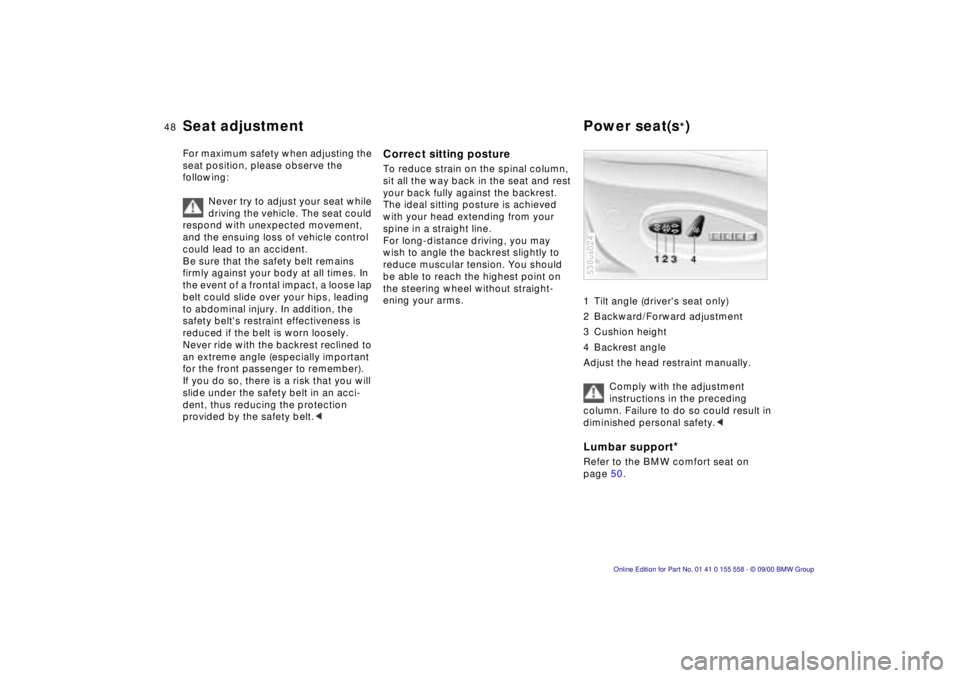
ening your arms. 1 Tilt angle (driver's seat only)
2 Backward/Forward adjustment
3 Cushion height
4 Backrest angle
Adjust the head restraint manually.
Comply with the adjustment
instructions in the preceding
column. Failure to do so could result in
diminished personal safety. <
Lumbar support*
Refer to the BMW comfort seat on
page 50.
530us024
Seat adjustment Power seat(s*)
Page 52 of 223
52nPower rear-seat backrests* Adjusting steering wheel
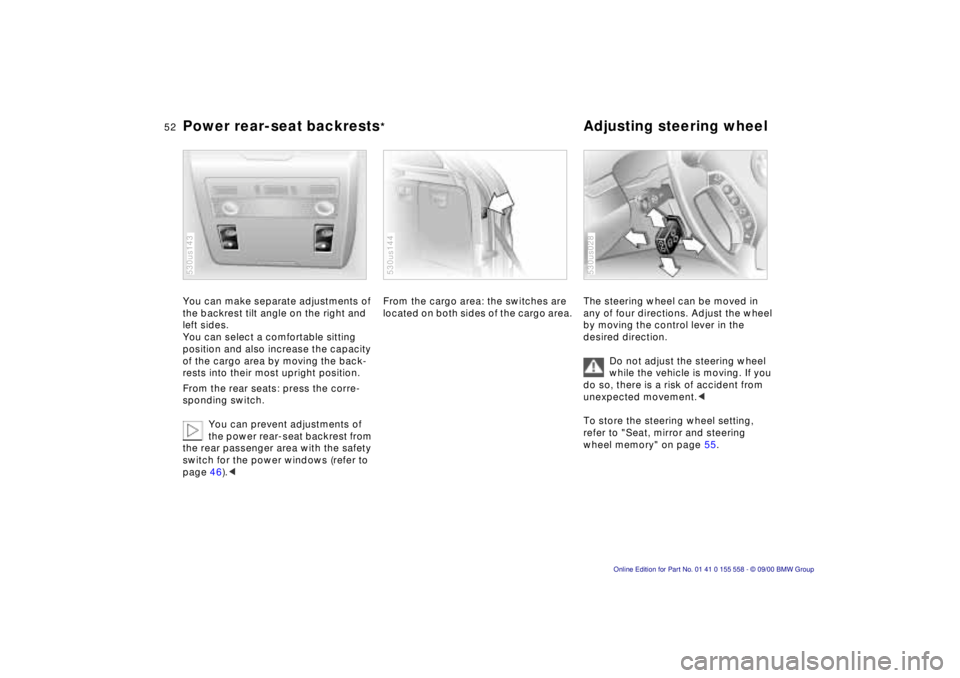
You can make separate adjustments of
the backrest tilt angle on the right and
left sides.
You can select a comfortable sitting
position and also increase the capacity
of the cargo area by moving the back-
rests into their most upright position.
From the rear seats: press the corre-
sponding switch.
You can prevent adjustments of
the power rear-seat backrest from
the rear passenger area with the safety
switch for the power windows (refer to
page 46).<
530us143
From the cargo area: the switches are
located on both sides of the cargo area.
530us144
The steering wheel can be moved in
any of four directions. Adjust the wheel
by moving the control lever in the
desired direction.
Do not adjust the steering wheel
while the vehicle is moving. If you
do so, there is a risk of accident from
unexpected movement. <
To store the steering wheel setting,
refer to "Seat, mirror and steering
wheel memory" on page 55.
530us028
Page 56 of 223
56nPersonalized memory*Car Memory, Key Memory
Your BMW center can adjust your
vehicle's systems in such a
manner that your personalized settings
are automatically called up for the seat,
mirror and steering wheel positions
when you unlock the vehicle with your
personal remote control key. <
If
you make use of the Key Memory,
be sure that the footwell behind
the driver's seat is unobstructed before
unlocking the vehicle. If you fail to do
so, persons or objects could be injured
or damaged if the seat should move
backward. <
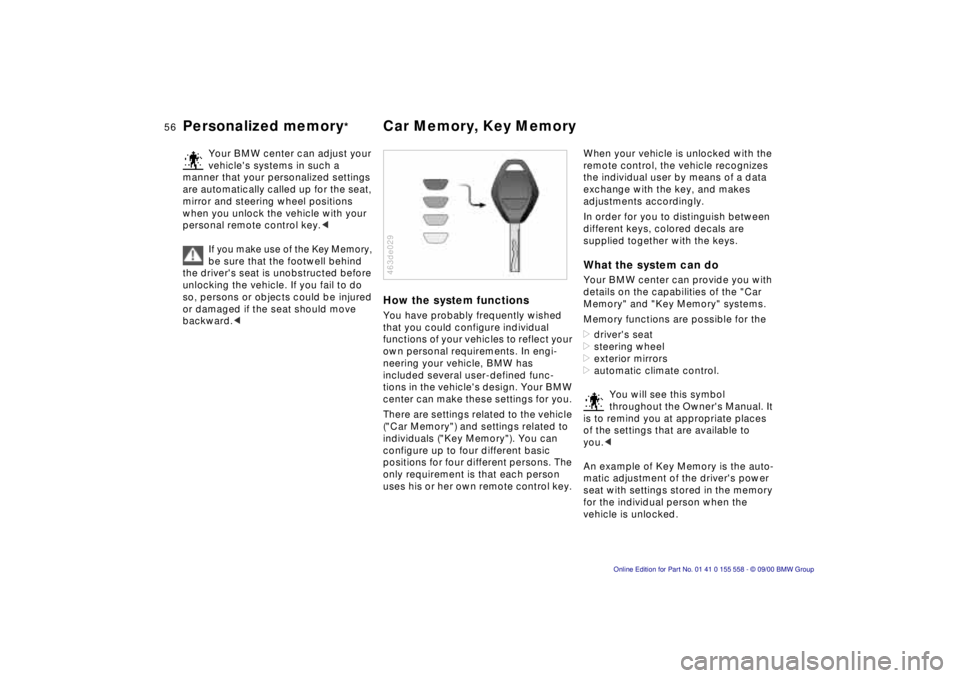
How the system functions
You have probably frequently wished
that you could configure individual
functions of your vehicles to reflect your
own personal requirements. In engi-
neering your vehicle, BMW has
included several user-defined func-
tions in the vehicle's design. Your BMW
center can make these settings for you.
There are settings related to the vehicle
("Car Memory") and settings related to
individuals ("Key Memory"). You can
configure up to four different basic
positions for four different persons. The
only requirement is that each person
uses his or her own remote control key.
463de029
When your vehicle is unlocked with the
remote control, the vehicle recognizes
the individual user by means of a data
exchange with the key, and makes
adjustments accordingly.
In order for you to distinguish between
different keys, colored decals are
supplied together with the keys.
What the system can do
Your BMW center can provide you with
details on the capabilities of the "Car
Memory" and "Key Memory" systems.
Memory functions are possible for the
> driver's seat
> steering wheel
> exterior mirrors
> automatic climate control.
You will see this symbol
throughout the Owner's Manual. It
is to remind you at appropriate places
of the settings that are available to
you. <
An example of Key Memory is the auto-
matic adjustment of the driver's power
seat with settings stored in the memory
for the individual person when the
vehicle is unlocked.
Page 133 of 223
IndexDataTechnologyRepairsCar careControlsOverview
Overview
Controls and features
Operation, care
and maintenance
Owner service procedures
Technical data
Index Advanced technology
133n
Under the hood:
Hood151
Engine compartment152
Washer fluid156
Washer nozzles156
Engine oil157
Coolant160
Brake fluid161
Vehicle Identification
Number161
Care and maintenance:
The BMW Maintenance
System162
Caring for your vehicle163
Airbags168
Vehicle storage168
Laws and regulations:
Technical modifications169
California Proposition
65 Warning169
OBD interface socket170
Car care Special operating instructions:
Break-in procedures134
Driving your BMW X5135
General driving notes136
Catalytic converter136
Antilock Brake System
(ABS)137
Disc brakes140
Brake system141
Winter operation141
Power steering143
Level control system143
Cellular phone144
Radio reception144
Wheels and tires:
Tire inflation pressure145
Tire condition145
Tire replacement146
Tire rotation147
Wheel and tire
combinations148
Special features of winter
tires149
Snow chains149
Approved wheel and tire
specifications150
Page 139 of 223
IndexDataTechnologyRepairsCar careControlsOverview
139n
Antilock Brake System (ABS) In the event of a fault
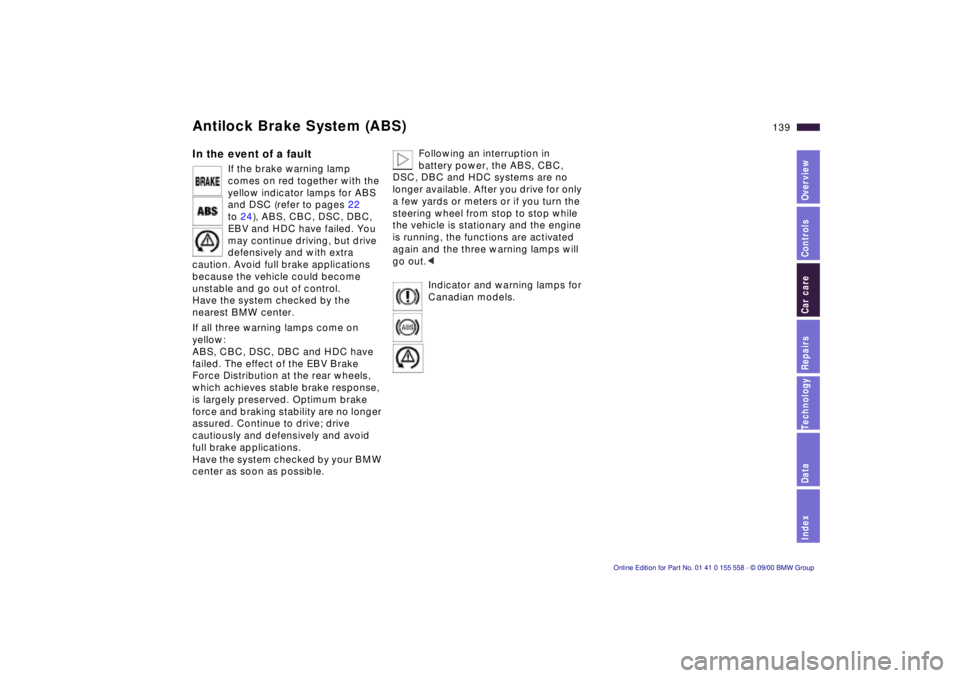
If the brake warning lamp
comes on red together with the
yellow indicator lamps for ABS
and DSC (refer to pages 22
to 24), ABS, CBC, DSC, DBC,
EBV and HDC have failed. You
may continue driving, but drive
defensively and with extra
caution. Avoid full brake applications
because the vehicle could become
unstable and go out of control.
Have the system checked by the
nearest BMW center.
If all three warning lamps come on
yellow:
ABS, CBC, DSC, DBC and HDC have
failed. The effect of the EBV Brake
Force Distribution at the rear wheels,
which achieves stable brake response,
is largely preserved. Optimum brake
force and braking stability are no longer
assured. Continue to drive; drive
cautiously and defensively and avoid
full brake applications.
Have the system checked by your BMW
center as soon as possible.
Following an interruption in
battery power, the ABS, CBC,
DSC, DBC and HDC systems are no
longer available. After you drive for only
a few yards or meters or if you turn the
steering wheel from stop to stop while
the vehicle is stationary and the engine
is running, the functions are activated
again and the three warning lamps will
go out.<
Indicator and warning lamps for
Canadian models.
Page 140 of 223

140n
Disc brakes Disc brakes furnish optimum decelera-
tion and braking control and greater
fade resistance under heavy use.
When the vehicle is driven only occa-
sionally, during extended periods when
the vehicle is not used at all, and in
operating conditions where brake appli-
cations are less frequent, there is an
increased tendency for corrosion of the
discs and accumulation of contamina-
tion on the brake pads. This occurs
because the minimal pressure which
must be exerted by the pads to clean
the discs by brake applications is not
reached.
If the brake discs are corroded, they will
tend to respond to braking with a
pulsating effect which even extended
application will fail to cure.
For your own safety: use only
brake pads that BMW has
released for your particular vehicle
model. BMW cannot evaluate non-
approved brake pads to determine if
they are suited for use, and therefore
cannot ensure the operating safety of
the vehicle if they are installed.<
Driving notes When driving in wet conditions and in
heavy rain, it is advisable to apply light
pressure to the brake pedal every few
miles (kilometers). Watch traffic condi-
tions to ensure that this maneuver does
not endanger other road users. The
heat which is generated by the brake
applications helps to dry the brake
pads and discs.
Maximum braking force is obtained
while the wheels continue to rotate,
peaking when the wheels remain on the
verge of locking without actually doing
so. ABS maintains this state automati-
cally. If the ABS fails, you should revert
to the staggered braking technique
(refer to page 142).
Extended or steep mountain descents
should be driven in the gear in which
only minimal periodic brake applica-
tions is required. This avoids excessive
strain on the brakes and possible
impairment of the braking effect.
You can further increase the engine's
braking effect by selecting a lower gear,
downshifting as far as first gear.
When driving a vehicle with automatic
transmission, you can still downshift
into first gear. Refer to page 69.If engine braking should prove to be
inadequate, you should still avoid
extended, continuous braking. Instead
of maintaining low to moderate pres-
sure over an extended period of time,
you should decelerate by applying
more substantial pressure to the brake
pedal (watch for following traffic), then
releasing the pedal, then repeating the
application. This staggered braking
technique allows the brakes to cool in
the intervals between active braking
phases, preventing overheating and
ensuring that full braking capacity
remains available at all times.
Do not coast with the clutch
depressed or with the transmis-
sion or selector lever in neutral. Do not
drive with the engine shut off. The
engine provides no braking effect when
the clutch is depressed or the transmis-
sion is in neutral, and there is no
power-assist for braking or steering
when the engine is not running.
Have brake inspections performed at
an BMW center only. If you do not,
parts of the four-wheel drive system
could be damaged. Never allow floor
mats, carpets or any other objects to
protrude into the area around the accel-
erator, clutch and brake pedals and
obstruct their movement.<