tailgate BMW X5 4.4I 2001 Owners Manual
[x] Cancel search | Manufacturer: BMW, Model Year: 2001, Model line: X5 4.4I, Model: BMW X5 4.4I 2001Pages: 223, PDF Size: 2.66 MB
Page 10 of 223

Contents
Overview
Controls and features
Cockpit 16
Instrument cluster 18
Indicator and warning lamps 22
Multifunction steering wheel 26
Sports steering wheel 27
Hazard warning flashers 28
Warning triangle 28
First-aid kit 28
Refueling 29
Fuel specifications 30
Tire inflation pressure 30
Locks and security systems:
Keys34
Electronic vehicle immobilizer 35
Central locking system 36
Opening and closing – from the outside 36
Using the key 36
Using the remote control 37
Opening and closing – from the inside 40
Liftgate 41
Tailgate 41
Alarm system 43
Electric power windows 45
Sliding/Tilt sunroof with glass moonroof 46
Adjustments:
Seats48
Steering wheel 52
Mirrors 53
Seat, mirror and steering wheel memory 55
Car Memory, Key Memory 56
Passenger safety systems:
Safety belts57
Airbags 58
Transporting children safely 61
Driving:
Steering/Ignition lock64
Starting the engine 64
Switching off the engine 65
Parking brake 66
Manual transmission 67
Automatic transmission with Steptronic 68
Turn signal indicator/Headlamp flasher 70
Washer/Wiper system 71
Rear window defroster 73
Cruise control 74
Everything under control:
Odometer, outside temperature
display 76
Tachometer 77
Energy control 77
Fuel gauge 77
Coolant temperature gauge 78
Service Interval Display 78
Check Control 79
Computer 82
Multi-Information display (MID) 84
Digital clock in the MID 85
Computer in the MID 88
Contents
Page 12 of 223

Contents
Operation, care and maintenanceOwner service proceduresAdvanced technology
Under the hood:
Hood 151
Engine compartment 152
Washer fluid 156
Washer nozzles 156
Engine oil 157
Coolant 160
Brake fluid 161
Vehicle Identification Number 161
Care and maintenance:
The BMW Maintenance
System 162
Caring for your vehicle 163
Airbags 168
Vehicle storage 168
Laws and regulations:
Technical modifications 169
California Proposition 65 Warning 169
OBD interface socket 170
Replacement procedures:
Onboard tool kit174
Windshield wiper blades 174
Lamps and bulbs 175
Changing a wheel 180
Battery 185
Fuses 187
In case of electrical
malfunction:
Fuel filler door 188
Sliding/Tilt sunroof 188
Liftgate 188
Tailgate 189
Assistance, giving and
receiving:
Jump-starting 190
Towing the vehicle 191 Airbags
196
Adaptive Transmission Control (ATC) 196
Four-wheel drive 197
Dynamic Stability Control (DSC) 197
Radio reception 198
Safety belt tensioner 198
DSP sound system 199
Rearview mirrors with automatic dimmer 199
Rain sensor 200
Front axle 200
Integrated rear suspension 201
Level control system 201
Xenon lamps 202
Page 32 of 223
32n
Locks and security systems:
Keys 34
Electronic vehicle immobilizer 35
Central locking system 36
Opening and closing – from the outside 36
Using the key 36
Using the remote control 37
Opening and closing – from the inside 40
Liftgate 41
Tailgate 41
Alarm system 43
Electric power windows 45
Sliding/Tilt sunroof with glass moonroof 46
Adjustments:
Seats 48
Steering wheel 52
Mirrors 53
Seat, mirror and steering wheel memory 55
Car Memory, Key Memory 56
Passenger safety systems:
Safety belts 57
Airbags 58
Transporting children safely 61Driving:
Steering/Ignition lock
64
Starting the engine 64
Switching off the engine 65
Parking brake 66
Manual transmission 67
Automatic transmission with Steptronic 68
Turn signal indicator/Headlamp flasher 70
Washer/Wiper system/Rain sensor 71
Rear window defroster 73
Cruise control 74
Everything under control:
Odometer, outside temperature display 76
Tachometer 77
Energy control 77
Fuel gauge 77
Coolant temperature gauge 78
Service Interval Display 78
Check Control 79
Computer 82
Multi-Information Display
(MID) 84
Digital clock in the MID 85
Computer in the MID 88
Controls
Page 36 of 223
36nCentral locking system Opening and closing – from the outside
The concept
The central locking system is ready for
operation as soon as you close the front
doors. The system engages and
releases the locks on the
>doors
> liftgate/tailgate
> fuel filler door.
The central locking system can be
operated
> from outside via the driver's door lock
as well as via the remote control.
> from inside via the button for the
central locking system.
If the system is locked from inside, the
fuel filler door remains unlocked. Refer
to page 40.
When the system is actuated from
outside of the vehicle, the anti-theft
protection is actuated simultaneously.
The alarm system is also activated or
deactivated.
In the event of an accident, the central
locking system unlocks automatically
(only those doors which were not
locked separately with the safety lock
buttons). Refer to page 40. In addition,
the hazard warning flashers and interior
lamps come on.
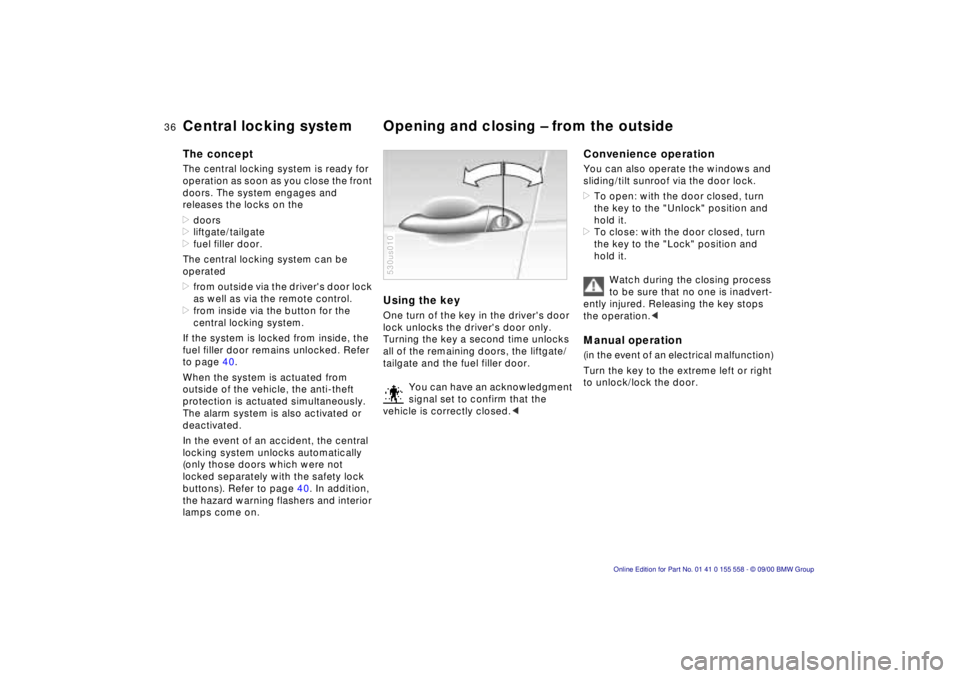
Using the key
One turn of the key in the driver's door
lock unlocks the driver's door only.
Turning the key a second time unlocks
all of the remaining doors, the liftgate/
tailgate and the fuel filler door.
You can have an acknowledgment
signal set to confirm that the
vehicle is correctly closed. <
530us010
Convenience operation
You can also operate the windows and
sliding/tilt sunroof via the door lock.
> To open: with the door closed, turn
the key to the "Unlock" position and
hold it.
> To close: with the door closed, turn
the key to the "Lock" position and
hold it.
Watch during the closing process
to be sure that no one is inadvert-
ently injured. Releasing the key stops
the operation. <
Manual operation
(in the event of an electrical malfunction)
Turn the key to the extreme left or right
to unlock/lock the door.
Page 38 of 223
38nOpening and closing – from the outside
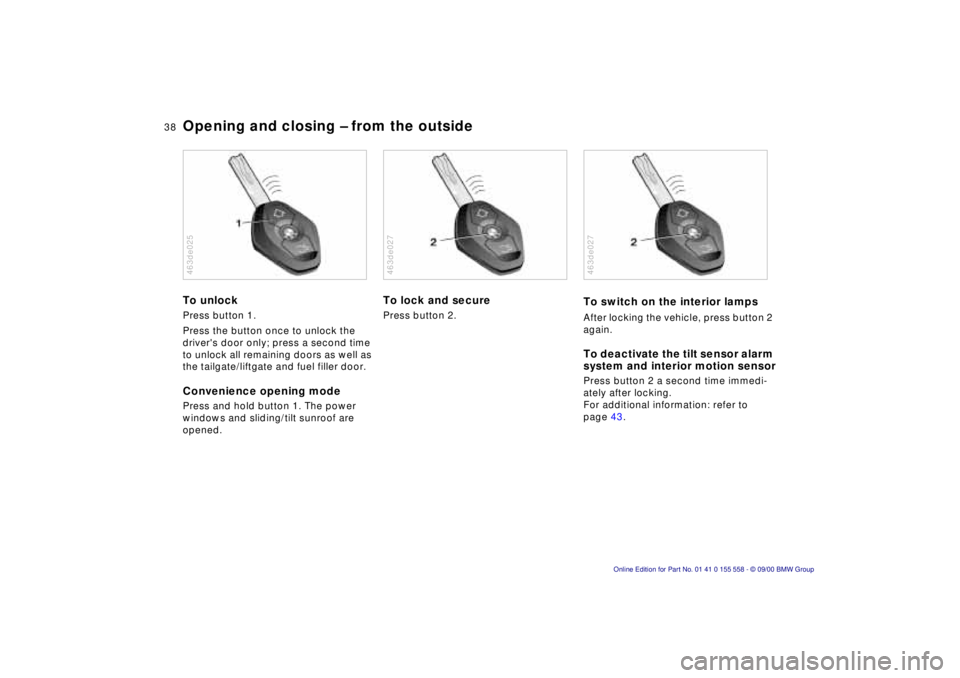
To unlock
Press button 1.
Press the button once to unlock the
driver's door only; press a second time
to unlock all remaining doors as well as
the tailgate/liftgate and fuel filler door.
Convenience opening mode
Press and hold button 1. The power
windows and sliding/tilt sunroof are
opened.
463de025
To lock and secure
Press button 2.
463de027
To switch on the interior lamps
After locking the vehicle, press button 2
again.
To deactivate the tilt sensor alarm
system and interior motion sensor
Press button 2 a second time immedi-
ately after locking.
For additional information: refer to
page 43.
463de027
Page 39 of 223
Index
Data
Technology
Repairs
Car care
Controls
Overview
39nOpening and closing – from the outside
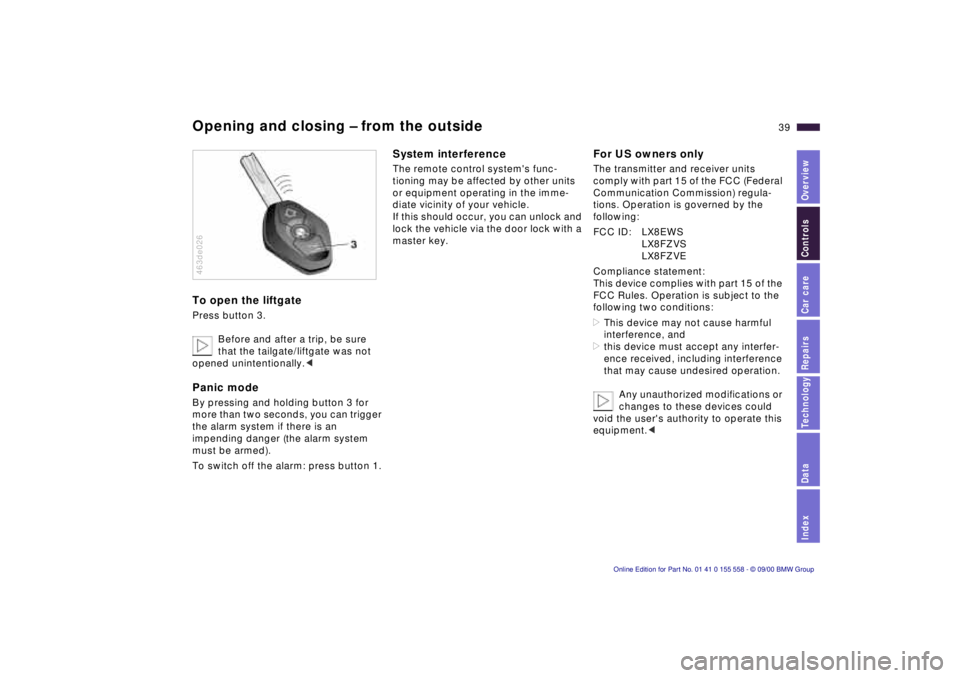
To open the liftgate
Press button 3.
Before and after a trip, be sure
that the tailgate/liftgate was not
opened unintentionally. <
Panic mode
By pressing and holding button 3 for
more than two seconds, you can trigger
the alarm system if there is an
impending danger (the alarm system
must be armed).
To switch off the alarm: press button 1.
463de026
System interference
The remote control system's func-
tioning may be affected by other units
or equipment operating in the imme-
diate vicinity of your vehicle.
If this should occur, you can unlock and
lock the vehicle via the door lock with a
master key.
For US owners only
The transmitter and receiver units
comply with part 15 of the FCC (Federal
Communication Commission) regula-
tions. Operation is governed by the
following:
FCC ID: LX8EWS
LX8FZVS
LX8FZVE
Compliance statement:
This device complies with part 15 of the
FCC Rules. Operation is subject to the
following two conditions:
> This device may not cause harmful
interference, and
> this device must accept any interfer-
ence received, including interference
that may cause undesired operation.
Any unauthorized modifications or
changes to these devices could
void the user's authority to operate this
equipment. <
Page 40 of 223
40nOpening and closing – from the inside
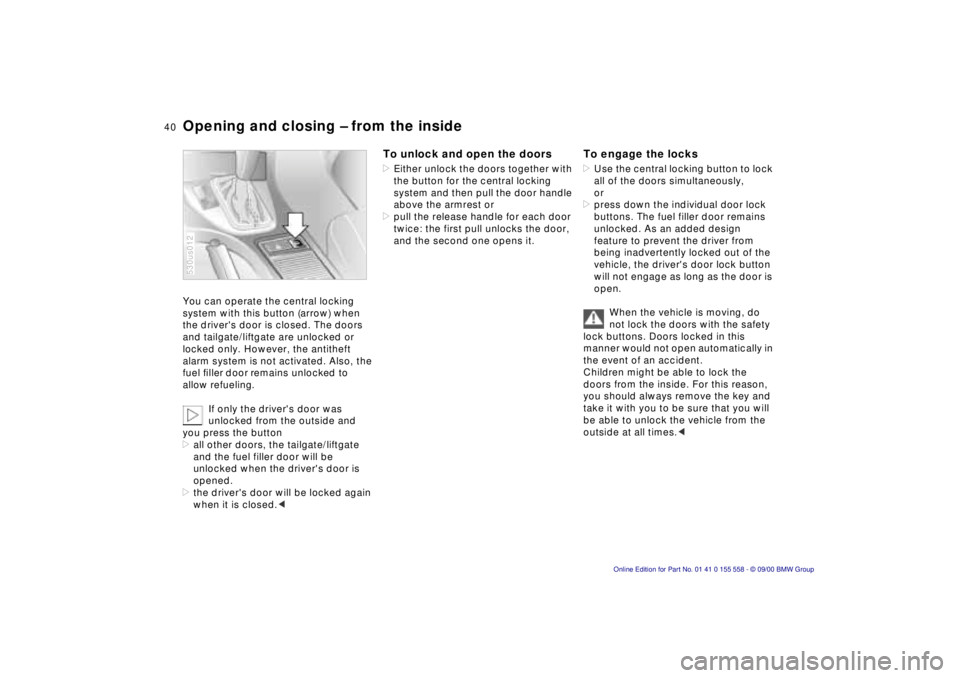
You can operate the central locking
system with this button (arrow) when
the driver's door is closed. The doors
and tailgate/liftgate are unlocked or
locked only. However, the antitheft
alarm system is not activated. Also, the
fuel filler door remains unlocked to
allow refueling.
If only the driver's door was
unlocked from the outside and
you press the button
> all other doors, the tailgate/liftgate
and the fuel filler door will be
unlocked when the driver's door is
opened.
> the driver's door will be locked again
when it is closed. <
530us012
To unlock and open the doors
> Either unlock the doors together with
the button for the central locking
system and then pull the door handle
above the armrest or
> pull the release handle for each door
twice: the first pull unlocks the door,
and the second one opens it.
To engage the locks
> Use the central locking button to lock
all of the doors simultaneously,
or
> press down the individual door lock
buttons. The fuel filler door remains
unlocked. As an added design
feature to prevent the driver from
being inadvertently locked out of the
vehicle, the driver's door lock button
will not engage as long as the door is
open.
When the vehicle is moving, do
not lock the doors with the safety
lock buttons. Doors locked in this
manner would not open automatically in
the event of an accident.
Children might be able to lock the
doors from the inside. For this reason,
you should always remove the key and
take it with you to be sure that you will
be able to unlock the vehicle from the
outside at all times. <
Page 41 of 223
Index
Data
Technology
Repairs
Car care
Controls
Overview
41nLiftgate Tailgate
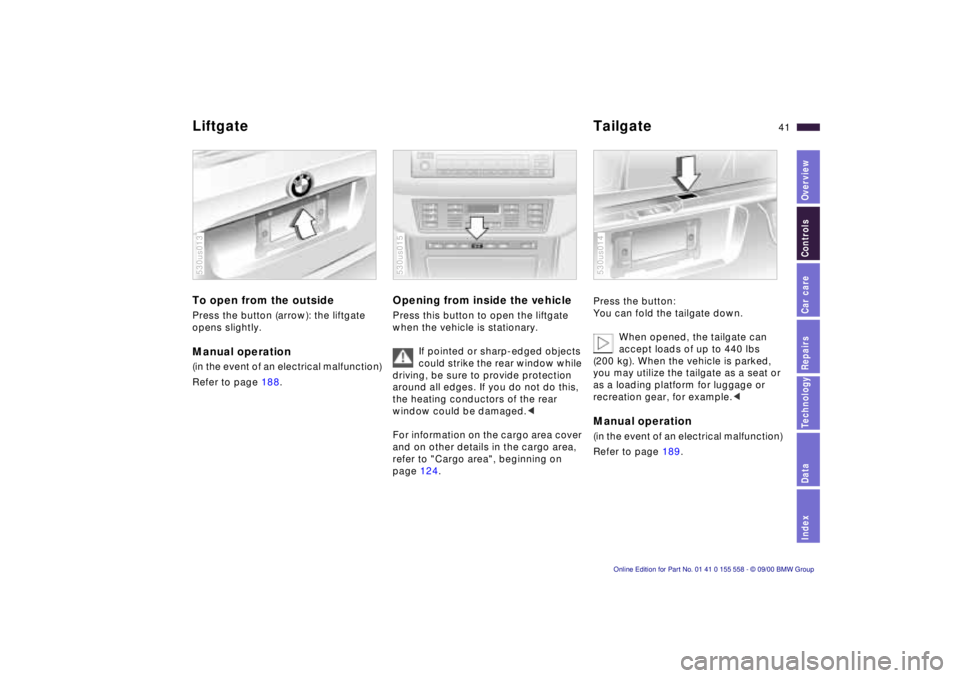
To open from the outside
Press the button (arrow): the liftgate
opens slightly.
Manual operation
(in the event of an electrical malfunction)
Refer to page 188.
530us013
Opening from inside the vehicle
Press this button to open the liftgate
when the vehicle is stationary.
If pointed or sharp-edged objects
could strike the rear window while
driving, be sure to provide protection
around all edges. If you do not do this,
the heating conductors of the rear
window could be damaged. <
For information on the cargo area cover
and on other details in the cargo area,
refer to "Cargo area", beginning on
page 124.
530us015
Press the button:
You can fold the tailgate down.
When opened, the tailgate can
accept loads of up to 440 lbs
(200 kg). When the vehicle is parked,
you may utilize the tailgate as a seat or
as a loading platform for luggage or
recreation gear, for example. <
Manual operation
(in the event of an electrical malfunction)
Refer to page 189.
530us014
Page 79 of 223
Index
Data
Technology
Repairs
Car care
Controls
Overview
79nCheck Control
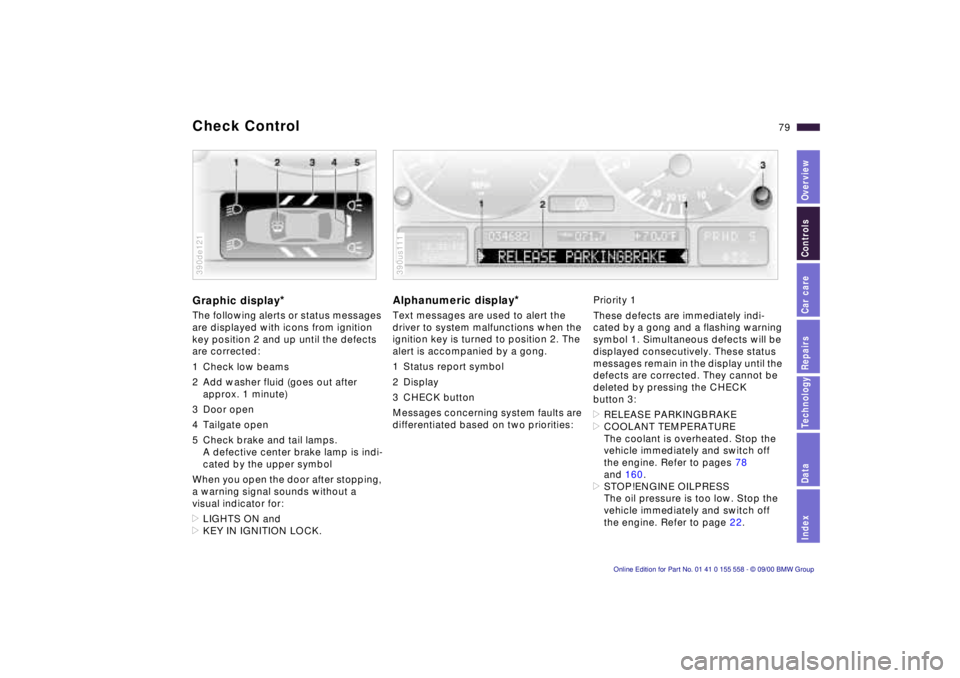
Graphic display*
The following alerts or status messages
are displayed with icons from ignition
key position 2 and up until the defects
are corrected:
1 Check low beams
2 Add washer fluid (goes out after
approx. 1 minute)
3 Door open
4 Tailgate open
5 Check brake and tail lamps. A defective center brake lamp is indi-
cated by the upper symbol
When you open the door after stopping,
a warning signal sounds without a
visual indicator for:
> LIGHTS ON and
> KEY IN IGNITION LOCK.
390de121
Alphanumeric display*
Text messages are used to alert the
driver to system malfunctions when the
ignition key is turned to position 2. The
alert is accompanied by a gong.
1 Status report symbol
2 Display
3 CHECK button
Messages concerning system faults are
differentiated based on two priorities:
390us111
Priority 1
These defects are immediately indi-
cated by a gong and a flashing warning
symbol 1. Simultaneous defects will be
displayed consecutively. These status
messages remain in the display until the
defects are corrected. They cannot be
deleted by pressing the CHECK
button 3:
> RELEASE PARKINGBRAKE
> COOLANT TEMPERATURE
The coolant is overheated. Stop the
vehicle immediately and switch off
the engine. Refer to pages 78
and 160.
> STOP!ENGINE OILPRESS
The oil pressure is too low. Stop the
vehicle immediately and switch off
the engine. Refer to page 22.
Page 142 of 223

142n
Winter operation Rubber seals and components In order to prevent the weather-strip-
ping from freezing, apply BMW rubber
treatment or silicone spray to the seals
on the doors, hood and liftgate/tailgate.
A full range of car care products is
available from your BMW center.< Snow chains Mount BMW snow chains
* only on tire
size 235/65 R 17. Always mount chains
in pairs and on the rear wheels only.
Read and comply with the chain manu-
facturer's safety precautions. Do not
exceed a maximum speed of 30 mph
(50 km/h).
Starting offWhen starting in deep snow or
"rocking" the vehicle free, it may be
advisable to deactivate the DSC system
briefly. Refer to page 94.
Driving on low-traction road
surfaces Use smooth, gentle pressure to control
the accelerator pedal. Avoid excessive
engine speeds and shift to the next
higher gear at an early point. Also shift
to the next lower gear at an early point
when approaching grades or slopes.
Maintain an adequate distance
between yourself and the car ahead. BrakingWinter road conditions substantially
reduce the amount of traction available
between the tires and the road surface.
The resulting increases in braking
distance are considerable and should
be kept in mind at all times.
ABS is intended to prevent the wheels
from locking during brake applications,
thus helping to maintain vehicle stability
and steering response. If the ABS does not respond in a critical
braking situation and the wheels lock:
Reduce the pressure on the brake
pedal until the wheels just start to roll
again while still maintaining enough
force to continue braking. Following
that, increase pedal pressure again.
Reduce the pressure as the wheels
lock, then reapply pressure. Repeat this
braking sequence.
This type of staggered braking will
reduce the braking distance, and the
vehicle still remains responsive to
steering.
You can then attempt to steer around
hazards after you have reduced pres-
sure on the brake pedal.
Do not shift down on slick road
surfaces if you want to decelerate.
Doing so could cause the wheels to
lose traction and skid, thus resulting in
the loss of vehicle control.<
Depress the clutch during hard
braking on road surfaces that
provide only poor or uneven traction.<