steering BMW X5 4.4I 2002 Owner's Manual
[x] Cancel search | Manufacturer: BMW, Model Year: 2002, Model line: X5 4.4I, Model: BMW X5 4.4I 2002Pages: 185, PDF Size: 2.7 MB
Page 135 of 185

135n
OverviewControlsMaintenanceRepairsDataIndex
Brake system Brake fluid levelIf the brake fluid level is too low and
brake pedal travel has become longer,
there may be a defect in one of the two
brake system's hydraulic circuits.
Proceed to the nearest
BMW Sports Activity Vehicle
center. Here increased pressure on the
brake pedal may be required, and slight
pulling to the side and longer braking
distances may result. Please remember
to adapt your driving style accord-
ingly.<
Disc brakesWhen the vehicle is driven only occa-
sionally, during extended periods when
the vehicle is not used at all, and in
operating conditions where brake appli-
cations are less frequent, there is an
increased tendency for corrosion of the
rotors and accumulation of contamina-
tion on the brake pads. This occurs
because the minimal pressure which
must be exerted by the pads to clean
the discs by brake applications is not
reached.
If the brake rotors are corroded, they
will tend to respond to braking with a
pulsating effect which even extended
application will fail to cure.
When driving in wet conditions and in
heavy rain, it is advisable to apply light
pressure to the brake pedal from time
to time. Watch traffic conditions to
ensure that this maneuver does not
endanger other road users. The heat
which is generated by the brake appli-
cations helps to dry the brake pads and
rotors. The braking force is then imme-
diately available when required.
Extended or steep mountain descents
should be driven in the gear in which
only minimal periodic brake application
is required. This avoids excessive strain on the brakes and possible impairment
of the braking effect.
Do not coast with the clutch
depressed or with the transmis-
sion or selector lever in neutral. Do not
drive with the engine switched off. The
engine provides no braking effect when
the clutch is depressed or the transmis-
sion is in neutral, and there is no
power-assist for braking or steering
when the engine is not running.
Have brake inspections performed at a
BMW Sports Activity Vehicle center
only. If you do not, parts of the four-
wheel drive system could be damaged.
Never allow floor mats, carpets or any
other objects to protrude into the area
around the accelerator, clutch and
brake pedals and obstruct their move-
ment.<
Brake pads
For your own safety: use only
brake pads that BMW has
released for your particular vehicle
model. BMW cannot evaluate non-
approved brake pads to determine if
they are suited for use, and therefore
cannot ensure the operating safety of
the vehicle if they are installed.<
Page 136 of 185
136n
Information for your safety The factory-approved radial tires are
matched to the vehicle and have been
selected to provide optimum safety and
driving comfort on your vehicle.
It is not merely the tire's service life, but
also driving comfort and Ð above all else
Ð driving safety which depend on the
condition of the tires and the mainte-
nance of the specified tire pressure.
Incorrect inflation pressure is a frequent
cause of tire damage. It also signifi-
cantly influences the roadholding ability
of your BMW.
Check tire inflation pressures Ð
including the spare wheel Ð regu-
larly (refer to page 26), at least every
two weeks and before beginning a
longer trip. If this is not done, incorrect
tire pressures can cause driving insta-
bility and tire damage, ultimately
resulting in an accident.<
Tire tread Ð Tire damage Inspect your tires frequently for tread
wear, signs of damage and for foreign
objects lodged in the tread. Check the
tread pattern depth.
Tread depth should not be allowed to
go below 0.12 in (3 mm), even though
the legally specified minimum tread
depth is 0.063 in (1.6 mm). Tread wear
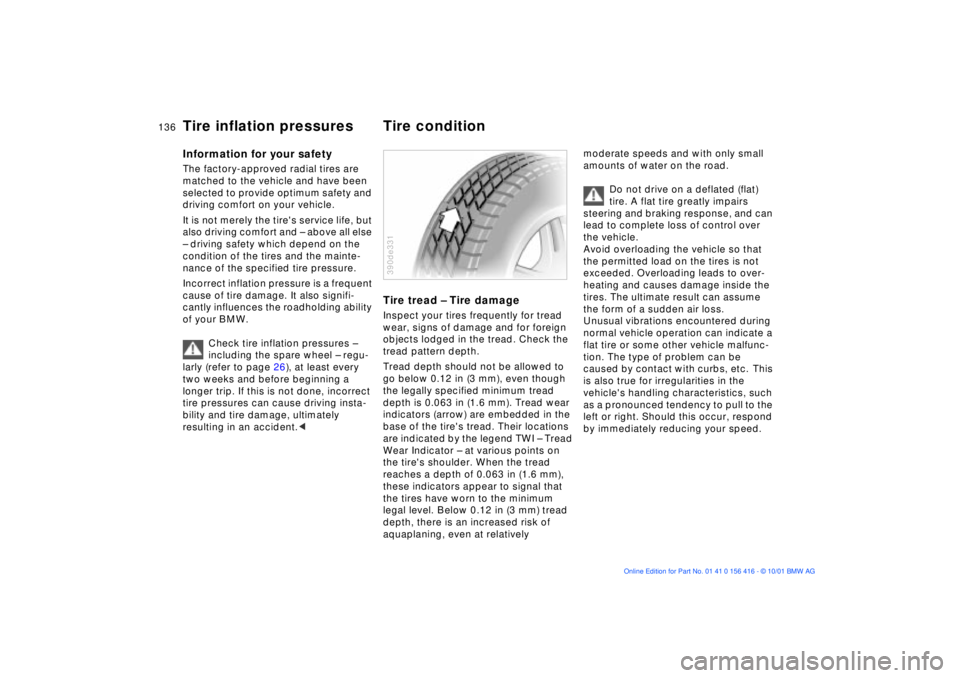
indicators (arrow) are embedded in the
base of the tire's tread. Their locations
are indicated by the legend TWI Ð Tread
Wear Indicator Ð at various points on
the tire's shoulder. When the tread
reaches a depth of 0.063 in (1.6 mm),
these indicators appear to signal that
the tires have worn to the minimum
legal level. Below 0.12 in (3 mm) tread
depth, there is an increased risk of
aquaplaning, even at relatively 390de331
moderate speeds and with only small
amounts of water on the road.
Do not drive on a deflated (flat)
tire. A flat tire greatly impairs
steering and braking response, and can
lead to complete loss of control over
the vehicle.
Avoid overloading the vehicle so that
the permitted load on the tires is not
exceeded. Overloading leads to over-
heating and causes damage inside the
tires. The ultimate result can assume
the form of a sudden air loss.
Unusual vibrations encountered during
normal vehicle operation can indicate a
flat tire or some other vehicle malfunc-
tion. The type of problem can be
caused by contact with curbs, etc. This
is also true for irregularities in the
vehicle's handling characteristics, such
as a pronounced tendency to pull to the
left or right. Should this occur, respond
by immediately reducing your speed.
Tire inflation pressures Tire condition
Page 140 of 185

140n
Winter tires Snow chains
*
Choosing the right tire BMW recommends winter tires (M+S
radial tires) for operation under
inclement winter driving conditions.
While so-called all-season tires (M+S
designation) provide better winter trac-
tion than summer tires with the load
ratings H, V, W, Y and ZR, they gener-
ally do not achieve the performance of
winter tires.
In the interests of safe tracking and
steering response, install radial tires
made by the same manufacturer and
with the same tread configuration on all
four wheels if you elect to mount winter
tires.
Do not exceed specified
maximum speeds
Never exceed the maximum speed
for which the tires are rated.
Unprofessional attempts by laymen to
service tires can lead to damage and
accidents.
Have this work performed by skilled
professionals only. Your BMW Sports
Activity Vehicle center will be glad to
assist you with both their expertise and
the proper equipment for your vehicle.<
Tire condition, tire pressureWinter tires display a perceptible loss in
their ability to cope with winter driving
conditions once the tread wears to
below 0.16 in (4 mm), and should thus
be replaced.
Comply with the specified tire inflation
pressures Ñ and be sure to have the
wheel and tire assemblies balanced
every time you change the tires.
The use of narrow-link BMW snow
chains is approved only in pairs on the
rear wheels and only with tire size
235/65 R 17. Comply with all manufac-
turer's safety precautions when
mounting the chains. Do not exceed a
maximum speed of 30 mph (50 km/h).
Page 144 of 185
144n
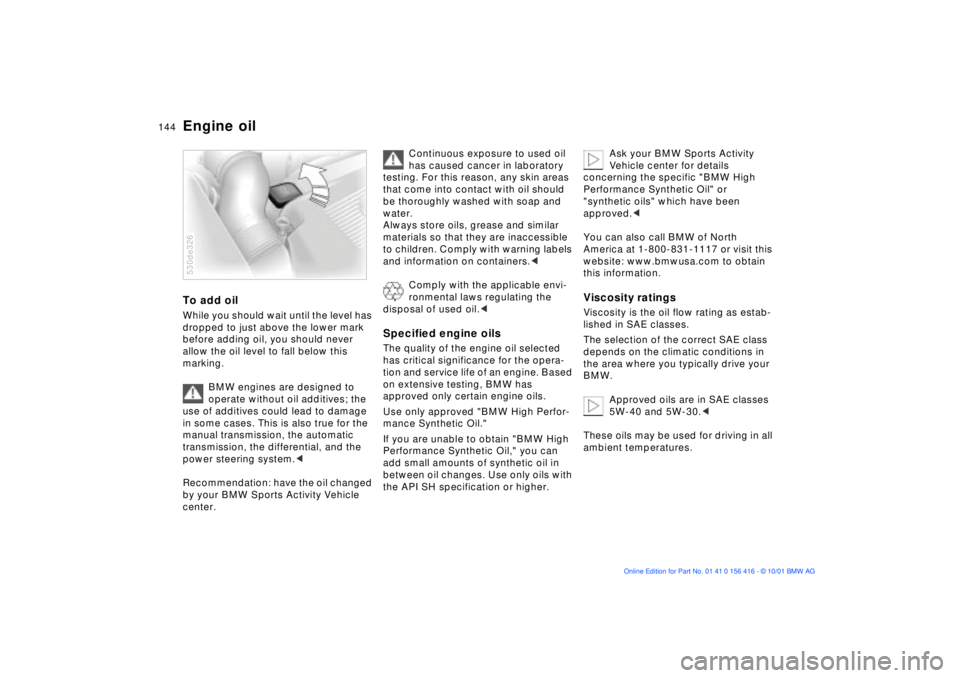
Engine oil To add oilWhile you should wait until the level has
dropped to just above the lower mark
before adding oil, you should never
allow the oil level to fall below this
marking.
BMW engines are designed to
operate without oil additives; the
use of additives could lead to damage
in some cases. This is also true for the
manual transmission, the automatic
transmission, the differential, and the
power steering system.<
Recommendation: have the oil changed
by your BMW Sports Activity Vehicle
center. 530de326
Continuous exposure to used oil
has caused cancer in laboratory
testing. For this reason, any skin areas
that come into contact with oil should
be thoroughly washed with soap and
water.
Always store oils, grease and similar
materials so that they are inaccessible
to children. Comply with warning labels
and information on containers.<
Comply with the applicable envi-
ronmental laws regulating the
disposal of used oil.<
Specified engine oils The quality of the engine oil selected
has critical significance for the opera-
tion and service life of an engine. Based
on extensive testing, BMW has
approved only certain engine oils.
Use only approved "BMW High Perfor-
mance Synthetic Oil."
If you are unable to obtain "BMW High
Performance Synthetic Oil," you can
add small amounts of synthetic oil in
between oil changes. Use only oils with
the API SH specification or higher.
Ask your BMW Sports Activity
Vehicle center for details
concerning the specific "BMW High
Performance Synthetic Oil" or
"synthetic oils" which have been
approved.<
You can also call BMW of North
America at 1-800-831-1117 or visit this
website: www.bmwusa.com to obtain
this information.
Viscosity ratings Viscosity is the oil flow rating as estab-
lished in SAE classes.
The selection of the correct SAE class
depends on the climatic conditions in
the area where you typically drive your
BMW.
Approved oils are in SAE classes
5W-40 and 5W-30.<
These oils may be used for driving in all
ambient temperatures.
Page 156 of 185
156n
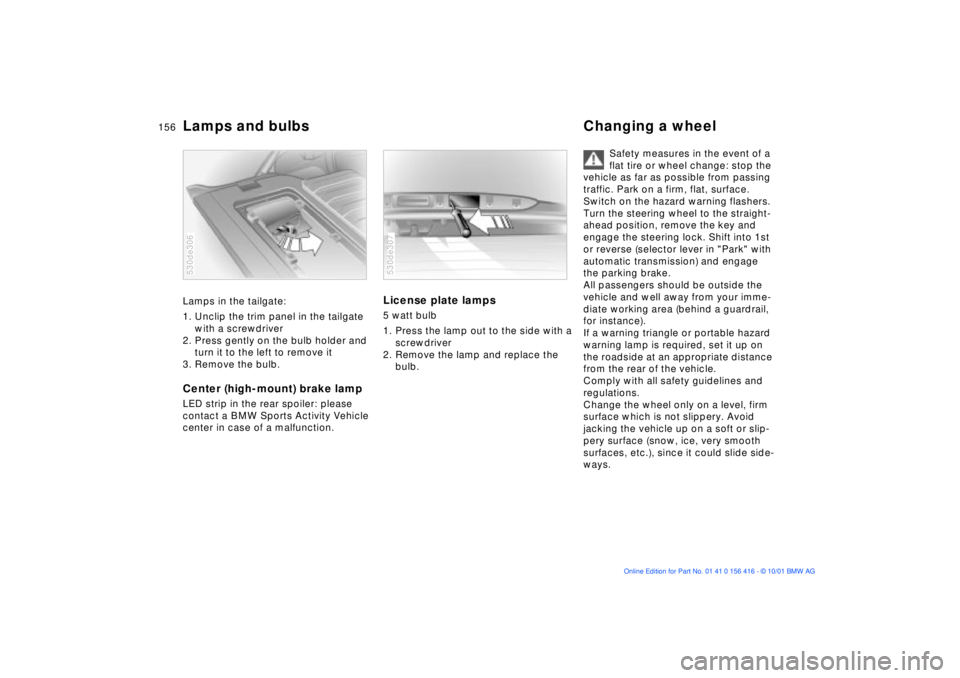
Lamps and bulbs Changing a wheel Lamps in the tailgate:
1. Unclip the trim panel in the tailgate
with a screwdriver
2. Press gently on the bulb holder and
turn it to the left to remove it
3. Remove the bulb. Center (high-mount) brake lamp LED strip in the rear spoiler: please
contact a BMW Sports Activity Vehicle
center in case of a malfunction. 530de306
License plate lamps 5 watt bulb
1. Press the lamp out to the side with a
screwdriver
2. Remove the lamp and replace the
bulb. 530de307
Safety measures in the event of a
flat tire or wheel change: stop the
vehicle as far as possible from passing
traffic. Park on a firm, flat, surface.
Switch on the hazard warning flashers.
Turn the steering wheel to the straight-
ahead position, remove the key and
engage the steering lock. Shift into 1st
or reverse (selector lever in "Park" with
automatic transmission) and engage
the parking brake.
All passengers should be outside the
vehicle and well away from your imme-
diate working area (behind a guardrail,
for instance).
If a warning triangle or portable hazard
warning lamp is required, set it up on
the roadside at an appropriate distance
from the rear of the vehicle.
Comply with all safety guidelines and
regulations.
Change the wheel only on a level, firm
surface which is not slippery. Avoid
jacking the vehicle up on a soft or slip-
pery surface (snow, ice, very smooth
surfaces, etc.), since it could slide side-
ways.
Page 167 of 185
167n
OverviewControlsMaintenanceRepairsDataIndex
Towing the vehicle Towing a vehicle with automatic
transmission1. Place the selector lever in position N
2. Towing speed:
Max. 45 mph (70 km/h)
3. Towing distance:
Max. 95 miles (150 km)
4. Leave the ignition key at position 1 to
ensure that the brake lamps, turn
signals, horn and windshield wipers
remain operative, and to prevent the
steering lock from engaging
5. Switch on the hazard warning
flashers (comply with country-
specific regulations).
Find some means of identifying the
vehicle in tow, for instance, place a sign
or warning triangle in the rear window.
Make sure that the ignition key
remains in position 1 even when
the electrical system has failed. This will
prevent the steering lock from
engaging. The steering and brakes are
without power assist when the engine is
not running. This means that increased
effort is required for steering and
braking.<
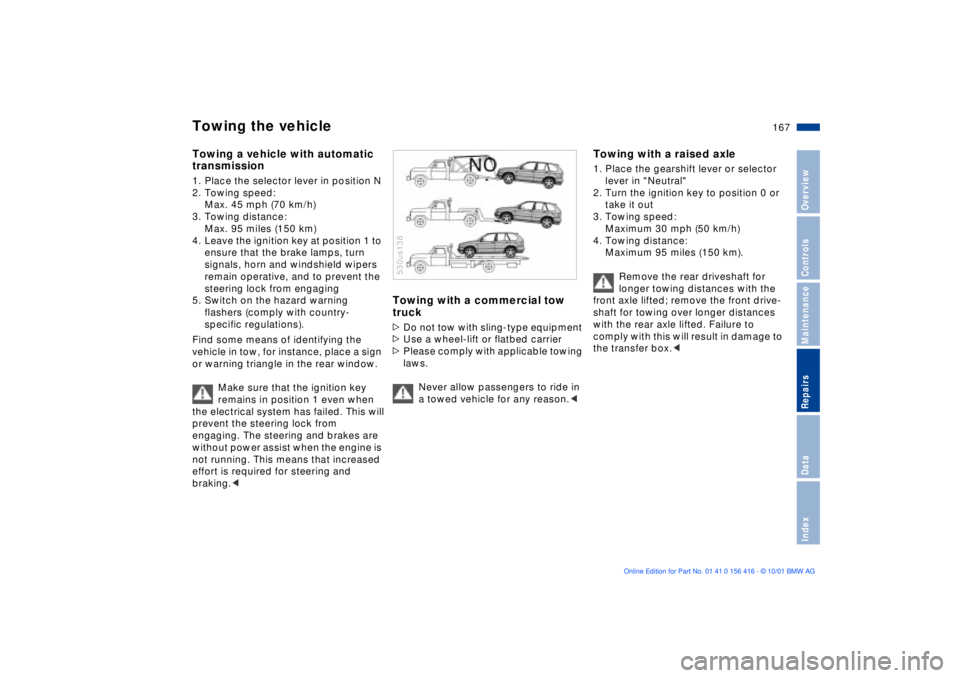
Towing with a commercial tow
truck >Do not tow with sling-type equipment
>Use a wheel-lift or flatbed carrier
>Please comply with applicable towing
laws.
Never allow passengers to ride in
a towed vehicle for any reason.< 530us138
Towing with a raised axle 1. Place the gearshift lever or selector
lever in "Neutral"
2. Turn the ignition key to position 0 or
take it out
3. Towing speed:
Maximum 30 mph (50 km/h)
4. Towing distance:
Maximum 95 miles (150 km).
Remove the rear driveshaft for
longer towing distances with the
front axle lifted; remove the front drive-
shaft for towing over longer distances
with the rear axle lifted. Failure to
comply with this will result in damage to
the transfer box.<
Page 176 of 185

Everything from A to ZAABS (Antilock Brake
System)19, 134
Accessories10
Activated-charcoal
filter111
Adaptive brake light99
Adding
brake fluid146t
coolant145t
engine oil143t
washer fluid143t
Adjusting
head restraints47
mirrors53
seats44
steering wheel52
thigh support45
Air conditioner103
Air distribution104, 108
Air outlets103, 106
Air supply104, 108
Airbags19, 55
Alarm system39
Antifreeze145
Antilock Brake System
(ABS)19, 134
Anti-theft system32
Approved gross vehicle
weight172
Aquaplaning134, 136Arrival time88
Ashtray
front118
rear119
AUC (Automatic
recirculated-air
control)109
Automatic climate
control106
removing condensation
from the windows108
Automatic cruise control71
Automatic curb monitor51
Automatic dimming
exterior rearview
mirrors54
interior rearview mirror54
Automatic headlight
control100
Automatic recirculated-air
control (AUC)109
Automatic steering wheel
adjustment52
Automatic transmission with
Steptronic66
Average fuel
consumption80
Average speed80, 89
Avoiding unintentional
alarms40t
Axle loads172
BBackup lamps65
bulb replacement155t
Battery162
charge162
discharged164t
Battery charge indicator
lamp18
Belts49
Beverage holder117
Blower104, 108
BMW comfort seat46
BMW High Performance
Synthetic Oil144
BMW Maintenance
System147
BMW sports seat45
BMW Universal
Transmitter113
Brake fluid146
Brake lamps
bulb replacement155t
Brake light, adaptive99
Brake system135
brake fluid146
brake fluid level135
brake pads indicator20
disc brakes135
hydraulic system
indicator18
malfunctions135tBreak-in procedures132
Bulbs and lamps153
CCalifornia Proposition
65 Warning148
Can holder, refer to
beverage holder117
Capacities173
Car care, refer to the "Caring
for your vehicle" manual
Car wash systems, refer to
the "Caring for your
vehicle" manual
Care of upholstery materials,
refer to the "Caring for your
vehicle" manual
Cargo area38, 122
capacity172
cover122
lamps102
Cargo floor, pull-out126
Cargo loading127
Cellular phone117
Center (high-mount) brake
lamp156
Central locking system30
button35
Changing a wheel157t
CHECK button77
Page 178 of 185
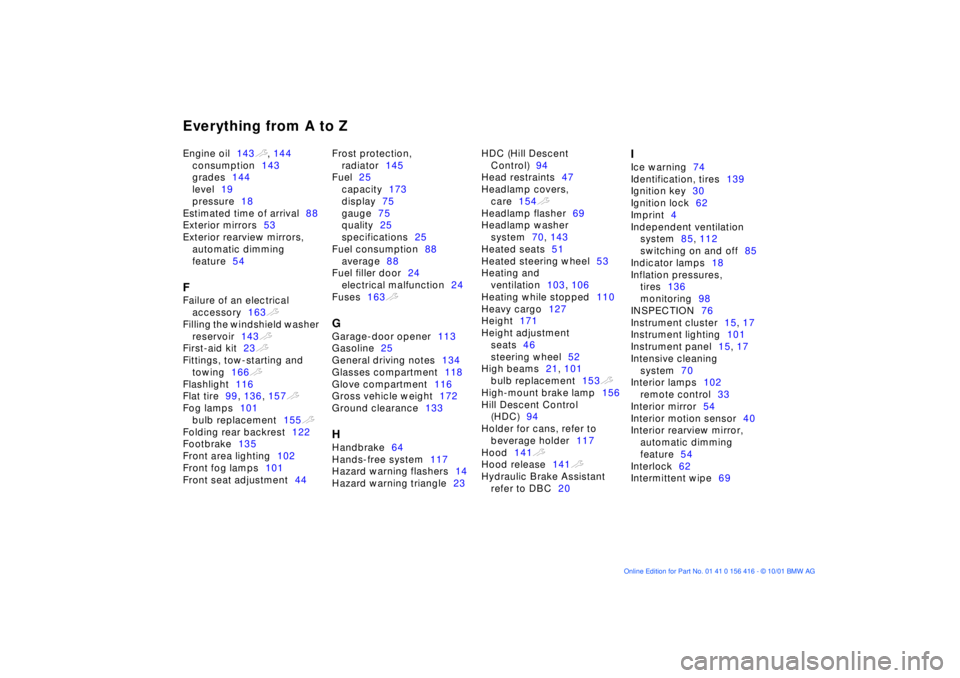
Everything from A to ZEngine oil143t, 144
consumption143
grades144
level19
pressure18
Estimated time of arrival88
Exterior mirrors53
Exterior rearview mirrors,
automatic dimming
feature54FFailure of an electrical
accessory163t
Filling the windshield washer
reservoir143t
First-aid kit23t
Fittings, tow-starting and
towing166t
Flashlight116
Flat tire99, 136, 157t
Fog lamps101
bulb replacement155t
Folding rear backrest122
Footbrake135
Front area lighting102
Front fog lamps101
Front seat adjustment44Frost protection,
radiator145
Fuel25
capacity173
display75
gauge75
quality25
specifications25
Fuel consumption88
average88
Fuel filler door24
electrical malfunction24
Fuses163t
GGarage-door opener113
Gasoline25
General driving notes134
Glasses compartment118
Glove compartment116
Gross vehicle weight172
Ground clearance133HHandbrake64
Hands-free system117
Hazard warning flashers14
Hazard warning triangle23HDC (Hill Descent
Control)94
Head restraints47
Headlamp covers,
care154t
Headlamp flasher69
Headlamp washer
system70, 143
Heated seats51
Heated steering wheel53
Heating and
ventilation103, 106
Heating while stopped110
Heavy cargo127
Height171
Height adjustment
seats46
steering wheel52
High beams21, 101
bulb replacement153t
High-mount brake lamp156
Hill Descent Control
(HDC)94
Holder for cans, refer to
beverage holder117
Hood141t
Hood release141t
Hydraulic Brake Assistant
refer to DBC20
IIce warning74
Identification, tires139
Ignition key30
Ignition lock62
Imprint4
Independent ventilation
system85, 112
switching on and off85
Indicator lamps18
Inflation pressures,
tires136
monitoring98
INSPECTION76
Instrument cluster15, 17
Instrument lighting101
Instrument panel15, 17
Intensive cleaning
system70
Interior lamps102
remote control33
Interior mirror54
Interior motion sensor40
Interior rearview mirror,
automatic dimming
feature54
Interlock62
Intermittent wipe69
Page 179 of 185
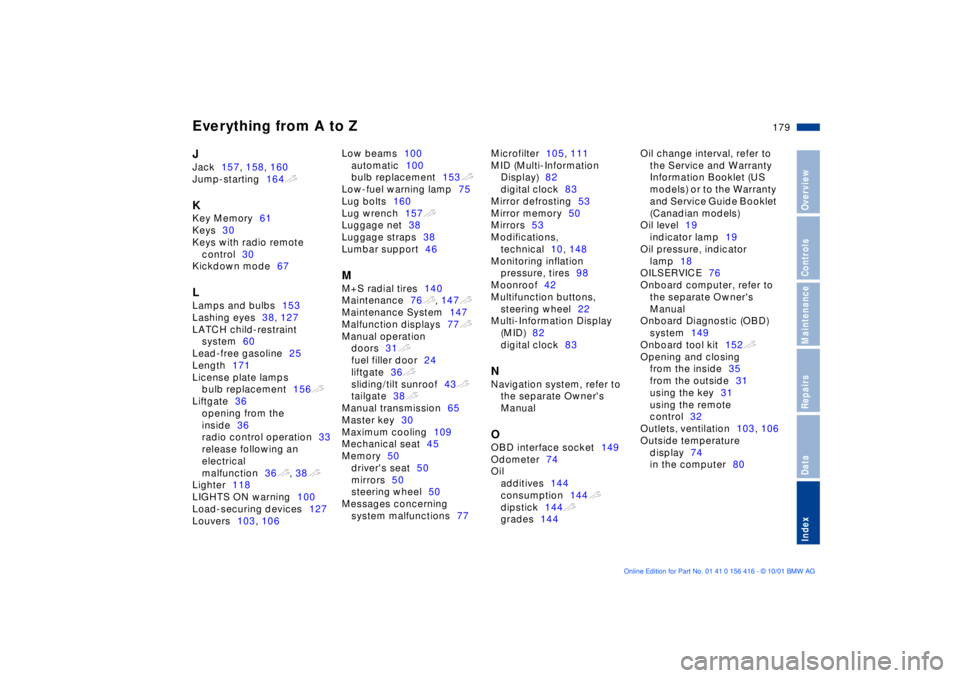
Everything from A to Z
179n
OverviewControlsMaintenanceRepairsDataIndex
JJack157, 158, 160
Jump-starting164tKKey Memory61
Keys30
Keys with radio remote
control30
Kickdown mode67LLamps and bulbs153
Lashing eyes38, 127
LATCH child-restraint
system60
Lead-free gasoline25
Length171
License plate lamps
bulb replacement156t
Liftgate36
opening from the
inside36
radio control operation33
release following an
electrical
malfunction36t, 38t
Lighter118
LIGHTS ON warning100
Load-securing devices127
Louvers103, 106Low beams100
automatic100
bulb replacement153t
Low-fuel warning lamp75
Lug bolts160
Lug wrench157t
Luggage net38
Luggage straps38
Lumbar support46
MM+S radial tires140
Maintenance76t, 147t
Maintenance System147
Malfunction displays77t
Manual operation
doors31t
fuel filler door24
liftgate36t
sliding/tilt sunroof43t
tailgate38t
Manual transmission65
Master key30
Maximum cooling109
Mechanical seat45
Memory50
driver's seat50
mirrors50
steering wheel50
Messages concerning
system malfunctions77Microfilter105, 111
MID (Multi-Information
Display)82
digital clock83
Mirror defrosting53
Mirror memory50
Mirrors53
Modifications,
technical10, 148
Monitoring inflation
pressure, tires98
Moonroof42
Multifunction buttons,
steering wheel22
Multi-Information Display
(MID)82
digital clock83
NNavigation system, refer to
the separate Owner's
ManualOOBD interface socket149
Odometer74
Oil
additives144
consumption144t
dipstick144t
grades144Oil change interval, refer to
the Service and Warranty
Information Booklet (US
models) or to the Warranty
and Service Guide Booklet
(Canadian models)
Oil level19
indicator lamp19
Oil pressure, indicator
lamp18
OILSERVICE76
Onboard computer, refer to
the separate Owner's
Manual
Onboard Diagnostic (OBD)
system149
Onboard tool kit152t
Opening and closing
from the inside35
from the outside31
using the key31
using the remote
control32
Outlets, ventilation103, 106
Outside temperature
display74
in the computer80
Page 180 of 185
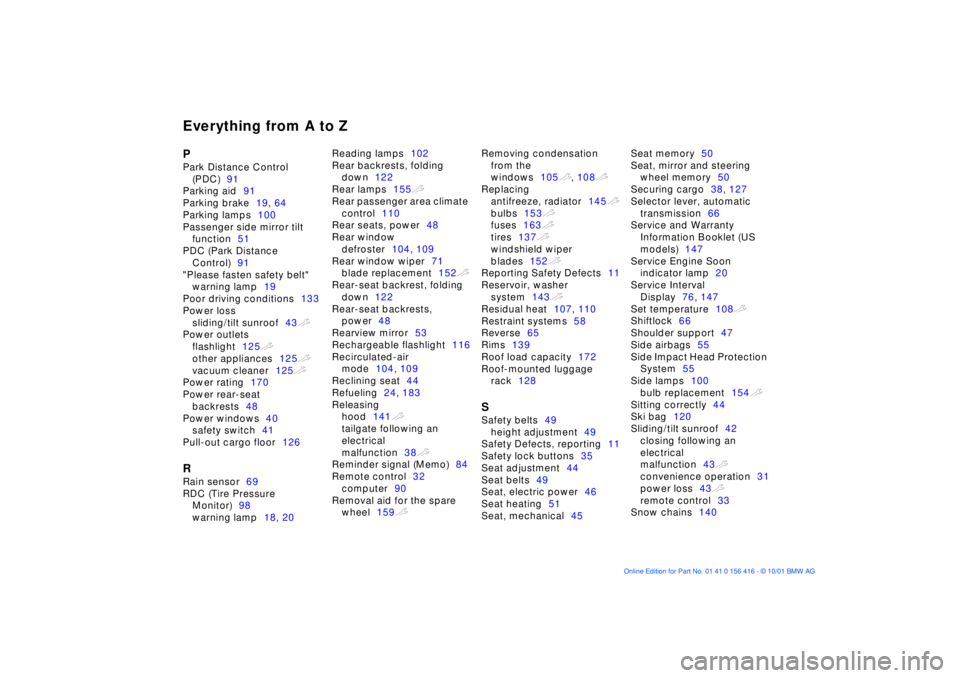
Everything from A to ZPPark Distance Control
(PDC)91
Parking aid91
Parking brake19, 64
Parking lamps100
Passenger side mirror tilt
function51
PDC (Park Distance
Control)91
"Please fasten safety belt"
warning lamp19
Poor driving conditions133
Power loss
sliding/tilt sunroof43t
Power outlets
flashlight125t
other appliances125t
vacuum cleaner125t
Power rating170
Power rear-seat
backrests48
Power windows40
safety switch41
Pull-out cargo floor126RRain sensor69
RDC (Tire Pressure
Monitor)98
warning lamp18, 20Reading lamps102
Rear backrests, folding
down122
Rear lamps155t
Rear passenger area climate
control110
Rear seats, power48
Rear window
defroster104, 109
Rear window wiper71
blade replacement152t
Rear-seat backrest, folding
down122
Rear-seat backrests,
power48
Rearview mirror53
Rechargeable flashlight116
Recirculated-air
mode104, 109
Reclining seat44
Refueling24, 183
Releasing
hood141t
tailgate following an
electrical
malfunction38t
Reminder signal (Memo)84
Remote control32
computer90
Removal aid for the spare
wheel159tRemoving condensation
from the
windows105t, 108t
Replacing
antifreeze, radiator145t
bulbs153t
fuses163t
tires137t
windshield wiper
blades152t
Reporting Safety Defects11
Reservoir, washer
system143t
Residual heat107, 110
Restraint systems58
Reverse65
Rims139
Roof load capacity172
Roof-mounted luggage
rack128
SSafety belts49
height adjustment49
Safety Defects, reporting11
Safety lock buttons35
Seat adjustment44
Seat belts49
Seat, electric power46
Seat heating51
Seat, mechanical45Seat memory50
Seat, mirror and steering
wheel memory50
Securing cargo38, 127
Selector lever, automatic
transmission66
Service and Warranty
Information Booklet (US
models)147
Service Engine Soon
indicator lamp20
Service Interval
Display76, 147
Set temperature108t
Shiftlock66
Shoulder support47
Side airbags55
Side Impact Head Protection
System55
Side lamps100
bulb replacement154t
Sitting correctly44
Ski bag120
Sliding/tilt sunroof42
closing following an
electrical
malfunction43t
convenience operation31
power loss43t
remote control33
Snow chains140