maintenance BMW X5 4.4I 2003 User Guide
[x] Cancel search | Manufacturer: BMW, Model Year: 2003, Model line: X5 4.4I, Model: BMW X5 4.4I 2003Pages: 183, PDF Size: 2.31 MB
Page 19 of 183
19n
OverviewControlsMaintenanceRepairsDataIndex
Indicator and warning lamps
Technology that monitors itself
Indicator and warning lamps that are
identified by
l
are tested for proper
functioning whenever the ignition key is
turned. They each light up once for
different periods of time.
If a fault should occur in one of these
systems, the corresponding lamp does
not go out after the engine is started or
it lights up while the vehicle is moving.
You will see how to react to this in the
following section.
Red: stop immediately
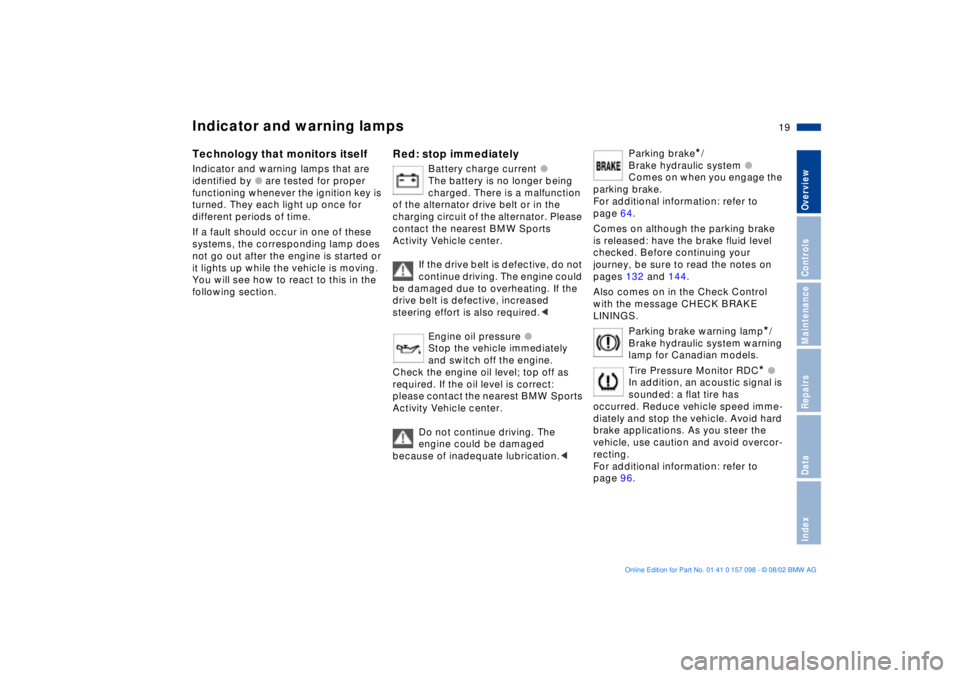
Battery charge current
l
The battery is no longer being
charged. There is a malfunction
of the alternator drive belt or in the
charging circuit of the alternator. Please
contact the nearest BMW Sports
Activity Vehicle center.
If the drive belt is defective, do not
continue driving. The engine could
be damaged due to overheating. If the
drive belt is defective, increased
steering effort is also required.
<
Engine oil pressure
l
Stop the vehicle immediately
and switch off the engine.
Check the engine oil level; top off as
required. If the oil level is correct:
please contact the nearest BMW Sports
Activity Vehicle center.
Do not continue driving. The
engine could be damaged
because of inadequate lubrication.
<
Parking brake
*
/
Brake hydraulic system
l
Comes on when you engage the
parking brake.
For additional information: refer to
page 64.
Comes on although the parking brake
is released: have the brake fluid level
checked. Before continuing your
journey, be sure to read the notes on
pages 132 and 144.
Also comes on in the Check Control
with the message CHECK BRAKE
LININGS.
Parking brake warning lamp
*
/
Brake hydraulic system warning
lamp for Canadian models.
Tire Pressure Monitor RDC
*
l
In addition, an acoustic signal is
sounded: a flat tire has
occurred. Reduce vehicle speed imme-
diately and stop the vehicle. Avoid hard
brake applications. As you steer the
vehicle, use caution and avoid overcor-
recting.
For additional information: refer to
page 96.
Page 21 of 183
21n
OverviewControlsMaintenanceRepairsDataIndex
Indicator and warning lamps
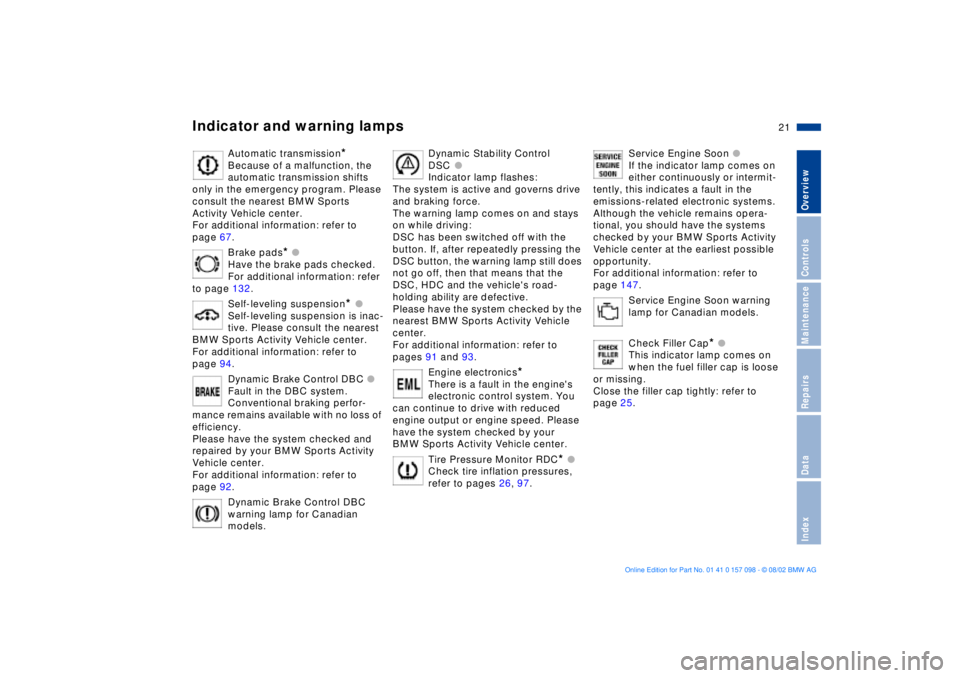
Automatic transmission
*
Because of a malfunction, the
automatic transmission shifts
only in the emergency program. Please
consult the nearest BMW Sports
Activity Vehicle center.
For additional information: refer to
page 67.
Brake pads
*
l
Have the brake pads checked.
For additional information: refer
to page 132.
Self-leveling suspension
* l
Self-leveling suspension is inac-
tive. Please consult the nearest
BMW Sports Activity Vehicle center.
For additional information: refer to
page 94.
Dynamic Brake Control DBC l
Fault in the DBC system.
Conventional braking perfor-
mance remains available with no loss of
efficiency.
Please have the system checked and
repaired by your BMW Sports Activity
Vehicle center.
For additional information: refer to
page 92.
Dynamic Brake Control DBC
warning lamp for Canadian
models.
Dynamic Stability Control
DSC
l
Indicator lamp flashes:
The system is active and governs drive
and braking force.
The warning lamp comes on and stays
on while driving:
DSC has been switched off with the
button. If, after repeatedly pressing the
DSC button, the warning lamp still does
not go off, then that means that the
DSC, HDC and the vehicle's road-
holding ability are defective.
Please have the system checked by the
nearest BMW Sports Activity Vehicle
center.
For additional information: refer to
pages 91 and 93.
Engine electronics
*
There is a fault in the engine's
electronic control system. You
can continue to drive with reduced
engine output or engine speed. Please
have the system checked by your
BMW Sports Activity Vehicle center.
Tire Pressure Monitor RDC
* l
Check tire inflation pressures,
refer to pages 26, 97.
Service Engine Soon l
If the indicator lamp comes on
either continuously or intermit-
tently, this indicates a fault in the
emissions-related electronic systems.
Although the vehicle remains opera-
tional, you should have the systems
checked by your BMW Sports Activity
Vehicle center at the earliest possible
opportunity.
For additional information: refer to
page 147.
Service Engine Soon warning
lamp for Canadian models.
Check Filler Cap
* l
This indicator lamp comes on
when the fuel filler cap is loose
or missing.
Close the filler cap tightly: refer to
page 25.
Page 23 of 183
23n
OverviewControlsMaintenanceRepairsDataIndex
Steering wheel with multifunction buttons
*
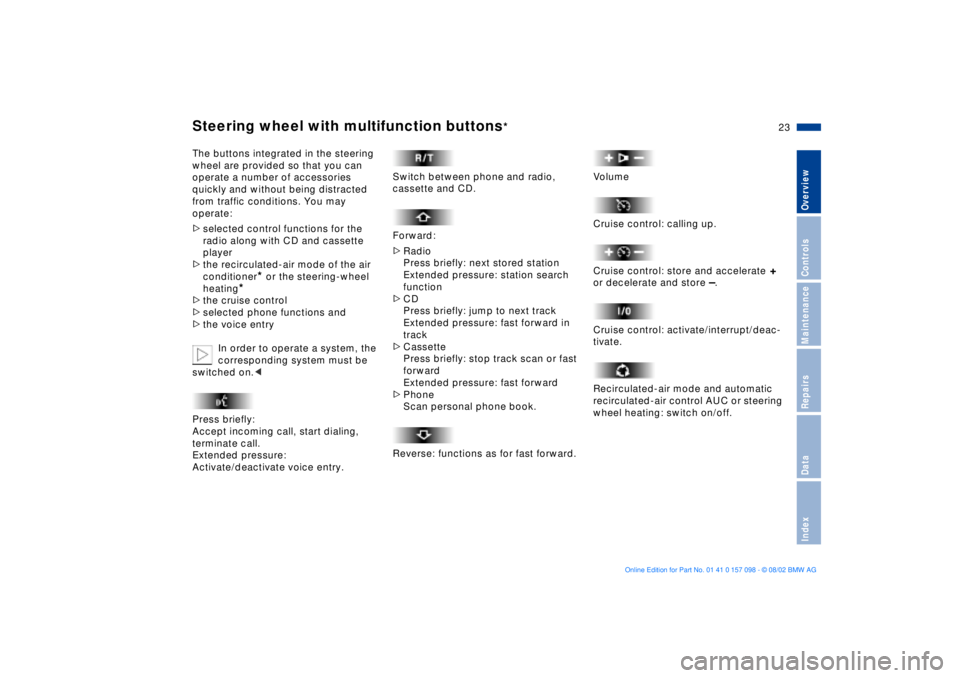
The buttons integrated in the steering
wheel are provided so that you can
operate a number of accessories
quickly and without being distracted
from traffic conditions. You may
operate:
>selected control functions for the
radio along with CD and cassette
player
>the recirculated-air mode of the air
conditioner
* or the steering-wheel
heating
*
>the cruise control
>selected phone functions and
>the voice entry
In order to operate a system, the
corresponding system must be
switched on.<
Press briefly:
Accept incoming call, start dialing,
terminate call.
Extended pressure:
Activate/deactivate voice entry.
Switch between phone and radio,
cassette and CD.
Forward:
>Radio
Press briefly: next stored station
Extended pressure: station search
function
>CD
Press briefly: jump to next track
Extended pressure: fast forward in
track
>Cassette
Press briefly: stop track scan or fast
forward
Extended pressure: fast forward
>Phone
Scan personal phone book.
Reverse: functions as for fast forward.
Volume
Cruise control: calling up.
Cruise control: store and accelerate
+
or decelerate and store
Ð.
Cruise control: activate/interrupt/deac-
tivate.
Recirculated-air mode and automatic
recirculated-air control AUC or steering
wheel heating: switch on/off.
Page 25 of 183
25n
OverviewControlsMaintenanceRepairsDataIndex
Refueling
When handling fuels, comply with
all of the applicable safety precau-
tions and regulations pertaining to
fuels. Never carry spare fuel containers
in your vehicle. Whether empty or full,
these containers can leak, cause an
explosion, or lead to fire in the event of
a collision.<
Simple and environmentally
friendly
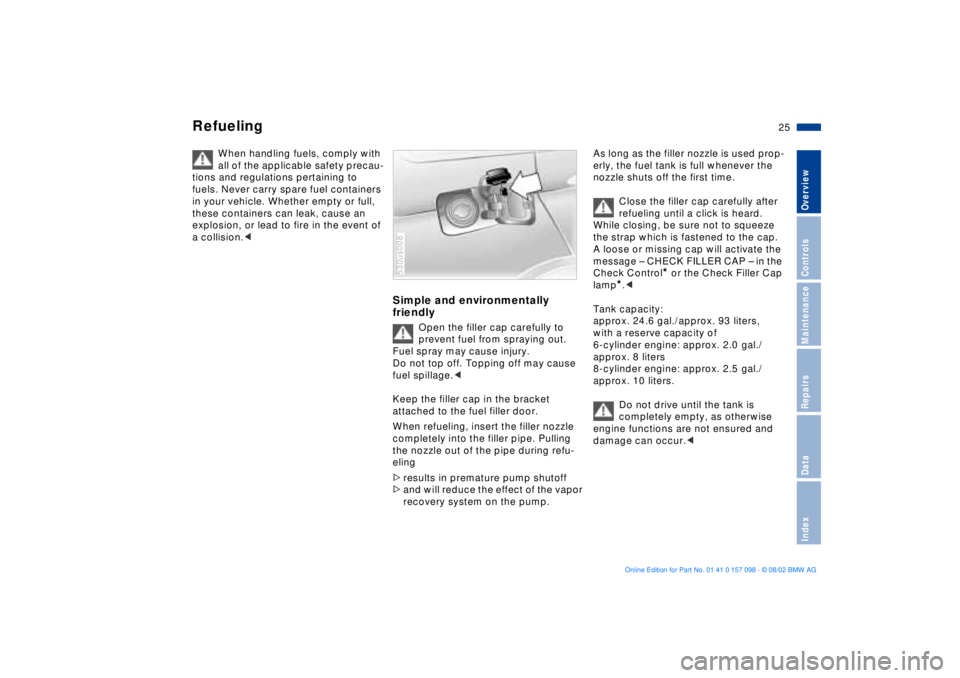
Open the filler cap carefully to
prevent fuel from spraying out.
Fuel spray may cause injury.
Do not top off. Topping off may cause
fuel spillage.<
Keep the filler cap in the bracket
attached to the fuel filler door.
When refueling, insert the filler nozzle
completely into the filler pipe. Pulling
the nozzle out of the pipe during refu-
eling
>results in premature pump shutoff
>and will reduce the effect of the vapor
recovery system on the pump.
530us008
As long as the filler nozzle is used prop-
erly, the fuel tank is full whenever the
nozzle shuts off the first time.
Close the filler cap carefully after
refueling until a click is heard.
While closing, be sure not to squeeze
the strap which is fastened to the cap.
A loose or missing cap will activate the
message Ð CHECK FILLER CAP Ð in the
Check Control
* or the Check Filler Cap
lamp
*.<
Tank capacity:
approx. 24.6 gal./approx. 93 liters,
with a reserve capacity of
6-cylinder engine: approx. 2.0 gal./
approx. 8 liters
8-cylinder engine: approx. 2.5 gal./
approx. 10 liters.
Do not drive until the tank is
completely empty, as otherwise
engine functions are not ensured and
damage can occur.<
Page 27 of 183
27n
OverviewControlsMaintenanceRepairsDataIndex
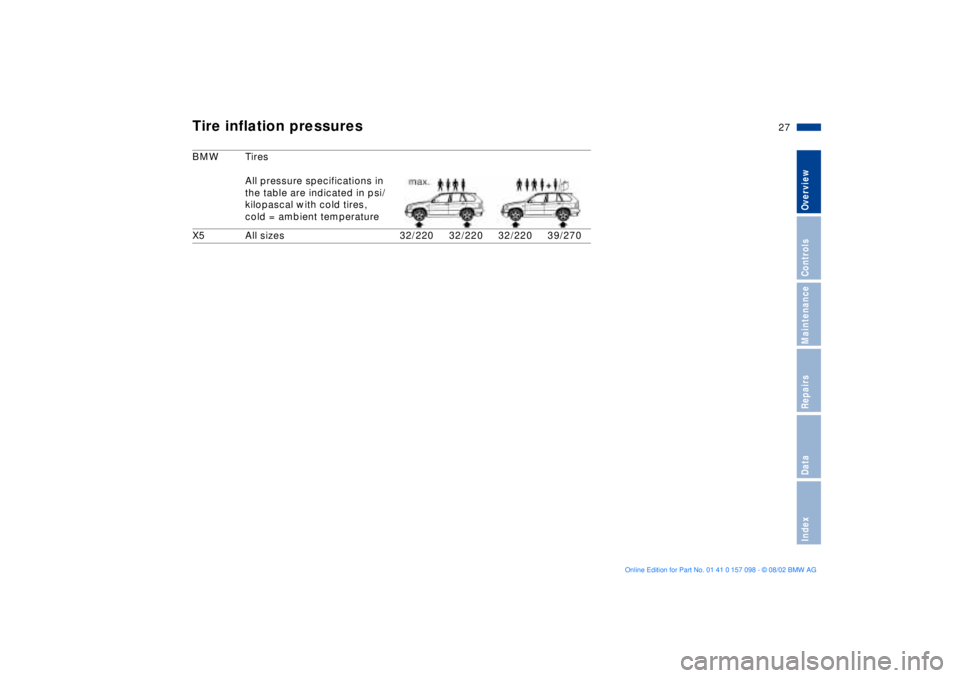
Tire inflation pressures BMW Tires
All pressure specifications in
the table are indicated in psi/
kilopascal with cold tires,
cold = ambient temperature
X5 All sizes 32/220 32/220 32/220 39/270
Page 29 of 183
29n
OverviewControlsMaintenanceRepairsDataIndex
Overview
Controls and features
Operation, maintenance
Index Technical data
Owner service procedures
Page 31 of 183
31n
OverviewControlsMaintenanceRepairsDataIndex
Opening and closing Ð via the remote controlThe conceptThe remote control makes opening and
locking the doors of your vehicle very
convenient. Furthermore it provides
three additional functions that can only
be executed via the remote control:
>Switch on the interior lamps, refer to
page 32.
With this function, you can also
search for your vehicle Ñ when
parked in an underground garage, for
instance
>Open the liftgate, refer to page 32.
The liftgate will open slightly, regard-
less of whether it was previously
locked or unlocked
>Panic mode, refer to page 32.
In case of danger, you can trigger an
alarm.
Whenever you unlock or lock the
vehicle, you simultaneously deactivate/
activate the anti-theft system, disarm/
arm the alarm system and switch the
interior lamps on/off.
You can have an acknowledgment
signal set to confirm that the
vehicle is correctly locked.<
Since passengers or animals
remaining in the vehicle might be
able to lock the doors from the inside,
take the vehicle's keys with you so that
the vehicle can be opened again from
the outside at any time.<
If it is no longer possible to lock
the vehicle via the remote control,
the battery is discharged. Use this key
while driving for an extended period in
order to charge the battery. To prevent
unauthorized use of the remote control,
surrender only the door and ignition key
or the spare key when leaving the
vehicle for valet parking, for example,
refer to page 30.
In the event of a system malfunction,
please contact your BMW Sports
Activity Vehicle center. You can also
obtain replacement keys there.<
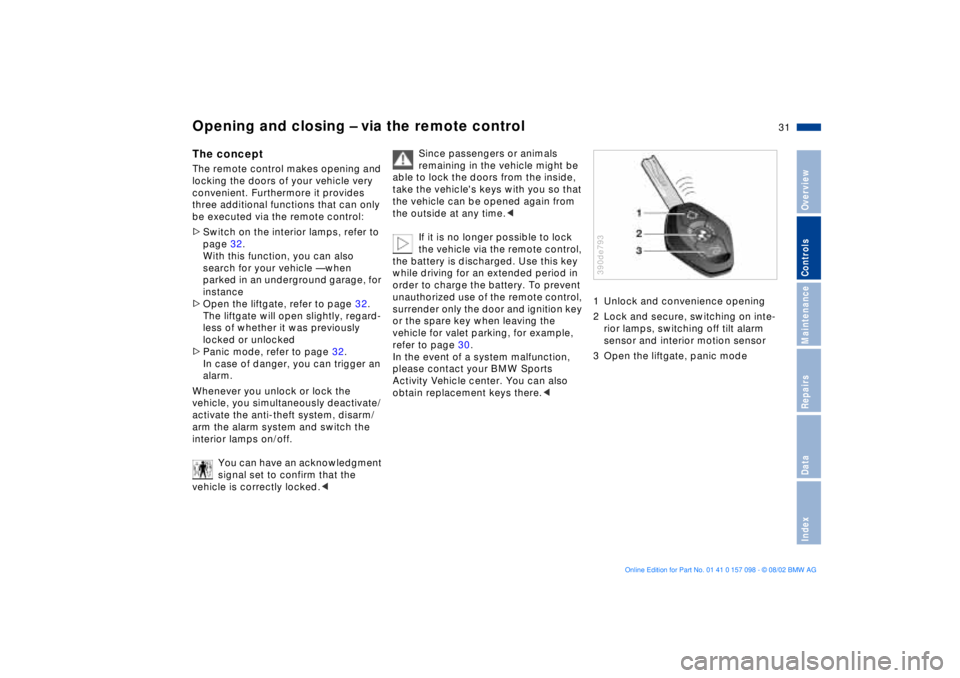
1 Unlock and convenience opening
2 Lock and secure, switching on inte-
rior lamps, switching off tilt alarm
sensor and interior motion sensor
3 Open the liftgate, panic mode390de793
Page 33 of 183
33n
OverviewControlsMaintenanceRepairsDataIndex
Opening and closing Ð via the remote controlSystem interferenceThe remote control system may be
affected by other units or equipment
operating in the immediate vicinity of
your vehicle.
If this should occur, you can unlock and
lock the vehicle via the door lock with a
master key.
For US owners onlyThe transmitter and receiver units
comply with part 15 of the FCC Ð
Federal Communication Commission Ð
regulations. Operation is governed by
the following:
FCC ID: LX8EWS
LX8FZVS
LX8FZVE
Compliance statement:
This device complies with part 15 of the
FCC Rules. Operation is subject to the
following two conditions:
>This device may not cause harmful
interference, and
>this device must accept any interfer-
ence received, including interference
that may cause undesired operation.
Any unauthorized modifications to
these devices could void the
user's authority to operate this equip-
ment.<
Page 35 of 183
35n
OverviewControlsMaintenanceRepairsDataIndex
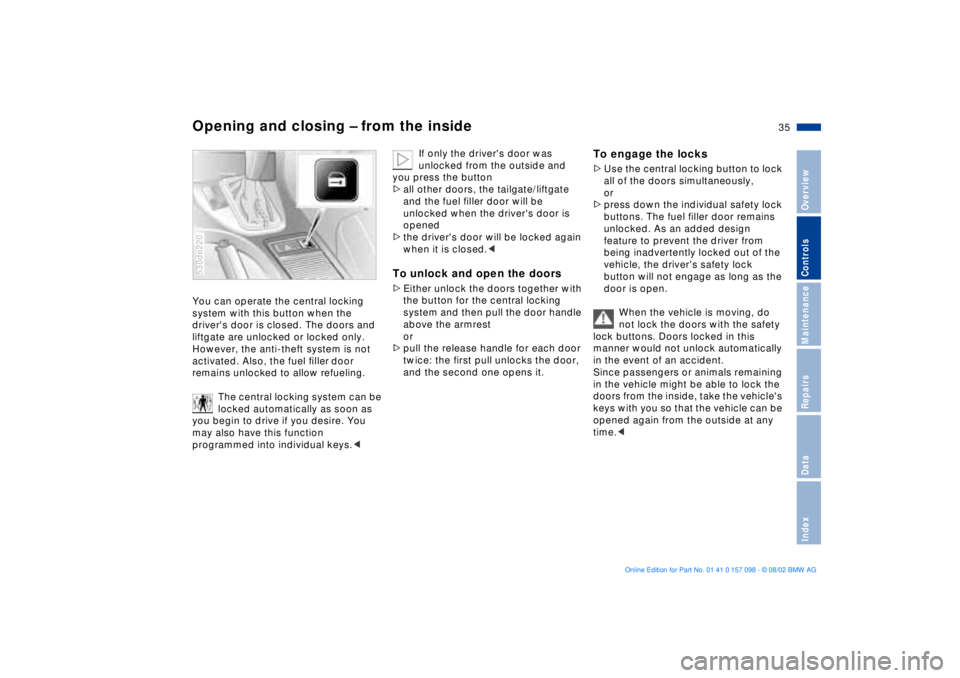
Opening and closing Ð from the insideYou can operate the central locking
system with this button when the
driver's door is closed. The doors and
liftgate are unlocked or locked only.
However, the anti-theft system is not
activated. Also, the fuel Þller door
remains unlocked to allow refueling.
The central locking system can be
locked automatically as soon as
you begin to drive if you desire. You
may also have this function
programmed into individual keys.<530de220
If only the driver's door was
unlocked from the outside and
you press the button
>all other doors, the tailgate/liftgate
and the fuel filler door will be
unlocked when the driver's door is
opened
>the driver's door will be locked again
when it is closed.<
To unlock and open the doors >Either unlock the doors together with
the button for the central locking
system and then pull the door handle
above the armrest
or
>pull the release handle for each door
twice: the first pull unlocks the door,
and the second one opens it.
To engage the locks >Use the central locking button to lock
all of the doors simultaneously,
or
>press down the individual safety lock
buttons. The fuel filler door remains
unlocked. As an added design
feature to prevent the driver from
being inadvertently locked out of the
vehicle, the driver's safety lock
button will not engage as long as the
door is open.
When the vehicle is moving, do
not lock the doors with the safety
lock buttons. Doors locked in this
manner would not unlock automatically
in the event of an accident.
Since passengers or animals remaining
in the vehicle might be able to lock the
doors from the inside, take the vehicle's
keys with you so that the vehicle can be
opened again from the outside at any
time.<
Page 37 of 183
37n
OverviewControlsMaintenanceRepairsDataIndex
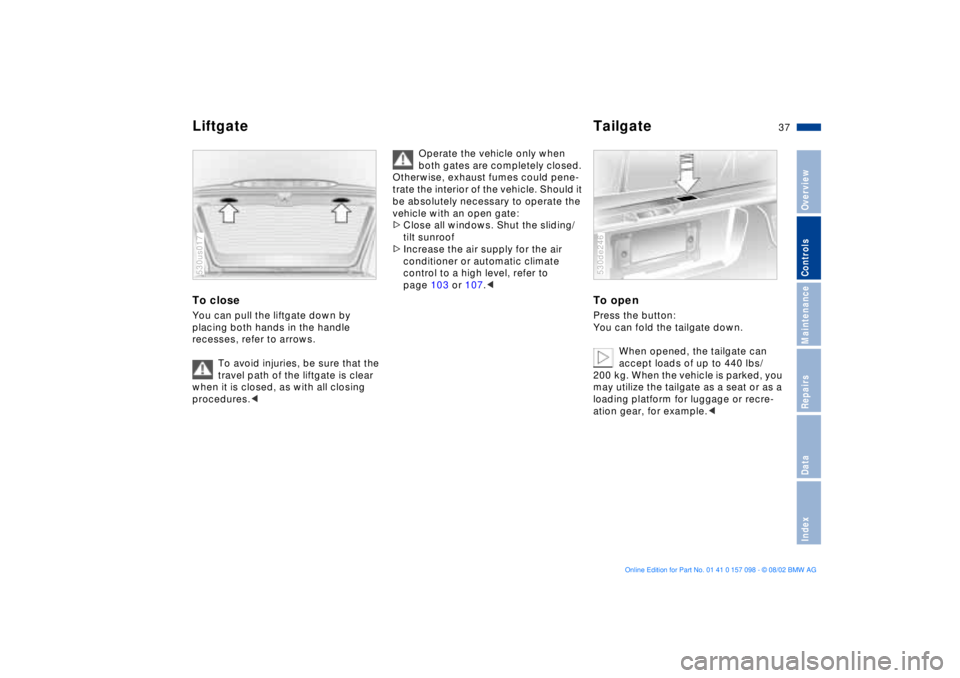
Liftgate TailgateTo close You can pull the liftgate down by
placing both hands in the handle
recesses, refer to arrows.
To avoid injuries, be sure that the
travel path of the liftgate is clear
when it is closed, as with all closing
procedures.< 530us017
Operate the vehicle only when
both gates are completely closed.
Otherwise, exhaust fumes could pene-
trate the interior of the vehicle. Should it
be absolutely necessary to operate the
vehicle with an open gate:
>Close all windows. Shut the sliding/
tilt sunroof
>Increase the air supply for the air
conditioner or automatic climate
control to a high level, refer to
page 103 or 107.<
To openPress the button:
You can fold the tailgate down.
When opened, the tailgate can
accept loads of up to 440 lbs/
200 kg. When the vehicle is parked, you
may utilize the tailgate as a seat or as a
loading platform for luggage or recre-
ation gear, for example.< 530de246