wheel BMW X5 4.4I 2003 Owner's Manual
[x] Cancel search | Manufacturer: BMW, Model Year: 2003, Model line: X5 4.4I, Model: BMW X5 4.4I 2003Pages: 183, PDF Size: 2.31 MB
Page 103 of 183
103n
OverviewControlsMaintenanceRepairsDataIndex
Air conditioner Temperature
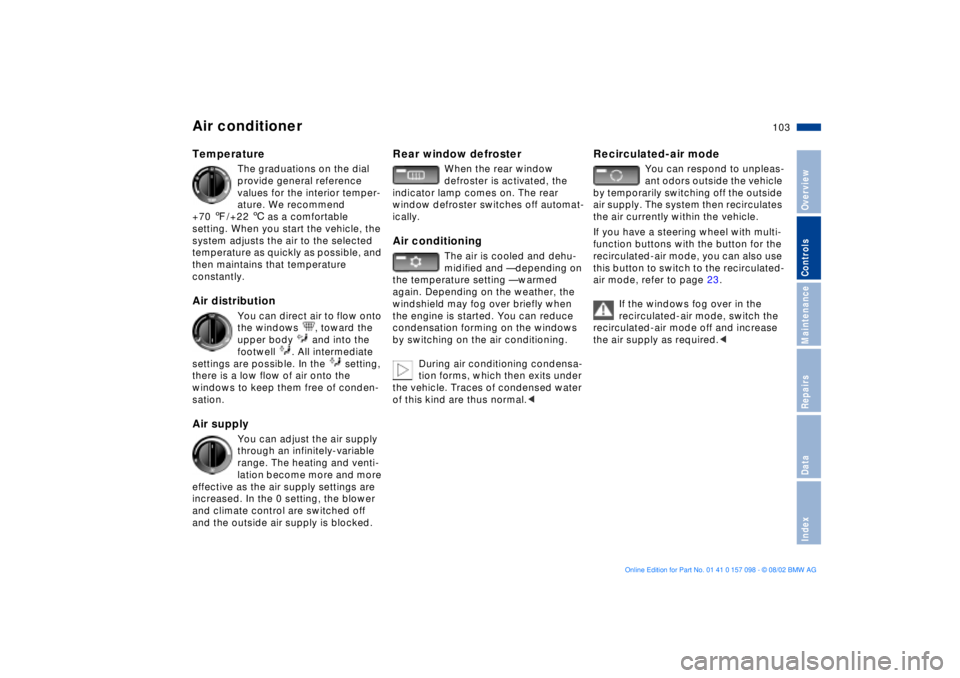
The graduations on the dial
provide general reference
values for the interior temper-
ature. We recommend
+70 7/+22 6 as a comfortable
setting. When you start the vehicle, the
system adjusts the air to the selected
temperature as quickly as possible, and
then maintains that temperature
constantly.
Air distribution
You can direct air to flow onto
the windows , toward the
upper body and into the
footwell . All intermediate
settings are possible. In the setting,
there is a low flow of air onto the
windows to keep them free of conden-
sation.
Air supply
You can adjust the air supply
through an infinitely-variable
range. The heating and venti-
lation become more and more
effective as the air supply settings are
increased. In the 0 setting, the blower
and climate control are switched off
and the outside air supply is blocked.
Rear window defroster
When the rear window
defroster is activated, the
indicator lamp comes on. The rear
window defroster switches off automat-
ically.
Air conditioning
The air is cooled and dehu-
midified and Ñ depending on
the temperature setting Ñ warmed
again. Depending on the weather, the
windshield may fog over briefly when
the engine is started. You can reduce
condensation forming on the windows
by switching on the air conditioning.
During air conditioning condensa-
tion forms, which then exits under
the vehicle. Traces of condensed water
of this kind are thus normal.<
Recirculated-air mode
You can respond to unpleas-
ant odors outside the vehicle
by temporarily switching off the outside
air supply. The system then recirculates
the air currently within the vehicle.
If you have a steering wheel with multi-
function buttons with the button for the
recirculated-air mode, you can also use
this button to switch to the recirculated-
air mode, refer to page 23.
If the windows fog over in the
recirculated-air mode, switch the
recirculated-air mode off and increase
the air supply as required.<
Page 108 of 183

108n
Automatic climate control
*
Air conditioning
The air is cooled and
dehumidified and Ñ
depending on the temperature setting Ñ
warmed again. Depending on the
weather, the windshield may fog over
briefly when the engine is started. You
can reduce condensation forming on
the windows by switching on the air
conditioning.
During air conditioning condensa-
tion forms, which then exits under
the vehicle. Traces of condensed water
of this kind are thus normal.<
Maximum cooling
You will get maximum
cooling capacity using this
program if the engine is running and
the outside temperature is above
approx. +41 7/+5 6.
The temperature display 9 jumps to
+60 7/+16 6, the system switches
over to the recirculated-air mode, and
the air streams out of the ventilation grill
with the maximum air supply. That is
why you need to keep these open if you
select this program.
Automatic recirculated-air
control AUC
If there are unpleasant
odors or pollutants in the
outside air, you can temporarily block
the air supply from the outside. The
system then recirculates the air
currently within the vehicle. Press the
button repeatedly to run through the
following control sequence
>Indicator lamps off: outside air supply
operational
>Left-hand indicator lamp on Ð AUC
mode: the system recognizes pollut-
ants in the outside air and blocks the
flow of air when necessary. The
system then recirculates the air
currently within the vehicle.
Depending on the air quality, the
automatic system then switches back
and forth between outside air supply
and recirculation of the air within the
vehicle
>Right-hand indicator lamp on: the
outside air supply into the vehicle is
completely blocked. The system then
recirculates the air currently within
the vehicle.
If you have a steering wheel with multi-
function buttons with the button for
recirculated-air mode, refer to page 23,
you can also use this button to switch
between Off and the recirculated-air
mode or AUC and the recirculated-air
mode.
If the windows fog over in the
recirculated-air mode, switch the
recirculated-air mode off and increase
the air supply as required.< Rear window defroster
When the rear window
defroster is activated,
the indicator lamp comes on. The
rear window defroster switches off
automatically.
Page 123 of 183
123n
OverviewControlsMaintenanceRepairsDataIndex
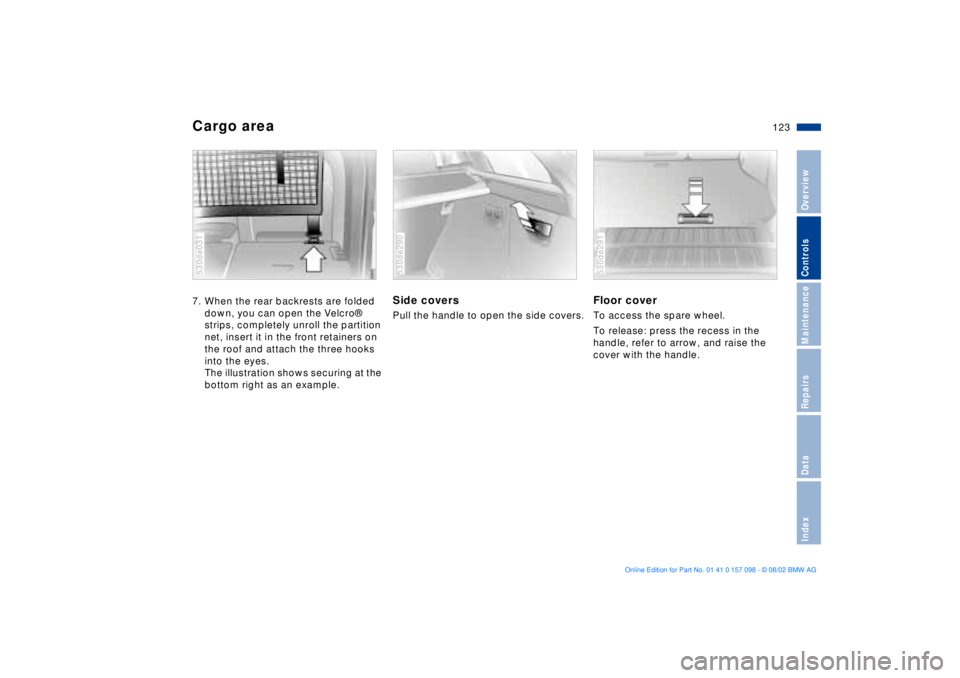
Cargo area 7. When the rear backrests are folded
down, you can open the Velcro¨
strips, completely unroll the partition
net, insert it in the front retainers on
the roof and attach the three hooks
into the eyes.
The illustration shows securing at the
bottom right as an example. 530de031
Side coversPull the handle to open the side covers.530de290
Floor cover To access the spare wheel.
To release: press the recess in the
handle, refer to arrow, and raise the
cover with the handle. 530de291
Page 125 of 183
125n
OverviewControlsMaintenanceRepairsDataIndex
Cargo areaWhen it is extended, you can load the
cargo floor:
>With up to 990 Ibs/450 kg, distrib-
uted evenly across the entire surface
>With up to 330 Ibs/150 kg on the rear
edge.
Do not overload the cargo floor
when it is extended. If you do so,
it could cause damage.
When you slide the cargo floor back in,
do not grasp it on the bottom. If you do
so, there is a risk of personal injury.<
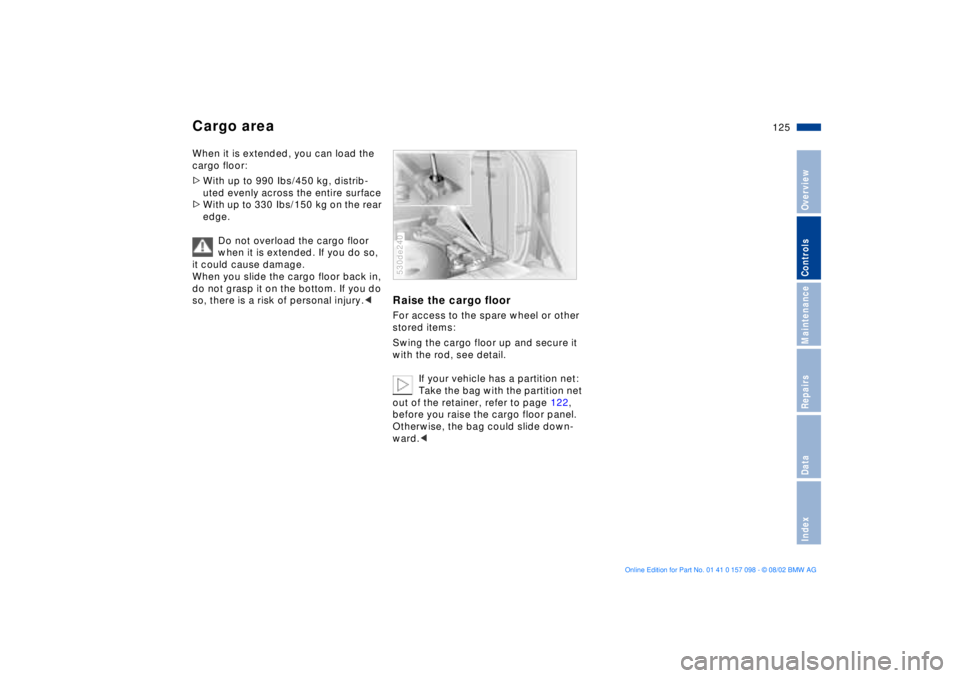
Raise the cargo floor For access to the spare wheel or other
stored items:
Swing the cargo floor up and secure it
with the rod, see detail.
If your vehicle has a partition net:
Take the bag with the partition net
out of the retainer, refer to page 122,
before you raise the cargo floor panel.
Otherwise, the bag could slide down-
ward.< 530de240
Page 131 of 183

131n
OverviewControlsMaintenanceRepairsDataIndex
Driving your BMW X5 Your BMW is right at home on all roads
and byways Ð even where the pavement
ends. It combines permanent four-
wheel drive with the agility of a typical
passenger vehicle. On bad roadsWhen you are driving on bad roads,
there are a few points which you should
strictly observe Ñ for your own safety,
for that of your passengers, and for the
safety of the vehicle:
>Familiarize yourself with the vehicle
before you begin driving. Do not take
risks with the vehicle under any cir-
cumstances
>Always adapt vehicle speed to road
conditions Ð the steeper and more
uneven the road surface is, the
slower the vehicle's speed should be
>You can operate your vehicle on
uphill and downhill gradients with a
maximum slope of 50 %. If you intend
to drive on either an uphill or downhill
gradient of this steepness, check to
be sure in advance that the engine oil
and coolant levels are both near the
MAX mark, refer to pages 141
and 143.
When driving down steep slopes, use
the Hill Descent Control HDC, refer to
page 93. Starting from a full stop is possible on
uphill gradients of up to 32 %.
The permitted side tilt is also 50 %
>While driving, watch carefully for
obstacles such as rocks or holes. Try
to avoid these obstacles whenever
possible
>On hill crests and bumpy roads, for
example, be careful to prevent the
body from bottoming Ð contact
between the body and the ground.
The ground clearance of the vehicle
is:
8 in/200 mm with up to four
passengers
7 in/180 mm fully loaded Ð without
self-leveling suspension
>Do not drive in water that is deeper
than 20 inches/50 cm. If you must
drive through water up to that depth,
drive at a walking speed and do not
stop.
After leaving the water, press on the
footbrake gently several times while
driving at a low speed. The brake
applications will help to dry the
brakes, thus preventing a reduction in
braking performance caused by the
moisture.
Back onto the paved road In recommending that you observe the
following points after driving on adverse
road surfaces, it is not as a beauty
treatment for your BMW. Instead, it is
intended for the maintenance of driving
safety:
>Clean accumulations of dirt from the
body and check the undercarriage for
damage
>Clean mud, snow, ice and other
materials from the wheels and tires.
Check the tires for damage
>Check to determine whether rocks,
gravel or accumulations of dirt on the
brake rotors and calipers could influ-
ence braking performance. Remove
all such foreign objects
>In order to clean the brake rotors,
apply the footbrake gently several
times while driving at a low speed. Be
sure that following traffic is not
endangered by this
>For cleaning the parking brake, apply
the lever slightly at approx. 25 mph/
40 km/h and continue to drive for
approx. 200 yards/200 meters, pro-
vided that traffic conditions allow you
to do so.
Page 132 of 183

132n
General driving notes
Antilock Brake System
Brake system
Brakes:
Do not drive with your foot resting
on the brake pedal. Even light but con-
sistent pedal pressure can lead to high
temperatures, brake wear and possibly
even brake failure.
Hydroplaning:
When driving on wet or slushy roads,
reduce vehicle speed. If you do not, a
wedge of water may form between the
tires and the road surface. This phe-
nomenon is referred to as hydroplaning
or aquaplaning. It is characterized by a
partial or complete loss of contact
between the tires and the road surface.
The ultimate results are loss of steering
and braking control.<
The conceptThe Antilock Brake System ABS keeps
the wheels from locking during braking,
thereby enhancing active driving safety.Braking with ABSIf you are in a situation that requires full
braking, you will exploit the full benefits
of the ABS system if you apply max-
imum pedal pressure Ð panic stop.
Pulsation at the brake pedal combined
with sounds from the hydraulic circuits
indicates to the driver that ABS is in its
active mode.
Brake fluid levelIf the brake fluid level is too low and
brake pedal travel has become longer,
there may be a defect in one of the two
brake system's hydraulic circuits.
Proceed to the nearest
BMW Sports Activity Vehicle
center. Here increased pressure on the
brake pedal may be required, and slight
pulling to the side and longer braking
distances may result. Please remember
to adapt your driving style accord-
ingly.<
Page 133 of 183

133n
OverviewControlsMaintenanceRepairsDataIndex
Brake systemDisc brakesWhen the vehicle is driven only occa-
sionally, during extended periods when
the vehicle is not used at all, and in
operating conditions where brake appli-
cations are less frequent, there is an
increased tendency for corrosion of the
rotors and accumulation of contamina-
tion on the brake pads. This occurs
because the minimal pressure which
must be exerted by the pads to clean
the discs by brake applications is not
reached.
If the brake rotors are corroded, they
will tend to respond to braking with a
pulsating effect which even extended
application will fail to cure.
When driving in wet conditions and in
heavy rain, it is advisable to apply light
pressure to the brake pedal from time
to time. Watch traffic conditions to
ensure that this maneuver does not
endanger other road users. The heat
which is generated by the brake appli-
cations helps to dry the brake pads and
rotors. The braking force is then imme-
diately available when required.Extended or steep mountain descents
should be driven in the gear in which
only minimal periodic brake application
is required. This avoids excessive strain
on the brakes and possible impairment
of the braking effect.
Do not coast with the clutch
depressed or with the transmis-
sion or selector lever in neutral. Do not
drive with the engine switched off. The
engine provides no braking effect when
the clutch is depressed or the transmis-
sion is in neutral, and there is no
power-assist for braking or steering
when the engine is not running.
BMW recommends having brake
inspections performed at a BMW
Sports Activity Vehicle center only. If
you do not, parts of the four-wheel
drive system could be damaged.
Never allow floor mats, carpets or any
other objects to protrude into the area
around the accelerator, clutch and
brake pedals and obstruct their move-
ment.<
Brake pads
For your own safety: use only
brake pads that BMW has
released for your particular vehicle
model. BMW cannot evaluate non-
approved brake pads to determine if
they are suited for use, and therefore
cannot ensure the operating safety of
the vehicle if they are installed.<
Page 134 of 183
134n
Information for your safety The factory-approved radial tires are
matched to the vehicle and have been
selected to provide optimum safety and
driving comfort on your vehicle when
used correctly.
It is not merely the tire's service life, but
also driving comfort and Ð above all else
Ð driving safety which depend on the
condition of the tires and the mainte-
nance of the specified tire pressure.
Incorrect inflation pressure is a
frequent cause of tire damage. It
also significantly influences the road-
holding ability of your BMW. Check tire
inflation pressures Ð including the spare
wheel Ð regularly, refer to page 26, at
least every two weeks and before
beginning a longer trip. If this is not
done, incorrect tire pressures can
cause driving instability and tire
damage, ultimately resulting in an
accident.<
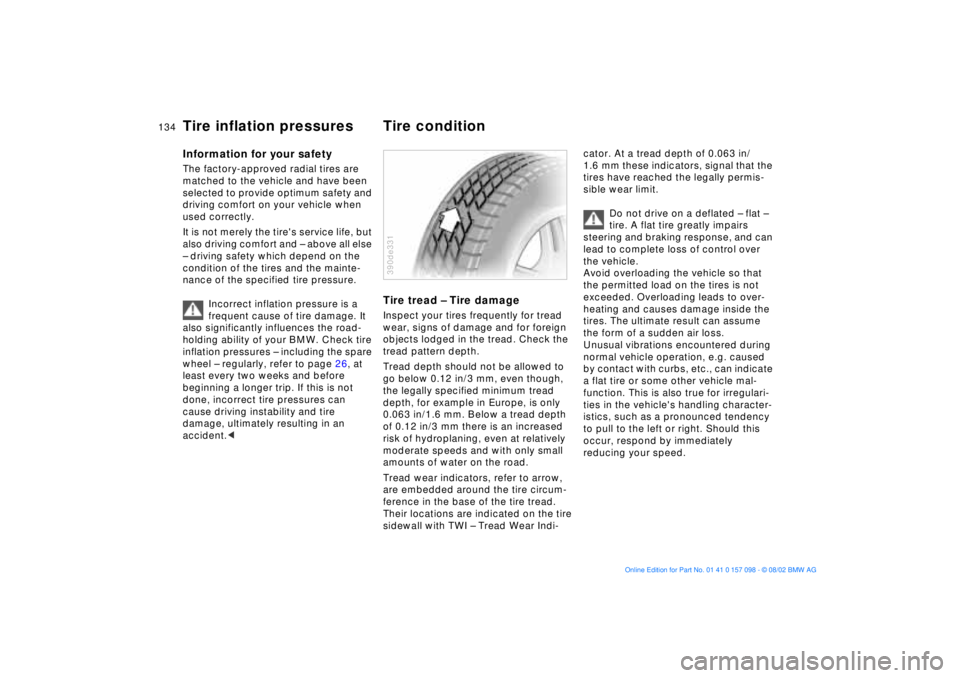
Tire tread Ð Tire damage Inspect your tires frequently for tread
wear, signs of damage and for foreign
objects lodged in the tread. Check the
tread pattern depth.
Tread depth should not be allowed to
go below 0.12 in/3 mm, even though,
the legally specified minimum tread
depth, for example in Europe, is only
0.063 in/1.6 mm. Below a tread depth
of 0.12 in/3 mm there is an increased
risk of hydroplaning, even at relatively
moderate speeds and with only small
amounts of water on the road.
Tread wear indicators, refer to arrow,
are embedded around the tire circum-
ference in the base of the tire tread.
Their locations are indicated on the tire
sidewall with TWI Ð Tread Wear Indi-390de331
cator. At a tread depth of 0.063 in/
1.6 mm these indicators, signal that the
tires have reached the legally permis-
sible wear limit.
Do not drive on a deflated Ð flat Ð
tire. A flat tire greatly impairs
steering and braking response, and can
lead to complete loss of control over
the vehicle.
Avoid overloading the vehicle so that
the permitted load on the tires is not
exceeded. Overloading leads to over-
heating and causes damage inside the
tires. The ultimate result can assume
the form of a sudden air loss.
Unusual vibrations encountered during
normal vehicle operation, e.g. caused
by contact with curbs, etc., can indicate
a flat tire or some other vehicle mal-
function. This is also true for irregulari-
ties in the vehicle's handling character-
istics, such as a pronounced tendency
to pull to the left or right. Should this
occur, respond by immediately
reducing your speed.
Tire inflation pressures Tire condition
Page 135 of 183

135n
OverviewControlsMaintenanceRepairsDataIndex
Tire condition Tire replacement Proceed carefully to the nearest
BMW Sports Activity Vehicle center or
professional tire center, or have the
vehicle towed in to have it, its wheels
and tires inspected.
Tire damage up to and including blow-
outs can endanger the lives of both the
vehicle occupants and other road
users.<
DOT Quality GradesTread wear
Traction AA A B C
Temperature A B C
All passenger car tires must con-
form to Federal Safety Require-
ments in addition to these grades.< Tread wearThe tread wear grade is a comparative
rating based on the wear rate of the tire
when tested under controlled condi-
tions on a specified government test
course.
For example, a tire graded 150 would
wear one and one-half Ð 1g Ð times as
well on the government course as a tire
graded 100. The relative performance
of tires depends upon the actual condi-
tions of their use, however, and may
depart significantly from the norm due
to variations in driving habits, service
practices and differences in road char-
acteristics and climate.
TractionThe traction grades, from highest to
lowest, are AA, A, B, and C.
Those grades represent the tire's ability
to stop on wet pavement as measured
under controlled conditions on speci-
fied government test surfaces of
asphalt and concrete. A tire marked C
may have poor traction performance.
The traction grade assigned to
this tire is based on straight-
ahead braking traction tests, and does
not include acceleration, cornering,
hydroplaning, or peak traction charac-
teristics.<
Page 136 of 183

136n
Tire replacement TemperatureThe temperature grades are A, the
highest, B, and C, representing the
tire's resistance to the generation of
heat and its ability to dissipate heat
when tested under controlled condi-
tions on a specified indoor laboratory
test wheel.
Sustained high temperature can cause
the material of the tire to degenerate
and reduce tire life, and excessive tem-
perature can lead to a sudden flat tire.
The grade C corresponds to a level of
performance which all passenger car
tires must meet under the Federal
Motor Car Safety Standard No. 109.
Grades B and A represent higher levels
of performance on the laboratory test
wheel than the minimum required by
law.
The temperature grade for this tire
is established for a tire that is
properly inflated and not overloaded.
Excessive speed, underinflation, or
excessive loading, either separately or
in combination, can cause heat buildup
and possible a tire failure.<
Uniform Tire Quality Grading Quality grades can be found where
applicable on the tire sidewall between
tread shoulder and maximum section
width. For example:
Tread wear 200
Traction AA
Temperature A
Tire age BMW recommends the replacement of
all tires Ð i.e. also of the spare tire, inde-
pendently of actual wear Ð when the
tires are no more than 6 years old, even
if a tire life of 10 years is possible.
The date on which the tire was manu-
factured is indicated by the code on the
sidewall:
DOT ... 2602 indicates that the tire was
manufactured in week 26 of 2002.