maintenance BMW X5 4.4I 2004 E53 Owner's Guide
[x] Cancel search | Manufacturer: BMW, Model Year: 2004, Model line: X5 4.4I, Model: BMW X5 4.4I 2004 E53Pages: 200, PDF Size: 3.91 MB
Page 59 of 200
57n
OverviewControlsMaintenanceRepairsDataIndex
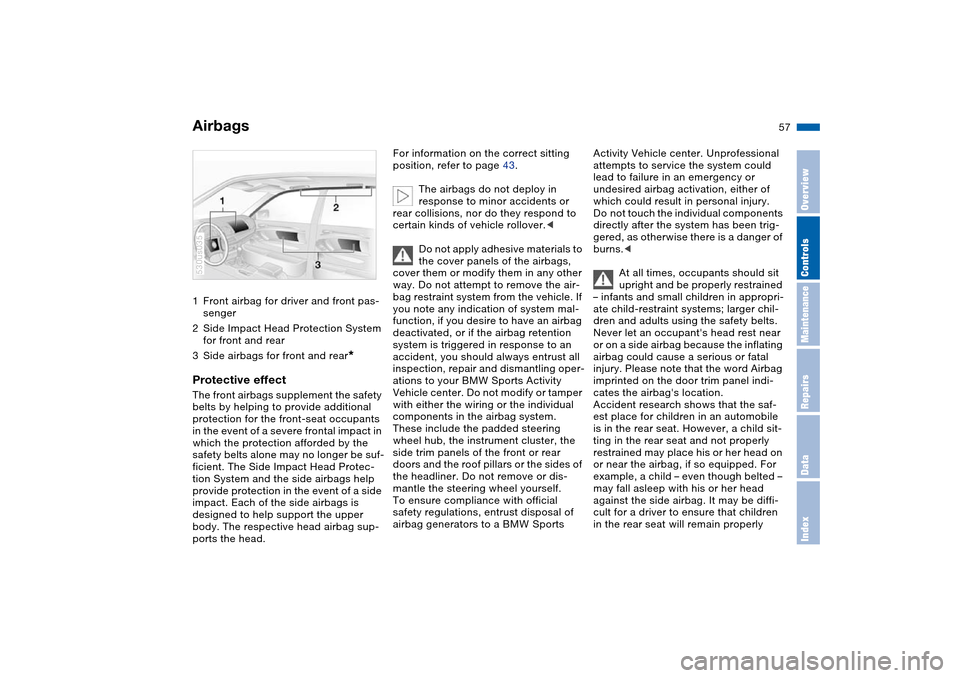
Airbags1Front airbag for driver and front pas-
senger
2Side Impact Head Protection System
for front and rear
3Side airbags for front and rear
*
Protective effect The front airbags supplement the safety
belts by helping to provide additional
protection for the front-seat occupants
in the event of a severe frontal impact in
which the protection afforded by the
safety belts alone may no longer be suf-
ficient. The Side Impact Head Protec-
tion System and the side airbags help
provide protection in the event of a side
impact. Each of the side airbags is
designed to help support the upper
body. The respective head airbag sup-
ports the head.530us035
For information on the correct sitting
position, refer to page 43.
The airbags do not deploy in
response to minor accidents or
rear collisions, nor do they respond to
certain kinds of vehicle rollover.<
Do not apply adhesive materials to
the cover panels of the airbags,
cover them or modify them in any other
way. Do not attempt to remove the air-
bag restraint system from the vehicle. If
you note any indication of system mal-
function, if you desire to have an airbag
deactivated, or if the airbag retention
system is triggered in response to an
accident, you should always entrust all
inspection, repair and dismantling oper-
ations to your BMW Sports Activity
Vehicle center. Do not modify or tamper
with either the wiring or the individual
components in the airbag system.
These include the padded steering
wheel hub, the instrument cluster, the
side trim panels of the front or rear
doors and the roof pillars or the sides of
the headliner. Do not remove or dis-
mantle the steering wheel yourself.
To ensure compliance with official
safety regulations, entrust disposal of
airbag generators to a BMW Sports
Activity Vehicle center. Unprofessional
attempts to service the system could
lead to failure in an emergency or
undesired airbag activation, either of
which could result in personal injury.
Do not touch the individual components
directly after the system has been trig-
gered, as otherwise there is a danger of
burns.<
At all times, occupants should sit
upright and be properly restrained
– infants and small children in appropri-
ate child-restraint systems; larger chil-
dren and adults using the safety belts.
Never let an occupant's head rest near
or on a side airbag because the inflating
airbag could cause a serious or fatal
injury. Please note that the word Airbag
imprinted on the door trim panel indi-
cates the airbag's location.
Accident research shows that the saf-
est place for children in an automobile
is in the rear seat. However, a child sit-
ting in the rear seat and not properly
restrained may place his or her head on
or near the airbag, if so equipped. For
example, a child – even though belted –
may fall asleep with his or her head
against the side airbag. It may be diffi-
cult for a driver to ensure that children
in the rear seat will remain properly
Page 61 of 200
59n
OverviewControlsMaintenanceRepairsDataIndex
Airbags Transporting children safely Airbag system operational
The warning lamp in the instru-
ment cluster indicates the oper-
ational readiness of the entire
airbag system and the safety belt ten-
sioners as of ignition key position 1.
The warning lamp goes out after a few
seconds.
Airbag system malfunction
Have the airbag system checked
immediately if a malfunction
occurs, as otherwise there is a danger
of the system failing to respond in the
expected manner to an impact occur-
ring within its normal response range.<
A fault has occurred in the air-
bag system:
>Warning lamp does not light up as of
ignition key position 1
>Warning lamp lights up continuously
>Warning lamp lights up while the
vehicle is being driven.
The right place for children Children always in the rear:
Accident research shows that the saf-
est place for children in a vehicle is in
the rear seat.
Older children should be tightly secured
with a safety belt, after they have out-
grown a booster seat that is appropri-
ate for their age, height and weight.
A child sitting in the rear seat and
not properly restrained may place
his or her head on or near the airbag, if
so equipped. For example, a child –
even though belted – may fall asleep
with his or her head against the side air-
bag. It may be difficult for a driver to
ensure that children in the rear seat will
remain properly positioned at all times
and do not place their heads on or near
the side airbag. Therefore, we recom-
mend that the rear side airbags, if pro-
vided, be deactivated if you plan to
transport children in the rear seat.<
Child-restraint systems in the rearChild-restraint systems appropriate for
every age group and weight are avail-
able at your BMW Sports Activity Vehi-
cle center.
Children under 13 years of age
and children less than 5 ft/150 cm
tall should always ride in the rear and
the restraint systems should be secured
with the vehicle's safety belts.<
No universal child-restraint sys-
tems facing the rear of the vehicle
may be mounted on the rear seats.
If you want to use a rearward-facing
child-restraint system in the rear, then
the BMW Baby Seat with or without the
LATCH child-restraint fixing is suitable
for this purpose.<
Younger children should be secured in
an appropriate forward-facing child-
restraint system that has first been
properly secured with a safety belt.
All rear sitting positions in your
vehicle meet the recommendations of
SAE J1819, an industry-recommended
practice for securing child-restraint sys-
tems in motor vehicles.
Page 63 of 200
61n
OverviewControlsMaintenanceRepairsDataIndex
Transporting children safelyUnlocking safety belt Unlock the safety belt, remove the
child-restraint device and allow the belt
retractor to reel the belt completely in.
Child-restraint system with tether
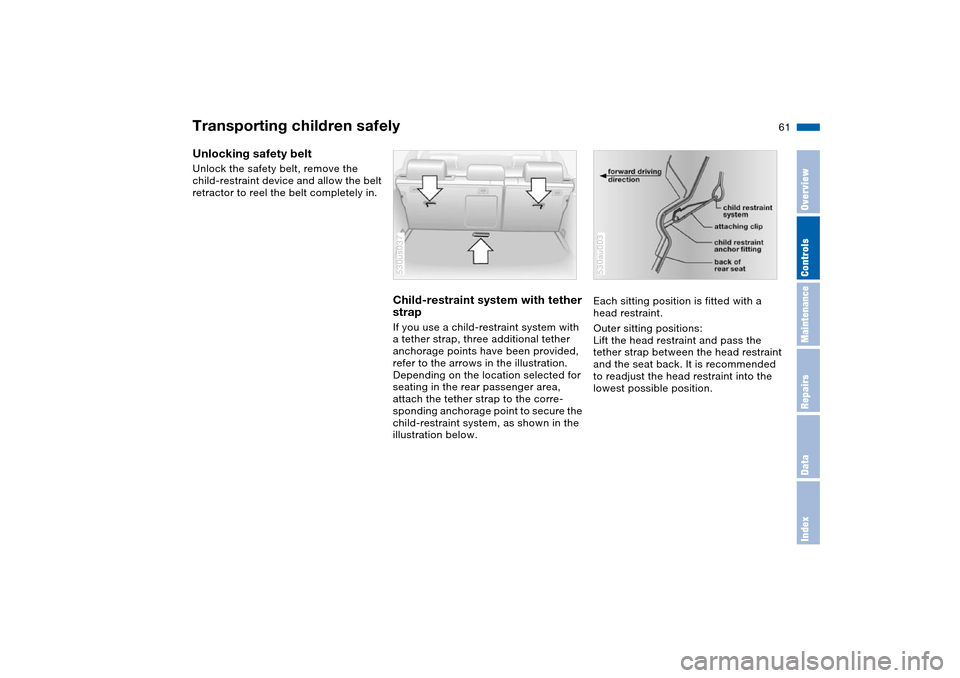
strapIf you use a child-restraint system with
a tether strap, three additional tether
anchorage points have been provided,
refer to the arrows in the illustration.
Depending on the location selected for
seating in the rear passenger area,
attach the tether strap to the corre-
sponding anchorage point to secure the
child-restraint system, as shown in the
illustration below. 530us037
Each sitting position is fitted with a
head restraint.
Outer sitting positions:
Lift the head restraint and pass the
tether strap between the head restraint
and the seat back. It is recommended
to readjust the head restraint into the
lowest possible position.530au003
Page 65 of 200
63n
OverviewControlsMaintenanceRepairsDataIndex
Vehicle Memory, Key Memory How the system functions You have probably frequently wished
that you could configure individual
functions of your vehicle to reflect your
own personal requirements. In engi-
neering your vehicle, BMW has
included several user-defined func-
tions in the vehicle's design. Your
BMW Sports Activity Vehicle center can
make these settings for you.
There are vehicle and person-related
adjustments: Vehicle Memory and Key
Memory. You can configure up to four
different basic positions for four differ-
ent persons. The only requirement is
that each person uses his or her own
remote control key.
When your vehicle is unlocked with the
remote control, the vehicle recognizes
the individual user by means of a data
exchange with the key, and makes
adjustments accordingly.
In order for you to distinguish between
the master keys with remote control,
color-coded decals are supplied
together with the keys.
What the system can doYour BMW Sports Activity Vehicle cen-
ter can provide you with details on the
capabilities of the Vehicle Memory and
Key Memory systems.
You will see this symbol through-
out the Owner's Manual. It is to
remind you at appropriate places of the
settings that are available to you.<
Following configuration of the
memory functions, vehicle opera-
tion may differ from the description in
the Owner's Manual. Should you want
to sell your BMW some day, please
remember to have the memory func-
tions reset to the default state.<
Examples for Vehicle Memory:
>Various signals that can serve as
acknowledgment for locking and
unlocking the vehicle, refer to
pages 31, 33
>Deactivating/activating the pathway
lighting function, refer to page 102.
Examples for Key Memory:
>Automatic adjustment of the driver's
seat, exterior mirror and steering
wheel with settings stored in the
memory for the individual driver when
the vehicle is unlocked, refer to
page 51
>Calling up customized settings for
the automatic climate control when
unlocking the vehicle, refer to
page 111.
Page 67 of 200
65n
OverviewControlsMaintenanceRepairsDataIndex
Starting engine Switching off engineWhen starting the engine, do not press
the accelerator pedal.
X5 3.0i:
Do not actuate the starter for too
short a time. Do not turn it for more
than approx. 20 seconds. Release the
ignition key immediately as soon as the
engine starts.
X5 4.4i, 4.8is:
Your BMW is equipped with the conve-
nience starting feature. Here, it is suffi-
cient to turn the ignition key only briefly
to position 3 'Start engine' and to let go
of it right away. The starter actuation
continues to operate automatically for a
certain period of time and is stopped
automatically as soon as the engine has
started.
The automatic starting mode will not
operate or will be canceled if the bat-
tery voltage is insufficient. The engine
can be started by jump-starting, refer to
page 171.<
Do not allow the engine to warm up
by leaving it running while the vehicle
remains stationary. Instead, begin to
drive immediately at a moderate engine
speed.
Should the engine fail to start on the
first attempt, if it is very hot or cold, for
instance:
>Press the accelerator pedal halfway
down while engaging the starter.
Cold starts at altitudes above 3,300 ft/
1,000 meters and at very low tempera-
tures, from approx. +57/–156:
>For the initial starting attempt, allow
the starter to remain engaged some-
what longer, approx. 10 seconds.
Engine idle speed is controlled by the
engine computer system. Increased
speeds at startup are normal and
should decrease as the engine warms
up. If engine speed does not decrease,
service is required.
To prevent the battery from discharg-
ing, always switch off electrical devices
that are not in use. Switch the ignition
off when the vehicle is not being driven.
Extended starting attempts, char-
acterized by excessively frequent
or long periods with the starter
engaged, can lead to damage of the
catalytic converter.<
Manual transmission:
1. Turn the ignition key to position 1
or 0
2. Engage first gear or reverse gear.
Automatic transmission:
1. Engage selector-lever position P
2. Turn the ignition key to position 1
or 0.
Do not remove the ignition key
when the vehicle is moving, as
otherwise the steering could lock.
When leaving the vehicle, always
remove the ignition key and lock the
steering.
Vehicles with manual transmission:
Always engage the handbrake when
parking on slopes and inclined sur-
faces. Even placing the gearshift lever
in 1st gear or reverse may not provide
adequate resistance to rolling.
Vehicles with automatic transmission:
Place the selector lever in Park.<
Vehicles with automatic transmission:
The vehicle must be stationary and the
selector lever in Park before you can
remove the ignition key.
Page 69 of 200
67n
OverviewControlsMaintenanceRepairsDataIndex
Manual transmission Automatic transmission with SteptronicReverse Select only when the vehicle is station-
ary. Press the gearshift lever to the left
to overcome the resistance.
As you do this, the backup lamps will
turn on automatically when the ignition
key is in position 2.
In addition to fully automatic operation,
you can also manually shift with the
Steptronic, refer to page 69.
Under normal operating conditions, fuel
consumption is lowest when driving in
position D.
530us238
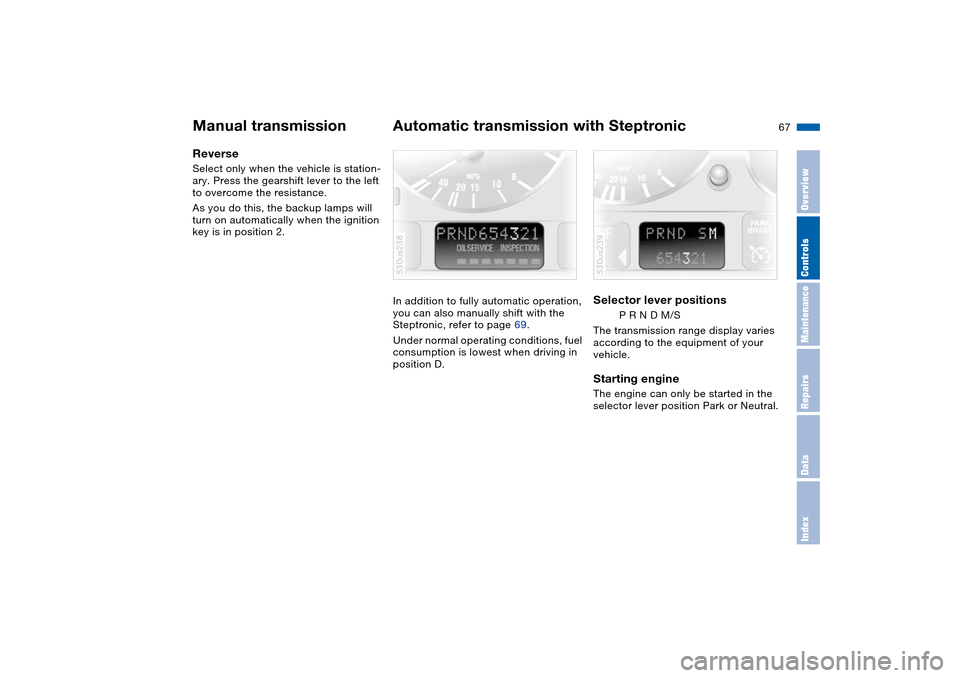
Selector lever positions
P R N D M/S
The transmission range display varies
according to the equipment of your
vehicle.
Starting engine The engine can only be started in the
selector lever position Park or Neutral. 530us239
Page 71 of 200
69n
OverviewControlsMaintenanceRepairsDataIndex
Automatic transmission with SteptronicSport program and M/S manual
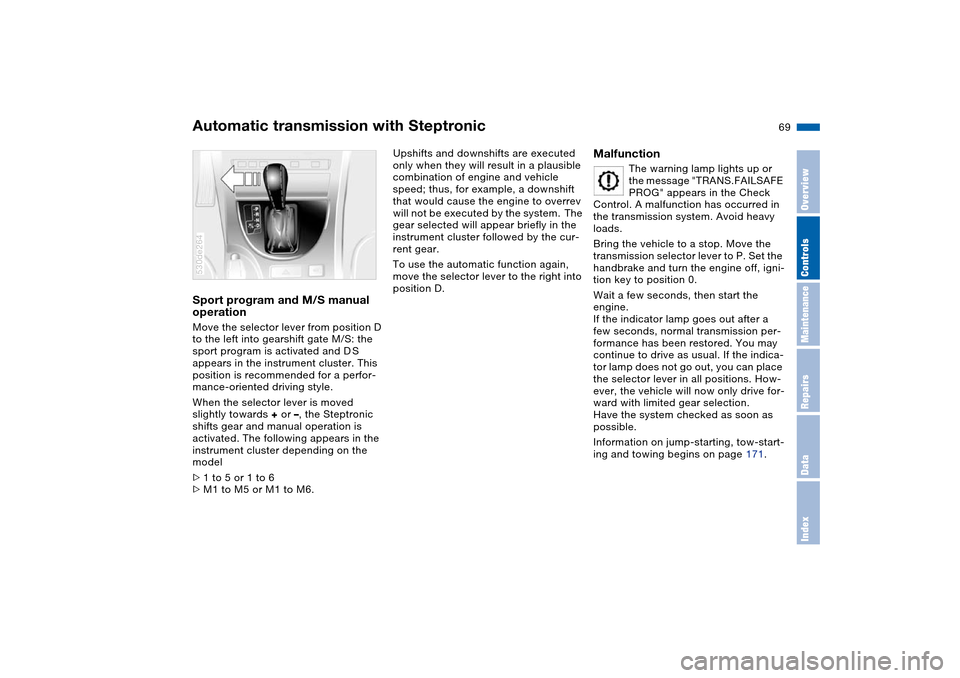
operation Move the selector lever from position D
to the left into gearshift gate M/S: the
sport program is activated and D S
appears in the instrument cluster. This
position is recommended for a perfor-
mance-oriented driving style.
When the selector lever is moved
slightly towards + or –, the Steptronic
shifts gear and manual operation is
activated. The following appears in the
instrument cluster depending on the
model
>1 to 5 or 1 to 6
>M1 to M5 or M1 to M6. 530de264
Upshifts and downshifts are executed
only when they will result in a plausible
combination of engine and vehicle
speed; thus, for example, a downshift
that would cause the engine to overrev
will not be executed by the system. The
gear selected will appear briefly in the
instrument cluster followed by the cur-
rent gear.
To use the automatic function again,
move the selector lever to the right into
position D.
Malfunction
The warning lamp lights up or
the message "TRANS.FAILSAFE
PROG" appears in the Check
Control. A malfunction has occurred in
the transmission system. Avoid heavy
loads.
Bring the vehicle to a stop. Move the
transmission selector lever to P. Set the
handbrake and turn the engine off, igni-
tion key to position 0.
Wait a few seconds, then start the
engine.
If the indicator lamp goes out after a
few seconds, normal transmission per-
formance has been restored. You may
continue to drive as usual. If the indica-
tor lamp does not go out, you can place
the selector lever in all positions. How-
ever, the vehicle will now only drive for-
ward with limited gear selection.
Have the system checked as soon as
possible.
Information on jump-starting, tow-start-
ing and towing begins on page 171.
Page 73 of 200
71n
OverviewControlsMaintenanceRepairsDataIndex
Washer/wiper system/rain sensor
*
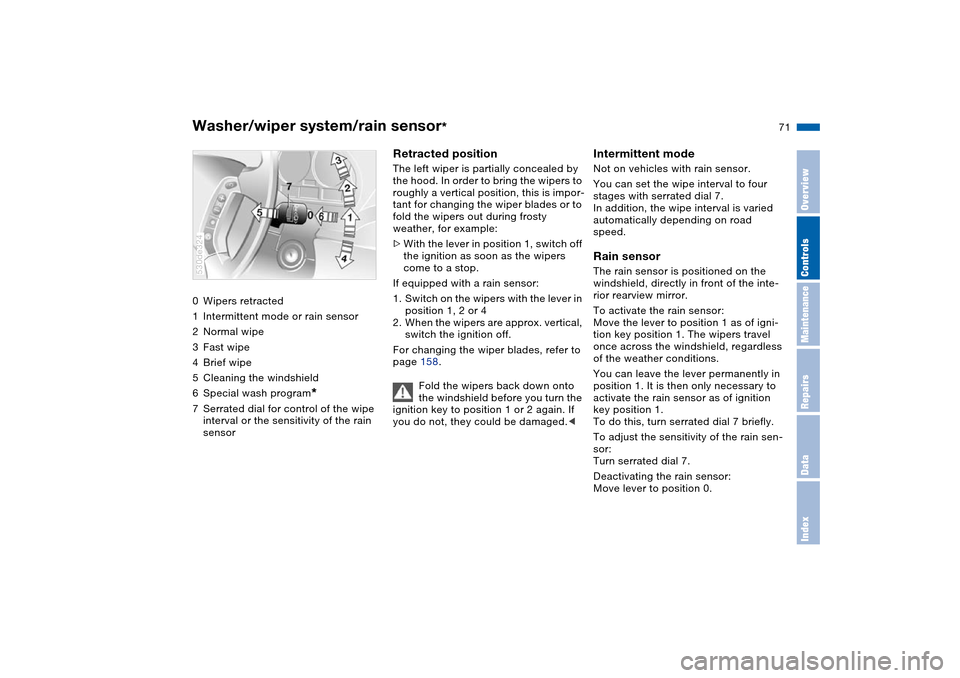
0Wipers retracted
1Intermittent mode or rain sensor
2Normal wipe
3Fast wipe
4Brief wipe
5Cleaning the windshield
6Special wash program
*
7Serrated dial for control of the wipe
interval or the sensitivity of the rain
sensor530de324
Retracted positionThe left wiper is partially concealed by
the hood. In order to bring the wipers to
roughly a vertical position, this is impor-
tant for changing the wiper blades or to
fold the wipers out during frosty
weather, for example:
>With the lever in position 1, switch off
the ignition as soon as the wipers
come to a stop.
If equipped with a rain sensor:
1. Switch on the wipers with the lever in
position 1, 2 or 4
2. When the wipers are approx. vertical,
switch the ignition off.
For changing the wiper blades, refer to
page 158.
Fold the wipers back down onto
the windshield before you turn the
ignition key to position 1 or 2 again. If
you do not, they could be damaged.<
Intermittent mode Not on vehicles with rain sensor.
You can set the wipe interval to four
stages with serrated dial 7.
In addition, the wipe interval is varied
automatically depending on road
speed. Rain sensor The rain sensor is positioned on the
windshield, directly in front of the inte-
rior rearview mirror.
To activate the rain sensor:
Move the lever to position 1 as of igni-
tion key position 1. The wipers travel
once across the windshield, regardless
of the weather conditions.
You can leave the lever permanently in
position 1. It is then only necessary to
activate the rain sensor as of ignition
key position 1.
To do this, turn serrated dial 7 briefly.
To adjust the sensitivity of the rain sen-
sor:
Turn serrated dial 7.
Deactivating the rain sensor:
Move lever to position 0.
Page 75 of 200
73n
OverviewControlsMaintenanceRepairsDataIndex
Washer/wiper system/rain sensor
*
Cruise control
*
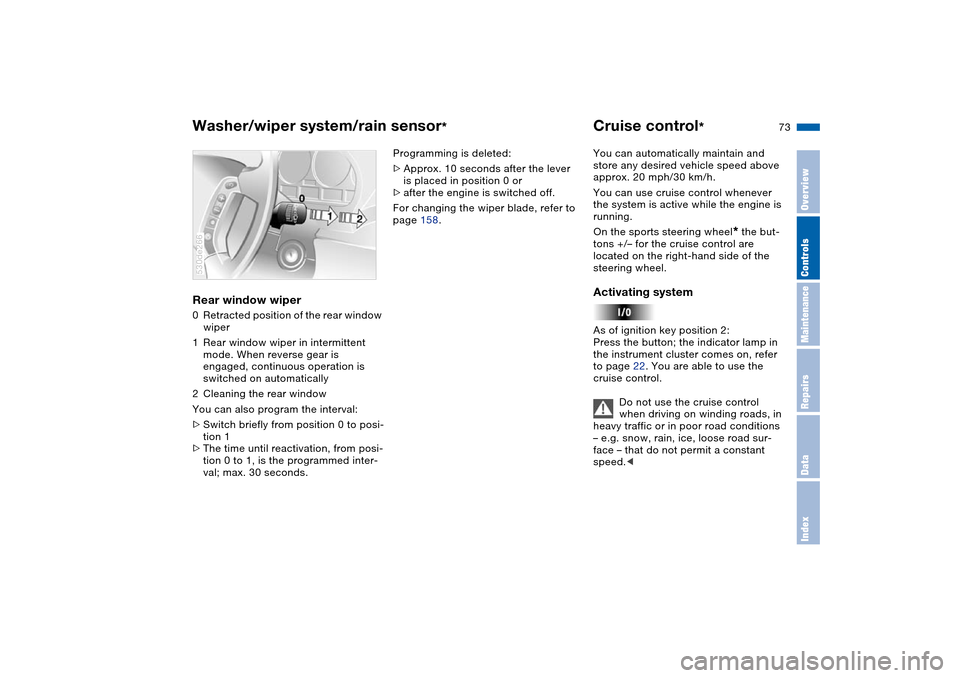
Rear window wiper 0Retracted position of the rear window
wiper
1Rear window wiper in intermittent
mode. When reverse gear is
engaged, continuous operation is
switched on automatically
2Cleaning the rear window
You can also program the interval:
>Switch briefly from position 0 to posi-
tion 1
>The time until reactivation, from posi-
tion 0 to 1, is the programmed inter-
val; max. 30 seconds. 530de266
Programming is deleted:
>Approx. 10 seconds after the lever
is placed in position 0 or
>after the engine is switched off.
For changing the wiper blade, refer to
page 158.You can automatically maintain and
store any desired vehicle speed above
approx. 20 mph/30 km/h.
You can use cruise control whenever
the system is active while the engine is
running.
On the sports steering wheel
* the but-
tons +/– for the cruise control are
located on the right-hand side of the
steering wheel.
Activating system As of ignition key position 2:
Press the button; the indicator lamp in
the instrument cluster comes on, refer
to page 22. You are able to use the
cruise control.
Do not use the cruise control
when driving on winding roads, in
heavy traffic or in poor road conditions
– e.g. snow, rain, ice, loose road sur-
face – that do not permit a constant
speed.<
Page 77 of 200
Maintenance
75n
OverviewControlsRepairsDataIndex
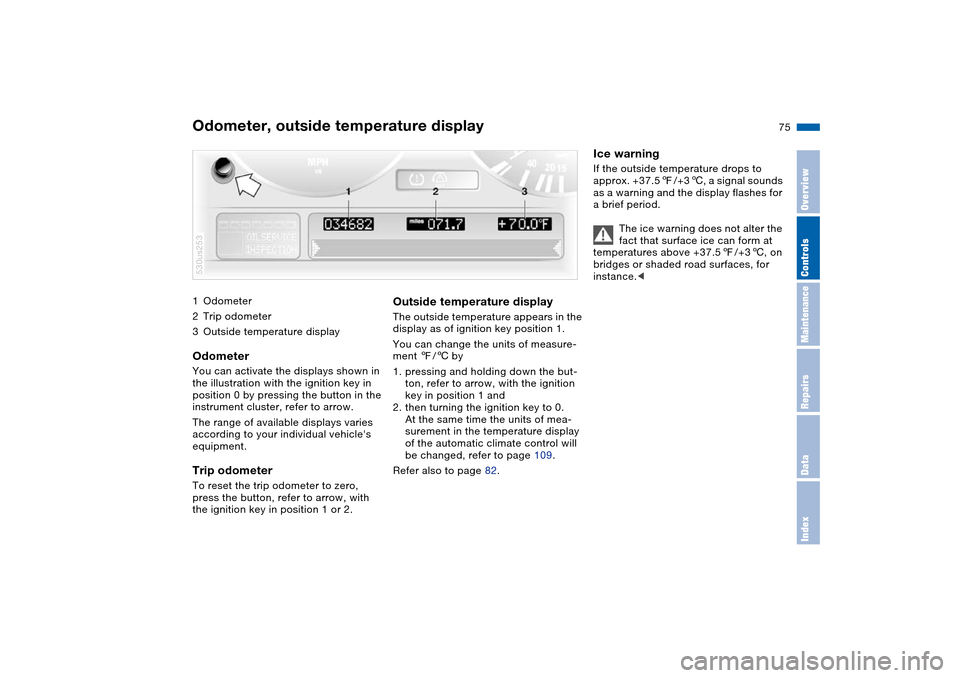
1Odometer
2Trip odometer
3Outside temperature displayOdometer You can activate the displays shown in
the illustration with the ignition key in
position 0 by pressing the button in the
instrument cluster, refer to arrow.
The range of available displays varies
according to your individual vehicle's
equipment.Trip odometer To reset the trip odometer to zero,
press the button, refer to arrow, with
the ignition key in position 1 or 2. 530us253
Outside temperature display The outside temperature appears in the
display as of ignition key position 1.
You can change the units of measure-
ment 7/6 by
1. pressing and holding down the but-
ton, refer to arrow, with the ignition
key in position 1 and
2. then turning the ignition key to 0.
At the same time the units of mea-
surement in the temperature display
of the automatic climate control will
be changed, refer to page 109.
Refer also to page 82.
Ice warning If the outside temperature drops to
approx. +37.57/+36, a signal sounds
as a warning and the display flashes for
a brief period.
The ice warning does not alter the
fact that surface ice can form at
temperatures above +37.57/+36, on
bridges or shaded road surfaces, for
instance.<
Odometer, outside temperature display