Rear end BMW X5 4.4I 2005 E53 User Guide
[x] Cancel search | Manufacturer: BMW, Model Year: 2005, Model line: X5 4.4I, Model: BMW X5 4.4I 2005 E53Pages: 200, PDF Size: 3.55 MB
Page 99 of 200
99n
OverviewControlsMaintenanceRepairsDataIndex
2-axle self-leveling suspension
*
The concept Your vehicle is equipped with 2-axle
self-leveling suspension acting on both
the front and rear suspension. This sys-
tem combines automatic self-leveling,
which compensates for variations in
front-to-rear load-distribution patterns,
with a selection feature allowing drivers
to choose from among several ride-
height options.
You may choose from among the fol-
lowing ride heights:
>Normal
The standard setting is intended for
most operating conditions, including
trailer towing
>Off-Road
Increased level for more ground
clearance
>Access
Lowers vehicle for more convenient
cargo handling or easier passenger
entries and exits.
Changes in ride height are initiated
either manually, using the control but-
ton, refer to page 100, or automatically
in response to specific speeds. When
the ride height is selected manually, the
driver has the additional option of revis-
ing the ride-height selection by entering a new command during the adjustment
process.
When the vehicle is stationary, the sys-
tem executes ride-height changes in
both directions – up and down – when-
ever the doors are closed. The tailgate/
liftgate may be open. The system raises
the vehicle only when the engine is run-
ning.
The system's automatic self-leveling
feature automatically compensates for
variations in the vehicle's load.
Frequent changes in ride height
initiated at short intervals can
overheat the compressor, causing the
system to briefly suspend active opera-
tion.<
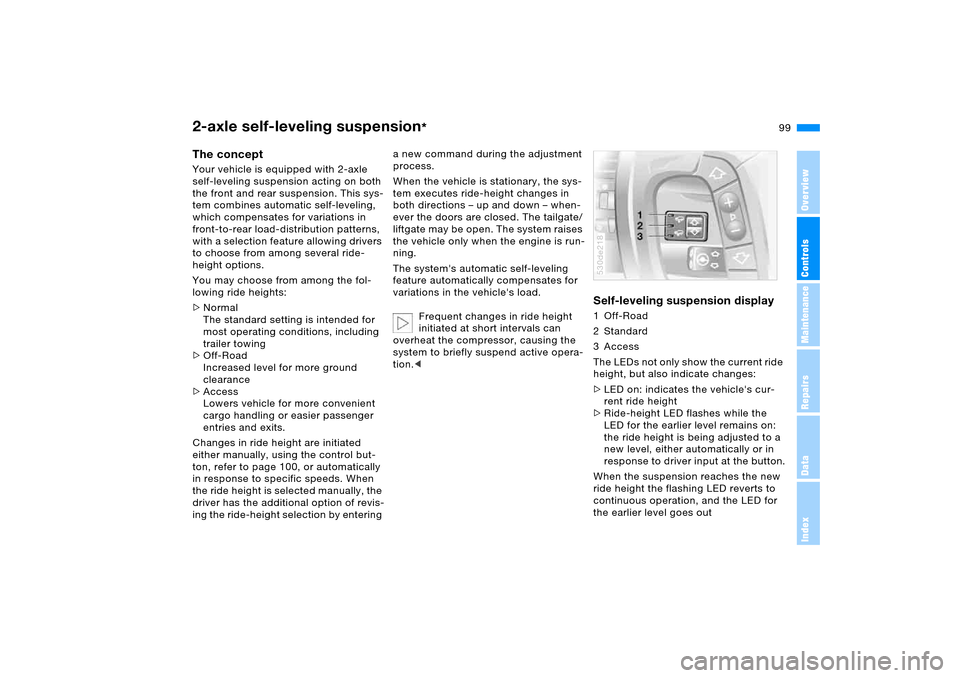
Self-leveling suspension display 1 Off-Road
2Standard
3 Access
The LEDs not only show the current ride
height, but also indicate changes:
>LED on: indicates the vehicle's cur-
rent ride height
>Ride-height LED flashes while the
LED for the earlier level remains on:
the ride height is being adjusted to a
new level, either automatically or in
response to driver input at the button.
When the suspension reaches the new
ride height the flashing LED reverts to
continuous operation, and the LED for
the earlier level goes out530de218
Page 108 of 200
108n
Air conditioner Temperature
The graduations on the dial
provide general reference val-
ues for the interior tempera-
ture. 707/226 is recom-
mended as a comfortable setting. After
the start of driving the selected temper-
ature is reached as quickly as possible
and held constant by the control sys-
tem.
Air distribution
You can direct air to flow onto
the windows , toward the
upper body and into the
footwell . All intermediate
settings are possible. In the setting,
there is a low flow of air onto the win-
dows to keep them free of condensa-
tion.
Air supply
You can adjust the air supply
through an infinitely-variable
range. The heating and venti-
lation become more and more
effective as the air supply settings are
increased. In the 0 setting, the blower
and climate control are switched off
and the outside air supply is blocked.
Rear window defroster
When the rear window
defroster is activated, the
indicator lamp comes on. The rear win-
dow defroster switches off automati-
cally.
Air conditioning
The air is cooled and dehu-
midified and — depending on
the temperature setting — warmed
again. Depending on the weather, the
windshield may fog over briefly when
the engine is started. You can reduce
condensation forming on the windows
by switching on the air conditioning.
During air conditioning condensa-
tion forms, which then exits under
the vehicle. Traces of water on the
ground are therefore normal.<
Recirculated-air mode
You can respond to unpleas-
ant odors outside the vehicle
by temporarily switching off the outside
air supply. The system then recirculates
the air currently within the vehicle.
With the button on the steering wheel
you can also switch over to the recircu-
lated-air mode, refer to page 23.
If the windows fog over in the
recirculated-air mode, switch the
recirculated-air mode off and increase
the air supply as required.<
Page 113 of 200
113n
OverviewControlsMaintenanceRepairsDataIndex
Automatic climate control
*
Air conditioning
The air is cooled and
dehumidified and —
depending on the temperature setting —
warmed again. Depending on the
weather, the windshield may fog over
briefly when the engine is started. You
can reduce condensation forming on
the windows by switching on the air
conditioning.
During air conditioning condensa-
tion forms, which then exits under
the vehicle. That traces of water on the
ground are therefore normal.<
Maximum cooling
You will get maximum cool-
ing capacity using this pro-
gram if the engine is running and the
outside temperature is above approx.
417/56.
The temperature display 9 jumps to
607/166, the system switches over
to the recirculated-air mode, and the
maximum air supply flows from the ven-
tilation grills only. That is why you need
to keep these open if you select this
program.
AUC Automatic recirculated-air
control
You can respond to
unpleasant odors or pollut-
ants in the immediate environment by
shutting off the supply of outside air.
The system then recirculates the air
currently within the vehicle. In AUC
operating mode, a sensor detects pol-
lutants in the external air and controls
the shut-off automatically.
Press the button repeatedly to run
through the following control sequence
>Indicator lamps off: outside air supply
operational
>Left indicator lamp on, AUC mode:
the system recognizes pollutants in
the outside air and blocks the flow of
air when necessary. The system then
recirculates the air currently within
the vehicle.
Depending on the air quality, the
automatic system then switches back
and forth between outside air supply
and recirculation of the air within the
vehicle
>Right-hand indicator lamp on: the
outside air supply into the vehicle is
completely blocked. The system then
recirculates the air currently within
the vehicle.
With the button on the steering wheel
you can also switch between Off and
recirculated-air mode or AUC and recir-
culated-air mode, refer to page23.
If the windows fog over in the
recirculated-air mode, switch the
recirculated-air mode off and increase
the air supply as required.< Rear window defroster
When the rear window
defroster is activated, the
indicator lamp comes on. The rear win-
dow defroster switches off automati-
cally.
Residual heat
Press button when the motor
is switched off, but warm.
The heat which is stored in the engine
is utilized for heating the interior when
the engine has been switched off –
while waiting at a railroad crossing, for
instance.
This function may be activated when
the outside temperature is below
approx. 597/156, the engine is at
operating temperature, and the battery
is adequately charged. The LED on the
button will light up when all conditions
have been met.
Page 121 of 200
121n
OverviewControlsMaintenanceRepairsDataIndex
Storage compartments Cup holders Clothes hooks
When suspending clothing from
the hooks ensure that it will not
obstruct the driver's vision. Do not hang
heavy objects on the hooks. If you do
so, they could cause endanger passen-
gers during braking or evasive maneu-
vers.<
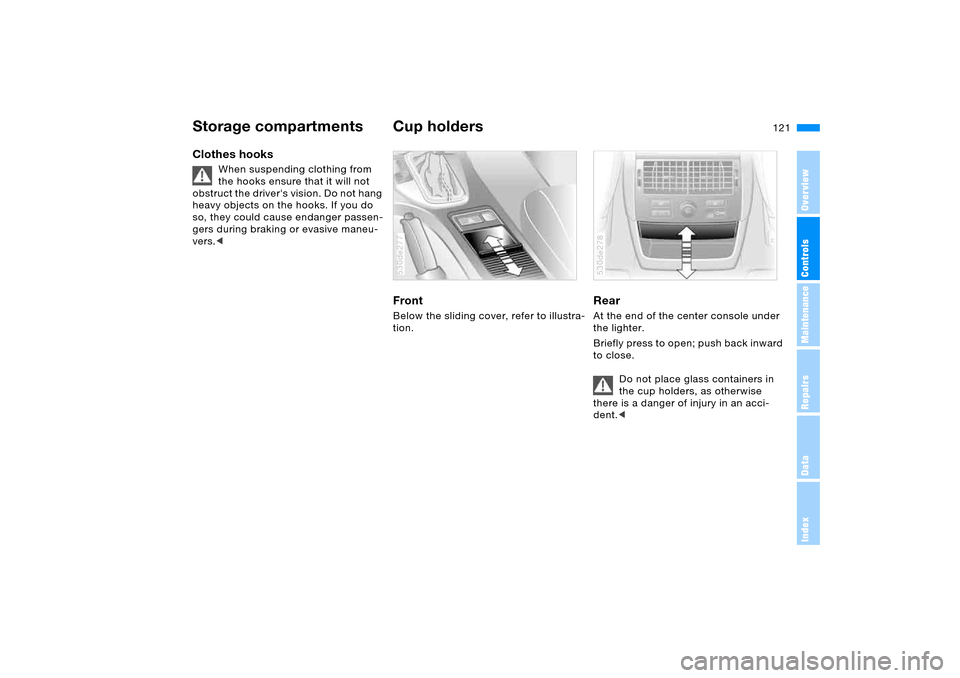
Front Below the sliding cover, refer to illustra-
tion.530de277
RearAt the end of the center console under
the lighter.
Briefly press to open; push back inward
to close.
Do not place glass containers in
the cup holders, as otherwise
there is a danger of injury in an acci-
dent.< 530de278
Page 125 of 200
125n
OverviewControlsMaintenanceRepairsDataIndex
Ski bag
*
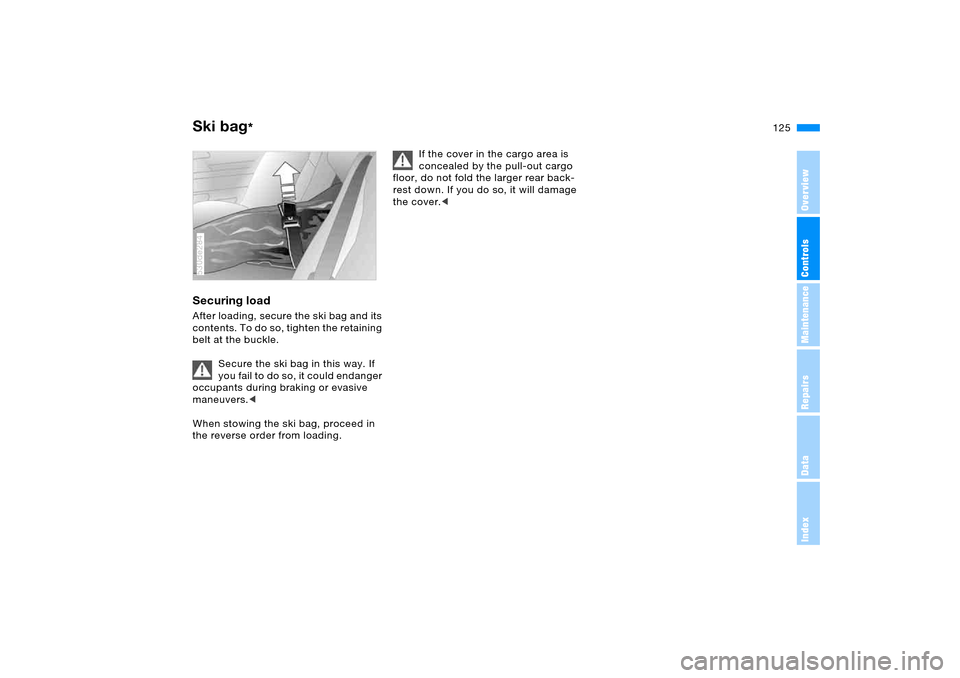
Securing load After loading, secure the ski bag and its
contents. To do so, tighten the retaining
belt at the buckle.
Secure the ski bag in this way. If
you fail to do so, it could endanger
occupants during braking or evasive
maneuvers.<
When stowing the ski bag, proceed in
the reverse order from loading.530de284
If the cover in the cargo area is
concealed by the pull-out cargo
floor, do not fold the larger rear back-
rest down. If you do so, it will damage
the cover.<
Page 130 of 200
130n
Cargo area Pull-out cargo floor
*
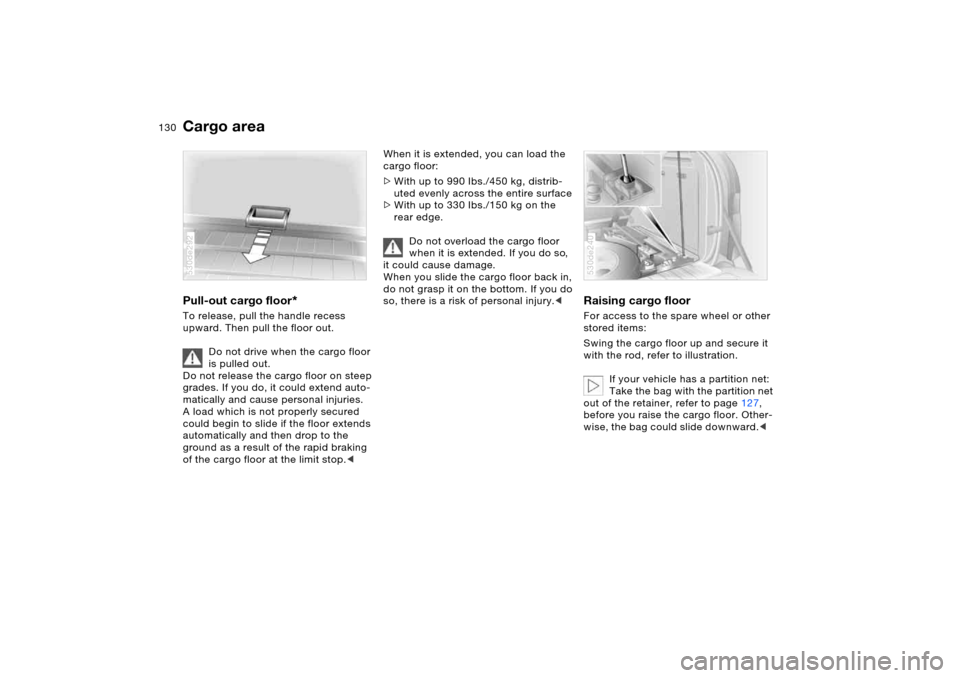
To release, pull the handle recess
upward. Then pull the floor out.
Do not drive when the cargo floor
is pulled out.
Do not release the cargo floor on steep
grades. If you do, it could extend auto-
matically and cause personal injuries.
A load which is not properly secured
could begin to slide if the floor extends
automatically and then drop to the
ground as a result of the rapid braking
of the cargo floor at the limit stop.< 530de292
When it is extended, you can load the
cargo floor:
>With up to 990 Ibs./450 kg, distrib-
uted evenly across the entire surface
>With up to 330 Ibs./150 kg on the
rear edge.
Do not overload the cargo floor
when it is extended. If you do so,
it could cause damage.
When you slide the cargo floor back in,
do not grasp it on the bottom. If you do
so, there is a risk of personal injury.<
Raising cargo floor For access to the spare wheel or other
stored items:
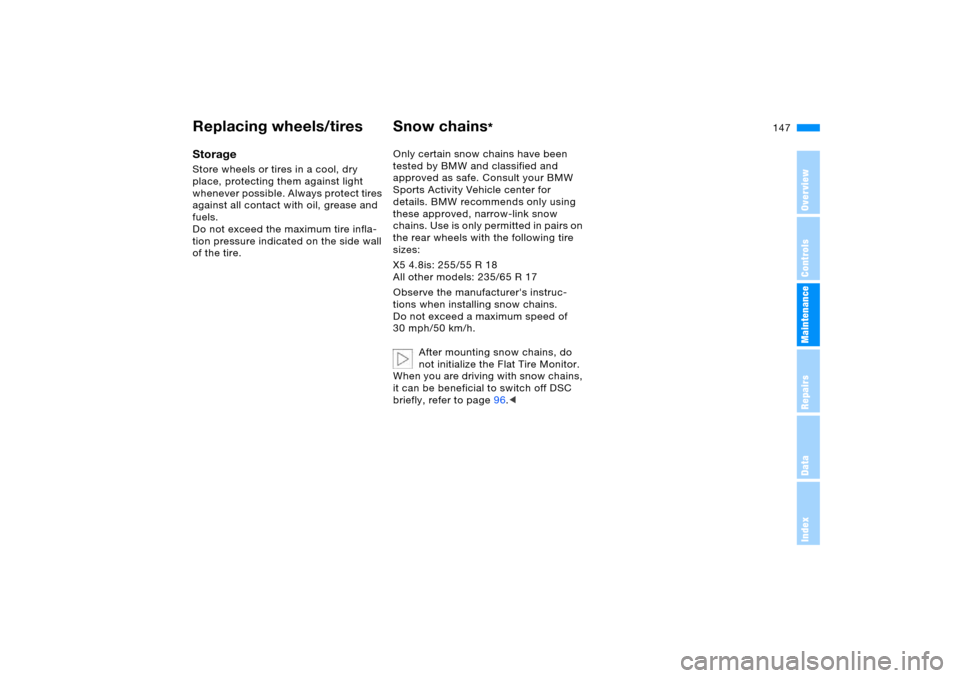
Swing the cargo floor up and secure it
with the rod, refer to illustration.
If your vehicle has a partition net:
Take the bag with the partition net
out of the retainer, refer to page127,
before you raise the cargo floor. Other-
wise, the bag could slide downward.< 530de240
Page 147 of 200
147n
OverviewControlsMaintenanceRepairsDataIndex
Replacing wheels/tires Snow chains
*
Storage Store wheels or tires in a cool, dry
place, protecting them against light
whenever possible. Always protect tires
against all contact with oil, grease and
fuels.
Do not exceed the maximum tire infla-
tion pressure indicated on the side wall
of the tire.Only certain snow chains have been
tested by BMW and classified and
approved as safe. Consult your BMW
Sports Activity Vehicle center for
details. BMW recommends only using
these approved, narrow-link snow
chains. Use is only permitted in pairs on
the rear wheels with the following tire
sizes:
X5 4.8is: 255/55 R 18
All other models: 235/65 R 17
Observe the manufacturer's instruc-
tions when installing snow chains.
Do not exceed a maximum speed of
30 mph/50 km/h.
After mounting snow chains, do
not initialize the Flat Tire Monitor.
When you are driving with snow chains,
it can be beneficial to switch off DSC
briefly, refer to page96.<
Page 160 of 200
160n
Lamps and bulbs 2 Halogen high beams H1 bulb, 55 watts
The bulb is pressurized. There-
fore, wear safety glasses and pro-
tective gloves. Failure to comply with
this precaution could lead to injury if the
bulb is accidentally damaged during
replacement.<
1. Remove the cover
2. Disconnect the plug
3. Unhook wire spring
4. Remove and replace the bulb. 530de359
3 Parking lamps and roadside
parking lamps 10 watt bulb: H 10 W
1. Remove the cover
2. Disconnect the plug
3. Turn reflector module with bulb to
left and remove
4. Replace module with bulb.Xenon lamps
*
The operating life of these lamp units
is extremely long and the likelihood of
failure very low, provided that they are
not switched on and off a very great
number of times. If one of these bulbs
should nevertheless fail, it is possible
to continue driving with great caution
using the fog lamps, provided traffic
laws in your area do not prohibit this.
To avoid risk of potentially fatal
injuries: owing to the extremely
high voltages at which these units oper-
ate, service work should always be
entrusted to qualified personnel.< Front turn signals/side-marker
lamps S 8 bulb
Please contact a BMW Sports Activity
Vehicle center in case of a malfunction.
Side turn signals 5 watt bulb: W 5 W or WY 5 W
*
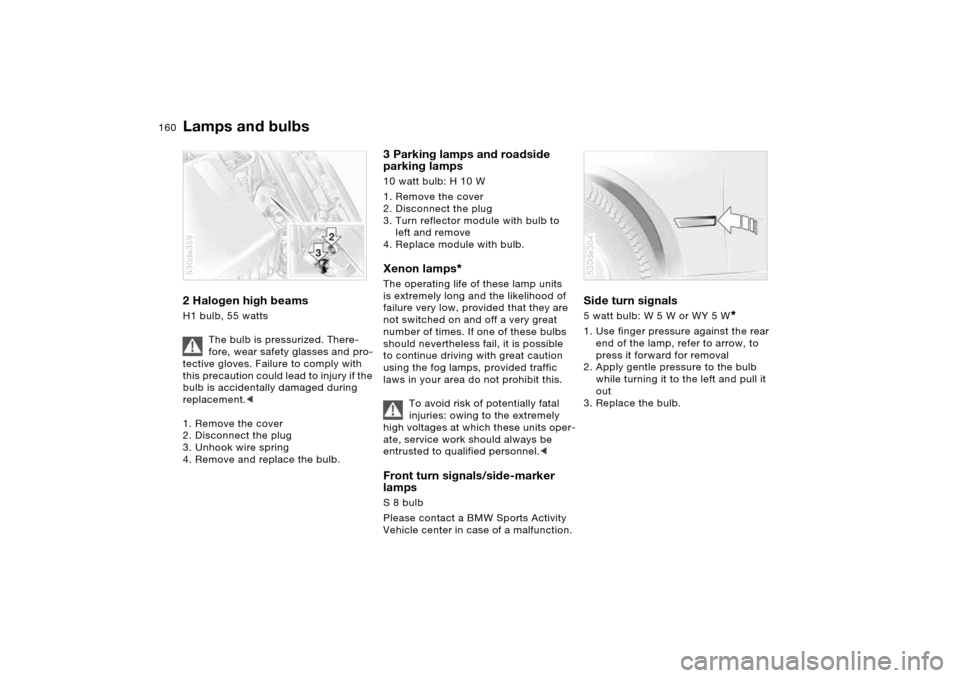
1. Use finger pressure against the rear
end of the lamp, refer to arrow, to
press it forward for removal
2. Apply gentle pressure to the bulb
while turning it to the left and pull it
out
3. Replace the bulb.530de304
Page 161 of 200
161n
OverviewControlsMaintenanceRepairsDataIndex
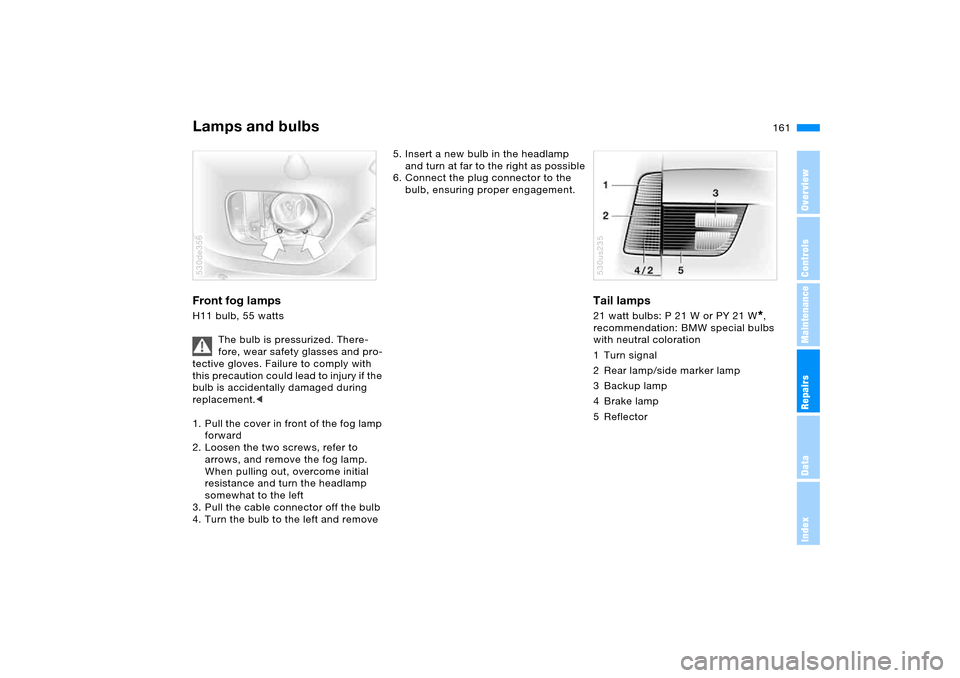
Lamps and bulbs Front fog lamps H11 bulb, 55 watts
The bulb is pressurized. There-
fore, wear safety glasses and pro-
tective gloves. Failure to comply with
this precaution could lead to injury if the
bulb is accidentally damaged during
replacement.<
1. Pull the cover in front of the fog lamp
forward
2. Loosen the two screws, refer to
arrows, and remove the fog lamp.
When pulling out, overcome initial
resistance and turn the headlamp
somewhat to the left
3. Pull the cable connector off the bulb
4. Turn the bulb to the left and remove530de356
5. Insert a new bulb in the headlamp
and turn at far to the right as possible
6. Connect the plug connector to the
bulb, ensuring proper engagement.
Tail lamps 21 watt bulbs: P 21 W or PY 21 W
*,
recommendation: BMW special bulbs
with neutral coloration
1 Turn signal
2 Rear lamp/side marker lamp
3 Backup lamp
4Brake lamp
5Reflector
530us235
Page 172 of 200
172n
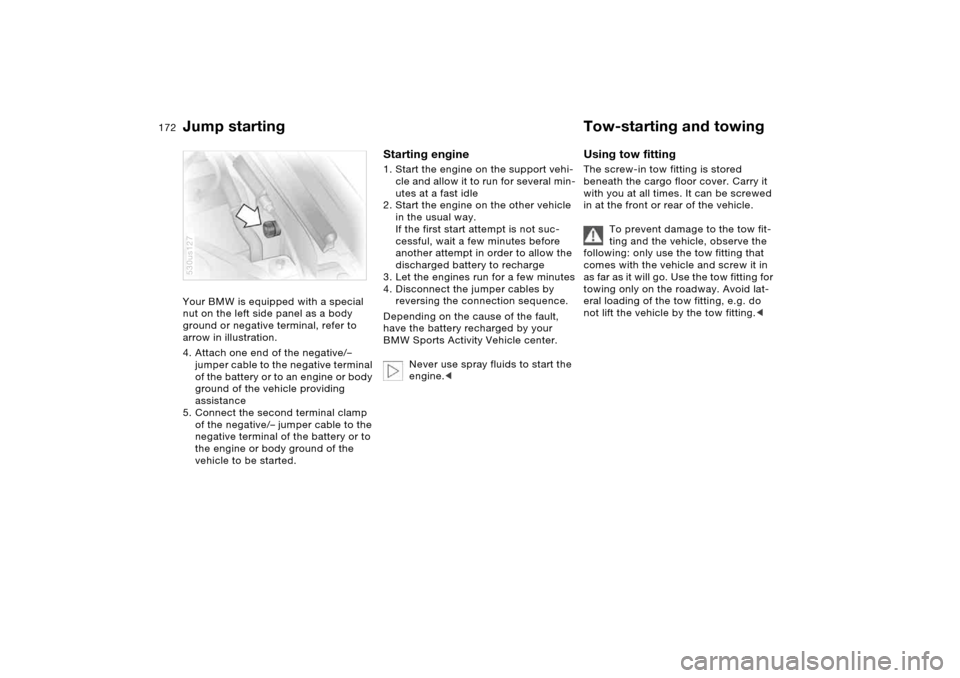
Jump starting Tow-starting and towing Your BMW is equipped with a special
nut on the left side panel as a body
ground or negative terminal, refer to
arrow in illustration.
4. Attach one end of the negative/–
jumper cable to the negative terminal
of the battery or to an engine or body
ground of the vehicle providing
assistance
5. Connect the second terminal clamp
of the negative/– jumper cable to the
negative terminal of the battery or to
the engine or body ground of the
vehicle to be started.530us127
Starting engine1. Start the engine on the support vehi-
cle and allow it to run for several min-
utes at a fast idle
2. Start the engine on the other vehicle
in the usual way.
If the first start attempt is not suc-
cessful, wait a few minutes before
another attempt in order to allow the
discharged battery to recharge
3. Let the engines run for a few minutes
4. Disconnect the jumper cables by
reversing the connection sequence.
Depending on the cause of the fault,
have the battery recharged by your
BMW Sports Activity Vehicle center.
Never use spray fluids to start the
engine.<
Using tow fitting The screw-in tow fitting is stored
beneath the cargo floor cover. Carry it
with you at all times. It can be screwed
in at the front or rear of the vehicle.
To prevent damage to the tow fit-
ting and the vehicle, observe the
following: only use the tow fitting that
comes with the vehicle and screw it in
as far as it will go. Use the tow fitting for
towing only on the roadway. Avoid lat-
eral loading of the tow fitting, e.g. do
not lift the vehicle by the tow fitting.<