battery BMW X5 4.4I 2005 E53 User Guide
[x] Cancel search | Manufacturer: BMW, Model Year: 2005, Model line: X5 4.4I, Model: BMW X5 4.4I 2005 E53Pages: 200, PDF Size: 3.55 MB
Page 106 of 200
106n
Interior lampsReading lamps
*
Reading lamps are located at the front
and in the rear next to the dome light.
They can be switched on and off with
the respective buttons 2 located next to
them.Footwell and cargo area lamps The lamps are controlled in the same
manner as the front interior lamps.Front area lighting
*
This lighting system in the two exterior
mirrors illuminates the ground in the
area near the two front doors. It is also
controlled in the same manner as the
front interior lamps, but it does not
function while the vehicle is moving.
In order to prevent battery dis-
charge, all of the lamps in the
vehicle are switched off automatically
approx. 15 minutes after the ignition
key is turned to position 0.<
Page 113 of 200
113n
OverviewControlsMaintenanceRepairsDataIndex
Automatic climate control
*
Air conditioning
The air is cooled and
dehumidified and —
depending on the temperature setting —
warmed again. Depending on the
weather, the windshield may fog over
briefly when the engine is started. You
can reduce condensation forming on
the windows by switching on the air
conditioning.
During air conditioning condensa-
tion forms, which then exits under
the vehicle. That traces of water on the
ground are therefore normal.<
Maximum cooling
You will get maximum cool-
ing capacity using this pro-
gram if the engine is running and the
outside temperature is above approx.
417/56.
The temperature display 9 jumps to
607/166, the system switches over
to the recirculated-air mode, and the
maximum air supply flows from the ven-
tilation grills only. That is why you need
to keep these open if you select this
program.
AUC Automatic recirculated-air
control
You can respond to
unpleasant odors or pollut-
ants in the immediate environment by
shutting off the supply of outside air.
The system then recirculates the air
currently within the vehicle. In AUC
operating mode, a sensor detects pol-
lutants in the external air and controls
the shut-off automatically.
Press the button repeatedly to run
through the following control sequence
>Indicator lamps off: outside air supply
operational
>Left indicator lamp on, AUC mode:
the system recognizes pollutants in
the outside air and blocks the flow of
air when necessary. The system then
recirculates the air currently within
the vehicle.
Depending on the air quality, the
automatic system then switches back
and forth between outside air supply
and recirculation of the air within the
vehicle
>Right-hand indicator lamp on: the
outside air supply into the vehicle is
completely blocked. The system then
recirculates the air currently within
the vehicle.
With the button on the steering wheel
you can also switch between Off and
recirculated-air mode or AUC and recir-
culated-air mode, refer to page23.
If the windows fog over in the
recirculated-air mode, switch the
recirculated-air mode off and increase
the air supply as required.< Rear window defroster
When the rear window
defroster is activated, the
indicator lamp comes on. The rear win-
dow defroster switches off automati-
cally.
Residual heat
Press button when the motor
is switched off, but warm.
The heat which is stored in the engine
is utilized for heating the interior when
the engine has been switched off –
while waiting at a railroad crossing, for
instance.
This function may be activated when
the outside temperature is below
approx. 597/156, the engine is at
operating temperature, and the battery
is adequately charged. The LED on the
button will light up when all conditions
have been met.
Page 116 of 200
116n
Independent ventilation
*
You can use this system to ventilate the
interior and lower its temperature, using
the blower of the independent ventila-
tion or of the automatic climate control.
The independent ventilation is operated
via the MID Multi-Information Display,
refer to page87, or via the onboard
computer, refer to the separate
Owner's Manual.
You can set two different times for the
system to start; it will remain active for
30 minutes. You can also switch it on
and off directly. Since the system uses
a substantial amount of electrical cur-
rent, you should refrain from switching
it on twice in succession without allow-
ing the battery to be recharged in nor-
mal operation between use.When a preselected activation time is
set, the independent ventilation is oper-
ational at outside temperatures above
approx. 607/166, or by direct switch
activation.
The air enters the passenger compart-
ment through the vent outlets in the
instrument cluster, which can be
adjusted for both direction and airflow.
Therefore, the vent outlets must be
open for the system to operate.
Page 159 of 200
159n
OverviewControlsMaintenanceRepairsDataIndex
Lamps and bulbs The lamps and bulbs make essential
contributions to the safety of your vehi-
cle. For this reason, follow the instruc-
tions below carefully when replacing
a bulb. If you are not familiar with any
of the procedures, consult your BMW
Sports Activity Vehicle center.
Never touch the glass on new
bulbs with your bare fingers, as
even minute amounts of contamination
will burn into the bulb's surface and
reduce its service life. Use a clean
cloth, paper napkin, or a similar mate-
rial, or hold the bulb by its metallic
base.<
A replacement bulb set is available from
your BMW Sports Activity Vehicle cen-
ter.
To prevent short circuits, before
working on any electrical system,
equipment or accessory you should
always switch it off and disconnect the
cable from the battery's negative termi-
nal before starting.
To avoid possible injury or equipment
damage when replacing bulbs, observe
any instructions provided by the bulb
manufacturer.<
Releasing lamp cover The illustration shows the right-hand
side of the engine compartment.
1 Halogen low beams
Turn cover cap to left, refer to arrow
2 High beams and parking lamps
Press tab downward, refer to arrow
For checking and adjusting head-
lamp aim, please contact your
BMW Sports Activity Vehicle center.< 530de357
1 Halogen low beams H7 bulb, 55 watts
The bulb is pressurized. There-
fore, wear safety glasses and pro-
tective gloves. Failure to comply with
this precaution could lead to injury if the
bulb is accidentally damaged during
replacement.<
1. Remove the cover
2. Turn the bulb holder to the left and
remove
3. Pull bulb out of bulb holder by base
and replace.530de358
Page 168 of 200
168n
Changing a wheel Vehicle battery 10. Screw in the remaining lug bolts.
Tighten all the bolts securely in a
diagonal pattern
11. Lower the jack and remove it from
beneath the vehicle
12. Tighten the lug bolts in a diagonal
pattern
13. Check and correct the tire inflation
pressure at the earliest opportunity.
After mounting the spare wheel or
correcting the inflation pressure,
reinitialize the Flat Tire Monitor,
refer to page102.
Protect valve stems and valves from dirt
using screw-on valve stem caps. Dirt in
the valve stems frequently leads to slow
leaks.
The vehicle jack is designed for
changing wheels only. Do not
attempt to raise another vehicle model
with it or to raise any load of any kind.
To do so could cause accidents and
personal injury.
To ensure safety, always have the lug
bolts checked with a calibrated torque
wrench as soon as possible to ensure
that they are tightened to the specified
torque. The tightening torque is
101 ft-lb/140 Nm.<
Store the wheel and the tools in the
order opposite that for removal.
Before removing the support rod,
be sure that the tailgate is held
down firmly. If you fail to do so, it could
retract sharply upward and cause per-
sonal injury and vehicle damage.
After you remove the rod, close the tail-
gate carefully. Continue to hold it firmly
until it is completely closed.<
If light-alloy wheels other than Genuine
BMW light-alloy wheels have been
mounted, it may be necessary to use
different lug bolts for those wheels.
Replace the defective tire as soon as
possible and have the new wheel/tire
balanced. Driving with spare wheel
Do not exceed a speed of
130 mph/210 km/h, otherwise tire
damage could lead to accidents.<
With certain wheel-and-tire com-
binations the size of the spare
wheel differs from that of the other
wheels. To restore the original state,
the normal wheel should be remounted
as soon as possible.<
Battery posts, terminals and
related accessories contain lead
and lead compounds. Wash hands after
handling.<
Battery care The battery is maintenance-free, that is,
the original electrolyte will normally last
for the service life of the battery under
moderate climatic conditions. Your
BMW Sports Activity Vehicle center will
be glad to advise in all matters con-
cerning the battery.Charging battery Only charge the battery in the vehicle
via the terminals in the engine compart-
ment with the engine off. For correct
connections, refer to Jump starting on
page171. Disposal
Following replacement, have old
batteries disposed of by your
BMW Sports Activity Vehicle center or
hand them in to a recycling center.
Maintain the battery in an upright posi-
tion for transport and storage. Always
restrain the battery to prevent it from
tipping over during transport.<
Page 169 of 200
169n
OverviewControlsMaintenanceRepairsDataIndex
Vehicle battery FusesPower failure Following a temporary power failure,
e.g. in the case of a flat battery, some
equipment is subject to restricted use
and must be reinitialized. Individual set-
tings are also lost and must be updated
again:
>Seat, mirror and steering wheel
memory
The positions must be newly stored,
refer to page50
>Time and date
Have to be updated, refer to page85
>Activation time for independent venti-
lation
Has to be updated again, refer to
page87.
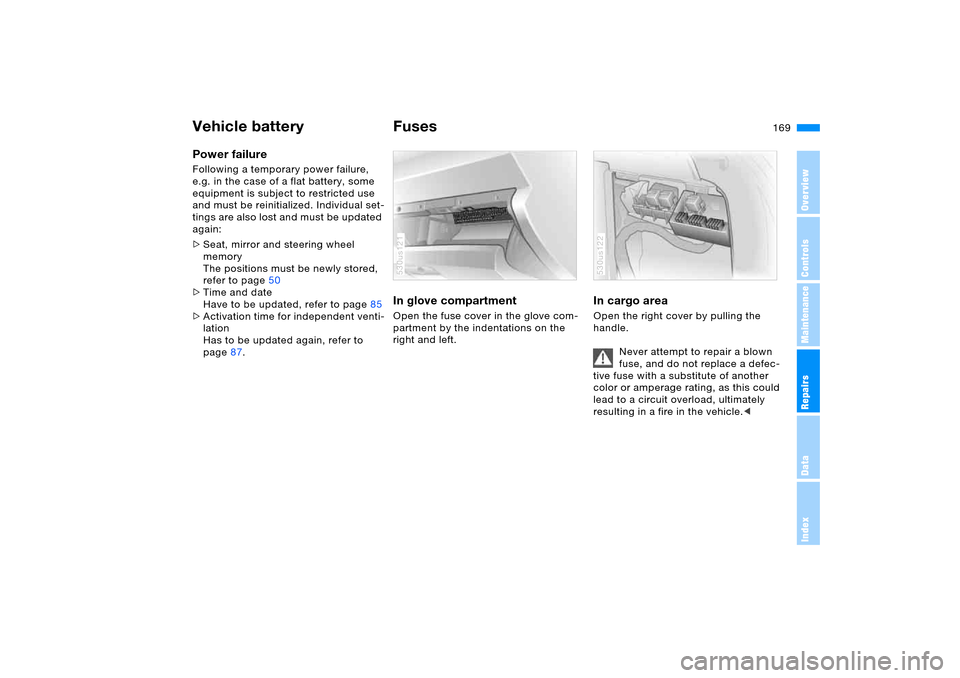
In glove compartment Open the fuse cover in the glove com-
partment by the indentations on the
right and left.530us121
In cargo area Open the right cover by pulling the
handle.
Never attempt to repair a blown
fuse, and do not replace a defec-
tive fuse with a substitute of another
color or amperage rating, as this could
lead to a circuit overload, ultimately
resulting in a fire in the vehicle.<530us122
Page 171 of 200
171n
OverviewControlsMaintenanceRepairsDataIndex
Jump starting When your battery is discharged you
can used two jumper cables to start
your vehicle with power from the bat-
tery in a second vehicle. You can also
use the same method to help start
another vehicle. Use only jumper cables
with fully-insulated clamp handles.
To avoid the risk of potentially
fatal injury, always avoid all con-
tact with electrical components while
the engine is running. Carefully observe
the following instructions to avoid per-
sonal injury and/or damage to one or
both vehicles.<
Preparing1. Check whether the battery of the
other vehicle has a voltage of
12 Volts and approximately the same
capacitance in Ah. This information
can be found on the battery
2. Switch off the engine of the support
vehicle
3. Switch off any electrical systems and
components in both vehicles.
Ensure that no contact exists
between the bodywork on the two
vehicles, otherwise there is a danger of
short circuits.
sparks, always observe this
sequence when connecting jumper
cables.<
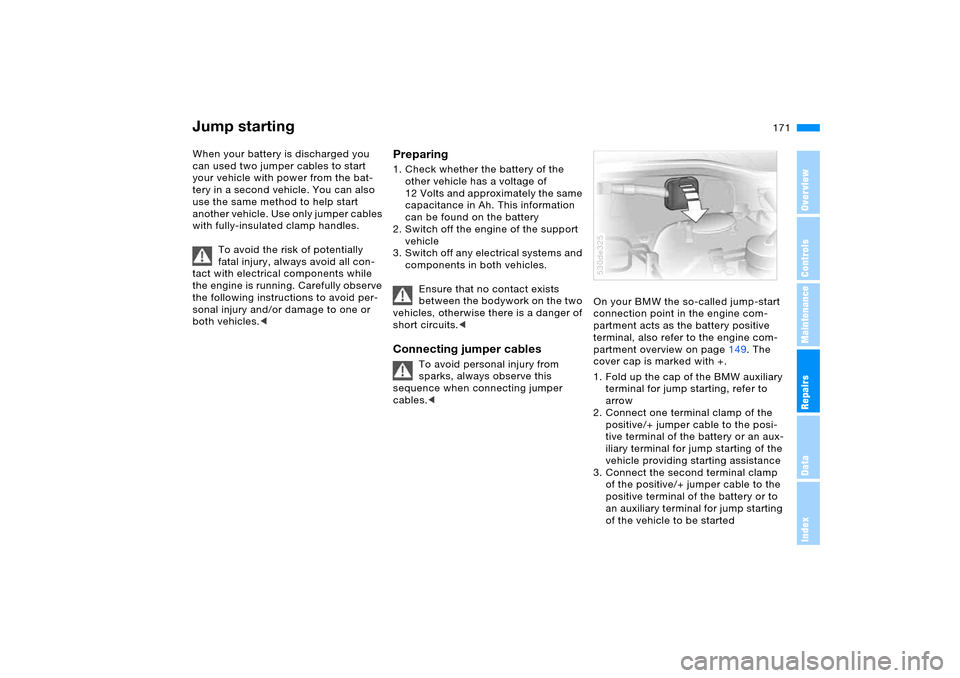
On your BMW the so-called jump-start
connection point in the engine com-
partment acts as the battery positive
terminal, also refer to the engine com-
partment overview on page149. The
cover cap is marked with +.
1. Fold up the cap of the BMW auxiliary
terminal for jump starting, refer to
arrow
2. Connect one terminal clamp of the
positive/+ jumper cable to the posi-
tive terminal of the battery or an aux-
iliary terminal for jump starting of the
vehicle providing starting assistance
3. Connect the second terminal clamp
of the positive/+ jumper cable to the
positive terminal of the battery or to
an auxiliary terminal for jump starting
of the vehicle to be started530de325
Page 172 of 200
172n
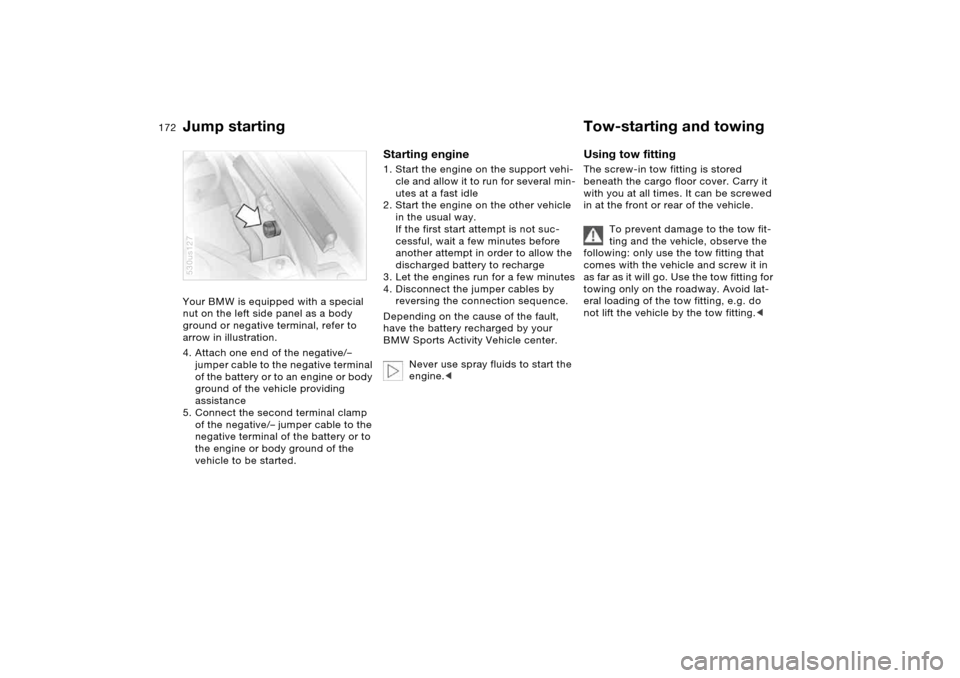
Jump starting Tow-starting and towing Your BMW is equipped with a special
nut on the left side panel as a body
ground or negative terminal, refer to
arrow in illustration.
4. Attach one end of the negative/–
jumper cable to the negative terminal
of the battery or to an engine or body
ground of the vehicle providing
assistance
5. Connect the second terminal clamp
of the negative/– jumper cable to the
negative terminal of the battery or to
the engine or body ground of the
vehicle to be started.530us127
Starting engine1. Start the engine on the support vehi-
cle and allow it to run for several min-
utes at a fast idle
2. Start the engine on the other vehicle
in the usual way.
If the first start attempt is not suc-
cessful, wait a few minutes before
another attempt in order to allow the
discharged battery to recharge
3. Let the engines run for a few minutes
4. Disconnect the jumper cables by
reversing the connection sequence.
Depending on the cause of the fault,
have the battery recharged by your
BMW Sports Activity Vehicle center.
Never use spray fluids to start the
engine.<
Using tow fitting The screw-in tow fitting is stored
beneath the cargo floor cover. Carry it
with you at all times. It can be screwed
in at the front or rear of the vehicle.
To prevent damage to the tow fit-
ting and the vehicle, observe the
following: only use the tow fitting that
comes with the vehicle and screw it in
as far as it will go. Use the tow fitting for
towing only on the roadway. Avoid lat-
eral loading of the tow fitting, e.g. do
not lift the vehicle by the tow fitting.<
Page 185 of 200
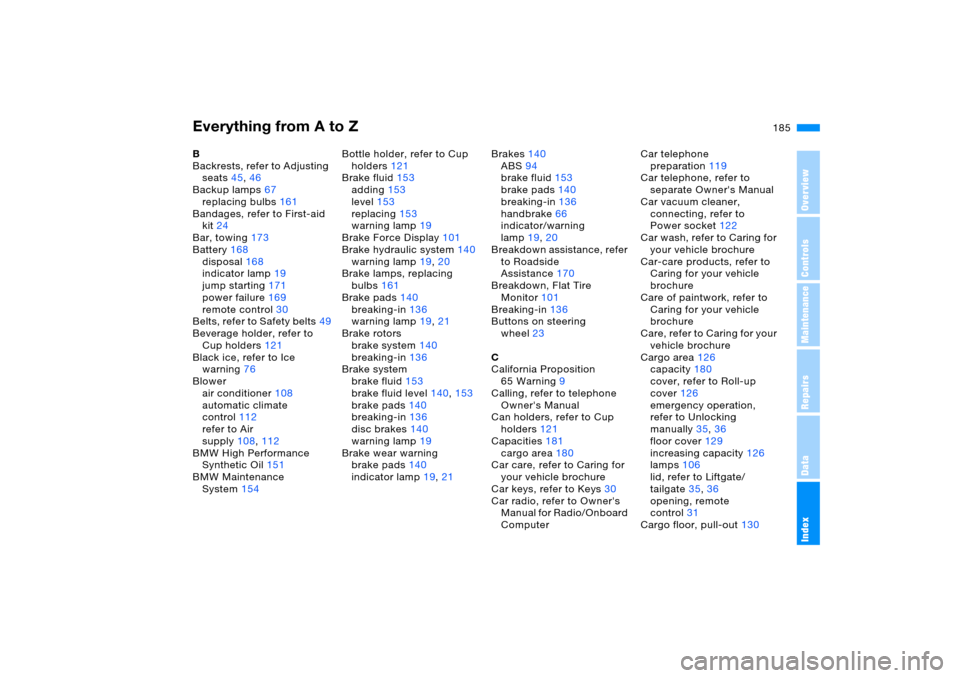
Everything from A to Z
185n
OverviewControlsMaintenanceRepairsDataIndex
B
Backrests, refer to Adjusting
seats45,46
Backup lamps67
replacing bulbs161
Bandages, refer to First-aid
kit24
Bar, towing173
Battery168
disposal168
indicator lamp19
jump starting171
power failure169
remote control30
Belts, refer to Safety belts49
Beverage holder, refer to
Cup holders121
Black ice, refer to Ice
warning76
Blower
air conditioner108
automatic climate
control112
refer to Air
supply108,112
BMW High Performance
Synthetic Oil151
BMW Maintenance
System154Bottle holder, refer to Cup
holders121
Brake fluid153
adding153
level153
replacing153
warning lamp19
Brake Force Display101
Brake hydraulic system140
warning lamp19,20
Brake lamps, replacing
bulbs161
Brake pads140
breaking-in136
warning lamp19,21
Brake rotors
brake system140
breaking-in136
Brake system
brake fluid153
brake fluid level140,153
brake pads140
breaking-in136
disc brakes140
warning lamp19
Brake wear warning
brake pads140
indicator lamp19,21Brakes140
ABS94
brake fluid153
brake pads140
breaking-in136
handbrake66
indicator/warning
lamp19,20
Breakdown assistance, refer
to Roadside
Assistance170
Breakdown, Flat Tire
Monitor101
Breaking-in136
Buttons on steering
wheel23
C
California Proposition
65 Warning9
Calling, refer to telephone
Owner's Manual
Can holders, refer to Cup
holders121
Capacities181
cargo area180
Car care, refer to Caring for
your vehicle brochure
Car keys, refer to Keys30
Car radio, refer to Owner's
Manual for Radio/Onboard
ComputerCar telephone
preparation119
Car telephone, refer to
separate Owner's Manual
Car vacuum cleaner,
connecting, refer to
Power socket122
Car wash, refer to Caring for
your vehicle brochure
Car-care products, refer to
Caring for your vehicle
brochure
Care of paintwork, refer to
Caring for your vehicle
brochure
Care, refer to Caring for your
vehicle brochure
Cargo area126
capacity180
cover, refer to Roll-up
cover126
emergency operation,
refer to Unlocking
manually35,36
floor cover129
increasing capacity126
lamps106
lid, refer to Liftgate/
tailgate35,36
opening, remote
control31
Cargo floor, pull-out130
Page 186 of 200
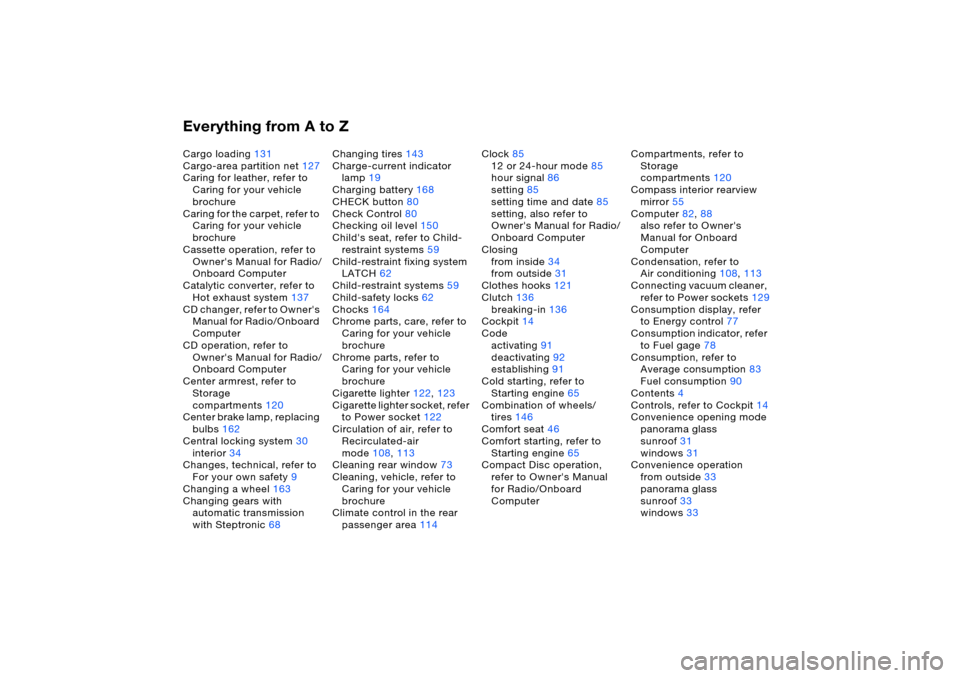
Everything from A to ZCargo loading131
Cargo-area partition net127
Caring for leather, refer to
Caring for your vehicle
brochure
Caring for the carpet, refer to
Caring for your vehicle
brochure
Cassette operation, refer to
Owner's Manual for Radio/
Onboard Computer
Catalytic converter, refer to
Hot exhaust system137
CD changer, refer to Owner's
Manual for Radio/Onboard
Computer
CD operation, refer to
Owner's Manual for Radio/
Onboard Computer
Center armrest, refer to
Storage
compartments120
Center brake lamp, replacing
bulbs162
Central locking system30
interior34
Changes, technical, refer to
For your own safety9
Changing a wheel163
Changing gears with
automatic transmission
with Steptronic68Changing tires143
Charge-current indicator
lamp19
Charging battery168
CHECK button80
Check Control80
Checking oil level150
Child's seat, refer to Child-
restraint systems59
Child-restraint fixing system
LATCH62
Child-restraint systems59
Child-safety locks62
Chocks164
Chrome parts, care, refer to
Caring for your vehicle
brochure
Chrome parts, refer to
Caring for your vehicle
brochure
Cigarette lighter122,123
Cigarette lighter socket, refer
to Power socket122
Circulation of air, refer to
Recirculated-air
mode108,113
Cleaning rear window73
Cleaning, vehicle, refer to
Caring for your vehicle
brochure
Climate control in the rear
passenger area114Clock85
12 or 24-hour mode85
hour signal86
setting85
setting time and date85
setting, also refer to
Owner's Manual for Radio/
Onboard Computer
Closing
from inside34
from outside31
Clothes hooks121
Clutch136
breaking-in136
Cockpit14
Code
activating91
deactivating92
establishing91
Cold starting, refer to
Starting engine65
Combination of wheels/
tires146
Comfort seat46
Comfort starting, refer to
Starting engine65
Compact Disc operation,
refer to Owner's Manual
for Radio/Onboard
ComputerCompartments, refer to
Storage
compartments120
Compass interior rearview
mirror55
Computer82,88
also refer to Owner's
Manual for Onboard
Computer
Condensation, refer to
Air conditioning108,113
Connecting vacuum cleaner,
refer to Power sockets129
Consumption display, refer
to Energy control77
Consumption indicator, refer
to Fuel gage78
Consumption, refer to
Average consumption83
Fuel consumption90
Contents4
Controls, refer to Cockpit14
Convenience opening mode
panorama glass
sunroof31
windows31
Convenience operation
from outside33
panorama glass
sunroof33
windows33