engine oil BMW X5 4.4I 2006 E53 User Guide
[x] Cancel search | Manufacturer: BMW, Model Year: 2006, Model line: X5 4.4I, Model: BMW X5 4.4I 2006 E53Pages: 202, PDF Size: 4.13 MB
Page 79 of 202
79n
OverviewControlsMaintenanceRepairsDataIndex
Check Control Computer>TRANS. FAILSAFE PROG
*
Please consult the nearest BMW
Sports Activity Vehicle center, refer to
page67
>CHECK BRAKE LININGS
Have the brake pads inspected by
your BMW Sports Activity Vehicle
center, refer to page140
>CHECK COOLANT LEVEL
Coolant too low, top off at the next
opportunity, refer to page154
>ENGINE FAILSAFE PROG
Fault in the engine electronics.
You can continue to drive with
reduced engine output or engine
speed.
Please have the system inspected by
your BMW Sports Activity Vehicle
center.
Displays after completion of trip All of the malfunctions registered during
the trip appear consecutively when the
ignition key is turned to position 0.
The following displays will appear when
appropriate:
>LIGHTS ON
>KEY IN IGNITION LOCK
>CHECK ENGINE OIL LEV
Replenish engine oil at the next
opportunity, e.g. while refueling, refer
to page152. This display appears when you open
the driver's door after parking the vehi-
cle. A supplementary acoustic signal
also sounds.
Status messages remain available with
the CHECK button 3 for a period of
approx. three minutes after the display
goes out and the key is removed from
the ignition lock. If there are multiple
messages, press the CHECK button
repeatedly to view them all in
sequence.
Checking Check Control Press the CHECK button 3 with the
ignition key in position 2:
CHECK CONTROL OK appears on the
display.
No malfunctions are present in the
monitored systems. Computer You can find a description of the com-
puter below and on page85 as well as
in the Owner's Manual for Onboard
Computer.
You can have the Check Control
and computer messages dis-
played in a different language.<
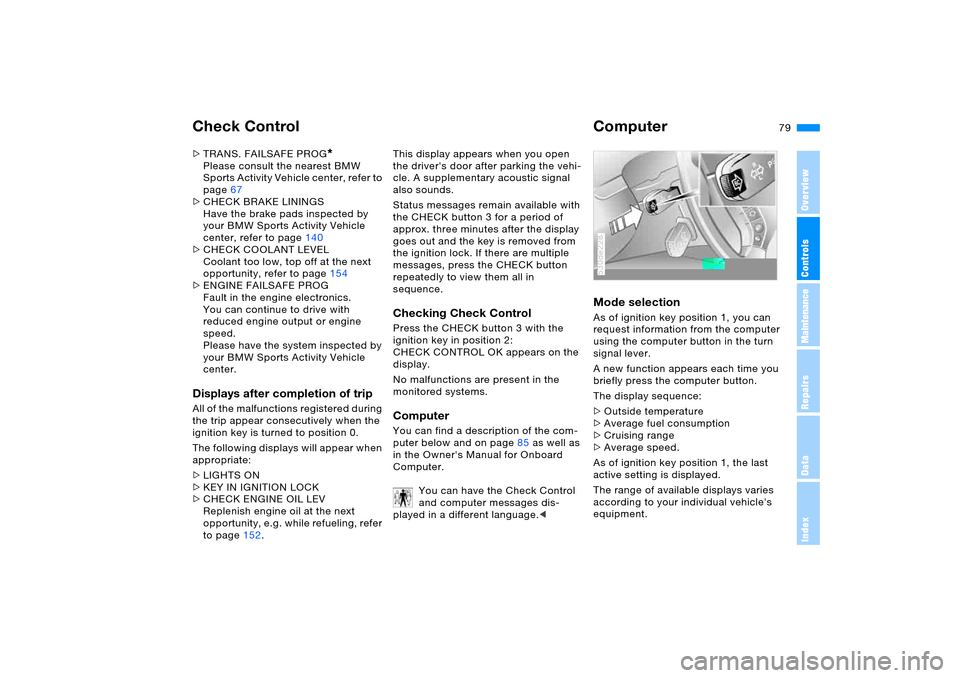
Mode selection As of ignition key position 1, you can
request information from the computer
using the computer button in the turn
signal lever.
A new function appears each time you
briefly press the computer button.
The display sequence:
>Outside temperature
>Average fuel consumption
>Cruising range
>Average speed.
As of ignition key position 1, the last
active setting is displayed.
The range of available displays varies
according to your individual vehicle's
equipment.530de228
Page 138 of 202
138n
General driving notes Driving your X5 Driving through water
Do not drive through water on the
road if it is deeper than 20 in/
50 cm, and then only at walking speed
at the most. Otherwise, the vehicle's
engine, the electrical systems and the
transmission may be damaged. When
equipped with 2-axle self leveling sus-
pension
*, switch the vehicle into the
Off-Road setting before driving through,
refer to page97.<
Using handbrake on slopes
Do not hold the vehicle in place on
slopes by slipping or riding the
clutch; use the handbrake instead. Oth-
erwise, severe clutch wear will result.<
Interior and exterior mirrors,
automatic dimming feature
*
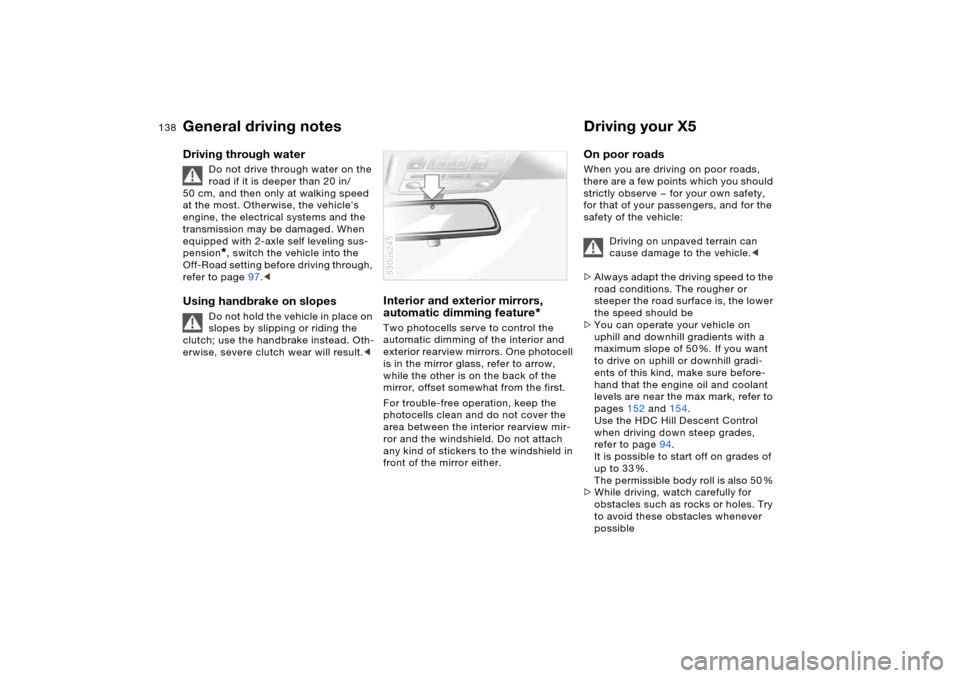
Two photocells serve to control the
automatic dimming of the interior and
exterior rearview mirrors. One photocell
is in the mirror glass, refer to arrow,
while the other is on the back of the
mirror, offset somewhat from the first.
For trouble-free operation, keep the
photocells clean and do not cover the
area between the interior rearview mir-
ror and the windshield. Do not attach
any kind of stickers to the windshield in
front of the mirror either. 530us245
On poor roads When you are driving on poor roads,
there are a few points which you should
strictly observe — for your own safety,
for that of your passengers, and for the
safety of the vehicle:
Driving on unpaved terrain can
cause damage to the vehicle.<
>Always adapt the driving speed to the
road conditions. The rougher or
steeper the road surface is, the lower
the speed should be
>You can operate your vehicle on
uphill and downhill gradients with a
maximum slope of 50 %. If you want
to drive on uphill or downhill gradi-
ents of this kind, make sure before-
hand that the engine oil and coolant
levels are near the max mark, refer to
pages152 and154.
Use the HDC Hill Descent Control
when driving down steep grades,
refer to page94.
It is possible to start off on grades of
up to 33 %.
The permissible body roll is also 50 %
>While driving, watch carefully for
obstacles such as rocks or holes. Try
to avoid these obstacles whenever
possible
Page 151 of 202
151n
OverviewControlsMaintenanceRepairsDataIndex
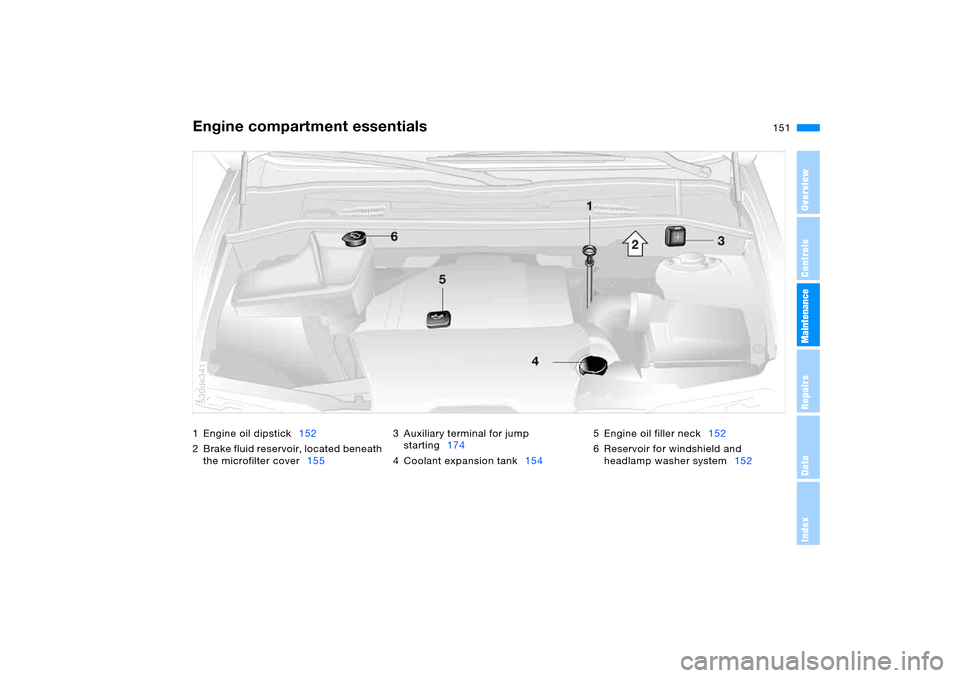
1Engine oil dipstick152
2 Brake fluid reservoir, located beneath
the microfilter cover1553 Auxiliary terminal for jump
starting174
4 Coolant expansion tank1545 Engine oil filler neck152
6 Reservoir for windshield and
headlamp washer system152Engine compartment essentials
530de341
Page 152 of 202
152n
Washer fluid Engine oilWindshield and headlamp washer
system Approximate capacity is 8.2 US quarts/
7.8 liters.
Fill with water and — if required — with
the addition of a washer antifreeze,
according to manufacturer's recom-
mendations.
We recommend that you mix the
washer fluid before adding it to
the reservoir.<
Antifreeze agent for the washer
systems is flammable. For this
reason, keep it away from sources of
flame and store it only in its original
containers. Store it so that it is inacces-
sible to children. Comply with the
instructions on the containers.< 530de298
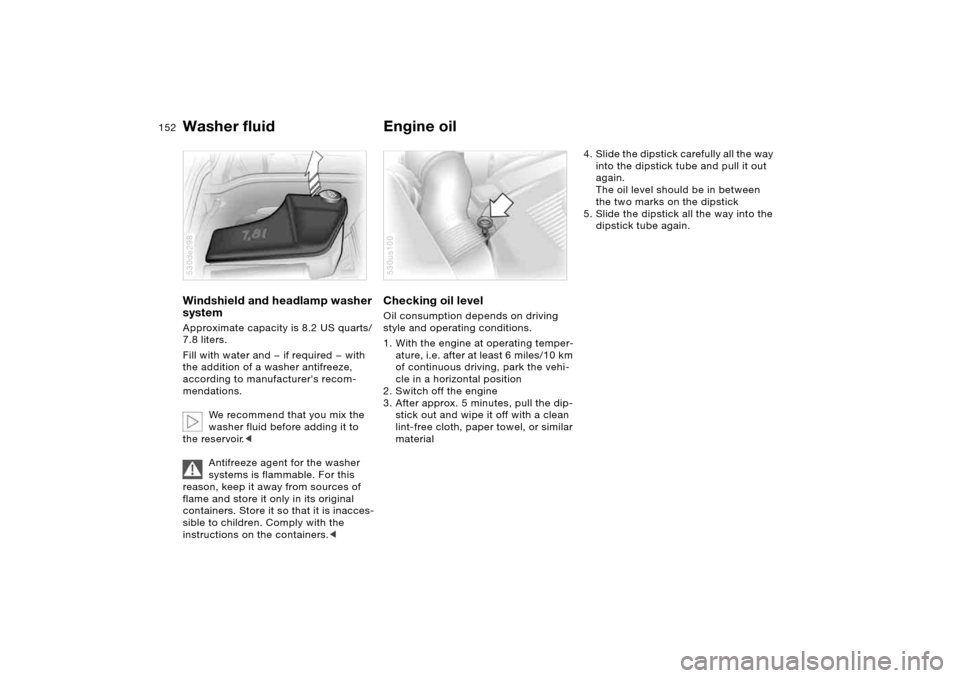
Checking oil level Oil consumption depends on driving
style and operating conditions.
1. With the engine at operating temper-
ature, i.e. after at least 6 miles/10 km
of continuous driving, park the vehi-
cle in a horizontal position
2. Switch off the engine
3. After approx. 5 minutes, pull the dip-
stick out and wipe it off with a clean
lint-free cloth, paper towel, or similar
material 530us100
4. Slide the dipstick carefully all the way
into the dipstick tube and pull it out
again.
The oil level should be in between
the two marks on the dipstick
5. Slide the dipstick all the way into the
dipstick tube again.
Page 153 of 202
153n
OverviewControlsMaintenanceRepairsDataIndex
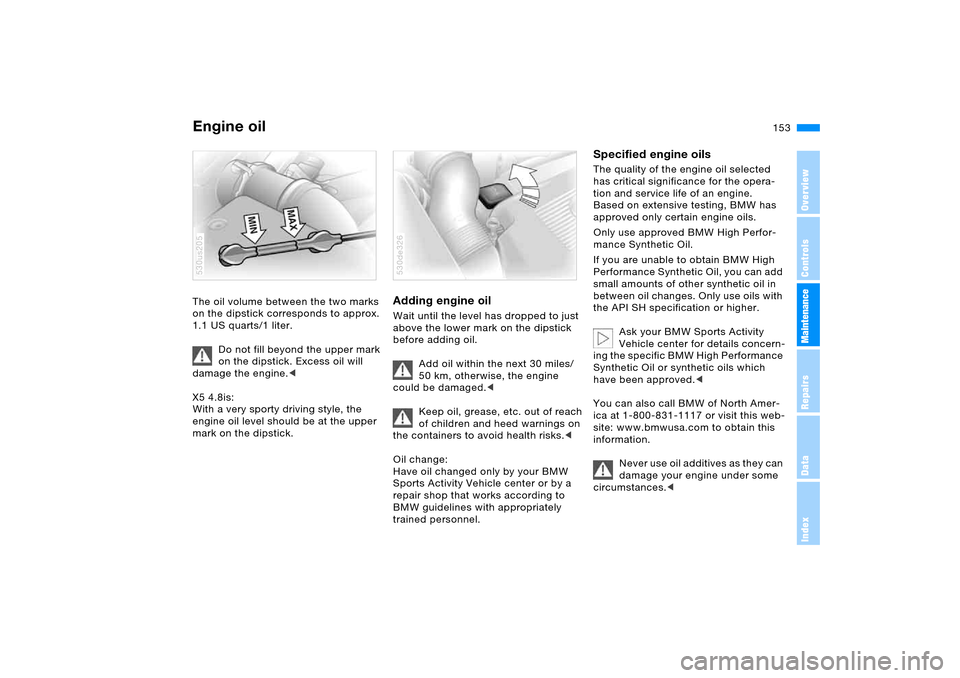
Engine oil The oil volume between the two marks
on the dipstick corresponds to approx.
1.1 US quarts/1 liter.
Do not fill beyond the upper mark
on the dipstick. Excess oil will
damage the engine.<
X5 4.8is:
With a very sporty driving style, the
engine oil level should be at the upper
mark on the dipstick.530us205
Adding engine oil Wait until the level has dropped to just
above the lower mark on the dipstick
before adding oil.
Add oil within the next 30 miles/
50 km, otherwise, the engine
could be damaged.<
Keep oil, grease, etc. out of reach
of children and heed warnings on
the containers to avoid health risks.<
Oil change:
Have oil changed only by your BMW
Sports Activity Vehicle center or by a
repair shop that works according to
BMW guidelines with appropriately
trained personnel.530de326
Specified engine oils The quality of the engine oil selected
has critical significance for the opera-
tion and service life of an engine.
Based on extensive testing, BMW has
approved only certain engine oils.
Only use approved BMW High Perfor-
mance Synthetic Oil.
If you are unable to obtain BMW High
Performance Synthetic Oil, you can add
small amounts of other synthetic oil in
between oil changes. Only use oils with
the API SH specification or higher.
Ask your BMW Sports Activity
Vehicle center for details concern-
ing the specific BMW High Performance
Synthetic Oil or synthetic oils which
have been approved.<
You can also call BMW of North Amer-
ica at 1-800-831-1117 or visit this web-
site: www.bmwusa.com to obtain this
information.
Never use oil additives as they can
damage your engine under some
circumstances.<
Page 154 of 202
154n
Engine oil Coolant Viscosity ratings Viscosity is the oil flow rating as estab-
lished in SAE classes.
The selection of the correct SAE class
depends on the climatic conditions in
the area where you typically drive your
BMW.
Approved oils are in SAE classes
5W-40 and 5W-30.<
These oils may be used for driving in all
ambient temperatures.
Do not open the cooling system
when the engine is hot. Escaping
coolant can cause burns.<
Coolant is comprised of water and
coolant additive. Not all commercially
available additives are suitable for your
BMW. Your BMW Sports Activity Vehi-
cle center knows which additives are
suitable.
Use only suitable additives, other-
wise you could damage your
engine. The additives can be harmful to
your health.<
Always observe all applicable
environmental rules and regula-
tions when disposing of coolant addi-
tives.<
Checking coolant level 1. The engine must be at ambient tem-
perature.
2. Start by turning the cap of the expan-
sion tank counterclockwise. Pause to
allow any accumulated pressure to
escape, then open.
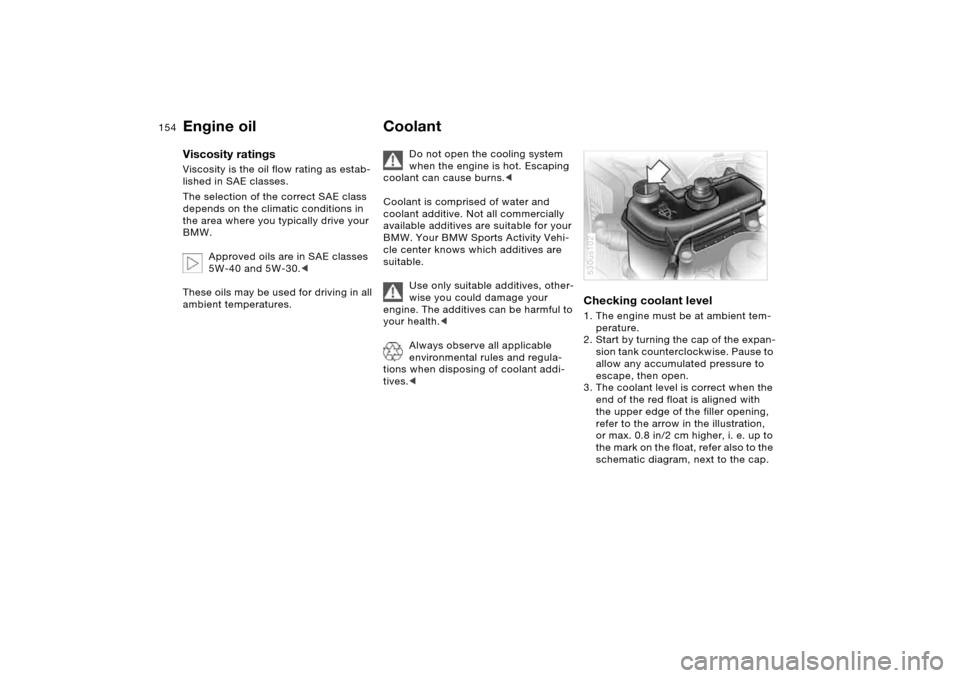
3. The coolant level is correct when the
end of the red float is aligned with
the upper edge of the filler opening,
refer to the arrow in the illustration,
or max. 0.8 in/2 cm higher, i. e. up to
the mark on the float, refer also to the
schematic diagram, next to the cap.530us102
Page 156 of 202
156n
The BMW Maintenance System helps
maintain the road and driving safety of
your BMW.
Please keep in mind that regular main-
tenance is not only necessary for the
safety of your vehicle, but also plays a
significant role in maintaining the resale
value of the vehicle.
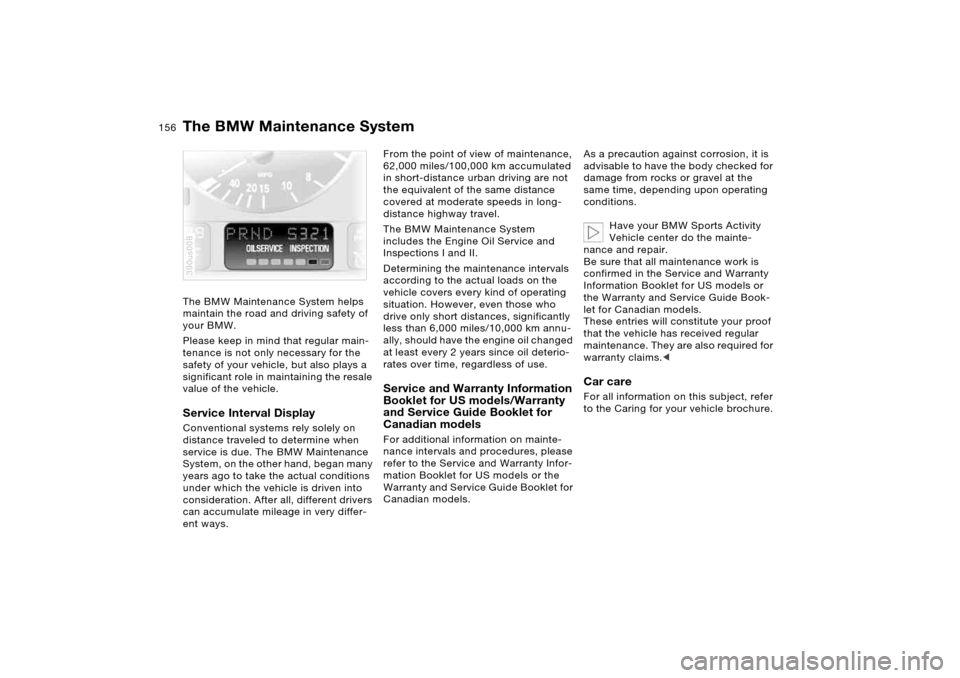
Service Interval Display Conventional systems rely solely on
distance traveled to determine when
service is due. The BMW Maintenance
System, on the other hand, began many
years ago to take the actual conditions
under which the vehicle is driven into
consideration. After all, different drivers
can accumulate mileage in very differ-
ent ways.390us008
From the point of view of maintenance,
62,000 miles/100,000 km accumulated
in short-distance urban driving are not
the equivalent of the same distance
covered at moderate speeds in long-
distance highway travel.
The BMW Maintenance System
includes the Engine Oil Service and
Inspections I and II.
Determining the maintenance intervals
according to the actual loads on the
vehicle covers every kind of operating
situation. However, even those who
drive only short distances, significantly
less than 6,000 miles/10,000 km annu-
ally, should have the engine oil changed
at least every 2 years since oil deterio-
rates over time, regardless of use. Service and Warranty Information
Booklet for US models/Warranty
and Service Guide Booklet for
Canadian models For additional information on mainte-
nance intervals and procedures, please
refer to the Service and Warranty Infor-
mation Booklet for US models or the
Warranty and Service Guide Booklet for
Canadian models. As a precaution against corrosion, it is
advisable to have the body checked for
damage from rocks or gravel at the
same time, depending upon operating
conditions.
Have your BMW Sports Activity
Vehicle center do the mainte-
nance and repair.
Be sure that all maintenance work is
confirmed in the Service and Warranty
Information Booklet for US models or
the Warranty and Service Guide Book-
let for Canadian models.
These entries will constitute your proof
that the vehicle has received regular
maintenance. They are also required for
warranty claims.<
Car careFor all information on this subject, refer
to the Caring for your vehicle brochure.
The BMW Maintenance System
Page 183 of 202
183n
OverviewControlsMaintenanceRepairsDataIndex
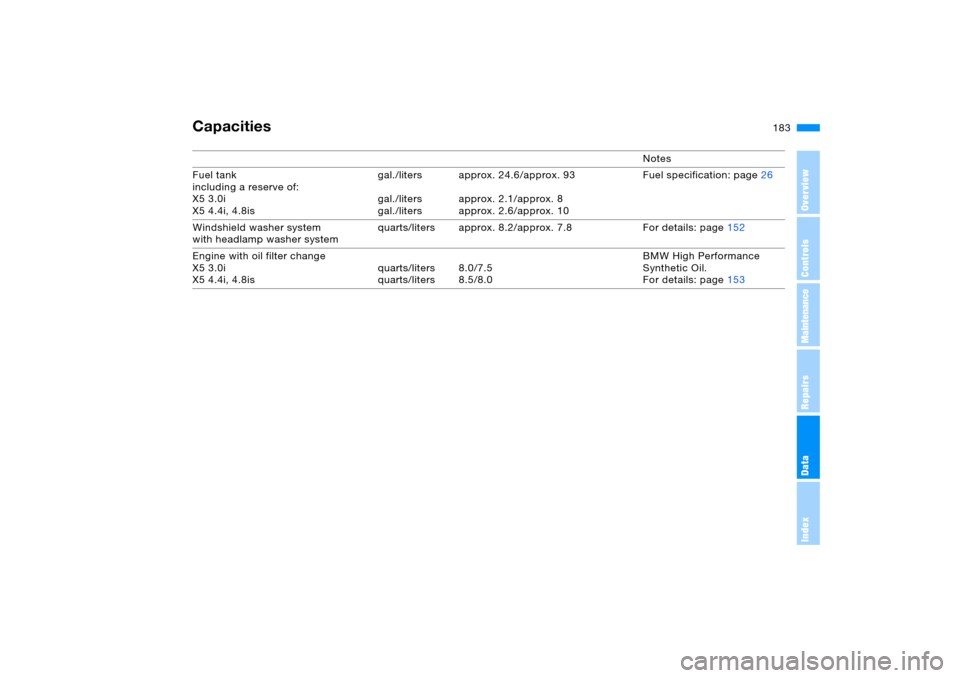
Capacities
Notes
Fuel tank
including a reserve of:
X5 3.0i
X5 4.4i, 4.8isgal./liters
gal./liters
gal./litersapprox. 24.6/approx. 93
approx. 2.1/approx. 8
approx. 2.6/approx. 10Fuel specification: page26
Windshield washer system
with headlamp washer system quarts/liters approx. 8.2/approx. 7.8 For details: page152
Engine with oil filter change
X5 3.0i
X5 4.4i, 4.8isquarts/liters
quarts/liters8.0/7.5
8.5/8.0BMW High Performance
Synthetic Oil.
For details: page153
Page 189 of 202
Everything from A to Z
189n
OverviewControlsMaintenanceRepairsDataIndex
Compartments, refer to
Storage
compartments119
Compass interior rearview
mirror117
Computer79,85
also refer to Owner's
Manual for Onboard
Computer
Condensation, refer to
Air conditioning105,110
Connecting vacuum cleaner,
refer to Sockets121,128
Consumption, refer to
Average fuel
consumption80
Fuel consumption87
Consumption display, refer
to Energy control74
Consumption indicator, refer
to Fuel gauge75
Contents4
Controls, refer to Cockpit14
Convenience opening mode
panorama glass roof31
windows31
Convenience operation
from outside33
panorama glass roof33
windows33Coolant154
level154
temperature gauge76
warning lamp76
Coolant temperature76
Coolant temperature
gauge76
Cooling, maximum110
Cooling, refer to
Air conditioning105,110
Temperature105,109
Copyright4
Cornering light, refer to
Adaptive Head Light101
Correct tires
wheel/tire
replacement148
winter tires149
Courtesy illumination, refer
to Courtesy lighting103
Courtesy lighting103
Cruise control71
buttons on steering
wheel23
indicator lamp22
Cruising range80
,87
Cup holders120
Curb weight, refer to
Weights182
Current consumption, refer
to Energy control74Cylinders, refer to Engine
data180
D
Dashboard, refer to
Cockpit14
Dashboard lighting, refer to
Instrument lighting102
Data, technical180
dimensions181
engine180
filling capacities183
weights182
Date
also refer to Owner's
Manual for Onboard
Computer
changing82
displaying82
Daytime driving lamps100
DBC Dynamic Brake
Control91
indicator lamp21
Deactivating the alarm in an
emergency89
Defective lamp161
Defrosting windows106,109
air conditioner106
automatic climate
control109Defrosting windows and
removing condensation
air conditioner106
automatic climate
control109
Defrost position, refer to
Defrosting
windows106,109
Digital clock82
also refer to Owner's
Manual for Onboard
Computer
Digital compass117
Dimensions181
Dimming feature, interior
mirror138
Dipstick, engine oil152
Directional indicators, refer
to Turn signals68
Disk brakes140
Displacement, refer to
Engine specifications180
Display, refer to Instrument
cluster15,17,18
Display lighting, refer to
Instrument lighting102
Disposal, vehicle battery171
Distance to destination86
Distance warning, refer to
PDC Park Distance
Control90
Page 190 of 202
Everything from A to ZDivided rear seat backrest,
refer to Folding rear seat
back124
Door keys30
Door lock33
DOT Quality Grades145
Draft-free
ventilation106,111
Driving lamps, refer to
Parking lamps/low
beams100
Driving notes
breaking-in136
driving hints137,138
Driving on poor roads138
Driving stability control92
Driving tips, refer to Driving
notes137
Driving your X5138
Dry air, refer to Air
conditioning105,110
DSC Dynamic Stability
Control92
warning lamp22
DVD changer, refer to
Owner's Manual for Radio/
Onboard Computer
Dynamic Brake Control
DBC91
indicator lamp21Dynamic Stability Control
DSC92
warning lamp22
E
EBV Electronic brake-force
distribution91
Electrical defect
liftgate35
tailgate36
Electrical malfunction
automatic transmission
with Steptronic67
door lock33
driver's door33
fuel filler door24
panorama glass roof42
Electric steering wheel
adjustment52
Electronic brake-force distri-
bution EBV91
Electronic Stability Program
ESP, refer to DSC Dynamic
Stability Control92
Emergency call173
Emergency operation, refer
to Manual operation
driver's door33
fuel filler door24
liftgate35
panorama glass roof42
tailgate36Emergency Service, refer to
Roadside Assistance173
Energy-conscious driving,
refer to Energy control74
Energy control74
Engine
breaking-in136
data180
electronic circuitry22
overheated, refer to
Coolant temperature
gauge76
speed74
starting62
switching off63
Engine compartment151
Engine coolant154
Engine oil152
additives, refer to
Specified engine oils153
filling capacity183
indicator/warning lamp19
specified engine oils153
Engine oil level152
indicator/warning lamp21
Engine oil pressure,
indicator/warning lamp19
Engine oil temperature
gauge75
Engine output, refer to
Engine specifications180Engine overheating, refer to
Coolant temperature
gauge76
Engine specifications180
Engine speed, refer to
Engine specifications180
Environmentally friendly
driving, refer to Energy
control74
ESP Electronic Stability
Program, refer to DSC
Dynamic Stability
Control92
Event Data Recorders157
Exhaust system137
Extended immobilizer
function88
Exterior mirrors53
automatic dimming
feature138
folding in and out54
External air, automatic
climate control110
F
Failure messages, refer to
Check Control77
Failure of a current
consumer172
False alarms, refer to
Avoiding unintentional
alarms39