service BMW X5 4.4I 2006 E53 User Guide
[x] Cancel search | Manufacturer: BMW, Model Year: 2006, Model line: X5 4.4I, Model: BMW X5 4.4I 2006 E53Pages: 202, PDF Size: 4.13 MB
Page 25 of 202
25n
OverviewControlsMaintenanceRepairsDataIndex
Refueling
When handling fuels, always
observe any safety guidelines
posted at the service station. Never
carry spare fuel containers in your vehi-
cle. Whether empty or full, these con-
tainers can leak, cause an explosion, or
lead to fire in the event of a collision.<
Observe the following when
refueling
Open the filler cap carefully to
prevent fuel from spraying out.
Fuel spray may cause injury.
Do not top off. Topping off may cause
fuel spillage.<
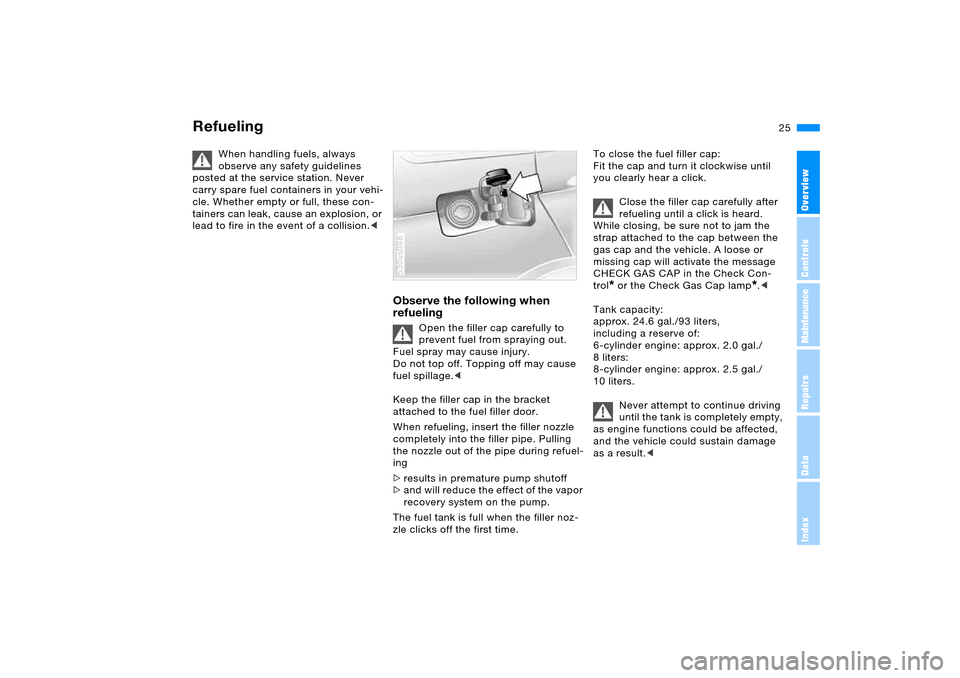
Keep the filler cap in the bracket
attached to the fuel filler door.
When refueling, insert the filler nozzle
completely into the filler pipe. Pulling
the nozzle out of the pipe during refuel-
ing
>results in premature pump shutoff
>and will reduce the effect of the vapor
recovery system on the pump.
The fuel tank is full when the filler noz-
zle clicks off the first time.
530us008
To close the fuel filler cap:
Fit the cap and turn it clockwise until
you clearly hear a click.
Close the filler cap carefully after
refueling until a click is heard.
While closing, be sure not to jam the
strap attached to the cap between the
gas cap and the vehicle. A loose or
missing cap will activate the message
CHECK GAS CAP in the Check Con-
trol
* or the Check Gas Cap lamp
*.<
Tank capacity:
approx. 24.6 gal./93 liters,
including a reserve of:
6-cylinder engine: approx. 2.0 gal./
8 liters:
8-cylinder engine: approx. 2.5 gal./
10 liters.
Never attempt to continue driving
until the tank is completely empty,
as engine functions could be affected,
and the vehicle could sustain damage
as a result.<
Page 29 of 202
29n
OverviewControlsMaintenanceRepairsDataIndex
Overview
Controls and features
Operation, maintenance
Index Technical data
Controls
Owner service procedures
Page 55 of 202
55n
OverviewControlsMaintenanceRepairsDataIndex
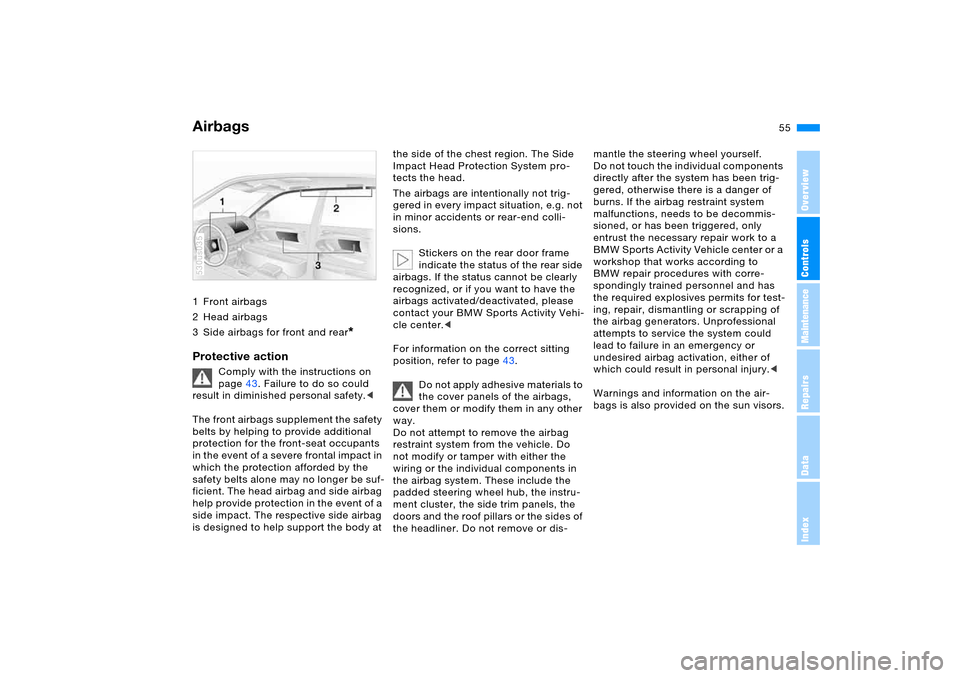
Airbags1 Front airbags
2 Head airbags
3 Side airbags for front and rear
*
Protective action
Comply with the instructions on
page43. Failure to do so could
result in diminished personal safety.<
The front airbags supplement the safety
belts by helping to provide additional
protection for the front-seat occupants
in the event of a severe frontal impact in
which the protection afforded by the
safety belts alone may no longer be suf-
ficient. The head airbag and side airbag
help provide protection in the event of a
side impact. The respective side airbag
is designed to help support the body at
530us035
the side of the chest region. The Side
Impact Head Protection System pro-
tects the head.
The airbags are intentionally not trig-
gered in every impact situation, e.g. not
in minor accidents or rear-end colli-
sions.
Stickers on the rear door frame
indicate the status of the rear side
airbags. If the status cannot be clearly
recognized, or if you want to have the
airbags activated/deactivated, please
contact your BMW Sports Activity Vehi-
cle center.<
For information on the correct sitting
position, refer to page43.
Do not apply adhesive materials to
the cover panels of the airbags,
cover them or modify them in any other
way.
Do not attempt to remove the airbag
restraint system from the vehicle. Do
not modify or tamper with either the
wiring or the individual components in
the airbag system. These include the
padded steering wheel hub, the instru-
ment cluster, the side trim panels, the
doors and the roof pillars or the sides of
the headliner. Do not remove or dis-
mantle the steering wheel yourself.
Do not touch the individual components
directly after the system has been trig-
gered, otherwise there is a danger of
burns. If the airbag restraint system
malfunctions, needs to be decommis-
sioned, or has been triggered, only
entrust the necessary repair work to a
BMW Sports Activity Vehicle center or a
workshop that works according to
BMW repair procedures with corre-
spondingly trained personnel and has
the required explosives permits for test-
ing, repair, dismantling or scrapping of
the airbag generators. Unprofessional
attempts to service the system could
lead to failure in an emergency or
undesired airbag activation, either of
which could result in personal injury.<
Warnings and information on the air-
bags is also provided on the sun visors.
Page 63 of 202
OverviewControlsMaintenanceRepairsDataIndex
63n
Starting engine Switching off engineDo not allow the engine to warm up by
leaving it running while the vehicle
remains stationary. Instead, begin to
drive immediately at a moderate engine
speed.
X5 3.0i:
Do not end the starting procedure too
soon, but do not continue for longer
than approx. 20 seconds. Release the
ignition key immediately as soon as the
engine starts.
X5 4.4i, 4.8is:
Your BMW is equipped with the conve-
nience starting feature. With this fea-
ture, it is sufficient to turn the ignition
key only briefly to position 3 'Start
engine' and to let go of it right away.
The starter actuation continues to oper-
ate automatically for a certain period of
time and is stopped automatically as
soon as the engine has started.
The automatic starting mode will not
operate or will be canceled if the bat-
tery voltage is insufficient. The engine
can be jump started, refer to page174.Should the engine fail to start on the
first attempt, if it is very hot or cold, for
instance:
>Press the accelerator pedal halfway
down while engaging the starter.
Cold starts at altitudes above 3,300 ft/
1,000 meters and at very low tempera-
tures, from approx. +57/–156:
>For the initial starting attempt, allow
the starter to remain engaged some-
what longer, approx. 10 seconds.
Engine idle speed is controlled by the
engine computer system. Increased
speeds at startup are normal and
should decrease as the engine warms
up. If engine speed does not decrease,
service is required.
To prevent the battery from being
drained, always switch off electrical
devices that are not in use. Switch the
ignition off when the vehicle is not
being driven.
Extended starting attempts, char-
acterized by excessively frequent
or long periods with the starter
engaged, can lead to damage of the
catalytic converter.<
Manual transmission:
1. Turn the ignition key to position 1
or 0
2. Shift into first gear or reverse.
Automatic transmission:
1. Shift into selector lever position P
2. Turn the ignition key to position 1
or 0.
Do not remove the ignition key
when the vehicle is moving, other-
wise, the steering could lock.
When leaving the vehicle, always
remove the ignition key and lock the
steering.
Manual transmission:
Always engage the handbrake when
parking on slopes and inclined sur-
faces. Even placing the gearshift lever
in 1st gear or reverse may not provide
adequate resistance to rolling.
Automatic transmission:
Place the selector lever in the P posi-
tion.<
Automatic transmission:
The vehicle must be stationary and the
selector lever in Park before you can
remove the ignition key.
Page 76 of 202
76n
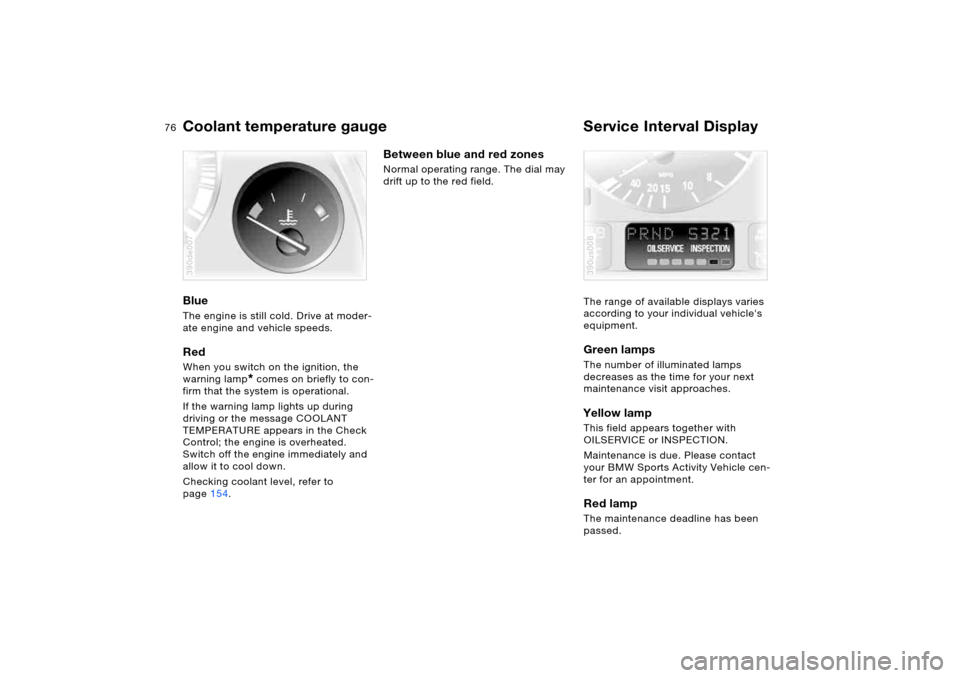
Coolant temperature gauge Service Interval Display Blue The engine is still cold. Drive at moder-
ate engine and vehicle speeds.Red When you switch on the ignition, the
warning lamp
* comes on briefly to con-
firm that the system is operational.
If the warning lamp lights up during
driving or the message COOLANT
TEMPERATURE appears in the Check
Control; the engine is overheated.
Switch off the engine immediately and
allow it to cool down.
Checking coolant level, refer to
page154.
390de007
Between blue and red zones Normal operating range. The dial may
drift up to the red field.
The range of available displays varies
according to your individual vehicle's
equipment.
Green lamps The number of illuminated lamps
decreases as the time for your next
maintenance visit approaches.Yellow lamp This field appears together with
OILSERVICE or INSPECTION.
Maintenance is due. Please contact
your BMW Sports Activity Vehicle cen-
ter for an appointment.Red lamp The maintenance deadline has been
passed.390us008
Page 135 of 202
135n
OverviewControlsMaintenanceRepairsDataIndex
Overview
Controls and features
Operation, maintenance
Owner service procedures
Index Technical data
Maintena
Page 136 of 202
136n
Moving parts should be allowed to
break in. To ensure that your vehicle
provides maximum economy through-
out a long service life, we request that
you comply with the following instruc-
tions:
Engine and differential Obey your local and state maximum
speed limits.
Up to 1,200 miles/2,000 km:
Drive at varying engine speeds and
road speeds, but do not exceed
4,500 rpm and the following road
speeds during this initial period:
>6-cylinder engine
100 mph/160 km/h
>8-cylinder engine
106 mph/170 km/h
Avoid full-throttle operation and use of
the transmission's kick-down mode
during these initial miles.
From 1,200 miles/2,000 km:
The engine and vehicle speed can
gradually be increased.
Tires Due to technical factors associated with
their manufacture, tires do not achieve
their full traction potential until after an
initial break-in period. Therefore, drive
reservedly during the first 200 miles/
300 km.
Obey your local and state maximum
speed limits.
When the vehicle is operated on
wet or slushy roads, a wedge of
water may form between the tire and
the road surface. This phenomenon is
referred to as hydroplaning and can
lead to partial or complete loss of trac-
tion, vehicle control and braking effec-
tiveness. Reduce your speed on wet
roads.< Brake system Brakes require an initial break-in period
of approx. 300 miles/500 km to achieve
optimal contact and wear patterns
between brake pads and rotors.
To break in the separate handbrake
drums, apply the handbrake lightly
when coasting to a standstill at a traffic
signal, for instance, provided that traffic
conditions allow you to do so.
To avoid corrosion, repeat this proce-
dure from time to time.
The brake lamps do not light up
when the handbrake is applied.
Vacuum for the brake system servo unit
on your BMW is available only when the
engine is running. When you move the
vehicle with the engine switched off,
when towing, for instance, substantially
higher levels of pedal force will be
required to brake the vehicle.< ClutchThe function of the clutch is only at its
optimized level after a distance driven
of approx. 300 miles/500 km. During
this break-in period, engage the clutch
gently.Following component
replacementsObserve the break-in instructions again
if previously addressed components
must be replaced again during subse-
quent driving.
Breaking-in
Page 141 of 202
141n
OverviewControlsMaintenanceRepairsDataIndex
Information for your safety The condition of the tires and the main-
tenance of the specified tire pressure
are crucial not only to the tire's service
life, but also to driving comfort and
most importantly, driving safety. Checking pressureOnly check tire inflation pressure when
the tires are cold. This means after a
maximum of 1.25 miles/2 km driving or
when the vehicle has been parked for at
least 2 hours. When tires are warm, the
tire inflation pressure increases.
Check the tire inflation pressure
regularly and correct it as needed,
even on the spare wheel: at least twice
a month and before starting long trips. If
you fail to observe this precaution, you
may be driving on tires with incorrect
tire pressures, a condition that can not
only compromise your vehicle's driving
stability, but also lead to tire damage
and the risk of an accident. Do not drive
with deflated, i.e. flat, tires. A flat tire
will seriously impairs your vehicle's
handling and braking response.
Attempts to drive on a flat tire can lead
to loss of control over the vehicle.<
After correcting the inflation pres-
sure(s), always reinitialize the Flat
Tire Monitor, refer to page99.<
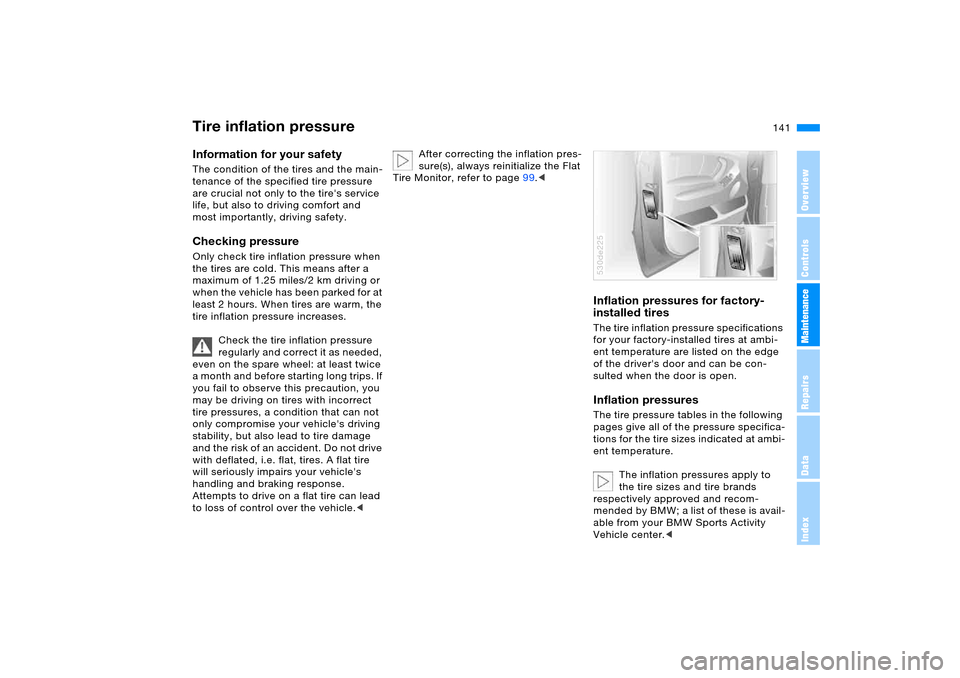
Inflation pressures for factory-
installed tiresThe tire inflation pressure specifications
for your factory-installed tires at ambi-
ent temperature are listed on the edge
of the driver's door and can be con-
sulted when the door is open.Inflation pressuresThe tire pressure tables in the following
pages give all of the pressure specifica-
tions for the tire sizes indicated at ambi-
ent temperature.
The inflation pressures apply to
the tire sizes and tire brands
respectively approved and recom-
mended by BMW; a list of these is avail-
able from your BMW Sports Activity
Vehicle center.<530de225
Tire inflation pressure
Page 145 of 202
145n
OverviewControlsMaintenanceRepairsDataIndex
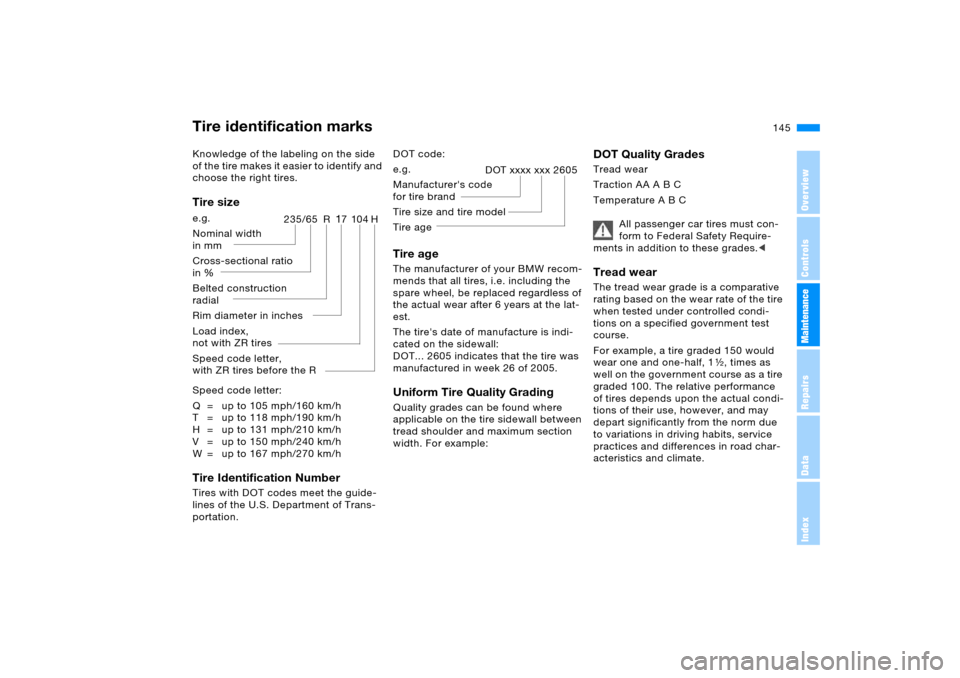
Tire identification marksKnowledge of the labeling on the side
of the tire makes it easier to identify and
choose the right tires.Tire sizeSpeed code letter:
Q = up to 105 mph/160 km/h
T = up to 118 mph/190 km/h
H = up to 131 mph/210 km/h
V = up to 150 mph/240 km/h
W = up to 167 mph/270 km/hTire Identification Number Tires with DOT codes meet the guide-
lines of the U.S. Department of Trans-
portation. e.g.
Nominal width
in mm
Cross-sectional ratio
in Ξ
Belted construction
radial
Rim diameter in inches
Load index,
not with ZR tires
Speed code letter,
with ZR tires before the R
235/65 R
17104H
DOT code: Tire age The manufacturer of your BMW recom-
mends that all tires, i.e. including the
spare wheel, be replaced regardless of
the actual wear after 6 years at the lat-
est.
The tire's date of manufacture is indi-
cated on the sidewall:
DOT... 2605 indicates that the tire was
manufactured in week 26 of 2005. Uniform Tire Quality Grading Quality grades can be found where
applicable on the tire sidewall between
tread shoulder and maximum section
width. For example: e.g.
Manufacturer's code
for tire brand
Tire size and tire model
Tire age
DOT xxxx xxx 2605
DOT Quality Grades Tread wear
Traction AA A B C
Temperature A B C
All passenger car tires must con-
form to Federal Safety Require-
ments in addition to these grades.< Tread wear The tread wear grade is a comparative
rating based on the wear rate of the tire
when tested under controlled condi-
tions on a specified government test
course.
For example, a tire graded 150 would
wear one and one-half, 1γ, times as
well on the government course as a tire
graded 100. The relative performance
of tires depends upon the actual condi-
tions of their use, however, and may
depart significantly from the norm due
to variations in driving habits, service
practices and differences in road char-
acteristics and climate.
Page 148 of 202
148n
Replacing wheels/tires
Have new wheels and tires
installed only by your BMW Sports
Activity Vehicle center or tire shop that
works according to BMW repair proce-
dures with correspondingly trained per-
sonnel. If this work is not carried out
properly, there is a danger of subse-
quent damage and related safety haz-
ards.<
Retreaded tires
BMW does not recommend the
use of retreaded tires, otherwise
driving safety may be reduced. The rea-
son for this is that possible variations in
the design and aging – which could be
substantial – of the tire casing can
result in a limited service life.<
The right wheels and tires
BMW recommends that you use
only wheel and tire combinations
that BMW has tested and approved for
your particular vehicle. Variations in fac-
tors such as manufacturing tolerances
mean that even wheels and tires with
identical official size ratings could actu-
ally have different dimensions than the
approved units – these differences
could lead to body contact, and with it
the risk of severe accidents. If non-
approved wheels and tires are used,
BMW cannot evaluate their suitability,
and therefore cannot be held liable for
driving safety.<
You can ask your BMW Sports Activity
Vehicle center for the correct wheel/tire
combination.
The correct wheel/tire combination also
affects various systems whose function
would otherwise be impaired, e.g. ABS,
DSC, xDrive.
To maintain good handling and vehicle
response, use only tires of a single
tread configuration from a single manu-
facturer. After tire damage, always
remember to have the original wheel
and tire combination remounted on the
vehicle as soon as possible.
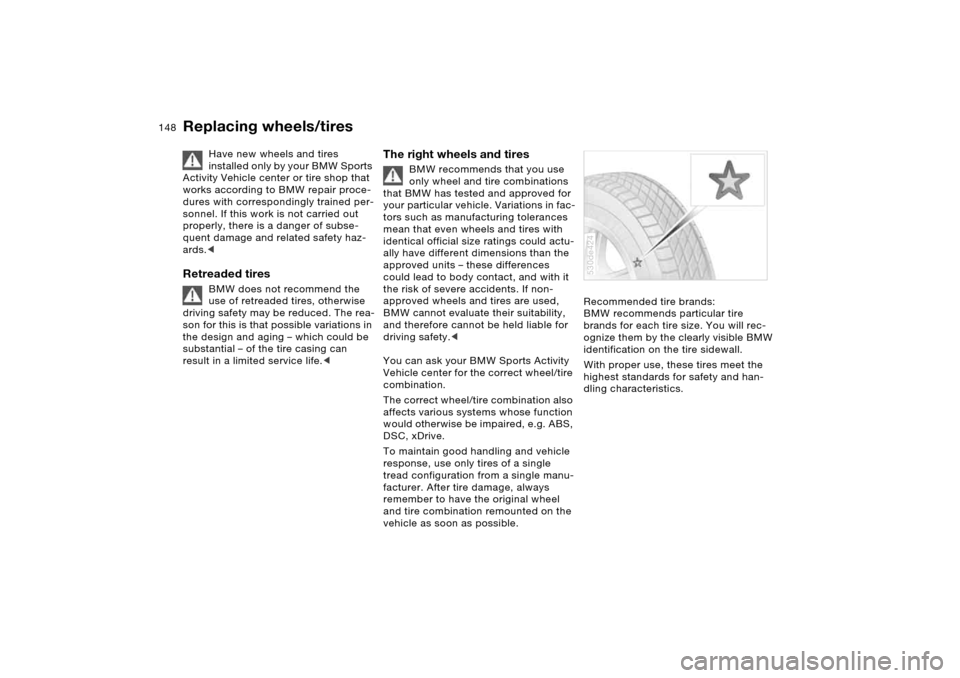
Recommended tire brands:
BMW recommends particular tire
brands for each tire size. You will rec-
ognize them by the clearly visible BMW
identification on the tire sidewall.
With proper use, these tires meet the
highest standards for safety and han-
dling characteristics.530de424