brake light BMW X5 4.6IS 2003 User Guide
[x] Cancel search | Manufacturer: BMW, Model Year: 2003, Model line: X5 4.6IS, Model: BMW X5 4.6IS 2003Pages: 183, PDF Size: 2.31 MB
Page 130 of 183

130n
Break-in proceduresTo ensure that your vehicle provides
maximum economy throughout a long
service life, we request that you
observe the following instructions: Engine and differential Up to 1,200 miles/2,000 km:
Drive at varying engine speeds and
road speeds, but do not exceed
4,500 rpm and the following road
speeds during this initial period:
6-cylinder engines: 100 mph/160 km/h
8-cylinder engines: 106 mph/170 km/h
Obey your local and state maximum
speed limits.
Refrain from using full throttle and avoid
pressing the accelerator beyond the
kickdown point.
Once you have driven 1,200 miles/
2,000 km, engine and vehicle speeds
can gradually be increased.
You should also comply with these
break-in procedures should the engine
or one of the differentials be replaced
later in the course of the vehicle's ser-
vice life.
TiresDue to technical factors associated
with their manufacture, tires do not
achieve their full traction potential until
an initial break-in period has elapsed.
For this reason, drive with extra care
during the initial 200 miles/300 km.
Obey your local and state maximum
speed limits.
When the vehicle is operated on
wet or slushy roads, a wedge of
water may form between the tire and
the road surface. This phenomenon is
referred to as aquaplaning, or hydro-
planing, and can lead to partial or com-
plete loss of traction, vehicle control
and braking effectiveness. Reduce your
speed on wet roads.<
Brake systemApprox. 300 miles/500 km must elapse
before the brake pads and rotors
achieve the optimal pad-surface and
wear patterns required for trouble-free
operation and long service life later on.
To break in the separate parking brake
drums, apply the parking brake lightly
when coasting to a standstill at a traffic
signal, for instance, provided that traffic
conditions allow you to do so.
To avoid corrosion, repeat this proce-
dure from time to time.
The brake lamps do not light up
when the parking brake is applied.
Vacuum for the brake system servo unit
on your BMW is available only when the
engine is running. When you move the
vehicle with the engine switched off Ð
when towing, for instance Ð substan-
tially higher levels of pedal force will be
required to brake the vehicle.<
Page 131 of 183

131n
OverviewControlsMaintenanceRepairsDataIndex
Driving your BMW X5 Your BMW is right at home on all roads
and byways Ð even where the pavement
ends. It combines permanent four-
wheel drive with the agility of a typical
passenger vehicle. On bad roadsWhen you are driving on bad roads,
there are a few points which you should
strictly observe Ñ for your own safety,
for that of your passengers, and for the
safety of the vehicle:
>Familiarize yourself with the vehicle
before you begin driving. Do not take
risks with the vehicle under any cir-
cumstances
>Always adapt vehicle speed to road
conditions Ð the steeper and more
uneven the road surface is, the
slower the vehicle's speed should be
>You can operate your vehicle on
uphill and downhill gradients with a
maximum slope of 50 %. If you intend
to drive on either an uphill or downhill
gradient of this steepness, check to
be sure in advance that the engine oil
and coolant levels are both near the
MAX mark, refer to pages 141
and 143.
When driving down steep slopes, use
the Hill Descent Control HDC, refer to
page 93. Starting from a full stop is possible on
uphill gradients of up to 32 %.
The permitted side tilt is also 50 %
>While driving, watch carefully for
obstacles such as rocks or holes. Try
to avoid these obstacles whenever
possible
>On hill crests and bumpy roads, for
example, be careful to prevent the
body from bottoming Ð contact
between the body and the ground.
The ground clearance of the vehicle
is:
8 in/200 mm with up to four
passengers
7 in/180 mm fully loaded Ð without
self-leveling suspension
>Do not drive in water that is deeper
than 20 inches/50 cm. If you must
drive through water up to that depth,
drive at a walking speed and do not
stop.
After leaving the water, press on the
footbrake gently several times while
driving at a low speed. The brake
applications will help to dry the
brakes, thus preventing a reduction in
braking performance caused by the
moisture.
Back onto the paved road In recommending that you observe the
following points after driving on adverse
road surfaces, it is not as a beauty
treatment for your BMW. Instead, it is
intended for the maintenance of driving
safety:
>Clean accumulations of dirt from the
body and check the undercarriage for
damage
>Clean mud, snow, ice and other
materials from the wheels and tires.
Check the tires for damage
>Check to determine whether rocks,
gravel or accumulations of dirt on the
brake rotors and calipers could influ-
ence braking performance. Remove
all such foreign objects
>In order to clean the brake rotors,
apply the footbrake gently several
times while driving at a low speed. Be
sure that following traffic is not
endangered by this
>For cleaning the parking brake, apply
the lever slightly at approx. 25 mph/
40 km/h and continue to drive for
approx. 200 yards/200 meters, pro-
vided that traffic conditions allow you
to do so.
Page 132 of 183

132n
General driving notes
Antilock Brake System
Brake system
Brakes:
Do not drive with your foot resting
on the brake pedal. Even light but con-
sistent pedal pressure can lead to high
temperatures, brake wear and possibly
even brake failure.
Hydroplaning:
When driving on wet or slushy roads,
reduce vehicle speed. If you do not, a
wedge of water may form between the
tires and the road surface. This phe-
nomenon is referred to as hydroplaning
or aquaplaning. It is characterized by a
partial or complete loss of contact
between the tires and the road surface.
The ultimate results are loss of steering
and braking control.<
The conceptThe Antilock Brake System ABS keeps
the wheels from locking during braking,
thereby enhancing active driving safety.Braking with ABSIf you are in a situation that requires full
braking, you will exploit the full benefits
of the ABS system if you apply max-
imum pedal pressure Ð panic stop.
Pulsation at the brake pedal combined
with sounds from the hydraulic circuits
indicates to the driver that ABS is in its
active mode.
Brake fluid levelIf the brake fluid level is too low and
brake pedal travel has become longer,
there may be a defect in one of the two
brake system's hydraulic circuits.
Proceed to the nearest
BMW Sports Activity Vehicle
center. Here increased pressure on the
brake pedal may be required, and slight
pulling to the side and longer braking
distances may result. Please remember
to adapt your driving style accord-
ingly.<
Page 133 of 183
133n
OverviewControlsMaintenanceRepairsDataIndex
Brake systemDisc brakesWhen the vehicle is driven only occa-
sionally, during extended periods when
the vehicle is not used at all, and in
operating conditions where brake appli-
cations are less frequent, there is an
increased tendency for corrosion of the
rotors and accumulation of contamina-
tion on the brake pads. This occurs
because the minimal pressure which
must be exerted by the pads to clean
the discs by brake applications is not
reached.
If the brake rotors are corroded, they
will tend to respond to braking with a
pulsating effect which even extended
application will fail to cure.
When driving in wet conditions and in
heavy rain, it is advisable to apply light
pressure to the brake pedal from time
to time. Watch traffic conditions to
ensure that this maneuver does not
endanger other road users. The heat
which is generated by the brake appli-
cations helps to dry the brake pads and
rotors. The braking force is then imme-
diately available when required.Extended or steep mountain descents
should be driven in the gear in which
only minimal periodic brake application
is required. This avoids excessive strain
on the brakes and possible impairment
of the braking effect.
Do not coast with the clutch
depressed or with the transmis-
sion or selector lever in neutral. Do not
drive with the engine switched off. The
engine provides no braking effect when
the clutch is depressed or the transmis-
sion is in neutral, and there is no
power-assist for braking or steering
when the engine is not running.
BMW recommends having brake
inspections performed at a BMW
Sports Activity Vehicle center only. If
you do not, parts of the four-wheel
drive system could be damaged.
Never allow floor mats, carpets or any
other objects to protrude into the area
around the accelerator, clutch and
brake pedals and obstruct their move-
ment.<
Brake pads
For your own safety: use only
brake pads that BMW has
released for your particular vehicle
model. BMW cannot evaluate non-
approved brake pads to determine if
they are suited for use, and therefore
cannot ensure the operating safety of
the vehicle if they are installed.<
Page 174 of 183
Everything from A to ZAABS Antilock Brake
System20, 132
Accessories9
Activated-charcoal
filter110
Adaptive brake light98
Adding
brake fluid144
coolant143
engine oil141
washer fluid141
Adjusting
head restraints47
mirrors53
seats44
steering wheel52
thigh support45
Air conditioner102
Air distribution103, 107
Air outlets102, 105
Air supply103, 107
Airbags20, 55
Alarm system39
Antifreeze143
Antilock Brake System
ABS20, 132
Anti-theft system31
Approved gross vehicle
weight170
Aquaplaning132, 134Arrival time87
Ashtray
front117
rear118
AUC Automatic recirculated-
air control108
Automatic climate
control105
removing condensation
from the windows107
Automatic cruise control71
Automatic curb monitor51
Automatic dimming
exterior rearview
mirrors54
interior rearview mirror54
Automatic headlamp
control99
Automatic recirculated-air
control AUC108
Automatic steering wheel
adjustment52
Automatic transmission with
Steptronic65
Average fuel
consumption80
Average speed80, 88
Avoiding unintentional
alarms40
Axle loads170
BBackup lamps65
bulb replacement153
Battery160
charge160
discharged163
Battery charge indicator
lamp19
Battery, disposal160
Belts49
Beverage holder116
Blower103, 107
BMW comfort seat46
BMW High Performance
Synthetic Oil142
BMW Maintenance
System145
BMW sports seat45
BMW Universal
Transmitter112
Brake fluid144
Brake fluid level144
Brake lamps
bulb replacement153
Brake light, adaptive98Brake system132
brake fluid144
brake fluid level133
brake pads indicator21
disc brakes133
hydraulic system
indicator19
malfunctions132
Break-in procedures130
Bulbs and lamps151
CCalifornia Proposition
65 Warning146
Can holder, refer to
beverage holder116
Capacities171
Cargo area38, 120
capacity170
cover120
lamps101
partition net122
Cargo floor, pull-out124
Cargo loading126
Cellular phone116
hands-free system116
Center Ð high-mount Ð brake
lamp153
Center (high-mount) brake
lamp153
Page 175 of 183
Everything from A to Z
175n
OverviewControlsMaintenanceRepairsDataIndex
Central locking system30
button35
Changing a wheel155
CHECK button77
Check Control77
Check tire pressures26
Checking
engine oil level142
Child-safety locks60
Cigarette lighter
front117
rear118
socket118
Clean the windshield69
Climate control in the rear
passenger area109
Clock82
refer also to the Owner's
Manual for the Onboard
Computer
Cockpit14
Code88
activating88
deactivating88
selecting88
Comfort seat46
Compartments116
Computer80, 81, 85
refer also to the Owner's
Manual for the Onboard
Computer
remote control89Configuring individual
settings via Vehicle and
Key Memory61
Consumption, fuel87
Convenience operation of
windows and sliding/tilt
sunroof34
Convenience starting
feature63
Coolant143
temperature gauge76
Copyright notice4
Correct sitting posture44
seat adjustment44
Cruise control71
Cruising range80, 87
Cup holder116
Curb weight170
DData link connector for On-
board Diagnostics147
Date
calling up82
changing82
refer also to the Owner's
Manual for the Onboard
Computer
Daytime driving lamp99
DBC Dynamic Brake
Control21, 92Deactivating the interior
motion sensor32, 40
Deep water131
Defrosting the
windows104, 107
Digital clock82
refer also to the Owner's
Manual for the Onboard
Computer
Dimensions169
Dipstick, engine oil142
Disc brakes133
Displacement168
Display lighting100
Displays15, 16, 17, 18
Disposal
used batteries160
used oil142
Disposal of battery160
Distance from
destination86
Distance warning90
Divided rear backrest120
Door keys30
Doors
convenience operation34
manual operation34
remote control32
unlocking and locking34
DOT Quality Grades135Drink holder, refer to
beverage holder116
Driving notes132
Driving through water131
Driving with spare
wheel159
Driving your BMW X5131
DSC Dynamic Stability
Control21, 91
Dynamic Brake Control
DBC21, 92
Dynamic Stability Control
DSC21, 91
EElectric power windows40
Electrical malfunction
liftgate36
sliding/tilt sunroof43
tailgate38
Elements of operation14
Emergency operation
doors34
liftgate36
sliding/tilt sunroof43
tailgate38
Energy control74
Engine
output168
power rating168
specifications168
Page 176 of 183
Everything from A to ZEngine compartment
essentials140
Engine coolant143
Engine oil141, 142
consumption141
grades142
level20
pressure19
Estimated time of arrival87
Exterior mirrors53
Exterior rearview mirrors,
automatic dimming
feature54FFailure of an electrical
accessory160
Filling the windshield washer
reservoir141
First-aid kit24
Fittings, tow-starting and
towing164
Flashlight115
Flat tire98, 134, 155
Fog lamps100
bulb replacement152
Folding rear backrest120
Footbrake133
Front area lighting101
Front fog lamps100
Front seat adjustment44Frost protection,
radiator143
Fuel26
capacity171
display75
gauge75
quality26
specifications26
Fuel consumption87
average87
Fuel filler door24
electrical malfunction24
Fuses160
GGarage-door opener112
Gasoline26
General driving notes132
Glasses compartment117
Glove compartment115
Gross vehicle weight170
Ground clearance131HHandbrake64
Hands-free system116
Hazard warning flashers14
Hazard warning triangle24
HDC Hill Descent
Control93Head restraints47
Headlamp flasher68
Headlamp washer
system69, 141
Heated seats51
Heated steering wheel53
Heating and
ventilation102, 105
Heating while stopped109
Heavy cargo126
Height169
Height adjustment
seats46
steering wheel52
High beams22, 100
bulb replacement151
High-mount brake lamp153
Hill Descent Control
HDC93
Holder for cans, refer to
beverage holder116
Hood139
Hood release139
Hydraulic Brake Assistant
refer to DBC21
Hydroplaning132, 134
IIce warning73
Identification, tires137
Ignition key30
Ignition lock62
Imprint4
Independent ventilation
system84, 111
switching on and off84
Indicator lamps19
Inflation pressures,
tires134
monitoring97
INSPECTION76
Instrument
cluster15, 16, 17, 18
Instrument lighting100
Instrument
panel15, 16, 17, 18
Intensive cleaning
system69
Interior lamps101
remote control32
Interior mirrors54
Interior motion sensor40
Interior rearview mirror,
automatic dimming
feature54
Interlock62
Intermittent wipe68
Page 178 of 183
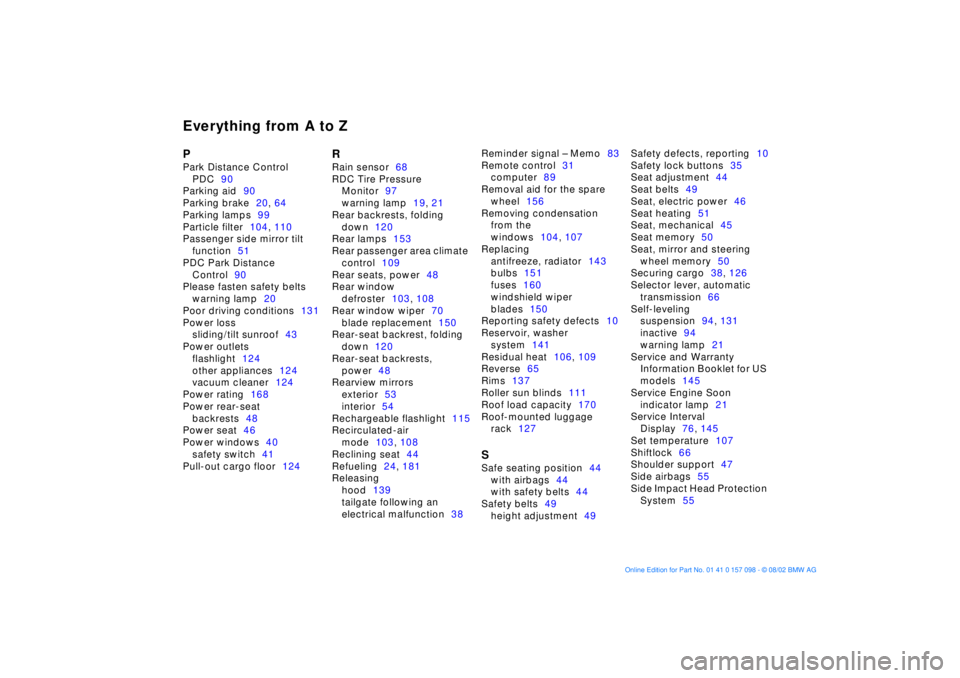
Everything from A to ZPPark Distance Control
PDC90
Parking aid90
Parking brake20, 64
Parking lamps99
Particle filter104, 110
Passenger side mirror tilt
function51
PDC Park Distance
Control90
Please fasten safety belts
warning lamp20
Poor driving conditions131
Power loss
sliding/tilt sunroof43
Power outlets
flashlight124
other appliances124
vacuum cleaner124
Power rating168
Power rear-seat
backrests48
Power seat46
Power windows40
safety switch41
Pull-out cargo floor124
RRain sensor68
RDC Tire Pressure
Monitor97
warning lamp19, 21
Rear backrests, folding
down120
Rear lamps153
Rear passenger area climate
control109
Rear seats, power48
Rear window
defroster103, 108
Rear window wiper70
blade replacement150
Rear-seat backrest, folding
down120
Rear-seat backrests,
power48
Rearview mirrors
exterior53
interior54
Rechargeable flashlight115
Recirculated-air
mode103, 108
Reclining seat44
Refueling24, 181
Releasing
hood139
tailgate following an
electrical malfunction38Reminder signal Ð Memo83
Remote control31
computer89
Removal aid for the spare
wheel156
Removing condensation
from the
windows104, 107
Replacing
antifreeze, radiator143
bulbs151
fuses160
windshield wiper
blades150
Reporting safety defects10
Reservoir, washer
system141
Residual heat106, 109
Reverse65
Rims137
Roller sun blinds111
Roof load capacity170
Roof-mounted luggage
rack127
SSafe seating position44
with airbags44
with safety belts44
Safety belts49
height adjustment49Safety defects, reporting10
Safety lock buttons35
Seat adjustment44
Seat belts49
Seat, electric power46
Seat heating51
Seat, mechanical45
Seat memory50
Seat, mirror and steering
wheel memory50
Securing cargo38, 126
Selector lever, automatic
transmission66
Self-leveling
suspension94, 131
inactive94
warning lamp21
Service and Warranty
Information Booklet for US
models145
Service Engine Soon
indicator lamp21
Service Interval
Display76, 145
Set temperature107
Shiftlock66
Shoulder support47
Side airbags55
Side Impact Head Protection
System55