Lock BMW X5 4.8IS 2005 E53 User Guide
[x] Cancel search | Manufacturer: BMW, Model Year: 2005, Model line: X5 4.8IS, Model: BMW X5 4.8IS 2005 E53Pages: 200, PDF Size: 3.55 MB
Page 39 of 200
OverviewControlsMaintenanceRepairsDataIndex
39n
Alarm system Windows>The indicator lamp flashes for
10 seconds after the vehicle is
unlocked: an attempted entry has
been detected in the period since the
system was armed.
Following triggering of an alarm, the
indicator lamp will flash continuously. Tilt alarm sensor and interior
motion sensor Tilt alarm sensor:
The tilt of the vehicle is monitored. The
alarm system reacts, for example, if
someone attempts to steal the wheels
or tow the vehicle.
Interior motion sensor:
In order for the interior motion sensor
to function properly, the windows and
panorama glass sunroof must be com-
pletely closed.
Avoiding unintentional alarms The tilt alarm sensor and interior motion
s en sor m ay be swi tch e d off a t t h e sam e
time. This prevents unintentional
alarms, e.g. in the following situations:
>In stacking garages
>When transporting on car-carrying
trains
>If animals are to remain in the vehicle.
Switching off the tilt alarm sensor and
interior motion sensor:
Press the button on the remote control
twice consecutively.
The indicator lamp lights up briefly and
then flashes continuously. The tilt alarm
sensor and the interior motion sensor
are switched off up to the next unlock-
ing and locking actions.
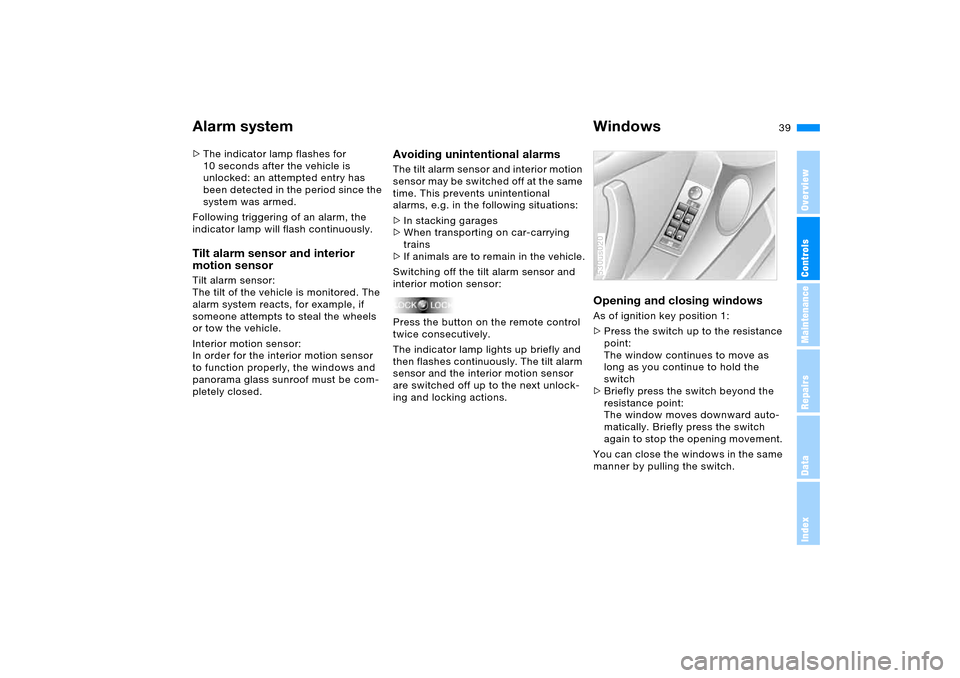
Opening and closing windows As of ignition key position 1:
>Press the switch up to the resistance
point:
The window continues to move as
long as you continue to hold the
switch
>Briefly press the switch beyond the
resistance point:
The window moves downward auto-
matically. Briefly press the switch
again to stop the opening movement.
You can close the windows in the same
manner by pulling the switch.530us020
Page 40 of 200
40n
Windows After the ignition has been switched off:
>You can still operate the windows as
long as neither of the front doors has
been opened. To open the windows,
press the switch beyond the resis-
tance point.
When leaving the vehicle, always
remove the remote control and
close the doors, as otherwise children
could operate the windows and injure
themselves etc.<
For the convenience mode via the
remote control or the door lock, refer to
pages31, 33. Anti-trapping mechanism A contact strip is integrated into the
inner side of each of the upper window
frame sections. If pressure is exerted
against this contact strip while a win-
dow is being raised, the system will
respond by stopping the window and
then retracting it a small distance.
Despite the anti-trapping mecha-
nism, be extremely careful that
the closing path of the window is not
obstructed whenever it is closed.
Otherwise, an object might not touch
the contact strip in some situations,
with very thin objects, for instance.
You can disable the anti-trapping
mechanism by pulling the switch
beyond the resistance point and hold-
ing it.
Because the power windows are sealed
at high pressure to prevent wind noise
when closed, a powerful motor is
required for efficient closing. When
closing the windows, always ensure
that they are not obstructed in any way.
Unsupervised use of these systems can
result in serious personal injury.
Remove the ignition key to deactivate
the power windows whenever you leave
the vehicle. Never leave the keys in the
vehicle with unsupervised children.
Never place anything that could
obstruct the driver's vision on or next
to the windows.<
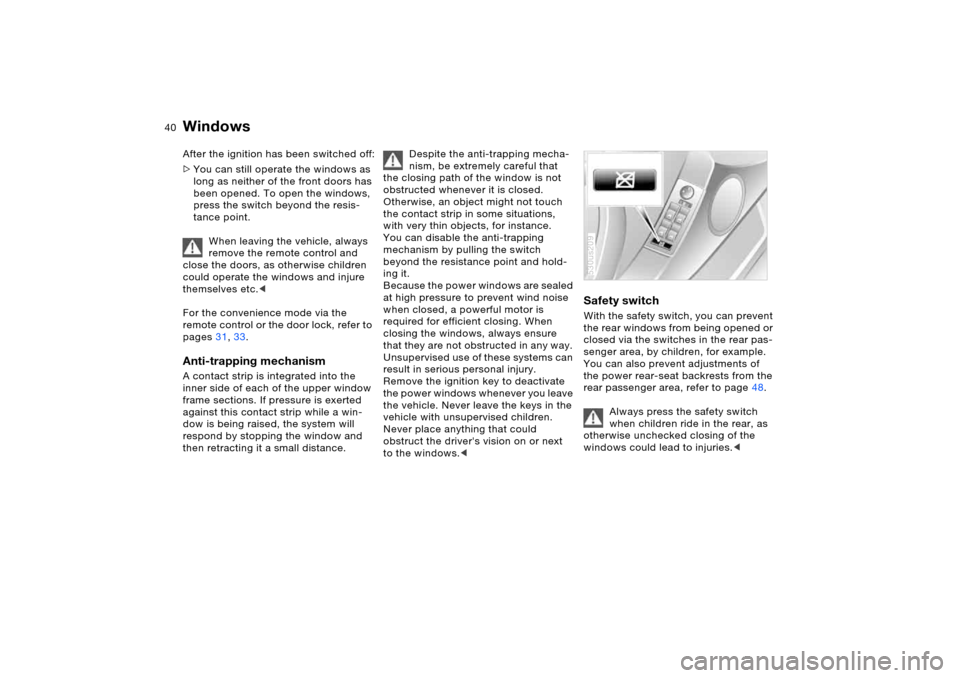
Safety switch With the safety switch, you can prevent
the rear windows from being opened or
closed via the switches in the rear pas-
senger area, by children, for example.
You can also prevent adjustments of
the power rear-seat backrests from the
rear passenger area, refer to page48.
Always press the safety switch
when children ride in the rear, as
otherwise unchecked closing of the
windows could lead to injuries.< 530us209
Page 43 of 200
43n
OverviewControlsMaintenanceRepairsDataIndex
The ideal sitting position can make a
vital contribution to relaxed driving that
is as fatigue-free as possible. In con-
junction with the safety belts, the head
restraints and the airbags, the seat
position also plays an important role for
the passive safety of the occupants in
an accident. To ensure that the safety
systems operate with optimized effi-
ciency, we strongly urge you to observe
the instructions contained in the follow-
ing section.
For additional information on transport-
ing children safely, refer to page59.Airbags
Always maintain an adequate dis-
tance between yourself and the
airbags. Always hold the steering wheel
by its rim with hands at the 9 o'clock
and 3 o'clock positions to minimize the
risk of injuries to your hands and arms
in the event of airbag deployment.
No one and nothing is to come between
the airbags and the seat occupant.
Do not use the cover of the front airbag
on the front passenger side as a stor-
age area. Make sure that the front pas-
senger is correctly seated and does not
rest feet or legs on the instrument
panel, otherwise leg injuries can occur
if the front airbag is triggered. Never let
an occupant's head rest near or on a
side airbag because the inflating airbag
could cause a serious injury.<
Even if you adhere to all the instructions
injuries resulting from contact with air-
bags cannot be fully excluded, depend-
ing on the circumstances. The ignition
and inflation noise may provoke a mild –
usually temporary – hearing loss in
extremely sensitive individuals.
For airbag locations and additional
information on airbags, refer to
page57.Safety belt For every trip, use the safety belt on all
occupied seats. Airbags complement
the safety belt as an additional safety
device, but they do not represent a sub-
stitute.
Your vehicle has five seats that are all
equipped with a safety belt.At all times, occupants should sit
upright and be properly restrained
– infants and small children in appropri-
ate child-restraint systems; larger chil-
dren and adults using the safety belts.
Each safety belt should always be used
by only one person, babies and children
may not ride on the lap of another pas-
senger.
Pregnant women should also always
wear a safety belt and take make espe-
cially sure that the belt rests low on the
hips in the lap area, and does not press
against the abdomen.
Do not route the belt across your neck,
or run it across sharp edges. Be sure
that the belt does not become caught
or jammed. Wear the safety belt without
twisting and tautly across the lap and
shoulders as close to the body as pos-
sible. Be sure not to route it over solid
or breakable objects, as otherwise the
belt can slip over the hips in the lap
area in a frontal impact and injure the
abdomen. Avoid wearing clothing that
prevents the belt from fitting properly
and pull the belt in the upper body area
periodically to readjust the tension, in
order to avoid a reduction in the
restraint of the safety belt.<
Sitting safely
Page 44 of 200
44n
Sitting safely SeatsIf the middle safety belt in the rear is
used, the wider seatback must be
locked, refer to page126, as otherwise
the safety belt has no restraining action.
Fasten safety belt, refer to page49.
Note before adjusting
Never try to adjust your seat while
operating the vehicle. The seat
could respond with unexpected move-
ment, and the ensuing loss of vehicle
control could lead to an accident. On
the front passenger side as well, do not
tilt the backrest too far toward the rear
while driving. Failure to observe this
precaution can prevent the belt from
providing effective protection against
injury, as the passenger could slide
under the belt in an accident.<
Also observe the information on the
safety belts on page49 and on the
head restraints on page47.
Seat adjustment>Mechanical seat adjustment, refer to
following columns
>Power seat adjustment, refer to
page46
>Head restraints, refer to page47
>Power rear-seat backrest adjustment,
refer to page48
Page 49 of 200
49n
OverviewControlsMaintenanceRepairsDataIndex
Safety belts
Comply with the instructions on
page43. Failure to do so could
result in diminished personal safety.<
For every trip, use the safety belts on all
occupied seats. Airbags complement
the safety belt as an additional safety
device, but they do not represent a sub-
stitute.
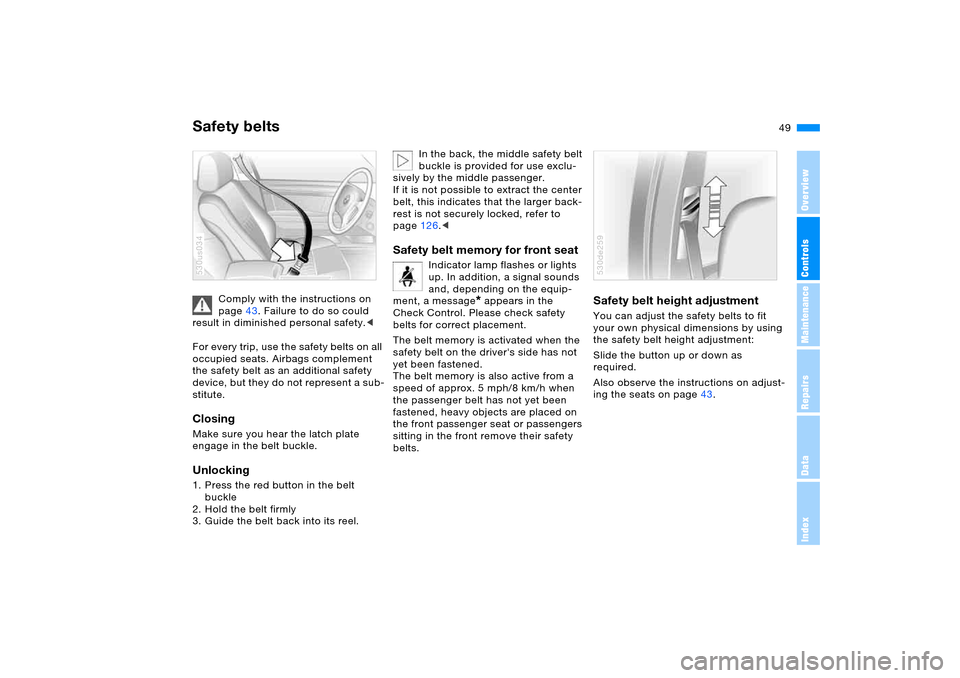
Closing Make sure you hear the latch plate
engage in the belt buckle.Unlocking1. Press the red button in the belt
buckle
2. Hold the belt firmly
3. Guide the belt back into its reel.530us034
In the back, the middle safety belt
buckle is provided for use exclu-
sively by the middle passenger.
If it is not possible to extract the center
belt, this indicates that the larger back-
rest is not securely locked, refer to
page126.<
Safety belt memory for front seat
Indicator lamp flashes or lights
up. In addition, a signal sounds
and, depending on the equip-
ment, a message
* appears in the
Check Control. Please check safety
belts for correct placement.
The belt memory is activated when the
safety belt on the driver's side has not
yet been fastened.
The belt memory is also active from a
speed of approx. 5 mph/8 km/h when
the passenger belt has not yet been
fastened, heavy objects are placed on
the front passenger seat or passengers
sitting in the front remove their safety
belts.
Safety belt height adjustment You can adjust the safety belts to fit
your own physical dimensions by using
the safety belt height adjustment:
Slide the button up or down as
required.
Also observe the instructions on adjust-
ing the seats on page43.530de259
Page 51 of 200
51n
OverviewControlsMaintenanceRepairsDataIndex
Seat, mirror and steering wheel memory
*
Calling up a stored setting
Do not call up a position from the
memory while the vehicle is mov-
ing. There is a risk of accident from
unexpected movement of the seat or
steering wheel.<
Convenience function:
1. Open the driver's door after unlock-
ing the vehicle or place the ignition
key in position 1
2. Briefly press memory button 1, 2
or 3, as desired.
Movement stops immediately when
one of the seat-adjustment or mem-
ory buttons is activated during the
adjustment process.
Security function:
1. With the driver's door closed and the
ignition key either removed or in
position 0 or 2
2. Maintain pressure on the desired
memory button 1, 2 or 3 until the
adjustment process is completed.
If you press the
M
EMORY button
accidentally: press the button a
second time – the indicator lamp goes
out.<
You can have your vehicle pro-
grammed to automatically dial in
your own individual adjustment settings
for the seat, mirrors and steering wheel
whenever you use your personal
remote control to unlock the vehicle.<
If you make use of this adjust-
ment, be sure that the footwell
behind the driver's seat is unobstructed
before unlocking the vehicle. If you fail
to do so, any persons or objects behind
the seat could be injured or damaged
by a rearward movement of the seat.<
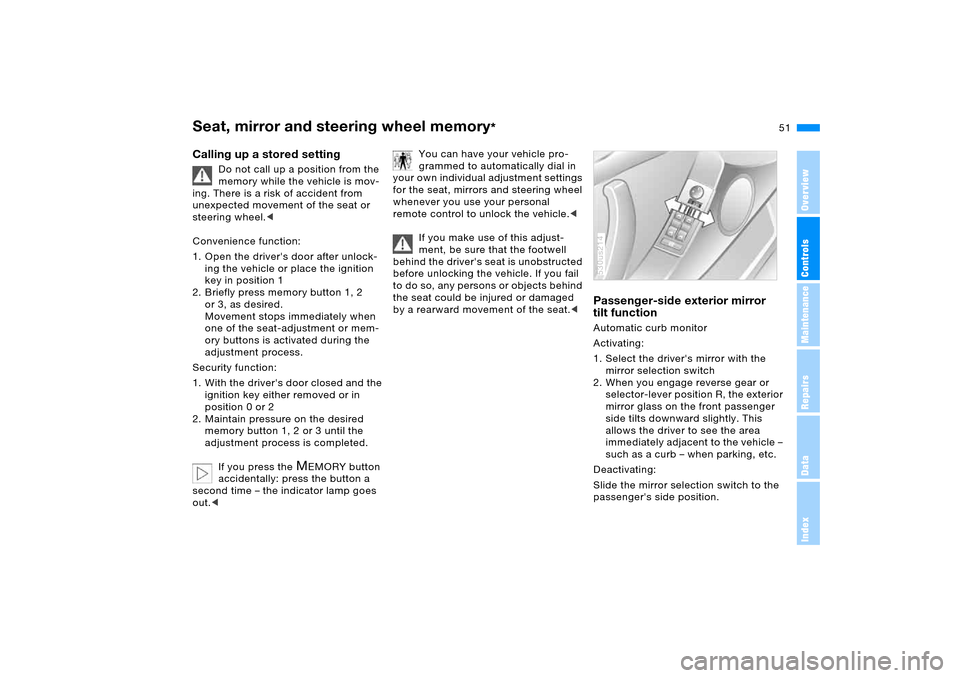
Passenger-side exterior mirror
tilt function Automatic curb monitor
Activating:
1. Select the driver's mirror with the
mirror selection switch
2. When you engage reverse gear or
selector-lever position R, the exterior
mirror glass on the front passenger
side tilts downward slightly. This
allows the driver to see the area
immediately adjacent to the vehicle –
such as a curb – when parking, etc.
Deactivating:
Slide the mirror selection switch to the
passenger's side position.530us214
Page 60 of 200
60n
Transporting children safely
Never install a rearward-facing
child-restraint system in the front
passenger seat of this vehicle if the
passenger airbag is not deactivated. If
you do so, the child could be severely
injured or killed when the airbag is trig-
gered. Your vehicle is equipped with an
airbag supplemental restraint system
for the front passenger. Because the
backrest on any rearward-facing child-
restraint system – of the kind designed
for infants under 1 year and 20 Ibs./9 kg
– would be within the airbag's deploy-
ment range, you should never mount
such a system in the front passenger
seat, since the impact of the airbag
against the child restraint's backrest
could lead to serious injuries.<
Installing child-restraint systemsBefore installing any child-restraint sys-
tem or child seat, read the following:
Observe the child-restraint system
manufacturer's instructions when
selecting, installing and using the child-
restraint systems. Otherwise the degree
of protection can be reduced. After an
accident, have all parts of the child-
restraint system and of the relevant
vehicle safety belt system checked by a
BMW Sports Activity Vehicle center and
replaced if necessary.<
Commercially-available child-restraint
systems are designed to be secured
with a lap belt or with the lap belt por-
tion of a combination lap/shoulder belt.
Improperly or inadequately installed
restraint systems can increase the risk
of injury to children. Always read and
follow the instructions that come with
the system.
Child-restraint system securityAll of the rear belt retractors and the
front passenger's safety belt can be
locked for mounting and securing child-
restraint systems.
Information regarding this is located
near the buckle latch of each safety
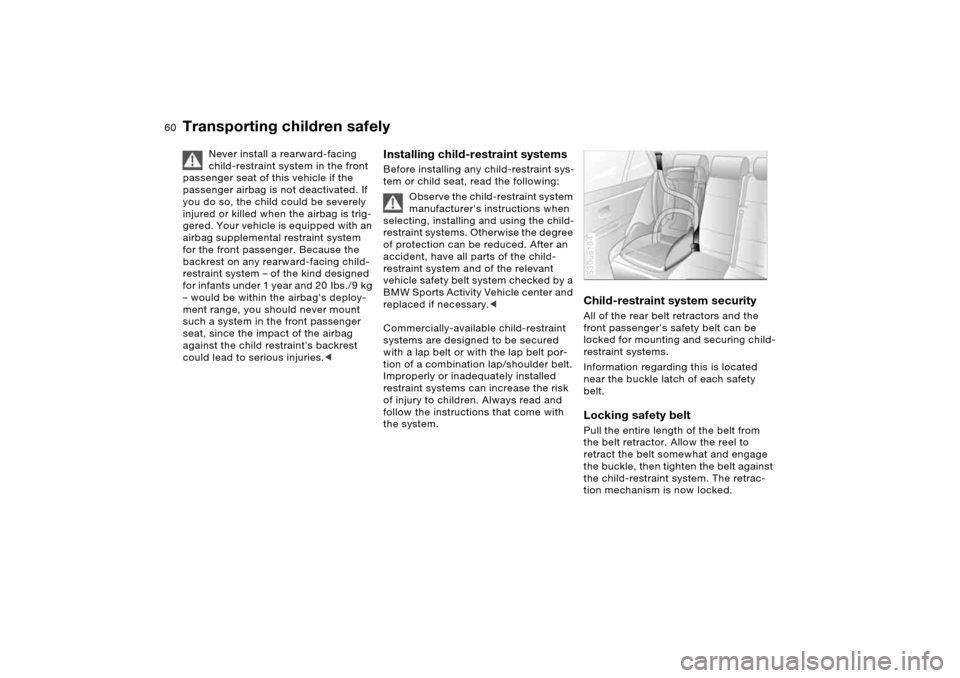
belt. Locking safety beltPull the entire length of the belt from
the belt retractor. Allow the reel to
retract the belt somewhat and engage
the buckle, then tighten the belt against
the child-restraint system. The retrac-
tion mechanism is now locked.530us104
Page 61 of 200
61n
OverviewControlsMaintenanceRepairsDataIndex
Transporting children safelyUnlocking safety belt Unlock the safety belt, remove the
child-restraint device and allow the belt
retractor to reel the belt completely in.
Child-restraint system with
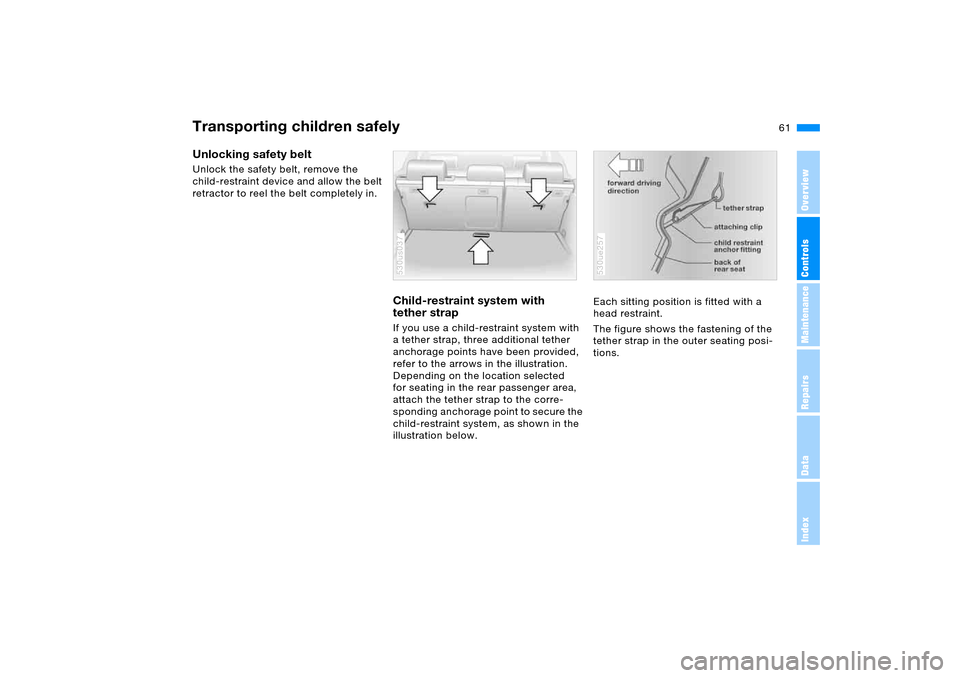
tether strapIf you use a child-restraint system with
a tether strap, three additional tether
anchorage points have been provided,
refer to the arrows in the illustration.
Depending on the location selected
for seating in the rear passenger area,
attach the tether strap to the corre-
sponding anchorage point to secure the
child-restraint system, as shown in the
illustration below. 530us037
Each sitting position is fitted with a
head restraint.
The figure shows the fastening of the
tether strap in the outer seating posi-
tions.530ue257
Page 62 of 200
62n
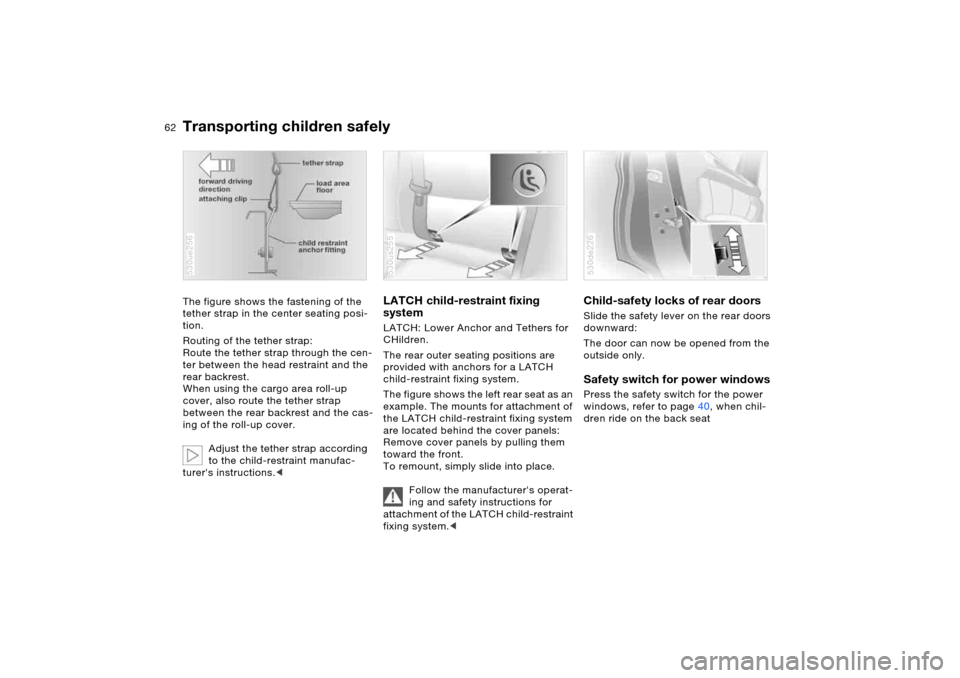
Transporting children safelyThe figure shows the fastening of the
tether strap in the center seating posi-
tion.
Routing of the tether strap:
Route the tether strap through the cen-
ter between the head restraint and the
rear backrest.
When using the cargo area roll-up
cover, also route the tether strap
between the rear backrest and the cas-
ing of the roll-up cover.
Adjust the tether strap according
to the child-restraint manufac-
turer's instructions.<530ue256
LATCH child-restraint fixing
system LATCH: Lower Anchor and Tethers for
CHildren.
The rear outer seating positions are
provided with anchors for a LATCH
child-restraint fixing system.
The figure shows the left rear seat as an
example. The mounts for attachment of
the LATCH child-restraint fixing system
are located behind the cover panels:
Remove cover panels by pulling them
toward the front.
To remount, simply slide into place.
Follow the manufacturer's operat-
ing and safety instructions for
attachment of the LATCH child-restraint
fixing system.<530us255
Child-safety locks of rear doorsSlide the safety lever on the rear doors
downward:
The door can now be opened from the
outside only. Safety switch for power windowsPress the safety switch for the power
windows, refer to page40, when chil-
dren ride on the back seat530de226
Page 63 of 200
63n
OverviewControlsMaintenanceRepairsDataIndex
Vehicle Memory, Key Memory How the system functions You have probably frequently wished
that you could configure individual
functions of your vehicle to reflect your
own personal requirements. In engi-
neering your vehicle, BMW has
included several user-defined func-
tions in the vehicle's design. Your
BMW Sports Activity Vehicle center can
make these settings for you.
There are vehicle and person-related
adjustments: Vehicle Memory and Key
Memory. You can have up to four differ-
ent basic positions configured for four
different persons. The only requirement
is that each person uses his or her own
remote control key.
When your vehicle is unlocked with the
remote control, the vehicle recognizes
the individual user by means of a data
exchange with the key, and makes
adjustments accordingly.
In order for you to distinguish between
the master keys with remote control,
color-coded decals are supplied
together with the keys.
What the system can doYour BMW Sports Activity Vehicle cen-
ter can provide you with details on the
capabilities of the Vehicle Memory and
Key Memory systems.
You will see this symbol through-
out the Owner's Manual. It is to
remind you at appropriate places of the
settings that are available to you.<
Following configuration of the
memory functions, vehicle opera-
tion may differ from the description in
the Owner's Manual. Should you want
to sell your BMW some day, please
remember to have the memory func-
tions reset to the default state.<
Examples for Vehicle Memory:
>Various signals that can serve as
acknowledgment for locking and
unlocking the vehicle, refer to
pages31, 33
>Deactivating/activating the Pathway
lighting function, refer to page103.
Examples for Key Memory:
>Automatic adjustment of the driver's
seat, exterior mirror and steering
wheel with settings stored in the
memory for the individual driver when
the vehicle is unlocked, refer to
page51
>Calling up customized settings for
the automatic climate control when
unlocking the vehicle, refer to
page112.